As I lay bleeding on the cracked desert asphalt of Route 66 after my motorcycle went sliding across the gravel, my club president Marcus looked down at my tor
The sirens were closer than the wind. Marcus did not draw the revolver. He looked at the ledger, then at the patched members who had stopped drinking, then at me. One of them started toward the pouch. I put my boot on it.
“Leave it,” I said. “The copies are already with the people who are about to come through that gate. Touching it only gives them a second set of prints.”
Marcus’s mouth tightened. “You staged the crash.”
“I staged the mile marker. You staged my father’s brakes. The difference is the server has your voice on the ride in. Weapons. Payoffs. The account that matches the emblem under your boot.”
The first cruiser cleared the rise. Then two more. The patched members looked at the gate and at Marcus and did not move. Harlan stepped out of the lead vehicle with the warrant already in his hand. He did not raise his voice.
“Marcus Hale, you are under arrest for the murder of Daniel Ruiz, conspiracy, and the shipments listed in the ledger now on the ground. The rest of you stay where you are. Weapons on the dirt. Hands where we can see them.”
Marcus looked at me one more time. The disgust was still there, smaller now that the sirens had a shape. He set the revolver down himself. Two agents took his arms. Another bagged the ledger. I stayed on the bike because the knee would not hold if I swung off, and because Harlan had told me to keep the recorder running until someone in a vest with a camera took it.
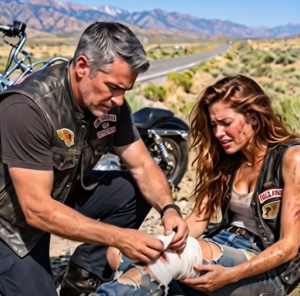
They took it. They took the pouch. They took statements from the members who decided talking was safer than the alternative. One of them, a man who had ridden with my father before Marcus took the gavel, said the brakes had been cut in the same garage where I had spent three months handing tools and taking falls. He named the prospect who had done the cutting. The prospect was already in the wind. Harlan put the name on the wire before the sun finished dropping.
At the clinic they x-rayed the knee, wrapped it again, and told me the ligament would need time. Harlan waited outside the curtain. When the doctor left he asked whether the recorder had caught the mile-marker conversation or only the ride back.
“Both,” I said. “The first half is the part where he calls me a liability and does not ask how the crash happened at that exact post. The second half is the shipments.”
“Good. The ledger matches two of the accounts we already flagged. The voice match will take a day. You stay here tonight. Tomorrow we do the formal statement. If anyone from the club calls the room, you do not answer.”
No one called. In the morning I gave the statement on camera: the three months, the pouch, the practiced slide, the recorder, the father who had been framed for a bust he tried to stop. Harlan added the garage footage they pulled overnight—Marcus’s truck at the bay the night the brakes were cut, the prospect’s hands on the line. The prospect was picked up at a motel two counties south, still carrying the cash Marcus had paid him to stay gone. He asked for a lawyer and then asked what the ledger was worth. It was worth the name of the buyer who had wanted my father silent.
The buyer was not at the compound. He was in a warehouse outside Phoenix, moving the last crates before the wire transfers could be frozen. Harlan’s team hit it at dusk. The crates matched the serials in the ledger. The buyer matched the voice on a call Marcus had made from the clubhouse phone three nights earlier, boasting that the girl was too clumsy to notice anything but the road. I listened to that call once, in Harlan’s office, and then did not ask to hear it again.
The hearings ran into winter. I testified to the crash, the pouch, the recorder, and the three years between the cut brakes and the mile marker. Cross-examination suggested a daughter’s invention and a convenient slide. The garage footage and the prospect’s plea made the suggestion expensive. Marcus did not testify. The jury was out for two days. The verdict on the murder count was guilty. The conspiracy and shipment counts followed. Sentencing was set for spring.
I did not attend the reading. Harlan texted the outcome. I was in physical therapy at the time, bending the knee until the ligament remembered its job. The therapist asked whether the injury was from a sport. I said it was from a road. She did not ask which one. When the session ended I sat in the parking lot and did not open the cloud folder where the recorder’s backup still lived. The login could stay unused. The knee could keep bending.
Spring sentencing gave Marcus decades. The prospect received less and disappeared into the arrangement that kept people alive after they named the buyer. The buyer took a plea that closed the route and left the clubhouse empty. I sold the bike. I kept the recorder only long enough to confirm the files had transferred, then mailed it to Harlan’s evidence locker. The knee healed to the point where I could walk without the brace and ride only if I chose to. I did not choose to for a long time.
On the anniversary of the mile marker I drove the highway in a rented car and did not stop. The post was still there. The gravel was the same. I kept going until the compound’s gate was behind me and the desert opened into ordinary road. The lesson that stayed was not that a practiced crash could return a father or erase three years of insults. Marcus had held the gavel and the story long enough to cut a line and collect the payments. The lesson was that a ledger and a recorder only mattered if someone was willing to bleed on the asphalt, keep the pouch hidden while he tied the bandage, and get both to a gate where the sirens already knew the mile marker. I had done that. Harlan had done the rest. What remained was a knee that worked, a job that did not require a vest, and the decision to treat every new road and every new offer of protection as something that went to the record before it went onto a bike. I checked the mirrors once, took the exit for the town I had chosen, and let the desert stay behind the glass. The evidence had held. The quieter miles could hold with it. That was the ending the ledger had earned.
The quieter miles held through the first season. I took a job at a parts counter that paid in checks and did not ask about scars or mile markers. The knee bent cleanly enough for the shifts. Harlan’s number stayed in the phone under a name that was not his. Once a month he sent a line confirming the appeals were proceeding and the buyer’s route remained closed. I answered with the same two words I had used before: still here.
In the fourth month the line changed. A cousin of the prospect who had cut the brakes had been asking at three garages whether anyone remembered a girl who wiped out at a specific post and then walked into a compound with a ledger. None of the garages had the name. One of them had my description. Harlan forwarded the report and the advice: vary the routes, do not correct anyone who misremembers the scar, call if a clean jacket spends more than ten minutes at the counter without buying a part.
I varied the routes. No clean jacket appeared. The cousin was stopped on an unrelated warrant two weeks later and advised, in a room with a camera, that further questions about the mile marker would be treated as contact with a witness. He stopped asking. I kept the alternating drives anyway. The habit cost nothing and answered the question the report had raised.
On the anniversary of the sentencing I did not take the highway. I stayed for the late shift, finished a carburetor kit, and clocked out at the usual time. The parking lot was empty except for the manager’s truck. He nodded when I passed the office. I nodded back. The lesson that had settled into the counter routine was the smallest one yet: the ledger and the recorder and the decades had done their work, and the remaining task was to treat every new inquiry and every new offer of a ride as something that either fit on a ticket or went to Harlan before it went onto a bike. I kept the distinction. The tools stayed ordinary. The mirrors stayed clear. I drove home by the longer route, checked the lock once, and let the night be only a night. That was the rest of it. It was enough.
The counter job held. The alternating routes held. Harlan’s monthly line stayed short until the day it did not: a storage unit rented under one of Marcus’s old aliases had been opened by a key that should not have existed. Inside were three phones and a notebook that listed dates after the sentencing. One date was circled. It matched the day I had started at the parts counter.
Harlan met me in the parking lot after my shift. He did not get out of the car. “The key was copied before we froze the accounts,” he said. “The notebook is thin. It does not name you. It names the counter and the hours. We are pulling the unit’s camera. If the face matches anyone still walking, you will hear before they do. Until then, the late shift is yours if you want it. The front counter is not.”
I took the late shift. The manager did not ask why. The phones from the unit were dead. The notebook went into evidence. The camera showed a man in a cap who kept his head down and paid cash. He did not match the cousin. He matched a driver who had worked for the buyer and had missed his own plea date. The driver was picked up at a truck stop two days later, still carrying the copied key. He asked what the notebook was worth. It was worth the name of the person who had paid him to watch the counter. That person was already in custody on the original case. The watching stopped.
I stayed on the late shift through the end of the month and then went back to days because the manager needed the coverage and Harlan said the immediate list was clear. The receipt with the old login stayed in the drawer. I did not open the folder. On the night the driver’s plea was entered I finished a clutch job, logged the parts, and drove home by the route that did not pass the highway. The lesson that continued was the one that no longer needed a crash or a siren: a copied key and a circled date could be answered by a camera, a late shift, and the decision to send the face outward before it became a conversation at the counter. I kept making that decision. The tools stayed ordinary. The mirrors stayed clear. It was enough to clock out and mean it.
The days held. The late-shift habit faded into ordinary coverage. Harlan’s line returned to its short form and stayed there. The driver who had carried the copied key took his plea and did not send anyone else. I kept the alternating routes for another month and then let them shorten because the longer one added nothing the camera had not already answered.
At the counter a woman brought in a regulator and asked whether we still stocked the older diaphragms. I checked the bin, found two, and wrote the ticket. She paid in cash and did not linger. The manager watched the exchange from the office door and said nothing. After she left he asked whether the part had been a special order. I said it had been on the shelf. He nodded and went back to the invoices. The question did not return.
I opened the drawer once, on a night the shop closed early, and looked at the receipt with the login. The ink had faded at the edges. I did not type the address. The folder could keep its files. Mara’s number stayed under the name that was not hers. I did not call. The knee that had bent on the asphalt bent cleanly when I stood. I locked the drawer, set the alarm, and walked to the truck.
The remaining part was no longer a pursuit. It was the decision, repeated at the end of each shift, to treat the counter as a counter and the road as a road. The ledger had done its work. The recorder had done its work. What stayed was the ordinary sequence of parts, tickets, and a lock that turned. I checked the mirrors once, took the direct route, and let the night arrive without a mile marker in it. That was the rest. It was sufficient.