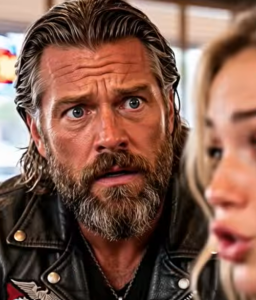
As a hardened biker grabbed my wrist inside the crowded roadhouse diner and demanded to know where I got the raven tattoo
He shoved me and the key bit into my palm like a second pulse.
“Don’t trust the watch.”
Then the treeline took me and the rain erased the shape of him.
I ran without looking back because looking back was how houses burned. Branches whipped my jacket. Mud climbed my boots. Behind me a shot cracked, then another, then the sheriff’s voice riding the downpour.
“Jax. Don’t make her an orphan twice.”
I did not stop. The numbers under the raven’s wings were a coordinate. The key was teeth and silence. The watch was a lie that had sat in family portraits like a blessing.
I hit a drainage cut and dropped into it, lungs tearing. Flashlights swept the trees too high. They were hunting a man, not a girl who had learned floorboards and folded clippings. I crawled until the roadhouse neon was only a sick color on the clouds.
A service road found me first. Gravel. A fence. A billboard for a candidate whose smile I now recognized from the governor’s office and from the night smoke ate the hallway of my childhood.
I walked the ditch until a logging spur gave me dark enough to breathe. I opened my fist. The key was old iron, no logo, a serial worn nearly smooth. On the raven’s tail, so small I had thought it decoration, the same serial sat in ink.
My father had not abandoned a child. He had abandoned a name so the name could grow old enough to carry a lock.
I did not cry. Tears were weight. I put the key in my boot and kept moving until the rain thinned to a mean drizzle and a all-night truck stop bled light onto wet asphalt.
I stole a moment in the bathroom to wash glass out of my arms and look like a woman who had fought a storm, not a county. I bought coffee with cash from the clipping envelope and sat where I could see both doors.
The television over the pie case showed a banner. ROADHOUSE SHOOTING. SUSPECTS AT LARGE. The sheriff’s face filled the screen, silver watch catching studio light as he asked the public to be vigilant. He said a known outlaw had kidnapped his own daughter. He said it with the softness of a man who had practiced funerals.
I turned my wrist face down on the laminate.
A driver two stools over muttered,
“Vipers used to run that stretch. Ravens too, before the fire.”
His friend shushed him. Some histories are still employed.
I left before the coffee cooled. A freight lot behind the stop held trucks whose drivers slept like the law was weather. I found an unlocked cab with a paper map and a pen. I copied the numbers from under the wings. Latitude. Longitude. Not poetry. A place.
The federal annex sat on the far side of the river city, a concrete box that pretended it was only archives. Twenty years of covered trial. 2006. Conspiracy. Men who became governors did not leave evidence on kitchen tables.
I rode in the back of a produce truck because asking for rides makes faces. Dawn came gray. I walked the last mile with my jacket zipped to my throat.
The annex had cameras and a guard who liked his thermos. I did not go to the front. Pinkerton work in old stories used kitchens. Federal buildings still ate.
A contractor van idled at the loading dock. I waited until the driver argued with a clipboard and I became part of the argument’s blind spot. Inside, the air was cold and paper-dry. Signs pointed to RECORDS and RESTRICTED and a vault corridor that required a card and, if the tattoo was not a cruel joke, an older kind of tooth.
I found the door by the coordinate more than by the sign. A side chamber. No window. A lock that had outlived three administrations. My hand shook once and then did the job it had been inked for.
The key turned.
The vault did not explode with gold. It exhaled dust and box numbers. I pulled the drawer that matched the serial. Files. Photographs. A ledger of payments from a sheriff’s slush to a statehouse fund. Testimony that had been marked LOST in 2006 and was not lost. A statement in my mother’s hand that ended in the middle of a sentence. A photo of the house before the burn, raven mark painted small on the cellar door. A photo of Jaxson in a courtroom hallway with the same scar, younger, already looking like a man arranging his own death.
And the watch.
Not the sheriff’s. A twin. Tagged. PROPERTY OF EVIDENCE. A note: duplicate issued to county office after original seized. Do not release. Do not photograph for press.
Don’t trust the watch.
The original had been evidence. The one in the rain was a costume.
Boots in the corridor. Not a guard’s rhythm. Too sure.
I shut the drawer to a crack, kept the thickest file against my ribs, and stepped behind the shelving as the vault lights hummed.
The sheriff entered alone. He held the silver watch like a compass. He looked at the open lock and smiled with no teeth.
“Clever girl. He always did like hiding things in plain skin.”
I did not answer.
“Come out. If I wanted you dropped in the alley I would have done it before the rain.”
I came out because files do not shoot and he already had the angle.
He glanced at the folder.
“That paper makes a mess. Messes elect opponents. I prefer quiet families.”
“You burned a quiet family.”
“I burned a problem that would not sell a road. Your father took the raven and ran. I let the world call him a ghost so I would not have to call him a witness.”
“Where is he.”
The sheriff wound the watch. The tick was loud in the concrete.
“Jaxson never could leave a door half closed. He drew us to the trees. He is not in the trees anymore.”
The words tried to become a grave. I did not let them finish.
“If he were dead you would not be here for a folder. You would be on television with a body.”
A muscle jumped in his jaw. Alive, then. Hurt, maybe. Used as bait, certainly.
“Put the file down.”
“No.”
He lifted a pistol that had never needed a roadhouse to feel official.
“Your tattoo is a map. Maps can be burned off.”
The annex fire alarm started because buildings have rules even when men do not. A contractor’s bad luck or a father’s last trick. Sprinklers stayed dry. Lights strobed. The sheriff’s eyes flicked. I threw the lighter drawer in his path and ran with the file.
Hallway. Exit stair. A guard shouting at the wrong person. I burst into morning with a siren attaching itself to the wrong story.
I did not go back to diners.
I went to the only place that still printed what governors hated: a weekly with a cracked window and an editor who had lost a brother to a “lost” file in 2006. I put the folder on his desk wet from my jacket.
“If I disappear,” I said,
“you already have it. If I do not, you still run it.”
He looked at the raven on my wrist, then at the payments, then at the watch tag.
“This gets you killed.”
“I was supposed to be dead at eight. I am late.”
He started scanning before I finished the sentence.
By afternoon the first pages were live and the sheriff’s smile on the truck-stop television looked like makeup. By evening the governor’s office called the documents a dangerous forgery. By night a hospital two counties over admitted a John Doe with a raven on his forearm and a bullet that had not found the heart.
I got there because some nurses still believed tattoos were medical information.
Jaxson was gray and breathing. Cuffs on the bed frame. A deputy outside who suddenly had a call down the hall when the story on his phone outran his orders.
I stood where he could see me without sitting, because sitting felt like the diner again.
His eyes opened.
“You used the key.”
“You used the alarm.”
“Cheap wiring. Old friends.”
He looked at my wrist.
“They’ll come harder.”
“They already came. The paper is out. The watch is a copy. The vault is empty of the part that mattered.”
A nurse adjusted a bag and pretended not to hear fathers return from the dead.
Jaxson swallowed.
“I left so they would stop looking in your direction. It did not work. Leaving never works. It only teaches a child the wrong name for love.”
“I kept a photo under a floorboard. I kept a clipping. I kept the ink. That was the name I had.”
“I’m sorry.”
“Save it for court. Sorry is not a verdict.”
He almost smiled and the smile turned into pain.
“Governor sits on the 2006 sealed list. Sheriff carried the duplicate watch so every public appearance looked like tradition. The raven was our unit mark before they sold the unit. I inked the coordinate when I thought I wouldn’t live to walk you there.”
“You walked me to a table and a hail of glass.”
“I walked you to the only clock I still trusted. Then I told you not to trust the other one.”
Outside, new sirens. Not all of them local. Federal plates do a different music.
I put my hand over his cuffed one, not for childhood, for blood that had finally chosen a direction.
“When they come in,” I said,
“you tell it in order. House. Fire. Vault. Watch. I will tell the diner and the rain and the key. We do not make them a legend. We make them a record.”
He nodded once.
The door opened on men who did not wear county patches. The deputy’s chair was empty. The story had grown teeth.
They took statements until the words felt like gravel. They moved Jaxson to a floor with a window that did not face a parking lot. They asked me if I wanted protection. I said I wanted a public hearing and a clean copy of my own skin in the file so no one could call the tattoo a rumor.
Weeks are slower than bullets and faster than grief.
The sheriff resigned into an indictment. The governor called it a witch hunt until the ledger used his initials too often for poetry. The roadhouse boarded its windows and then opened them again because people still needed eggs after history.
I sat through testimony with my sleeve rolled so the raven faced the room. Some days Jaxson spoke. Some days he could not. Twenty years of being dead is a language you relearn in fragments.
On a morning after the worst of the hearings, we stood in a courthouse corridor that smelled like floor wax and old nerves.
“You can disappear again,” I said.
“I did that. It made a tattoo have to do a father’s job.”
“Then stay and be inconvenient.”
He looked at the mark on my arm, then at his own.
“Matching ink is not a family. Showing up when the door comes off the hinges is.”
I thought of the grip on my wrist, the demand, the shatter, the table flipping, the key, the vault, the watch ticking like a threat.
“The symbol never belonged to the men who burned the house,” I said.
“It belonged to the evidence. You hid it on a child because a child might live long enough to become a witness. That was monstrous and it worked. I am not going to thank you for the fire. I am going to use the map.”
He accepted that the way a man accepts a sentence he earned.
Outside, the weather was only weather. No neon. No rifle light. A city going about the dull miracle of not shooting.
The lesson did not need a jukebox. Blood marks can be coordinates. Official watches can be counterfeits. The stranger who grabs your wrist in a diner may be the ghost you prayed would stay dead and the only person who still knows why you were supposed to. Love that abandons to protect still abandons. Truth that waits twenty years still needs a key, a file, and someone willing to run into trees while a father draws the guns the other way.
I rolled my sleeve down against the wind and left it ready to roll up again. The raven was not a curse on my skin anymore. It was a record that had finally been read aloud, in a room with a clock that did not belong to the sheriff.