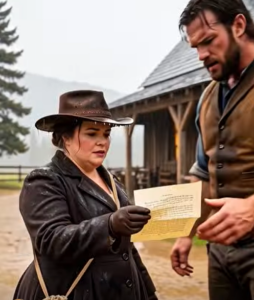
A towering, muscular rancher arrogantly sneered at my worn-out traveling clothes
Sterling’s nickel plate caught the lantern and made a small cold sun. The battering ram still hung in the splintered door. Badges behind him were real enough to gleam and wrong enough to wait for his nod. I kept the master key in the apron pocket and the potato peel stuck to my wrist, because a cook who reaches is a cook who confesses. Cole did not reach either. He set the ham down as if supper still mattered.
“Commissioner,” he said. “You brought a posse to a smokehouse. The deeds you want are already in a mail sack on the north road. Hanging us does not unsend it.”
Sterling’s smile did not move. “Cole, you were paid to hold the canyon until the vein was retitled. Holding the daughter was not in the wage.” He tipped the revolver a fraction toward my apron. “Judge Dawson’s girl. The survey office burned. The judge did not. He is in a drainage cut above the pass, alive enough to sign if she watches. Drop the key.”
The older hand made a sound like a man who had hoped the floorboards were the whole secret. I looked at Cole. The arrogant sneer from the ham had been a performance for the gunman in the corner. The search in his face now was not. “You knew he was alive,” I said.
“I knew Sterling does not pay for dead mapmakers,” Cole said. “I did not know the cut. If I had, I would not have let you peel potatoes for three weeks.”
A deputy behind Sterling shifted, young, rain in his collar, eyes on the revolver instead of the badge. I had fed him yesterday. He had thanked me. Gratitude is a thin lever and I used it. “The mail sack is a lie,” I said, loud enough for the young one. “The copies are in the stove ash can, under the peelings. Sterling needs the key because the safe in the floor is empty. My father moved the originals before the fire. The commissioner is here to make a daughter watch a signature. That is not a posse. That is a kidnapping with lanterns.”
Sterling fired into the beam above my head. Splinters. Smoke. The young deputy flinched and did not raise his rifle. Cole moved on the flinch, not for the gun, for the ram, and drove it into the deputies who had been waiting for a nod. The room became a quarrel between badges and men who had been called outlaws for guarding a canyon the title had already stolen. I went for the ash can because the copies were real. I had put them there at dawn. The key was for a strongbox on the north road that held nothing but a letter in my father’s hand: If she reaches the smokehouse, the commissioner is the robbery.
I got the packet out in a cloud of potato dust. Sterling came through the quarrel with the revolver and the smile finally cracked. Cole hit him low. The gun spoke into the floor. I ran for the side door and the mud, packet inside my shirt, and the young deputy ran with me because staying had become a confession. Rain. Courtyard. A horse that did not care about silver. We rode for the cut.
The drainage was a black mouth above the pass. My father was in it, thinner, tied, alive. Sterling’s man at the lid died surprised when the deputy finally used the rifle for the law he had been wearing. I cut the ropes with a kitchen knife and put the letter in my father’s hand before I put my arms around him. He smelled of wet stone and three weeks of my not knowing. “You cooked,” he said.
“I cooked,” I said. “The vein map is in the packet. The title is not his.”
Cole came up the trail with Sterling cuffed to his own saddle horn and the older hand carrying the ham, absurdly, as if supper could still be saved. The federal marshal who was not on the commissioner’s list met us at the switch, summoned by the young deputy’s shaken radio, and took the packet without a speech. Sterling tried the wicked smile once more and spent it on the rain. It did not answer.
The hearing sat in a schoolhouse because the courthouse belonged to the title office Sterling had staffed. My father testified sitting down. The vein map matched the burned survey. The letter matched his hand. Cole testified that the wage had been for guarding a canyon and had become a cage, and that he had worn the sneer so the gunman would not search the cook. I testified to the ham, the key, the ash can, the cut. The young deputy testified to the flinch. It was enough. The false robbery collapsed. The titles reverted to the canyon families and to the Dawson map, which my father gave to a trust so no single hand could sell the vein again. Sterling took the conspiracy and the kidnapping. Cole took a suspended sentence and a job walking the new boundary. He did not ask for the cook. I did not offer the role.
On the first dry morning I made supper in the smokehouse for the men who had stayed to mend the door, and for my father, who ate slowly and did not dangle anything in front of anyone. The lesson was in the peelings. A public rejection can be a curtain. A rescue can be a wage. What cuts the rope is the copy you hid before the ram, the deputy who flinches toward the law, the father who is alive because you did not wait to be believed. I keep the kitchen knife. I do not keep the disguise. The canyon is mapped in the open now, and no commissioner gets to call a daughter a dear while the hammer is back. We eat. The rain is only rain. The ground stays named.
The dry morning did not hold. A week after the schoolhouse, a clerk from the title office arrived with a mineral exception Sterling’s deputy had filed the night before the ram, stamped and forgotten in a drawer the marshal had not opened. The exception named the vein as a federal reserve and the Dawson trust as a tenant. My father read it at the stove and laughed once, the laugh of a man who had already been in a hole. “They title the theft twice,” he said. “The second time in pencil so it looks like mercy.”
I rode to the clerk with the packet copy and the young deputy, whose name was Ames and who had not gone back to the old badge. The drawer gave up three more exceptions, each dated to a night when the smokehouse had been loud and the canyon quiet. Cole walked the lines with us and pointed out the stakes that did not match the map. He did not sneer. The ham was a memory. The gunman from the corner had fled and been taken at a ferry with the wage book in his coat. The book named the clerk. The clerk named a banker. The banker named no one and sat down anyway when the marshal showed him the ash-can photographs.
The second hearing was meaner because it was about paper that pretended to be help. Ames testified that a posse can be a kidnapping with lanterns. I testified that I had peeled potatoes so the room would watch my hands and not the floor. My father put the vein map on the bench and refused to sign the exception even as a tenant. The judge voided the drawer. The trust stayed the owner of the map. The families stayed the owners of the approaches. Sterling, already convicted, lost the pencil mercy and did not get a speech.
We burned the false stakes in the courtyard and ate the ham that had finally been cooked for a table instead of a taunt. Cole stood at the mended door and said he would leave in the morning. I told him the boundary still needed walking. He stayed for the walking and not for a romance the ham had counterfeited. My father slept in a real bed and woke without listening for a lid. I hung the apron on a peg and did not wear it. The lesson, finished in the drawer, is that a conspiracy’s last trick is a courtesy stamp. Open the drawer. Match the stakes to the map. Let the cook be a daughter in daylight. The canyon keeps its name. The supper is only supper. And no one dangles a mercy over us again.
The smokehouse story is fiction, but it sits on a real nineteenth-century fight over who got to turn a map into a title.
Wyoming’s silver and gold rushes were real and messy. Atlantic City and South Pass, in the Wind River country, boomed after 1867, then busted. Miners, surveyors, and territorial officials all chased the same veins, and a surveyor who knew where the ore ran was worth more than a sheriff. Burning a survey office and calling it a robbery was a plausible crime, not a melodramatic invention. Territorial land offices and appointed commissioners sat between the claimant and the patent. That gap was where fraud lived: forged assignments, “exceptions,” dummy entries, and courtesy stamps filed after the real owner was dead or missing.
Federal authority on that frontier was thin and easy to costume. U.S. marshals did ride with posses. Local deputies were few, poorly paid, and often tangled with the same cattle, mining, and town syndicates they were meant to police. A badge in a doorway was not automatically the law. It could be a contractor with a warrant. The story’s split between Sterling’s gleaming posse and Ames, the deputy who flinches, matches that ambiguity. After 1868 the Wyoming Territory had a governor, a surveyor general’s orbit, and courts that were still learning which paper outranked which gun. Statehood came only in 1890, with women’s suffrage already on the books from 1869, which is why a woman speaking in a schoolhouse hearing is less anachronistic there than it would be in many other territories.
The cook disguise is also period-true in spirit. Frontier camps hired women as cooks and laundresses because the work was constant and the witnesses were hungry. A woman could cross a hostile yard with a knife and a sack of potatoes when a man with a survey rod would be stopped. What the story invents is the neatness of the conspiracy: one commissioner, one ham, one key, one drainage cut. Real land grabs were slower, dirtier, and more clerical. The Homestead Act, desert-land entries, and mining claims were abused with false residency and straw claimants for decades. The historical sting is not the revolver. It is the second filing, the mineral “exception” dated the night before the raid, which could outlive the gunman.
So the emotional engine is modern, and the props are Western, but the core conflict is historical: information about the ground was power, and the office that recorded it could steal it with a stamp faster than a posse could steal it with a ram. The lesson the story lands on, open the drawer and match the stakes to the map, is exactly how those frauds were actually beaten when they were beaten at all.