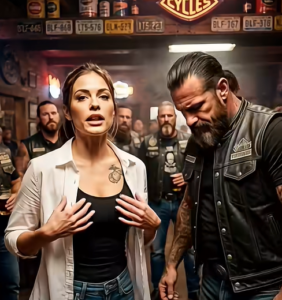
A towering gang leader violently ripped open my white shirt, I swallowed back my panic, knowing this public degradation was intentionally staged
A blinding flash of white light engulfed the sub-basement stairs as the auxiliary charges I had set under the register blew the first landing into smoke and plaster. The tactical officer’s visor filled with glare. He staggered, rifle high, and the shot he meant for my chest took the neon sign instead. Glass fell in a bright rain. I was already moving, not toward the hatch, but along the bar, keeping his attention on a Marine with her hands empty and her shirt clutched shut.
“Vance, stand down,” he shouted, and the name in his mouth told me he was not a random cleaner. He had been briefed. Briefed men hesitate when the file and the room disagree.
“Your colonel sold the armory,” I said. “The club was the coat he hung the theft on. Lower the rifle and you might still be a soldier at dawn.”
He did not lower it. A second figure came through the ruined dock door, laser swept the bottles, and the leader—Rourke, though the patch said only GRAVE—fired once from the hatch lip and drove them both back into the smoke. He should have been on the stairs. He was not. The hesitation I had seen in him had lasted exactly as long as it took to shove a prospect down with the drive and come back up.
“You do not buy time by dying in a bar,” he said. “Down. Now.”
We dropped through the hatch as the next burst chewed the mahogany. The sub-basement smelled of cold concrete and the sweet rot of a cooler that had failed. A prospect crouched at a laptop wired to a server that had no business in a desert tavern. My father’s old credentials still opened the side door of a Pentagon drop the colonel thought he had buried. The upload bar crawled. Above us boots hit the floor.
“Thirty seconds,” the prospect said.
“You have ten,” Rourke answered.
I took the shotgun he pushed at me and did not argue about jurisdiction. Months of pouring drinks had been a cover. The tattoo had blown it. The sirens had ended the chess match. What remained was a ledger and a stairwell. I had come for the colonel’s signatures. I had not come to adopt a club. The club, for the next ten seconds, was the only wall between the file and a wipe command.
The bar above us caught. Liquor makes a generous fire. Heat rolled down the hatch. The prospect swore, slapped the laptop, and yanked the drive free. “It’s sent. Partial. Enough names.”
“Enough is a word lawyers use at funerals,” I said, but I took the drive anyway and sealed it in the foil sleeve at my belt. Redundant. Halloran had taught me that. One copy in the air, one in the hand, one in a place the colonel did not know.
We went out through the cooler tunnel, a rib of cinder block my father had walked when this was still a supply cache and not a scapegoat’s clubhouse. Desert night hit like a slap. Bikes waited behind the propane tanks, engines cold. Floodlights swept the front lot. The corrupt unit had come heavy and left the wash unwatched, because men who trust a colonel’s map trust the front door.
Rourke threw me a jacket. I got on behind him because my bike was still in the lot under a camera. The prospect took the second machine. We ran dark along the alkali flat until the tavern was a red thumbprint on the horizon. Only then did he speak.
“Your father,” he said. “The treason file. I knew the name. Vance. They said he diverted rifles to a border crew and ate his pistol when the auditors came. Club was told not to ask. Asking got my predecessor buried past the playa.”
“He did not eat his pistol,” I said. “The colonel signed the diversion, used my father’s login, and sent a cleanup team when the login was about to be traced. I have worn a bartender’s name for eleven months to put the real signature next to the fake one. You tearing my shirt was not in the plan.”
“The shirt was a test the colonel paid a drunk to start. He wanted to see if you spooked like a fed. You spooked like a Marine. That bought you a minute. Do not waste it telling me I should have asked politely.”
A flare popped behind us, white, then a pair of headlights that were not the club’s. The unit had found the wash. Rourke killed our lights and took a cut between two dunes that would have pitched a truck. The prospect was not as lucky. A burst walked across his rear tire. The bike went down in a fan of sparks. Rourke turned, which was stupid, and I got off, which was the job.
The prospect was alive, leg wrong, drive still in my belt. I hauled him into the lee of the bike. Rourke’s shotgun spoke twice. The lead truck’s windshield starred. Men spilled out, visors down, and for a moment it was the loading dock again, only with stars overhead and nowhere to upload anything.
“Left flank,” I said. “They stack. They always stack.”
We did not win the flat. We broke contact, dragging the prospect, until a drainage pipe took us under the highway and the trucks lost the angle. Sirens that were not theirs wailed on the interstate, real deputies, late, useless, still better than silence. Rourke bound the leg with a belt. The prospect grayed out and came back.
“Halloran,” I said. “Ranger cache at Mile Twelve. If the colonel tracked the transmission, he tracked the tavern, not the cache. My father kept it off the club books.”
“Your father kept a lot off the books,” Rourke said. “Including us. Move.”
Mile Twelve was a tin shed and a cistern, no sign, no mercy. Deputy Director Halloran was already there, coat too clean for the desert, rifle on the table, face arranged for bad news. She looked at the blood, the jacket, the tattoo showing at my collar, and did not waste a greeting.
“The upload landed broken,” she said. “Names, not the voice. He will call it fabrication by morning. I need the sleeve.”
I gave it to her. She slotted it, watched the hash match, and closed her eyes once, which was the only celebration I would get.
“Colonel Reese is at the county strip,” she said. “Charter filed. He thinks the tavern fire ate you and the server. Briggs is stalling the tower. You have a window the size of a lie.”
“Then we use it,” I said.
Halloran looked at Rourke. “You are not a deputy.”
“I am the man who did not let your operative burn for a spectacle,” he said. “The colonel framed her father and used my club as the coat. I am done being fabric.”
We took the service road. The strip was a fence, a wind sock, and a hangar throwing light onto a twin-engine with its door open. Reese stood on the apron in a uniform he had not earned that night, talking to a pilot who wanted only to be airborne. Briggs’s voice crackled on the handheld Halloran had shoved at me, calm, buying seconds with a fake hydraulic warning.
I walked out of the dark with the badge I had not shown in a year. Reese saw it and saw the tattoo and understood the tavern had not done its work.
“Agent Vance,” he said. “You are relieved. These men are the buyers. Step aside and the record can still call you loyal.”
“The record has your voice on a warehouse mic,” I said. “It has my father’s login beside your token. It has the cleanup order with your initials. Halloran has the sleeve. The plane is a wish.”
His hand moved. Rourke’s shotgun was already up. I fired first, low, through the holster, not the man, because a dead colonel is a martyr and a living one is a docket. Reese sat down hard. The pilot raised his hands. Halloran’s people took the gate as the flare of real authority finally arrived, late, loud, sufficient.
They cuffed him beside the wheel. He looked at me the way men look when a tool learns to speak.
“Your father would have taken the deal,” he said.
“My father took a bullet with your paperwork on it,” I said. “I took the deal off the table.”
The hearings ran into winter. I said the dates until they belonged to the room. Reese called me compromised, then hysterical, then a plant for a club. The sleeve called him specific. Rourke testified in a borrowed shirt and did not decorate the dead. The prospect walked again by spring, badly. Some buyers fled. Some did not. Justice arrived looking like a transcript, incomplete, and still more honest than a treason file.
I did not put the bartender name back on. I did not pretend the club was clean. I kept the drive’s lesson and the scar on the bar that no one painted over. Rourke fixed the hatch and left the bullet holes. He said a cover is a story, and stories that hide bodies should stay visible.
On the anniversary of the raid I stood under the dead neon and buttoned a shirt no one was allowed to tear for spectacle. The desert was only weather. The colonel was in a room with hours instead of a plane. The lesson was not that a tattoo makes you righteous, or that outlaws become saints when the sirens turn. It was that a public shaming is often a script, and the answer is not to hide the mark, but to make the ledger louder than the crowd. I had been written as a bartender, a traitor’s daughter, a body in a wash. I kept the pen. That was the part no raid could seize.
The anniversary under the dead neon was not the last knock. I had wanted it to be. A closed transcript, a colonel counting hours, a hatch that latched. The desert does not file things that neatly.
Three nights later a prospect found the cistern at Mile Twelve pried open and the backup sleeve gone. Not the original. Halloran still had that in a vault that smelled of carpet and procedure. What vanished was the copy my father had buried in a coffee tin, the one Rourke and I had agreed to leave as a superstition. Superstition, it turned out, had an address.
Rourke met me at the shed with a flashlight and no poetry. “They knew the tin. That is not a scavenger. That is someone who heard your old man talk.”
“Or someone who heard me,” I said.
The list of people who had heard me was short and unpleasant. Halloran. Briggs. The prospect with the bad leg. A club lawyer who had opened a will envelope and wished he had not. I rode to Red Knife with the jacket zipped to the throat and the tattoo covered, because spectacle had already spent itself once.
Briggs was in the field-office lot, engine running, as if he had been waiting to be accused. He did not get out.
“I did not take the tin,” he said. “I told Reese’s buyer the cache was burned. I lied. The lie bought the plane delay. It also told a living man that Mile Twelve was real.”
“Who did you tell?”
“A warrant clerk who cried on the phone and said she was Halloran’s. She was not. Her name is in the sleeve as a payroll ghost. I checked after the cistern. I was coming to you.”
I believed him because the alternative was a partner who had stalled a tower and then sold the shed, and even my year in the tavern had not made me that poor at faces. “Then we take the ghost before she takes the hearing.”
The clerk was not at her desk. She was at a bus station in a coat too warm for the room, ticket in the name of a cousin, the coffee tin in a canvas tote that had once held yarn. Rourke’s prospect, leg braced, had beaten us there by watching the only cab that left the county building twice in one hour. We did not make a scene. I sat beside her and put my hand on the tote.
“You can get on the bus,” I said. “The tin stays. Reese is already in a cage. The buyer who paid you is not loyal enough to meet you at the other end.”
She cried the way people cry when the arithmetic fails. “He said the Marine was dirty. He said the club would kill me for opening the envelope.”
“The club is standing at the vending machine buying you a water,” I said. “The Marine is tired. Give me the tin.”
She did. Inside, the sleeve was intact, hash still honest. A note in a buyer’s hand offered her a car and a county line. I bagged the note. Halloran, when she saw it, did not raise her voice. She added a name to the transcript and canceled a leave. The buyer was taken off a freight ramp with a false manifest and a real fear. The second hearing was dull, hot, and decisive in the way dull things sometimes are. The ghost clerk testified. Briggs testified to his lie and its cost. Nobody called me a bartender.
Afterward Rourke walked me to the bikes and did not offer a patch.
“You keep thinking the mission ends when the powerful man sits down,” he said. “It ends when the small hands stop passing the tin. That is slower. It is the part your father did not live to see.”
“I am seeing it,” I said.
We sealed the cistern with a weld, not a lock. Locks are invitations. A weld is a sentence. I sent Halloran the last personal copy and kept none in the ground, because burial had become a kind of bait. On the tavern wall the bullet scars stayed. I stopped buttoning the shirt to the throat. The mark was mine. The ledger was no longer a secret that could be torn open for a crowd.
What I taught the prospect, and what I meant to keep, was plain. A blown cover is not the end of the work. It is the moment the work has to survive without costume. Reese had a uniform. The clerk had a ticket. Both lost to pages that existed in more than one hand. I rode back across the flat at dusk with the jacket open, the neon still dead, the hatch latched from the inside, and the road no longer a script someone else had written for my body. That was the remaining part. Not a parade. A weld. A choice to stay readable.