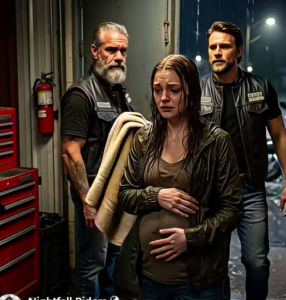
A towering, bearded biker stared down at my heavily pregnant belly with cold suspicion
The coffee was bitter and too hot, and for three breaths I let myself believe the broker. Rain ticked on the roll-up door. Marshals zip-tied the cartel men beside the tire rack. Badges flashed. The younger rider who had thrown me the blanket holstered his revolver with hands that still shook. Through the open bay the black SUV sat crooked in the mud, doors ajar, one headlight smashed against the fence post. It looked like an ending. Endings, I had learned, are often only the moment before someone checks the ledger twice.
“Where is the book?” the lead marshal asked. Her name tape read SOLANO. She did not look at my belly first. She looked at my hands.
“In the lining of the jacket,” I said. “The account numbers, the shell companies, the nights my husband drove to the port. I copied what I could before he burned the laptop.”
Solano took the jacket as if it might still be a trick. A deputy peeled the lining. Pages came out damp at the edges, my handwriting cramped between printed transfers. The bearded broker, the one the others called Rook, watched the pages and did not smile.
“That is not all of it,” he said.
Solano’s eyes cut to him. “You said she was the witness.”
“She is. The club kept the other half because her father asked us to, years ago, when he was still allowed to wear the patch. Route logs. Names your warrant does not have yet. We were waiting to see who came through that door wearing a badge and who came wearing a cartel ring.” He nodded at the zip-tied man with the silver pistol. “He came wearing both, once. Check his ankle. Old scar. He ran protection for the port before he ran enforcement.”
The man spat. “You are already dead, old man. The husband knows this address.”
“Then he knows marshals are standing in it,” Rook said.
I set the coffee down. The warmth had been a loan. “My husband is not the top. He is the man they send when a wife becomes a file. If the agents were in the side rooms before I arrived, someone told them I would come here.”
Solano did not deny it. “Your father still had one friend in the field office. He called us when the Black Ridge gate camera pinged a plate that was not a bike. We have been on the ridge since dusk. The plea at the door was real. The timing was ours.”
“And the millions they say I stole?”
“A story to make a pregnant woman sound like a thief instead of a clerk who would not sign a false manifest. The money moved through your husband’s company. You documented it. That is not theft. That is why they want you in a ditch.”
A contraction, small and warning, crossed my side. I breathed the way the clinic had taught me before I stopped going to the clinic. Rook saw it. The younger rider saw it. Solano saw it and pointed at the office cot.
“You are not riding anywhere tonight,” she said. “We hold this building. At first light we move you to a safehouse off the county map. The ledger pages go in an evidence case. You go in a sedan with two of mine.”
“I go with the club until the sedan is real,” I said. “My father said the old code was the only promise that did not invoice itself.”
Rook grunted. “Your father also said you were stubborn enough to get a saint fined. Sit. Lock the inner door if it helps. Nobody here is handing you to a husband.”
I sat. The blanket itched. Outside, the storm softened to a steady drill on the roof. Marshals photographed the SUV. One of the cartel men began to talk in a low hurry, offering a dock number, a time, a name that was not my husband’s. Solano wrote none of it where I could see. Trust, even on the winning side, was a corridor with doors.
Near midnight the younger rider, Jesse, brought soup and did not ask questions he had not earned. “My sister had a boy in a snowstorm,” he said. “She cursed the whole county and then asked for ice. You need anything, you knock on the glass.”
“I need the rest of the book,” I said.
He looked at Rook through the window. “That is above my patch.”
Rook brought it himself an hour later. A mechanic’s binder, stained, the entries in my father’s block print. Dates matched the pages from my jacket. Where I had account numbers, he had truck numbers. Where I had a husband’s signature, he had the man who had met the truck. On the last page a line had been added in a different hand: If she comes, the child is club blood. Do not trade her for peace.
“He wrote that after he knew he was sick,” Rook said. “Before the syndicate decided a dying brother was a loose end. The crash was not ice. You knew that.”
“I knew when they would not let me see the body.” My voice stayed level. The levelness felt like theft. “He told me if the port ever knocked, I should knock here. I waited until my husband found the copies in the nursery drawer.”
“You waited long enough to walk out pregnant and alive. That is not nothing.”
A radio cracked in the bay. Solano’s head came up. She listened, and the calm she had worn like armor shifted.
“Roadblock at the county line did not hold,” she said. “Three vehicles passed it moving this way. One of them is registered to your husband’s firm.”
The soup went cold in my hands. Jesse drew the revolver again, then looked ashamed of the gesture in a room full of marshals. Rook killed the overheads. Emergency strips stayed on, red and thin. I moved to the cot, not because I was weak, but because the glass office had become a lantern and lanterns draw eyes.
They did not ram the fence. They cut the power to the yard lights and came through the drainage cut on the north side, the way someone does when he has studied a building instead of hated it. The first shot was not a warning. It took a marshal in the shoulder and spun him into a tool chest. Solano returned fire through the bay gap. The sound in a metal building is a living thing. It climbs the walls and stays in the teeth.
“Clara, floor,” Rook said, and put himself between the glass and the bay.
I went down among drop cloths that smelled of solvent. Another contraction came, stronger, unfair. I counted. I had been counting for months, miles, lies. Jesse crawled to the side door with a marshal and kicked it shut as a figure tried the handle. Through the wired glass I saw my husband for the first time since the nursery. He was not holding a gun. He was holding an umbrella, absurd in the crossfire, suit dark at the cuffs, face arranged in the concern he used for clients.
“Clara,” he called, voice pitched to carry. “They are using you. Come out. The baby needs a hospital, not a gang. I will not sign anything. We can fix the misunderstanding.”
The misunderstanding was a ledger with his initials on a transfer that bought silence at the port. I did not answer. Answering was how he found the edges of people.
“She is not coming out,” Solano shouted. “Federal property. Step back.”
He sighed into the rain, as if the marshal had been rude at a dinner. Then he nodded, and the men with him stopped pretending the umbrella mattered. A canister came through the broken bay window and bloomed white. Tear gas. Jesse swore and dragged a wet rag to me. Rook pulled the office door shut. The gas crept anyway, thin and vicious. My eyes burned. The baby rolled, offended by the chemistry of the world.
“Back room,” Rook said. “Tunnel to the wash bay. Your father dug it when the county tried to seize the shop for taxes. We kept it because codes outlive sheriffs.”
The tunnel was a concrete throat under the floor, lit by a single bulb. I went on hands and knees with the binder clutched to my chest and the jacket pages inside my shirt. Water dripped. Behind us the firefight stuttered, then picked up. Solano did not follow. She had a wounded man and a doorway to hold. At the wash bay Jesse lifted the grate. Rain hit my face like a pardon that had not been signed.
Two bikes waited under a tarp, engines cold. A marshal’s sedan was supposed to be the plan. The plan was coughing in a cloud of gas.
“I cannot ride,” I said.
“You can sit,” Jesse said. “I will drive the truck. Rook, you lead. If we are not at the switchback in twenty minutes, we are not coming.”
The truck was a dented service van with a club plate Rook swapped for a plain one. I lay in the back among belts and a spare helmet, the binder under my palm, contractions pacing themselves like a second engine. We left by the service track as headlights swept the front fence. I heard my husband shout my name once more, not loving, only accurate, the way a man shouts a file he does not intend to lose.
The switchback was a turnout above the river, black water, no rails. A single car waited with its parking lights on. Solano had said the safehouse was off the map. She had not said a deputy would meet us halfway. The figure that stepped out was not Solano. It was the port man from the zip-ties, the one with the ankle scar, somehow un-cuffed, a marshal’s windbreaker over his clothes and a pistol loose at his side.
“Change of escort,” he said. “Solano is pinned. I have the sedan. Hand me the binder and get in.”
Rook did not get off the bike. “Solano does not hand a witness to a man she just arrested.”
“She does when the man flips. I gave her the dock. This is the trade.”
Jesse’s hand stayed under his coat. I looked at the windbreaker. The badge was real. The boots were wrong, polished, city, not ridge mud. My husband’s taste in help had always been expensive.
“He is not flipped,” I said. “He is borrowed. If I get in that car, the ledger ends in the river and I end in a story about a crash.”
The man smiled without commitment. “You are in labor in a van full of outlaws. Who do you think a jury believes?”
“A jury believes pages,” I said. “And there are three copies. One in my shirt. One in the binder. One already on a phone Rook used before the lights died, sent to the field office my father still had a friend in. Shoot us and the morning still has your dock number.”
It was half true. Rook had used the burner. I did not know if the message had left the ridge before the canister. Bluff is a kind of faith. The man’s smile thinned. He raised the pistol. Jesse fired first, not at the chest, at the hand, and the pistol jumped into the gravel. Rook was off the bike and on him before the echo died. They zip-tied him with a belt. The sedan keys went into the river, a small bright loss.
“Now we are kidnapping a fake marshal,” Jesse said, breathing hard.
“Now we are delivering a cartel driver to a real one,” Rook said. “Drive.”
We did not make the safehouse. We made the county hospital by a back ambulance bay because the contractions stopped being warnings. Fluorescent light. A nurse who did not care about patches or warrants. Solano arrived twenty minutes later with her arm in a sling and fury held neatly in her mouth. She looked at the man in the windbreaker, at the binder, at me on the gurney, and nodded once, which in her language was a cathedral.
“Your husband fled the yard when the second team came in,” she said. “He will not flee long. The phone copy landed. Ugly, partial, enough to hold him if a trooper is brave. You did not have to bluff the third copy. There is a third. Your father mailed it to the club’s lawyer in a will envelope. We opened it at dusk.”
I laughed, and the laugh broke into the next wave of pain. “He never trusted one door.”
“No,” Rook said. “He trusted the person who would knock.”
The baby came before dawn, a girl, furious and red, with a cry that filled the bay louder than the shots had. They put her on my chest. She smelled like heat and soap. The syndicate did not enter the room. For ten minutes the world was that small and that sufficient. Jesse cried and pretended it was the antiseptic. Rook stood with his back to the door, not sentimental, only placed. Solano took the binder with gloved hands and left a receipt on the tray, because paper is how the living argue with the dead.
The hearings took months. I testified with the baby in a sling and a name the marshals chose, then with my own name when hiding became a smaller danger than erasure. My husband sat in a suit that no longer fit his story and called me emotional. The pages called him precise. The port logs matched. The scarred man took a deal and drew a map. The syndicate did not collapse in an afternoon. It lost a route, a company, a husband who had believed marriage was a seal on a false manifest. That was not nothing. Rook’s club lost a bike and a quiet year. They gained a story they did not tell in bars.
I did not move into the clubhouse. I rented a room above a laundry in a town that did not know my husband’s umbrella. Jesse fixed the sink. Rook came on Sundays with parts he did not need and news he did not dress up. Solano sent copies of filings and never sent comfort. Comfort was not her office. When the sentence came down, it was years, not forever. Forever is rare in a ledger. Years were enough for my daughter to learn her own hands before she learned his.
On her first birthday the ridge was clear, the repair shop rebuilt, the tunnel grate bolted but not filled. I stood in the bay with the baby on my hip and told Rook the thing I had not said in the tunnel.
“I came because I was out of doors. I stayed because you did not invoice the code.”
“Your father paid in advance,” he said. “The rest is interest we do not collect from widows.”
The lesson was not that a midnight plea summons heroes. The Black Ridge Riders were mechanics with a memory and a line they would not sell. The marshals were tired people with badges and one friend who still answered a dead man’s number. I was a clerk who copied what she was told to falsify and walked into the rain rather than sign. Safety had not been the coffee, or the raid, or the hospital light. Safety was a stack of pages in more than one hand, and a door that opened because someone older had written, Do not trade her for peace. I intended to teach my daughter that peace which costs the truth is only a locked gate with a smile on it. Outside, the autumn rain started again, ordinary, unpaid, and we did not run.