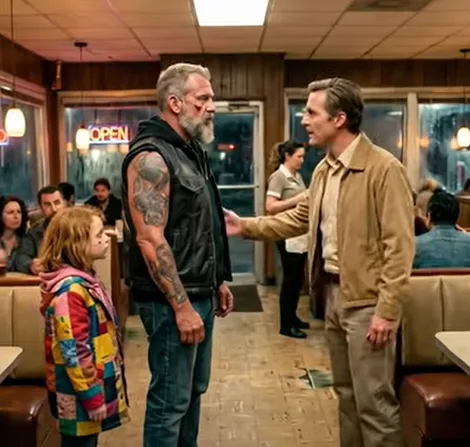
A sharply dressed stranger cornered us inside the neon-lit Starlight Diner, publicly spitting venom that my little girl was a dangerous pathological liar who belonged in state custody
Lily’s arms stayed locked around my neck long after the diner had begun to breathe again, and I stayed on one knee on the checkered floor, holding her, because I had learned a long time ago that you do not let go of a child until she lets go first.
“Sir?” said a gentle voice above us. “Sir, there’s a booth in the back. It’s quiet. The coffee’s on the house.”
I looked up and found the waitress standing over us, a stout woman in her sixties with silver hair pinned under a paper cap and a name tag that read DOLORES. She had a plate of pancakes balanced on one palm and tears standing in her eyes.
“And these are for the little lady,” she said. “With extra whipped cream. I won’t hear a word against it.”
Lily lifted her face from my collar and studied the pancakes with the grave suspicion of a child who has not been offered anything kind in a very long time.
“Are they poisoned?” she whispered.
Dolores’s face crumpled, and she knelt right down on the linoleum in her white apron and her orthopedic shoes.
“No, sweetheart,” she said softly. “Nobody’s going to hurt you in my diner. Not today, and not ever.”
Lily looked at me.
I nodded, and she took the plate in both hands as if it were made of glass, and I felt something in my chest break open and heal in the same instant.
We slid into the back booth, the red vinyl cracked and patched with silver tape, and Lily ate with her back pressed against my side and one hand still fisted in my vest. Around us the diner slowly went back to its business, forks clinking, the jukebox winding into an old Patsy Cline song, but every few seconds someone glanced over with a kind of shy reverence and looked away.
My name is Jack Morrow, I am forty-three years old, and five days earlier I had walked out of a federal courthouse a free man for the first time in four years.
The man who framed me had been standing in a diner in the rain, calling my daughter a liar.
“Daddy,” Lily said, around a mouthful of whipped cream.
“Yeah, baby?”
“Are you really not in jail anymore?”
“Not anymore.”
“Did you do something bad?”
“No.” I took a breath and chose my words the way you choose footing on ice. “A bad man told lies about me, and the lies were so loud that nobody could hear the truth. It took a long time for somebody to listen.”
“Mr. Arthur?”
“Mr. Arthur.”
“He told me you didn’t want me.” Her voice was very small. “He said you signed papers. He said you were glad.”
The pancake fork bent in my fist.
“Lily,” I said, and my own voice shook. “Look at me.”
She did, with her mother’s wide blue eyes.
“I wrote you a letter every single week,” I said. “For four years. Two hundred and eight letters. I never stopped. They never gave them to you, but I never stopped.”
“Two hundred and eight?”
“I counted.”
She considered this with tremendous seriousness.
“That’s a lot of letters,” she said.
“I have them all in my saddlebag. Every one. I kept the copies.”
“Can I read them?”
“Every one.”
“Even the boring ones?”
“Especially the boring ones,” I said, and she laughed, a rusty, startled sound that made the waitress at the counter drop a spoon.
The marshal who had arrested Arthur came back in twenty minutes later, shaking rain off his windbreaker, a lean man with graying hair and a face weathered into patience. He slid into the booth across from us and set a battered cardboard box on the table.
“Deputy Marshal Samuel Ortega,” he said, and offered a hand. “Mr. Morrow, I’m sorry about the theater. We wanted to wait until he said something on tape, and he was kind enough to say a great deal.”
“You were listening?”
“The waitress’s apron has a very good microphone.” He smiled faintly. “Dolores has been with us since Tuesday.”
I turned and stared at the woman behind the counter, who gave me a tiny, mischievous wave.
“She’s a deputy?”
“Retired. Twenty-two years. She said she’d always wanted to catch a man in a diner.” Ortega’s smile faded. “There’s something else I need to tell you, and I’d rather tell it here than in an office.”
My stomach tightened.
“Your wife,” he said gently.
I did not breathe.
“Claire isn’t dead, Mr. Morrow.”
The jukebox seemed to go very far away.
For four years I had believed that my wife had died in a car accident on a mountain road two months after I was convicted, that the news had reached me in a prison chaplain’s office with a folded newspaper clipping and a hand on my shoulder. I had mourned her in a cell. I had asked Lily’s foster family for a photograph of the grave and had not received one.
“She was in a coma for eleven months,” Ortega said. “Arthur’s people staged the crash and told everyone she was gone, and then they moved her to a private care facility in Nevada under a false name. They needed her alive, because she was the only person who could testify that the firm’s money had been moved through her father’s trust.”
“Where is she?” I said. My voice came out as a stranger’s.
“The facility was raided at noon today. We found her in a sunny room on the second floor, awake and lucid, with a book in her lap.” Ortega’s eyes were wet. “She asked for you first. And then she asked for Lily.”
Lily had gone very still against my side.
“Mommy?” she whispered.
“She’s okay, sweetheart,” Ortega said. “She’s very tired, and she’s very weak. But she’s alive, and she’s waiting for you.”
Lily looked up at me, and her lower lip trembled, and then the whole small face dissolved.
“Daddy,” she sobbed. “Daddy, they told me she was in heaven.”
“I know.”
“They told me she was gone forever.”
“I know, baby. I know.”
I pulled her into my lap and held her while she cried, great shuddering sobs that shook her whole frame, and I buried my face in her hair and wept without shame in the back booth of the Starlight Diner while a dozen strangers pretended to study their menus.
Dolores brought a box of tissues and a second pot of coffee and set both down without a word.
Ortega drove us himself, in an unmarked black sedan with the heater turned up high, while I followed on my Harley through the dark and the rain, Lily wrapped in the marshal’s spare jacket in the passenger seat of his car because I had promised her I would not let the sedan out of my sight.
It was a three-hour drive across the Nevada border.
I watched his taillights the whole way, two small red eyes bobbing through the wet black desert, and I thought about a lot of things.
I thought about a night five years ago, a Friday in October, when Arthur Callahan had walked into my office at Prescott and Callahan with a bottle of expensive scotch and a friendly smile and told me he’d found a discrepancy in the books. I had been the firm’s accountant. I had trusted him. I had stayed late to check the numbers.
By morning there were federal agents in my office and a hundred and forty thousand dollars missing from the client trust account, and every transaction bore my login.
I thought about Claire, standing in the doorway of our kitchen with her hands over her mouth, watching them put me in handcuffs, and the last thing she said to me before they closed the cruiser door.
“I believe you, Jack. Whatever they say. I believe you.”
She had been the only one.
The care facility was a low white building at the edge of a dry lake bed, with a rose garden out front and a sign reading SAGEBRUSH HOUSE in gentle blue letters.
Federal vehicles lined the parking lot, and a pair of agents in windbreakers stood at the entrance and parted for us without a word. Ortega walked us up the front steps, and through a hushed lobby that smelled of lavender and floor polish, and down a long corridor lined with watercolors of desert flowers.
At the end of it stood a pale yellow door.
“Second floor, room twelve,” Ortega had said, but the elevator had been out and we had taken the stairs, and I do not remember climbing them. I remember only the sound of my own boots, and Lily’s small hand crushed inside mine.
Ortega stopped at the door.
“I’ll wait here,” he said. “Take as long as you need.”
I put my hand on the knob.
My fingers were shaking so badly that I could not turn it.
“Daddy,” Lily whispered. “I’ll do it.”
She reached up with her free hand, and wrapped her small fingers around the brass knob, and twisted.
The door swung open on a bright, quiet room.
It was a small room, with white curtains and a window that looked out over the rose garden, and a narrow bed made up with a patchwork quilt. A woman sat in a wheelchair beside the window with a thin blanket over her knees and a book open in her lap.
She was much thinner than I remembered.
Her dark hair had been cut short and had grown out unevenly, and there was a pale scar curving along her temple. But her profile against the window light was exactly the same, the straight little nose, the stubborn chin, the way she tilted her head when she was thinking.
“Claire,” I said.
The book slid from her lap onto the floor.
She turned in the wheelchair, slowly, with one hand gripping the armrest, and she looked at me with enormous blue eyes that filled and brimmed and spilled over.
“Jack,” she breathed.
I do not know who moved first.
I only know that I was on my knees on the linoleum with my arms around her thin shoulders and my face against her neck, breathing in the soft clean smell of her hair, and that she was clutching the back of my vest with both hands and sobbing my name over and over like a prayer.
“You’re alive,” I kept saying. “You’re alive, you’re alive.”
“I’m so sorry,” she wept. “I’m so sorry I wasn’t there. I tried to wake up. I tried and tried.”
“It’s not your fault.”
“I could hear you. In the dark. I could hear you saying my name.”
“I said it every day.”
“I know,” she whispered. “I know you did.”
A small cool hand touched my shoulder.
“Mommy?”
Claire went rigid in my arms.
She lifted her head, slowly, over my shoulder, and looked down into the face of the little girl standing beside my knee in a borrowed marshal’s jacket that came to her ankles.
“Lily,” she said.
It was barely a sound.
“Mommy, you’re not in heaven,” Lily said, in a very small clear voice. “They said you were in heaven, but you’re here.”
“I’m here, baby.”
“I knew they were lying.”
“You did?”
“Daddy always said that when people tell you something awful, you should ask yourself who it helps.” Lily’s chin wobbled. “It helped Mr. Arthur. So I knew.”
Claire put out both arms, and Lily climbed into her lap, boots and oversized jacket and all, and the three of us tangled together in a clumsy knot of arms and tears in the middle of that bright, quiet room.
We stayed that way a very long time.
Outside the window the sun was coming up over the dry lake, a long smear of rose and gold that crept across the desert floor and set the roses in the garden glowing like lamps.
Arthur Callahan’s trial lasted six months.
He pleaded not guilty, of course, and hired the most expensive defense attorney in the state, a silver-haired man in a three-thousand-dollar suit who spent four days trying to convince a jury that a federal marshal’s recording had been manipulated. On the fifth day, the prosecution played the audio from Dolores’s apron.
It lasted nineteen minutes.
Arthur’s voice filled the courtroom, smug and slick and unmistakable, describing the forged custody papers, the bribed judges, the staged crash. Describing, with a chilling casual relish, how he had planned to adopt Lily and move her out of the country before her father was released.
The defense attorney asked for a recess.
Arthur sat at the defense table with his face in his hands.
I testified for two days.
I told the jury about the night in my office, and the missing money, and the four years in a cell. I told them about Claire, and the grave I had never seen, and the two hundred and eight letters. I did not raise my voice, and I did not look at Arthur once.
When the prosecutor asked me, at the end, how I had survived, I looked at my daughter in the front row, swinging her feet in a pair of new red sneakers, with her mother’s hand resting on her shoulder.
“I made her a promise,” I said. “I told her in a letter that I would always find a way home. I didn’t know how. I just knew I had to keep the promise, because she was keeping hers.”
“What promise was hers?”
“She never stopped believing me,” I said, and my voice cracked. “A little girl, alone, in a house full of people telling her I’d abandoned her. She never once believed it.”
The courtroom was so quiet I could hear the clock ticking.
The jury deliberated for three hours.
Arthur Callahan was convicted on all fourteen counts, wire fraud, embezzlement, conspiracy, witness tampering, kidnapping, attempted murder. The judge, a stern white-haired woman with a voice like a church bell, sentenced him to ninety-five years in federal prison and ordered every dollar of his seized fortune returned to the clients he had robbed.
He did not look at me as they led him away.
But at the door he stopped, and turned, and looked at Lily.
“I was never cruel to you,” he said, in a flat, bewildered voice. “I gave you everything. Why didn’t you ever love me?”
Lily stood up on the bench, small and straight in her red sneakers.
“Because you took my mommy,” she said clearly. “And you can’t love somebody who takes your mommy.”
The room was silent.
Arthur stared at her for a long moment, and something in his face went out like a lamp.
Then the marshals took him through the door, and it closed behind him with a quiet, final click.
We rented a house in a little town in the high desert, a faded blue bungalow with a screened porch and a lopsided apple tree in the yard. It had two bedrooms, a kitchen with a yellow stove, and a front window that caught the morning sun.
Claire came home in May.
She was still weak, still walking with a cane, still waking in the night from dreams of white ceilings. But she was strong in a way I had never seen, a quiet, bone-deep strength that came from having climbed out of a dark that went all the way down. Every morning she sat on the porch in the sun with a cup of tea, and every evening she sat with Lily at the kitchen table and helped her with her spelling.
I got a job at a small accounting firm on Main Street, a one-room office run by a gruff old man named Hollis who had read my case in the newspapers and said he didn’t give a damn about the felony, because he’d never met an honest man with a worse reputation.
I worked there for two years.
Then, on a Saturday in June, with the apple tree in bloom and the whole yard drifting with pink petals, I walked out of the house with my leather vest over my arm and a small velvet box in my pocket.
Lily was in the yard, building a fairy house under the tree with twigs and acorn caps.
“Where are you going, Daddy?”
“For a ride.”
“Can I come?”
“Not this time. I need you to stay and help Mommy.”
She looked at me with narrowed, shrewd eyes.
“You’re being sneaky.”
“I’m being a gentleman.”
“That’s the same thing,” said my daughter, and went back to her twigs.
I rode out to the lake, forty miles of straight desert highway with the window of the sky wide open overhead, and I parked at the place where the road ended in a little gravel lot beside the water.
Claire was waiting.
She had driven out an hour before, with Lily’s friend’s mother, and she stood at the edge of the shore in a plain yellow dress with her cane planted in the sand and her short dark hair stirring in the breeze. The water behind her was a dazzling deep blue, rippled with little gold coins of light.
“You’re late,” she said.
“I got caught behind a tractor.”
“Liar.”
“I was nervous.”
“That’s better.”
I walked down the slope of the shore, my boots sinking into the soft sand, and stopped in front of her.
Four years in a cell, and one night I’d been told she was dead. Eleven months in a coma. Two years of slow, patient, ordinary mornings, learning how to be a family again.
“Claire,” I said.
“Yes?”
“I wrote you letters, too. Did you know that? Not just to Lily. To you.”
“I read them.”
“Every one?”
“The marshals found them in a box at the prison,” she said. “They gave them to me in the hospital, before I could walk.” Her eyes filled. “Jack, I read them in the dark, with a flashlight, a hundred times. They were the only thing that made me want to stand up.”
I could not speak.
I opened the velvet box with unsteady hands.
It was a plain gold band, simple and a little worn, the one I had bought at a pawn shop on Fourth Street with the first paycheck I had ever earned after my release.
“I can’t promise you a perfect life,” I said. “I have a record. I have a bad temper. I make a terrible omelet.”
“You do.”
“But I promise I will never stop telling you the truth. And I promise that no matter what anyone says, no matter how loud the lies get, I will always find a way home.”
Claire laughed, and cried, and held out her left hand.
“Ask me,” she said.
“Claire Morrow. Will you marry me again?”
“A thousand times,” she said. “Yes.”
I slid the ring onto her finger, and it caught the light and flashed like a small gold sun.
From the top of the gravel slope above us came a joyful shriek.
“She said yes! She said yes! Dolores, they did it, she said yes!”
I turned and looked up.
Lily was racing down the hill in her red sneakers, braids flying, with Deputy Marshal Ortega loping after her and a stout silver-haired woman in an apron bringing up the rear with a picnic basket.
“You told her?” I called.
“Nobody told her,” Ortega said, grinning. “She’s been hiding in my backseat since nine o’clock this morning.”
“I was supervising,” Lily announced, skidding to a stop in front of us in a spray of sand. “Somebody had to make sure you didn’t mess it up.”
“Thank you for your confidence.”
“You’re welcome.” She threw her arms around both our waists, and burrowed her face between us, and said in a small muffled voice, “This is the best day of my whole life.”
I looked at Claire over our daughter’s head, and she looked at me, and neither of us said anything, because there was nothing left to say.
We ate lunch on the shore, the five of us, on a faded quilt in the shade of a lone cottonwood, with a basket of sandwiches and a thermos of coffee and a lopsided cake that Dolores had baked herself. The lake lay broad and blue and gold before us, and a pair of ducks drifted across it in lazy circles, and the whole high desert sky arched overhead, clear and endless as a promise.
“To Dolores,” Ortega said, raising his paper cup. “The finest apron microphone in the history of federal law enforcement.”
“I’ll drink to that,” said Dolores, and did.
“To Jack and Claire,” said Lily solemnly, lifting her juice box.
“To Lily,” I said. “The bravest person I ever met.”
“To family,” said Claire softly.
We touched cups, and the sound rang out over the water.
Later, when the others had wandered down to the shore to skip stones, I sat beside my wife on the quilt with my arm around her shoulders and her head against my chest.
“Jack,” she said.
“Yes?”
“Do you remember what you told me, the night before they arrested you? You said you could feel something coming. A storm.”
“I remember.”
“I’ve been thinking about it.” She smiled up at me, with the sun in her eyes. “I think you were right. There was a storm. It lasted a very long time.”
“It did.”
“But I’ve been looking out this window every morning for a year, and I think it’s finally over.”
I looked out over the lake, at the bright broad water and the laughing child and the high clear sky, and I felt the last of the heaviness leave my chest like a bird lifting off a wire.
“I think so too,” I said.
Down on the shore, Lily shouted, and held up a flat gray stone, and let it fly. It skipped four times across the shining water, in long glittering arcs, before it sank.
“Four!” she crowed. “Daddy, did you see? Four!”
“I saw!”
“Mommy, did you see?”
“I saw it, baby,” Claire called, and her voice rang out across the water, strong and clear and unafraid.
And as the afternoon light turned gold, and the ducks settled on the lake, and my daughter’s laughter rose into the endless desert sky, I understood at last that the promise I had made in two hundred and eight letters had been kept.
I had found a way home.
It had never been a place at all.
It was a woman in a yellow dress, and a little girl in red sneakers, and a table with room for everyone who had ever waited in the dark.