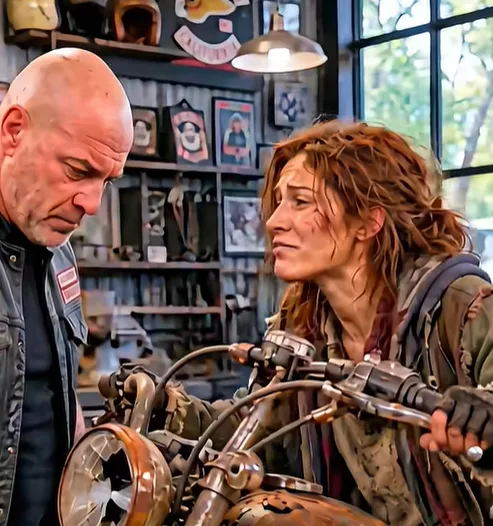
A motorcycle clubhouse while the furious president screamed in my face and demanded to know why I dragged my brother’s wrecked
The folder weighed almost nothing, and yet my arms shook as though I were holding up the sky.
“Ms. Reyes?” the lead agent said quietly. “Take your time.”
I stared at my father’s signature slanting across the federal seal, the same careful, looping hand that had signed every birthday card I ever received. Daniel Reyes, the ink said, and beneath it a date from five weeks before he died.
Behind us, the clubhouse was coming apart in the best possible way. Agents were bagging ledgers, photographing the vault, and walking handcuffed men out into the morning light, where a long row of black vans waited along the gravel like patient hearses.
My name is Rosalind Reyes, I am twenty-four years old, and I had spent three years pretending to be a girl with nothing left to lose.
The truth was that I had lost everything, and then I had planned.
“Special Agent Priya Nair,” said the woman beside me, offering a hand. She was slim and silver-haired, in a gray windbreaker, with the calm, tired eyes of someone who had been awake for two days and would not have traded a minute of it. “I’ve been reading your messages since March. You were very convincing.”
“I cried on purpose.”
“I noticed. Then I noticed that some of it wasn’t on purpose.” Her mouth softened. “That’s usually how the best ones work.”
I laughed, a wet, shaky sound, and opened the folder.
The first page was a letter, typed on plain paper and signed by hand.
To whom it may concern, it began. My name is Daniel Reyes. I am the treasurer of the Iron Saints Motorcycle Club, and I am writing this because I believe I will not live to testify.
For eleven years I kept the club’s books honestly. Three years ago, I discovered that our president, Walter Tank Brannigan, had been moving narcotics through our charity runs and laundering the money through the clubhouse vault. When I confronted him, he promised to stop. He did not.
I have copied every record. I have given the originals to my son Jason, who is smarter than I am and braver than he knows. If something happens to us both, look to the bike.
Tell my daughter Rosalind that I was never ashamed of her, and that the only thing I regret is not teaching her to fix a carburetor.
I read the last line three times.
“He wanted me to fix carburetors,” I said, and my voice broke.
“Can you?”
“Not a single one.”
“Then it seems we have a project,” said Agent Nair, and her eyes were gentle.
In the middle of the garage, the wrecked chopper sat where I had dragged it, a skeleton of rusted chrome with a bullet-torn fender and a shattered headlamp. Two technicians in white coveralls knelt beside it, easing a welded seam open with a tiny blowtorch.
“Easy,” one of them murmured. “Easy. There.”
A hollow steel tube slid out of the frame like a bone from a wound, and inside it, wrapped in plastic, lay a USB drive and a folded square of paper.
The technician held it out to me with both hands.
I did not want to take it.
I wanted to stand there forever, with the drive still inside my brother’s motorcycle, with my brother still somehow near. But I reached out, and my fingers closed around it, and the paper fell open.
It was a note in Jason’s rough, hurried handwriting.
Ros. If you’re reading this, you found it, and I was right about you. Don’t be mad that I didn’t tell you. I wanted you out of this. You always were the one who was going to get out.
Dad’s in the ledger. So am I. Everything’s true. Do the thing we talked about as kids, remember? When the sky’s falling, you stand still and look for the exit.
I’m sorry I’m not there. I love you, kiddo. Be loud about it.
Jay
I bent over and pressed my forehead to the cold gas tank, and I cried the way I had not allowed myself to cry in three years, not in front of Tank, not at my mother’s grave, not in the dark of my childhood bedroom.
Nobody told me to stop.
Agent Nair stood a little apart, with her hand resting lightly on my shoulder, and let the sobs run through me like a storm through a field.
It was nearly noon before the garage was quiet.
They had carried the last of the club out into the sun. Tank had gone last, still cursing, with his bald head bleeding from the concrete and his face the color of raw meat. As they led him past me, he twisted around and spat.
“You little rat,” he snarled. “Your brother was a thief and your father was a coward.”
“My father was the only man in this building who told the truth,” I said.
“He’s dead.”
“So are you, Tank. You just haven’t noticed yet.”
It was not clever, and I regretted it a little afterward. But the agent holding his arm smiled, and a dozen of the younger bikers, boys of twenty, twenty-two, who had joined for the brotherhood and the leather and the wind, lowered their eyes in shame.
One of them, a thin, freckled kid with a split lip, looked up as he was led by.
“Miss Reyes,” he said hoarsely. “I didn’t know. About Jay. I swear to God.”
“I believe you.”
“They told us he ran.”
“They told everyone that.”
“I’m sorry.”
I looked at his face, young and stricken and wet, and I thought of all the boys who walk into rooms like this one believing they are joining a family.
“Tell the truth in court,” I said. “That’s the only apology that matters.”
“Yes, ma’am,” he whispered, and nodded, and went.
Agent Nair drove me back to my mother’s house in the afternoon, in a plain gray sedan, with the folder in my lap and the USB drive in my fist.
The house stood at the end of Cottonwood Lane, a small yellow cottage with a sagging porch and a lilac bush that had grown wild over the front steps. The paint was peeling. The mailbox leaned. In three years, I had not been able to change a single thing about it.
“You can stay at a hotel,” Nair said gently. “The Bureau will cover it.”
“I want to go in.”
“Of course.”
She walked me to the door, and I stood there with my key in my hand, and found, to my surprise, that I could not turn it.
“Rosalind?”
“My mother died in there,” I said. “Three months after Jason disappeared. She stopped eating. She just, she faded. I sat beside her for six weeks and held her hand and told her he’d be home soon.”
“I’m so sorry.”
“I lied to her. Every day.”
“You gave her hope,” Nair said. “That’s not the same as a lie.”
“It felt like one.”
“I know.” She was silent a moment. “My father died in a hospital in Mumbai while I was on a case in Baltimore. I told myself for years that he’d forgiven me. It wasn’t until someone showed me his last letter that I believed it.”
I looked at her.
“Did he?”
“He wrote, ‘Go and do the work. The world needs it more than I need you.'” A smile trembled on her face. “I still can’t read it without crying.”
I put the key in the lock, and turned it, and pushed.
The house smelled of dust and lilac and the faint ghost of my mother’s tea. Sunlight slanted through the front window in a long bright bar across the faded carpet, and the old clock on the mantel was still ticking, because I had wound it every Sunday.
“Oh, Mama,” I whispered.
On the kitchen table, beside a cracked blue teacup, lay something I had never seen before.
It was a small brown envelope, sealed with tape, with a single line across the front.
For Rosalind. When it’s over.
My hand flew to my mouth.
“When did—”
“I don’t know,” I said. “She must have left it. After Jason. She must have known.”
“Open it.”
My fingers shook so violently that Nair had to steady the paper while I tore it.
Inside lay a single photograph and a note.
The photograph was of my family, all four of us, standing on the porch on the Fourth of July the summer I turned twelve. My father in his club vest, grinning. Jason, gap-toothed and sunburned, holding a sparkler. My mother in a yellow sundress, laughing, her head thrown back. And me, in the middle, with a lopsided ponytail and a scab on my chin, looking up at them all like the luckiest girl in the world.
The note was in my mother’s thin, trembling hand.
My Rosie, it said.
I am very tired, and I will be gone soon, so I’ll say it plain.
I know you’ve been lying to me about your brother. I knew the first day. A mother always knows. I let you do it because it gave you something to do with your love, and because I was too tired to take it from you.
Here is what I want. I want you to stop. Not stop looking for the truth, you’ll never stop, you’re your father’s girl, but stop carrying us.
We are not heavy. We are only yours.
Live loud, sweetheart. Make it count.
Mama.
I read it, and I read it again, and then I sank to the kitchen floor with my back against the cabinets and the photograph against my chest, and I wept until I had no more tears.
Nair sat down beside me.
She said nothing. She only put her arm around my shoulders, and let me lean, and sometime in the long gold stretch of that afternoon I realized that I was laughing.
“What?” she said.
“She said live loud.”
“I heard.”
“Jason said be loud about it.”
“Then it seems,” said Nair gently, “that the instructions are consistent.”
The trial began in November, in a high, bright courtroom in Phoenix, and lasted four months.
It was the largest organized crime case the state had ever prosecuted. Walter Tank Brannigan, six lieutenants, a county commissioner, a banker, and a municipal judge sat at the defense table in suits that did not fit, and every day the benches were packed with reporters, families, and curious strangers.
I testified for five days.
I sat in the witness box in my mother’s old navy dress, with the folder in my lap, and told twelve strangers the whole story, the three years of pretending, the bike, the weld, the drive. When the defense lawyer, a smooth silver-haired man with a voice like warm butter, tried to paint me as a grieving girl who had fabricated everything out of spite, I looked straight at him.
“Mr. Garrett,” I said, “you’ve never lost anyone, have you?”
He blinked.
“That’s not relevant.”
“I only ask because grief doesn’t invent ledgers,” I said. “It doesn’t weld them into frames, or sew them into jackets, or hide them in the one place the wrong people will never think to look. Love does that. Love is very, very organized.”
A ripple of soft laughter ran through the gallery.
The judge, a stern, kindly woman with silver spectacles, smiled in spite of herself.
When the drive was played, the whole room went silent.
It was all there, every transaction, every payoff, every dead-drop coordinate, my father’s neat, honest handwriting scrolling across the courtroom screen like a quiet, patient judgment. And at the very end, a short video file, three minutes long, recorded on a shaky phone in a dim garage.
My brother’s face filled the screen.
He was pale and bruised, with a cut above his eye and blood on his shirt, and he was grinning his stupid, glorious, gap-toothed grin.
“Hey, everybody,” Jason said. “If you’re watching this, I’m probably dead, and I’d like to say, for the record, that it was totally worth it.”
I made a sound that was half laugh and half sob.
“This is Walter Brannigan’s garage,” he went on. “He’s coming in about five minutes with three guys, and I’d say I’m in trouble. But I wanted somebody to know. My dad was a good man. My mom was a good woman. My little sister is the smartest person in the world, and if she’s seeing this, she’s already figured out the rest.”
He paused, and glanced offscreen, and I heard a door.
“Ros,” he said, softly. “If you can hear me. I’m sorry I didn’t tell you. But you’re going to be okay. You always were.”
Then the door burst open, and the screen went black.
Nobody in the courtroom moved.
Walter Brannigan sat at the defense table with his bald head bowed, and for the first time in my life I saw him look small.
The verdict came on a cold bright Friday in March.
Brannigan received life without parole, plus ninety years. His lieutenants received between thirty and sixty. The banker, the commissioner, and the judge went to federal prison for terms that would outlast them. By spring, the entire apparatus of the Iron Saints had been dismantled, thread by thread, in the full light of a federal courtroom.
But that was not the end of it.
In April, I received a letter from the club.
Not the old club, the one in handcuffs, but forty-three members who had been cleared of wrongdoing and who had spent the winter meeting in a borrowed church basement, trying to figure out what to do with a name that had been dragged through the mud.
We would like to invite you to speak, it said. We think you have something to tell us.
I almost threw it away.
I did not want to go back into a room full of bikers. I did not want to see the vests, or smell the leather and oil, or hear the rumble of an engine through a wall.
But I thought of my brother’s grin, and my father’s careful hand, and I went.
The church basement was a long low room with a linoleum floor and folding chairs, and forty-three men and women in plain clothes sat waiting under a flickering fluorescent light. Not one of them wore a vest.
At the front stood a gray-bearded man named Old Hollis, who had been the club’s chaplain for thirty years.
“Miss Reyes,” he said gravely. “Thank you for coming.”
“I almost didn’t.”
“I know.” His eyes were kind. “I would have understood.”
“What do you want me to say?”
“Whatever’s true.”
I looked at the faces, young and old, weathered and scared, and I thought of every word I had practiced in the car.
“I don’t know what you want from me,” I said at last. “I’m not a leader. I’m a girl who dragged a motorcycle into a garage.”
“That’s the bravest thing anyone in this room has ever seen,” said Hollis.
“I was terrified.”
“That’s what brave is.”
I laughed, startled.
“My brother used to say that,” I said.
“Your brother was a good man,” said Hollis. “He was the first one to tell me something was wrong. I told him to be careful, to wait. I’ve regretted it every day for three years.”
“You couldn’t have known.”
“I could have asked.” His voice cracked. “That’s the thing I wish I’d done. Asked one more question.”
The room was very quiet.
I took a breath.
“Then ask now,” I said. “That’s what I came to say. Whatever this club becomes, ask the question. Ask who benefits. Ask where the money goes. Ask what the quiet man in the corner knows and isn’t saying. The Iron Saints didn’t fall because of one bad man. They fell because forty good ones looked away.”
A woman near the front began to cry.
“My father kept the books for eleven years,” I said. “He never raised his voice. He never made a speech. He just wrote everything down. If you want to know what this club should be, be that. Be the people who write everything down.”
Hollis bowed his head.
“Would you consider,” he said slowly, “joining us?”
“As what?”
“As treasurer.”
I stared.
“Your father held the post,” said Hollis. “We can’t think of a better successor. Not because of your name, but because of what you did.”
“I’m twenty-four.”
“So was Jason when he joined.”
I put my hand over my mouth.
Behind Hollis, a young man with a crooked smile and a faded denim jacket, who looked so much like my brother that my heart stopped, lifted a hand in a shy little wave.
“That’s Eli,” said Hollis. “Jason’s best friend. He’s the one who helped us find the old charter.”
I looked at the boy, and he looked at me, and his eyes were wet.
“He talked about you all the time,” Eli said. “He said you could out-argue a lawyer.”
“I’m an accountant.”
“That’s what he said.” He grinned. “He said you were going to be the one who finally audited the world.”
I laughed, and wiped my eyes, and said yes.
We rebuilt the club that summer.
We called it the Iron Saints still, because Hollis said the name had been stolen once and we should steal it back. But we wrote a new charter, drafted in pencil on a yellow legal pad at my mother’s kitchen table, and read aloud at a long wooden table in the clubhouse garage.
First: all books are open.
Second: no money moves without two signatures.
Third: nobody rides alone.
We sold the vault. We sold the expensive trucks and the gleaming chrome bikes, and put every dollar into a fund for the families the old club had hurt. We opened the garage on Saturday mornings to anyone who needed a repair, and charged nothing, and by August there was a line down the block.
In September, a package arrived at the clubhouse.
It was a long, flat crate, addressed to me, with no return label, and inside lay a motorcycle part wrapped in oiled cloth.
It was a gas tank.
It was rusted, and dented, and had a bullet hole through one side, and I knew it before I lifted the cloth.
“It’s from the bike,” I whispered.
“The evidence people cleared it,” said Agent Nair, who had driven down from Phoenix for the weekend and was standing in the doorway with a cup of coffee. “They said the family should have it back. I thought you might want to decide what to do with it.”
I ran my hand along the cold steel.
In the corner, near the filler cap, I felt a tiny scratch, three letters carved with a pocketknife, long ago, by a ten-year-old boy who had wanted to claim a motorcycle he was not allowed to ride.
J.R.
“He carved that when he was ten,” I said. “Dad was so angry. He made him sand it off. He never did.”
“I think he did it again,” said Nair.
She was right.
Beneath the old scratch, in clean sharp lines, a second inscription had been added. It was deeper, and newer, cut with a steady hand.
J.R. AND R.R. KEEP RIDING.
My breath caught.
“Who—”
“I don’t know,” Nair said softly. “But I think someone loved you both very much.”
I carried the gas tank into the garage, and set it on the workbench, and stood looking at it for a long time.
Then I picked up a wrench.
It took me the whole of that autumn to rebuild my brother’s motorcycle.
Eli taught me, patiently, in the evenings after the garage had emptied, with a thermos of black coffee and an endless supply of terrible jokes. He showed me how to strip the frame, and straighten the forks, and fit a new chain. I swore and skinned my knuckles and dropped a socket into the engine twice.
“You’re doing great,” Eli lied.
“I’m doing terribly.”
“You’re doing terribly with a very good attitude.”
We rode her for the first time on the first of November, a cold clear Saturday with a sky the color of a robin’s egg.
She was black and red now, with fresh paint and polished chrome, and the old gas tank gleamed like a mirror, bullet hole and all. I had insisted on keeping it, filled with a clear resin, a tiny window into a terrible night that had ended in the best possible way.
Forty bikes rode behind me, in a long, quiet line.
We rolled out of town on the old highway, past the diner and the feed store and the little yellow cottage with the sagging porch, and out along the river road where the cottonwoods stood bare and gold against the sky. The engine thrummed beneath me, deep and steady, like a heartbeat.
At the overlook above the valley, I pulled over and cut the engine.
The line of bikes stopped behind me, one by one, until the whole ridge was silent. Below us the river wound through the golden valley like a silver ribbon, and the far mountains stood blue and shining against the sky.
I climbed off, and knelt in the dry grass, and laid my hand on the cool metal of the tank.
“Hi, Jay,” I said softly. “I rebuilt her.”
The wind moved through the cottonwoods, warm and gentle.
“Dad,” I said. “Mama. We did it.”
I do not know what I expected.
A voice, perhaps, or a sign, or a bird. What came was only the sound of the wind in the grass, and the rustle of leaves, and a long quiet that felt like a held breath finally let go.
But I knew.
I knew the way you know a hand on your shoulder in a dark room, the way you know that someone you love is standing very close.
Eli came up beside me and laid a hand on my back.
“You okay?”
“I’m better than okay,” I said. “I’m loud.”
He laughed.
I stood up, and brushed the dust from my knees, and turned to face the long line of bikers standing quiet in the autumn sun.
“Who wants breakfast?” I called.
A roar of cheers went up, and engines rumbled to life, and we rode back down the hill in a gleaming river of chrome and leather, past the golden fields, toward a town that was finally, truly ready to wake up.
The little yellow cottage stood waiting at the end of Cottonwood Lane.
I had finally painted it in October, a bright buttery yellow with a red door, and planted a row of tulip bulbs along the walk. The mailbox stood straight. The lilac bush had been trimmed. On the porch, beside the front door, hung a small wooden sign carved in careful, shaky letters.
THE REYES HOUSE. WE KEEP THE PORCH LIGHT ON.
I parked the bike in the gravel drive, and killed the engine, and sat for a moment in the quiet.
The light above the door glowed warm and gold in the afternoon sun, though it was not yet dark.
I had left it on that morning, and every morning since.
Somewhere in the house, the old clock chimed the hour, soft and slow, and a breeze stirred the lilac, and I could have sworn I heard a small, familiar laugh drifting out through the open window, light and bright and exactly like a boy with a sparkler on the Fourth of July.
I walked up the steps and opened the door.
Home smelled of coffee and lilac and warm bread, and I stood in the doorway for a long time, with the sun at my back and my whole family around me, in every room, in every corner, in every beam of golden light.
Then I stepped inside, and closed the door softly behind me, and for the first time in three years I was not alone.