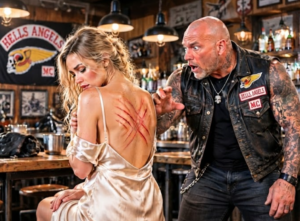
A massive patched enforcer grabbed my arm with bruising force and shouted insults at me in front of everyone
Michael’s face in the headlight wash was thinner than the photograph I kept in the lining of the evening bag, and more alive than any rumor the syndicate had permitted.
“Get in, Chloe.”
Holt shoved the door. I went. Rain hit the leather and turned the silk into a second skin. The brass key was still in my fist, cutting a small crescent into the palm.
“Drive,” Holt said.
Michael drove. He did not look at me for the first three turns. The bar’s neon shrank in the mirror until it was only a red smear, then nothing. Sirens went the other way, toward the raid that had been staged for cameras and for my husband’s peace of mind.
“You were dead,” I said.
“I was useful as dead. Dead brothers do not testify. Dead brothers do not make sisters ask the wrong questions in the wrong bars.”
“The man at the wheel of my marriage.”
“Your husband signed the order that put Father in the ground and put me in a basement under a garage that does not exist on any map he files taxes for. The team that kicked the door tonight takes his calls. Not all of them. Enough that a badge in that doorway is not a rescue.”
Holt spoke from the back seat without ceremony.
“Name’s Holt. I rode with your father before the patch on that bar learned to invoice people. Michael left the key with me because he could not mail it to a house your husband owns.”
I opened my hand. The key was small, ordinary, the kind that opens a locker or a drawer and ruins a life.
“What does it open.”
“A unit on the east spur,” Michael said.
“Father’s second set of books. Not the ones your husband showed the mourners. The ones that name the shipments, the deputies, and the marriage he used as cover. You were the respectable room. I was the ghost. He needed both.”
Rain hammered the roof. The evening bag still held the forged syndicate documents I had spent four months copying in bathrooms and sewing into lining no one thought a clumsy wife would carry. Marcus’s insults had been the curtain. The glass on the floor had been the cue for Holt to speak my brother’s name out loud.
“Marcus knew,” I said.
“Marcus performs,” Holt said.
“He grabs arms so the room looks at the woman on the boards and not at the bag. Tonight he performed for the wrong audience. I do not like that show.”
Michael took a side road that turned to gravel. The town car complained and kept going.
“If we go to the spur now, they will already be rolling. If we go to the office that does not drink with your husband, we need an hour they may not give us.”
“Then we split the hour,” I said.
“Holt takes the key. You take me to the office. The film in the bag does not require the unit to be true. The unit makes it fatal for him.”
Holt grunted, which in his dialect was a paragraph of approval.
We dropped him at a dark turnout with the key and a phone that was not on my husband’s plan. He vanished into the rain like a man who had practiced it. For a moment I watched the place where he had been, half expecting the night to return him as a trick. It did not.
The office was a brick annex behind a courthouse most people used for traffic tickets. Michael knew the night door. A woman named Ruiz opened it without asking us to perform gratitude.
“You are late,” she said.
“And wet. And alive. That last part was optional in the other plan.”
I set the evening bag on her table and did not apologize for the glass dust.
“Forged transfers. Club accounts. A recording of my husband telling Marcus that a public scene at the bar would keep me busy while they moved a truck. The truck is the east spur. The key is with a man named Holt. My brother is not a rumor.”
Ruiz looked at Michael the way people look at a file that has just grown a pulse.
“We buried a jacket with your name on it.”
“You buried a jacket,” he said.
“I was under a floor. Chloe was in a kitchen learning which smile kept her breathing. We are done with both.”
They moved after that in the way that does not look like a movie. Phones. A second team that did not answer to the men who had filled the bar with noise and badges. A warrant with my husband’s name spelled correctly, which felt like a luxury after years of hearing it said like a favor.
I changed into a borrowed sweater that did not shine. Michael sat across from me with coffee he did not drink.
“Why the bar,” he asked.
“Because Holt said you left a trail and the trail ended at a man behind the taps. Because Marcus had already decided I was furniture. Furniture can carry a bag through a room that is busy humiliating it.”
“I am sorry I let you think I was gone.”
“You can be sorry after the truck is stopped. Sorry before that is just another delay.”
He accepted it. We had both learned to postpone tenderness until the door was actually shut.
Ruiz came back near dawn with rain still in her hair.
“Spur is sealed. Holt is irritated and unharmed, which he considers a professional outcome. The unit had the books. Your husband is in a car that is not his, wearing cuffs that are. Marcus is explaining a bruised pride to someone who does not care about his patch. The team that kicked the bar door is being sorted. Some were lied to. Some were paid. The paid ones are having a worse morning.”
I did not cry. The tears I had fought on the floor had been for the room. These would have been for me, and I was not ready to spend them in an annex that still smelled like wet wool.
“And the marriage,” I said.
“Voidable,” Ruiz said.
“Fraud, coercion, and a contract signed over a crime. You will not have to ask him for permission to leave a house that was never yours.”
That landed harder than the raid. I had spent three years arranging my face around a man who called me clumsy in public so no one would watch my hands. The idea that the law could call the arrangement what it was felt like a window opening in a room I had forgotten had walls.
They let me see him through glass before the hearing week. My husband looked smaller without a house to stand in. He tried the old voice.
“Chloe. This is a misunderstanding with your brother’s friends.”
“This is a ledger. You married a room and called it a wife. You ordered a father into the ground and a brother into a story. I picked up glass so the room would watch my hands and not my bag. That is the misunderstanding.”
He had nothing after that that the glass needed.
Michael waited in the corridor.
“You did not have to face him.”
“I did. If I only spoke about him, he would stay a myth. Myths get to write the ending.”
The hearings took months, and months are less glamorous than alleys. I said the arm, the heel, the key, the rain, the face in the car. Michael said the floor and the years and the jacket they buried without a body. Holt said very little and made it count. He described the bar, the grab, the way Marcus kicked the glass, and the way I did not run until the key was in my hand. The forged documents stopped being rumors with letterhead.
On a Tuesday that did not deserve the weight it carried, the last plea landed. My husband took years. Marcus took fewer and talked more. Two deputies who had stood in that doorway lost the star and the story they had told their children. The truck from the spur was logged, photographed, and emptied of the polite fiction that it carried machine parts.
We stood outside afterward in weather that could not decide. Michael kept his hands in his pockets.
“There is a house that was Father’s before it was his,” he said.
“The court will peel it back. You do not have to live in it.”
“I do not want the house. I want a lock that is mine and a name that does not flinch when a man says sweetheart.”
“Then we start there.”
Holt found us on the steps, older in daylight, less myth, still carrying the rain in his shoulders as a habit.
“Your father talked about you like you were the part of the family that might outlast the patches,” he said.
“He was half right. You outlasted the marriage too.”
I shook his hand. It was not a blessing. It was a receipt.
We did not go back to the bar. The neon came down in a sale I did not attend. Marcus did not get a legend. My husband did not get a balcony speech. Michael rented a room over a garage and learned to sleep without listening for boots. I took a room of my own with a lock I had chosen and a job that used my head and did not require silk.
Some evenings we ate at a table with no one performing. He asked if I still heard the glass. I said sometimes. He said he still heard the floor. We let the sounds sit between us without turning them into a reason to disappear again.
Ruiz sent a copy of the final order in a plain envelope. I read it once at the kitchen table and put it in a drawer. Not a shrine. A file. Father’s name was cleared of the debts my husband had hung on it. Michael’s death certificate was marked in error. My name was on a decree that called the marriage what it had been.
On the first clear night I walked past the old bar because I wanted to know if the street still owned me. It did not. The sign was gone. A hardware store was measuring the front for a new window. A kid on a bicycle did not look twice at a woman in a coat.
I texted Michael one line.
Street is just a street.
He answered.
Good. Come eat.
I went. Holt was already there, complaining about the coffee, which meant he intended to stay. We did not toast. We passed bread. Michael told a story about Father that did not end in a basement. I laughed once, surprised, and did not take it back.
The lesson did not need a patch or a gown.
Humiliation can be a tactic.
A missing brother can be a strategy someone else chose.
A marriage can be a locked door with a polite name.
You do not have to be what the room wants in order to carry the truth through it.
You pick up the glass if you must.
You keep the bag.
You get in the car when the dead man is driving.
And you do not go back to the house that called you clumsy, except as a witness, and only long enough to make the record say your name without a sneer.
I slept that night with the window open a crack. Rain again, ordinary rain. No headlights in an alley. No brass key in my fist. My brother was four blocks away and breathing. The books were in a building that locked from the outside against the men who had written them. I was not furniture.
In the morning I made coffee that was only coffee and drank it standing up, listening to a street that had finally run out of orders for me. That was the ending I kept. Not a ballroom. Not a patch. A morning, a name, and a door I could open from both sides.