A dozen burly bikers jeered at me, I crossed my arms and swallowed my rising pride
The manifest shook once in my hand and then went still because paper does not care who it names.
The president—Cole, according to every title I had traced through chop-shop VINs—looked from the roaring Shovelhead to the marshals and then to me.
“You fixed it to bury us.”
“I fixed it because it was a seventy-two and it deserved to run. The burial was already in your books.”
An agent cuffed him while another bagged the tarp, the tank, the hidden compartment I had not opened in front of the room. Younger members stared at my greasy hands as if competence were a kind of betrayal. It was. That was the point of sending a mechanic instead of a speech.
I slid the manifest into an evidence sleeve before anyone with a sentimental streak could crease the signature. Twenty years old. Auction block in a county that no longer used that barn. My father’s name in the approval line, the same slant I had hated on birthday cards that arrived late and empty.
A marshal named Brennan took the sleeve.
“You know that hand.”
“I know it. I didn’t authorize it. Difference the law still pretends matters.”
“We’ll need a statement before you leave the county.”
“You’ll get it after I see the tank liner. If this bike is the first ghost, the compartment is the mouth.”
They let me work because a forensic mechanic who has already started a motor is cheaper than a lab delay. I drained what little fuel remained, unbolted the tunnel, and lifted the tank. Inside the cavity, not drugs, not cash: a thin logbook wrapped in oilcloth and a set of title jackets with VINs that had died in other states and been born again here with new stories.
Cole spoke from the doorway, wrists behind him.
“Your old man taught half this valley how to make a frame number look shy. Don’t play saint with a wrench.”
“I’m not playing saint. I’m closing a loop he left on a child and a county.”
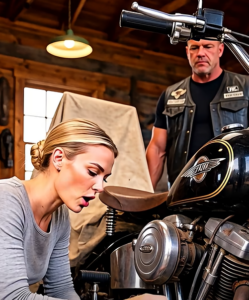
The Shovelhead ticked as it cooled, honest metal after three years of silence. I wiped the plugs I had scraped and set them in a tray like teeth.
Outside, the compound filled with cones and quiet men. Neon still buzzed over a workshop that had thought itself a church. Nobody believed her, Cole had said, pointing. One man had. That man was now asking for a lawyer and a cigarette and a version of events in which a woman with a bag full of blueprints was the only thief in the room.
Brennan walked me to a folding table under the open bay.
“Blueprints.”
I opened the leather bag. Not shop doodles. Frame jigs. Engine number restamp maps. A flow chart of how a stolen Sportster became a “barn find” with a notary who drank at this same bar. The microchip in the pouch held hashes of emails between a lieutenant here and a clerk at the DMV annex. Digital signatures. The club’s protection had a municipal letterhead.
Brennan swore without poetry.
“How long were you in?”
“Long enough to be laughed at and not long enough to like the coffee.”
“And the father.”
“Estranged is a soft word for a man who signed the first auction and then sent child support in cash so it wouldn’t leave a trail to a title mill.”
I said it flat. Flat is how you keep a hearing from becoming a eulogy for your own judgment.
They processed the members in twos. Some spat. Some asked if I had really known the advance curve on a Shovelhead without a manual. I had. Love of a motor is not cancelled by the company it kept. That was the part that would not photograph well.
Night pulled the heat out of the concrete. I sat on the workbench with the helmets I had dropped as a calling card and wrote the timeline: entry, three hours of labor, kickstart, alert, doors, manifest. Addendum: paternal signature, 20yr, first known laundered auction in this network. Recommend financial cross-check against closed account ending 4419, the one that used to appear on envelopes with no return address.
A younger rider, the one who had whispered that I knew what I was doing, waited until the marshals were between cigarettes.
“You could’ve just called it in. You didn’t have to make it run.”
“A dead bike is a rumor. A running bike is a witness. They needed to hear it live so they couldn’t say I planted a sound.”
He nodded like a man learning a trade too late.
Cole was loaded into a van. He paused, one boot on the bumper.
“He used to say the same thing. Make it run and nobody asks where it slept. You’re his hands.”
“I’m the part that files a report after the rumble. He never learned that half.”
The van left. The Shovelhead stayed on a recovery trailer with a tag that made it evidence instead of legend.
I did not sleep in the county. Motels remember faces. I slept in a field office cot that smelled of toner and someone else’s rain. At 0500 Brennan woke me with coffee that had given up and a printout.
“Your father’s last known address is a storage park two hours south. Unit paid through a shell that also paid the notary. We have a warrant if you want to stand in the door. You don’t have to.”
“I have to. If I don’t, I’ll spend the rest of my life wondering if the signature was a forgery I wanted to be true.”
The storage park was a row of orange doors and lies with padlocks. The unit opened on the smell of old gasoline and paper. No body. No dramatic trunk. Shelves. Carburetors in oil baths. A box of cancelled titles. A photo of me at nine standing beside a panhead I was not allowed to touch. On the back, in his hand: she has the ear for it. Keep her out of the books.
Too late, old man.
Under the photo, a second log, earlier than Cole’s. The first auction. The buyer’s alias. The split. My father’s initials again, and beside them a note: last time. It was not the last time. Men who write last time on stolen bikes are writing a style, not a vow.
I sat on an overturned milk crate until my legs remembered they were federal property for another day.
Brennan waited in the sun.
“Enough?”
“Enough to stop calling him a rumor. Not enough to put him in a cell. Dead men don’t do intake.”
“Natural?”
“A crash in a canyon with a bike that had no business being that clean. You can guess who certified the wreck.”
He did not guess aloud. Good.
We seized the unit. I took nothing personal but the photograph, logged it, and signed that I would not keep it. Some rules exist so daughters do not start museums of pain in glove boxes.
Back in town the clubhouse neon looked smaller. A city wrecker took the remaining frames. The pool table collected dust like a unused altar. I packed my tools the way I always had, each wrench in its ghost outline, because sloppy kits make sloppy testimony.
On the workbench someone had left a note in block print.
YOU FIXED IT. DON’T FIX HIM.
I bagged that too. Threats are just another kind of signature.
The hearings began in rooms with bad portraits. I testified about carbon on plugs, about restamp maps, about a kickstart that ended three years of theater. When they put the manifest on the screen I did not look away from the name. A defense attorney asked if my motive was revenge.
“My motive was a syndicate that turned dead riders’ machines into cash and called it brotherhood. The signature is a conflict I disclosed before I unrolled a socket set. If that disqualifies the plugs I cleaned, you can hire another mechanic. The motor still ran.”
It played. Juries like motors that run. They like women who do not cry on cue even more, which is a different problem, but it served the day.
Cole took a plea that saved his remaining teeth and not his myth. The DMV clerk flipped. Two officials discovered sudden retirements. The encrypted chip became a tree of names that did not look romantic in sans serif.
I requested reassignment off vintage interdiction for a year. Not because I had broken. Because some ears need quiet after they have been used as keys.
Before I left the county I went back to the bay at dusk with Brennan’s reluctant blessing. The trailer was gone. The corner where the Shovelhead had sat was a pale rectangle of cleaner floor. I stood in it and listened to a shop that had run out of jokes.
“Nobody believed her,” I said to the rafters,
“except the man who needed the engine to stay dead. Belief is not virtue. Sometimes it is just inventory control.”
I set my helmets on the empty bench one last time, then took them. Calling cards that stay become relics.
On the highway the bag rode heavier without the blueprints and lighter without the need to pretend I was only good with iron. The desert darkened. Somewhere a seventy-two that was now a numbered exhibit would be photographed, measured, and eventually, if the world was still capable of small mercies, rebuilt by someone who did not have to lie about the numbers.
My father had heard a child with an ear for motors and tried to keep her out of the books while signing the first page. That contradiction was the whole of him. I would not spend a life resolving it into a toast. I would spend it making sure the next dead bike was allowed to stay dead or to run in the open, not in a tarp in a room full of laughter.
The lesson sat in the vibration of the road. Skill is not innocence. A running engine can be a confession. Clubs that jeer at the person holding the wrenches have already described how they will fall. Blood on an auction line does not transfer title to your silence. And the one man who believes you may believe you only because you are useful to his myth—until the doors open and usefulness changes sides.
I checked the side mirror, empty of choppers, full of ordinary night, and rode toward a report that would use my name, his name, and the displacement of a motor that had waited three years to tell the truth.