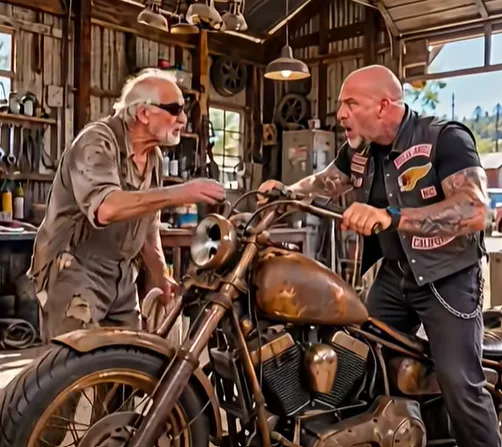
A biker gang leader smashed his heavy fist against a rusted vintage motorcycle and screamed that the machine was a worthless piece of junk
I read the line on the back of the photograph, and the garage lights seemed to hum louder, as though the whole building had drawn a breath and forgotten how to let it out.
Mother didn’t die in that hospital five years ago. She was taken.
“Dad,” I said, and my voice came out thin and strange. “You signed her papers. You sat with me at the funeral.”
He did not answer at first.
He stood beside the cooling motorcycle with the manila envelope in his weathered hands, and for the first time since the raid began, my father looked every one of his sixty-four years.
“I signed what they put in front of me,” he said at last. “I was told she had passed in the night. I was told the body had to be cremated because of the infection. I never saw her, Maya. I never saw her face.”
“And you didn’t think to ask?”
“I was a broken man. I asked everything of God and nothing of the men in white coats.” His jaw trembled. “God forgive me, I buried an urn I never opened.”
A federal agent approached us, a tall woman in a navy windbreaker with a gray braid over one shoulder and tired, intelligent eyes.
“Mr. Castillo? Ms. Castillo?” she said. “Special Agent Rosa Delgado. I’m sorry to interrupt, but I think you should both hear what’s on that drive before it goes into evidence.”
“You’ve seen it?” my father asked.
“I’ve seen the first folder. I stopped when I saw the name.” She looked at me gently. “Your brother was one of the finest agents I ever trained, Maya. He left more than a ledger. He left a map.”
We sat in the back office of the garage, the three of us, around a battered steel desk with a laptop humming between us.
Delgado opened the encrypted file with a code she said Ethan had given her years ago, in a sealed envelope, in case of his death.
A video window opened, and my brother’s face filled the screen.
I put my hand over my mouth.
He was thinner than I remembered, with a three-day beard and shadows under his eyes, but he was grinning the same crooked grin that had once talked me out of a hundred childhood punishments.
“Hey, Maya,” he said. “If you’re watching this, it means I’m not around to say it in person, and that makes me sad, because I had a whole speech planned.”
A wet, helpless laugh broke out of me.
“First thing. I love you. Second thing. Don’t be mad at Dad. I made him lie, and he hated every second of it.”
My father made a small sound and bowed his head.
“Third thing,” Ethan said, and his smile faded. “Mom. I found her, Maya. Three weeks before I filmed this, I found out the syndicate had been using the private hospital where she was treated as a front. They needed a nurse with specialized training to run their clinic, and a very sick woman with no family nearby was a convenient cover story.”
My stomach turned over.
“She wasn’t sick, Maya. Not the way we thought. They induced symptoms to make her look terminal, and then they staged her death and moved her to a compound in the Sierra foothills, where she’s been working as a medic for their people ever since. Not because she wants to. Because they threatened us.”
“No,” I whispered.
“They told her that if she ever tried to leave, they’d hurt you and Dad. She believed them. She’s believed them for five years.” Ethan’s voice cracked. “I was going to bring her home. I had a plan. But they found out I was a fed before I could finish.”
The video flickered, and he glanced off screen as if he had heard something.
“I welded the drive into that engine because it was the one thing Jax cared about enough to keep safe. If you’re watching this, then he’s finally brought it to you for repair, and you know what to do. The compound’s coordinates are in folder three. Mom’s in the east building, second floor, the room with the blue curtains.”
He leaned close to the camera, and his eyes were bright.
“Tell her I never stopped looking,” he said. “Tell her I’m sorry I’m late. And Maya, please, please, take care of Dad.”
The screen went dark.
For a long time nobody in that cramped little room spoke.
My father was weeping silently, with his hands over his face and his shoulders shaking, and I put my arm around him and pulled his head against my shoulder the way he had once done for me.
“She’s alive,” he kept whispering. “Maya, she’s alive.”
“I know, Dad.”
“Five years. She’s been alive five years.”
“We’re going to bring her home.”
Agent Delgado cleared her throat, gently.
“We can move on the compound at dawn,” she said. “Jax’s lieutenants are in custody, but there are still twenty armed men up there, and they’ll know something’s wrong the moment their boss fails to check in.”
“Then we go now,” I said.
“Ms. Castillo—”
“I’m not asking permission,” I said. “I’m telling you I’m going. You can bring me in the car, or I’ll follow on a motorcycle. But I’m going.”
Delgado studied me for a long moment, and then, slowly, she smiled.
“Your brother said you’d say that,” she said. “He bet me twenty dollars.”
We drove through the desert in the black hour before dawn, a convoy of six unmarked vehicles with their headlights dimmed, climbing steadily into the foothills where the sand gave way to scrub and then to dark, whispering pines.
I sat in the back of Delgado’s SUV with my father’s hand in mine.
Neither of us said a word for most of the drive.
At last, as the sky began to pale at the edges, he spoke in a low, rough voice.
“Do you remember the day she taught you to ride?”
“The red bicycle,” I said. “In the church parking lot.”
“You fell off six times.”
“Seven.”
“You were so angry. You threw the helmet at her.”
“She caught it,” I said, and smiled through my tears. “She caught it, and she said, ‘Anger is just fear wearing boots.’ I never forgot that.”
“She always said wise things at the worst moments.”
“She always did.”
He squeezed my fingers, and I felt his hand trembling like a leaf.
“I’m afraid,” he admitted. “I’m so afraid, Maya. What if she doesn’t recognize me? What if five years has made me a stranger?”
“She’ll know you.”
“I’m an old man.”
“You’re the man who taught me that anything broken can be fixed if you’re patient and you tell the truth about the damage,” I said. “She’ll know you, Dad. She never stopped.”
He closed his eyes, and a single tear slid down into his gray stubble.
The compound sat on a ridge above a narrow valley, a cluster of low concrete buildings behind a chain-link fence, with watchtowers at the corners and a single dirt road winding up through the trees.
Delgado’s team moved with quiet efficiency, fanning out through the pines in the gray light, black shapes flitting from trunk to trunk.
I was supposed to stay in the vehicle.
I lasted four minutes.
“Maya,” my father hissed, as I eased the door open.
“I’m going to the east building.”
“You’ll be killed.”
“I’ll be careful.”
“That’s what your brother said.”
“I know,” I said, and my voice broke, “and I’m going anyway.”
He stared at me.
Then he reached down, pulled the heavy steel wrench from his tool belt, and put it into my hand.
“If anyone touches you,” my father said, “you hit them with that.”
I laughed, and kissed his cheek, and slipped out into the trees.
I do not remember crossing the fence.
I remember the cold dew on the grass, and the faint sweet smell of pine resin, and the sound of my heart hammering in my ears. I remember a guard in a watchtower slumped suddenly forward as one of Delgado’s snipers took him, and the soft sigh of a flashbang going off somewhere to the west, and the low, urgent chatter of voices over radios.
By the time the compound woke, I was already at the east building.
It was a plain gray structure with barred windows and a heavy steel door, and the lock gave way at the third blow of my father’s wrench, crashing open on a narrow corridor lit by a single flickering bulb.
I ran up the stairs two at a time.
Second floor. East side. The room with the blue curtains.
There it was, at the end of a long hallway, a plain wooden door with a hand-painted sign pinned above it, a tiny watercolor of a red bicycle.
My knees nearly gave out.
I put my hand on the knob and turned it, and pushed.
The room was small and bright, with a narrow bed and a rickety table and a single window hung with faded blue cloth. A woman sat in a chair by the window with her back to me and a book open in her lap, and sunlight was just beginning to creep across her silver-streaked hair.
She was thin, much thinner than I remembered.
But I knew the curve of her shoulders, and the tilt of her head, and the way her fingers rested on the page, as certainly as I knew my own name.
“Mom,” I whispered.
She did not turn.
For a moment I thought she had not heard me, and a terrible fear rose in my chest that grief and captivity had taken her mind.
Then, very slowly, she set the book down on the table, and rose from her chair, and turned around.
Her eyes were exactly as I remembered, a warm clear brown, but there were lines around them now, deep and tired, and a faint scar curving along one cheekbone.
She looked at me, and her whole face went still.
“Maya?” she breathed.
“Hi, Mom.”
She made a sound I will never forget, a low broken cry like something torn out by the roots, and then she was across the room and I was in her arms, and she was holding me so tightly that I thought my ribs might break.
“My baby,” she kept saying. “My baby, my baby, my baby.”
“I’m here.”
“You’re so grown.”
“I’m twenty-six.”
“You were twenty-one.” She pulled back and held my face in both hands, and her eyes searched mine with a hunger that made my throat ache. “You were twenty-one, and I missed it all. I missed everything.”
“You didn’t choose it.”
“I let them keep me,” she sobbed. “I could have fought. I could have run.”
“They would have hurt us.”
“They would have,” she whispered. “I know. I know they would. But it doesn’t stop hurting.”
“I know,” I said. “I know it doesn’t.”
I held her while she wept, and I wept too, and the sound of gunfire and shouting outside seemed to fade into some far distant world.
“Ethan,” she said, at last, drawing back. “Did he—”
“He found you,” I said. “Before he died. He left a message. He said to tell you he never stopped looking.”
Her face crumpled.
“My brave boy,” she whispered. “My brave, foolish boy.”
“He said he was sorry he was late.”
“He wasn’t late.” She pressed her hands against her mouth. “He found me. Even dead, he found me.”
I took her hand and led her down the corridor, down the stairs, out through the shattered door into the cold gray light of morning.
The compound was quiet now.
Jax’s remaining men knelt in the dirt with their hands on their heads, flanked by agents in dark windbreakers, and the first rays of the sun were just touching the tops of the pines.
And standing in the middle of the yard, with his hat in his hands and a steel wrench tucked in his belt, was my father.
He saw her.
For a long, suspended moment neither of them moved.
Then my mother’s hand slipped out of mine, and she took one step, and another, and my father let out a broken sound and dropped his hat in the dust.
“Elena,” he said.
“Tomás.”
They crossed the last few feet like sleepwalkers and fell into each other’s arms, and I stood at the edge of the yard with tears running down my face and watched my parents hold each other as though the whole terrible world had dissolved around them.
“I buried you,” my father said into her hair. “I buried you, I buried you.”
“I know.”
“I buried an urn. I thought it was you.”
“I know, my love.”
“I’m so sorry I didn’t know.”
“You couldn’t have known.” She cupped his face in her hands, and her thumbs brushed the tears from his cheeks. “You came. That’s all that matters. You came.”
Agent Delgado stood a respectful distance away with her arms folded and her eyes suspiciously bright.
“Well,” she said, to nobody in particular. “I may have gotten something in my eye.”
The trial of the California Outlaws MC lasted nine months, and it was the largest organized-crime prosecution in the history of the state.
Jax took the stand in his own defense and was dismantled in an afternoon, his arrogance crumbling under the weight of the ledger my brother had hidden in a motorcycle engine. Forty-one members of the syndicate went to prison, and a dozen corrupt officials with them, including the director of the private hospital where my mother had been held.
My mother testified for six days.
She sat in the witness box in a plain blue dress with her hands folded, and told the court every detail of her five years in captivity in a clear, steady voice that never once wavered. When the prosecutor asked her how she had endured it, she looked across the courtroom at my father and me, sitting side by side in the front row.
“I held on to a bicycle,” she said.
The judge frowned. “A bicycle?”
“A red one,” my mother said. “In a church parking lot. My daughter fell off it seven times and got back on seven times. I thought of her every night. I thought, if she can get back on, so can I.”
The courtroom was so quiet that I could hear the clock ticking on the back wall.
Jax received life without parole.
When the sentence was read, he turned and looked at my father, and for once the cruelty had gone out of his face, leaving only something gray and hollow and tired.
“The bike,” he said hoarsely. “Was it ever a real engine?”
“It was real,” my father said quietly. “I rebuilt every part of it myself. I wouldn’t put a lie in a machine.”
Jax stared at him for a long moment, and then, slowly, he nodded, and the bailiffs led him away.
We buried Ethan in the spring.
It was a bright blue Saturday, with a warm wind pouring down from the hills and the first wildflowers coming up along the cemetery fence. Two hundred people came, federal agents in dress uniforms, old neighbors, men and women my brother had saved without ever telling them his real name.
My mother stood at the graveside in a black dress with my father’s arm around her waist, and when the folded flag was placed in her hands, she held it against her chest and finally let herself cry the way she had not been able to cry in five years.
I stood beside her with my hand on her shoulder.
When the last words were spoken and the crowd began to drift away, I knelt in the grass and laid something on the stone.
It was a small, battered wrench, the one my father had given me in the pines.
“Hi, Ethan,” I whispered. “We found her. We found everything. You did it.”
The wind moved through the grass, warm and soft, and I could have sworn I heard his laugh.
Don’t be mad at Dad.
“I’m not,” I said, and smiled. “I’m not mad at anyone.”
By summer the garage had a new sign.
It had been painted by my mother, with her tongue between her teeth and a smear of red on her wrist, in big careful letters across the old corrugated tin.
CASTILLO & FAMILY CUSTOM CYCLES.
She worked the front desk now, with a pair of reading glasses on a chain and a cup of coffee at her elbow, and she greeted every customer by name and remembered every detail of their lives. My father worked in the back, humming off-key over the engines. I did the custom builds, and the waiting list stretched to six months.
In the corner of the shop, on a raised platform under a soft light, sat the rusted vintage motorcycle that had started it all.
We had restored it.
It had taken us three months, my father and I, bolting and welding and polishing until the old frame gleamed like new, and when we were done, we painted the tank a deep, glowing red and stenciled a small white line of script along the side.
FOR ETHAN. HE FOUND US.
On a warm evening in August, with the sun sinking behind the desert hills and the whole sky glowing orange and gold, the three of us sat on the porch outside the garage with a pitcher of iced tea and a plate of my mother’s burnt cookies.
Nobody was hunting us.
Nobody was watching.
There was only the long soft light, and the smell of motor oil and warm dust, and the sound of crickets starting up in the dry grass.
“Maya,” my mother said.
“Yes?”
“Do you remember what I told you, the day you threw the helmet?”
“Anger is just fear wearing boots.”
“I’ve been thinking about that for five years.” She smiled, and her eyes crinkled. “I think I’ve got a second half now.”
“What is it?”
“Love is just courage with the boots off,” my mother said. “It’s what’s left when you finally stop being afraid.”
I laughed, and leaned over, and rested my head on her shoulder.
My father reached across the table and took both our hands in his, rough and warm and a little shaky, and the three of us sat together while the last of the sun slid down behind the mountains.
Somewhere in the distance, a motorcycle engine rumbled, low and steady, rolling across the desert like a heartbeat.
I closed my eyes and listened.
It sounded like a song, and I knew exactly who it was for.