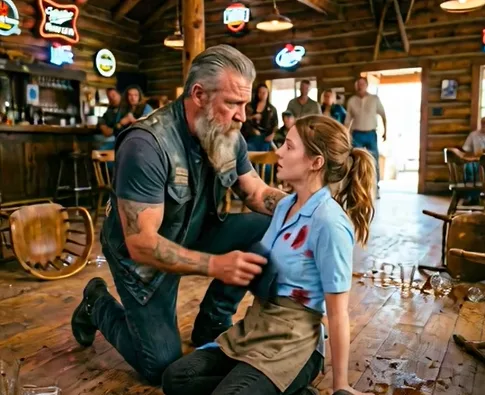
A biker father cradled my trembling shoulders in the dusty light
The last thing I felt was the cold mountain wind, and the first thing I felt after that was warmth.
It came slowly, a soft golden warmth that crept up from somewhere far below me, and with it came a low, steady beeping that sounded like a heart learning how to beat again.
I tried to open my eyes, and the lids felt like they had been stitched shut with heavy thread.
Somewhere close by, a woman’s voice was humming a tune I did not know, and a chair creaked, and a page turned.
“Her fingers moved,” the woman said suddenly, and the humming stopped.
“Doctor, her fingers just moved.”
I forced my eyes open a crack, and a blade of white light stabbed through them, and I winced and tried to turn away.
“Easy, Chloe, easy,” said a calm, kind voice, and a shadow fell across my face, shielding me from the glare.
When my vision cleared, I saw a young nurse with round glasses and a braid of dark red hair leaning over the bed, smiling at me with her whole face.
“Welcome back,” she said softly.
“You have been asleep for nine days, and we have been waiting very patiently.”
I tried to speak, and my throat felt like I had swallowed a handful of sand.
She lifted a cup with a bendy straw to my lips, and the cool water tasted better than anything I had ever known.
“Where am I?” I rasped.
“Cedar Valley Medical Center,” she said.
“You were airlifted in during a very bad night, and the surgeons worked on you for six hours, and your heart stopped twice on the table.”
“Twice,” I repeated, and the number seemed unreal.
“Twice,” she said gently.
“But you came back both times, and I think that means you are a very stubborn girl.”
A weak laugh escaped me, and it turned into a cough that sent a bright line of pain through my chest.
“Careful,” the nurse said, laying a hand on my shoulder.
“The bullet clipped your lung and missed your heart by less than the width of a pencil, and you have forty-two stitches that would like to stay where they are.”
I stared up at the ceiling tiles, counting the tiny holes, and the memory of the tavern came back in jagged pieces.
The red neon, the broken glass, the smell of spilled beer and blood, and the sound of my father’s voice breaking as he pressed his hand against my chest.
Except he was not my father.
The thought struck me like cold water, and I closed my eyes against it.
“Where is he?” I whispered.
“Where is Jaxson?”
The nurse’s expression shifted, and she glanced toward the door.
“There is someone outside who would like to speak with you,” she said carefully.
“But only when you are ready, and only if you want to.”
“Who?”
“A federal agent named Marcus Hale,” she said.
“He has been here every day since you arrived, sitting in the hallway in the same gray jacket, and the night nurses have started calling him the guardian of the third floor.”
I let out a breath, and my mind slowly clicked into place.
The commander who had knelt beside me, the one with the steady hand and the gauze and the voice that said hold on, kid.
“Let him in,” I said.
He came into the room quietly, as though afraid that his footsteps might break something.
He was a tall man in his late forties, with short salt-and-pepper hair, a lean, lined face, and tired brown eyes that looked as though they had not closed properly in weeks.
His gray jacket was creased, and a paper cup of cold coffee dangled forgotten from his fingers.
“Miss Chloe,” he said, and his voice was rough and gentle.
“I am Special Agent Marcus Hale, and I do not know if you remember me.”
“You held the gauze,” I said.
A small smile touched his mouth, and it transformed his whole serious face.
“I did,” he said.
“I have been holding my breath ever since.”
He set the cup on the windowsill and pulled the visitor’s chair a respectful distance from the bed, and he sat down with his hands folded between his knees.
“I want you to know that you are safe,” he said.
“There is an agent at your door twenty-four hours a day, and your name is protected, and nobody from the club can reach you.”
“And Jaxson?” I asked.
“He is in federal custody, awaiting trial,” Hale said.
“He did not resist, and he has refused to speak to anyone except his lawyer, and every night he asks the guards the same question.”
“What question?”
“Whether you are still alive,” said Hale.
I turned my face toward the window, where the afternoon sun poured through the glass in a long, dusty shaft, and a tear slid sideways into my hair.
“I do not know how to feel about that,” I whispered.
“You do not have to know yet,” said Hale.
“You have the rest of your life to figure it out.”
He was quiet for a moment, and then he reached into his jacket and drew out a small, flat evidence bag.
Inside lay my silver locket, its chain tangled and its surface streaked with dried blood.
“I kept it safe,” he said.
“The micro-drive inside it contained everything, twenty years of ledgers, payoffs, names, and the plans for the fire at the farmhouse.”
“It is the most thorough piece of evidence I have seen in twenty-two years of federal service.”
“It took you six months to copy it,” he added quietly, “and I do not think you ever knew how many lives you saved by finishing.”
I stared at the locket, and my fingers twitched on the blanket, wanting to reach for it.
“The farmhouse,” I said.
“The fire.”
Hale nodded slowly, and his face grew grave.
“Chloe, there is something I need to tell you, and I want you to take as much time as you need,” he said.
“I have to tell you about your mother.”
My heart began to thud against my bandaged ribs, and the monitor beside me beeped faster.
“I know what she was to him,” I said.
“I know he killed her, I read it in his own handwriting.”
“What you read was true,” said Hale.
“But it was not the whole truth, and the part that is missing is the part that I have carried for two decades.”
He drew a long breath, and his eyes grew distant.
“Your mother’s name was Elena Marsh, and she was not a member of the club, and she was not a bystander,” he said.
“She was a federal agent, one of the best I ever trained.”
The room seemed to tilt, and I gripped the edge of the mattress.
“Undercover,” I whispered.
“Deep undercover,” Hale said.
“She spent three years inside Jaxson’s syndicate, posing as his wife, gathering evidence for a task force that I led.”
“And I was the one who gave her the assignment.”
His voice cracked, and he pressed his lips together, and I saw the old grief rise in his face like a tide.
“She was my partner, Chloe, and my closest friend, and I sent her into that house knowing the danger.”
“I have never forgiven myself.”
I stared at him, and the numb stillness in my chest began to crack.
“She was pregnant,” I said slowly.
“With me.”
“She found out two months into the assignment,” Hale said.
“She wanted to leave, but she was so close to the evidence that she begged me for six more weeks.”
“I agreed, and I have regretted that agreement every day since.”
“The night of the fire, Jaxson discovered who she was, and he set the farmhouse ablaze with her inside it.”
“We believed that you had died in the flames, too, and we spent years grieving two losses.”
“But you did not,” I whispered.
“No,” Hale said, and a tear ran down the deep groove beside his nose.
“Jaxson pulled you out of the fire himself, and for reasons that I still do not fully understand, he raised you as his own.”
I closed my eyes, and the whole story rearranged itself in my mind like pieces of a puzzle clicking into a darker shape.
The cold discipline, the shooting lessons, the long nights in the compound where he had sometimes stood in my doorway and stared at me for minutes without speaking.
I had always thought it was suspicion.
I wondered now whether it had been grief.
“Why?” I asked.
“Why did he keep me?”
“I have asked him that,” said Hale.
“He would not answer, and I do not think he knows himself.”
“But I believe that somewhere beneath the violence, he loved you in the only crooked way he was capable of.”
“That does not make it right,” I said, and my voice shook.
“No,” Hale agreed.
“It does not make anything right, and I will never ask you to pretend that it does.”
We sat in silence while the sun slid lower and the shadows lengthened across the white sheets.
“How did you know I was his daughter?” I asked at last.
“I did not know you were hers until six months ago,” he said.
“The micro-drive began sending signals to a secure drop that I monitor, and when I traced the account, the name on the file was Chloe, and the birth date matched.”
“I stayed up all night staring at the screen.”
“And you did not tell me,” I said.
“I could not,” said Hale.
“If I had approached you, Jaxson’s men would have noticed, and you would have been dead within the week.”
“So I waited, and I watched, and I prayed that you would stay alive until the warrants were ready.”
“I am sorry that it took so long.”
“Do not be sorry,” I said.
“You were there in the tavern, with the gauze and the radio.”
“I am the reason you were in that tavern at all,” said Hale.
“I should have gone in sooner, and I will carry that for the rest of my life.”
“Agent Hale,” I said, and I lifted my hand from the blanket, and it trembled in the air between us.
He took it carefully in both of his, as if it were a bird, and his shoulders began to shake.
“You came,” I said.
“That is what matters.”
He bowed his head over our joined hands, and for a long time neither of us spoke, and the monitor beeped softly in the quiet room.
Recovery was slow, and it was not gentle.
There were weeks of physical therapy, learning to take deep breaths without wincing, learning to walk the length of the hallway holding a metal rail while the nurses cheered me on like a child learning to ride a bicycle.
There were nights when I woke screaming from dreams of red neon and breaking glass, and the red-haired nurse, whose name was Tessa, would come and sit on the edge of my bed and hold my hand until the shaking passed.
“You are allowed to be afraid,” she told me once, in the soft blue dark.
“But you are not allowed to be alone, so I will stay for as long as you need.”
She stayed, and in time she became my first real friend.
Hale visited every afternoon, bringing small, strange gifts, a paperback mystery, a bag of lemon drops, a houseplant in a chipped blue pot that he swore could not be killed.
“It is a spider plant,” he told me, setting it on the windowsill with great ceremony.
“I have owned one for fifteen years, and I have forgotten to water it for months at a time, and it just keeps going.”
“Like you,” I said, and he laughed, and I realized with a small shock that I was smiling.
On the thirty-first day, the doctors declared me well enough to leave.
I stood in the hospital lobby in a borrowed gray sweater and a pair of jeans that Tessa had bought for me, with a paper bag of belongings in one hand and the locket’s empty chain around my neck.
Hale waited by the glass doors with his car keys in his hand and a strange, shy expression on his face.
“Where will I go?” I asked.
It was the first time the question had truly landed, because I had no home, no money, no name that I was sure was mine, and nobody in the world who had known me before the age of twenty.
“I have a spare room,” Hale said.
“It is not much, and it has a leaky faucet, and my sister says the curtains are an offense to the eyes.”
“But it is yours for as long as you want it, and nobody will ask you for anything in return.”
I looked at him, at the tired brown eyes and the crumpled gray jacket and the hand held out to me like an offering, and my chest tightened.
“Why are you doing this?” I whispered.
“Because I owe your mother a debt that I can never repay,” he said simply.
“And because, Chloe, I think she would have wanted someone to be there.”
I took his hand, and we walked out together into the bright, cold morning.
His house was a small brick bungalow on a quiet tree-lined street, with a sagging porch, a patch of brown lawn, and a mailbox shaped like a fish.
Inside, it smelled of old books and coffee and lemon cleaner, and every surface was piled with files and mismatched mugs.
“I did not have time to tidy,” Hale said, scooping a stack of folders off the couch.
“I had to choose between cleaning and sleeping, and I chose neither, because I was worried about you.”
“It is perfect,” I said, and I meant it.
The spare room was tiny and sunny, with a narrow bed, a bookshelf, and a window that looked out on a crooked apple tree.
On the bed lay a folded quilt in faded blue and yellow squares, and Hale cleared his throat awkwardly.
“That belonged to your mother,” he said.
“She left it at my sister’s house years ago, and I kept it in a closet, because I did not know what else to do with it.”
I sat down on the bed and pressed the soft worn fabric against my face, and I smelled cedar and old sunshine and something far beneath it that might have been a memory.
I cried for a long time, and Hale stood quietly in the doorway, and when I looked up, he was crying too.
The trial began in the spring, in a federal courthouse of gray stone and tall, narrow windows.
I did not want to attend, but Hale told me gently that the choice was mine, and that nobody would think less of me if I stayed away.
I went.
I sat in the second row in a navy dress, with Hale on one side and Tessa on the other, and I watched Jaxson being led into the courtroom in an orange jumpsuit and chains.
He had lost weight, and his hair had gone almost entirely white, and the broad shoulders that had once seemed to hold up the whole world had curved inward like a collapsing arch.
His eyes found mine across the room, and he stopped dead, and the guard beside him had to tug his arm.
There was no arrogance in his face, only a naked, bottomless hunger, as though he were a drowning man looking at the shore.
I held his gaze, and I did not look away, and I did not smile.
The prosecutor, a sharp, silver-haired woman named Mrs. Okonkwo, laid out the case over three weeks.
She presented the ledgers from my locket, the witness statements from five former club members who had turned state’s evidence, and the forensic reports from the fire at the farmhouse.
She called Hale, who testified about Elena Marsh with a voice so steady and so full of sorrow that the entire jury sat motionless.
Then she called me.
I walked to the witness stand with my head high, and I swore the oath, and I told them everything.
I told them about the mountain compound and the shooting lessons and the corporate boardrooms where I had learned to smile at men I despised.
I told them about the night I found my mother’s name in his ledger, written in his own cramped hand beside the date of the fire.
I told them about the tavern, and the bullet, and the moment I understood that the man I had called Dad had ordered my death without hesitation.
When I finished, the courtroom was so silent that I could hear the soft ticking of the radiator.
Jaxson’s lawyer declined to cross-examine me, which I later learned was at Jaxson’s own instruction.
As I stepped down from the stand, Jaxson rose to his feet, and the guards moved toward him, but the judge raised a hand.
“Mr. Reed,” she said, “do you wish to address the court?”
He stood very straight, with his chained hands clasped in front of him, and he looked at me for a long, long moment.
“I do not want mercy,” he said, and his voice was gravelly and raw.
“I want the record to show that everything in those ledgers is true, and that the girl told you nothing but the truth.”
“I killed Elena Marsh, and I tried to kill her daughter, and I do not deserve the air I am breathing.”
A stunned murmur rippled through the room, and the judge struck her gavel gently.
“I have only one thing to say to Chloe,” Jaxson continued, and his voice trembled.
“I raised you wrong, and I loved you wrong, and I am sorry for every day that I did.”
“I know that sorry is a worthless word coming from me.”
“But I wanted you to hear it, once, before they take me away.”
My heart pounded, and my hands felt cold, and I was aware of every eye in the room.
I rose slowly from my seat, and Hale half reached out as if to stop me, and then let his hand fall.
“Mr. Reed,” I said, and my voice came out calm and clear.
“I heard you.”
“I do not forgive you, and I may never forgive you, because my mother deserved a life and you took it.”
“But I will say this, because it is true, and because I am not you.”
“You taught me to be strong, and you taught me to survive, and you taught me to hold a secret until the world was ready to hear it.”
“I am going to use all of it for good.”
Jaxson’s face crumpled, and a great, shuddering sob tore out of his chest, and he lowered his head until his chin touched his collarbone.
The jury deliberated for four hours.
They found him guilty on every count, murder, conspiracy, racketeering, arson, and attempted murder, and the judge sentenced him to life in federal prison without the possibility of parole.
As the guards led him toward the side door, he turned his head one last time, and I met his eyes, and I gave him the smallest nod.
It was not forgiveness, and it was not peace, but it was something, a recognition that we had both survived each other.
He nodded back, and the heavy door closed behind him with a quiet, final click.
Outside, on the courthouse steps, the spring air smelled of cut grass and rain, and the clouds had begun to break apart over the city in long ribbons of gold.
Hale stood beside me, silent, with his hands in his pockets, and I leaned my shoulder gently against his arm.
“It is over,” I said.
“It is over,” he agreed.
“And you did it.”
“We did it,” I said.
“You, and Mom, and Tessa, and a spider plant that refuses to die.”
He laughed, a deep, helpless laugh, and I felt the last knot of tension unravel in my chest.
The months that followed were the strangest and sweetest of my life.
I enrolled in classes at the community college, because for the first time in my life, nobody was telling me what to be.
I studied history and psychology and a little bit of everything, and I discovered that I loved the smell of library books and the squeak of marker pens on whiteboards.
Hale taught me to drive in an empty parking lot on Sunday mornings, gripping the dashboard with white knuckles while I stalled the car for the eleventh time.
“Brake,” he said.
“I am braking,” I said.
“Brake harder,” he said, and then he started laughing so hard that he had to put his head down on the dashboard.
Tessa came over on Fridays with takeout, and the three of us ate cross-legged on the living room floor and watched terrible movies until midnight.
Hale’s sister, a brisk, warm woman named Gwen, arrived one Saturday with a carload of new curtains, and she hung them in the spare room with the air of a general winning a war.
“Honestly,” she said, eyeing the old ones with disgust, “I do not know how you survived in here.”
“They had a certain charm,” I said.
“They had a certain smell,” said Gwen, and she hugged me so tightly that I almost lost my breath.
Slowly, quietly, without anyone announcing it, the little brick house began to feel like a home.
One evening in early summer, I came home from the library and found Hale sitting on the porch steps with a thick manila envelope in his hands.
His face was unreadable, and he patted the step beside him without a word.
I sat, and the warm dusk settled around us, filled with the hum of cicadas and the distant sound of a neighbor’s radio.
“I have something for you,” he said at last.
“It came from the Bureau this morning, and I have been sitting here for an hour trying to decide how to give it to you.”
He handed me the envelope, and I opened the flap with careful fingers.
Inside was a stack of legal papers and a single photograph, and I drew out the photograph first.
It showed a young woman with long brown hair and a wide, mischievous smile, standing on the porch of a small farmhouse with her hand resting on a gently rounded belly.
She wore a plain blue dress, and her eyes, warm and brown and full of light, looked straight at the camera as though she could see the person who would one day hold the picture.
“Mom,” I whispered.
“That was taken the week before the fire,” Hale said softly.
“She sent it to me in a letter, and she wrote on the back that she hoped the baby would have her laugh.”
I turned the photograph over, and there, in faded blue ink, were the words I had never seen.
To Marcus, so you will remember what we are fighting for.
I pressed the photograph against my heart, and I wept, and Hale’s arm came around my shoulders, and we sat like that while the twilight deepened.
When I could speak again, I picked up the legal papers and unfolded them under the porch light.
They were adoption forms, already signed in a firm, steady hand at the bottom, and my own name was typed neatly on the top line.
Chloe Marsh Hale.
I stared at the words, and the world seemed to stop turning.
“I know that I am not your father,” Hale said quickly, and his voice trembled.
“I know that I could never replace the people you lost, and I do not want to.”
“But you are twenty years old, and you have a right to a name that belongs to you, and a family that chose you rather than owning you.”
“I would be honored to be that family, if you will have me.”
“And if you do not want to,” he added, “I will tear these papers up right now, and nothing will change, and I will still be here.”
I looked at him, at the gentle, anxious face of the man who had held the gauze and the radio and the broken pieces of my life, and I felt a joy so large that it almost frightened me.
“Marcus,” I said, and I laughed through my tears.
“Do you have a pen?”
His face crumpled, and he dug frantically through his pockets, and he produced a chewed ballpoint with the cap missing.
I signed my name on the dotted line, my hand shaking so badly that the letters came out crooked, and I gave the papers back to him.
“Dad,” I said, testing the word on my tongue, soft and strange and new.
He made a small broken sound, and he pulled me into a hug so fierce that my ribs ached, and neither of us cared.
“Chloe Marsh Hale,” he whispered into my hair.
“My daughter.”
Inside the house, the old clock ticked in the hallway, and in the kitchen the spider plant sat in its chipped blue pot, green and sprawling and stubbornly alive.
Years passed, soft and quick, like pages turning in a book I never wanted to end.
I finished college with honors, and then I went on to law school, because I wanted to stand in courtrooms and speak for people who had been silenced.
Hale, who had retired from the Bureau, sat in the front row at my graduation in a suit that Gwen had picked out, crying openly and waving a handkerchief.
Tessa, who had become a head nurse, sat beside him, and she cried even harder.
I became a federal prosecutor, specializing in organized crime, and my colleagues quickly learned that the quiet young woman with the sharp eyes and the silver locket could read a ledger faster than anyone in the building.
The locket, which Hale had returned to me after the trial, held a new photograph now, the one of my mother on the porch in her blue dress, beside a tiny picture of Hale and me laughing on the steps of the brick bungalow.
On the tenth anniversary of the night at the tavern, I stood in the dusty parking lot of the old roadhouse, which had been torn down years earlier and replaced with a small community garden.
Marigolds and sunflowers and tomato vines grew in tidy rows where the broken glass had once glittered, and children from the nearby neighborhood ran laughing between the beds with watering cans.
At the center of the garden stood a simple stone bench with a small brass plaque.
It read, In memory of Elena Marsh, who gave everything so others could be free.
I sat down on the bench with a paper cup of coffee, and the late afternoon sun warmed my face.
A small voice beside me said, “Excuse me, ma’am, is this your garden?”
I looked down and saw a girl of about seven, with dark braids and a gap-toothed grin, holding a squirming caterpillar in her cupped hands.
“It belongs to everyone,” I said.
“Do you like it?”
“I love it,” she said.
“My mama says a lady who was a hero planted the first flower here.”
“I think your mama is right,” I said, and my eyes grew warm.
The girl studied the caterpillar solemnly.
“Do you think he will turn into a butterfly?” she asked.
“I think he already knows how,” I said.
“He just needs time, and some safe leaves to eat, and someone who will not step on him.”
She nodded with great seriousness and ran off to place the caterpillar on a sunflower leaf.
I watched her go, and I thought of the frightened, bleeding girl on the tavern floor, and of how long and winding the road had been from that red-lit night to this golden evening.
A familiar step crunched on the gravel behind me, and I turned to see Hale walking slowly toward the bench with a cane in one hand and a paper bag in the other.
His hair had gone completely white, and his shoulders had softened with age, but his brown eyes were as warm as ever.
“I brought lemon drops,” he said, sinking down beside me with a groan.
“I knew you would be here.”
“I am always here on this day,” I said, and I took a lemon drop and let it dissolve on my tongue.
We sat in comfortable silence, watching the children play among the flowers, while the sun sank in a blaze of gold and rose behind the old mountains.
“Do you ever think about her?” Hale asked softly.
“Every day,” I said.
“I think about her laugh, even though I never heard it, and I think about how she would feel to see this.”
“She would be so proud,” he said.
“She would be insufferable about it, honestly, she would tell everyone she met.”
I laughed, and he laughed, and the sound drifted out across the garden like a bell.
I slipped my arm through his and rested my head on his shoulder, and the evening breeze carried the sweet scent of marigolds and warm earth.
“Thank you, Dad,” I said quietly.
“For what?” he asked.
“For being there,” I said.
“For holding the gauze, and the radio, and the door.”
His hand came up and covered mine, rough and warm and trembling a little.
“Thank you for letting me,” he whispered.
The first stars blinked awake above the garden, small and silver and steady, and the children’s laughter faded into the soft hush of the dusk.
I closed my eyes and let the gentle quiet settle around me, and I felt my mother there in the whisper of the leaves and the warmth of the last light.
The nightmare was over, the long road had ended, and the girl who had once bled in the dust had grown into a woman who stood in the light.
“We’re home, Mom,” I whispered, so softly that only the wind could hear.
And in the rustling of the sunflowers, I could have sworn that someone whispered back.