The wooden walls of the isolated mountain cabin groaned under the violent fury of the blizzard raging outside
The revolver wavered in Matthew’s hand, and for a moment the only sound in the cabin was the blizzard clawing at the broken doorframe.
“Uncle Silas,” he said, and the name came out as a whisper, as though speaking it too loudly might make it untrue.
The trapper’s weathered face did not change, but his eyes, a pale and faded blue beneath the heavy brows, flickered with something that might have been shame.
“Hello, Matty,” he said quietly.
“It has been a long time since anyone called me that, and longer since I deserved to hear it back.”
I pressed my back against the cold stove, my hands still stained with Matthew’s blood, and I stared from one man to the other.
Matthew had told me once that his mother’s brother had vanished from the territory when he was a boy, and that the family had stopped speaking his name.
He had never told me that the man might be standing three feet from me, holding a rifle.
“You are working for Julian,” Matthew said, and his voice shook with a fury so raw that I felt it in my own chest.
“You let me tell you everything these past three weeks, you shared my fire and my bread, and the whole time you were his dog.”
“Not his dog,” said Silas, and slowly, deliberately, he tilted the rifle barrel toward the ceiling.
Julian’s smile faltered.
“What are you doing, old man?” he snapped.
“I gave you an order.”
“You gave me a lie,” Silas said, and he turned his head to look at the man in the dry wool suit with a calm that seemed to freeze the room more than the wind.
“You told me that Matthew’s mother lived, and that she was behind everything, and that I would be doing the boy a mercy by bringing him to hear it.”
“I came along to see her face for myself, Julian, because I did not believe you.”
“I buried my sister twenty years ago, with my own hands, beneath an elm tree behind the burned farmhouse.”
“Do you want to know how I am certain it was her?”
Nobody spoke, and the fire popped in the stove.
“Because she was holding a locket,” Silas said, and his voice cracked down the middle, “and inside it was a picture of her son.”
Matthew made a small, broken sound, and the revolver sagged in his grip.
“She did not fund your empire,” Silas said, staring straight at Julian.
“She was the bookkeeper who discovered it, and your partner Edward set that fire to silence her.”
“You have been feeding me a story for two years, hoping I would deliver the boy into your hands, and I was fool enough to half believe it.”
“But a man cannot lie about the dead to someone who dug the grave.”
Julian’s face twisted, and his hand shot toward the revolver beneath his coat.
“Kill them,” he screamed.
“Kill them all!”
Everything happened at once.
Silas swung the rifle down and fired, and the guard nearest the door crumpled with a howl, clutching his thigh.
Matthew threw himself sideways and dragged me down behind the overturned table as a bullet tore a long splinter from the wall above our heads.
The second guard fired wildly, and the lamp on the mantel exploded in a burst of burning oil, and a ribbon of fire raced along the dry timber.
“Hannah, stay low!” Matthew shouted, and he fired back, and the third guard dropped his weapon and stumbled into the snow with blood on his sleeve.
The cabin filled with smoke and the roar of wind, and through it all I heard Julian’s voice, high and furious, cursing us in a language I had never heard him use.
He lunged for me.
I saw him come, his dry suit now streaked with soot and his handsome face distorted into something ugly and desperate, and I did the only thing I could think of.
I snatched the cast-iron kettle off the stove, still hot enough to sting through my sleeve, and I swung it with every ounce of strength in my body.
It struck him across the shoulder with a dull clang, and he staggered and fell against the wall, and Silas was upon him in a heartbeat, pinning his arms behind his back.
“Rope,” the old trapper growled.
“There is a coil beside the door, boy, and be quick about it before this place burns down around our ears.”
Matthew crawled across the floor, white-faced and gasping, and dragged the rope to him, and together they bound Julian’s wrists and ankles while he spat and thrashed.
I beat out the flames along the wall with a wool blanket, coughing, my eyes streaming, and Silas smashed the remaining window and shoveled in handfuls of snow until the last of the fire hissed and died.
Then it was quiet.
The blizzard still wailed beyond the shattered door, but inside the cabin there was only the sound of ragged breathing and the slow drip of melting snow.
Julian lay trussed on the floor like a sack of grain, glaring at the rafters, while his three guards sat huddled against the far wall with their hands tied and their heads hung low.
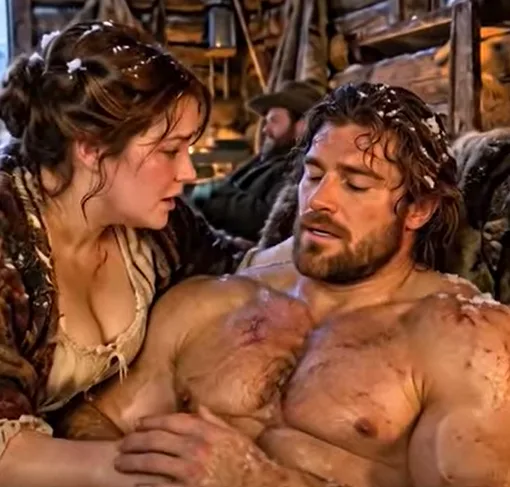
Matthew slid down against the stove and pressed his hand against the wound in his chest, and I hurried to his side and tore a strip from the hem of my petticoat.
“Let me,” I said, and my fingers shook as I bound it tight.
“You foolish, stubborn man, you cannot keep leaping at people with those injuries.”
“I seem to recall someone hitting a man with a kettle,” Matthew said weakly, and he smiled, a faint, lopsided, astonished smile.
“That was efficient.”
“I was aiming for his head,” I admitted.
He laughed, and winced, and laughed again, and I could not help laughing with him, a wild, shaky, helpless sound born of relief.
Silas stood a few paces away with his hat in his hands, looking suddenly very old and very tired.
“Matty,” he began.
“I am so sorry.”
“I should have found you years ago, and I should have told you what I knew, and I let my own cowardice keep me in the mountains.”
“I did not want to face her grave, and I did not want to face you.”
Matthew looked up at the man who had once taught him to whittle and to skip stones on the creek, and his eyes shone.
“You faced it tonight,” he said.
“You lowered the rifle, Uncle, and that is what I will remember.”
Silas let out a breath that seemed to carry two decades with it, and he crossed the floor in three long strides and knelt and wrapped his arms around his nephew.
Matthew’s good hand gripped the back of the old man’s coat, and his shoulders shook, and I turned my face away and wiped my eyes, because some moments belong only to the people in them.
Dawn came pale and golden, and with it came the scouts.
They arrived in a column of snowshoes and sled dogs, a dozen men in the gray coats of the territorial service, led by a lean, white-mustached marshal named Garrett Bell.
He stood in the splintered doorway, took in the tied prisoners and the burned wall and the three battered figures by the stove, and slowly removed his hat.
“Agent Dunmore,” he said, addressing Matthew, “I believe you have been busy.”
“A little, sir,” said Matthew, and he tried to rise and failed, and the marshal waved him back down.
“Stay put, son.
“We have a doctor on the sled, and a wagon waiting at the foot of the ridge, and I think that this young lady has something to say to me.”
I stepped forward, my heart pounding, and drew from the lining of my coat the small leather journal that Julian had tried to steal.
“My father kept this,” I said.
“It contains his original land patents, and the dates of every payment that Edward and Julian funneled through our family’s accounts.”
“There is also a letter in the back, in his handwriting, naming the men who threatened him.”
Marshal Bell took the journal with careful hands and paged through it, and his bushy brows drew together.
“This is more than we hoped for,” he murmured.
“We have been building a case against the Edward Hale syndicate for four years, and we were missing one piece, a witness who could tie the money to the murder.”
“You have just handed me the rope,” he said gently.
“Miss Hannah, your father would be very proud.”
Something broke open inside me, a door I had kept shut for ten long years, and I pressed both hands over my mouth and wept.
Matthew’s arm came around my shoulders, and I leaned into him, and Silas stood close by with his scarred hand resting lightly on my back.
They carried Matthew down the mountain on a sled, wrapped in furs, with the dogs barking and the morning sun glittering across the snow like scattered diamonds.
I walked beside him, one hand on the runner, and the whole white world seemed to sing.
The valley below lay quiet and gold, with smoke curling from a hundred chimneys, and I realized I had not looked at it properly in a decade, because I had always been too afraid of what it held.
The doctor in the town of Pinecrest sewed Matthew’s wounds and pronounced him the luckiest man in the territory, and ordered six weeks of rest.
I did not leave his bedside for four days.
On the fifth, he woke clear-eyed and hungry, and he asked me for a bowl of my terrible oatmeal.
“It is not terrible,” I said.
“It is lumpy and flavorless, and I would eat ten bowls of it,” he said.
I laughed and fetched it, and he ate every bite, and when I set the bowl aside he took my hand and held it against his chest.
“Hannah,” he said.
“I need to tell you something I should have said long ago.”
My pulse quickened, and I sat down carefully on the edge of the cot.
“When I first came to your estate, three months ago, I was posing as a surveyor,” he said.
“I told you I was there to measure the timber, and I lied.”
“I know,” I said softly.
“You do?” he said, startled.
“You kept looking at the old ledgers when you thought I was not watching,” I said.
“And you never charged for your work, and you carried my firewood without being asked.”
“A man who does that is not a surveyor, Matthew, he is something else entirely.”
He stared at me, and then he started to laugh, and the laugh turned into a cough, and he pressed a hand to his ribs.
“I am a terrible liar,” he said ruefully.
“The worst,” I agreed.
“But I am an honest man where it counts,” he said, and his face grew serious.
“I fell in love with you somewhere between the third week and the fourth, watching you stand on that porch every evening looking out at the mountains as though you were waiting for someone to come home.”
“I wanted to be the one who finally did.”
My eyes filled, and I looked down at our joined hands, his big and scarred and mine small and pale.
“You came home to me in a blizzard with a bullet in your chest,” I whispered.
“I think that counts.”
He lifted my fingers to his lips and kissed them, and I felt the last of the winter inside me melt away.
The trial of Edward Hale and Julian Crane was held in the spring, in a crowded courthouse in the territorial capital, and it lasted nearly a month.
I took the stand on the third day, in a plain gray dress and my mother’s cameo brooch, and I told the jury everything.
I told them about the night my father’s carriage went over the cliff, and the way my uncle’s face had looked when he came to collect me, solemn and sorrowful and secretly satisfied.
I told them about the engagement to Julian, and the cold way he had smiled when I asked about the wedding date, and the afternoon in the carriage when he found the journal.
When I described being thrown into the snow, a woman in the gallery gasped, and a dozen men in the back rows muttered angrily.
The defense attorney, a smooth, oily man with a gold watch chain, tried to suggest that I was a hysterical girl and that the journal was a forgery.
“Sir,” I said, and my voice rang out across the courtroom, “my father taught me to read a ledger before I learned to ride a horse, and I can tell you the date, amount, and account number of every payment on those pages without opening the book.”
“Would you care to test me?”
The lawyer hesitated, and the jury laughed, and the judge hid a smile behind his hand.
Silas testified the following day, in a clean borrowed suit, with his white beard combed and his voice trembling.
He described the night of the fire, and the grave beneath the elm tree, and the locket with the photograph of a small boy that he had kept in his pocket for twenty years.
He placed it on the witness rail, and the courtroom fell silent, and Matthew, seated in the front row with his arm in a sling, bowed his head and wept.
Julian Crane and Edward Hale were convicted on every count, murder, conspiracy, fraud, and attempted murder, and the judge sentenced them both to hang, though the governor later commuted the sentences to life.
I felt no satisfaction as the words were read, only a vast, cool quiet, like the stillness after a long storm.
On the courthouse steps, a crowd of townspeople had gathered, and they parted before us in silent respect.
An old woman with a shawl over her head pressed my hand and said that she had known my father, and that he used to carry sacks of flour to the widows on Sundays.
A young man in a miner’s cap told Matthew that his brother had died in the same fraud, and that today he could finally sleep.
I accepted every word with a trembling smile, and when at last the crowd drifted away, I found myself standing in the thin spring sunshine beside the three men I loved best in the world.
Matthew, pale but upright, with his sling and his shy, crooked grin.
Silas, bent and gentle, wiping his eyes on his sleeve.
And Marshal Bell, who cleared his throat and held out a long cream envelope bearing the seal of the territory.
“This came for you this morning, Miss Hannah,” he said.
“It is a deed.”
My fingers trembled as I broke the seal.
It was the original patent to my father’s timberlands, every acre of it, restored in full to the Whitmore family and signed by the governor himself.
“It is yours,” said the marshal.
“The estate, the mill, the forest, and every dollar recovered from the Hale accounts.”
I stared at the page until the words blurred, and Matthew’s hand found mine and squeezed.
“What will you do with it?” he asked softly.
I looked out over the rooftops of the town, toward the blue shoulders of the distant mountains, and a plan that had been taking shape in my heart for weeks finally came clear.
“I am going to go home,” I said.
“And I am going to make it a place where nobody is ever thrown into the snow again.”
We rode back into the mountains in the first week of May, in a wagon laden with lumber and seed and bolts of calico, with Silas driving and Matthew beside me wrapped in a blanket, grumbling that he was perfectly well enough to hold the reins.
The snow had retreated up the slopes, and the valley blazed with new green, with wildflowers spilling down the hillsides in rivers of yellow and violet.
When the estate came into view, my breath caught, because the old house stood waiting at the end of the long drive with its windows glittering, as though it had been holding its breath for ten years.
Uncle Edward had stripped it bare, but the bones were good, and within a month, a crew of neighbors had repaired the roof, scrubbed the floors, and painted the porch a cheerful buttercup yellow.
Mrs. Delaney from the next ranch brought a pie, and the blacksmith’s wife brought curtains, and half the children in the valley turned up on Saturdays to help weed the garden.
I opened the mill again in June, and I hired the widows and orphans and unemployed loggers of three counties, and I paid every one of them double what Edward ever had.
I set aside the old study for a school, with a stove and a chalkboard and a shelf of donated books, and Silas, to everyone’s astonishment, turned out to be a wonderful teacher.
He taught the children to whittle and to read the weather, and he told them tall tales about bears and rivers until they begged to stay after the bell.
Matthew resigned from the forestry department that summer, and when I asked him why, he looked at me as though the answer were obvious.
“I have spent ten years chasing justice,” he said.
“I think I would like to spend the next ten building something instead.”
He took charge of the forest, planting a thousand seedlings for every tree we cut and marking out trails for visitors, and he walked the ridges every dawn with a notebook and a stubborn, contented smile.
On a golden evening in late August, I found him sitting on the porch steps with his boots off and his face turned toward the sunset.
I sat beside him, and neither of us spoke for a while, and the crickets began their evening hymn in the long grass.
“Hannah,” he said, “do you remember what I said in the cabin, the first night?”
“You said a great deal,” I said, smiling.
“You said, do not disappear on me again,” he said, and shook his head.
“But I think it was the other way around, and I was the one who should have been begging.”
“I have been thinking,” he said slowly, and he reached into his shirt pocket and drew out a small, worn box.
My heart stopped.
Inside lay a plain gold ring, set with a single tiny garnet that glowed in the amber light.
“It was my mother’s,” he said, and his voice trembled.
“Silas kept it all these years, and he gave it to me the day of the verdict.”
“I know that I am a poor man with a bad shoulder and a worse sense of humor, and I cannot promise you a life without hardship.”
“But I can promise you that I will come home to you every night for as long as I draw breath, and I will never again let you stand alone on this porch.”
Tears slid down my cheeks, and I laughed, and I put out my hand.
“Matthew Dunmore,” I said, “you are the stubbornest man I have ever met.”
“Is that a yes?” he asked, wide-eyed.
“It is a yes,” I said.
“It is a thousand yeses, and every one of them is for you.”
He slid the ring onto my finger, and it fit perfectly, and he kissed me beneath the glowing sky while the first stars blinked awake above the ridge.
We were married in September, in the meadow below the house, with the whole valley gathered on quilts in the grass.
I wore my mother’s white lace gown, taken in at the waist by Mrs. Delaney, and a crown of wild asters that the schoolchildren had woven that morning.
Silas walked me down the grassy aisle, because there was no one else I would have chosen, and his hand shook on my arm so hard that I had to steady him.
“Your father would have loved this,” he whispered.
“And your mother,” I whispered back, and his eyes brimmed over.
At the end of the aisle, Matthew stood in a borrowed black coat, with his hair slicked flat and his hands clasped nervously before him, and when he saw me, his face lit up so completely that a ripple of tender laughter passed through the crowd.
We said our vows beneath the great old oak that my father had planted on the day I was born, and the preacher’s voice rang out clear and warm over the meadow.
When he pronounced us husband and wife, a flock of starlings burst from the branches overhead and wheeled across the blue sky, and every child in the valley cheered.
The feast lasted until the stars came out, with long tables heaped with roasted venison and fresh bread and berry pies, and a fiddler from Pinecrest who played reels until his bow frayed.
Late in the evening, when the lanterns had been lit and the dancing had softened into a slow waltz, Silas tapped on his cup and rose with his hat in his hands.
“I am not a man of many words,” he said, and the crowd quieted.
“For twenty years, I believed that I had lost every person I loved, and I hid in the mountains and told myself that I deserved it.”
“Then a stubborn girl and a stubborn boy dragged me back into the light, and I want to thank them.”
“To Hannah and Matthew,” he said, lifting his cup, and his voice cracked.
“And to the family a man can find when he has finally stopped running.”
The meadow echoed with the answer, and Matthew drew me into his arms, and we danced beneath the lanterns while the whole valley sang.
The years that followed were gentle and full.
The mill thrived, and the school grew, and the valley became known across the territory as the place where nobody was turned away.
Our first child came in the spring of the third year, a squalling, dark-haired girl with Matthew’s blue eyes and my stubborn chin, and we named her Eleanor, after his mother.
Silas held her on the porch the day she was born, rocking her in his big gnarled hands, and he sang her an old trapper’s lullaby in a voice rough as bark and soft as snow.
Two sons followed, Thomas and Walter, and they grew up wild and laughing among the pines, climbing the oak and fishing the creek and listening to their great-uncle’s tall tales until they fell asleep on the floor.
On a crisp autumn evening, when the maples blazed red and the first frost silvered the grass, Matthew and I took Eleanor up the ridge trail to the old cabin where everything had changed.
It stood just as we had left it, with the scorched wall still black and the door still hanging crooked, but a trumpet vine had climbed the logs and bloomed in a riot of orange flowers.
Eleanor, now six, ran ahead of us on sturdy little legs, and she pushed open the broken door and peered inside.
“Is this where Papa was brave?” she called.
“This is where Mama was brave,” Matthew called back, laughing.
“She hit a bad man with a kettle.”
“Really?” Eleanor said, spinning around with her eyes shining.
“Mama, is that true?”
“It is true,” I said, and I crouched down and held her small face between my hands.
“But I want you to understand something, my darling.”
“I was not brave because I was not afraid, because I was more frightened than I had ever been in my life.”
“I was brave because I loved the people in that room, and because I did not let the fear stop me from doing what was right.”
Eleanor considered this with great solemnity, and then she nodded and threw her arms around my neck.
“I will be brave like you, Mama,” she said.
“You will be brave like yourself,” Matthew said gently, and he knelt and wrapped his arms around both of us.
We stayed there for a long while, the three of us, while the sun slid behind the ridge and the blue shadows crept across the valley.
Below us, the lights of the estate began to twinkle, one by one, and I could see the smoke curling from our chimney, and the glow of Silas’s pipe on the porch, and the tiny figures of my sons racing across the yard with a lantern.
The long winter was over, the storms had passed, and the mountains that once seemed so cruel now held us in their arms like old friends.
I leaned my head against Matthew’s shoulder, and I felt the steady beat of his heart, and I whispered the words that had once seemed impossible.
“We are home.”
He kissed my hair, and Eleanor tucked her hand into mine, and together we walked down the mountain toward the light.