The name on the back of the envelope was not a stranger’s. Helen Voss. My aunt. My father’s sister. The woman who had stood in the penthouse after the funeral and told me grief was a poor auditor, then offered me the chair he had left empty. I read it twice under the cruiser lights while Ethan shouted into the mud about encrypted shells and love. The shouting had already become scenery. Marcus had gone still beside me, the way a man goes still when a lock he trusted turns out to be a door.
“He wrote that the week he faked your arrest,” I said. “If the rehearsal dinner moved without a board vote, look at the penthouse, not the groom.”
Marcus took the envelope as if it might cut him. Inside was a single card in my father’s hand and the silver key I had already palmed from the folder’s seam, which fit nothing in the woods and everything, I suspected, in the office Helen never let the cleaners enter. The card said: She signs what I refuse. The key opens the lake cabinet. Do not drink what she pours.
“The marshals can take Ethan,” I said. “The penthouse is still pouring.”
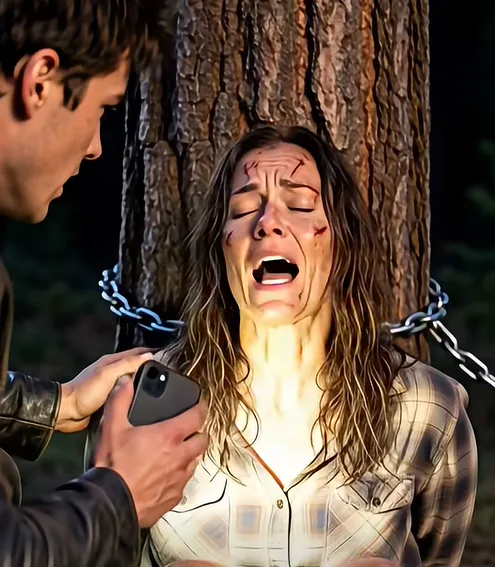
We did not ride the spectacle down the mountain. Marcus put me in an unmarked car with a deputy who owed my father a silence, and we took the lake road while the cruisers painted the pines for the cameras. My wrists ached where the chain had been. The plaid shirt was a loss. The folder was not. At the corporate tower the night guard waved Marcus through on a badge that federal custody had never actually revoked, because the arrest had been a costume and the costume still opened doors. The elevator smelled like polished steel and the lilies Helen favored. I watched the numbers climb and practiced not looking like a woman who had been padlocked to a tree.
Helen received us in the penthouse office with a glass in her hand and the city laid out behind her like a ledger she had balanced. She was silver where my father had been dark, and she smiled the family smile, the one that had paid for my school and my almost-wedding. “Mia. They said the woods. I was preparing a statement.”
“Prepare a different one,” I said, and set the card on her desk. “He named you.”
She did not deny the card. Denial is for people who still need the room to like them. She turned the glass once and looked at Marcus with something like pity. “You brought the prop. He always liked props. The arrest, the key, the loyal dog. Ethan was the blunt instrument. I was the continuity. When your father refused to move the pension fund through Alden Shore, someone had to keep the company from becoming a eulogy. I kept it. The fund is intact. The shareholders will not thank you for a scene.”
“The fund is frozen,” Marcus said. “Midnight. Real board. Not the one you staffed with Ethan’s college friends.”
Helen’s smile thinned. “Then you have a liquidity crisis and a niece in a torn shirt. Congratulations.”
I held up the key. “Lake cabinet. He said not to drink what you pour. I haven’t. Open it, or the marshals on the service elevator will open it with less manners.”
She laughed, short, and I heard Ethan in it, the same pitch of a person who had mistaken intimacy for immunity. “You think a cabinet saves you. The cabinet is full of his hesitations. Minutes he would not sign. I signed them. A company is a series of signatures that refuse to die with the signer. You want the moral version. The street wants the open version. I gave the street what it could spend.”
The service elevator did arrive. Not theater. Two marshals Marcus had peeled off the woods detail, warrant already walked through a night judge who had once lost a pension in a similar smoothness. Helen set the glass down ungently. The lake cabinet was not a metaphor. It stood behind a panel in the credenza, black enamel, keyhole small as a secret. The silver key turned. Inside were the minutes, the Alden Shore wire templates, and a photograph of my father at the lake with a line on the back: If she offers continuity, count the missing names. The missing names were the machinists’ fund, the widows’ stipends, the scholarship he had funded in my mother’s spelling. Helen had rolled them into the heist Ethan thought he had invented. He had been the groom. She had been the author.
She ran for the private stair. Pride makes people run even when the stair is a dead end with a marshal at the landing. They took her at the fire door, glass still in her perfume, no mud on her, which somehow made the cuffs louder. She looked at me as they turned her. “He would have hated the publicity.”
“He hated the minutes more,” I said.
Ethan saw her in the precinct hallway at dawn, both of them unshaven by circumstance, and the alliance died in a sentence. He called her the penthouse. She called him the dosage. The marshals wrote both versions down. I sat in an interview room that smelled of wet wool and pine and gave the chain, the champagne, the folder, the key. Marcus stood outside the glass and did not coach me. Coaching would have looked like the old costume. When the statement ended I slept for two hours in a chair and dreamed of a flashlight that did not kneel.
The hearing took nine days. Ethan pled to the abduction and tried to gift Helen the money. Helen pled to nothing and tried to gift the street a story about a dying brother’s unfinished merger. The minutes would not hold the story. A machinist named Ruiz testified that his fund statement had changed typeface in the month my father died. A scholarship student testified that the check had bounced and Helen’s office had called it a transition. I testified that the man who untied me in the clearing had locked me to the tree, and that the woman who offered continuity had signed the transfers he was too vain to understand. The judge froze what remained, appointed a receiver who did not drink Helen’s brand of lily water, and returned the operating deeds to a board that included Ruiz and excluded fiancés.
I did not take the penthouse chair. Marcus asked once, in the corridor, whether the legacy needed a Voss at the head of the table. I said the legacy had suffered from exactly that theory. We put Ruiz in the chair on an interim vote. I took the lake minutes and the scholarship list and a small office on the third floor where the windows did not perform. Ethan wrote from county jail that the woods had been a mistake of love. I returned the letter unopened. Some sentences are complete when the padlock clicks the first time.
In the spring I went back to the pine with Marcus and a cutter from facilities, not for ritual, for the chain, which was still there, rusting into the bark. We cut it out. The tree would keep the scar. Scars are more honest than plaques. Marcus held the links and said my father had taught him to pick locks and to distrust rehearsals. He had been late to the second lesson. I told him late had still been soon enough to matter, which was as much absolution as the night could spend.
What the envelope proved, and what the verdict only filed, was a harder kindness than rescue. The man who runs toward your voice in the dark may be returning to a scene he staged. The woman who offers to preserve the family name may be the one who spent it. My father faked a custody and hid a key because he could not make his sister small without evidence, and evidence is a slow mercy. I had wanted the sirens to be the end. They were the middle. The end was a cabinet, a bounced check, a machinist in a chair, and the decision to read the final name even when it shared my table at holidays. Legacy is not what survives the heist. Legacy is what you refuse to sign when the glass is poured and the room calls refusal disloyalty. I keep the silver key in the third-floor drawer. I do not drink what the penthouse sends down. The fund pays out in the old typeface again. That is the whole of the victory, and it is enough.