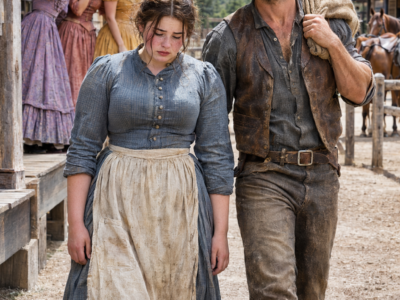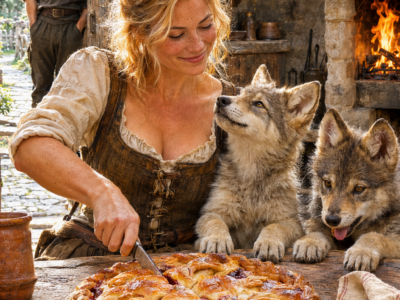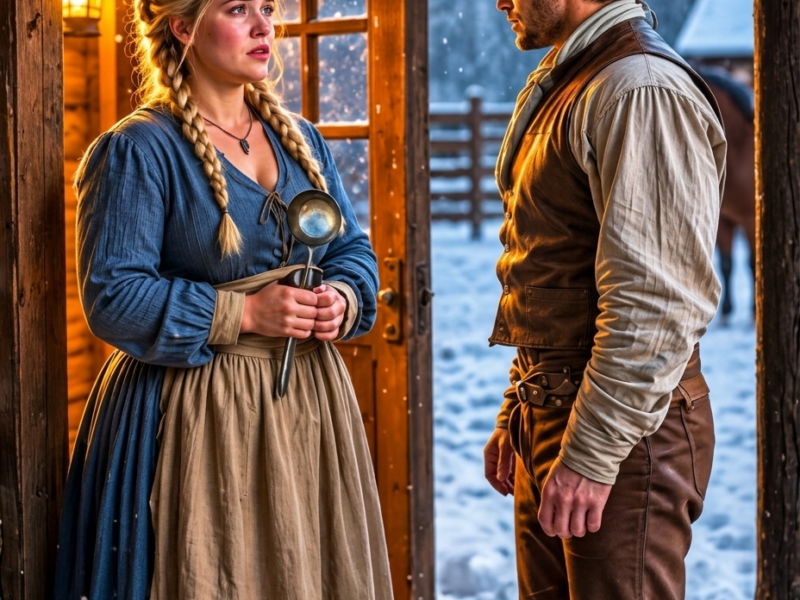
“That woman will eat more than she cooks,” a cowboy announced as Hattie Sorrel stepped down from the wagon. What he didn’t expect was the ranch owner’s response.
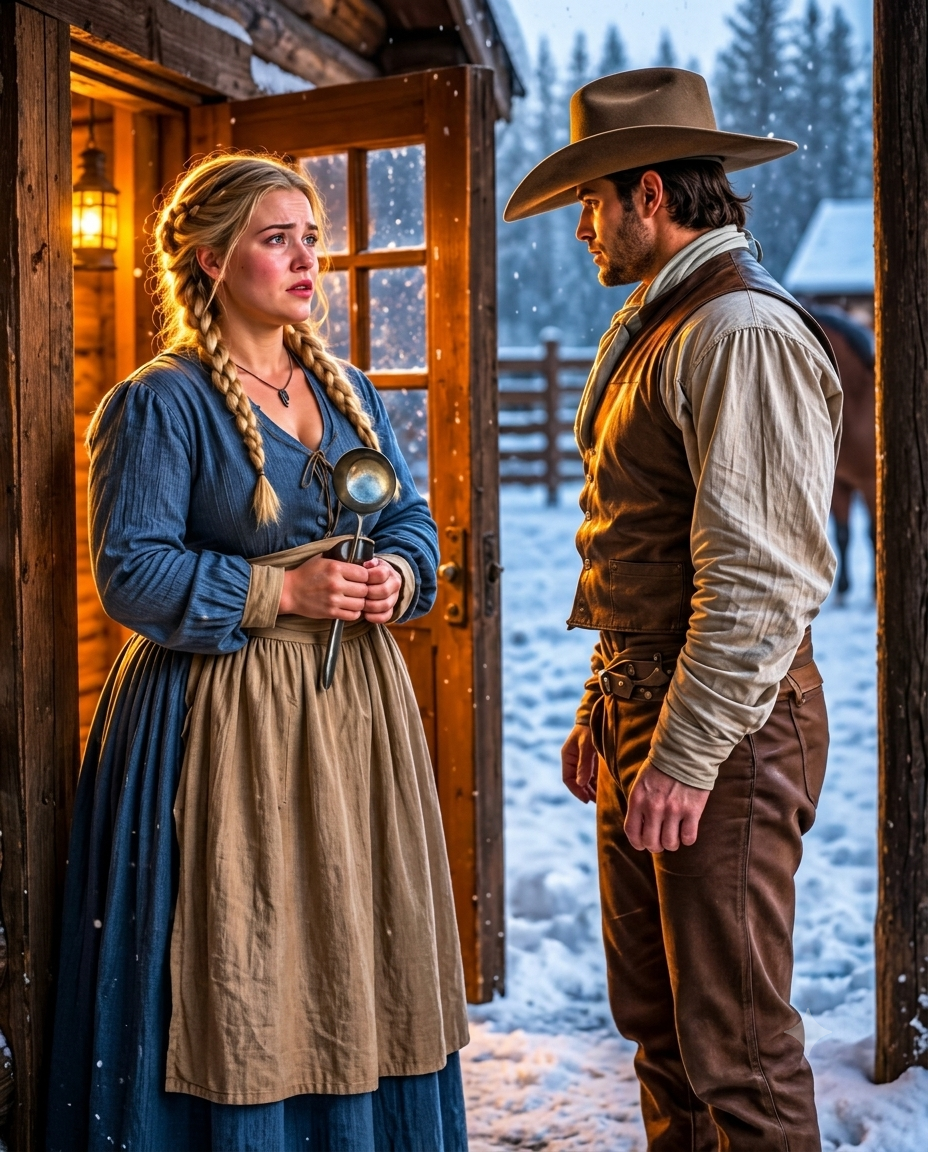
Before Hattie could answer, Wade appeared in the doorway, carrying an armful of firewood. The moment he recognized the woman standing beside the kitchen table, his expression changed.
“Evelyn. What are you doing here?”
The woman smiled and removed her leather gloves.
“Is that any way to greet the woman you were once going to marry?”
Hattie nearly dropped the bowl she was holding.
Wade placed the firewood beside the stove.
“That was three years ago. You made your decision.”
“And perhaps I’ve reconsidered.”
Evelyn glanced toward Hattie, her eyes traveling slowly over her faded dress and flour-covered apron.
“Although I must admit, your standards seem to have changed considerably.”
“That’s enough,” Wade replied.
The sharpness in his voice surprised both women.
“Hattie works here, and you’ll treat her with respect.”
Evelyn laughed lightly, but there was nothing pleasant about the sound.
“Of course. I wouldn’t dream of interfering with the servants.”
Hattie excused herself and disappeared into the pantry. She pressed her trembling hands against the wooden shelves, ashamed of the tears gathering in her eyes.
She had never believed Wade could love someone like her. Yet somewhere between their quiet conversations, his unexpected smiles, and the evenings he spent helping her carry water, she had begun hoping for something more.
Now she understood how foolish that hope had been.
Evelyn was everything Hattie wasn’t. Beautiful, educated, wealthy, and graceful enough to make every man turn his head when she entered a room.
Hattie looked down at her rough hands.
She belonged beside a stove, not beside a man like Wade Callister.
That evening, Evelyn joined Wade at the dining table while Hattie served supper.
The ranch hands ate quietly, sensing the uncomfortable tension.
When Hattie brought out a freshly baked peach cobbler, Evelyn pushed her plate away.
“I couldn’t possibly eat something so rich. A woman must exercise discipline if she wants to remain attractive.”
Several cowboys exchanged uncomfortable glances.
Wade set down his fork.
“Then don’t eat it.”
The oldest ranch hand, a gray-haired man named Amos, reached for Evelyn’s untouched portion.
“Wouldn’t want good food going to waste,” he muttered.
Hattie almost smiled.
Later that night, Wade found her scrubbing a spotless pot.
“You don’t have to listen to anything she says.”
“She’s your guest, Mr. Callister.”
“Since when did you start calling me that again?”
Hattie kept her eyes on the pot.
“It’s proper.”
Wade studied her face.
“Evelyn left me when my ranch nearly went bankrupt. My father had died, the cattle were sick, and I owed more money than I could earn. She wanted a comfortable life, and I couldn’t promise her one.”
“Perhaps things are different now.”
“They are. I’m no longer foolish enough to confuse beauty with kindness.”
Hattie stopped scrubbing.
For a moment, their eyes met.
Before either could speak, a small voice called from the adjoining room.
“Hattie?”
The Shoshone boy she had rescued stood in the doorway, clutching his blanket.
She immediately went to him.
His name was Thomas, and although his English was limited, he had managed to explain that he had become separated from his family during the storm.
Hattie had spent several nights beside his bed, coaxing him to eat and reassuring him that his family would be found.
Now he slipped his little hand into hers.
Wade watched as she led him back toward the warm bedroom.
There was something about the tenderness in her voice that made his chest ache.
He had spent years convincing himself that he needed nothing beyond his land, cattle, and independence.
Hattie was slowly proving him wrong.
The following morning, Evelyn found Thomas sitting at the kitchen table eating pancakes.
“What is that child doing here?”
“Having breakfast,” Hattie answered.
“Surely you don’t intend to keep him.”
“Until we find his family.”
Evelyn wrinkled her nose.
“There are authorities for such matters. Children like him don’t belong in respectable households.”
Thomas lowered his head.
Hattie placed a protective hand on his shoulder.
“Any hungry child belongs at my table.”
Evelyn stared at her, clearly unaccustomed to being challenged.
“You seem to have forgotten your position.”
“No, ma’am. I remember it perfectly.”
Hattie placed another pancake on Thomas’s plate.
“I’m the cook. And nobody leaves my kitchen hungry.”
Unbeknownst to either woman, Wade had heard every word from the hallway.
For the first time in years, he found himself imagining children around his dining table, laughter filling the empty rooms, and Hattie standing beside him when the day’s work was done.
But Evelyn had not traveled all that distance simply to renew an old acquaintance.
Her father’s business had collapsed. Their family fortune was nearly gone, and creditors were threatening to seize their house.
When she learned that Wade’s ranch had become one of the most prosperous properties in the territory, she saw an opportunity.
She intended to marry him.
And she wasn’t about to let a ranch cook stand in her way.
Three days later, Evelyn accompanied Wade into town, claiming she needed to send a telegram.
While he purchased supplies, she visited a man named Silas Granger.
Silas owned the neighboring ranch and had spent years trying to purchase Wade’s northern pasture, where a natural spring supplied water throughout the driest months.
Wade had refused every offer.
Evelyn entered Silas’s office and closed the door.
“I understand you’ve been having difficulties with Wade Callister.”
Silas leaned back in his chair.
“Depends who’s asking.”
“Someone who might be able to help.”
By the time she returned to the wagon, Evelyn was smiling.
That afternoon, Hattie found Thomas standing beside the fence, staring toward the distant mountains.
“My mother,” he whispered.
“You miss her?”
He nodded.
Hattie knelt beside him.
“When I was little, I used to wait for my mother too.”
“Where she go?”
“She died when I was six.”
Thomas looked at her solemnly.
Hattie brushed the hair away from his forehead.
“But your mother is still looking for you. I believe that with all my heart.”
The boy leaned against her, and she wrapped her arms around him.
Two mornings later, three riders approached the ranch.
The moment Thomas saw them, he shouted and ran outside.
One of the riders dismounted before her horse had fully stopped. She rushed forward, fell to her knees, and gathered the boy into her arms.
Thomas cried against her shoulder.
Hattie stood on the porch, wiping her eyes with her apron.
An older Shoshone man named Joseph, who spoke fluent English, explained that the family had searched desperately since the storm.
Thomas’s mother, Mary, approached Hattie and took both her hands.
“My son says you carried him home.”
“He needed help. That’s all.”
Mary looked into her eyes.
“To you, perhaps. To me, it is everything.”
Before leaving, Mary removed a small beaded pouch from her belongings and placed it in Hattie’s palm.
Hattie promised to treasure it.
Thomas hugged her tightly and made her promise that he could return for pancakes.
She laughed through her tears.
“Anytime you like.”
Wade stood beside her as the riders disappeared across the snowy landscape.
“You’ve got a remarkable heart, Hattie.”
She looked away.
“Sometimes that’s all a person has.”
“Sometimes it’s worth more than everything else.”
His hand brushed hers, and this time, she didn’t pull away.
Watching from an upstairs window, Evelyn realized she was running out of time.
The following evening, Wade discovered that nearly six hundred dollars intended for the ranch hands’ wages had vanished from his office.
The money had been locked inside his desk.
Every worker was summoned.
Wade questioned them individually, but nobody had seen anything unusual.
Then Evelyn stepped forward.
“I hate to say this, Wade, but I saw Hattie leaving your office yesterday.”
Hattie turned pale.
“I was delivering coffee.”
“With your apron pockets looking rather full.”
“That’s a lie.”
Evelyn raised her eyebrows.
“Perhaps we should search her room.”
Wade’s jaw tightened.
“There won’t be any accusations without proof.”
But Hattie stepped forward.
“Search it.”
She had nothing to hide.
Amos accompanied Wade upstairs while the others waited below.
Minutes later, they returned.
Amos looked devastated.
In Wade’s hand was a bundle of banknotes discovered beneath Hattie’s mattress.
The room became painfully silent.
Hattie stared at the money.
“No.”
Evelyn sighed theatrically.
“How disappointing. After all the kindness you’ve shown her.”
“I didn’t take it,” Hattie whispered.
Wade looked at her.
She desperately searched his expression for reassurance.
“I swear to you, Wade. I would never steal from you.”
“I need to understand how this happened.”
Those words hurt more than any insult Evelyn had delivered.
Hattie backed away.
“You think I did it.”
“I didn’t say that.”
“You didn’t have to.”
She hurried upstairs and shut her bedroom door.
Wade followed, but when he knocked, she refused to answer.
Inside, Hattie packed the few possessions she owned.
She remembered every household that had dismissed her, every cruel joke she had pretended not to hear, and every person who had made her feel grateful simply to be tolerated.
She had survived those humiliations.
But seeing doubt in Wade’s eyes was unbearable.
Before dawn, she left an envelope on the kitchen table containing her accumulated wages.
Alongside it was a short letter.
Dear Wade,
I cannot prove my innocence, but I know what kind of woman I am. Please give this money to the men if anything is still missing. Thank you for giving me a place where, for a little while, I felt at home.
Hattie.
When Wade discovered the letter, he felt as though someone had struck him.
He saddled his horse immediately.
But fresh snowfall had already covered Hattie’s footprints.
He searched the road toward town and questioned every traveler he encountered.
Nobody had seen her.
Back at the ranch, Amos confronted Evelyn.
“You were mighty quick to suggest searching that girl’s room.”
“Are you accusing me?”
“I’m saying I’ve watched Hattie feed men who insulted her, work through fevers, and give away her own blankets. I’ve seen you do nothing but complain.”
Evelyn dismissed him and retreated upstairs.
That afternoon, one of the youngest cowboys, Billy, approached Wade.
“Boss, there’s something I should’ve told you.”
“What is it?”
“I saw Miss Evelyn coming out of Hattie’s room yesterday. Thought maybe she’d borrowed something.”
Wade went completely still.
“Why didn’t you tell me sooner?”
Billy swallowed.
“Miss Evelyn said she’d have me dismissed if I mentioned it. I got a mother and two sisters depending on my wages.”
Wade placed a hand on his shoulder.
“You did the right thing telling me now.”
He marched upstairs and confronted Evelyn.
She denied everything.
But when Wade demanded that she open her traveling trunk, her composure disappeared.
“You have no right!”
“Then you can explain yourself to the sheriff.”
She reluctantly stepped aside.
Inside the trunk, beneath several expensive dresses, Wade discovered the remaining missing banknotes and a letter from Silas Granger.
The letter promised Evelyn a substantial payment if she could persuade Wade to sell his northern pasture after their marriage.
Wade read it twice.
Then he looked at the woman he had once intended to marry.
“You were willing to destroy an innocent woman’s life for money?”
Evelyn’s face twisted.
“She was nothing before she came here!”
Wade’s voice became dangerously quiet.
“She was more than you’ll ever understand.”
Evelyn began crying, insisting that desperation had driven her to make a mistake.
But Wade summoned the sheriff.
By sunset, she was gone from the ranch, and the evidence against Silas had been placed in the sheriff’s hands.
None of it mattered to Wade as much as finding Hattie.
Meanwhile, miles away, Hattie had taken shelter inside an abandoned stagecoach station when the weather worsened.
She had planned to reach town and ask for work at the boardinghouse.
Instead, she found herself stranded with a broken suitcase, aching feet, and very little food.
As darkness fell, she heard horses approaching.
Two men entered the station.
One of them was Silas Granger.
He recognized her immediately.
“Well, if it isn’t Callister’s cook.”
Hattie stood.
“I don’t want any trouble.”
“Neither do I. But you’ve become quite inconvenient.”
He had learned from Evelyn’s frantic telegram that their arrangement was falling apart. Believing Hattie might be able to testify against him, he intended to prevent her from reaching town.
His companion, a hired man named Russell, blocked the doorway.
Silas ordered Hattie outside.
She refused.
When he grabbed her arm, she struggled free, knocking a lantern onto the floor.
The flame caught the dry straw beneath an old bench.
Within moments, smoke filled the station.
Silas cursed and rushed outside with Russell, leaving Hattie coughing near the rear wall.
She tried to reach the door, but part of the burning ceiling collapsed.
Outside, Silas mounted his horse.
“Come on!” he shouted.
Russell hesitated.
“We can’t leave her in there.”
“Do you want to hang for this?”
Terrified, Russell followed him into the night.
Hattie wrapped her shawl around her face and stumbled toward a broken window.
The opening was narrow, and the damaged frame refused to move.
She pushed desperately.
Smoke burned her lungs.
Her strength began failing.
Then she heard someone shouting.
“Hattie!”
She thought she was imagining it.
“Hattie, answer me!”
It was Wade.
He had encountered Joseph and several other Shoshone riders while searching the countryside. Together, they had followed signs of recent travel toward the abandoned station.
When they saw smoke rising above the trees, they hurried toward it.
“Wade!” Hattie screamed.
He rushed toward the entrance, but Joseph caught his shoulder as burning timber fell across the doorway.
“Here!” another rider shouted from the window.
Wade raced around the building.
Through the smoke, he saw Hattie struggling to remain standing.
He and Joseph broke away the damaged window frame, creating enough space to reach her.
“Give me your hands!”
Hattie stretched toward him.
“I can’t!”
“Yes, you can. I’ve got you.”
With Joseph’s assistance, Wade pulled her through the opening just moments before another section of the roof collapsed.
They fell together into the snow.
Hattie coughed violently, gasping for clean air.
Wade wrapped her in his coat and held her against his chest.
“Thank God.”
His voice broke.
Hattie looked up at him.
“You came.”
“I should never have let you leave.”
She began crying.
Wade pressed his forehead against hers.
“I found the money. Evelyn planted it. I know everything.”
Hattie closed her eyes.
“I told you I didn’t take it.”
“I know. And I’m sorry I made you feel you needed to prove yourself.”
He held her more tightly.
“I was afraid of being deceived again, and I let that fear hurt the one person who never gave me a reason to doubt her.”
Joseph approached and handed Wade another blanket.
“We must get her somewhere warm.”
They carried Hattie to a nearby settlement, where Mary immediately welcomed her into her home.
Thomas refused to leave Hattie’s side.
When she finally awoke the following morning, he was sitting beside her with a bowl of soup.
“You eat,” he instructed seriously.
Despite the pain in her throat, Hattie laughed.
“Yes, sir.”
Wade had remained awake throughout the night.
When Mary took Thomas outside, he sat beside Hattie’s bed.
“The sheriff has Silas. Russell confessed after they were caught trying to leave the territory.”
Hattie nodded weakly.
“I’m glad nobody else will get hurt.”
Wade stared at her in disbelief.
Even after everything she had endured, her concern was for others.
“Hattie, will you come home?”
She looked toward the window.
“I don’t know if I can.”
He lowered his head.
“I understand.”
“I’ve spent my entire life depending on people who could send me away whenever they pleased. I don’t want to live like that anymore.”
Wade took a moment before answering.
“Then I don’t want you coming back because you need a job.”
She turned toward him.
“I want you to come back because you want to build a life there. And if that life doesn’t include me, I’ll still help you find whatever future you choose.”
Hattie’s lips trembled.
“Why?”
“Because I love you.”
The room became still.
Wade took her hand.
“I love the woman who remembers how every man takes his coffee. The woman who walked into a blizzard because she heard a child crying. The woman who stood up to Evelyn when everyone else was too intimidated to speak.”
He smiled faintly.
“And I love the way you hum when you bake bread, even though you insist you can’t carry a tune.”
Hattie laughed through her tears.
“You could have someone much prettier.”
“I’m looking at the woman I want.”
He kissed her knuckles.
“I wish you could see yourself the way I do.”
For several seconds, Hattie couldn’t speak.
Then she squeezed his hand.
“I love you too, Wade.”
Two weeks later, Hattie returned to the ranch.
Every cowboy was waiting outside.
Amos removed his hat.
“Ma’am, we’ve been eating Billy’s cooking. We’re begging you to forgive us.”
Billy grinned.
“Didn’t know biscuits could catch fire.”
The men laughed, and Hattie found herself laughing with them.
Then the cowboy who had insulted her on her first day stepped forward.
His name was Frank.
He looked deeply ashamed.
“I judged you before you ever opened your mouth. You’ve been kinder to me than I deserved, and I reckon I owe you an apology.”
Hattie smiled.
“Accepted. But you’re peeling potatoes tonight.”
Frank nodded.
“Fair enough.”
That spring, Wade proposed beneath an apple tree behind the kitchen.
They married in June, with the ranch hands, neighboring families, Mary, Joseph, and Thomas among their guests.
Hattie wore a simple ivory dress that she had sewn herself.
When Wade saw her walking toward him, his eyes filled with tears.
Years passed, and the Callister ranch became known throughout the territory for something far more valuable than its cattle.
No hungry traveler was turned away. No frightened child was refused shelter. And no person seeking honest work was judged by their appearance or circumstances.
Hattie helped establish a small boardinghouse in town for orphaned girls and women who had nowhere else to go. She taught them cooking, sewing, bookkeeping, and how to earn their own living.
Above its entrance hung a wooden sign bearing the words: A Place at the Table.
One afternoon, a frightened young woman arrived carrying a battered suitcase. She was heavyset, poorly dressed, and too ashamed to raise her eyes.
“I was told you might have work,” she whispered. “But I understand if you don’t want someone like me.”
Hattie remembered standing outside Wade’s kitchen years earlier, hearing strangers laugh at her.
She stepped forward and took the woman’s suitcase.
“Come inside, dear. You must be hungry.”
From the porch, Wade watched his wife welcome another stranger into their lives.
He smiled, remembering how close he had come to losing her.
Hattie had arrived at his ranch believing she had nothing to offer except her ability to cook.
Yet she had given him a home, taught hardened men compassion, reunited a child with his family, and opened doors for people the world had overlooked.
Most importantly, she had finally learned that she never needed to earn her right to be loved.
Her worth had existed long before anyone recognized it.
And the woman once mocked for taking up too much space had spent the rest of her life making room for others.
Cho đến nay, cuộc hội thoại này có hữu ích với bạn không?