My Mother-in-Law Sued Me for Our 120-Acre Kentucky Farm Just Weeks After My Husband Died Without Warning. She Claimed She Was Protecting His Legacy, Yet Her Daughter Had Been Talking to Real Estate Developers. When I Finally Signed Everything Away, My Mother-in-Law Smiled Across the Table as Though She Had Won. Then Her Own Lawyer Opened My Husband’s Sealed Envelope and Asked a Question Nobody Was Ready to Answer.
My Mother-in-Law Sued Me for Our 120-Acre Kentucky Farm Just Weeks After My Husband Died Without Warning. She Claimed She Was Protecting His Legacy, Yet Her Daughter Had Been Talking to Real Estate Developers. When I Finally Signed Everything Away, My Mother-in-Law Smiled Across the Table as Though She Had Won. Then Her Own Lawyer Opened My Husband’s Sealed Envelope and Asked a Question Nobody Was Ready to Answer.
Part 1…
My mother-in-law smiled when I surrendered the 120-acre farm my husband and I had spent 18 years building together.
She looked victorious. Almost relieved.
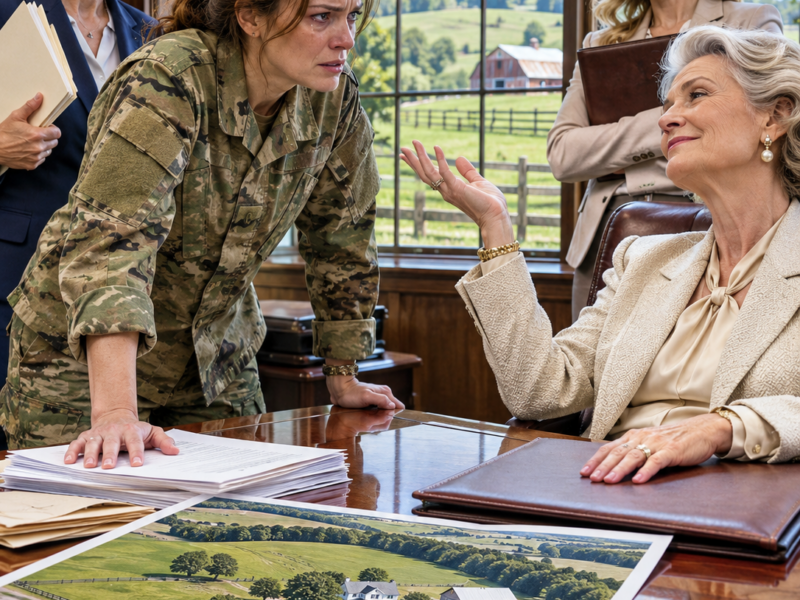
Then her own attorney opened a sealed envelope my husband had prepared years before his death.
He read the first page.
Then he read it again.
His expression changed so suddenly that my mother-in-law stopped smiling.
“Mrs. Hart,” he said quietly, “what have you done?”
Nobody answered.
And sitting across that conference table, I realized my husband had left behind something none of us fully understood.
But to understand how we reached that moment, I have to take you back six weeks.
Back to the day my entire life fell apart.
My name is Rebecca Hale. Most people call me Becca.
I was married to Ethan Hale for 18 years.
He was 46 when I lost him.
It happened on a Tuesday morning.
Ethan walked into our kitchen outside Lexington, Kentucky, complaining about a terrible headache.
By lunchtime, I was sitting beneath the fluorescent lights at UK Albert B. Chandler Hospital, listening to a neurosurgeon explain that a ruptured aneurysm had taken him from me.
Just like that.
Eighteen years of marriage ended between breakfast and lunch.
One moment, we were an ordinary married couple.
The next, I was a widow.
People came to our house carrying casseroles, flowers, and sympathy cards.
They hugged me. They offered help.
I thanked them because I didn’t know what else to do.
But when everyone went home, the silence was unbearable.
Ethan’s work boots were still beside the mudroom door.
His reading glasses sat on our nightstand.
His favorite coffee mug waited in the kitchen cabinet.
Everywhere I looked, something belonged to a man who would never walk through our front door again.
Nine days after his funeral, I accidentally made two cups of coffee.
I didn’t realize what I’d done until I reached for his mug.
My hands froze.
I stood there staring at the coffee, knowing he would never drink it.
That hurt more than I expected.
At least the funeral had been filled with people.
This was just me.
And an empty cup.
At Ethan’s funeral, his mother, Marjorie Hart, barely spoke to me.
I understood.
She had lost her son. I had lost my husband.
Grief wasn’t a competition.
When she hugged me in the church parking lot and whispered, “I just want something of Ethan left,” I held her tighter.
I thought she meant photographs.
Maybe his grandfather’s old walnut desk.
Maybe the watch Ethan wore every day.
I never imagined what she actually wanted.
Forty-three days later, a gray sedan pulled into my driveway.
I had just returned from a long day of logistics meetings at Fort Knox.
I was still wearing my Army uniform.
A Kroger grocery bag hung from one hand when a stranger approached with a thick envelope.
“Rebecca Hale?”
I nodded.
He handed me the papers.
My mother-in-law was suing me.
Not over furniture.
Not over family photographs.
She wanted the farm.
Our farmhouse. Our barns. Our pastures.
All 120 acres.
I sat at the kitchen table and read the complaint twice.
A frozen lasagna slowly warmed beside me.
The words barely made sense.
How could Ethan’s mother do this?
To understand the lawsuit, you need to understand the land.
I met Ethan in 2007, when I was 31 and stationed at Fort Knox.
A mutual friend invited me to a cookout near Elizabethtown.
Ethan arrived late in a faded Ford pickup, carrying charcoal and potato salad he had forgotten to refrigerate.
“Don’t eat that,” he whispered.
“You brought it.”
“That’s how I know.”
That was Ethan.
Funny without trying.
Honest about everything except how carefully he’d measured kitchen cabinets.
We married 14 months later.
The first time he drove me to his family’s property, I discovered that his idea of an impressive estate was very different from mine.
The driveway was full of potholes.
The farmhouse needed paint.
One barn door was held closed with a chain.
The north pasture fence leaned like it was ready to surrender.
Ethan climbed out of his truck and spread his arms.
“Welcome to the empire.”
I looked around.
“Should I notify the treasury?”
He laughed until he nearly lost his balance.
That farm became our home.
But ownership was complicated.
Years earlier, Ethan’s parents had placed the acreage into a family limited liability company.
After his father passed away, Ethan gradually acquired the controlling interest.
Marjorie kept a minority stake and certain rights under the company’s operating agreement.
I was careful about that arrangement.
I worked in military logistics.
Documents mattered to me.
So before I invested my savings in the property, I insisted that we understand our legal position.
Ethan didn’t argue.
He hired an attorney.
We documented our improvements, preserved receipts, and updated our estate plans.
Then we went to work.
We repaired fences in brutal Kentucky summer heat.
We improved drainage.
We rebuilt the porch and renovated the kitchen.
We maintained a modest cattle operation and cut hay on part of the land.
Some years were good.
Other years, one tractor repair erased months of profit.
But we kept going.
I handled the books and helped plan improvements whenever I wasn’t away for Army training.
Ethan handled the daily farm work.
We were a team.
And little by little, that neglected property became something beautiful.
Marjorie enjoyed those changes.
At church dinners, she’d proudly announce how wonderful “our farm” looked.
But when the well pump failed, it was Ethan’s responsibility.
When insurance bills arrived, those were our decisions.
I noticed.
Ethan usually shrugged it off.
“She likes the history,” he would say.
“She likes the porch when somebody else pays to stain it,” I’d answer.
He would laugh.
His sister, Tessa, was even less interested in farming.
She lived outside Louisville and worked in medical sales.
She visited for holidays, complained about the animals, and wore shoes that couldn’t survive ten yards beyond the driveway.
I never imagined she would become so interested in those 120 acres.
Not until the lawsuit.
Marjorie’s legal claim centered on the family company’s operating agreement.
She argued that Ethan’s death triggered provisions allowing her to challenge how his controlling interest would pass.
I didn’t understand how something we’d invested in for 18 years could suddenly become the subject of a lawsuit.
So I called Miriam Cole.
Miriam was 57, practical, sharp, and unnervingly calm.
She read the papers and removed her glasses.
“This isn’t nonsense, Becca.”
My stomach tightened.
“Can she take my home?”
“She can try.”
Those three words changed everything.
Suddenly, my evenings weren’t spent reviewing farm expenses or making dinner.
They were spent reviewing probate records, legal agreements, and receipts.
My Army duties filled my days.
Lawyers filled my nights.
And Ethan’s empty chair sat across from me at every meal.
Marjorie called once.
I answered because some part of me still believed we were family.
“This doesn’t have to get ugly,” she said.
I stared at the phone.
“You sued me.”
“I’m protecting what belongs to the Harts.”
I looked through the window toward the pasture Ethan and I had reseeded together.
“I was married to a Hart for 18 years.”
“That’s not what I meant.”
I went silent.
Because I finally understood.
In her mind, I was no longer family.
I was an obstacle.
The following weeks were exhausting.
Miriam believed we had strong legal arguments.
But strong arguments didn’t guarantee victory.
The dispute could last years.
Attorney fees could climb from $20,000 to $50,000 or more.
Appraisals. Depositions. Discovery.
Every document opened another argument.
Still, I wanted to fight.
Then Miriam called with a question I didn’t expect.
“Do you know a man named Grant Keller?”
“No.”
“What about Keller Residential?”
That name I recognized.
Their development signs had appeared around Fayette and Jessamine counties for years.
“Why?”
“I’d rather show you.”
I drove to her office after work.
A folder waited on her desk.
Inside were copies of emails and materials produced during the case.
Tessa had been communicating with someone connected to Keller Residential.
Before the lawsuit.
Not after.
Before.
One email discussed potential residential development.
Another referenced acreage, road access, and preliminary estimates.
I felt the room grow smaller.
“How much money are we talking about?”
Miriam hesitated.
“If the land could be developed as they’re imagining, potentially several million dollars.”
Several million.
I sat back.
Marjorie’s speeches about preserving Ethan’s legacy suddenly sounded very different.
“They’re planning to sell it.”
“They appear to be exploring that possibility.”
I remembered something Ethan had said three years earlier.
A developer had purchased nearby farmland.
Trees disappeared.
New roads appeared.
Then houses went up, one after another.
Ethan hated watching it happen.
One evening, we sat on our porch drinking iced tea while the sun lowered behind the western field.
He looked toward the pasture.
“When I’m gone, I don’t want this becoming forty houses with some ridiculous name like Hart Meadows.”
I laughed.
“Ethan, you’re 43. Stop planning your funeral.”
But he didn’t laugh.
“I just want the land to stay land.”
That conversation stayed with me.
He had started attending meetings and speaking with people about land conservation.
Sometimes he came home frustrated after discussing paperwork with Marjorie.
Eventually, he told me everything had been handled.
I believed him.
I trusted my husband.
Now his mother and sister were apparently exploring the very future he had feared.
I drove home that evening with my hands gripping the steering wheel.
I wanted to confront Marjorie immediately.
Instead, I called Miriam.
“Fight them.”
“Are you sure?”
“Yes.”
For the next two weeks, I worked like a machine.
Army. Lawyer. Farm.
Then repeat.
I gave Miriam every document she requested.
But the bills kept arriving.
And the grief never stopped.
I started waking at three in the morning.
I forgot simple things.
Once, I stood in the grocery store holding a carton of eggs, unable to remember whether I’d already bought some.
I put them back and went home.
I was exhausted.
I wasn’t just fighting for property.
I was fighting for the place where I had imagined growing old with Ethan.
Every fence reminded me of him.
Every crooked gate.
Every scratch on the kitchen cabinets.
And I was terrified of losing the last home we had shared.
Then, one rainy Saturday, I decided to sort through his office.
Most of it was ordinary.
Farm invoices.
Old tax records.
Equipment manuals.
Veterinary receipts.
Then I noticed something on the bottom shelf of the closet.
A small fireproof file box.
Ethan had always kept it locked.
I knew where the spare key was.
Inside were several thick folders.
One was labeled “Land Permanent.”
Another contained correspondence from a conservation organization.
I stopped breathing for a moment.
Underneath those folders was a sealed envelope.
My name was written across the front.
In Ethan’s handwriting.
I carefully lifted it.
The message on the envelope read:
“Becca, if there’s ever a fight about the farm.”
I sank onto the floor.
For a long moment, I couldn’t move.
Ethan had written those words years before anyone sued me.
Years before his sudden passing.
How could he have known?
Had he expected someone to challenge us?
Had Marjorie threatened him before?
I didn’t know.
But something told me this envelope was different from everything else in that box.
I picked up my phone and called Miriam.
“I found something.”
“What?”
“An envelope Ethan left for me.”
“What’s inside?”
I looked down at my husband’s handwriting.
“I don’t know yet.”
Then I whispered the thought I couldn’t get out of my mind.
“Miriam, I think Ethan knew this day might come.”
Continue in the comments 👇…
Part 2….
I didn’t open Ethan’s envelope that night.
I couldn’t.
His handwriting felt like the last unopened door between us.
The next morning, I carried the entire fireproof box into Miriam’s office.
She examined the envelope.
“Do you want me to open it?”
I nodded.
Inside was a two-page letter and copies of several older documents.
Miriam began reading.
Then she stopped.
“What is it?” I asked.
“Give me a minute.”
She compared the papers with documents already in our case file.
Then she turned toward her computer.
“County records,” she said.
My heart started racing.
“Miriam, please.”
“I need to verify something before I explain it.”
Over the next three days, she examined recorded agreements, traced old paperwork, and consulted an attorney familiar with agricultural land conservation.
Every passing hour made me more anxious.
On Friday afternoon, she finally called.
“Becca, come to my office.”
When I arrived, her conference table was covered with documents.
She pointed to a chair.
“Remember when Ethan became worried about developers buying neighboring farms?”
“Of course.”
She slid a recorded document toward me.
There were dates, legal descriptions, and signatures.
Miriam turned several pages.
Then she stopped at one particular section.
“Your husband didn’t just talk about protecting the farm,” she said.
I leaned closer.
She placed her finger beside a signature I recognized immediately.
Marjorie Hart.
My mother-in-law.
The woman suing me had signed something years earlier.
And as Miriam began explaining why that signature mattered, I realized Ethan’s envelope might change everything.
SAY ”Full Story” IF YOU WANT TO READ THE FULL STORY ✨💕