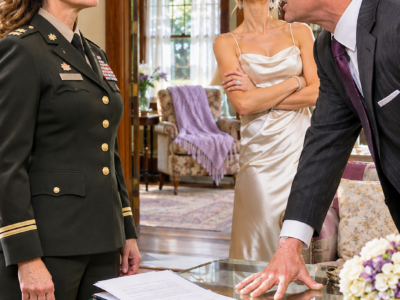
My Father Called Me A Paper Soldier In Front Of 140 Neighbors At The Ceremony To Honor Me. He Refused To Walk Beside Me While My Brother Smirked And My Mother Could Not Meet My Eyes. For Fourteen Years They Believed I Worked Behind A Desk And I Had Never Told Them Otherwise. But When A Military Convoy Entered Our Small Town My Father Had No Idea Who Was Coming Inside.
My Father Called Me A Paper Soldier In Front Of 140 Neighbors At The Ceremony To Honor Me. He Refused To Walk Beside Me While My Brother Smirked And My Mother Could Not Meet My Eyes. For Fourteen Years They Believed I Worked Behind A Desk And I Had Never Told Them Otherwise. But When A Military Convoy Entered Our Small Town My Father Had No Idea Who Was Coming Inside.
Part 1…
My mother’s house always smells like someone is about to be forgiven.
But that evening, standing inside the American Legion Hall in my hometown, I realized there are some things even a mother’s love cannot fix.
“Nobody stands next to a paper soldier.”
My father said those words loudly enough for all 140 people to hear.
Then he walked away.
He sat in the front row, folded his arms across his chest, and left me standing beside an empty folding chair.
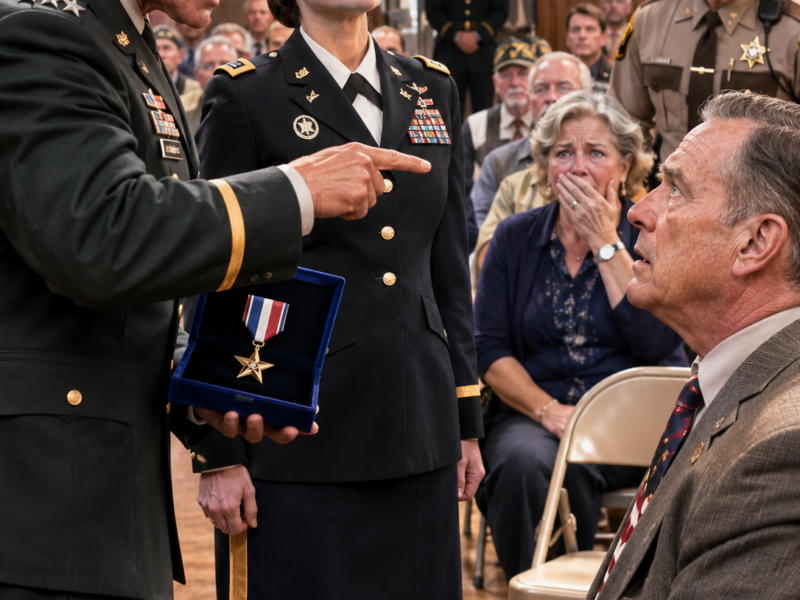
My Silver Star was resting on that chair.
Nobody moved.
My brother looked embarrassed. My mother stared at her hands. And my father looked like a man who had just defended his family’s honor.
He had no idea.
He didn’t know what had happened in a remote valley 19 months earlier. He didn’t know about the eleven men whose names I carried in my heart.
And he certainly didn’t know who was about to arrive.
Because before that evening was over, a man with three stars on his shoulders would walk through those double doors.
But I’m getting ahead of myself.
Let me start at 4:40 that morning.
I woke in my childhood bedroom before the alarm sounded.
For a moment, I forgot where I was.
The familiar water stain on the ceiling still looked like Florida. My sheets smelled of lavender detergent and old cedar.
Downstairs, someone was cooking breakfast.
I could hear a frying pan scraping against the stove. The smell of onions floated through the hallway.
Everything felt familiar.
Except me.
I lay still and performed the same quiet check I performed every morning.
Left ankle. Stiff.
Right shoulder. Aching.
Hands. Steady.
Breathing. Controlled.
Four hours and ten minutes of sleep.
That was a good night.
Since the valley, three hours was usually all I managed.
My dress uniform hung behind the bedroom door, pressed perfectly. On the dresser sat a small blue case.
Inside was a Silver Star.
I didn’t open it.
I’d already looked at it once, in a quiet office two states away. That had been enough.
The ceremony was scheduled for six that evening at American Legion Post 318 in Cairo, Ohio.
Nothing fancy.
Folding chairs. A flag. A grocery-store sheet cake.
Exactly what I’d requested.
I was 36 years old, an Army major, and I’d stood in places most people would never see.
But a small part of me still wanted something embarrassingly simple.
I wanted my father to be proud.
I wanted him sitting in the front row.
Maybe even smiling.
I also wanted the ceremony close to my grandmother’s grave, just four miles away.
She would have understood why the medal mattered.
I wasn’t so sure about anyone else.
Downstairs, my mother, Ruth Keller, stood at the stove wearing her best blouse.
She kept flipping eggs she wasn’t eating.
My mother has been nervous for as long as I can remember. Her hands are always moving, even when the rest of her is perfectly still.
My father sat at the head of the kitchen table.
Frank Keller.
The family authority.
The decorated storyteller.
The man everyone listened to.
He had the local newspaper open, but his eyes weren’t moving across the page.
“Morning, Dad.”
“Morning.”
He didn’t look up.
Then he started talking about parking arrangements for the ceremony.
My older brother Wade was bringing his truck at four. Dad had already told Ed Gaskill, the Legion commander, that our family would handle its own parking.
“The post doesn’t need strangers directing our family.”
Our family.
I swallowed the response that came to mind.
I’d been swallowing responses for years.
Wade arrived a minute later, still wearing his deputy’s uniform after working the night shift.
He smelled like cold air and burnt coffee.
He was two years older than me and had spent most of his life agreeing with our father.
He kissed Mom’s cheek, squeezed Dad’s shoulder, and turned toward me.
“There she is. Big day. Did the Army send you a car?”
“I drove myself.”
“Of course you did.”
He filled his coffee mug.
“Must be nice getting a whole ceremony for filing the right paperwork.”
Dad chuckled.
It wasn’t a big laugh.
That somehow made it worse.
For fourteen years, my family believed I had a comfortable administrative position in the Army.
I had never corrected them.
Not because I was ashamed.
Because much of my work wasn’t something I could discuss freely.
When I called home, I said I was busy. When Dad asked about my assignment, I told him it was demanding.
He assumed paperwork.
Wade repeated it.
Eventually, the entire family accepted it as fact.
A daughter wearing a uniform and sitting behind a desk.
That was the version of me Dad preferred.
My father had served eight months during the Gulf War in 1991.
I respected that service.
I always had.
But over the years, his stories became bigger.
Every Veterans Day at the Legion, the desert seemed more dangerous. Every retelling brought him closer to the action.
In our house, there was room for only one military hero.
And he sat at the head of the table.
When the Army notified my family that I’d been selected to receive a medal, Dad barely reacted.
“They hand those things out like candy nowadays.”
Then he asked whether the front rows could be reserved for his friends.
He never asked what I’d done.
Not once.
That morning, he folded his newspaper and announced his favorite opinion.
“Real service means getting dirt under your fingernails. Paper soldiers get ribbons for showing up.”
Mom’s spatula stopped moving.
Just for a second.
Then she resumed cooking.
I stared at my plate.
People might wonder why I never defended myself.
I’ve wondered the same thing.
The answer is complicated.
I loved my father.
When I was eight, he taught me to read maps in his old truck.
Every Sunday, he’d let me navigate the roads between Cairo and Columbus. He smelled of peppermint gum and diesel.
Those were some of my favorite childhood memories.
But when I turned twelve and told him I wanted to fly, he laughed.
“Johanna, girls don’t fly. They file the flight plans.”
He didn’t shout.
He didn’t mean to sound cruel.
But I remember the words perfectly.
That was the moment I realized my father had already decided what I was capable of becoming.
After that, I stopped asking his permission to dream.
I went after my goals anyway.
And eventually, I learned that doing difficult things didn’t always mean getting to talk about them afterward.
Some memories don’t belong at a dinner table.
Some nights can’t be explained over coffee.
So whenever my father asked how work was going, I gave him the same answer.
“Fine, Dad. Busy.”
That morning, I had a folded piece of paper inside my uniform pocket.
My official citation.
Fourteen typed lines describing one extraordinary night, nineteen months earlier.
I’d mailed my parents a copy when it was approved.
Nobody mentioned receiving it.
I suspected nobody had bothered reading it.
The Silver Star is one of the Army’s highest honors for bravery in combat.
I knew exactly what it represented.
Eleven people had come home from that valley.
Eleven men who could wake up beside their families because of what happened that night.
But there was another name.
A twelfth.
One I rarely said aloud.
And sometimes, when my father joked about paperwork, that was the name I heard instead.
We arrived at the Legion Hall at 4:50 that afternoon.
The building looked exactly as I remembered.
A low brick structure. A gravel parking lot. An American flag snapping in the wind.
Inside, the familiar smell of floor wax and burnt coffee greeted me.
Twelve rows of folding chairs faced a small stage.
Someone had hung a homemade banner with red letters reading, “HONORING OUR OWN.”
Paper stars decorated the edges.
For reasons I couldn’t explain, those little stars almost brought me to tears.
One hundred forty people arrived.
I counted them.
Counting helps me stay calm.
Neighbors. Former teachers. My high school coach. The mayor in his blue blazer.
Women from Mom’s church brought lemon bars.
Mrs. Dowling, who’d lived next door since I was a little girl, held my face between her hands.
“You were always such a serious child.”
I smiled.
She had no idea how serious life had become.
Ed Gaskill, the Legion commander, approached me near the stage.
He was seventy years old, broad-shouldered, and one of the few men in town who had always treated me kindly.
“Joe, we’re doing this the traditional way.”
He explained that the honoree walked forward with a family escort.
Usually a parent.
The escort carried the medal on a blue velvet cushion.
“Frank’s the obvious choice,” he said.
I nodded.
“I’d really like that.”
And I meant it.
Despite everything my father had said, I still wanted him beside me.
At 5:20, Ed walked over to Dad near the coffee urn.
I watched from the doorway.
Ed offered him the velvet cushion.
Dad looked down at the medal.
Then he looked away.
He didn’t take it.
I couldn’t hear the conversation, but I recognized my father’s expression.
Stubborn.
Dismissive.
Certain he was right.
At 5:38, Ed approached him again.
This time, several people were listening.
“Frank, it’s four minutes up the aisle. It would mean the world to your daughter.”
Dad finally accepted the cushion.
For one hopeful second, my chest loosened.
Maybe he’d changed his mind.
Maybe he would do this one thing for me.
He walked toward the chair beside mine.
Then he placed the cushion on its seat.
He didn’t look at me.
“I told you, Ed.”
His voice carried across the hall.
“Nobody stands next to a paper soldier.”
Then he turned around, walked to the front row, and sat down.
He folded his arms.
The room went quiet in waves.
First the people near the coffee urn.
Then the middle rows.
Then the back.
Someone stopped laughing halfway through a sentence.
I could hear a fork touch a paper plate.
Wade came toward me.
For one second, I thought my brother might take Dad’s place.
Instead, he leaned close.
“He’s just being Dad, Joe. Don’t make this weird. Walk up by yourself.”
I looked at him.
My own brother.
The man who’d joked about my service over breakfast.
He wasn’t offering to stand beside me.
He was asking me to make our father comfortable.
I turned toward Mom.
She sat in the second row, looking down at her hands.
For the first time all day, they weren’t moving.
One hundred forty people watched me stand beside an empty chair.
My medal sat on the cushion.
My father refused to look at me.
And I felt twelve years old again, standing beside his truck, explaining that I wanted to fly.
Only this time, I didn’t need his permission.
I didn’t cry.
I didn’t argue.
I’ve been in darker places, with far fewer options, and learned that losing control rarely makes anything better.
So I breathed.
I counted.
And I waited.
At 5:41, my phone vibrated against my chest.
I pulled it from my pocket.
A message from a number I’d saved under a single initial.
“11 minutes out. Do not start without me.”
My heartbeat changed.
I read it twice.
Then I turned toward Ed.
“Can we delay the ceremony ten minutes?”
He looked miserable.
“Joe, honey, we’ve got 140 people waiting. I can’t hold everything for someone who might not show.”
“He’ll be here.”
“Who’s coming?” Dad demanded from the front row.
He didn’t even turn around.
“Some friend from your office?”
A few uncomfortable faces turned toward him.
“Let her wait, Ed. I already said what I said.”
He paused.
“Nobody stands next to a paper soldier.”
Someone whispered, “Frank, that’s your daughter.”
But Dad ignored it.
I looked at the clock.
Each second seemed louder than the last.
And suddenly, I wasn’t thinking about the Legion Hall anymore.
I remembered a dark ridgeline.
A voice over a radio.
Someone calling for help.
Someone saying there were injured men who couldn’t get out.
I remembered the terrible feeling of knowing time was running out.
I pushed the memory aside.
Not here.
Not now.
At 5:52, Walter Pruitt, the seventy-four-year-old post chaplain, stopped beside the window.
His coffee cup froze halfway to his mouth.
He stared outside.
Then he spoke.
“Ed. You need to see this.”
Ed approached the glass.
His clipboard slipped from his fingers and hit the floor.
Outside, tires crunched across the gravel.
A state patrol cruiser had entered the parking lot.
Its emergency lights were off.
Behind it came two black SUVs.
Then a gray van.
Small flags fluttered from its front fenders.
The vehicles stopped in a perfectly straight line.
Doors opened.
Uniformed men stepped onto the gravel.
Wade stood so quickly that his chair tipped backward.
Dad finally turned around.
“What in the world is that?”
Nobody answered.
I heard the refrigerator humming in the kitchen.
I heard the flag outside striking its rope.
Then the double doors began to open.
And the entire room turned toward the entrance.
Continue in the comments 👇…
Part 2…
A young Army captain stepped inside and held the door open.
Behind him stood a tall, silver-haired man wearing a perfectly pressed dark green military uniform.
Three silver stars rested on each shoulder.
His chest was covered with ribbons.
The room went completely silent.
Walter Pruitt stood first.
Then another veteran.
Then another.
Within seconds, the men who had spent their lives recognizing military rank were standing at attention.
My father remained seated.
For once, he had nothing to say.
The visitor walked slowly down the center aisle.
He passed the mayor.
He passed Ed Gaskill.
He passed my father’s chair without stopping.
Then he stood directly in front of me.
I noticed the faint scar along his jaw.
The slight stiffness in his left leg.
I knew where both had come from.
His eyes filled with emotion.
“Major Keller.”
Two words.
Everyone heard them.
“General,” I whispered. “You didn’t have to come.”
“Yes,” he answered. “I did.”
He looked at the empty chair.
Then at my medal.
He lifted the velvet cushion and turned toward the crowd.
“Good evening. I’m Lieutenant General Marcus Delaney.”
My father’s expression changed.
The general continued.
“I’m told a family member normally escorts the honoree. Since Major Keller’s escort has declined, I would consider it a privilege to stand beside her.”
Then he looked directly toward my father.
“Nineteen months ago, I was on a ridge in northern Iraq. And if this woman hadn’t made a decision that night, I would not be standing here.”
SAY ”Full Story” IF YOU WANT TO READ THE FULL STORY ✨💕