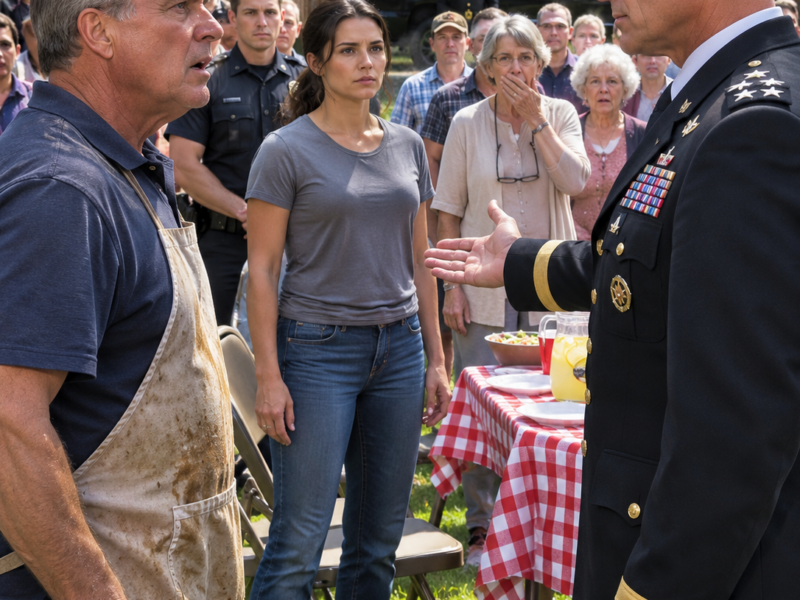
My Father Called Me a Disgrace for Twelve Years Because I Joined the Army Against His Wishes. He Humiliated Me Before Thirty-One Relatives at Our Fourth of July Barbecue, Convinced I Had Achieved Nothing Worth Respecting. My Mother Stayed Silent While Everyone Watched Me Swallow Another Insult, Unaware of the Secret I Had Kept. Then a Black Government SUV Pulled Up Outside Our House, and a Three-Star General Asked for Someone Unexpected.
My Father Called Me a Disgrace for Twelve Years Because I Joined the Army Against His Wishes. He Humiliated Me Before Thirty-One Relatives at Our Fourth of July Barbecue, Convinced I Had Achieved Nothing Worth Respecting. My Mother Stayed Silent While Everyone Watched Me Swallow Another Insult, Unaware of the Secret I Had Kept. Then a Black Government SUV Pulled Up Outside Our House, and a Three-Star General Asked for Someone Unexpected.
Part 1…
My father called me a disgrace in front of 31 people at our family barbecue.
He said it without hesitation.
Without embarrassment.
And without knowing that, just 48 hours earlier, the United States Senate had made a decision that would change my life forever.
My name is Sierra Vaughn. I’m 33 years old, and for twelve years, my father treated my decision to join the Army like a stain on our family’s reputation.
To him, I was a disappointment.
A daughter who had wasted her potential.
A woman who had chosen the wrong life.
He had no idea what I had accomplished. And he certainly didn’t know that a three-star general was already on his way to our house.
But I’m getting ahead of myself.
Every year, the Vaughn family held a Fourth of July barbecue at my parents’ house in Fayetteville, North Carolina.
Same backyard. Same folding tables. Same red-checkered tablecloths.
And the same uncomfortable feeling whenever I walked through the gate.
My father, Frank Vaughn, was a retired police lieutenant. He had served with the Fayetteville Police Department for 24 years, and retirement hadn’t diminished his pride in that title.
He introduced himself as Lieutenant Vaughn everywhere.
At restaurants. At church. Even at family gatherings where everyone already knew who he was.
His badge might have been retired, but his authority wasn’t.
At least not inside our family.
That Saturday, I drove four hours from Washington, D.C., in a rented Honda Civic.
My own vehicle had government plates.
I didn’t want questions.
Not from him.
Not yet.
I parked along the street because the driveway was already crowded with relatives’ cars.
There was another reason, too.
In my father’s house, certain people belonged in the driveway.
I had learned to leave my car outside.
The North Carolina heat was suffocating. Ninety-one degrees, with humidity so thick my shirt stuck to my back before I reached the gate.
I carried two bags of ice and a store-bought pecan pie.
My mother had specifically requested both.
I wore ordinary blue jeans and a gray T-shirt. Nothing about my appearance suggested my rank, assignments, or responsibilities.
That was intentional.
When I entered the backyard, I counted 31 people.
I always count.
Years of military training had made some habits impossible to switch off.
My mother, Diane, stood near the picnic table arranging paper plates.
She was 61, with her hair pinned neatly above her neck and reading glasses hanging from a chain.
She noticed me.
Her mouth formed a smile.
Her eyes didn’t.
“Put the ice in the cooler, Sierra. And keep the pie out of the sun.”
“Yes, ma’am.”
That was my welcome home.
My father stood at the grill wearing an old apron and holding metal tongs.
He glanced over his shoulder.
“You’re late.”
“Traffic on I-95.”
“You should’ve left earlier.”
Then he turned back to the burgers.
Five hours of driving, and those were the first words he offered me.
Actually, I’d driven four hours. But the emotional distance between us had been growing for twelve years.
I put the ice away, placed the pie in the shade, and found an empty folding chair near the fence.
Nobody asked about my life.
Nobody asked about my work.
Nobody asked where I had spent the previous six months.
That silence was familiar.
My family believed I worked an unimportant desk job at the Pentagon.
They knew I joined the Army at 21 against my father’s wishes.
They knew I wasn’t married, didn’t have children, and had missed two Christmases.
That was about it.
They didn’t know I had commanded a joint task force in eastern Syria when I was 29.
They didn’t know I’d been injured by shrapnel in Helmand province at 26.
They didn’t know about my two Bronze Stars, Purple Heart, or Defense Superior Service Medal.
And they didn’t know that the commanding general of U.S. Special Operations Command had personally recommended me for promotion.
I never deliberately lied about my career.
I simply stopped volunteering information to people who never seemed interested.
When I first enlisted, my father refused to speak to me for four months.
When I completed Officer Candidate School, he said the Army might finally teach me the discipline he supposedly couldn’t.
When I became a captain, my mother reminded me that Dad still believed I should have attended law school.
When I became a major, he said nothing.
And when I made lieutenant colonel at just 31, my mother congratulated me briefly before announcing that my cousin Derek had become a detective.
Derek was at the barbecue that afternoon.
His badge was clipped to his belt, even though he was off duty.
My father stood beside him, laughing proudly.
His arm rested across Derek’s shoulders.
I watched them from the fence.
There was no jealousy in me.
Derek had worked hard for his position.
But I wondered what it would feel like to have my father look at me the same way.
Just once.
Then my mother appeared beside my chair.
“Sierra, come greet your Aunt Pauline.”
She took my elbow and guided me toward a group of relatives near the garage.
Aunt Pauline was my father’s older sister.
Seventy years old. Loud. Opinionated.
And completely convinced she understood my life.
“There’s our mystery girl!” she announced.
Several relatives turned.
Pauline studied my jeans and T-shirt.
“Still doing that Army thing?”
“Yes, Aunt Pauline.”
She shook her head.
“Your daddy says you spend your days pushing papers. Something like that.”
I kept my expression neutral.
“Something like that.”
“He worries, you know. Says the military isn’t any life for a woman.”
I looked toward the grill.
My father was still laughing with Derek.
“He’s mentioned it.”
Pauline leaned closer.
“Well, he’s not wrong.”
I smiled politely.
Then I excused myself.
Arguing wouldn’t have changed anything.
I had learned that lesson years earlier.
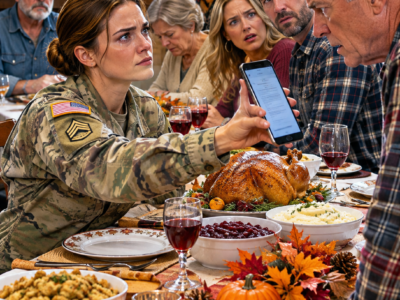
By 2:35 that afternoon, the backyard was crowded with adults holding drinks and children eating hot dogs.
The smell of charcoal hung over the tables.
Somewhere beyond the fence, a sprinkler clicked rhythmically.
My father tapped his tongs against the grill.
“Everybody! Gather around!”
His annual toast.
Every year, he delivered a speech about family pride, responsibility, and the importance of the Vaughn name.
Usually, I could predict every sentence.
This year was different.
He raised his drink.
“I want to talk about standards.”
Something tightened inside my stomach.
He continued, speaking loudly enough for the entire backyard to hear.
“This family has always stood for hard work, discipline, and earning your place.”
People nodded.
Derek smiled.
My father paused.
“Unfortunately, not everybody in this family has lived up to those standards.”
The atmosphere shifted.
Nobody looked directly at me.
They didn’t need to.
“Some people make choices that don’t reflect what this family represents,” he continued. “And I’ll admit, that’s been a real disappointment.”
I stared at my hands.
My fingers remained still.
I had sat through operational briefings under extraordinary pressure.
I had made decisions when people depended on me.
Yet somehow, sitting in my childhood backyard was harder than either.
My father took another sip.
Then he delivered the sentence I had heard for twelve years.
“But family means loving people even when they’re a disgrace.”
There it was.
Disgrace.
Thirty-one people heard him.
My mother lowered her eyes.
Derek stared at the grass.
Aunt Pauline nodded as though he’d just delivered an important lesson.
Nobody objected.
Not one person.
I didn’t cry.
I didn’t shout.
I simply sat there, feeling that familiar ache beneath my ribs.
The same place where an old shrapnel injury had left a scar.
For one painful moment, I wasn’t a decorated officer.
I was a daughter who still wanted her father to be proud.
Then I stood.
Quietly.
I walked around the side of the house and pressed my palms against the warm brick wall.
My breathing was steady.
My heart wasn’t.
Twelve years.
Twelve years of trying to prove that choosing my own future didn’t mean rejecting my family.
And somehow, I was still that stubborn 21-year-old girl in his eyes.
My phone vibrated.
One encrypted message appeared.
“ETA 42 minutes. Price.”
I read it twice.
Lieutenant General Calvin Price.
Three stars.
Vice Director of the Joint Staff.
I had served under his command in two theaters, and he had written the opening of my promotion recommendation.
He was coming here.
To my father’s house.
In 42 minutes.
I locked the screen.
For the first time that afternoon, I wondered what my father would say when someone outside our family described my career.
But there was another truth.
I didn’t want my achievements to become weapons against him.
I had spent my entire adult life trying not to let his disappointment define me.
I didn’t intend to start now.
I went inside for water.
The kitchen was empty.
The familiar smell of pine cleaner and cinnamon candles hung in the air.
Everything looked exactly as I remembered.
The brown carpet.
The old wallpaper.
The hallway filled with framed family photographs.
Then I noticed something.
A blank space on the wall.
I stopped walking.
There had always been a picture there.
My commissioning portrait.
Twenty-one-year-old Sierra Vaughn in dress uniform, shoulders straight, eyes fixed forward.
My mother had hung it years earlier, during one of the rare moments when she seemed proud of me.
Now there was only a small nail.
And a pale rectangle where the frame had protected the wallpaper from sunlight.
I opened the hallway closet.
There it was.
On the floor.
Behind a box of Christmas lights.
Face down.
I picked it up carefully.
The glass was cracked diagonally across my younger face.
For a moment, I couldn’t move.
Of all the photographs in that hallway, mine was the one that had been hidden.
My father had erased the only visible reminder that his daughter served in the Army.
The realization hurt more than the public insult.
Because words disappear into the air.
But that empty space had been waiting for me.
I turned the frame over, placed it back behind the Christmas lights, and closed the closet.
No confrontation.
Not yet.
Outside, the barbecue continued.
Children laughed.
Plates rattled.
My father entertained his friends with an old police story about a traffic stop in 1998.
I returned to my folding chair.
I watched the shadows stretch slowly across the grass.
Then, at exactly 3:14 p.m., I heard an engine approaching.
A familiar sound.
Low. Controlled. Distinctive.
I turned toward the street.
A black Chevrolet Suburban with government plates rolled onto Ridgefield Drive.
It pulled directly behind my rental Honda.
Two doors opened.
A staff sergeant in full dress uniform stepped from the driver’s side.
He walked around the vehicle and opened the rear passenger door.
Then a tall officer emerged.
Lieutenant General Calvin Price.
Fifty-eight years old.
Six feet one.
Impeccably dressed.
Three silver stars gleamed on each shoulder.
He adjusted his military cap and studied the house number before walking toward our driveway.
My father saw him first.
His story stopped halfway through a sentence.
The metal tongs hung motionless in his hand.
He looked at the uniform.
Then at the stars.
Then at the unfamiliar face.
“Can I help you?”
General Price stopped beside the lawn.
His voice was calm.
“Good afternoon. I’m looking for General Vaughn.”
My father blinked.
Then he straightened his shoulders.
“There’s no general here.”
He paused.
“I’m Lieutenant Vaughn, retired. Fayetteville Police Department.”
General Price studied him.
Then he answered with five words that changed the entire afternoon.
“I’m not looking for you.”
Continue in the comments 👇…
Part 2….
My father’s face changed.
For the first time that afternoon, he seemed unsure of what to say.
General Price looked past him.
Past Derek and his polished badge.
Past Aunt Pauline.
Past my mother and the crowded picnic tables.
Then his eyes found me.
“There she is.”
I stood.
Thirty-one people watched a three-star general walk across our backyard toward the daughter my father had just called a disgrace.
He stopped directly in front of me.
“General Vaughn.”
His words carried through the silence.
My mother froze.
Derek slowly lowered his drink.
My father’s metal tongs slipped from his hand.
They landed on the ground.
Nobody moved to pick them up.
“General Price, sir,” I replied.
We shook hands.
“You’re early.”
He smiled slightly.
“Couldn’t wait.”
Then he reached inside his jacket.
“I have something for you from the Secretary of the Army.”
A folded official letter appeared in his hand.
“He wanted you to receive this before tomorrow’s ceremony.”
My father’s expression shifted again.
Tomorrow’s ceremony?
What ceremony?
I could almost hear the questions forming behind his stunned expression.
General Price unfolded the letter.
The backyard fell completely silent.
“Brigadier General Sierra R. Vaughn,” he began.
My mother covered her mouth.
My father stared at me as though he was seeing his daughter for the first time.
And General Price hadn’t even reached the most important sentence.
SAY ”Full Story” IF YOU WANT TO READ THE FULL STORY ✨💕