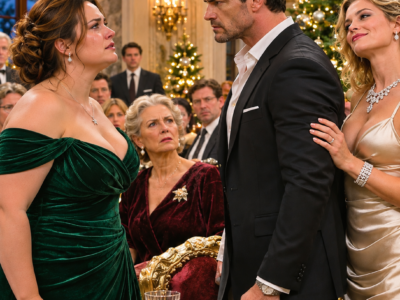
My Billionaire Husband Slapped Me in Front of 100 Wealthy Guests, Thinking I Was Too Weak to Fight Back. I Walked Away Without a Word and Called My Quiet Brother. Seven Days Later, My Husband’s Billion-Dollar Empire Began Falling Apart—and He Never Saw Who Was Behind It.
My Billionaire Husband Slapped Me in Front of 100 Wealthy Guests, Thinking I Was Too Weak to Fight Back. I Walked Away Without a Word and Called My Quiet Brother. Seven Days Later, My Husband’s Billion-Dollar Empire Began Falling Apart—and He Never Saw Who Was Behind It.
Part 1…
The slap echoed across the elegant dinner terrace like a gunshot, silencing nearly a hundred wealthy guests in a single horrifying second. Audrey Thorne stood motionless beside her husband, her cheek burning beneath the weight of his hand. Champagne glasses stopped halfway to painted lips. Conversations died. Even the musicians seemed uncertain whether they should continue playing.
Vincent Thorne, the powerful CEO of Thorne Dynamics, had just struck his wife in front of New York’s most influential investors, politicians, and business leaders.
But what happened next was something no one expected.
Audrey didn’t scream. She didn’t beg for an apology. She simply looked at the man she had married, turned away, and walked toward the mansion.
Less than ten minutes later, she made one phone call.
“Jonathan,” she whispered. “I need you.”
Her husband had always dismissed her brother as a quiet businessman with an ordinary office in Manhattan. Vincent had no idea that Jonathan Knight controlled a private investment empire worth billions.
And when Jonathan discovered what had happened to his sister, he made a decision that would change Vincent’s life forever.
He wasn’t going to demand an apology.
He was going to take everything.
To understand how one slap could destroy a corporate empire, however, you have to understand the life Audrey had been living long before that terrible evening.
For nearly ten years, Audrey had occupied one of Manhattan’s most luxurious penthouses overlooking Central Park. There were marble floors, floor-to-ceiling windows, priceless furniture, and a climate control system that kept every room at exactly sixty-eight degrees.
Nothing was allowed to be imperfect.
Not the furniture.
Not the temperature.
And certainly not Audrey.
Vincent had built Thorne Dynamics into a powerful technology and logistics corporation through aggressive acquisitions and relentless ambition. Financial magazines praised his leadership. Investors admired his confidence. Business competitors feared his ruthlessness.
But behind the expensive suits and charming public speeches was a man who treated his marriage like another corporate transaction.
Audrey was expected to be beautiful, agreeable, and silent.
Her opinions were unnecessary. Her emotions were inconvenient. Her dreams were distractions.
Years earlier, before marrying Vincent, Audrey had been a talented painter. She loved vibrant landscapes and unusual colors, and she had once dreamed of opening her own gallery.
Vincent had slowly convinced her that painting was beneath a woman in her position.
“You’re married to a man building an empire,” he frequently reminded her. “You have responsibilities now.”
Eventually, Audrey stopped visiting her studio.
Her paints dried.
Her canvases gathered dust.
And the woman who once filled rooms with laughter gradually became someone who apologized for taking up space.
On the afternoon of the annual Thorne Dynamics Charity Gala, Audrey stood in their dressing room wearing a beautiful emerald-green silk gown.
Vincent entered wearing an immaculate tuxedo.
“Is that what you’re wearing?” he demanded.
Audrey glanced at him through the mirror.
“You chose it.”
“I approved it from a catalog. That doesn’t mean it looks impressive on you.”
His eyes traveled critically over her appearance.
“You’re too pale. And that necklace looks cheap.”
Audrey instinctively touched the small gold locket around her neck.
It was a gift from Jonathan, her younger brother.
“It’s sentimental,” she explained.
“Sentiment doesn’t impress investors. Wear the diamonds I bought you.”
The diamond necklace Vincent wanted was magnificent, but its weight always made Audrey uncomfortable.
Still, she obeyed.
She removed Jonathan’s locket, placed it carefully in a drawer, and fastened the diamonds around her throat.
When she looked at herself again, she barely recognized the woman in the mirror.
Twenty minutes later, a helicopter carried them toward their sprawling estate in the Hamptons.
Vincent spent the flight reviewing business documents and criticizing employees over the phone.
Audrey watched Manhattan disappear beneath them.
She had attended countless parties like this. She knew exactly when to smile, when to compliment someone, and when to remain silent.
But that evening, something felt different.
Perhaps she was simply exhausted.
Perhaps she had finally reached the point where pretending required more strength than she possessed.
Whatever the reason, Audrey had a strange feeling that her life was approaching a moment she could no longer avoid.
The Hampton estate glittered beneath thousands of lights when they arrived.
Elegant guests wandered across perfectly maintained lawns. Waiters carried silver trays of champagne. A massive ice sculpture displaying the Thorne Dynamics logo stood near the terrace.
Everything looked spectacular.
And everything existed to celebrate Vincent.
For the first two hours, Audrey performed her familiar role.
She welcomed distinguished guests, complimented their families, and politely redirected questions about her personal life.
Then she met Mr. Henderson, an elderly board member from another corporation.
Unlike most guests, Henderson seemed genuinely interested in Audrey herself.
When he discovered that she loved painting, he began discussing the Impressionists.
For the first time that evening, Audrey smiled naturally.
She spoke enthusiastically about light, movement, and how artists could transform ordinary landscapes into something extraordinary.
Henderson listened with delight.
“Mrs. Thorne, you have an exceptional understanding of art,” he told her. “Have you ever considered exhibiting your own work?”
Before Audrey could answer, Vincent appeared.
He wrapped an arm tightly around her waist.
“Darling, I hope you aren’t boring Mr. Henderson with your little hobbies.”
Henderson shook his head.
“Quite the opposite. Your wife has extraordinary insight.”
Vincent’s smile tightened.
“Audrey dabbles. It keeps her occupied.”
His fingers pressed painfully against her waist.
Audrey recognized the warning.
She fell silent.
After Henderson politely excused himself, Vincent leaned closer.
“I told you not to embarrass me tonight.”
“I wasn’t embarrassing you.”
“You were talking like a schoolgirl showing off her finger paintings.”
“He asked about my work.”
“He was being polite because he felt sorry for you.”
Audrey lowered her eyes.
Vincent interpreted her silence as agreement.
He walked away satisfied, leaving her alone beside the champagne table.
What he didn’t understand was that something inside her had begun to change.
For years, Audrey had believed that if she behaved perfectly, Vincent might eventually become the loving husband she remembered from their courtship.
But perfection never satisfied him.
It only raised his expectations.
Later, dinner was served beneath an enormous glass canopy overlooking the Atlantic Ocean.
Vincent sat at the head of the main table, surrounded by important investors and senior executives.
Audrey sat beside him.
After dessert, Vincent rose to deliver his annual speech.
He spoke passionately about innovation, social responsibility, and his company’s commitment to improving communities.
He described programs supporting disadvantaged families and praised the importance of corporate generosity.
The audience applauded enthusiastically.
Audrey clapped too.
But she couldn’t stop thinking about a community clinic Vincent had promised to finance the previous year.
The clinic had received tremendous publicity when he announced the donation.
Three months earlier, however, its funding had quietly disappeared.
Families who had been promised affordable healthcare were still waiting.
When Vincent returned to his seat, he noticed Audrey’s distracted expression.
“What did you think?” he asked.
“It was a powerful speech.”
“Don’t patronize me. You looked bored.”
“I wasn’t bored.”
“Then what were you thinking about?”
Audrey hesitated.
Normally, she would have invented something harmless.
But this time, she answered truthfully.
“The community clinic.”
Vincent’s expression changed instantly.
“What about it?”
“The one you promised to support last year. A reporter asked me about it tonight.”
His fingers tightened around his glass.
“What did you tell him?”
“That I wasn’t involved in the company’s financial decisions.”
“You should have said nothing.”
“He asked me directly.”
“You should have walked away.”
Audrey looked at him.
“Those families were counting on that clinic, Vincent.”
The words were barely louder than a whisper.
But Vincent heard them.
And several people seated nearby did too.
His face hardened.
“You are my wife,” he said. “Your responsibility is to support me, not question my decisions.”
“I wasn’t questioning you.”
“That’s exactly what you’re doing.”
He leaned forward.
“Do you understand how much money I’ve spent building everything around you? You have a life most women would kill for, and you still manage to make yourself a liability.”
Liability.
That single word seemed to settle heavily between them.
Audrey remembered years of criticism.
The abandoned painting studio.
The dinners where she had been mocked.
The birthdays Vincent forgot.
The countless nights she had cried quietly in rooms filled with expensive things.
And suddenly, she couldn’t bear another moment of pretending.
“I’m not a liability,” she said.
Vincent stared at her.
“What?”
“I’m a person. And those people deserved the help you promised.”
The table fell silent.
Gregory Finch, Vincent’s closest executive, slowly lowered his fork.
Several investors exchanged uncomfortable glances.
Vincent’s face turned crimson.
He had spent his entire career making people fear challenging him.
And now his own wife had contradicted him in public.
“You will never question me again,” he whispered.
Then he raised his hand.
The slap came without warning.
Audrey’s head turned sharply.
A terrible silence followed.
For several seconds, she could hear nothing except the distant waves crashing against the shoreline.
Her cheek burned.
But something deeper inside her had gone strangely cold.
She looked at Vincent.
He appeared almost as shocked as his guests.
Then he attempted an awkward laugh.
“She’s overtired,” he announced. “It’s been a stressful evening.”
Nobody laughed.
Audrey slowly stood.
She didn’t touch her cheek.
She didn’t speak.
She simply turned and walked away.
Behind her, Vincent called her name.
She kept walking.
Through the terrace.
Past the melting ice sculpture.
Into the enormous mansion.
She entered a guest bedroom, locked the door, and took out her phone.
There was only one person she wanted to hear.
Jonathan answered after two rings.
“Audrey?”
“Jonathan. I need you.”
He immediately recognized something frightening in her voice.
“Where are you?”
“At the Hamptons house.”
“Are you safe?”
“I’m in a locked room.”
“Stay there. I’m coming.”
He ended the call.
In downtown Manhattan, Jonathan Knight stood inside an ordinary-looking office surrounded by financial monitors.
Unlike Vincent, Jonathan had never needed the public to recognize his wealth.
His company, Knight Industries, controlled investments across technology, transportation, energy, and international finance.
He preferred quiet offices, careful research, and discreet transactions.
The financial world knew him as a formidable strategist.
But Audrey knew him simply as her brother.
The boy who had protected her when they were children.
The man who had never laughed at her paintings.
The one person who always asked whether she was happy.
Jonathan entered the neighboring office, where his chief operating officer and legal counsel, Rebecca Vance, was working.
“Cancel my meetings,” he said.
Rebecca looked up.
“Something wrong?”
“It’s Audrey.”
His expression told her everything she needed to know.
“Arrange the helicopter. I need security in the Hamptons.”
She reached for her phone.
“Anything else?”
Jonathan paused.
“Start gathering everything we can legally obtain about Thorne Dynamics. Financing, contracts, investors, operations, vulnerabilities.”
Rebecca studied him carefully.
“Jonathan, what happened?”
He looked toward the window.
“I don’t know all the details yet. But Vincent has hurt my sister.”
Ninety minutes later, Jonathan arrived at the estate.
When Audrey opened the guest-room door, he saw the red mark across her cheek.
His expression tightened.
For one terrible second, she thought he might lose his temper.
Instead, he opened his arms.
And Audrey broke down.
“He hit me,” she sobbed. “In front of everyone.”
Jonathan held her tightly.
“I know.”
“They all watched.”
“I’ve got you.”
For several minutes, neither spoke.
Then Audrey whispered something that changed everything.
“I can’t go back to him.”
Jonathan gently pulled away.
“You don’t have to.”
He helped her gather a few belongings and escorted her through a side entrance to a waiting car.
Vincent had already called her repeatedly.
His messages alternated between apologies, accusations, and demands.
Audrey ignored them.
Jonathan took her to a secure luxury residence he owned in Manhattan.
There, he arranged food, comfortable clothes, and discreet protection.
Before leaving, he asked one important question.
“Audrey, what do you want?”
She looked exhausted.
“I want my life back.”
Jonathan nodded.
“Then that’s what matters.”
That night, while Audrey finally slept without fearing Vincent’s footsteps, Jonathan returned to Knight Industries.
Rebecca was waiting with a preliminary financial report.
“Thorne Dynamics is in worse condition than the market realizes,” she explained.
She displayed a complicated network of loans and corporate obligations.
“Vincent expanded too quickly. He’s heavily dependent on refinancing a major Deutsche Bank loan in six months.”
She highlighted another figure.
“And nearly forty percent of projected annual revenue depends on one government contract.”
“Odyssey,” Jonathan said.
Rebecca nodded.
“The Odyssey project. If that contract collapses, the company could face a severe liquidity crisis.”
Jonathan studied the screen.
“How much of the company can we acquire?”
Rebecca hesitated.
“Vincent controls the largest voting block. A takeover would be expensive, complicated, and risky.”
“Then we find out exactly what we’re dealing with.”
He looked at the Thorne Dynamics logo.
“Vincent thinks Audrey is powerless because she doesn’t have his money.”
Rebecca remained silent.
Jonathan continued.
“I want him to understand that cruelty has consequences. But whatever happens, Audrey’s safety comes first.”
The following morning, Vincent began repairing his public image.
He issued a carefully worded apology, describing the incident as an unfortunate private disagreement caused by stress.
He announced a generous donation to a women’s shelter.
His public relations team contacted journalists, hoping the scandal would disappear.
Privately, he continued sending Audrey increasingly aggressive messages.
He offered jewelry.
Then vacations.
Then money.
When those offers failed, he threatened to make their divorce financially devastating.
Audrey’s attorney advised her to preserve every message.
Jonathan encouraged her to focus on her recovery.
For the first time in years, she bought new painting supplies.
At first, she could barely hold a brush without remembering Vincent’s insults.
But gradually, colors returned to her life.
She painted the ocean.
Then a storm.
Then a tiny flower growing through broken concrete.
Meanwhile, Jonathan’s financial team began quietly acquiring shares in Thorne Dynamics through three investment entities: Orion Holdings, Lyra Investments, and Phoenix Capital.
Rebecca supervised the acquisitions and required the team to comply with applicable disclosure rules.
Their purpose was to establish a meaningful position before deciding whether a formal takeover was possible.
Within days, the investors controlled a substantial minority stake.
Vincent noticed unusual trading activity but dismissed his financial department’s concerns.
“The market believes in me,” he told Gregory Finch. “People know I’m the reason this company exists.”
But Gregory was nervous.
He had witnessed the incident at the gala.
He knew Vincent’s temper.
And he knew there were dangerous secrets inside Thorne Dynamics.
One of those secrets involved Henry Coleman.
Henry was fifty-eight, a respected logistics executive who had helped build the company’s original infrastructure.
He had spent years watching Vincent sacrifice quality and employee welfare to improve short-term profits.
Recently, Vincent had begun pushing him toward early retirement.
Jonathan approached Henry during a quiet meeting in a Manhattan park.
“My name is Jonathan Knight,” he said.
Henry recognized the surname.
“Audrey’s brother?”
“Yes.”
Henry’s expression softened.
“How is she?”
“Recovering.”
A painful silence followed.
Jonathan explained that his investment group was examining the possibility of acquiring Thorne Dynamics.
“I need to understand whether the company can survive without Vincent.”
Henry studied him.
“You should look closely at Odyssey.”
“Why?”
Henry hesitated.
“The contract required a very specific encryption system. Vincent approved a cheaper substitute.”
“Was the substitute certified?”
“No. Several engineers raised objections.”
Jonathan leaned forward.
“Do you have documentation?”
“I can identify the relevant records and provide testimony through the proper channels.”
Jonathan nodded.
“Then we’ll involve independent counsel. Nobody should have to compromise themselves to expose the truth.”
Henry looked relieved.
“The software came from Cybernetic Solutions,” he added.
Jonathan wrote down the name.
Later that afternoon, Audrey was painting when her brother mentioned the investigation.
“Cybernetic Solutions?” she repeated.
Jonathan looked up.
“You know it?”
“I remember Vincent having a late-night meeting with someone connected to that company.”
“Who?”
“Alistair Finch.”
Jonathan froze.
“Gregory Finch’s brother?”
Audrey nodded.
“Vincent was furious afterward. I remember hearing him argue with Gregory about a substitution.”
Jonathan immediately contacted Rebecca.
Within hours, their investigators confirmed that Alistair Finch controlled Cybernetic Solutions.
The relationship raised serious concerns about undisclosed conflicts of interest.
But suspicions weren’t enough.
They needed reliable evidence.
Henry’s testimony and properly obtained company records began revealing a troubling picture.
Engineers had warned that the replacement encryption technology did not satisfy the government’s contractual requirements.
Their objections had been ignored.
Procurement approvals pointed toward Gregory’s office.
Yet the strongest evidence of Vincent’s personal involvement remained missing.
Then Audrey remembered something.
One evening, while discussing the old penthouse with Rebecca, she suddenly looked up.
“Vincent kept another safe.”
Rebecca stopped writing.
“Where?”
“In the library. Behind a wooden panel.”
“What did he keep inside?”
“Old contracts. Important documents. Things he called the foundation of his empire.”
Jonathan listened carefully.
Audrey continued.
“He once showed me the safe when he was drinking. He said no one could ever take his legacy away.”
“Do you know what’s inside now?”
“No.”
For several moments, the room was silent.
Then Audrey spoke.
“I want to go back.”
Jonathan immediately objected.
“You don’t need to.”
“I know. But I need to collect my personal things anyway. And I remember the hiding place.”
They consulted her divorce attorney, who arranged a supervised visit to the residence and instructed them not to remove or open Vincent’s private documents without proper authorization.
Audrey agreed.
On Wednesday morning, accompanied by a security professional named Peterson, she returned to the penthouse.
The moment she stepped inside, the familiar cold air touched her skin.
The apartment still smelled faintly of expensive leather and polished wood.
Everything looked exactly as she had left it.
Except Audrey.
She walked into the library.
Thousands of decorative books lined the walls.
She found the hidden panel almost immediately.
Behind it stood the black safe.
Audrey stared at it for a long moment.
She remembered Vincent boasting about the combination, based on the stock prices of three companies he had destroyed through hostile acquisitions.
For years, she had thought those memories were meaningless.
Now they reminded her how much she had observed while everyone assumed she wasn’t paying attention.
She photographed the concealed safe and sent the image to her lawyer.
Then she left it untouched.
Her attorney moved to preserve potentially relevant documents through the appropriate legal process.
That decision proved important.
During a subsequent authorized examination, investigators obtained records connecting Vincent directly to Odyssey’s procurement changes.
Among them was a signed directive approving Cybernetic Solutions as the replacement vendor specifically to reduce costs and increase profit margins.
The evidence was devastating.
Vincent had not merely trusted a subordinate’s recommendation.
He had personally approved the substitution despite the documented requirements.
When Rebecca showed Jonathan the authenticated records, he remained silent.
Then he asked, “Can the government verify this independently?”
“Yes. The procurement trail is extensive.”
“Then make sure the appropriate authorities receive it.”
By then, Jonathan’s consortium had accumulated approximately seventeen percent of Thorne Dynamics.
His financial advisers were preparing a formal offer.
And Audrey, who had once been dismissed as an insignificant housewife, had become an essential witness to the truth.
Vincent still believed his biggest problem was an embarrassing scandal involving his marriage.
He had no idea that his business empire was beginning to collapse from within.
The following Monday, a major financial newspaper published an investigation into Odyssey.
It exposed the inferior software, the connections between senior executives and Cybernetic Solutions, and the internal warnings that had been ignored.
The market reacted immediately.
Thorne Dynamics shares plunged.
Investors panicked.
Vincent stormed through his office shouting at anyone unfortunate enough to cross his path.
“Who leaked this?” he demanded.
Gregory stood beside the desk, pale and trembling.
“I don’t know.”
Vincent slammed the newspaper down.
“Someone is trying to destroy me!”
At ten that morning, Phoenix Capital formally announced a takeover proposal.
The offer included a premium over the company’s recently depressed trading price and a commitment to provide emergency financing under a new leadership structure.
Meanwhile, the federal agency overseeing Odyssey suspended further payments while investigating the contract.
Thorne Dynamics’ lenders demanded urgent explanations.
Financial pressure intensified.
By early afternoon, the company’s valuation had fallen dramatically.
Vincent called an emergency board meeting.
He entered the room determined to convince everyone that he remained in control.
But when he looked around the table, he saw something unfamiliar in the eyes of his directors.
Fear.
Not fear of him.
Fear of what would happen if they continued trusting him.
And when the boardroom doors opened, Rebecca Vance stepped inside carrying a thick folder.
Vincent rose angrily.
“Who invited you?”
Rebecca placed the documents on the table.
“Mr. Thorne, I’m here representing the investors who intend to save this company.”
She paused.
“But saving it will require one very important change.”
Vincent stared at her.
“What change?”
Rebecca looked directly into his eyes.
“Your removal.”
Part 2…
Vincent burst into laughter.
“You can’t remove me. I built this company!”
Rebecca calmly explained that the investment consortium now controlled approximately thirty-two percent of the company’s shares through disclosed purchases and additional agreements.
The board also faced evidence of serious misconduct, threatened financing, and an escalating federal investigation.
“We’re prepared to provide the capital necessary to stabilize operations,” Rebecca said. “But we will not finance this company while you remain CEO.”
Vincent turned desperately toward his directors.
“Tell her she’s insane!”
Nobody answered.
Philip Croft, one of the oldest board members, spoke first.
“Vincent, did you authorize the software substitution?”
“It was a business decision.”
“Did you know it violated the contract requirements?”
Vincent’s silence lasted too long.
Then Gregory Finch stood.
“The allegations are true,” he admitted. “Mr. Thorne gave the order.”
Vincent stared at his closest ally in disbelief.
“You traitor.”
Gregory lowered his eyes.
The board proceeded under its governing procedures, and every director eligible to vote supported Vincent’s removal from executive leadership.
His remaining ownership rights would be addressed through the restructuring process, but his authority over daily operations ended immediately.
Security appeared at the doorway.
Vincent’s hands trembled.
Then another man entered.
Jonathan Knight.
Vincent recognized him instantly.
And suddenly, the entire nightmare made sense.
“You,” he whispered. “You did this.”
Jonathan approached without raising his voice.
“No, Vincent. Your decisions did this.”
Vincent looked away.
Jonathan continued quietly.
“You thought my sister had nobody powerful enough to stand beside her.”
He paused.
“You were wrong.”
For the first time in his career, Vincent Thorne had absolutely nothing to say.
Part 3…
Six months later, Thorne Dynamics no longer existed under that name.
Its remaining operations had been reorganized as Apex Logistics, supported by Knight Industries and managed by a new leadership team.
The Odyssey investigation resulted in a settlement, stricter oversight, and substantial changes to the company’s procurement policies.
Vincent’s lawsuits failed to restore his authority.
But Audrey’s life had changed even more dramatically.
Her divorce was finalized, and she moved into a beautiful Greenwich Village brownstone with a sunlit painting studio.
One autumn evening, Jonathan visited.
He brought a leather portfolio containing documents establishing a trust for Audrey’s benefit.
Inside was a controlling interest in Apex Logistics.
Audrey stared at him.
“Jonathan, this is too much.”
He shook his head.
“Vincent used wealth to control you. I want you to have the freedom to decide your own future.”
Months later, Audrey held her first major exhibition in SoHo.
Her centerpiece was an enormous abstract painting titled Shatter.
Emerald, black, white, and crimson exploded across the canvas.
Visitors admired its beauty.
Audrey knew its meaning.
It represented the evening her old life ended.
Standing beside her brother, she touched the little gold locket she had begun wearing again.
Then she smiled.
Because Vincent had lost the empire he believed made him powerful.
But Audrey had regained something far more valuable.
Herself.