Nine cooks had walked out of the mafia boss’s mansion. Some left in tears. Others refused to explain what had happened behind those gates.
THE CASTELLARI MANSION — THE SECRET THAT CHANGED EVERYTHING
“That’s enough, Lorenzo.”
Giordano Castellari’s voice cut through the cold Illinois evening like a warning neither his son nor Tessa Whitlock could ignore.
Lorenzo froze beside the massive oak doors, his face turning pale beneath the porch lights.
Tessa looked from father to son, immediately sensing that the tension between them had nothing to do with a simple family disagreement.
“Go upstairs,” Giordano ordered.
“But Dad, she deserves to know,” Lorenzo protested, his voice trembling with something far more painful than anger.
“I said upstairs.”
For several seconds, the seventeen-year-old refused to move.
Then he turned toward Tessa, and the desperation in his eyes made her chest tighten.
“Ask him why Mom was crying the night before she died.”
Before Tessa could respond, Lorenzo disappeared into the mansion, leaving behind a silence that seemed heavier than the darkness gathering over Chicago.
Giordano stood motionless beneath the doorway.
For the first time since Tessa had met him, the feared mafia boss looked less like a powerful man and more like someone standing at the edge of an old wound.
“Good night, Mrs. Whitlock,” he finally said.
But Tessa didn’t leave.
“Your son is hurting, Mr. Castellari, and whatever happened that night is still hurting him.”
Giordano’s expression hardened.
“Some things are better left alone.”
“Maybe,” she replied gently. “But children rarely heal from questions nobody allows them to ask.”
For a brief moment, she thought he might tell her everything.
Instead, he stepped backward and closed the door.
Tessa drove home through the quiet Chicago suburbs with Lorenzo’s words repeating in her mind.
Her own house was small compared with the Castellari estate, but warmth spilled from its windows as soon as she pulled into the driveway.
Inside, her three children were finishing their homework at the kitchen table.
Twelve-year-old Emma looked up first.
“Mom, why do you look sad?”
Tessa hung her coat beside the door and forced a smile.
“Just a long day, sweetheart.”
Her eight-year-old son, Noah, rushed forward to hug her, while little Sophie proudly displayed a drawing of their family beneath an enormous rainbow.
There were only four people in the picture.
Tessa’s husband, Daniel, had been gone for nearly two years.
A highway accident outside Milwaukee had taken him on an ordinary Tuesday, leaving behind a grieving wife, three frightened children, and medical bills that seemed to arrive faster than sympathy cards.
Since then, Tessa had learned that survival was rarely dramatic.
Sometimes it meant smiling through exhaustion.
Sometimes it meant pretending the refrigerator wasn’t almost empty.
And sometimes it meant taking a job inside the home of a man whose reputation frightened half of Chicago.
That night, after putting her children to bed, Tessa unfolded the drawing the youngest Castellari boy had slipped into her handbag.
“Please don’t leave us too.”
She stared at those words for a long time.
Then she placed the drawing beside Sophie’s picture on the refrigerator.
Seven children.
Two broken families.
And somewhere between them, a woman who had begun to realize that the job she accepted was becoming something much more complicated.
The following morning, despite Giordano’s instruction to take the day off, Tessa received an unexpected telephone call.
It was Mrs. Donnelly, the Castellari housekeeper.
“Mrs. Whitlock, I’m terribly sorry to disturb you, but the youngest boy hasn’t eaten since yesterday.”
Tessa sat upright.
“Is he sick?”
“No, ma’am. He says he won’t eat unless you make breakfast.”
Tessa closed her eyes.
“What about his father?”
“Mr. Castellari left for a meeting before sunrise, and the boys have barely spoken to one another.”
A few minutes later, Tessa called the mansion herself.
When little Nico answered, his voice sounded smaller than she remembered.
“Are you quitting too?”
“No, sweetheart. I’m spending the day with my children.”
There was a long pause.
“That’s what people say before they disappear.”
Tessa felt her throat tighten.
“Nico, listen carefully. Taking a day off isn’t the same as leaving someone.”
“Promise?”
She thought about all the promises children were given by adults who couldn’t always keep them.
“I promise I’ll tell you the truth, even when the truth is difficult.”
The line remained quiet for several seconds.
Then Nico whispered, “Okay.”
By Monday morning, Tessa returned to the Castellari mansion carrying homemade blueberry muffins and a determination not to let fear decide how she treated the boys.
But something had changed.
Two additional security guards stood near the entrance.
A black SUV waited beside the garage.
And the housekeeper seemed unusually nervous as she welcomed Tessa inside.
“Is everything all right?” Tessa asked.
Mrs. Donnelly glanced toward the staircase.
“Mr. Castellari has been dealing with some unpleasant business.”
Tessa knew better than to ask about Giordano’s criminal connections.
Her responsibility was the kitchen, not the dangerous world surrounding the man who owned it.
Still, she couldn’t ignore the atmosphere.
At breakfast, Lorenzo appeared with dark circles beneath his eyes.
Matteo refused to sit beside him.
Fourteen-year-old Adrian barely touched his food.
Only Nico seemed pleased to see her.
He rushed into the kitchen and wrapped his arms around her waist.
“You came back!”
Tessa gently squeezed his shoulder.
“I said I would.”
Across the room, Lorenzo looked away.
But she noticed the smallest change in his expression.
Relief.
Over the next two weeks, Tessa worked patiently to rebuild the fragile trust that had begun forming between the brothers.
She introduced Wednesday family dinners, where everyone had to remain seated for at least twenty minutes.
She invited Adrian to help prepare homemade pizza.
She convinced Matteo to teach Nico how to ride his bicycle without training wheels.
And when Lorenzo refused to participate, she simply left an extra chair at the table.
One evening, he finally sat down.
Nobody mentioned it.
But Nico smiled into his mashed potatoes as though he had witnessed a miracle.
The real turning point came during a rainy Friday afternoon.
Tessa was preparing chicken soup when Adrian entered the kitchen carrying an old photograph.
In it, four younger boys stood beside a beautiful dark-haired woman whose smile seemed to illuminate the entire picture.
“That’s our mom,” Adrian said quietly.
Tessa turned off the stove.
“She was beautiful.”
“Her name was Isabella.”
Tessa nodded.
“Would you like to tell me about her?”
Adrian hesitated.
Then he sat down.
“She used to make pancakes shaped like stars. Dad said they looked terrible, but he always ate the most.”
Tessa laughed softly.
Soon Nico joined them, followed by Matteo.
They began remembering birthday parties, snowball fights, road trips to Lake Michigan, and a summer vacation when Isabella insisted everyone sleep in tents despite owning a perfectly comfortable vacation home.
For almost an hour, the kitchen filled with stories instead of arguments.
Then Lorenzo appeared in the doorway.
His younger brothers immediately fell silent.
He stared at the photograph.
“She hated this house,” he said.
The warmth vanished.
Matteo stood.
“Don’t start again.”
“She did,” Lorenzo insisted. “She wanted us to leave.”
Tessa remained still.
Lorenzo’s eyes filled with tears he clearly despised.
“She told Dad we couldn’t keep living like this.”
Before anyone could speak, Giordano entered the kitchen.
He had heard everything.
“Lorenzo.”
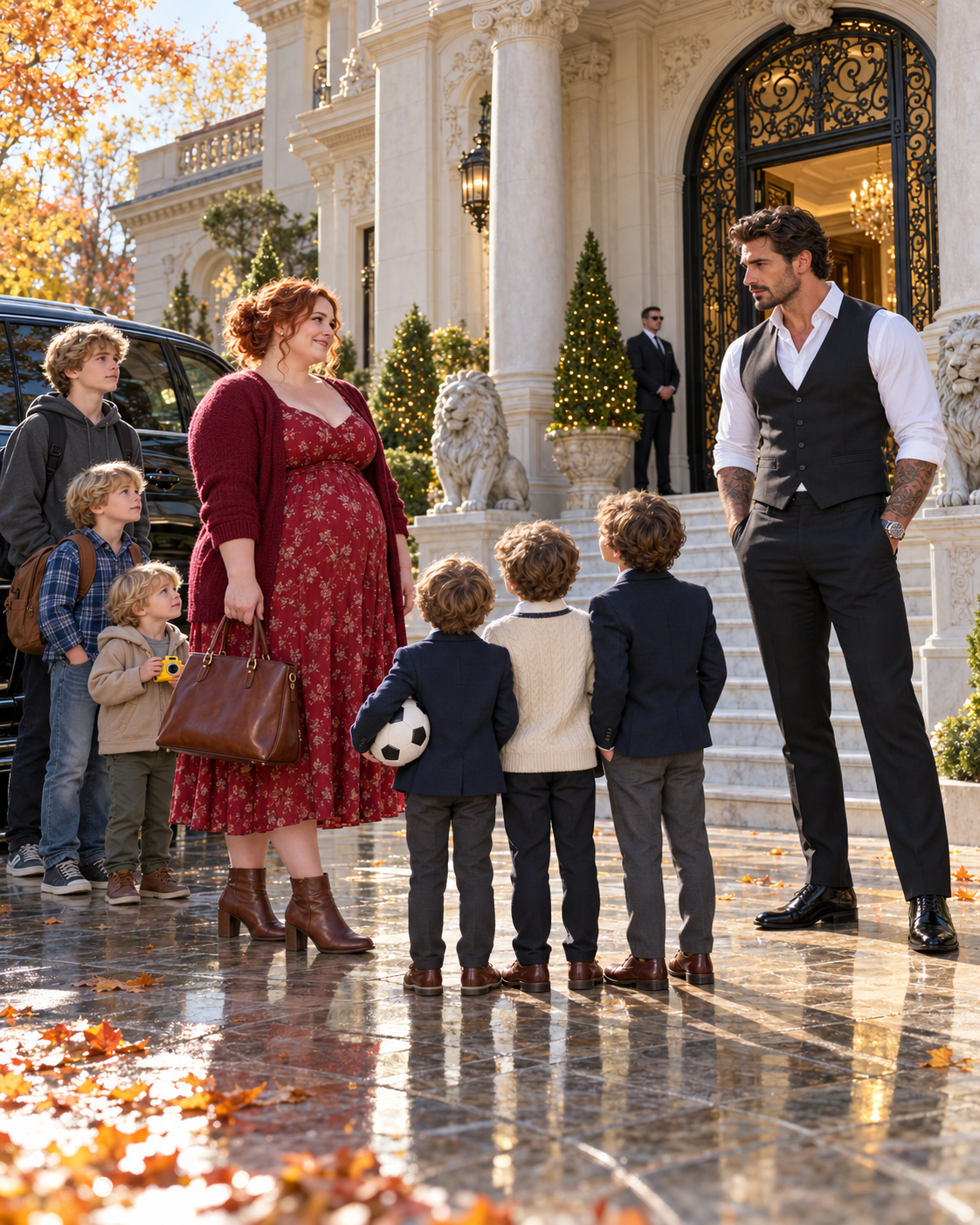
This time, however, his son didn’t retreat.
“No, Dad. I’m tired of pretending.”
The room grew painfully quiet.
“Mom was going to take us away, wasn’t she?”
Giordano’s face drained of color.
Tessa immediately guided the younger boys toward the dining room, but Nico clung to her hand.
“Why is everybody angry?”
“Because sometimes people are frightened by memories they don’t understand,” she whispered.
From the hallway, Lorenzo’s voice rose.
“I heard her crying that night!”
Then came Giordano’s answer.
“I know.”
Those two words stopped everyone.
Lorenzo stared at his father.
“You knew?”
Giordano slowly lowered himself into a chair.
For years, he had commanded men, negotiated dangerous deals, and built an empire that stretched across Chicago.
Yet facing his own son seemed to require more courage than anything he had ever done.
“Your mother wanted me to leave the business,” he admitted.
Lorenzo’s hands trembled.
“And you refused.”
“At first.”
“What does that mean?”
Giordano stared at the floor.
“It means she was right.”
Nobody moved.
He explained that Isabella had grown increasingly frightened of the life surrounding their family.
There were armed guards outside their home, whispered conversations behind locked doors, and strangers who knew far too much about their children.
She had begged him to walk away from the criminal organizations that had made him wealthy.
For years, Giordano had convinced himself that money and power could protect the people he loved.
Isabella had understood something he didn’t.
A guarded mansion was not necessarily a safe home.
On the night Lorenzo remembered, Isabella had told Giordano she was taking the boys to stay with her sister in Wisconsin until he made a decision.
They argued.
She cried.
And Giordano, too proud to admit his fear, told her she was overreacting.
The following morning, Isabella drove toward Milwaukee to visit her sister and arrange somewhere the children could stay.
She never arrived.
A truck lost control on an icy stretch of highway, causing a terrible collision.
The state investigation concluded it had been an accident.
But Lorenzo had spent three years believing the worst.
He believed his father had chosen his empire over his mother.
And Giordano had never corrected him because, deep inside, he believed the same thing.
“Did you love her?” Lorenzo finally asked.
Giordano lifted his head.
“More than I knew how to show.”
“Then why didn’t you listen?”
The question struck harder than any accusation.
Giordano covered his face with both hands.
“Because I thought being powerful meant never admitting I was wrong.”
For the first time in his life, Lorenzo saw his father cry.
Not loudly.
Not dramatically.
Just a broken man sitting in a kitchen where his wife once made terrible star-shaped pancakes.
Tessa quietly placed a cup of coffee beside him.
She didn’t offer comforting words.
Some grief deserved silence.
But just as the tension began to ease, Giordano’s phone rang.
His expression changed the moment he answered.
He listened without speaking, then stood so abruptly that his chair scraped across the floor.
“Keep everyone inside the house,” he instructed his security chief.
Tessa felt her stomach tighten.
“What’s happened?”
Giordano looked toward his children.
“Someone has been asking questions about this family.”
Within an hour, the mansion became a fortress.
Security guards checked the property.
Vehicles were moved behind locked gates.
And Giordano ordered the boys to remain indoors until further notice.
Lorenzo confronted him in the study.
“Is this because of your business?”
Giordano didn’t answer immediately.
That hesitation told his son everything.
Tessa found him later beside the kitchen window, staring at the rain.
“Your children are frightened,” she said.
“I know.”
“Then don’t make them guess what danger looks like.”
Giordano turned toward her.
“You don’t understand the people I’m dealing with.”
“You’re right,” Tessa replied. “But I understand what happens when children grow up feeling that the adults around them are hiding the truth.”
He looked away.
“My wife used to say something similar.”
“Then perhaps it’s time you listened.”
That evening, Giordano gathered his sons in the living room.
He told them that a former business associate was attempting to pressure him over an unresolved financial dispute.
He admitted that some of his past choices had exposed their family to risks they never deserved.
He didn’t tell them everything.
But he stopped pretending nothing was wrong.
Then he made a promise.
“I am going to change the way this family lives.”
Lorenzo folded his arms.
“You’ve promised things before.”
“I know.”
“Why should we believe you now?”
Giordano looked at his eldest son.
“Because this time, I’m not asking you to trust my words.”
Three days later, he contacted an attorney experienced in complex criminal matters.
He began cooperating with federal authorities through legal counsel, seeking a lawful path out of the activities that had defined his adult life.
It was not an easy decision.
There were investigations to face, relationships to sever, assets to examine, and consequences he could no longer escape.
He understood that changing his future would require accepting responsibility for his past.
For the first time, he was willing.
But the danger did not disappear simply because he decided to become a better man.
One bitter November afternoon, Tessa arrived at the mansion and found police vehicles outside the gates.
An unfamiliar car had followed the boys’ school bus through several neighborhoods.
The driver had disappeared before officers could question him.
No one had been harmed.
But Nico was terrified.
He refused to leave his bedroom.
Matteo paced the hallway.
And Lorenzo blamed his father for everything.
Tessa found Giordano standing alone in Isabella’s old sitting room, surrounded by photographs he had avoided for years.
“Maybe I should send them away,” he whispered.
“Where?”
“Somewhere safe.”
Tessa stepped closer.
“They need protection, yes. But they also need their father to stop disappearing whenever life becomes frightening.”
Giordano looked exhausted.
“What if I fail them again?”
“Then you get up and try to do better. That’s what parenting is.”
That night, Giordano made arrangements through his attorney and the authorities for the children to stay temporarily with Isabella’s sister, Margaret, in Madison, Wisconsin.
He asked Tessa to help prepare them for the move.
Lorenzo refused.
“I’m not leaving you here.”
Giordano stared at him.
Only weeks earlier, his eldest son had barely spoken to him.
Now the boy was frightened of losing him.
“You’re not leaving me,” Giordano said gently. “You’re giving me time to make things right.”
Lorenzo’s face crumpled.
“What if you don’t come back?”
Giordano pulled his son into his arms.
For several seconds, Lorenzo resisted.
Then he held on.
Tessa turned away, giving them privacy.
Two days later, the boys departed for Wisconsin under arrangements coordinated with the authorities.
The mansion suddenly became painfully quiet.
No arguments echoed down the hall.
No sneakers were abandoned near the staircase.
No one complained about the vegetables.
Even the enormous kitchen seemed to have lost its purpose.
Tessa continued working, helping Mrs. Donnelly organize the house while Giordano attended meetings with his attorneys.
But she could feel something changing between them.
Without the boys, they had more time to talk.
Giordano learned about Daniel, Tessa’s late husband, and the ordinary life they had built before the accident.
He listened as she described family camping trips, school concerts, and the way Daniel always burned toast because he refused to admit the toaster needed replacing.
In return, Giordano spoke about Isabella.
Not as a beautiful memory trapped inside a photograph, but as a real woman who laughed too loudly, loved gardening, and had once thrown his expensive Italian shoes into the yard because he tracked mud across her freshly cleaned floor.
For the first time, they could remember their spouses without treating those memories as wounds that must never be touched.
One evening, Giordano asked Tessa a question that surprised her.
“Do you think people like me deserve another chance?”
She considered her answer carefully.
“I think people can earn another chance by changing how they live. But forgiveness doesn’t erase responsibility.”
Giordano nodded slowly.
“And what about happiness?”
Tessa glanced toward the window.
“Happiness isn’t something we steal from the past. It’s something we learn to make room for again.”
Their eyes met.
Neither spoke.
But something quiet and unexpected passed between them.
A week later, the federal investigation became public.
News reports connected Giordano Castellari to a wide-ranging inquiry involving financial crimes and organized criminal activity in Illinois.
Reporters gathered outside the estate.
Former associates offered statements.
And the family’s private grief suddenly became a topic for strangers on television.
Tessa worried most about the boys.
She traveled to Madison with Giordano’s permission and found them waiting at Margaret’s comfortable brick house.
Nico nearly knocked her over with his hug.
“Are we ever coming home?”
Tessa knelt beside him.
“I hope so, sweetheart.”
“Is Dad going to jail?”
The question silenced the room.
Tessa refused to lie.
“I don’t know what will happen, Nico. Your father has some difficult things to face, and the people responsible for deciding what comes next will need time.”
Nico’s lower lip trembled.
“Does that mean he’s bad?”
Tessa brushed his hair from his forehead.
“It means he’s made choices that hurt people, and now he has to take responsibility. But making wrong choices doesn’t mean a person can never choose to do better.”
Lorenzo had been listening from the doorway.
Later, he approached her in the kitchen.
“Do you think my mom would forgive him?”
Tessa looked at the photograph Margaret kept above the fireplace.
“I can’t answer for your mother.”
Lorenzo nodded sadly.
“But I think she’d want you boys to grow into men who understand that love doesn’t mean pretending mistakes never happened.”
He was quiet for a while.
Then he whispered, “I miss her.”
Tessa took his hand.
“I know.”
“And I miss Dad too.”
This time, he didn’t hide his tears.
Winter settled over the Midwest.
Snow covered Chicago’s rooftops, and the Castellari estate stood almost deserted beneath the gray December sky.
Giordano’s legal troubles continued.
He entered a formal agreement with prosecutors, admitted his involvement in criminal financial dealings, and agreed to provide truthful cooperation under the supervision of the court.
His wealth could not purchase his innocence.
His influence could not erase his mistakes.
And for once, he did not try to make either happen.
He surrendered interests in several businesses, paid substantial penalties, and faced a sentence that would keep him away from home for a time.
When the judgment came, the courtroom was silent.
Tessa sat behind him beside his attorney.
She had not promised him that everything would be fine.
She had promised only that the boys would be cared for while he faced the consequences of his choices.
Before officers escorted him away, Giordano turned toward her.
“Tell them I love them.”
Tessa nodded.
“Tell them yourself. Write to them every week.”
A faint smile crossed his face.
“You really don’t let anyone escape responsibility, do you?”
“No, Mr. Castellari.”
He hesitated.
“Giordano.”
For the first time, she smiled and used his name.
“Take care of yourself, Giordano.”
The months that followed were difficult.
Without Giordano’s income and influence, the estate could no longer operate as it once had.
The mansion was eventually sold to satisfy legal obligations and help settle legitimate debts.
Mrs. Donnelly retired to be closer to her grandchildren.
The remaining staff found new employment.
And the four boys moved permanently into Margaret’s home while their father served his sentence.
Tessa returned to caring for her own children full-time and began looking for work closer to home.
But she didn’t disappear from the Castellari boys’ lives.
Every Sunday, she drove to Madison whenever she could, bringing homemade bread, cookies, and enough food to make Margaret complain affectionately that her refrigerator was becoming too small.
Sometimes Emma, Noah, and Sophie came along.
At first, the seven children were awkward together.
Then came board games, snowball fights, backyard soccer matches, and arguments over whose turn it was to wash the dishes.
Ordinary family chaos slowly replaced the painful kind.
Lorenzo began helping Noah with math.
Matteo taught Emma how to play guitar.
Adrian discovered that Sophie loved drawing as much as he did.
And Nico finally learned that people could leave for a little while and still come back.
Meanwhile, Giordano wrote letters.
Not excuses.
Not promises of extravagant gifts.
Just honest letters about the books he was reading, the mistakes he regretted, and the things he hoped to do differently when he returned.
Lorenzo kept every one.
During that period, Tessa made a decision of her own.
With the savings she had carefully set aside, a small business loan, and encouragement from Margaret, she opened a modest neighborhood café on Chicago’s North Side.
She called it Second Chances Kitchen.
The menu featured homemade soups, blueberry muffins, fresh bread, and star-shaped pancakes inspired by the stories the Castellari boys had told her about Isabella.
Above the entrance hung a simple wooden sign.
“Everyone deserves a place at the table.”
The café was not immediately successful.
There were slow mornings, unexpected repair bills, and nights when Tessa wondered whether she had made a terrible mistake.
But neighbors began returning.
A retired teacher brought her friends.
Construction workers stopped for coffee before sunrise.
Single parents discovered that Tessa always kept a few affordable meals available for families struggling to make ends meet.
Eventually, Second Chances Kitchen became more than a café.
It became a place where people felt welcome.
Two years passed.
On a bright spring morning, Tessa was arranging fresh flowers beside the register when the bell above the café door rang.
She looked up.
A tall man stood in the entrance wearing a simple navy coat, carrying a small suitcase, and looking strangely nervous.
For a moment, she couldn’t speak.
Giordano Castellari had returned.
He looked older.
The sharp edges of his former arrogance had softened.
There were new lines around his eyes, but his expression carried something she had never seen when they first met.
Peace.
“Do you have a table available?” he asked.
Tessa folded her arms.
“That depends. Are you planning to frighten away nine cooks?”
He laughed.
A genuine, unguarded laugh.
“I’ve retired from that business.”
She led him to a table beside the window.
He glanced at the menu and stopped when he saw the star-shaped pancakes.
“Isabella would have loved this.”
Tessa sat across from him.
“I hoped the boys might.”
Giordano looked around at the warm little café, the families sharing breakfast, and the handwritten messages pinned near the counter.
“You built something wonderful.”
Tessa smiled.
“I had help.”
He shook his head.
“No, Tessa. You built the kind of place I spent my entire life trying to buy, without ever understanding what made it valuable.”
Before she could answer, the door opened again.
Four young men hurried inside.
Lorenzo was first.
Matteo followed with Adrian, while Nico nearly collided with a chair as he rushed across the room.
“Dad!”
Giordano barely had time to stand before all four sons surrounded him.
There were tears.
There was laughter.
There were apologies spoken between embraces.
And for several beautiful minutes, nobody cared that the entire café was watching.
Margaret entered behind them, followed by Tessa’s three children.
The little café filled with joyful noise.
Giordano looked at Tessa over his sons’ shoulders.
She understood that look immediately.
It was gratitude.
Not because she had rescued his family.
But because she had reminded them that they were worth saving.
In the months that followed, Giordano worked to rebuild his life legally and quietly.
He took a modest position with a legitimate logistics company, attended counseling, and continued repairing his relationships with his sons.
He no longer had a mansion.
He no longer traveled with armed security.
And he no longer expected his name to open every door.
But when his children called, he answered.
When they needed him, he showed up.
And when he made mistakes, he apologized.
One summer evening, after the café closed, Giordano stayed behind to help Tessa stack chairs.
The last rays of sunlight glowed against the Chicago skyline.
“Tessa,” he said carefully, “I’ve spent a long time thinking about what you told me that first night.”
She looked up.
“Which part?”
“That my sons needed someone willing to listen.”
He set down the chair he was holding.
“I think I needed that too.”
Tessa smiled softly.
“We all do sometimes.”
Giordano hesitated.
“I don’t know what the future looks like, and I won’t pretend the past has disappeared. But I’d like to take you to dinner sometime, somewhere you aren’t responsible for cooking.”
Tessa laughed.
“That would be a welcome change.”
“Is that a yes?”
She considered him for a moment.
Then she nodded.
“One dinner, Giordano. And no expensive gestures.”
He raised both hands.
“Understood.”
Their relationship developed slowly.
There were no grand declarations or sudden fairy-tale transformations.
They talked honestly about grief, family, regret, and the complicated emotions that came with loving someone new.
They respected the memories of Daniel and Isabella.
They never expected their children to forget the parents they had lost.
And they allowed trust to grow through ordinary acts of kindness rather than promises too large to keep.
A year later, all seven children gathered for Thanksgiving at Tessa’s house.
The dining table was too small.
Someone burned the dinner rolls.
Nico spilled cranberry sauce.
Matteo complained that Lorenzo had stolen the best piece of turkey.
Emma played music too loudly.
And Sophie insisted everyone share one thing they were thankful for before dessert.
When Giordano’s turn came, he looked around the crowded room.
There were no expensive chandeliers.
No marble floors.
No guards standing outside.
Just mismatched chairs, homemade food, and people who had chosen to remain together through difficult seasons.
He cleared his throat.
“I’m thankful that I finally learned what a home is.”
Lorenzo looked at his father.
“And what’s that?”
Giordano smiled.
“It’s not the building. It’s the people who are willing to love one another, tell each other the truth, and stay long enough to work through the hard things.”
Tessa reached for his hand beneath the table.
Across from them, Nico proudly raised a star-shaped pancake he had insisted on saving for dessert.
“Mom would like this,” he said.
Nobody looked away.
Nobody changed the subject.
Giordano nodded, his eyes shining.
“Yes, son. I think she would.”
Later that evening, Tessa stood alone in the kitchen, washing the last few dishes.
Giordano joined her with a towel.
For a while, they worked in comfortable silence.
Then he noticed the two old drawings still hanging on her refrigerator.
One showed Tessa and her three children beneath a rainbow.
The other showed the Castellari boys asking someone not to leave them.
Between them was a newer photograph.
All nine of them were standing outside Second Chances Kitchen, laughing in the afternoon sunlight.
Giordano studied it for a long moment.
“When you first came to my house,” he said, “I thought I was hiring someone to prepare meals.”
Tessa smiled.
“And I thought I was accepting a job to pay my bills.”
He looked at the picture again.
“Funny how life works.”
She nodded.
“Sometimes the people we think we’re helping end up changing us just as much.”
Outside, the first snowflakes of the season began drifting over the quiet Chicago streets.
Inside, laughter echoed from the living room.
And for the first time in years, neither Tessa nor Giordano felt afraid of what tomorrow might bring.
They had both lost people they loved.
They had both experienced days when hope seemed impossible.
And they had both discovered that beginning again didn’t require forgetting everything that came before.
It required courage.
It required honesty.
And sometimes, it required nothing more extraordinary than showing up, setting another plate on the table, and reminding someone that they still belonged.
Because the greatest families are not always the ones connected by blood, wealth, or perfect histories.
Sometimes they are built by people who have known loss, learned forgiveness, accepted responsibility, and chosen kindness when bitterness would have been easier.
And Giordano Castellari, a man who once believed power could give him everything, finally understood the one truth his late wife had tried so desperately to teach him.
A house can be protected by walls, money, and security guards, but a home can only be protected by love, honesty, and the everyday decision to care for one another.
THE END.