“You’re Just a Nurse!” the Chief Surgeon Snapped—Then the SEAL’s K9 Chose Her
“You’re Just a Nurse!” the Chief Surgeon Snapped—Then the SEAL’s K9 Chose Her
The emergency room doors slammed open at 2:47 in the morning, and the freezing winter air rushed into Raven Creek Military Hospital before anyone had time to understand what was happening. Outside, a violent snowstorm was sweeping across the region, turning the roads into sheets of ice and burying everything beneath a thick layer of white. Inside, the hospital was already struggling to keep up with a night that had become increasingly difficult. Half the building was running on backup power, the generators were cycling unpredictably, and nearly every trauma bay was occupied. Nurses hurried between rooms, physicians called out instructions, and monitors filled the corridors with their relentless electronic beeping. Nobody expected the next arrival to change the course of the entire hospital.
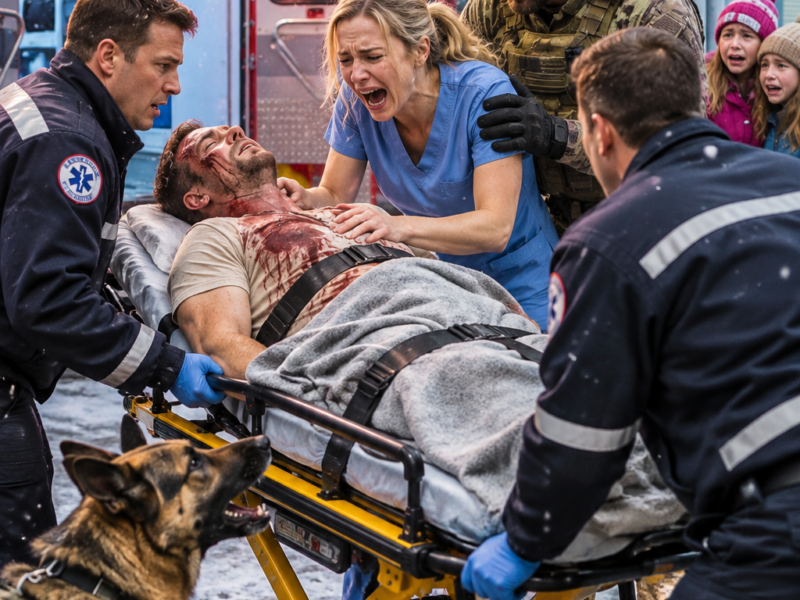
A Navy SEAL was being rushed through the ambulance entrance on a stretcher. He was unconscious, covered in blood, and suffering from three gunshot wounds. His left shoulder was wrapped in trauma gauze that had already become saturated, while his right forearm was secured with a pressure dressing that was barely controlling the bleeding. His vital signs were deteriorating rapidly. Every passing second brought him closer to a point from which even the most experienced medical team might struggle to bring him back.
Behind the stretcher came a large Belgian Malinois wearing a tactical vest. The dog was pulling hard against his leash, his muscular body tense, his amber eyes fixed on the wounded soldier. A military officer held the leash with both hands, struggling to keep the animal away from the medical personnel rushing toward the trauma bay.
Standing near the nurses’ station was Emily Carter, a twenty-nine-year-old registered nurse who had been working at Raven Creek for three years. Her identification badge read Staff Nurse, Level Two. To most people in the hospital, that small designation defined exactly who she was and how much authority she possessed. She was competent, dependable, and known for her calmness under pressure, but she was not a physician, and the hospital’s hierarchy made sure everyone understood the difference.
Emily had already been working for nineteen hours.
She had originally been scheduled to finish her shift at three in the afternoon the previous day, but the nurse assigned to relieve her had called in sick. No replacement had been available, and Dennis Kowalski, the charge nurse, had simply pointed toward the staffing board and told her that she could either stay or find someone willing to cover the position. Emily stayed. She had spent the night inserting IV lines, administering medication, documenting patient histories, correcting a potentially dangerous dosage error, and helping several exhausted colleagues manage an emergency department that seemed determined to produce one crisis after another.
She had barely eaten half a granola bar.
Despite her exhaustion, her attention remained sharp. She noticed things other people sometimes overlooked, and she had learned long ago that remaining calm could be more valuable than appearing confident.
When the wounded soldier entered Trauma Bay One, Emily immediately recognized the danger in his breathing pattern. His left side was moving differently from his right. The breath sounds were diminished, and the trajectory of the shoulder wound suggested that the injury might involve something deeper than the visible damage.
She had barely finished assessing him when Dr. Marcus Hargrove, Raven Creek’s chief surgeon, entered the room.
Hargrove was fifty-three, silver-haired, and accustomed to being treated as the most important medical authority in the building. He had spent nine years cultivating his reputation, publishing research on military trauma procedures and building relationships with hospital administrators. His colleagues respected his credentials, while the administration regarded him as one of the institution’s greatest professional assets.
He took one look at the patient and began issuing orders.
“Clear the bay. I need Duval and Reyes in here. Respiratory on standby.”
Emily stepped forward.
“Doctor, his breath sounds on the left are diminished.”
Hargrove turned toward her with an expression that suggested she had interrupted something important.
“I’m aware of how to assess a patient, Nurse Carter.”
“I understand. I just wanted to point out—”
“Stay out of this. This is beyond your scope. Go back to your station.”
The words were quiet, but their meaning was unmistakable.
Emily stepped away.
However, she did not completely leave the area. She positioned herself near the edge of the curtain, where she could still observe the medical team. Something about the situation bothered her, and she could not convince herself to ignore it.
The dog was bothering her, too.
The Belgian Malinois was not behaving like an ordinary distressed working dog. He was not barking, snapping, or desperately searching for attention. Instead, he was staring at the wounded soldier with an almost unnerving concentration, as though he were monitoring the patient’s condition.
The military officer tried moving him several feet away from the stretcher.
The dog resisted, then turned his head and looked directly at Emily.
Their eyes met.
For a moment, she felt something strange, a faint sense of recognition she could not explain.
“Easy, Blaze,” the officer murmured.
The dog continued watching her.
Inside the trauma bay, Hargrove was moving quickly through the initial assessment. The attending physician, Dr. Duval, confirmed his orders, while a respiratory technician prepared equipment for intubation. The patient’s numbers improved briefly, then began falling again.
Emily watched the monitor.
She knew what she was seeing.
The diminished breath sounds, the wound trajectory, the patient’s increasingly unstable oxygen saturation, and the pattern of deterioration pointed toward a tension pneumothorax. Air was accumulating in the pleural space, compressing the lung and interfering with the body’s ability to maintain circulation.
If they intubated him before relieving the pressure, they could make the situation considerably worse.
She had seen this pattern before.
Not in a comfortable hospital trauma bay, but in places where the sound of incoming fire could be heard beyond the walls and where medical personnel had to make decisions without the luxury of waiting for someone senior to arrive.
She took a step toward the curtain.
“Doctor Hargrove, I believe there’s air accumulating in the left pleural space. The wound trajectory suggests this isn’t just soft-tissue damage. You need to decompress before intubating.”
The room fell silent.
Hargrove looked at her.
“Remove her.”
Dennis Kowalski appeared near the doorway and gently touched Emily’s arm.
“Come on, Emily.”
She allowed him to guide her into the corridor.
Forty seconds later, the alarm sounded.
It was the unmistakable tone of a patient deteriorating rapidly. The monitor’s rhythm changed, voices inside the room became sharper, and someone called for additional equipment.
Emily closed her eyes briefly.
She had known this was coming.
When she returned through the curtain, nobody attempted to stop her.
“Needle decompression kit,” she called.
Sandra Okafor, an experienced nurse who had worked beside Emily for years, immediately handed her the equipment. Sandra looked alarmed, but she did not argue.
Emily located the anatomical landmark and prepared to perform the procedure.
Hargrove began protesting.
“You are not authorized to—”
“Second intercostal space, midclavicular line,” Emily said, speaking more to herself than to him.
Her hands did not shake.
They never did when something important needed to be done.
She performed the decompression.
The release of trapped air was immediate.
The monitor responded gradually. First one number improved, then another. The patient’s oxygen saturation, which had been dangerously low, began climbing.
The respiratory technician stared at the screen.
“She’s coming up.”
Emily stepped back slightly.
“Intubate now. He’s stable enough. Do it.”
Duval moved immediately, and the procedure was completed.
Within moments, the alarms stopped.
The patient was still critically ill, but he was no longer spiraling toward cardiac arrest.
Emily removed her gloves and stepped away.
Hargrove turned toward her.
There was no gratitude in his expression. No acknowledgement that she had identified the problem or that her intervention had helped save a man’s life.
Instead, his face carried the unmistakable anger of someone who had been publicly challenged.
“Get out of my trauma bay.”
His voice was low.
Emily left without answering.
Outside, she leaned against the hallway wall and took a slow breath. Her hands remained steady, but inside her chest, something was tightening.
A few feet away, the Belgian Malinois was still watching her.
She approached him cautiously.
“Good boy.”
The dog moved as close as his leash allowed and pressed the top of his head against her hand.
Emily gently touched his fur.
The officer holding the leash stared at them.
“He doesn’t do that,” he said.
Emily looked up.
“Do what?”
“Approach strangers like that. Especially in a hospital.”
“Maybe he’s just having a difficult night.”
The officer shook his head.
“Blaze has been through four combat deployments and two major training cycles. I’ve seen him around hundreds of people. He doesn’t behave this way with strangers.”
Emily withdrew her hand.
The man’s name was Lieutenant Cord Rainer. He was the operational liaison accompanying the wounded SEAL, Petty Officer First Class Dale Warick.
The patient had survived the initial emergency, but his condition remained serious.
Emily returned to the nurses’ station and finished documenting the chart she had been working on before the ambulance arrived. She recorded the patient’s initial presentation, the observed deterioration, the intervention, and the subsequent improvement. Her documentation was precise and clinical.
Thirty minutes later, Dennis approached her.
“Hargrove wants to see you.”
“Tonight?”
“Apparently.”
Emily nodded.
“All right.”
Dennis hesitated.
“Emily, you probably should have let them handle it.”
She looked at him.
“He would have died.”
Dennis lowered his eyes.
“I know.”
There was a long silence.
Then he added, “That’s not really the point around here.”
Emily understood.
She had worked at Raven Creek long enough to recognize the difference between medicine and institutional medicine. One was concerned with the patient in front of you. The other was concerned with hierarchy, liability, reputation, and the preservation of established authority.
Sometimes those priorities aligned.
Sometimes they did not.
At 4:15, Rainer found Emily in the supply hallway and offered her a cup of coffee.
She accepted it despite the terrible taste.
“How long have you been a nurse?” he asked.
“Three years at this hospital.”
“And before that?”
She looked at him over the coffee cup.
“Why do you ask?”
“Because Blaze recognized something about you.”
“He’s probably just tired.”
Rainer shook his head.
“I’ve been with him for six years. He doesn’t do that.”
Emily thanked him for the coffee and returned to work before he could ask another question.
But his curiosity stayed with her.
At 6:30, Dale Warick had been stabilized and transferred to the surgical intensive care unit. Sandra mentioned that a senior military officer had visited him and asked specifically about the nurse who had performed the emergency decompression.
Then Dennis returned.
“Hargrove moved your meeting to eight. His office.”
Emily finished her documentation.
At that moment, she noticed movement behind the glass separating the nurses’ station from the intensive care unit.
Warick’s eyes had opened.
He slowly turned his head and looked directly toward her.
His lips moved beneath the intubation tape.
Emily could not hear him, but she knew how to read the shape of words.
You were there before.
Her pen stopped.
For several seconds, she remained motionless.
Then Warick’s eyes closed, and the sedation pulled him back into unconsciousness.
Emily finished her notes, handed over her patients, and changed out of her scrubs.
She had fifty-three minutes before the meeting.
She spent part of that time drinking another terrible coffee in a quiet waiting area outside radiology.
Sandra eventually found her.
“Hargrove has already spoken to administration.”
Emily looked up.
“He called Gerald Bowmont at six this morning. He’s filed a formal complaint against you.”
“What kind of complaint?”
“Practicing outside your scope. He’s describing your intervention as an unauthorized invasive procedure that compromised the treatment environment.”
Emily held the coffee cup between both hands.
“The patient’s oxygen saturation went from eighty-two to ninety-seven in four minutes.”
“I know. I was there.”
Sandra’s voice remained calm.
“But Hargrove is framing it as patient endangerment.”
Emily stared at the floor.
She understood what was happening. The surgeon was preparing to protect himself by turning the situation into a disciplinary issue against the nurse who had contradicted him.
The meeting was held in Hargrove’s office.
Present were Hargrove, hospital director Gerald Bowmont, Dennis Kowalski, and a civilian man Emily had never met.
The man was in his fifties, dressed plainly, and carried himself with a quiet authority that did not seem connected to the hospital.
Hargrove began by discussing protocol.
Bowmont followed with references to professional scope, liability exposure, and institutional responsibility.
Neither man seemed particularly interested in discussing the fact that Dale Warick was alive.
Emily listened until there was an opportunity to speak.
“Mr. Warick is alive,” she said.
“That is not the point of this conversation,” Bowmont replied.
“With respect, sir, it should be.”
Hargrove leaned forward.
“This institution has established protocols for exactly these circumstances. Those protocols exist to protect patients and staff. When they are circumvented, regardless of the outcome, they create unacceptable legal and operational risks.”
Emily looked directly at him.
“His oxygen saturation was dropping approximately four points per minute. We were approaching a critical window. I believed he had a tension pneumothorax, and the numbers supported that assessment.”
“You are not a physician.”
“I know.”
“Then you should understand the limits of your authority.”
“I understand the limits of my authority. I also understood what was happening to that patient.”
Bowmont shifted uncomfortably.
The civilian man finally spoke.
“Miss Carter, I have one question. What is your current assessment of Mr. Warick’s prognosis?”
Hargrove immediately objected.
But the man ignored him.
Emily answered carefully.
“If there is no secondary hemorrhage, his chances are good. His lung needs close monitoring for the next seventy-two hours. His shoulder repair will be complicated, depending on the imaging, but he responded well after decompression and intubation. If nothing changes, I believe he’ll survive.”
The man nodded.
“Thank you.”
Emily was informed that she would be suspended with pay for two weeks pending an administrative review.
She accepted the decision without arguing.
Outside the office, Cord Rainer was waiting with Blaze.
“They suspended you?” he asked.
“Pending review.”
He nodded.
“The civilian in there was Aldis Ren. He’s a federal medical oversight liaison.”
Emily frowned.
“Why is he here?”
“Because Dale Warick isn’t simply another wounded soldier. He’s a team leader in an active classified program. His medical transport triggered a federal review protocol.”
Rainer paused.
“There’s something else. Your name is connected to an operational record that Ren has been investigating for two years.”
Emily felt her stomach tighten.
“What record?”
“That’s what we’re trying to establish.”
They went to a small diner two blocks from the hospital.
Emily ordered eggs and toast because she had not eaten properly since the previous afternoon.
For several minutes, neither spoke.
Then she finally said, “I wasn’t always a nurse.”
Rainer waited.
“I was a combat trauma medic attached to an Emergency Rescue and Vascular Evacuation unit. We conducted hot extractions, stabilized critically wounded personnel, and evacuated people from forward positions when standard medical evacuation wasn’t possible.”
“How long?”
“Six years.”
“What happened?”
Emily stared at her coffee.
“My last deployment.”
She explained that the final operational cycle had ended with three deaths. Two were officially attributed to hostile action. The third was classified as a training accident.
But Emily had been first on the scene of that third death.
She knew what she had seen.
The circumstances did not match the official report.
She had filed an informal query through the chain of command, believing someone would investigate.
Two weeks later, she was separated from military service.
Her file was sealed, and she was told that the circumstances were classified and that her separation was in the best interest of the program.
She had been twenty-six years old.
Exhausted, frightened, and uncertain whom she could trust, she had accepted the decision. She obtained her nursing degree and found work at Raven Creek, believing that a hospital would allow her to use her medical abilities without returning to the world she had left behind.
Rainer listened without interrupting.
Then he explained that Warick’s operational history crossed into the same program. It was possible that he had been among the personnel Emily had stabilized during her deployments.
He also explained something about Blaze.
Before becoming Warick’s working dog, Blaze had belonged to another handler, a specialist named Tomas.
Tomas had died in the same operational environment where Emily’s unit had served.
Emily went still.
She remembered Tomas.
She remembered the deployment.
And suddenly the dog’s behavior seemed less mysterious.
Rainer placed a folded document on the table.
It contained preliminary findings from Ren’s investigation.
The most important conclusion was that the three deaths during Emily’s final deployment might not have resulted from enemy action or accident.
Evidence suggested they were connected to a deliberate pattern of information suppression involving operational decisions made above her command level.
Emily read the document twice.
“How long have you known?”
“Three months,” Rainer replied. “Ren has been investigating for two years.”
Before she could ask another question, her phone rang.
It was Sandra.
“Emily, you need to come back to the hospital.”
“What happened?”
“Hargrove has submitted a request to transfer Warick to another facility. He’s claiming your intervention may have caused complications.”
Emily looked at Rainer.
He immediately understood.
Hargrove was trying to move Warick before the federal review could examine his medical and operational records.
The transfer had been authorized through Bowmont’s office and scheduled for 9:15 that morning.
It was already 8:47.
Emily and Rainer rushed back to the hospital.
They found the surgical intensive care corridor crowded with administrative personnel and a transport team preparing a stretcher.
Warick’s vital signs were stable, but he remained intubated and was still within the critical monitoring period following his lung injury.
Moving him prematurely would introduce unnecessary risks.
Emily immediately went looking for Ren.
She found him in Conference Room B, speaking with regional military medical authorities.
The transfer authorization had technically been granted by someone with the appropriate signature authority. However, the approval appeared to have been based on incomplete or misleading information about Warick’s condition.
Ren turned his laptop toward Emily.
“I can designate you as a federal medical consultation resource. That designation supersedes the hospital’s suspension.”
Within minutes, the paperwork was completed.
Emily sat down and documented everything she knew about Warick’s condition, the risks associated with moving him, and the medical reasons the transfer should be stopped.
Her report was clinical, specific, and supported by the patient’s recorded vital signs.
Ren read it and immediately began making calls.
At 9:09, the transport team was ordered to stand down.
The transfer was suspended pending federal medical review.
For the first time that morning, Emily felt that the truth might actually have a chance to survive the institution attempting to bury it.
Rainer sat across from her.
“Ren needs more than the report you just wrote. He needs to understand what happened during your last deployment.”
Emily looked down at her hands.
“There were three deaths,” she said quietly. “Two listed as hostile action. One listed as a training accident. I was first on scene for the third. I knew the report was wrong.”
She described the scene, the inconsistencies, and the query she had filed.
When she finished, Rainer remained silent.
Then he admitted something.
“I was there for one of them.”
Emily looked at him.
He had also been connected to the operational environment during the period under investigation.
At 9:32, Ren returned and explained that the transfer had been permanently blocked pending the federal investigation.
He then placed a digital recorder on the table.
Emily gave her formal statement.
For forty minutes, she described the deployment, the people who had died, the circumstances surrounding the supposed accident, and the events leading to her separation.
Ren listened carefully.
When she finished, he explained that the deaths were not isolated incidents. Investigators had discovered evidence of a deliberate pattern of suppressing concerns raised by personnel who questioned an operational decision.
Emily’s query had been the fourth documented instance.
The response to it, including the sealed file and expedited separation, had followed the same pattern.
The investigation was getting closer to identifying the people responsible.
Warick was connected to the same program, and investigators believed he might possess additional evidence.
That explained why someone had tried so urgently to transfer him.
Emily left the conference room and returned to the intensive care unit.
She wanted to see Warick.
As she stood outside his room, another monitor alarm sounded farther down the corridor.
A patient in Bay Seven was experiencing intermittent ventricular tachycardia.
The nurse on duty, a young man named Torres, was already attempting to assess the situation.
Emily stepped inside.
She reviewed the patient’s medication reconciliation and immediately noticed a potentially dangerous dosing problem.
An antiarrhythmic medication had been prescribed at an appropriate dose when the patient was admitted, but his kidney function had deteriorated overnight. The medication was accumulating in his system, and his heart rhythm was beginning to reflect that problem.
“Get Dr. Duval,” she instructed Torres. “Tell him this is a medication accumulation issue. We need a revised order immediately.”
Duval arrived four minutes later.
He examined the laboratory results, recognized the problem, and revised the dosage.
The patient’s rhythm gradually stabilized.
“Good catch,” Duval said quietly.
Emily nodded.
“The overnight reconciliation process needs review. This shouldn’t have reached morning.”
Duval agreed.
It was not a dramatic intervention, but it was precisely the kind of ordinary vigilance that prevented medical emergencies.
When Emily returned to the corridor, Hargrove stepped out of the elevator.
He looked surprised to see her.
“I wasn’t aware you still had access to the intensive care unit.”
“Federal consultation designation. It was approved at 8:53.”
His jaw tightened.
“I’m going to need to discuss the limits of that designation with Mr. Ren.”
“He’s in Conference Room B. He’s expecting you.”
Hargrove clearly had not anticipated that response.
Emily also informed him about the medication reconciliation error in Bay Seven and recommended a departmental quality review.
Hargrove said it would be addressed, then walked away.
Rainer watched him disappear down the corridor.
“He’s trying to find out what you know,” Emily said.
“And now he’s going to find out what Ren knows.”
Twelve minutes later, Ren emerged from the conference room.
He explained that Hargrove had attempted to justify the transfer using information that did not appear in Warick’s medical chart.
Instead, the details came from the soldier’s classified operational file.
Someone had provided Hargrove with information he should never have possessed.
That discovery connected the hospital’s actions directly to the wider investigation.
Hargrove was not simply attempting to protect himself from a clinical mistake.
He was potentially participating in an organized effort to prevent federal investigators from accessing evidence.
Soon afterward, Ren received another update.
Warick’s sedation was being reduced, and the patient was expected to regain consciousness within the next thirty to forty-five minutes.
There was something else.
During the sedation reduction, Warick had repeatedly attempted to write something on the back of his hand.
A name.
Emily immediately went to his bedside.
She sat beside him and spoke quietly.
“I’m here.”
Nine minutes later, his eyes opened.
He looked at her with the unmistakable recognition of someone who had been waiting for a familiar face.
His lips moved around the breathing tube.
You came back.
Emily leaned closer.
“I never left.”
He slowly moved his head, indicating that he meant something else.
She understood.
He was talking about the past.
She asked him questions, requesting that he blink once for yes and twice for no.
Had someone approached him before his deployment?
One blink.
Had he provided information about the deaths during the last operational cycle?
One blink.
Did he know the person who had contacted him?
One blink.
Could he write the name?
Emily gave him a pen and offered her forearm as a writing surface.
With considerable effort, Warick formed several letters.
The name was Marcus Aldrin.
When Ren entered the room shortly afterward, he saw the name written on Emily’s arm and immediately recognized it.
“Not here,” he said.
He led Emily to a family waiting room where two federal investigators were waiting.
One introduced herself as Agent Sariah Vance.
Ren explained that Marcus Aldrin was a senior director within a defense contracting organization that had held military medical service contracts for eleven years.
His signature appeared on several internal communications recommending expedited separation for personnel who raised concerns during Emily’s final service cycle.
Her query had reached her command, been flagged upward, and eventually landed on Aldrin’s desk.
He had recommended that her file be sealed.
The military medical command had authorized the action.
There was another connection.
Aldrin and Marcus Hargrove served together on the board of a medical research foundation that had received funding from Aldrin’s contracting organization.
The relationship explained how Hargrove had obtained access to Warick’s operational information.
It also explained why he had attempted to arrange the transfer.
Warick’s file contained evidence corroborating the investigation.
If the patient remained under federal medical review, investigators could examine that evidence without the jurisdictional complications that would arise from transferring him elsewhere.
Agent Vance explained that Hargrove was currently in his vehicle in the hospital parking structure.
His phone records were being subpoenaed.
One of his recent calls had gone to a number associated with Aldrin’s organization.
The investigation was expanding.
Emily asked what would happen to Hargrove.
Vance explained that his exposure was significant. The attempted transfer could constitute obstruction if investigators established that he had knowingly acted on improperly obtained information.
His clinical record would also be reviewed.
The overnight medication error in Bay Seven was only one concern.
Investigators had already requested a broader examination of the previous four years at Raven Creek.
Emily also asked about her own service record.
Ren explained that if Aldrin’s recommendation to seal it was found to be procedurally improper, the restriction could be removed.
Her full record, including her commendations, could be restored.
For the first time in three years, Emily allowed herself to imagine what it might feel like to see her own history again.
Ren advised her to rest.
She had been awake for approximately twenty-seven hours, and there was still more work to do.
Emily found an empty call room on the second floor and fell asleep almost immediately.
Three hours later, Sandra called.
Hargrove had returned to his office and made an announcement in front of the nursing staff.
He claimed that any clinical decisions made outside standard protocol during the previous twenty-four hours were the direct result of interference by a suspended employee.
He announced that he intended to make a full accounting of the harm supposedly caused.
Emily understood his strategy.
He was preparing witnesses.
If investigators eventually questioned the staff, he wanted them to remember him as the surgeon who had publicly expressed concern about protocol violations.
He was attempting to build a defensive narrative before the investigation could establish what had actually happened.
Emily returned to the hospital.
Ren explained that Hargrove had come back because his attorney had advised him that leaving the premises could be interpreted as flight. He also suspected the surgeon wanted access to his office records.
However, investigators had already placed a hold on the relevant files and suspended his system credentials.
Hargrove could no longer access the records he might have hoped to alter.
At approximately eleven in the morning, the federal quality review became a matter of public record.
Hargrove eventually agreed to answer preliminary questions voluntarily with his attorney present.
The investigators began interviewing him.
Meanwhile, Ren informed Emily that the wider criminal investigation would take longer. The hospital’s conduct could be addressed immediately, but the deaths and the suppression of military medical information involved additional agencies and a more complicated legal process.
Emily understood.
She had spent enough years in military operations to know that some battles were decided in hours while others took months or years.
At 12:47, Gerald Bowmont approached the nurses’ station.
He informed Emily that the Federal Oversight Office had directed the hospital to treat her suspension as administratively nullified.
She was reinstated to her clinical position effective 11:59 that morning.
Sandra stood beside her, listening.
“Administratively nullified,” Sandra repeated after Bowmont left.
“It means it’s gone,” Emily replied.
“I know what it means. I just wanted to say it out loud.”
That afternoon, at 3:14, the pulmonologist determined that Warick was ready for extubation.
Emily stood nearby while the breathing tube was removed.
The first breaths were difficult. His throat was irritated, and his lungs needed time to adjust. But gradually, his breathing became more regular.
His eyes opened fully.
He looked at Emily.
“Hey,” he whispered.
“Hey.”
“You look terrible.”
She almost laughed.
“I’ve been awake for a long time.”
“Me, too.”
He shifted carefully against the bed and looked around.
After a few moments, his attention returned to the name written on his hand.
“Did you read that?”
“I did. Ren knows the name.”
Warick’s expression relaxed.
He explained that he had begun communicating with a federal contact six weeks earlier. During the process, he had reviewed personnel records from the region and discovered Emily’s name.
He remembered her from the final operational cycle.
He had suspected that if investigators ever needed someone who could confirm the timeline from inside the unit, Emily would be the person.
She told him she remembered the training accident.
“It wasn’t a training accident,” Warick said.
“I know.”
He looked at her for a long moment.
“You filed a query. Two weeks later, you were separated.”
“I know.”
“I found out afterward. I’ve been carrying that for a long time.”
Before Emily could respond, Rainer entered the room with Blaze.
The dog’s reaction was immediate.
Warick looked at him, and something changed in his expression. It was the unmistakable emotion of a man encountering someone he had feared he might never see again.
“Hey, buddy.”
Blaze made a low sound and approached the bed.
Rainer loosened the leash, allowing the dog to place his chin on the blanket near Warick’s hand.
For several moments, nobody spoke.
Emily quietly stepped toward the door.
“Don’t deserve any of what happened to you,” Warick said before she left.
She stopped.
He continued.
“I know what you did during that last cycle. I know what it cost. And I know what they did to you for asking questions afterward.”
Emily nodded once.
It was all she could manage.
At 4:51 that afternoon, Marcus Hargrove was formally placed on administrative leave by federal order.
His clinical privileges were suspended pending the quality review and obstruction investigation.
At 5:17, Bowmont issued a facilitywide communication acknowledging the federal review.
The announcement was carefully worded, but everyone in the hospital understood what it meant.
Hargrove’s nine-year tenure was effectively over.
Emily read the message beside Sandra at the nurses’ station.
“Nine years,” Sandra said.
“Yes.”
“Did you know?”
Emily shook her head.
“I knew he was the kind of person who put the institution ahead of the work. I didn’t know how far it went.”
The investigation would determine the rest.
At 6:40, Ren returned with a tablet.
“The seal on your service record has been lifted.”
Emily took it.
Her name appeared at the top, followed by six years of service, her unit designation, and her operational history.
She scrolled through the deployment records.
Some of the locations were familiar only through memories of heat, cold, dust, rotor noise, and the faces of people she had treated.
Then she reached the commendations section.
There were four.
She read each one slowly.
For three years, she had lived without access to the record of her own service. She had worked as though those six years belonged to someone else, as though everything she had done before becoming a civilian nurse had simply disappeared.
Now the evidence was there in front of her.
She handed the tablet back.
“Thank you.”
Ren looked at her.
“There’s something else.”
During Hargrove’s interview, investigators had discovered that Aldrin’s representative had given the surgeon specific instructions about what might happen if the federal review reached Emily’s sealed record.
Aldrin’s legal team intended to argue that Emily’s original query had constituted a security breach.
The argument was baseless, but it could have been used to threaten her with criminal liability and discourage her from cooperating.
The plan had been developed over several months.
It involved Warick’s transfer, Emily’s suspension, and the attempt to portray her medical intervention as dangerous misconduct.
They had expected the hospital to protect its hierarchy.
They had expected Emily to be powerless.
They had underestimated her.
That evening, Emily received an unexpected telephone call.
The man introduced himself as Deputy Surgeon General Ferris.
He explained that he had been briefed on the events at Raven Creek, reviewed her restored service record, and learned about her actions during the emergency.
He wanted to offer her a position within the military medical system.
It was not an ordinary nursing position.
It was a regional trauma coordination role that had remained vacant for eight months because the medical command had been unable to find someone with the necessary experience.
The role would involve coordinating trauma response across military and civilian medical facilities, particularly during deployment transitions and emergencies involving personnel whose treatment crossed institutional boundaries.
Emily listened carefully.
When Ferris finished explaining, she remained silent for several seconds.
“I’d need to think about it.”
“Of course,” he replied.
Before ending the call, he added something else.
“I’ve read your complete service record. I owe you an apology on behalf of this institution. What happened to your file should never have happened.”
Emily looked toward the hospital windows.
“I appreciate that.”
He promised to send her the formal details.
She returned to work, although she knew the decision would require more than a single conversation.
In the hospital parking structure, Hargrove remained in his car for several hours.
He had a legal pad filled with notes, dates, names, and records of decisions made during his relationship with Aldrin.
He understood that the investigation was closing in.
Eventually, he called his attorney.
For forty minutes, he spoke.
What he revealed substantially expanded the scope of the investigation.
Three weeks later, the consequences began unfolding.
Emily was eating toast in her apartment when Ren called with an update.
Marcus Aldrin had been taken into federal custody at 6:47 that morning.
Two associates from his contracting organization had also been arrested.
The warrants involved fraud, obstruction, and the improper suppression of official military medical records.
Hargrove had entered a cooperation agreement four days earlier.
His testimony provided investigators with dates, communications, and financial information connecting the medical research foundation to Aldrin’s contracting organization.
His clinical privileges had been permanently revoked.
He would never practice medicine again.
Emily listened quietly.
“What about the three deaths?”
Ren explained that the preliminary findings had been upgraded to a formal criminal investigation.
The circumstances surrounding those deaths were being actively examined.
It would take time, but the investigation was moving.
She thought about the three people she had lost.
For six years, she had tried not to think about them individually. She had treated the memories as something to be managed rather than something to be grieved.
Now she allowed herself to remember their faces.
It hurt.
But it was a different kind of hurt from the one she had carried for years.
The investigation had also uncovered seven cases involving inadequate clinical responses during Hargrove’s tenure at Raven Creek. Two were being referred to the state medical licensing authority for further examination.
Bowmont resigned the following week.
The hospital board accepted his resignation.
The institution was beginning to change, although Emily knew that changing a culture took more than removing two senior administrators.
Ren asked how she was doing.
“I’m okay,” she replied after thinking carefully.
“I think I’m actually okay.”
And for the first time in a long while, she believed it.
That afternoon, Emily called Deputy Surgeon General Ferris and accepted the position.
She had waited three weeks before making the decision because she wanted to be certain that she was not choosing her next life simply because she was angry, exhausted, or eager to escape the previous one.
The decision still felt right.
The new position would be demanding. It would involve building a system that did not yet exist, coordinating between institutions, and ensuring that wounded military personnel received appropriate care regardless of which facility happened to be closest when an emergency occurred.
It would be difficult.
It would also matter.
Emily gave Raven Creek four weeks’ notice.
She did not have to give that much time, but she wanted to ensure that the patients currently under her care would experience a smooth transition.
The work still mattered.
The people still mattered.
On her final Friday, Sandra organized a small farewell gathering in the staff break room.
There was a grocery-store cake, terrible coffee, and a collection of colleagues who were not particularly skilled at expressing their feelings.
Torres handed Emily a card signed by everyone on the shift.
She read it later in her car.
The messages were simple, sometimes awkward, but sincere.
She sat there for several minutes longer than she intended.
Warick’s recovery was progressing steadily.
By the following Monday, he had left intensive care. Within two weeks, he was walking with supervision, although his shoulder remained painful and required careful rehabilitation.
Emily visited him twice.
During the second visit, they talked for nearly an hour in a room overlooking the hospital parking lot and the distant lake.
Warick told her about his contact with federal investigators and the evidence he had gathered.
He also spoke about Tomas.
Emily had been the first person to reach him after Tomas’s death.
She remembered the day clearly.
Tomas had been more than a colleague. They had trained together, worked together, and developed the kind of trust that only existed between people who had repeatedly depended on one another in dangerous circumstances.
He had been the person she would have called if something happened to her.
Warick explained that in another version of events, Tomas would have been the one to respond when he was wounded.
But that version had never happened.
Emily had been there instead.
And she had saved his life.
He asked about Ferris’s offer.
She told him she had accepted.
“Good,” he said.
“Why?”
“Because it’s the right role for you.”
“You don’t even know what the role is.”
“I know enough.”
He explained that her abilities were too valuable to be confined to one hospital. She had spent nineteen hours covering a staffing shortage and then saved his life between ordinary nursing responsibilities.
A system that needed someone like her should not waste her experience.
Emily did not immediately respond.
His assessment was accurate, but hearing it from someone who understood the work she had done carried a weight she had not anticipated.
It did not erase the three years she had spent at Raven Creek.
It did not erase the sealed record, the suspension, or the loneliness of being competent in a place that refused to recognize her full abilities.
But it gave those experiences a different meaning.
Vindication did not make the past disappear.
It simply allowed her to look at it without believing that she had been wrong about herself.
“Thank you for writing my name,” she said.
Warick looked at her.
“Thank you for being here to write it to.”
Six days before her final shift, the Federal Medical Oversight Office released a formal public statement.
It confirmed that a pattern of information suppression within a military-related medical contracting structure had resulted in improper separations, concealed circumstances surrounding three deaths, and coordinated obstruction of federal medical review at Raven Creek.
The individuals responsible had been identified, and legal proceedings were underway.
Emily’s name was not included in the main statement.
It appeared in an appendix concerning corrected personnel records.
The appendix confirmed the restoration of her six years of military service, her four commendations, and the deployment history that had been sealed away from her for three years.
She read that appendix three times.
Then she put her phone down and sat quietly at her kitchen table.
Aldrin’s trial was scheduled for the following spring.
His associates had entered guilty pleas, and the investigation into the financial relationship between his organization and Hargrove’s foundation continued.
Hargrove’s cooperation had significantly reduced his personal criminal exposure, but his medical career was finished.
Emily did not celebrate his downfall.
She understood that the consequences were the result of choices he had made over nine years, across multiple cases and countless opportunities to put patients ahead of his reputation.
He had chosen otherwise.
Now he was living with the consequences.
Justice was imperfect and slow, but it was moving.
That was enough.
On the morning of her last shift, Emily arrived at 6:50.
Snow was falling again.
It was the first significant snowfall since the storm three weeks earlier, but this time the flakes drifted gently toward the ground. There was no violent wind, no emergency, and no sense that the weather was about to overwhelm the city.
She stood outside the entrance for a moment.
Then she went inside.
Her final shift was remarkably ordinary.
A child arrived with an asthma attack. Another patient had a fracture. Two people needed medication consultations. An elderly man came in complaining of chest pain, but his evaluation suggested that he was experiencing a panic attack rather than a cardiac emergency.
His name was Roland.
He had recently retired after forty years in the insurance industry and was struggling with the sudden absence of structure in his life.
Emily spent twenty minutes talking with him.
She explained that his feelings were not unusual and that retirement could sometimes bring unexpected emotional challenges.
She encouraged him to speak with someone who had more time to help him work through those changes.
Roland nodded thoughtfully.
It was a small conversation, but it mattered.
At noon, Rainer arrived.
He was wearing civilian clothes, and Blaze was not with him. The dog was accompanying Warick, who had been discharged into an outpatient recovery program.
Rainer found Emily at the nurses’ station.
“Last day?”
“Last day.”
“Ready?”
She considered the question.
“Yes.”
She was ready, although she understood that readiness did not mean having no fear or uncertainty.
Sometimes it simply meant accepting that the next step was necessary even when the destination remained unfamiliar.
Rainer stayed for a while, drinking coffee and offering quiet company.
At 2:15, Sandra handed Emily an envelope.
“From the overnight team.”
Inside was a card and a photograph.
It was a still image from the ambulance bay security camera, timestamped 3:11 a.m. on the night of the storm.
The picture showed the ambulance doors open, the stretcher entering, and the medical team gathering around the wounded SEAL.
At the edge of the frame stood Emily.
She was wearing her scrubs and identification badge.
Her shoulders were angled forward, her attention fixed on the stretcher.
She studied the image.
She had remembered standing back, waiting for instructions, trying to remain within the limits of her position.
But the photograph showed something different.
Even before anyone had asked for her help, she was already moving toward the emergency.
Sandra watched her.
“We thought you might want it.”
Emily slipped the photograph back into the envelope.
She thought about the woman in that image.
That woman had not known what the next twenty-seven hours would bring. She had not known about the federal investigation, the restored record, the arrests, or the new position waiting for her.
She had simply seen a wounded man and recognized what needed to be done.
That had always been the defining part of her.
At three, she handed over her final charts to Deja, a relatively new nurse who had joined the department three months earlier.
The handoff was thorough and professional.
Before leaving, Emily looked directly at her.
“Your instincts about the asthma patient in Bay Two were right before I confirmed them. Trust that.”
Deja looked surprised.
“How did you know?”
“You hesitated before calling it. You were right before the hesitation. The hesitation was about permission, not the clinical picture.”
Emily paused.
“You’ll figure out the difference.”
She placed her Raven Creek identification badge on the counter.
Then she walked through the emergency department, crossed the lobby, and stepped outside.
The snow had stopped.
The sky was a quiet shade of gray, and the air carried the clean stillness that followed a winter storm.
Blaze was waiting near the entrance.
Warick stood at one end of the leash, leaning on a cane, while Rainer stood beside him.
Warick looked considerably better than he had in the intensive care unit. He was still recovering, and his shoulder was not fully healed, but he was upright and alert.
Emily stopped in front of them.
“You’re supposed to be at the outpatient program.”
“Afternoons are optional,” Warick replied.
Rainer added, “We wanted to see you off.”
Blaze approached as far as the leash allowed.
Emily bent down and placed her hand on the dog’s head.
“Good boy.”
It was the same thing she had said three weeks earlier, when he had first pressed his head into her hand in the hallway.
The dog leaned into her touch.
“He’s going to miss you,” Rainer said.
“He’ll be fine.”
She straightened.
“You’ll all be fine.”
Warick looked at her.
“Ferris sent me your job description.”
Emily raised an eyebrow.
“Why?”
“He’s asked me to consult on some of the operational parameters. Once I’m medically cleared, apparently there’s a component involving coordination with active units during deployment transitions.”
He gestured toward himself.
“That’s my area.”
Emily looked at him.
“So we’re going to be working together.”
“Apparently.”
Neither said anything for a moment.
It was an unusual beginning to a professional relationship, but then their connection had never been ordinary.
Emily had a three-hour drive ahead of her.
The new regional facility was located far enough away that she would need a different apartment, a different grocery store, and an entirely new daily routine.
She had packed her belongings into her car over the previous two days.
There had not been much to pack.
Three years at Raven Creek had not produced many possessions, partly because she had never allowed herself to feel completely settled there.
She had treated that apartment and that job as temporary arrangements, a way to live near the world she understood without becoming involved in it again.
Now she was leaving to build something permanent.
Before getting into her car, she turned toward Warick.
“Don’t push that shoulder before the six-week mark.”
“I know.”
“I mean it. I’ll know if you do.”
“You’re not my doctor.”
“I’m the person who decompressed your lung at four in the morning. I’ve earned an opinion.”
He almost smiled.
She shook hands with Rainer, said goodbye to Warick, and gave Blaze one final pat.
Then she got into her car.
For a moment, she remained behind the steering wheel, looking at the hospital.
Raven Creek was not a beautiful building. It was functional, designed around patient capacity and operational efficiency rather than appearance.
The parking lot still contained patches of old snow.
The entrance doors opened and closed as people entered and left.
She remembered her first morning there, three years earlier, when she had walked inside wearing a new nursing badge and carrying a plan.
She had intended to use her skills without getting close enough to her former life to be hurt by it again.
But avoidance had never truly protected her.
It had only delayed the moment when she would have to confront what she had left behind.
The storm had brought that moment to her.
A wounded SEAL, a working dog, a surgeon who underestimated her, and an investigation that had been waiting years for someone to connect the missing pieces.
She had not returned to the trauma bay because she wanted recognition.
She had returned because she knew what was happening and a human being needed help.
That was the truth of it.
The same instinct had carried her through six years of military service, three years of civilian nursing, and the long hours of a night when nearly everyone in the room believed she should remain silent.
She had spent years thinking that the gap between what she knew and what she was permitted to do was something she needed to close by becoming smaller.
Now she understood that she had been approaching the problem from the wrong direction.
The gap was not proof that she did not belong.
It was the space where her abilities were needed most.
She started the engine.
The temporary identification credential from Ferris’s office rested on the passenger seat. It carried her name and a new professional title, along with the insignia of the federal medical oversight system.
She did not need to look at it.
She knew what it said.
More importantly, she knew what she was.
The people who had dismissed her had believed that their judgment could define her limits. They had mistaken her badge for her abilities, her job title for her experience, and her silence for a lack of strength.
They had been wrong.
The woman who had been ordered out of Trauma Bay One was the same woman who had stepped back into it four minutes later.
Neither version of her was a mistake.
One had understood the hierarchy.
The other had understood the emergency.
And when the moment came, she had chosen the patient.
The restored records, the commendations, the new title, and the federal investigation all mattered. She would never pretend otherwise. She had earned those things, and she was no longer willing to minimize the work that had brought her there.
But they were not what defined her.
What defined her was the quiet certainty that when someone needed help, she would move toward them.
She had stopped waiting for a room full of people to decide whether she deserved to act.
She had stopped confusing permission with competence.
And she had stopped treating the life she had built as something temporary.
She pulled out of the parking lot and headed toward the highway.
Behind her, Raven Creek gradually disappeared from view. Ahead lay a new facility, a new responsibility, and a system that needed someone who understood what happened when institutions failed to communicate with one another.
There would be difficult days.
There would be resistance, paperwork, disagreements, and decisions that would not have easy answers.
But Emily was no longer afraid of entering rooms where people underestimated her.
She had learned that recognition was not something she needed to wait for before doing meaningful work.
As the road opened ahead, the snow began falling again, light and unhurried.
Emily Carter drove toward the next chapter of her life, carrying six years of military experience, three years of nursing, four hard-earned commendations, and memories that would never entirely leave her.
She was a trauma medic, a nurse, and now a regional trauma coordinator.
But beyond every title, she was the same woman who had always been there beneath the uniform and the hospital badge.
The woman who noticed what others missed.
The woman whose hands remained steady when the monitors began screaming.
The woman who understood that sometimes the difference between life and death was not a complicated decision or a remarkable piece of equipment.
Sometimes it was simply one person recognizing what needed to be done and refusing to look away.
And that morning, for the first time in three years, Emily was no longer driving toward a life designed to keep her small.
She was driving toward the work she had always been meant to do.
She was finally moving forward without waiting for permission.
And she had never been more certain of where she belonged.
THE END