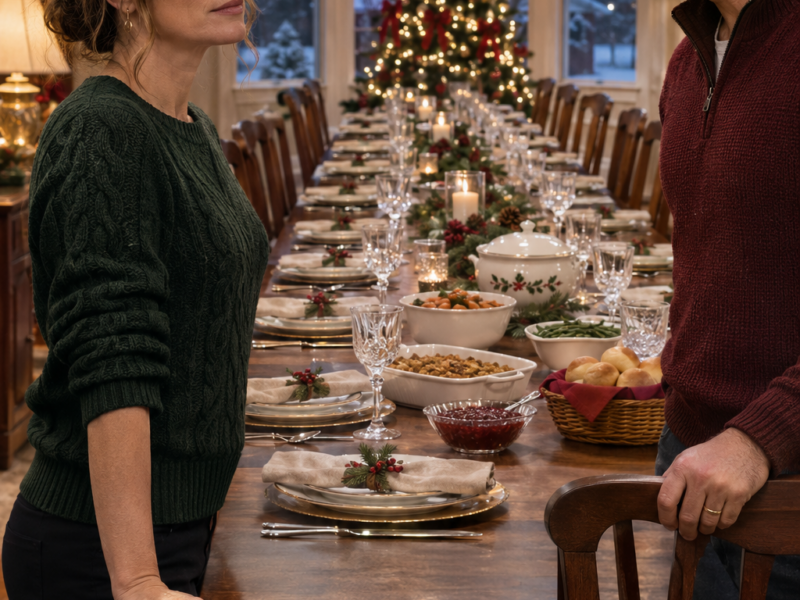
“You Can’t Stop 18 People From Having Christmas,” My Husband Said—He Was Wrong
“You Can’t Stop 18 People From Having Christmas,” My Husband Said—He Was Wrong
On Christmas Eve, my husband pulled into the driveway of my cabin in Hocking Hills with his mother beside him and the rest of the family following in two cars. They had presents, overnight bags, enough food for eighteen people, and an air mattress strapped to the roof of his sister’s SUV. They were already close enough that I could see one loose corner of the mattress flapping over the windshield when Mark caught sight of the woman standing on my porch.
He hit the brakes. The two cars behind him stopped crooked in the driveway.
I watched his mother lean forward to get a better look. Mark kept both hands on the wheel. He knew exactly who the woman was. Susan Keller had settled my father’s estate six years earlier and helped us write our wills. She was wearing the same brown wool coat she wore to meetings in Lancaster, and under her arm was a folder containing a copy of the deed to the house his mother was about to order eighteen people into.
The night before, Mark had told me I couldn’t stop eighteen people from having Christmas. I had spent most of the drive down hoping he would give me a chance to prove him wrong by staying home.
Twelve days earlier, I was standing at my kitchen counter in Columbus, picking at a leftover rotisserie chicken while the weatherman ran through three different things the sky might drop on us by morning. At 7:16 my phone buzzed. The message was from my mother-in-law, Diane, in the family group chat.
“We’re spending Christmas at your cabin. Eighteen people. Stock the fridge and make up the beds.”
I read it twice. Then I typed, “Absolutely not,” and put the phone down.
My cabin sat outside Logan. It had three bedrooms, two bathrooms, a screened porch, and a sleeper sofa that gave the person on the left side a good idea of where the springs were manufactured. Eight people could stay there comfortably. I’d once had ten, and by Sunday morning two of them were brushing their teeth over the kitchen sink. I could have explained all this to Diane, but I was still stuck on the fact that she’d announced where I was spending Christmas and assigned me chores in the same breath.
Mark came in through the garage a few minutes later. He was fifty-five, a regional sales manager who could get a room full of strangers talking before anybody had taken off a coat. I’d liked that about him from the beginning. Sixteen years into our marriage, I still liked watching him walk into a room where I knew he was about to have a good time.
“Mom texted you,” he said.
“You knew?”
“She asked if we could do Christmas down there.”
“And what did you tell her?”
He opened the refrigerator and stood looking into it. “I said it would probably be fine.”
“You volunteered my cabin.”
He shut the door. “Our cabin.”
I set my fork down. “Dad left it to me, Mark.”
“Of course I know that. We’ve been married sixteen years. Do we really have to do the mine-and-yours thing?”
I asked him if he remembered his brother Kevin wanting to borrow his bass boat for a weekend on Lake Erie. Mark had refused on the grounds that nobody treated your things the way you treated them yourself. He remembered. I could tell by how fast he said it was different.
My phone lit up again. Diane had assigned Rachel and Paul the big bedroom, Ethan and his girlfriend Kelly the smaller one, and the younger relatives whatever floor space could accommodate an air mattress. At the end of the message she’d put a Christmas tree.
“She’s trying to make it easier for you,” Mark said.
I held the phone out to him. “Which part of this is for me?”
He started counting the people whose plans would be disrupted. Rachel’s kids were coming. Ethan was bringing Kelly. Aunt Marlene had already rearranged her holiday. Diane had bought presents. By the time he finished, you’d have thought I’d agreed to host in July and changed my mind after everybody bought plane tickets.
“Tell her you spoke before you had my answer,” I said.
“They’re coming whether you like it or not.”
He let that sit between us. For a moment I thought he might take it back. Instead he asked me to stop looking at him that way, though I was only standing there holding my dinner plate.
I went upstairs. Mark fell asleep before I did. At 10:42 another message came through, this one from Rachel.
“Mom says Mark gave us the garage code. Thanks! We’ll probably bring some stuff up early.”
I read that one in the dark beside him. Until then I’d assumed we were arguing about an invitation. Rachel had already been given a way into the house.
The next morning Mark told me he’d given Diane the code sometime the previous summer. He said it was for emergencies. When I asked what kind of emergency his mother was likely to have at a cabin ninety miles from her house, he told me I was turning breakfast into an interrogation. I opened the app on my phone, deleted the old code, and made a new one while he stood on the other side of the counter holding his coffee.
“Now Mom’s going to know I don’t have any say,” he said.
By ten, Diane had called me at work. She asked why I’d changed the code, heard my answer, and launched straight into a grocery list. Two turkeys, a spiral ham, eggs and bacon for Christmas morning, wine, soda, something gluten-free for Kelly. Rachel was bringing her sweet potato casserole, so I could cross that off my list.
I wrote Not my problem on the legal pad in front of me. It was a little embarrassing how much I wanted to say it out loud.
“Diane,” I said, “I’m not buying groceries for eighteen people. I’ve already told you they can’t stay there.”
“Well, you’ll need to clear out your father’s room. Rachel and Paul should have the king bed.”
My pen stopped moving.
I’d changed the curtains in that room and replaced the mattress. Dad’s dresser was still there, along with the wooden valet stand he’d built in high school shop class. One of its legs was shorter than the others. Dad had fixed it with a folded piece of cardboard and left it that way for about fifty years.
“Nobody’s sleeping in that room,” I said.
“Laura, your father’s been gone six years.”
On the other side of my office wall, two coworkers were trying to get a printer tray to close. One of them laughed at something the other said. I remember watching them for a moment and wishing I could walk out there and spend the rest of the morning talking about a paper jam.
“We’re done here,” I said, and hung up.
By evening I’d started bargaining with myself. Three days would go by fast. I could put away the breakables, buy the ham, and hope the septic system outlasted Diane’s enthusiasm. She was seventy-six. Mark loved having his family together. I knew how much he would enjoy watching Ethan and the younger kids play cards at the table after dinner.
I called my friend Nancy and told her I might just let it happen.
“If eighteen people announced they were spending Christmas at my house,” she asked, “what would you tell me?”
“I’d tell you you’d lost your mind if you let them.”
Nancy waited.
“Oh, don’t do that,” I said.
She laughed. “I didn’t say anything.”
On December 16, I drove down to the cabin. My father bought it after Mom died, and he spent years finding projects that could have waited until the following weekend if he’d been the sort of man who knew how to sit down. He rebuilt the porch twice because the first version bothered him every time he looked at it. He kept a red Coleman lantern in the kitchen even after he installed backup power. He said electricity had gotten cocky.
I turned up the heat and walked through the house. It smelled a little stale, the way it always did when nobody had opened a window for a few weeks. Everything looked familiar. Then I reached into the ceramic crock over the refrigerator for the spare key and touched the bottom.
I checked the junk drawer twice and went through the pockets of my coat. Mark had done some maintenance in October. He might have moved it. I was still standing at the sink trying to think where when I saw my neighbor Tom Alvarez coming across from his place.
Tom had retired from the sheriff’s department and now split more firewood than any one household could reasonably burn. He knocked, waited for me to open the door, and asked if I’d finally decided to rent the cabin.
“What made you think that?”
His eyes went past me into the kitchen. “Mark was down here a couple weeks ago with a guy taking pictures. He had a tablet and a tape measure. Mark said you two were looking at making the place earn its keep.”
I think Tom knew before I said a word. He offered to tell me the day he’d seen them if he could narrow it down. I thanked him and went back inside.
There were faint pencil marks by a bedroom doorway. I found a tape measure behind a basket in the living room. Then I went to Dad’s desk and opened the drawer where I kept the property survey. The folder was gone.
I rehearsed an argument with Mark all the way home. In my version I remembered every relevant date, and he listened patiently while I made each point. I knew from experience that a real argument could start with a missing property survey and somehow end with us relitigating who picked out the dishwasher in 2019. I wanted something more solid than a speech.
The next morning I called Susan. She listened and asked whether I’d added Mark to the deed, signed anything allowing him to manage the property, or seen anything in Dad’s estate documents that gave him an interest in it. The answer to all three was no.
“Then the deed still says what it said when we settled your father’s estate,” she told me. “Find out what he’s planning, Laura. And read anything he puts in front of you before you even pick up a pen.”
My next call was to Frank Mercer, a real estate agent who had known Dad for nearly thirty years. When I asked if Mark had been in touch, Frank said, “I assumed you knew.”
Mark had asked about short-term rental rates, weekend traffic, seasonal demand, and how much more a cabin with a hot tub might bring in. He’d mentioned a photographer, though Frank hadn’t sent anybody to the house. Then Frank told me Mark had brought up Ethan.
Ethan was twenty-seven. He worked on a landscaping crew and had talked for years about starting a company of his own. I’d heard all about the used trucks he looked at online and the commercial mower he wanted to buy. What I hadn’t heard was that Mark thought some of the cabin’s rental income might pay for equipment or help Ethan line up financing.
“What income?” I asked Frank. “There isn’t a rental.”
“I know,” he said. He sounded tired suddenly, as though he wished he’d asked Mark one more question three weeks earlier.
That evening I went looking in the den for the warranty on the cabin’s smart lock. Under a stack of old statements I found a folded document headed Property Management Authorization. It listed my full name and the cabin address. Farther down, beside Authorized Representative, was Mark Bennett.
My signature line was blank. I was grateful for that blank line, and I hated that I’d had to look.
I sent Susan photographs of the pages. She called back and explained that, depending on how the form was completed and used, it could give Mark broad authority to deal with vendors, bookings, and maintenance agreements on my behalf. While we were talking, the garage door opened downstairs.
“He’s home,” I said.
“Then ask him,” she said. “You’ve got enough in front of you to have the conversation.”
I set the document on the kitchen table. Mark came in with a Kroger bag and stopped when he saw it.
“Where’d you find that?”
“In our desk. What were you going to do with it?”
He set the bag down. Once he started explaining, I could hear how long he’d been thinking about it. The cabin might gross thirty or forty thousand dollars in a good year, he said. A management company could handle the bookings. A few improvements might increase the nightly rate. Ethan could use a little help getting established. Mark even knew how much a decent used mower cost.
“When were you going to ask me?”
“After Christmas.”
“Why after Christmas?”
He looked down at the form. “Because you’re emotional about the cabin.”
A container of yogurt tipped sideways inside the grocery bag. I could see it through the plastic. For some reason I had the absurd urge to stand it upright.
“Suppose you showed me the numbers and I said no,” I said. “What would you have done?”
“I figured once you saw what we could make—”
“You’ve shown me the numbers. I’m saying no. What happens next?”
Mark looked toward the living room. “I don’t know.”
He had an estimate for the rental income, a plan for his nephew, and a form waiting for my signature. We sat at that table for a long time, and “I don’t know” was as close as he came to telling me what place he’d left for my answer.
“I was trying to help this family,” he said at last.
“I’m your family, too.”
He opened his mouth, then closed it. The groceries sat between us until I got up and put them away.
The next afternoon I drove back to the cabin. It was fifty-six degrees inside. I turned on the heat and made coffee in Dad’s old Mr. Coffee machine, which took its time and made a noise toward the end like someone clearing his throat. I got Dad’s mug out of the cabinet. World’s Okayest Dad, it said. He’d bought it for himself because the one that said World’s Best Dad struck him as presumptuous.
I sat at the table and tried to think about the cabin the way Mark might have seen it. The roof was going to need work. I paid taxes on the place every year whether I came down twice a month or once all winter. I could imagine renting it for a few weekends. I could even imagine sitting down with Ethan and asking what he needed to start taking jobs on his own. Given a chance to consider either idea, I might have said yes to something.
I could also imagine Mark across from me in that kitchen, asking what I thought before he called Frank. Of all the conversations we’d had in the last week, I would have given a great deal to have had that one.
My phone rang. Mark wanted to know where I was. When I told him, he asked whether I’d changed the electronic access at the cabin, too.
“Yes.”
“Fine,” he said. “I have the key.”
He’d taken the spare from the crock months earlier. He said he hadn’t thought he needed permission to carry a key to a house we both used. By itself, on a different day, I might have understood that. But he had told me about the key only after finding out the code wouldn’t work.
“I’d like you to act like we’re married,” he said.
I ran my thumb over the handle of Dad’s mug. “So would I, Mark.”
The next morning a locksmith named Carl came from Logan in a white van with a rattling heater. He replaced the exterior lock cylinders and asked me how many keys I wanted. While he was writing up the invoice, Rachel texted to ask if I could let her mother have one Christmas. Then Brenda, a cousin I hadn’t spoken to since Easter, told me family mattered more than property.
“Great,” I wrote back. “Which property are you volunteering?”
I laughed hard enough that Carl looked up.
“Family Christmas,” I told him.
He went straight back to his invoice.
By the time I got home, Mark had explained to several relatives that I was having a control issue. I wondered what he expected me to do with that information. Call them each in turn and explain the code, the survey, the man with the tape measure? I wanted my husband to hear me in our kitchen. Somehow I’d ended up defending myself to Brenda.
I met Susan in Lancaster. She drew up a formal notice spelling out that Mark had no authority to grant access, arrange rentals, hire contractors, sign management agreements, or make financial commitments involving the cabin. I also arranged for a local company to check on the property through the winter and make sure nobody went in without authorization.
“Are you sure you want him to get this before Christmas?” Susan asked.
I looked at the paper. Even then I wanted another day in which he might call his mother and straighten the whole thing out himself.
“Send it,” I said.
He got it on December 23. I was loading the dishwasher when he came into the kitchen with the envelope in his hand.
“You brought a lawyer into Christmas.”
“Is anything in the letter wrong?”
He put it down on the counter. “Mom bought the food. Rachel’s halfway packed. Everybody’s going.”
“Tell them to stop packing.”
He looked at me almost kindly. “You can’t stop eighteen people from having Christmas.”
I dried my hands on a dish towel. The next time I saw him was through the front window of the cabin, his headlights shining across Susan’s coat.
He finally got out of the SUV. Behind him, Rachel climbed down with a Crock-Pot braced against her hip. Paul had two overnight bags and a folding chair. Ethan wrestled a cooler out of the back while Kelly held three gift bags to her chest. Somebody had packed a pillow in a grocery sack that split as soon as they lifted it. By then the temperature had dropped to around freezing, and I remember wanting to tell whoever was holding that pillow to get it out of the wet gravel.
Mark stopped at the foot of the porch. “Susan. What are you doing here?”
“Laura and I had some paperwork to finish.”
Diane stepped around him. “Everybody start bringing things in. It’s freezing.”
Nobody moved. Rachel looked at me. “Laura, can we please talk about this inside?”
“You can put the Crock-Pot back in the car, Rachel. You’re going to need it wherever you have dinner.”
Her grip tightened on the handles. Mark came up the steps, reached into his coat pocket, and walked past me to the door. I watched him slide the old spare key into the lock.
It went in. It wouldn’t turn.
He pulled it out and looked at the teeth. Then he put it back in and tried again. Behind him, Rachel said his name, quietly enough that he could have pretended he hadn’t heard her. He tried once more before he turned around.
“You changed the locks.”
“Yes.”
Diane told him to open the garage. He told her the code had been changed. She looked from him to me, still waiting for one of us to give her something she could work with.
“This is between my wife and me,” Mark said to Susan.
“Then I’m surprised you brought so many people,” she said.
Under different circumstances, I would have laughed. I looked out at the driveway instead. Ethan had lowered the cooler to the ground. The flapping corner of the air mattress had gone still.
“Laura,” Mark said, “can we go inside and talk? It’s our cabin.”
Susan opened her folder. “The deed is in Laura’s name, Mark. She inherited the property from her father. You have no recorded ownership interest, and Laura hasn’t authorized you to let anyone in over her objection.”
There was just enough light left for me to see Diane’s face change.
“You told me your name was on it,” she said.
Mark looked at her. “I said it was basically ours.”
“You told me your name was on the deed. I remember asking you.”
Until then I’d thought Diane simply believed her son could decide for both of us. Hearing her say that, I realized Mark had given her a much easier story to believe.
Rachel lowered the Crock-Pot to the top step. “Wait. You don’t own any of the cabin?”
“We’ve used it together for years,” he said. “I thought Laura would come around.”
Then Ethan asked, “Does this mean we’re not doing the rental thing either?”
Mark turned so fast I thought he’d missed a step.
“The rental thing,” Ethan repeated. “You said you guys had talked about it. You said the money could help me get the equipment.”
It was the first time Ethan had spoken directly to me since he arrived. He looked less like a man asking about a business deal than a boy who’d just realized he’d answered a question meant for somebody else.
“Your uncle talked to a realtor,” I told him. “He didn’t talk to me.”
Ethan stared at Mark. “You told me she knew.”
Rachel asked her brother why he’d told her I wanted to rent it. Diane said he’d also told her I was fine with Christmas at the cabin.
“I said she’d be fine,” Mark said.
Diane pulled her coat tighter. “That’s a different thing entirely.”
I could see her working backward through every conversation she’d had with him. I could also remember exactly how she’d sounded on the phone when she told me to clear out Dad’s room. Both things were there on her face for a second, and then she looked away.
Mark pointed toward the house. “It sits empty half the year. Ethan needs help. Mom wanted one Christmas with everybody together. I was trying to do something good for everybody.”
“Did it ever occur to you to ask what would be good for me?”
He dropped his hand. For once he let the question stand.
Ethan picked up the cooler again. “Laura, I swear I thought you knew.”
“I believe you.”
Diane asked where eighteen people were supposed to go on Christmas Eve. I said I’d assumed someone had made a backup plan. Rachel told me they hadn’t, with the same bewilderment you might hear from someone whose flight had been canceled at the gate. Then she got out her phone and started looking for hotel rooms. Three minutes later Diane announced they’d all go back to her place in Westerville. It would be crowded. It would also be warm, and she had a working oven.
While Paul secured the air mattress, Mark came back up to the porch.
“Are you really doing this?” he asked. His voice had gone quiet. I wished he’d used that voice with me in our kitchen twelve days earlier.
“Go spend Christmas with your mother,” I said. “When we get home, we need to talk about what happens to us.”
He looked frightened. I’d imagined feeling vindicated when he finally understood I was serious. All I wanted in that moment was for him to say something that would make it easier to watch him go. He looked as if he wanted the same thing from me.
He was the last one into his car. I watched the taillights disappear between the trees, and Susan stayed beside me until the driveway was dark again.
“You okay?” she asked.
“No.”
She nodded, handed me the folder, and wished me a merry Christmas.
I ate a corner of a family-size Stouffer’s lasagna at Dad’s kitchen table that night. Or I tried to. I’d poured a glass of wine and gotten three or four bites in when I started crying. I had one paper napkin. It fell apart long before I was finished with it, and the lasagna was cold by the time I went back to my plate. Mark called around nine and again twenty minutes later. I watched his name light up the phone both times.
On Christmas morning I woke on the sleeper sofa without having bothered to pull it out. The television was showing a family in matching pajamas. I turned it off, washed Dad’s mug, and carried my coffee out to the screened porch. Mark had sent a text asking if we could talk. I called him before I could spend the whole morning deciding whether to.
“I’m sorry,” he said. “I never thought it would get this far.”
“Why didn’t you?”
He was quiet. From the porch I could see a bare branch moving in the wind. I watched it for so long I thought the call had dropped.
“I thought you’d get mad,” he said finally. “Then we’d argue. Then you’d cool off, and we’d work something out.”
“By ‘work something out,’ you mean I’d let everybody in.”
“Yeah,” he said.
It was the first time he’d answered that question. He apologized again, and this time he let me sit there with it.
We went home separately on December 26. Mark slept in the guest room. By New Year’s we’d made an appointment with a marriage counselor in Dublin, and by the middle of January he was living in a furnished apartment fifteen minutes away. Some evenings I reached for my phone to tell him a story from work and remembered that we were supposed to be giving each other space. Other evenings I came in, set down my purse, and felt the relief of knowing nobody was waiting to talk me out of a decision I’d already made. Sometimes both things happened before I took off my coat.
We spent more time in counseling on ordinary Tuesdays than we did on Christmas Eve. Diane moving Thanksgiving at the last minute. Rachel needing a dog sitter with six hours’ notice. Mark promising money toward a family gift before checking with me. I’d usually object, then rearrange my plans or write the check because getting on with the day seemed easier than arguing. Mark had come to count on that second part so completely that he’d built a holiday around it.
At one session he said, for what felt like the twentieth time, “I was trying to help.”
The counselor asked him, “Can you do something disrespectful while you’re trying to help?”
Mark started to answer, paused, and sat back. I remember that pause better than most of what we said in the weeks that followed.
Ethan called in January to apologize. I told him I believed what he’d said in the driveway. A few months later he bought a used trailer and a secondhand commercial mower, kept his job on the crew, and started taking work on weekends. The first time he told me how many lawns he’d done in one Saturday, I could hear in his voice exactly how sore he was and how proud he was of being sore.
Diane took longer. Her first apology came through other people, mostly in the form of news that she wanted everybody to move past it. Then she called in February and said she was sorry things had gotten out of hand. I asked her what she was sorry she’d done. The conversation ended shortly afterward.
Three weeks later she called again.
“I’m sorry I treated your no like something Mark could overrule,” she said.
I thanked her. We talked for another minute about the weather. She told me she’d started a pot of soup, and I could hear a spoon tapping against the side of it while we said goodbye.
By spring Mark and I were having dinner twice a week. He was still in the apartment. He told Diane he’d lied about being on the deed. He told Rachel I’d never agreed to rent the cabin and told Ethan that the business plan had been his idea alone. I learned about those conversations afterward. For months I’d been bracing myself to correct him in front of somebody. It took a while to realize he’d gone ahead and done it without me there.
I kept the cabin. I’d considered selling it during the worst of that winter, mostly because I was tired of feeling my stomach tighten every time someone said the word. By spring I could go down for a weekend and think about the roof or the mouse in the workshop. I had the roof repaired and sorted Dad’s tools. Later that year I hired a professional management company and began renting the place on weekends I chose. The income covered upkeep, and eventually I put some of it toward a small scholarship at the community college where Dad had taught evening woodworking classes.
I told Mark about the rentals at a diner after counseling. He smiled and asked, “So you finally made the cabin earn its keep?”
I turned my head and looked at him. He lowered his coffee cup.
“Oh,” he said. “I heard it that time.”
I laughed, and then he did too. The waitress came to refill our cups, and we were still laughing when she asked if she’d missed something. It had been months since either of us could have laughed about the cabin. I think we both needed a minute to finish.
Mark moved home later that summer. We got clearer about money. We asked each other before offering up a weekend, a favor, or a set of keys. One Friday he told me his mother wanted him to ask whether we could have a few people down to the cabin. I said I wanted that weekend to myself.
“All right,” he said. He took out his phone and told her I already had plans.
I went down alone. That evening I sat on the screened porch with Dad’s mug and watched the light go out of the trees. When I got up to go inside, I put a hand on the door. Dad used to say a good door needed a solid lock and somebody inside who knew when to open it. I’d always assumed he was giving me advice about buying a lock. I stood there a little longer, listening to the last of the birds, and went in when I was ready.