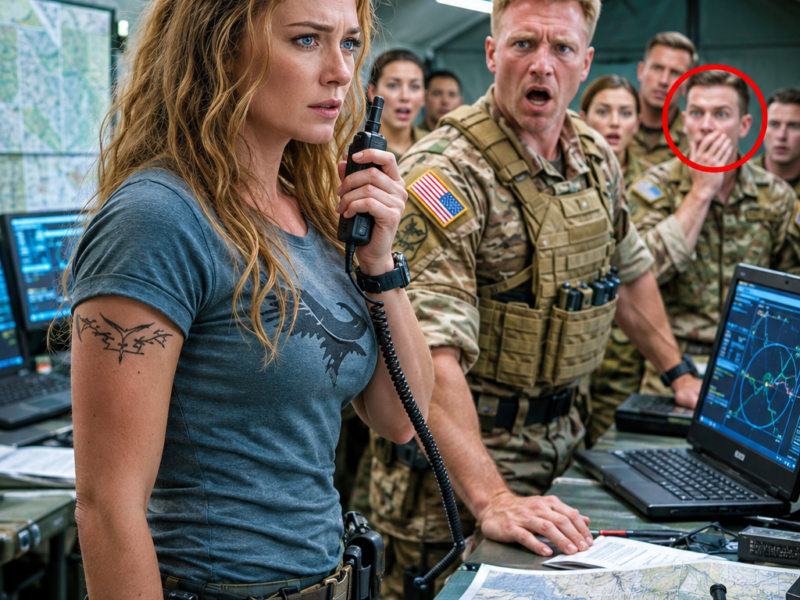
Who Is She They Mocked Her at NATO Field — SEAL Commander Halted When She Spoke Command Code
Who Is She They Mocked Her at NATO Field — SEAL Commander Halted When She Spoke Command Code
“Go back to your desk, Quinn. This is a military training field, not a charity program for people who couldn’t make it anywhere else.”
Captain Derek Sloan’s voice sliced through the cold morning air, loud enough to silence an entire weapons inspection station. Around him, fifteen soldiers and instructors stopped what they were doing. A few turned openly to watch. Others pretended to remain occupied with their equipment, though their attention was unmistakably fixed on the small woman standing in front of him.
Sergeant Riley Quinn did not move.
The morning was barely six hours old. A pale strip of sunlight stretched across the horizon, illuminating the rows of training structures, armored vehicles, and temporary buildings inside the NATO joint training compound. The air smelled of damp gravel, gun oil, and strong coffee. Somewhere beyond the eastern fence, a diesel engine struggled to start.
Derek stood nearly a foot taller than Riley, his broad shoulders filling his uniform. He had built his reputation on aggression, discipline, and the belief that fear was an acceptable substitute for respect. His subordinates rarely questioned him, and those who did tended to discover that their evaluations suffered mysterious setbacks.
Riley, by contrast, seemed almost deliberately unremarkable.
Her brown hair was secured in a regulation bun. Her gray eyes remained fixed on a point beyond Derek’s shoulder. Her uniform was clean but faded, without the impressive collection of insignia that decorated the uniforms of some of the more experienced personnel. At first glance, there was nothing about her that suggested she belonged among the elite soldiers participating in the international training rotation.
And that was precisely what made the situation so dangerous for Derek Sloan.
Because Riley Quinn was not what she appeared to be.
Not even close.
“Did you hear me?” Derek demanded, taking another step forward. “Or do I need to explain things more slowly?”
A couple of trainees laughed.
Lieutenant Mark Hayes, standing near the equipment racks, exchanged an amused glance with another instructor. He had learned that agreeing with Derek was usually the quickest way to remain in the captain’s favor.
Riley said nothing.
She breathed in for four counts, held for four, and released the air over another four. It was an old habit, so deeply ingrained that she no longer consciously thought about it.
Derek interpreted her silence as weakness.
“Maybe we should find you something more appropriate,” he continued. “Filing reports. Making coffee. Cleaning offices. Something that doesn’t require actual combat skills.”
He picked up a dirty maintenance rag from the nearby table and threw it at her boots.
“Since you’re standing around doing nothing, clean these stations.”
The laughter stopped.
Even Hayes looked momentarily uncomfortable.
Riley lowered her eyes toward the rag. For a brief instant, her right hand moved toward her trouser pocket, where a small metal object rested against the fabric.
It was a worn challenge coin, its engraved raven almost smooth from years of handling.
She touched it once.
Then she bent down, picked up the rag, and began cleaning.
Thirty feet away, retired Major Sam Grayson watched the confrontation with an expression that slowly changed from irritation to curiosity.
Sam had spent decades working with military units across several continents. He knew the difference between confidence and arrogance, between trained discipline and frightened obedience. More importantly, he knew what an experienced operator looked like, even when that operator was trying very hard not to be noticed.
And something about Riley Quinn bothered him.
It was not her silence.
It was the way she moved.
Her balance never shifted unnecessarily. Her shoulders remained relaxed even when Derek approached aggressively. Her eyes tracked the surrounding environment without appearing to move at all. When another trainee accidentally knocked a metal tool from a table, her gaze had already located the sound before anyone else reacted.
Those were not habits acquired in an administrative office.
Sam watched her approach the third weapons station, where a trainee had abandoned a partially disassembled rifle after struggling to reassemble it.
Riley stopped wiping the table.
Without asking permission, she picked up the components.
Her hands moved with such effortless precision that Sam almost missed what happened. Within seconds, the rifle was assembled, inspected, and placed neatly on the bench.
Twelve seconds.
Sam looked at his watch.
He had seen experienced special operations personnel perform similar tasks under pressure. He knew how much repetition was required to make those movements appear automatic.
No inexperienced trainee worked like that.
Riley returned to cleaning as though nothing unusual had occurred.
Sam narrowed his eyes.
“Who the hell are you?” he whispered.
Riley heard nothing, or at least gave no indication that she had.
When the inspection ended, Derek dismissed her with another insult and ordered everyone to formation.
Private Jake Lawson was waiting near the assembly point.
He was twenty-two, recently transferred into the training program, and still young enough to believe that military authority and personal integrity usually belonged together.
As Riley approached, he leaned toward her.
“That wasn’t right,” he said quietly.
She glanced at him.
“What he did,” Jake explained. “You didn’t deserve that.”
For the first time that morning, something faintly human passed across Riley’s expression.
“I know,” she answered.
Then she stepped into formation.
Jake watched her for a moment, surprised by the calm certainty in her voice.
He did not know that those two words contained eighteen months of grief, calculated restraint, and a promise made beside a grave.
The day’s briefing was conducted by Commander Elias Grant, a veteran Navy SEAL officer assigned to the NATO Joint Task Force. At forty-five, Elias possessed the kind of authority that required neither shouting nor intimidation. His career had taken him through enough dangerous assignments to recognize that the loudest person in a room was rarely the most capable.
He reviewed range safety procedures, obstacle course requirements, communication exercises, and emergency protocols.
Derek occasionally interrupted with pointed remarks about maintaining standards.
At one point, he glanced toward Riley.
“Even recruits with limited backgrounds will be expected to perform without special treatment.”
Elias noticed the emphasis.
He also noticed that Riley did not react.
Later that morning, she reported to the live-fire qualification range.
Sergeant Tom Briggs, the range safety officer, was waiting beside lane seven.
Briggs was a stocky man who liked rules, routine, and predictable outcomes. Unfortunately, he also liked remaining on Derek Sloan’s good side.
Earlier, Derek had spoken to him privately.
The conversation had lasted less than two minutes.
Its consequences were about to become much more serious.
“Hold up, Quinn,” Briggs said as Riley prepared her assigned carbine. “Additional inspection.”
She stepped aside.
Briggs examined the weapon with exaggerated care, checking the chamber and exterior components. Then his fingers moved briefly near the rear sight.
The adjustment was small.
Deliberate.
Almost invisible.
“Good to go,” he announced.
Riley took the rifle and settled into position.
Her first round struck low and left.
The second did the same.
She paused.
There was no visible frustration, but her eyes sharpened. She knew exactly where those shots should have landed. The difference was not random, and it was not caused by nervousness.
Someone had altered her equipment.
She glanced toward Briggs.
He was watching too closely.
Riley returned her attention to the target. Rather than interrupt the exercise, she compensated. Her remaining shots formed a respectable group near the center.
“Barely passing,” Briggs announced afterward. “Your fundamentals need work.”
Riley cleared her weapon.
“Yes, Sergeant.”
Major Sam, standing beyond the firing line, had watched the entire sequence.
He had seen the first two impacts. He had seen the tiny adjustment in her posture and the immediate correction that followed.
His suspicion deepened.
That evening, the humiliation continued.
Riley sat alone in the mess hall when Lieutenant Hayes walked past with two instructors.
“I heard she got into the program because of connections,” Hayes said loudly.
One of the others laughed.
“Would explain why her performance doesn’t match her paperwork.”
Hayes leaned closer to his companion.
“Some people know how to get promoted without earning it.”
Riley’s fork stopped halfway to her mouth.
For one moment, the muscles along her jaw tightened.
Then she set the fork down.
She had spent eighteen months preparing to stand within reach of Derek Sloan. Eighteen months following money transfers, studying communications patterns, building relationships with sources who could disappear if their identities were exposed.
And now, after all that effort, she was being tested by something as simple as an insult.
Her father’s voice returned to her memory.
Never let your anger announce what your patience is trying to accomplish.
She stood, returned her tray, and left.
Jake watched her go.
This time, he was ashamed of himself.
He had spoken kindly to her that morning, but he had remained silent while Hayes humiliated her in front of everyone.
He was beginning to understand that sympathy without courage accomplished very little.
The following morning, Derek announced a new evaluation system.
Every trainee would be assessed by designated peers and instructors. Officially, the purpose was to improve cohesion and identify weaknesses.
In practice, it gave Derek another opportunity to control Riley’s results.
She was assigned to Hayes and Briggs.
The first assessment involved emergency medical procedures.
Riley approached a simulated casualty, identified the injuries, and completed the required treatment with a level of efficiency that should have earned an excellent score.
Hayes marked her as failing.
“You didn’t establish a defensive perimeter.”
“The scenario specified a secured treatment area,” Riley replied.
“Assumptions get people killed.”
“The conditions were provided in the briefing.”
Hayes gave her a dismissive smile.
“Arguing with an evaluator isn’t helping your case.”
The next exercise involved radio communication.
Riley completed the transmission correctly, using the prescribed phonetic alphabet and reporting format.
Briggs marked another failure.
“Incorrect terminology.”
Commander Elias, who happened to be reviewing documents nearby, looked up.
“What terminology?”
Briggs hesitated.
“The transmission format, sir.”
“Play it back.”
The recording was replayed.
Elias listened without changing his expression.
Then he turned toward Briggs.
“That transmission is correct.”
“Sir, I—”
“Correct the evaluation.”
Briggs obeyed.
Elias looked at Riley.
She stood quietly, her face unreadable.
He had encountered soldiers who concealed their abilities before. Sometimes they lacked confidence. Sometimes they were avoiding attention. And sometimes they were operating under orders that did not appear in ordinary personnel files.
The last possibility stayed with him.
On the third day, Riley returned to the firing range.
This time, she inspected the weapon before the qualification began.
She found the sight adjustment almost immediately.
Her expression did not change.
She corrected it and prepared to fire.
Major Sam observed from the tower.
When the first target was retrieved, there was no longer any reasonable excuse for calling her unskilled.
Her grouping was exceptional.
Derek stared at the results for several seconds.
“Acceptable,” he finally said.
Briggs looked uncomfortable.
“Sir, that’s one of the highest scores we’ve recorded this rotation.”
Derek shot him a warning glance.
“I said acceptable.”
Riley turned away.
As she adjusted her sleeve, the fabric slipped back from her wrist, exposing part of a dark tattoo beneath a narrow bandage.
Sam saw it.
His breath caught.
A raven.
Only part of the design was visible, but the placement, shape, and angle were unmistakably familiar.
He had seen that insignia before.
Twenty years earlier, on the arm of a man named Colonel Alan Quinn.
Alan had been one of the most extraordinary officers Sam had ever known, a quiet specialist in counterintelligence who believed the greatest threats to an organization often came from people already trusted to protect it.
He had also been Sam’s friend.
Two years earlier, Alan Quinn had died during an operation whose details were buried beneath layers of classification.
The official account described an ambush.
Sam had never believed it.
Now he was staring at a young woman carrying Alan’s surname, wearing what appeared to be his unit’s insignia, and demonstrating skills that no administrative assignment could explain.
He approached her.
“Sergeant Quinn.”
She stopped.
“Yes, sir?”
“Where were you stationed before coming here?”
“Fort Hamilton. Administrative support.”
The answer came too quickly.
Sam studied her.
“Ever work with Colonel Alan Quinn?”
For the first time, she hesitated.
Only for a fraction of a second.
“No, sir.”
Sam understood then that the truth was somewhere behind her eyes, carefully guarded.
He did not press.
“Good shooting today.”
“Thank you, sir.”
She walked away.
Sam watched until she disappeared behind the equipment building.
The resemblance was suddenly impossible to ignore.
Alan’s eyes.
Alan’s stubborn jaw.
And that extraordinary ability to remain calm when everything around him was falling apart.
Later that afternoon, the compound experienced its first genuine security crisis.
The planned exercise was a communications failure simulation. Trainees were supposed to navigate toward designated rally points without relying on radios.
But shortly after the exercise began, the actual communication network collapsed.
The training radios stopped responding.
Then the command channels.
Then the internal monitoring system.
Technicians hurried between buildings. Instructors shouted conflicting instructions. Security personnel attempted to establish alternative communication.
Riley stood motionless near the training yard.
She recognized the pattern.
This was not an accidental outage.
It was coordinated interference.
And whoever had planned it knew the compound’s systems well enough to disrupt multiple layers simultaneously.
Before Derek could stop her, Riley moved toward the communications building.
“Quinn!” he shouted. “Get back here!”
She continued walking.
Inside, two technicians were struggling to isolate the fault.
“You’re not cleared to be in here,” one protested.
Riley glanced at the diagnostic display.
“Your primary network isn’t the problem. Your external link is being interfered with.”
The technician frowned.
“How would you know?”
“Because the failure pattern is wrong for equipment malfunction.”
She pointed toward an indicator on the screen.
“Check your protected backup channel.”
The second technician looked.
His expression changed.
Working with them, Riley helped isolate the interference and restore limited communications.
Less than a minute later, Commander Elias heard his radio crackle back to life.
“Command, this is Communications. Partial network restored.”
Elias immediately requested a full status report.
Outside, Derek was waiting.
“What the hell do you think you’re doing?” he demanded as Riley emerged.
“Helping restore communications, sir.”
“You entered a restricted facility without authorization.”
“There was an active emergency.”
“You don’t decide what constitutes an emergency!”
Riley looked directly at him.
“No, sir. The situation does.”
Derek’s expression hardened.
Before he could respond, Major Carl Benson approached with a personnel report.
Benson supervised administrative security and logistics oversight. He had spent the previous two days examining Riley’s records after Derek requested a background review.
“I found irregularities,” Benson announced. “Her service history contains unexplained gaps. Several assignments cannot be verified through normal channels.”
Derek seized the opportunity.
“Exactly what I’ve been saying.”
Benson continued.
“Pending further investigation, I recommend immediate suspension.”
Riley remained silent.
Derek turned toward her with visible satisfaction.
“Sergeant Quinn, you are relieved from training activities. Military police will escort you to administration.”
Two MPs approached.
Riley allowed them to take position beside her.
From the observation tower, Elias reviewed her electronic personnel file.
The redactions were extraordinary.
Entire sections of her training history were inaccessible. Several assignment records returned restricted-access notices. Her emergency contacts were protected under an authorization level normally reserved for extremely sensitive operations.
Then he noticed a designation embedded in a partially obscured section.
Family association: classified operational personnel.
Elias frowned.
This was not an ordinary trainee’s file.
And Benson should have understood that.
Before he could investigate further, a technician hurried into the courtyard carrying a tablet.
“Commander! We recovered the range footage.”
Derek turned.
“What footage?”
“The first qualification. Lane seven.”
The technician displayed the recording.
It clearly showed Briggs adjusting Riley’s weapon immediately before the firing sequence.
The footage included the time, inspection station, and identifying information.
Benson took the tablet.
His face darkened.
“Sergeant Briggs. Captain Sloan. Explain this.”
Briggs looked toward Derek.
Derek said nothing.
Then the emergency sirens sounded.
Three sharp bursts echoed across the compound.
Security personnel began moving toward defensive positions.
Elias’s voice came over the restored communication network.
“All personnel, this is Command. We have a possible perimeter breach. Nonessential personnel shelter in place. Security teams report to assigned sectors.”
Riley turned toward the northern fence.
Beyond the vehicle gate, something moved.
A shadow separated from the fence line and disappeared behind a storage container.
Her eyes narrowed.
“There’s someone inside the perimeter.”
One of the MPs tightened his grip on her arm.
“Ma’am, you need to stay with us.”
Riley looked at him.
“Release me.”
“Those aren’t my orders.”
“Then tell your commander there’s an intruder near the north gate.”
Something in her voice made him hesitate.
It was no longer the soft, almost emotionless voice of the woman who had endured Derek’s insults.
It was the voice of someone accustomed to being obeyed during dangerous situations.
The MP loosened his grip.
Riley moved.
She reached the fence and discovered a fresh opening in the chain link. A cutting tool lay partially concealed in the grass.
She did not touch it.
Instead, she took the nearby MP’s offered radio.
“Command, Sergeant Quinn. North perimeter breach confirmed. Evidence of deliberate entry. Possible diversion targeting communications.”
Elias answered immediately.
“Copy. Security team inbound. Hold your position.”
Derek’s voice interrupted.
“Commander, Quinn has been suspended. She has no authority to issue tactical reports.”
Elias did not hesitate.
“Captain Sloan, stand down.”
“But sir—”
“That is an order.”
Within minutes, security recovered additional evidence. The cutting tool matched equipment reported missing from the compound’s inventory weeks earlier.
This was no random intrusion.
Someone had access to military supplies.
Someone understood internal security procedures.
And someone was actively working to compromise the base.
As the security team photographed the breach, Elias approached Riley.
He stopped in front of her.
“Sergeant Quinn, I want to ask you something.”
“Yes, sir.”
“During your earlier communications exercise, you used a particular phrasing before transmitting your grid reference.”
Riley remained still.
“Standard protocol, sir.”
“Mostly.”
His eyes narrowed.
“I’ve heard that pattern before. Years ago. During a joint operation involving a unit called Raven Directive.”
Riley felt her heartbeat change.
She kept her expression steady.
“I wouldn’t know anything about that, Commander.”
“Wouldn’t you?”
He studied her face.
“Your father was Colonel Alan Quinn.”
This time, Riley did not answer.
She did not need to.
The silence told him enough.
Before Elias could continue, Major Sam approached.
“I think,” Sam said quietly, “we need to have a conversation away from the crowd.”
They moved toward a deserted area beside the storage buildings.
For several seconds, nobody spoke.
Then Sam reached into his jacket and removed a worn challenge coin.
Riley stared at it.
The raven engraving had faded almost completely, but its outline remained recognizable.
“Your father gave me this,” Sam said. “Twenty years ago.”
Riley swallowed.
Sam turned the coin over.
“He told me that if I ever met someone carrying the same mark, I should remember that appearances can be deliberately misleading.”
Slowly, Riley reached into her pocket.
She removed her own coin.
The two were nearly identical.
Sam’s expression softened.
“He talked about you, Riley.”
Her eyes glistened.
“He said you were smarter than he was, and twice as stubborn.”
A small, painful smile crossed her face.
“He usually said that when I disagreed with him.”
Sam nodded.
“That sounds like Alan.”
For a moment, they stood together in silence.
Then Sam asked the question that had been troubling him.
“What are you doing here?”
Riley looked toward the administrative building.
“Finishing his work.”
Sam’s face became serious.
“Does this have something to do with Sloan?”
She nodded.
“Derek Sloan was involved in my father’s death.”
The older man went completely still.
“Are you certain?”
“I’ve spent eighteen months making certain.”
She explained that her father had uncovered a network selling sensitive NATO intelligence to hostile organizations. Before he could expose the people involved, his operation had been compromised.
The ambush that killed him had been arranged.
Derek was one of the people responsible.
“He thought the danger ended when my father died,” Riley said. “He didn’t know Dad had left evidence behind.”
“And you’ve been following the trail.”
“Yes.”
“Why let Sloan humiliate you?”
“Because arrogant people become careless when they believe someone is beneath them.”
Sam looked toward the distant command tower.
“And he’s become careless.”
“Very.”
She slipped the coin back into her pocket.
“But Sloan isn’t the highest-ranking person involved.”
Sam’s eyes narrowed.
“How high does it go?”
Riley hesitated.
“High enough that I couldn’t trust the normal reporting channels.”
That evening, the compound settled into a tense silence.
The security breach had shaken everyone. Additional guards patrolled the fences, communications equipment was examined, and personnel were questioned about suspicious activity.
Derek remained under investigation but had not yet been formally detained.
Riley knew he was becoming desperate.
Desperate people made mistakes.
But they also became dangerous.
The next morning, Commander Elias announced special evaluations under direct observation.
Every event would be recorded. Multiple independent evaluators would review results.
Derek protested when Riley’s name appeared on the schedule.
“Commander, she should be undergoing remedial instruction.”
Elias barely looked at him.
“Her performance will speak for itself.”
The obstacle course began shortly afterward.
Riley stood beside five other trainees at the starting line.
The whistle sounded.
She launched forward.
There was no dramatic display of strength. No wasted effort. Every movement had a purpose.
She cleared the first wall, climbed the rope, crossed the water obstacle, and moved beneath the low wire barriers with remarkable efficiency.
By the time she reached the final obstacle, two of the other competitors were still struggling halfway through the course.
She finished in four minutes and thirty-seven seconds.
Second fastest.
Only three seconds behind the winner.
Derek stared at the stopwatch.
“Her climbing technique was deficient.”
Briggs hesitated.
“Sir, it was within standards.”
“Mark it down.”
Briggs looked toward the nearby observation team.
“No, sir.”
Derek turned sharply.
“What did you say?”
“I can’t record a violation that didn’t happen.”
Commander Elias approached and took the clipboard.
He reviewed the results.
“Excellent performance, Sergeant Quinn.”
Riley nodded.
“Thank you, sir.”
Derek’s face flushed.
His authority was slipping, and everyone could see it.
That afternoon, the trainees entered a simulated combat village for a team extraction exercise.
Riley was assigned to a group led by Private Jake Lawson.
Jake was visibly nervous.
He had never commanded a team through a complex exercise before.
Derek had selected him specifically because of that inexperience.
He expected the team to fail.
Inside the village, Jake gave his instructions carefully.
“Martinez, right side. Chen, watch the rear. Quinn, with me.”
Riley followed without questioning him.
At the entrance to the designated target building, she spotted a concealed training sensor.
She signaled the group to stop.
Jake approached.
“What is it?”
“Alarm trigger. It wasn’t mentioned in the briefing.”
Jake studied the obstruction.
“Can we get around it?”
“Yes.”
“Then show me.”
Riley identified a safe alternate route that avoided the sensor.
Jake nodded.
“Good catch.”
They continued.
The team located the simulated target and prepared to extract.
Then the lights went out.
Not just inside the building.
Across an entire section of the compound.
Riley turned toward the window.
In the distance, near the communications facility, she saw someone moving between structures.
The figure’s movements were too deliberate to belong to a confused technician.
She raised her radio.
“Command, Team Three. Possible unauthorized movement near communications.”
Only static answered.
Another disruption.
Jake looked at her.
“What do we do?”
“We finish the extraction and report in person.”
He nodded.
“Everyone, move.”
They left the building together, carrying the simulated casualty and maintaining formation.
When they reached the command area, the compound was already entering partial lockdown.
Elias was speaking with security officers.
Derek stood nearby, loudly demanding explanations.
Riley watched him carefully.
For the first time, she saw something behind his anger.
Fear.
The investigation was drawing closer to the truth.
And Derek knew it.
Later, Sam found her behind the command tent.
“The preliminary review found unauthorized transfers from restricted systems,” he told her.
Riley nodded.
“And Sloan?”
“Financial irregularities. Suspicious communications. Several unexplained contacts.”
“Enough to detain him?”
“Not yet.”
Riley looked toward the vehicle depot.
“He keeps an unauthorized phone.”
Sam studied her.
“How do you know?”
“I’ve watched him use it. He hides it near the maintenance vehicles.”
“Then we need to recover it through the investigation.”
“We do,” she agreed. “And we need to catch him with it.”
Sam glanced at her.
“You think he’ll try to destroy it.”
“I think he’ll run before he lets anyone search it.”
That evening, Elias assembled the entire compound.
His expression was severe.
“At approximately sixteen hundred hours, security personnel identified evidence of unauthorized access to classified information. Sensitive material may have been transferred outside approved channels.”
A murmur spread through the crowd.
“This is now an active counterintelligence investigation. Movement off the compound is suspended. Military intelligence personnel are being dispatched. All personal communications devices will be secured for examination under appropriate authority.”
Riley watched Derek.
He stood perfectly still.
But his hand moved once toward his pocket.
Then stopped.
A faint sheen of sweat appeared along his forehead.
Elias continued.
“Anyone possessing relevant information must report it immediately. Attempts to conceal evidence will result in additional action.”
The formation was dismissed.
Derek moved away from the administrative buildings.
He walked quickly.
Too quickly.
Riley followed at a distance.
He crossed the training yard and entered the vehicle depot.
There, beside an older utility truck, he looked around and crouched near the rear wheel.
When he stood, he was holding a small plastic-wrapped package.
Riley recognized it instantly.
The phone.
She raised her radio.
“Commander Grant, this is Quinn. Captain Sloan is at the vehicle depot. He has recovered a concealed electronic device.”
“Maintain visual contact,” Elias replied. “Security is responding. Do not confront him.”
But Derek heard her voice.
He turned.
For one suspended moment, their eyes met across the depot.
His expression changed from surprise to recognition.
Then he ran.
He sprinted toward the northern fence, abandoning any attempt to appear innocent.
Riley followed.
The distance between them narrowed rapidly.
Derek reached the fence and began climbing.
Riley caught him before he reached the top.
He twisted violently, trying to break free.
They fell to the ground.
Derek scrambled upright and swung at her.
Riley moved beneath the attack, caught his arm, and brought him down with a controlled restraint.
He landed hard on one knee.
“Don’t move,” she said.
Her voice was cold.
Derek struggled.
She increased the pressure just enough to stop him.
“It’s over, Captain.”
Military police arrived seconds later.
They secured Derek and recovered the package.
Commander Elias reached the scene soon afterward.
The phone was placed into evidence for forensic examination.
Derek stared at Riley with open hatred.
“You planned this.”
She looked at him.
“Yes.”
“You were never some useless trainee.”
“No.”
His face changed.
He had finally noticed the resemblance.
The gray eyes.
The jaw.
The expression he had last seen on another face, years earlier, during an operation that was supposed to have left no witnesses capable of threatening him.
“Quinn,” he whispered.
Riley said nothing.
Derek took a step backward, restrained by the MPs.
“Alan Quinn.”
Sam approached.
Derek’s breathing became uneven.
“You’re his daughter.”
Riley met his eyes.
“Yes.”
A terrible realization crossed Derek’s face.
“Raven.”
The word was barely audible.
Then anger overcame his caution.
“We should have gotten rid of you when we had the chance.”
The surrounding officers fell silent.
Elias stepped forward.
“What did you say, Captain?”
Derek froze.
He realized too late what he had admitted.
Riley felt the words strike somewhere deep inside her chest.
For eighteen months, she had imagined confronting the man responsible for her father’s death.
She had imagined anger.
She had imagined satisfaction.
What she felt instead was a cold, terrible sadness.
“My father was Colonel Alan Quinn,” she said quietly. “He discovered your intelligence trafficking network. He was preparing to expose you.”
Derek shook his head.
“You can’t prove anything.”
Riley reached into her pocket and removed a small evidence drive.
“I can prove a great deal.”
She turned toward Elias.
“My father’s final recorded testimony identifies the people he believed were involved. I’ve spent eighteen months corroborating his findings.”
Elias looked from the drive to her face.
“Who authorized your investigation?”
Riley took a slow breath.
“Raven Directive.”
The words changed the atmosphere.
Sam stepped beside her.
“Commander, I served with Colonel Quinn. Raven Directive was a compartmented counterintelligence operation. If she has inherited its authorization, higher command needs to confirm it.”
Elias reached for his radio.
“Establish a secure connection to counterintelligence command.”
A communications specialist hurried forward.
Within minutes, a protected channel was opened.
Elias looked at Riley.
“Sergeant, I need your authentication.”
For the first time, she seemed to hesitate.
Not because she was afraid of being discovered.
Because speaking the code would mean the end of the identity she had spent so long constructing.
The anonymous trainee would disappear.
The quiet woman who cleaned tables, accepted insults, and stood at the back of formations would cease to exist.
And whatever came next would place her directly in the sights of everyone who remained inside her father’s network.
She thought of him.
Of his voice.
Of the challenge coin he had placed in her hand years earlier.
Then she stepped toward the radio.
“Raven Directive. Theta Six.”
Silence.
A faint crackle followed.
Then a senior voice answered.
“Authentication recognized. Stand by for secondary verification.”
The communications specialist entered the required confirmation.
Several seconds passed.
Then the voice returned.
“Identity confirmed. Sergeant Riley Quinn. Designated successor under Raven Directive contingency authorization.”
Elias straightened.
The voice continued.
“This is General Marcus Hail. Sergeant Quinn, your protected operational status is now acknowledged. Commander Grant, you will provide full assistance to the authorized investigation.”
Elias came to attention.
“Yes, General.”
Riley closed her eyes briefly.
She knew the voice.
Her father had trusted Marcus Hail.
More importantly, he had told her that if the day ever came when she could no longer remain hidden, Hail was the one man she should contact.
“General,” she said.
There was a pause.
“Riley.”
The warmth in the older man’s voice nearly broke her composure.
“Your father would have been proud of you.”
She swallowed.
“Sir, Captain Sloan is in custody. I have evidence identifying additional members of the network.”
“How many?”
“Three beyond Sloan. Possibly more.”
Derek’s face drained of color.
Riley continued.
“Major Carl Benson. Colonel Thomas Vance. And an unidentified senior contact operating through Washington.”
Major Benson, who had arrived near the perimeter with other officers, stopped moving.
Sam noticed immediately.
Benson began backing away.
Sam stepped into his path.
“Going somewhere, Major?”
Benson’s face hardened.
“This is absurd.”
“Then you won’t object to remaining available for questioning.”
Before Benson could respond, Elias ordered military police to secure him pending investigation.
Riley turned toward the communications specialist.
“I have a recording from Colonel Quinn.”
She removed a second device.
It was old, scratched, and worn from being carried for years.
When she pressed play, her father’s voice emerged through the speaker.
It was deeper than she remembered.
Tired.
But unmistakably his.
“If this recording is being reviewed, my investigation has reached the point where I can no longer personally guarantee the safety of the evidence.”
A pause followed.
“I have identified Captain Derek Sloan as an active participant in an intelligence trafficking operation. Available information also implicates Major Carl Benson and Colonel Thomas Vance.”
The surrounding officers listened without speaking.
Alan’s voice continued.
“There is a fourth individual, operating at a higher level. I have not established that person’s identity. Until I do, assume the network retains the ability to influence official investigations.”
Static briefly interrupted the recording.
Then his voice returned.
“Riley, if you’re hearing this, it means circumstances have forced you to make decisions I hoped you would never face.”
Her eyes filled with tears.
“I taught you to investigate patiently because the truth is worth more than any moment of revenge. Never sacrifice your principles just to punish the people who betrayed ours.”
Another pause.
“I love you. I’m proud of the person you’ve become. Finish the work, but don’t lose yourself doing it.”
The recording ended.
Nobody moved.
Riley lowered the device.
She had listened to those words many times.
But hearing them here, in front of the man implicated in her father’s death, was different.
For the first time, her private grief belonged to the world outside her.
Derek stared at the ground.
Benson began protesting that the recording was fabricated.
Elias ordered the evidence secured for forensic authentication.
No accusation would replace proper investigation. No confession would be accepted without scrutiny.
That was what Alan Quinn had believed.
That was what Riley intended to uphold.
When military intelligence arrived, Agent Carla Reeves assumed responsibility for the investigation.
Reeves was in her forties, with sharp eyes and a manner that suggested she had very little patience for excuses.
She reviewed the initial evidence, arranged secure transport for the detainees, and immediately began coordinating additional inquiries.
“Colonel Vance was detained earlier this evening,” she informed Riley privately. “We moved after command confirmed your authorization.”
Riley exhaled.
“Did he attempt to flee?”
“Yes.”
“And the fourth contact?”
“Still unidentified.”
Riley nodded.
She had expected that answer.
The most powerful member of the network had remained hidden while others handled the visible work.
That person would not be easy to find.
Reeves studied her.
“General Hail wants you in Washington for a full debriefing.”
“When?”
“As soon as transport is available.”
Riley looked toward the training compound.
The same place where she had been publicly humiliated days earlier was now filled with investigators, security personnel, and senior officers reviewing evidence of an intelligence conspiracy.
The reversal should have felt satisfying.
Instead, she felt exhausted.
Eighteen months of preparation had ended in a single extraordinary evening.
Yet the work was far from complete.
Before leaving, Riley returned to the training yard.
Jake Lawson found her near the assembly area.
He looked nervous.
“Sergeant Quinn?”
She turned.
“Jake.”
He hesitated.
“I wanted to apologize.”
“For what?”
“For standing there while they treated you like that. I knew it was wrong. I just didn’t want to get involved.”
Riley studied him.
“Why?”
He looked down.
“I was afraid they’d turn on me.”
She nodded.
“That’s how people like Sloan maintain control. They convince everyone that speaking up is more dangerous than staying silent.”
Jake’s face reddened.
“I should have done something.”
“Yes,” she said gently. “You should have.”
He looked surprised by her honesty.
“But you still can. The next time you see someone being mistreated, don’t wait until you know they’re important.”
Jake raised his eyes.
Riley continued.
“Defend them because they’re human. That’s enough.”
He nodded slowly.
“I will.”
Lieutenant Hayes approached a few minutes later.
Gone was the confident smirk.
He looked deeply uncomfortable.
“Quinn, I owe you an apology.”
Riley waited.
“I believed Sloan. I repeated things I had no right to say. I made your life harder because I thought it would help my career.”
“That was your decision,” Riley replied.
Hayes lowered his head.
“I know.”
“If you want to make it right, cooperate fully with the investigators. Tell them what you saw. Don’t leave anything out to protect yourself.”
“I won’t.”
She held his gaze.
“And remember that wearing a uniform doesn’t automatically make someone honorable.”
Hayes nodded.
“Yes, Sergeant.”
Sergeant Briggs was harder to face.
He stood alone near the empty firing range, staring at the benches where he had tampered with Riley’s rifle.
When she approached, he straightened.
“I don’t expect forgiveness.”
Riley stopped beside him.
“Good.”
He flinched.
“You put another person’s safety at risk to satisfy your commanding officer,” she continued. “You knew it was wrong.”
“Yes.”
“You also refused to falsify the final evaluation.”
Briggs nodded.
“That doesn’t erase what I did.”
“No. It doesn’t.”
She looked toward the distant targets.
“But it means you eventually remembered that an order doesn’t excuse misconduct.”
Briggs swallowed.
“I’ll tell the investigators everything.”
“You should.”
She walked away without another word.
There was no reason to pretend every wrongdoing could be healed by an apology.
Some actions required consequences.
And some lessons were only meaningful when those consequences were accepted.
Later, Major Sam joined Riley near the vehicle depot.
He carried two cups of coffee.
“Thought you might need one.”
She took the cup.
“Thanks.”
They stood quietly beneath the fading evening light.
After a while, Sam spoke.
“Your father would have been proud.”
Riley looked down at her coffee.
“He would have told me I took too long.”
Sam laughed softly.
“He might have complained about your timing. Then he would have spent an hour explaining why patience was the most underrated weapon in intelligence work.”
A faint smile crossed her face.
“He did like giving lectures.”
“Especially when nobody asked for them.”
For a moment, the grief between them became something lighter.
A memory shared.
A person briefly restored through the affection of those who had loved him.
Riley reached into her pocket and removed her challenge coin.
Sam studied it.
“I remember when he first had those made.”
“He gave me mine before my first classified assignment.”
“What did he tell you?”
Riley turned the coin between her fingers.
“That the raven wasn’t a symbol of power. It was a reminder to watch carefully, think independently, and never confuse authority with integrity.”
Sam nodded.
“That was Alan.”
She looked toward the administration building.
“What if I missed something?”
“You probably did.”
She glanced at him.
Sam shrugged.
“Everyone misses something. That’s why good investigators work in teams. Your father knew that.”
Riley remained quiet.
“You’ve carried this alone for too long,” he continued. “You don’t have to anymore.”
Her eyes filled.
For eighteen months, she had forced herself to appear indifferent. She had endured insults without reacting, watched people betray their principles, and slept with her father’s final words echoing through her mind.
Now the danger of revealing herself had passed, at least temporarily.
And she suddenly found it difficult to breathe.
Sam placed a hand on her shoulder.
“You got him, Riley.”
She shook her head.
“We exposed him.”
“All right. We exposed him.”
She looked at the coin.
“But Dad’s still gone.”
Sam’s expression softened.
“I know.”
There was nothing else to say.
No triumph could erase that loss.
No arrest could restore the years her father would never live.
Justice could hold people accountable.
It could protect others.
It could reveal the truth.
But it could not turn back time.
Over the following weeks, the investigation expanded far beyond the training compound.
Financial records revealed suspicious payments moving through layers of intermediaries. Electronic communications exposed unauthorized relationships with foreign intelligence buyers. Testimony from military personnel helped investigators reconstruct how Derek Sloan and his associates had exploited their positions.
The evidence also demonstrated that the abusive training environment had served a larger purpose.
Derek had deliberately cultivated fear.
Subordinates who questioned him were threatened with poor evaluations or reassignment. Personnel who obeyed without hesitation were rewarded. Instructors learned that their careers depended less on competence than on loyalty.
That culture had allowed him to conceal suspicious behavior for years.
Riley’s experience exposed both the criminal conspiracy and the institutional weaknesses that had helped protect it.
Formal proceedings followed.
Derek and Benson faced serious charges related to espionage, conspiracy, and obstruction. Colonel Vance was investigated for his role in facilitating unauthorized access to sensitive materials.
The outcomes were determined through the military justice system, with evidence examined and testimony tested.
The training program underwent a substantial review.
Instructors were reassessed. Reporting procedures were strengthened. Independent oversight was introduced to reduce the possibility of retaliation against soldiers who raised legitimate concerns.
Briggs faced disciplinary action for tampering with training equipment.
Hayes cooperated with investigators and received sanctions for his misconduct.
Jake Lawson remained in the program.
And slowly, the compound began to change.
New trainees heard the story of Sergeant Riley Quinn.
Not simply the story of a woman who had been underestimated.
But the story of an institution that had mistaken intimidation for leadership, obedience for integrity, and silence for weakness.
Meanwhile, Riley traveled to Washington to meet General Marcus Hail.
Their first conversation lasted several hours.
Hail reviewed the evidence her father had left behind, the investigative work she had completed, and the questions that remained unanswered.
Near the end, he placed a photograph on the table.
It showed Alan Quinn standing beside several younger officers during an overseas assignment.
Riley picked it up.
Her father was smiling.
A genuine smile, the kind she remembered from childhood, long before classified work and dangerous assignments had become the defining features of his life.
“He believed Raven Directive needed to evolve,” Hail told her.
Riley looked up.
“How?”
“He wanted it to become something more accountable. Less dependent on individual operators. Better protected against the very corruption it was designed to investigate.”
Riley considered that.
“He never told me.”
“He intended to.”
Hail paused.
“His death interrupted many things.”
Riley looked back at the photograph.
“What are you proposing?”
“A reconstituted counterintelligence oversight program. Independent review authority. Clear safeguards. A mandate to investigate credible insider threats regardless of rank.”
“And who would lead it?”
Hail held her gaze.
“You.”
Riley did not answer immediately.
She was still young.
She understood the weight of such responsibility.
She also understood what could happen when an organization became too dependent on a single person’s judgment.
“If I accept,” she finally said, “there will be conditions.”
Hail leaned back.
“I’m listening.”
“No unchecked authority. Independent oversight. Protected reporting channels. Proper evidence standards. And no one gets to use my father’s name to justify breaking the principles he believed in.”
A slow smile appeared on the general’s face.
“You sound remarkably like him.”
Riley looked toward the photograph.
“I hope so.”
She accepted the assignment after the necessary authorization process.
Raven Directive was reestablished with a broader oversight structure, transparent accountability to designated authorities, and a renewed emphasis on protecting intelligence organizations from threats within their own ranks.
Riley helped select its first team.
She chose investigators who challenged assumptions, analysts who refused to manipulate evidence, and officers who understood that loyalty to an institution sometimes required questioning the people who led it.
Her father’s old challenge coin became the inspiration for the unit’s insignia.
A raven in flight.
Not as a symbol of superiority.
As a reminder that vigilance required humility.
Months later, Riley returned briefly to the training compound.
The atmosphere was different.
The familiar weapons stations remained. The obstacle course stood exactly where she remembered it. Trainees still hurried between exercises, instructors still demanded discipline, and the morning air still carried the smell of coffee and damp earth.
But something important had changed.
During a qualification exercise, Riley watched an instructor stop a trainee who had made a mistake.
Instead of humiliating him, the instructor explained the error, demonstrated the correct procedure, and allowed him to try again.
Riley stood quietly near the observation area.
Jake Lawson noticed her.
He approached with a broad smile.
“Sergeant Quinn.”
“Private Lawson.”
“Actually, Corporal now.”
She raised an eyebrow.
“Congratulations.”
“Thank you.”
He hesitated.
“People still talk about what happened.”
“I imagine they do.”
“They talk about how you handled it.”
Riley looked toward the trainees.
“What do they say?”
Jake smiled.
“That being the loudest person doesn’t make you the strongest.”
She nodded.
“Not a bad lesson.”
“And that sometimes the person everyone underestimates is the one holding everything together.”
Riley laughed softly.
“Don’t believe every story you hear about me, Jake.”
He grinned.
“Too late.”
Before leaving, she stopped at the memorial area near the main administration building.
A small plaque had been installed in honor of Colonel Alan Quinn and his contributions to Allied security.
Riley stood before it alone.
For several minutes, she said nothing.
Then she reached into her pocket and took out the challenge coin.
She held it in her palm.
“I did it, Dad,” she whispered.
The words felt strange.
Too small for everything they represented.
She thought of the eighteen months she had spent searching for answers. The sleepless nights. The people who had lied to her. The moments when she had doubted whether the truth would ever emerge.
And she thought of what her father had taught her when she was younger.
He had never promised that justice would be easy.
He had never claimed that good people always won.
He had simply insisted that integrity mattered most when abandoning it seemed convenient.
Riley closed her fingers around the coin.
“We’re still working,” she said.
A light wind moved through the trees beyond the memorial.
She smiled faintly.
It was time to leave.
That evening, Agent Carla Reeves met her beside a waiting vehicle.
“Washington wants us back,” Reeves said.
“Something new?”
Reeves handed her a secured tablet.
“A possible lead on the unidentified contact.”
Riley examined the brief report.
One name remained missing from the conspiracy her father had begun investigating.
The person known only as Cardinal.
The individual who had apparently protected Derek Sloan, Carl Benson, and Thomas Vance from exposure.
Someone with enough influence to interfere with internal investigations and enough caution to remain invisible while others took the risks.
Riley’s expression became serious.
“Is the source credible?”
“Not confirmed yet.”
“Then we verify it.”
Reeves nodded.
“That’s what I thought you’d say.”
They entered the vehicle.
As the compound disappeared behind them, Riley looked through the rear window.
For the first time, she felt no desire to return.
The place had served its purpose.
It had been the stage on which Derek Sloan’s arrogance finally destroyed him.
But more importantly, it had become a place where people were beginning to question the assumptions that had allowed him to flourish.
She turned toward the road ahead.
Reeves studied her.
“You ever regret it?”
“What?”
“Letting them treat you that way. You could have revealed your identity much sooner.”
Riley considered the question.
“Yes,” she said.
Reeves seemed surprised.
“Really?”
“There were days I hated every second of it.”
“Then why stay?”
“Because walking away would have protected me, but it might also have allowed Sloan to continue hurting other people.”
Reeves nodded slowly.
“And now?”
Riley looked down at the coin resting in her hand.
“Now I know patience only matters when you’re using it to accomplish something worth the cost.”
The vehicle continued toward the airfield.
Above them, clouds gathered over the horizon, carrying the promise of rain.
Somewhere in Washington, the person known as Cardinal was still free.
Perhaps they were sitting in a comfortable office, reading reports and believing the worst danger had passed.
Perhaps they thought Derek Sloan’s arrest had closed the investigation.
Perhaps they believed that power, secrecy, and influence would continue to protect them.
They were wrong.
Riley Quinn had learned something from her father that no training manual could adequately explain.
The most dangerous investigator was not always the one who made threats.
Sometimes it was the one who listened while others talked.
The one who noticed details everyone else dismissed.
The one who could endure being underestimated without forgetting what she had come to accomplish.
Riley closed her eyes as the vehicle approached the airfield.
For the first time in a long while, she allowed herself to rest.
She had exposed the man implicated in her father’s death. She had helped uncover a network that had operated behind the protection of military authority. And she had begun rebuilding the organization her father believed could make a difference.
But there was still one name missing.
One final shadow.
One last unanswered question.
Before the vehicle reached the waiting aircraft, Riley opened her eyes and looked toward the darkening sky.
She remembered the last words her father had spoken to her before leaving on his final assignment.
Tonight we rest. Tomorrow we hunt.
At the time, she had thought it was merely one of his familiar sayings.
Now she understood.
The battle against betrayal was not won through a single dramatic confrontation.
It was won through patience, evidence, courage, and the refusal to surrender when the truth became inconvenient.
Riley slipped the coin back into her pocket.
Then she stepped from the vehicle and walked toward the aircraft, her expression calm, her movements deliberate.
Behind her lay the compound where she had once been called useless.
Ahead lay a far more dangerous investigation.
And somewhere beyond the darkness, someone who believed themselves untouchable was about to discover the same lesson Derek Sloan had learned too late.
Never mistake a person’s silence for surrender.
Never confuse humility with weakness.
And never underestimate someone who has already decided that the truth is worth fighting for.
Because justice does not always arrive with noise, anger, or grand declarations.
Sometimes it arrives quietly.
Sometimes it waits.
Sometimes it stands directly in front of the guilty, wearing an ordinary uniform, accepting every insult, and revealing nothing.
Until the evidence is ready.
Until the lies begin to collapse.
Until there is nowhere left to hide.
And when that moment comes, the people who once laughed discover that the person they dismissed was never powerless at all.
She was simply waiting for the truth to speak louder than they ever could.
THE END