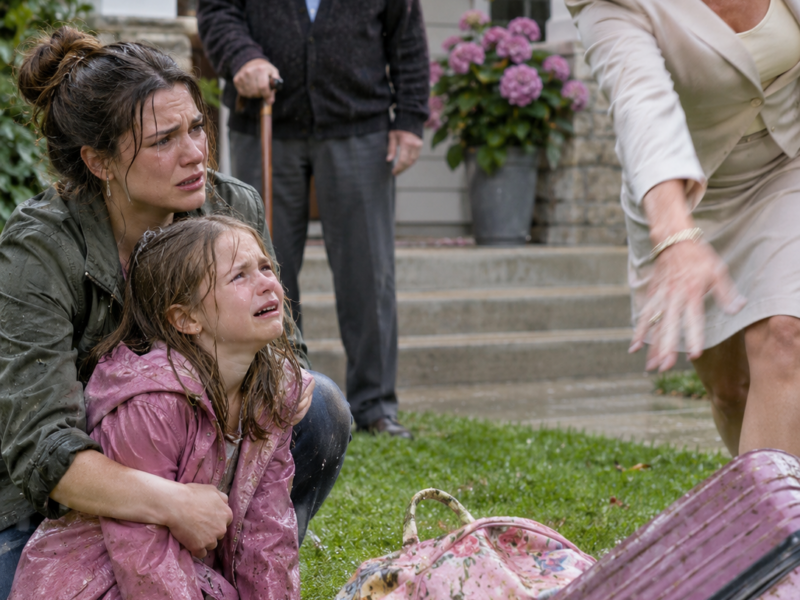
While My Father Was Fighting for His Life in the ICU, My 14-Year-Old Daughter Called Me Sobbing. My Stepmother Had Thrown Her Belongings Onto the Wet Grass, Called Her “Trailer Trash,” and Screamed, “Your Grandfather Is Gone! This House Belongs to Me Now!” I Told My Daughter Not to Move and Drove Twenty Minutes With My Best Friend, Who Had Kept a Painful Secret for Years. But When My Stepmother Opened the Door and Heard Two Simple Words, Her Face Turned Ghostly White… Is this conversation helpful so far?
While My Father Was Fighting for His Life in the ICU, My 14-Year-Old Daughter Called Me Sobbing. My Stepmother Had Thrown Her Belongings Onto the Wet Grass, Called Her “Trailer Trash,” and Screamed, “Your Grandfather Is Gone! This House Belongs to Me Now!” I Told My Daughter Not to Move and Drove Twenty Minutes With My Best Friend, Who Had Kept a Painful Secret for Years. But When My Stepmother Opened the Door and Heard Two Simple Words, Her Face Turned Ghostly White…
“Your grandfather is gone, Hannah. This house belongs to me now. Take your garbage and get off my property.”
Those were the words I heard through my fourteen-year-old daughter’s phone while standing outside an intensive care unit, less than ten feet from the hospital bed where my father was still alive.
For a moment, I couldn’t move.
Hannah was crying so violently that her words came out in broken gasps. Behind her, I could hear my stepmother shouting, a door slamming, and something heavy hitting the ground.
“Mom, she threw everything outside. My clothes, my books, everything. She called us trailer trash.”
I pressed my free hand against the hospital wall.
“Hannah, where are you?”
“The driveway.”
“Are you hurt?”
“No. But she keeps telling me to leave.”
I looked through the glass at my father. His blood pressure had finally begun to stabilize after hours of uncertainty. His chest rose and fell beneath the hospital blanket.
He wasn’t dead.
He wasn’t even unconscious anymore.
Less than thirty minutes earlier, he had opened his eyes and asked me where his granddaughter was.
And now his wife was throwing that same granddaughter out of his house.
“Listen to me, sweetheart,” I said. “Don’t go anywhere. I’m coming.”
My best friend, Jenna Walsh, stood beside me. She had heard enough of the conversation to understand what was happening.
Without asking a single question, she reached into her purse and took out her car keys.
“I’ll drive.”
I looked at her.
“Jenna, you know who’s going to be there.”
Her expression didn’t change.
“I know exactly who’s going to be there.”
There was something about the way she said it that made me realize this wasn’t going to be an ordinary confrontation.
For eleven years, I had kept a secret about Jenna’s past. I had promised never to reveal it, not even to my father.
That night, she decided she was done hiding.
And when my stepmother opened the front door twenty minutes later, she came face-to-face with the one person she had spent nineteen years pretending didn’t exist.
But the confrontation on that porch was only the beginning.
What followed exposed years of deception, stolen correspondence, deliberate isolation, and a plan to take possession of a house that had once represented everything good about my childhood.
My name is Katie Shepherd. I’m forty years old, and until that summer, I believed my father had stopped loving me.
It took my fourteen-year-old daughter to prove otherwise.
I grew up in Weaverville, North Carolina, in a two-story brick house at the end of Berkshire Court. My father, Dale Shepherd, bought the house with my mother in 1991, when I was five.
He was a carpenter, the kind of man who could turn a pile of discarded lumber into something beautiful.
The summer we moved in, he built a wide wooden porch across the front of the house. My mother planted flowers beside the steps and hung a small brass wind chime near the front door.
That porch became the center of my childhood.
It was where Dad taught me to tie my shoes, where Mom helped me prepare for school dances, and where we sat together on summer evenings watching thunderstorms move across the mountains.
When I turned fifteen and began testing the limits of my curfew, Dad developed a habit of leaving the porch light on.
One night, after I arrived home nearly an hour late, I expected him to be furious.
Instead, he was sitting in his chair with a newspaper folded across his lap.
He looked at me and said, “You see that light, Katie girl?”
I nodded.
“As long as it’s on, you know you’ve got somewhere to come home to.”
He still grounded me for a week.
But he never turned off the light.
Years later, when my mother became sick with ovarian cancer, that little light became even more important.
During her final months, I often drove home from the hospital after midnight. Dad would be waiting on the porch, looking older and more exhausted every time I saw him.
My mother died in October 2009.
She was fifty.
I was twenty-three.
After the funeral, Dad spent most of his time in the garage. He repaired things that didn’t need repairing and built furniture nobody had asked for.
He didn’t know how to talk about grief.
Neither did I.
But whenever I drove past the house, the porch light was glowing.
It reassured me that, despite everything we had lost, my father was still there.
Two years later, he met Darlene Pruitt at Weaverville Methodist Church.
She seemed wonderful at first.
She was outgoing, attentive, and always volunteering to help someone. She brought food to elderly church members, organized fundraisers, and remembered everyone’s birthday.
When Dad introduced us, she hugged me as though we had known each other for years.
“Your father talks about you all the time,” she said.
I wanted to believe her.
More than anything, I wanted Dad to be happy again.
They married in June 2012, four months after Hannah was born.
At the wedding reception, I watched them dance while holding my sleeping daughter.
Dad was smiling in a way I hadn’t seen since Mom’s death.
I remember thinking that perhaps our family had finally found a way forward.
I didn’t realize Darlene’s idea of moving forward involved removing nearly every reminder of the life Dad had lived before her.
The first thing to disappear was my mother’s wedding photograph.
Then several family portraits were taken down.
The brass wind chime vanished from the porch.
When I asked Darlene where everything had gone, she gave me a patient smile.
“Katie, your father deserves a fresh start. We can’t live in the past forever.”
I found the photographs in a plastic container in the garage.
The wind chime was lying beneath them.
I wanted to confront her, but Dad looked happier than he had in years, and I was afraid of creating tension in his marriage.
So I swallowed my anger.
That was my first mistake.
Two years later, my own life fell apart.
Hannah’s father, Tyler, left us.
There was no dramatic argument, no warning that he was unhappy enough to disappear. One morning, I found a note on the kitchen counter saying he couldn’t handle the responsibilities of being a husband and father.
He took his clothes and left.
Hannah was two years old.
I was working as a nursing assistant and couldn’t afford our apartment without his income.
After weeks of searching, I rented a modest single-wide trailer at Hilltop Meadows Mobile Home Park.
It wasn’t much.
The cabinets were outdated, the water heater barely worked, and the bedroom windows rattled whenever the wind picked up.
But I could afford it.
And for the first time, I was building a home entirely on my own.
I worked overtime whenever possible. I bought secondhand furniture, learned to stretch groceries, and celebrated every small improvement.
Hannah didn’t care that our home was a trailer.
She cared that we had pancakes on Saturday mornings and that I read to her before bed.
Unfortunately, Darlene cared very much.
At Thanksgiving that year, I arrived at Dad’s house carrying a homemade pecan pie.
Darlene was entertaining several relatives in the kitchen.
When she saw me, she smiled.
“Well, look who made it out of the trailer park.”
The conversation stopped.
Someone laughed nervously.
I set the pie on the counter and pretended the remark hadn’t hurt.
Later, while we washed dishes, she leaned toward me.
“You really ought to think about Hannah’s future.”
“What do you mean?”
“Children pick up reputations from their parents.”
I stared at her.
She lowered her voice.
“You don’t want people calling her trailer trash because of the choices you’ve made.”
My hands froze beneath the running water.
My father was sitting in the next room.
The door was open.
I knew he could hear us.
I waited for him to intervene.
He didn’t.
When I left that evening, Dad followed me outside carrying my mother’s glass pie dish.
“Darlene can be a little harsh sometimes,” he said.
“She called me trailer trash.”
“She didn’t mean it like that.”
“How else could she have meant it?”
He looked uncomfortable.
I waited.
He said nothing.
Finally, I took the dish from his hands, put Hannah in her car seat, and drove home.
I cried most of the way.
When I arrived at the trailer park, a woman sitting on the neighboring steps noticed me struggling to carry Hannah, my purse, and the pie dish.
“Need a hand?” she called.
Before I could answer, she was already walking toward me.
That was how I met Jenna Walsh.
She lived next door with her six-year-old son, Caleb. Like me, she worked as a nursing assistant and was raising a child without much help.
We understood each other almost immediately.
Neither of us had much money, but between us, we somehow always had enough.
When Jenna worked late, Caleb stayed with me. When Hannah got sick and I couldn’t miss another shift, Jenna took care of her.
We celebrated birthdays together, shared meals, and helped each other survive the difficult years of single motherhood.
She became my closest friend.
Then, one evening in 2015, everything changed.
Jenna was sitting in my living room when she noticed a framed photograph of Dad and Darlene on their wedding day.
She stopped talking in the middle of a sentence.
“Who’s that woman?”
I followed her gaze.
“My stepmother. Darlene.”
Jenna stared at the photograph.
“Darlene Pruitt?”
“Yes. Do you know her?”
Her face turned pale.
She sat down, pressed her hands together, and took several deep breaths.
Then she said something that left me speechless.
“She’s my mother.”
I thought I had misunderstood.
“What?”
“Darlene is my mother.”
For the next hour, Jenna told me about the childhood she rarely discussed.
She had grown up with Darlene and her older brother, Brent.
Her mother had always been strict, but when Jenna became pregnant at eighteen, everything changed.
Darlene was furious.
She called Jenna irresponsible, selfish, and an embarrassment to the family.
When Jenna refused to end her relationship with Caleb’s father, Darlene packed her belongings and threw her out.
“She told me I would never be anything but trailer trash,” Jenna said.
The words sent a chill through me.
Jenna moved into a trailer with her boyfriend, married him, and took his surname.
The marriage eventually failed.
But she raised Caleb, completed her training, and built a life without her mother’s support.
Darlene never contacted her.
Not once.
Instead, she told people she had only one child.
Brent.
I remembered asking Darlene whether she had other children.
She had answered without hesitation.
“Just Brent.”
I couldn’t believe she had erased her own daughter so completely.
“Does Dad know?” I asked.
Jenna shook her head.
“Please don’t tell him.”
“But—”
“Katie, please. I finally have a life where she can’t hurt me anymore. I don’t want to lose that.”
I understood.
I promised to keep her secret.
And for eleven years, I did.
In 2018, after years of studying and working exhausting shifts, I became a registered nurse.
I was proud of what I had accomplished.
Dad was proud, too, although Darlene rarely allowed him to express it without adding some remark about how difficult my schedule must be for Hannah.
Then came 2020.
The pandemic turned my hospital into a place of constant uncertainty.
I worked twelve-hour night shifts in the emergency department while Hannah struggled with remote learning.
Jenna was working nights, too.
We were running out of childcare options.
On April 11, I drove to Dad’s house hoping he could help.
Darlene answered the door.
She was wearing a mask and stood behind the screen without opening it.
“Your father isn’t here.”
“When will he be back?”
“Later.”
“I need to ask him something.”
She crossed her arms.
“If this is about Hannah, we’ve already discussed it.”
I frowned.
“Discussed what?”
“Your father thinks you need to learn to manage your own responsibilities.”
I couldn’t believe what I was hearing.
“I’m working in an emergency department during a pandemic. I’m asking for temporary help.”
“And we’re not interested in exposing ourselves to whatever you’re bringing home from that hospital.”
“I just want to speak to Dad.”
Her expression hardened.
“You’re not welcome here anymore, Katie.”
Then she shut the door.
I stood on the porch for several seconds, staring at the screen.
I felt humiliated.
But I refused to believe Dad would actually turn his back on me.
So I wrote him a letter.
It came back unopened.
REFUSED. RETURN TO SENDER.
I wrote another.
The same thing happened.
Then a third.
Again, it was returned.
I tried calling his house, but the number had been disconnected.
His cellphone rang once and went straight to voicemail.
I couldn’t understand how the man who had spent my childhood reminding me that I always had a home could suddenly refuse to speak to me.
Eventually, I stopped calling.
I continued writing occasionally, sending birthday cards, Christmas photographs, and letters about Hannah.
But I never received a response.
Not a single one.
Six years passed that way.
Six birthdays.
Six Christmases.
Six Father’s Days.
I moved out of the trailer park and rented a duplex in West Asheville.
Hannah grew taller.
She became interested in science, earned excellent grades, and developed a stubborn streak that reminded me of my mother.
Jenna and Caleb remained part of our lives.
From the outside, everything seemed fine.
But every time I passed a father shopping with his adult daughter or saw a grandfather holding his granddaughter’s hand, I felt something painful twist inside me.
I missed Dad.
I just didn’t believe he missed me.
Then, in February 2026, Hannah won a regional science fair.
Her photograph appeared in the local newspaper.
I bought three copies and proudly displayed one on our refrigerator.
What I didn’t know was that Dad had seen it, too.
With help from Aunt Peggy, his younger sister, he created an Instagram account and contacted Hannah.
His first message was simple.
“This is your Grandpa Dale. I saw your picture in the paper. I’m proud of you, kiddo.”
Hannah responded.
For four months, they exchanged messages without telling me.
She told him about her science projects, her teachers, and her friends.
He sent photographs of Buck, his aging yellow Labrador, and told her stories about when I was little.
Their relationship grew quietly.
Then, one evening in June, Hannah sat across from me at the kitchen table.
“Mom, can I ask you something?”
“Of course.”
“Why didn’t you give me Grandpa’s birthday cards?”
I looked up.
“What birthday cards?”
She showed me her phone.
Dad had written that he sent her a birthday card and a Christmas card every year, each containing fifty dollars.
I read the message several times.
“Hannah, I’ve never received any cards from Grandpa.”
She frowned.
“He says he’s been sending them.”
“Then I don’t know what happened.”
She looked at me with an expression I couldn’t quite read.
“Mom, either Grandpa’s lying or somebody else is.”
I felt defensive.
“Are you saying I’m lying?”
“No. I’m saying I don’t think Grandpa is.”
That conversation unsettled me for days.
A few weeks later, Hannah asked if she could spend part of her summer vacation at Dad’s house.
I immediately refused.
She argued.
I refused again.
Eventually, after speaking with Dad through Hannah and confirming that he genuinely wanted her there, I agreed.
But I wasn’t ready to see him.
So every Monday morning, I drove Hannah to Berkshire Court and stopped near the curb.
Dad would come onto the porch.
He would wave.
I would wave back.
Then I drove away.
It was a ridiculous arrangement, but at the time, it was all I could manage.
Hannah enjoyed spending time with him.
They watched old movies, worked on puzzles, walked Buck, and talked about school.
Darlene was less enthusiastic.
She complained about Hannah’s belongings, the food she ate, and how much time Dad spent with her.
But Dad began defending Hannah.
One afternoon, when Darlene complained that she wasn’t running a hotel, Dad told her to leave his granddaughter alone.
Hannah proudly reported that conversation to me.
I was surprised.
Dad had rarely defended me when Darlene insulted me.
Something was changing.
Then Hannah told him about the missing birthday cards.
Dad became concerned.
He asked whether I had ever mentioned receiving letters from him.
She told him no.
He began searching the house whenever Darlene was away.
On Tuesday, July 14, Darlene left for her weekly Bible study.
Dad went upstairs and searched the spare bedroom closet.
Behind a stack of winter blankets, he found Darlene’s wicker sewing basket.
Inside was a Belk shoebox secured with a red rubber band.
Hannah told me later that she found him sitting on the edge of her bed, holding the box with trembling hands.
He looked devastated.
That evening, when Darlene returned home, Hannah heard them arguing downstairs.
Dad kept asking, “How long have you been doing this?”
Darlene’s answers were too quiet for Hannah to hear.
Around ten o’clock, Dad knocked on her bedroom door.
He handed her the shoebox.
“I need you to give this to your mother.”
“What is it?”
“Something she should have received a long time ago.”
He told her not to open it and not to let Darlene take it.
Hannah put the box inside her backpack.
The next morning, Dad was rushed to the hospital.
He had been experiencing abdominal pain for several days, but like many stubborn men his age, he ignored it until he could barely stand.
Doctors discovered a severely inflamed gallbladder and performed emergency surgery.
I went upstairs to the surgical waiting area after finishing my shift.
Darlene was already there.
When she saw me, she turned her chair away.
I stood near the entrance for nearly a minute.
Then I left.
I was ashamed of that decision afterward.
But six years of rejection had made me afraid that Dad wouldn’t want to see me.
Hannah begged to remain at his house while he recovered.
She wanted to look after Buck and help Grandpa when he returned.
I was scheduled to work nights, and I agreed to let her stay until Friday.
Meanwhile, Dad was transferred to the surgical floor where Jenna worked.
When she entered his room, she recognized him immediately.
He didn’t recognize her.
Eventually, he asked her name.
Jenna hesitated.
Then she told him everything.
She explained that she was Darlene’s daughter, that her mother had thrown her out at eighteen, and that she had been my closest friend for more than a decade.
Dad listened in stunned silence.
Later, Jenna sent me a message.
“He knows who I am. He wants to see you.”
I promised myself I would visit Friday.
But before I could, Dad’s condition deteriorated.
A complication from his surgery caused bile to leak into his abdomen.
An infection spread into his bloodstream.
He became septic.
Doctors rushed him into intensive care.
By the time I arrived, he was receiving medication to maintain his blood pressure.
He looked frighteningly weak.
Darlene sat beside him.
When she saw me, she said, “Nice of you to finally show up.”
I didn’t respond.
I sat on the opposite side of his bed and took his hand.
For hours, I watched the monitors, listened to the nurses, and prayed silently.
At seven that evening, the ICU physician explained that Dad’s condition remained critical.
Darlene stood up.
“I can’t stay here and watch this.”
She picked up her purse.
Then she looked at me.
“Tell Hannah I’ll be home.”
I should have recognized the warning in her voice.
I should have left immediately.
But Dad’s blood pressure dropped again, and the nurses rushed into the room.
I stayed.
Around eight-thirty, after another adjustment to his medication, Dad opened his eyes.
“Katie girl?”
I leaned toward him.
“I’m here, Dad.”
His fingers moved weakly around mine.
“I wrote you.”
I felt tears rising.
“What?”
“Every year.”
“Dad, I never got your letters.”
He looked confused.
Then he asked about Hannah.
I told him she was safe at his house.
Twenty-five minutes later, she called me crying.
And that was how Jenna and I ended up driving through the dark toward Berkshire Court.
I remained on the phone with Hannah the entire journey.
Ellen Hartley, the retired schoolteacher across the street, had gone outside to sit with her.
When we arrived, Hannah was wrapped in Ellen’s cardigan.
Her belongings were scattered across the wet lawn.
Her purple duffel bag had split open.
Her stuffed rabbit lay beside a pile of damp clothing.
She was clutching her backpack tightly.
I knelt in front of her and pulled her into my arms.
“I’m here, baby.”
She cried against my shoulder.
Ellen told me she had witnessed everything from her front window.
“That woman dragged the girl’s bags outside and threw them down the steps,” she said. “I’ve never seen anything like it.”
Hannah whispered that Darlene had searched her room first.
“She kept asking where it was.”
“Where what was?”
Hannah looked at her backpack.
“Grandpa’s box.”
Suddenly, I understood that this wasn’t simply about Darlene wanting Hannah out of the house.
She wanted something Hannah possessed.
I asked Ellen to stay with her.
Then Jenna and I walked toward the porch.
The motion-sensor light came on.
I knocked.
Darlene opened the door with an irritated expression.
“If you’re here for the rest of that child’s garbage—”
Her voice stopped.
She stared at Jenna.
For several seconds, nobody spoke.
Then Jenna stepped forward.
“Hello, Mom.”
Darlene gripped the doorframe.
Her face went completely white.
“Jenna?”
“Surprised?”
Darlene looked from Jenna to me.
“What are you doing here?”
Jenna’s voice was quiet.
“I came because I heard you threw a fourteen-year-old girl out of her grandfather’s house.”
“This doesn’t concern you.”
“You called her trailer trash.”
Darlene opened her mouth.
Jenna continued.
“That’s what you called me when I was eighteen. Remember?”
The silence was almost unbearable.
Then Jenna delivered the news Darlene clearly hadn’t expected.
“Dale is alive. He’s awake, and he’s asking for Hannah.”
Darlene blinked.
For the first time, she seemed uncertain.
I told her we were taking the rest of Hannah’s belongings.
She tried to refuse.
“This is my house.”
“My father is still alive,” I replied. “You don’t get to decide otherwise.”
She glanced toward the street, where Ellen stood watching.
Eventually, she stepped aside.
Upstairs, Hannah’s room looked as though someone had conducted a desperate search.
Drawers had been emptied.
The mattress had been moved.
The closet had been cleared.
Darlene’s wicker sewing basket lay overturned on the floor.
“Whatever she took,” Darlene said from behind me, “belongs to me.”
I turned around.
“What exactly did she take?”
Darlene didn’t answer.
Instead, she announced that Brent was moving into the room the following morning.
I ignored her.
Jenna helped me gather Hannah’s remaining possessions.
When we went downstairs, Buck approached us, wagging his tail.
Darlene pointed toward the door.
“Take him, too. I’m not looking after that animal.”
I clipped on his leash.
We left together.
At home, shortly before midnight, Hannah handed me the shoebox.
I removed the red rubber band.
Inside were twenty-seven envelopes.
Fourteen were addressed to Dad in my handwriting.
Thirteen were addressed to Hannah or me in his.
I recognized every letter I had written.
There were Christmas cards, birthday wishes, photographs, and personal messages I had sent during some of the hardest moments of my life.
None had been opened.
Dad’s envelopes had stamps but no postmarks.
They had never been mailed.
Inside Hannah’s twelve cards were twelve checks for fifty dollars each.
Six hundred dollars.
Six years of birthdays and Christmases.
I couldn’t stop shaking.
Then I opened the letter Dad had written to me in May 2020.
He explained that Darlene had told him I had come to the house and announced that I never wanted to see him again.
He said he was heartbroken but would respect my wishes.
He promised to continue writing to Hannah.
At the bottom, he had written:
“The light’s still on, Katie girl. It always will be.”
I covered my mouth.
For six years, I had believed Dad had deliberately rejected me.
For six years, he had believed I had deliberately rejected him.
Neither of us knew that the other was still reaching out.
Hannah leaned against my shoulder.
“Grandpa wasn’t lying.”
“No,” I whispered. “He wasn’t.”
Jenna stared at the box.
“My mother did this.”
I retrieved the three envelopes that had been returned to me in 2020.
Then I found an old Christmas card Darlene had signed.
The handwriting on the returned envelopes looked remarkably similar to hers.
It wasn’t conclusive proof by itself, but combined with everything else, it painted a devastating picture.
Darlene had controlled the mail.
She had controlled Dad’s phone.
She had controlled the story each of us heard about the other.
And she had managed to keep us apart for six years.
The following morning, I visited Ellen.
She confirmed that Darlene collected the mail every day.
She also remembered the morning in 2020 when Darlene had turned me away.
Dad had returned from a medical appointment about an hour later.
Darlene had been waiting in the driveway.
Ellen couldn’t hear what she told him, but she remembered Dad looking devastated.
Then Ellen admitted that Dad had occasionally asked whether she ever saw me driving past.
“He missed you,” she said. “I should have told you.”
I didn’t know how to respond.
As I was leaving, a moving truck pulled into the cul-de-sac.
Brent climbed out.
He looked tired and embarrassed.
He explained that his marriage was ending and that Darlene had promised him a place to stay.
“She said Dale offered me the spare bedroom.”
“When?”
He showed me a text message from Monday evening.
“The room is yours by the weekend. The girl won’t be a problem.”
My stomach tightened.
Darlene had planned to remove Hannah before Dad became critically ill.
Brent also admitted that his mother had always told him Jenna wanted nothing to do with their family.
He hadn’t known where she lived.
Another lie.
Another relationship destroyed.
Over the following days, Darlene became increasingly aggressive.
Dad developed temporary confusion related to his infection, and because he hadn’t designated a healthcare power of attorney, Darlene was consulted about his care while he couldn’t make decisions himself.
She restricted our visits.
She changed the locks on his house.
She told church members that Jenna and I were attempting to manipulate Dad into changing his will.
Then she filed a complaint against Jenna at the hospital.
Jenna was placed on administrative leave while the complaint was investigated.
I felt responsible.
But Jenna refused to blame me.
“I should have disclosed the relationship,” she admitted. “I made that decision.”
Meanwhile, Brent warned me that Darlene was arranging for Dad to be transferred to a nursing facility in Hendersonville.
I was terrified that she would isolate him again.
One evening, I sat at my kitchen table staring at the shoebox, wondering whether I had enough strength left to continue fighting.
Hannah walked into the kitchen.
“Mom?”
I looked up.
“Remember when you told me not to move?”
I nodded.
“You said you were coming.”
“Of course I was.”
She sat beside me.
“Grandpa needs somebody to come for him, too.”
Those words stayed with me.
The next morning, I arranged to switch to day shifts for six weeks.
I didn’t know whether Dad would need my help or even accept it.
But I wanted to be ready.
On Tuesday evening, my phone rang.
“Katie?”
I recognized his voice immediately.
“Dad?”
“They moved me out of intensive care.”
He sounded weak but clear.
“I told them I want to see you.”
I closed my eyes.
“Okay.”
“Bring Hannah. And bring that box.”
The next morning, we visited him together.
He hugged Hannah first.
Then I placed the shoebox on his bed.
He opened one of my letters and discovered an old school photograph of Hannah.
She was smiling with a missing front tooth.
He stared at it for a long time.
“I missed all of this,” he whispered.
I sat beside him.
“You could have come to see us, Dad.”
He looked at me.
“So could you.”
Neither of us spoke.
The truth was painful.
Darlene had deceived us, but we had both allowed fear and pride to keep us from confronting what had happened.
Then Hannah checked Dad’s phone.
My number was blocked.
Dad stared at the screen.
“Darlene set that phone up for me.”
He shook his head.
“I didn’t know.”
After a long silence, he told us there would be a discharge-planning meeting the following afternoon.
“I want everybody there,” he said.
The meeting took place in a hospital conference room.
Dad sat in a wheelchair.
Aunt Peggy was beside him.
Brent sat near the door.
Jenna sat next to me, attending as Dad’s guest.
Darlene arrived carrying a brochure for the nursing facility.
She placed it in front of Dad.
“They’ve reserved a room for you.”
Dad pushed it aside.
“First, we’re going to talk about the letters.”
Darlene immediately began describing everything she had done for him during their fourteen-year marriage.
She listed appointments, meals, household chores, and medical emergencies.
Then she pointed toward me.
“Where was Katie when you needed her?”
I placed the shoebox on the table.
“Trying to reach him.”
Darlene stared at it.
I showed everyone the unopened letters, the uncashed checks, and the returned envelopes.
Dad picked up one of Hannah’s birthday cards.
“You told me she received every one of these.”
Darlene said nothing.
Aunt Peggy compared the handwriting on the returned envelopes with Darlene’s old Christmas card.
Her expression changed.
“That’s your handwriting.”
Darlene turned toward Brent.
“Tell them Dale promised you the room.”
Brent unlocked his phone.
Instead of defending her, he showed Dad the messages.
One said Hannah wouldn’t be a problem.
Another, sent after Jenna had told Darlene that Dad was awake, said he wouldn’t be coming home.
Dad looked at his wife.
“You wrote this?”
Darlene tried to explain.
Brent interrupted.
“You told me he was dying. You told me he’d already agreed to let me move in.”
Dad shook his head.
“I never agreed to anything.”
Brent looked toward Jenna.
Then he apologized for believing their mother’s story all those years.
Jenna began crying.
Darlene became furious.
“This is all because of that girl!”
I asked whether Hannah could join us.
The social worker agreed.
When Hannah entered, she held my hand and looked directly at Grandpa.
“She came into my room and started searching everything,” Hannah explained. “She wanted to know what you gave me.”
Dad listened.
“I wouldn’t tell her. That’s when she threw my stuff outside.”
Darlene suddenly stood.
“That box was in my sewing basket! She had no right to take it!”
The room fell silent.
Darlene realized what she had admitted.
Dad looked at her.
“So you knew exactly what was inside.”
She slowly sat down.
I showed the social worker the message Darlene had sent me demanding that I return what Hannah had taken before she would consider allowing me to visit Dad.
Nobody needed another explanation.
Dad turned toward the social worker.
“I want to go home.”
He explained that I had arranged to stay with him during his recovery.
After discussing his needs and available home health services, the social worker agreed that returning home could be arranged safely.
Then Dad looked at Darlene.
“I need you to stay with Lorraine. We need some time apart.”
Darlene stared at him.
“If I walk out, Dale, don’t expect me to come back.”
He nodded.
“I understand.”
She collected her purse and left.
Outside the conference room, she encountered Caleb.
He was standing near the elevators.
Months earlier, he had helped install the motion-sensor porch light at Dad’s house through his electrical apprenticeship.
Darlene had served him lemonade and given him a twenty-dollar tip.
She hadn’t known he was her grandson.
Now Jenna stood beside him.
“Mom, this is Caleb.”
Darlene looked at the young man.
“Your grandson,” Jenna added.
The elevator doors opened.
Darlene remained motionless.
For nineteen years, she had denied her daughter’s existence.
Now she was looking at the grandson she had never bothered to meet.
Caleb didn’t approach her.
Jenna didn’t ask him to.
Eventually, Darlene stepped into the elevator.
The doors closed.
Dad returned home on July 25.
Darlene had already moved to her sister’s house.
She took her clothes, jewelry, and expensive dishes.
She left the wicker sewing basket in the hallway.
Her house key rested on top.
Brent had arranged to stay with a friend.
Before leaving, he cleaned Hannah’s bedroom and repaired the damage caused when Darlene emptied the drawers.
For six weeks, Hannah and I stayed with Dad.
His recovery was slow.
There were difficult mornings, medical appointments, and nights when he struggled to sleep.
But there were also wonderful moments.
We ate dinner together.
Hannah helped him organize his workshop.
Buck followed him everywhere.
And every day, the house felt a little more like home.
Darlene eventually left a voicemail explaining that she had been afraid of losing Dad.
She claimed everything she had done was intended to protect their marriage.
She didn’t apologize.
Not to Hannah.
Not to Jenna.
Not to me.
Dad listened to the message and decided not to respond.
He wasn’t ready to make a final decision about his marriage, but he knew he needed to live separately while he considered his future.
In August, the hospital completed its investigation into Jenna’s conduct.
She received a written warning for failing to disclose her family connection.
But she kept her job.
Dad’s statement helped establish that she had been honest with him and that he had wanted her company.
Jenna accepted responsibility for the warning.
Soon afterward, she met Brent for breakfast.
They hadn’t shared a meal in nineteen years.
They talked for hours.
When Caleb arrived, Brent introduced himself properly to his nephew.
It was a small beginning, but after nearly two decades of silence, it meant everything.
One evening, Dad and I sat on the front porch.
I finally asked him about Thanksgiving 2014.
“Do you remember what Darlene called me?”
He nodded.
“I heard her.”
“Why didn’t you defend me?”
He looked down at his hands.
“Because I was afraid of what would happen if I confronted her.”
I felt tears rising.
“And I was the one who had to live with what happened because you didn’t.”
He nodded again.
“I’m sorry, Katie.”
There was no excuse.
No attempt to blame me.
Just an apology I had waited twelve years to hear.
He went inside and returned with my mother’s old glass pie dish.
He had kept it all those years.
We sat together until the porch light switched itself off.
Dad looked up.
“I hate that thing.”
I laughed.
“Then change it.”
He smiled.
“I think I will.”
Before school started, Hannah admitted she sometimes blamed herself for everything that had happened.
She believed that if she hadn’t contacted Grandpa, Darlene would never have become angry and the family would still be together.
I told her the truth.
“You didn’t destroy anything, sweetheart. You discovered what was already broken.”
I apologized for making her the messenger between Dad and me.
She should never have been responsible for repairing relationships between adults.
We arranged for her to speak with a school counselor, and gradually, she began feeling better.
In September, Dad took Hannah to the credit union.
He brought the twelve uncashed checks.
He tore them in half and deposited one thousand dollars into a savings account for her.
“Six hundred for the cards,” he explained. “Four hundred in late fees.”
Hannah laughed.
She kept one of the torn checks as a reminder.
On September 27, Dad invited everyone to dinner.
Caleb arrived early and removed the motion-sensor porch light.
He replaced it with a simple brass fixture connected to an ordinary switch.
Dad handed him a warm amber bulb.
Then he retrieved my mother’s wind chime from the garage.
Caleb hung it beside the light.
When the evening breeze moved through the porch, the familiar sound filled the air.
I stood in the driveway listening.
For the first time in years, the house looked exactly as I remembered it.
Jenna arrived with Caleb.
Brent brought a pie.
Aunt Peggy brought a casserole.
Ellen came carrying a bowl of green beans.
Hannah set the table.
Dad said grace before dinner.
He thanked God for his recovery and for everyone gathered around him.
Then he paused.
“And please look after Darlene, wherever she is tonight.”
Nobody said anything.
I understood that he wasn’t excusing her actions.
He was simply refusing to let anger become the center of his remaining years.
After dinner, I joined him on the porch.
Buck was sleeping beside his chair.
I handed Dad an envelope.
He looked at me.
“What’s this?”
“Another letter.”
He smiled.
“You’re not mailing this one?”
“No. I’m delivering it myself.”
He opened it beneath the amber light.
Inside, I had written about everything I wished we had done differently.
I told him I loved him.
I told him I still carried pain from the years we had lost.
And I told him that I wasn’t going to spend another six years waiting for him to make the first move.
When he finished reading, he folded the letter and held it against his chest.
“First letter I’ve received the same day you wrote it,” he said.
I rested my head against his shoulder.
Neither of us needed to say anything else.
Later that evening, Hannah and I prepared to leave.
Dad walked us to the front steps.
“Drive carefully, Katie girl.”
“I will.”
As I backed out of the driveway, I looked in the rearview mirror.
Dad stood in the doorway.
Above him, the porch light glowed warmly.
Beside it, my mother’s wind chime moved gently in the darkness.
I waited for the light to switch off.
It didn’t.
It stayed on.
For six years, I had believed my father lived too far away for our relationship to be repaired.
I had imagined the distance between us as something enormous.
But his house was only twenty minutes from mine.
It had always been twenty minutes.
Darlene had managed to turn that short drive into six years of silence.
She had convinced us that love had disappeared when, in reality, she had simply prevented us from seeing it.
She hid the letters.
She blocked the calls.
She controlled the conversations.
She separated a mother from her daughter, a brother from his sister, and a grandfather from his granddaughter.
But she couldn’t control everything forever.
Eventually, a fourteen-year-old girl asked a question nobody else had been brave enough to ask.
And because Hannah refused to accept an explanation that didn’t make sense, the truth finally found its way out of a dusty shoebox hidden behind winter blankets.
Today, Hannah visits her grandfather whenever she wants.
She has her own drawer in his spare bedroom.
Her purple duffel bag is folded on the closet shelf, exactly where Darlene once kept her sewing basket.
Dad collects his own mail.
He answers his own phone.
And when he wants to see me, he calls.
Sometimes, I think about the night Darlene threw Hannah’s belongings onto the wet grass.
I remember my daughter’s frightened voice.
I remember Jenna standing beside me.
I remember Darlene’s expression when she opened the door and saw the daughter she had abandoned nineteen years earlier.
At the time, I thought that moment would be the most satisfying part of everything that followed.
But it wasn’t.
The greatest victory wasn’t watching Darlene lose control.
It was watching Hannah discover that her grandfather had remembered every birthday.
It was hearing Dad finally apologize.
It was seeing Jenna reconnect with her brother.
It was realizing that our family could move forward without allowing someone else’s cruelty to determine how we treated one another.
Darlene believed that controlling the house meant controlling the family.
She believed that possessing the keys gave her the right to decide who belonged.
She was wrong.
A family isn’t built by locking people out.
It’s built by making sure they know they can come home.
And whenever I drive down Berkshire Court after dark, I see the proof waiting at the end of the street.
A little brick house.
A familiar brass wind chime.
An amber porch light that never turns itself off.
And a father who no longer waits for someone else to tell him whether his daughter is welcome.
Six years were stolen from us.
We will never get them back.
But we have today.
We have tomorrow.
And this time, neither of us is going to waste another minute waiting for the other person to knock.