When Grandma Died, My Parents Kept Me From the Will — Her First Line Was About What They Did to Me
When Grandma Died, My Parents Kept Me From the Will — Her First Line Was About What They Did to Me
The first thing my mother did when I walked into the lawyer’s office was tell me to go home.
“You can leave, Zoe. This is for the heirs.” She looked around the table as if someone might need her to explain. “You’re the useful one. Brooke is the successful one.”
My sister kept her eyes on her phone. My father studied the carpet. At the far end of the table, my nephew Owen watched my mother with both hands pressed flat against the wood.
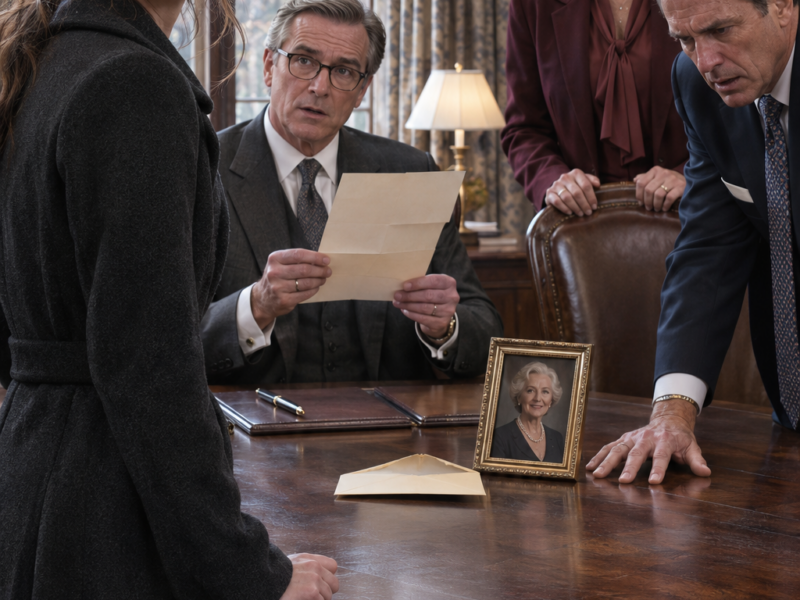
Thomas Hale, my grandmother’s attorney, stepped around me, shut the door, and turned the lock.
“She stays,” he said. “Your mother was very clear about that.”
He took his seat and opened a folder my grandmother had sealed nearly four months before. The top sheet was covered in her small, slanted handwriting. I recognized it from the backs of birthday cards, where she always put the date, even if the date was already printed on the envelope.
“Start with what they did to her,” he read.
My mother, who had been halfway out of her chair, sat down.
I was thirty-eight years old. I had heard her call me useful at kitchen tables, in parking lots, and over the phone to women from church. Until that afternoon, I had always found something to do with my hands when she said it. There was nothing on the table in front of me, so I folded them in my lap and waited to hear what my grandmother had written next.
Five months earlier, on a Saturday in January, my mother had texted me at seven in the morning. Garage door sensor. Sink filter. Christmas lights back to the attic. I let myself in with the spare key she’d given me twelve years earlier, the one with the blue rubber cover. She was on the phone with Brooke and raised one finger as I passed.
“Hold on, honey. Zoe’s here doing the garage thing.”
Through the wall, I heard her repeat the amount of Brooke’s latest bonus. My sister had made regional director and was getting a company car. By the time I’d fixed the sensor, changed the filter, and carried the Christmas lights upstairs, my mother had told the whole story twice. I put the screwdriver back in its drawer and let myself out. She never asked if I’d had breakfast.
On my way to the door, I passed what she called the milestone wall. Brooke’s degrees hung there, along with a picture of her wedding to Carter and one of her at twenty-one, holding her newborn son. I’d once asked my mother if she had room for a photo Grandma Nell had taken at Owen’s first Christmas. In it, he’d got one fist tangled in my hair and was laughing too hard to let go.
“We don’t have room for every snapshot,” she’d said.
Before I got to the car, Owen called from Ohio State. He was nineteen, away at college in Columbus, and had a fever.
“Zozo, is it dramatic to go to student health?”
He’d called me Zozo since before he could say my name. I asked what his temperature was, talked him through what to do next, and told him to call me back. I use that same voice at the dental office with kids who have never heard a suction tube before. People think I learned it in school. I learned it with a feverish toddler on my shoulder at three in the morning. School gave me a license.
“Grandma Nell keeps asking what I remember from when I was little,” he said.
“What do you tell her?”
“The truth. I remember you.”
I should have asked what she wanted to know. Instead, I reminded him to call me back, then sat in my car a little longer than I needed to.
Nell had taught school for thirty-four years. She kept every card anyone sent her in a cookie tin and dated every photograph. When her heart began to fail in 2023, I started making the three-hour drive to Lakewood once a month to sort her pills and mow the grass. Once, when I came in with wet shoes after finishing the lawn in the rain, she gave me a towel and said, “You’re the one who comes, Zoe. I notice who comes.”
Owen had spent the summer before college at her house. He told her his first memory was of somebody singing in a kitchen. When she asked who, he said it was me. Then he asked why nobody ever talked about the years he’d lived with me. By the following spring, she was asking me who taught him to tie his shoes and who took him to the emergency room when he had croup. I answered, then heard myself adding that Mom helped and everybody pitched in.
At Thanksgiving, Grandma asked my father, in front of the whole table, who had got up with Owen at night.
Dad looked at Mom. “Ask Diane.”
Grandma nodded as though he’d answered her.
On one of my winter visits, she asked if I’d ever tried to keep him.
“That wasn’t my place, Grandma.”
“Who told you that?”
A few weeks later, she called me at nine on a Sunday night. “Zoe, I need to ask you about the summer Owen was born.”
There was a rustle. Then my mother’s voice came on, bright and close.
“She’s tired, honey. She’s not making sense tonight.”
The call lasted forty-one seconds. Two days later, Mom told me Grandma wanted no visitors. She was confused and saying cruel things about people, and I would only upset myself if I drove up. I crossed February 14 off my calendar. I wrote a card instead. I wrote another in March and another in April, and I gave all three to Mom to deliver. I called twice. The first time Mom answered and said Grandma was asleep. The second time I left a message.
In March, Brooke called to say Mom thought we should all give Grandma some space. Then she asked if I’d write something she could read at the funeral, in case it came to that.
“You could write it yourself,” I said.
“You’re better at words. I’ll read whatever you write.”
That night I wrote about the cookie tin and the dates on the photographs. I wrote about the people who show up on ordinary Saturdays, even when it means six hours in the car. I saved the file under Brooke’s name.
Grandma died at 4:10 on the morning of May 14, with a hospice nurse beside her bed. My mother put the news in the family group chat at six. Brooke was flying in that night. Could I handle the church and the lunch?
By the time I got to Lakewood, Mom had stripped the bed and bagged the sheets. I asked if I could sit in Grandma’s room for a minute.
“There’s nothing in there, Zoey. The church will need numbers for lunch.”
I was on the phone when Owen arrived from Columbus. He walked right past me, turned around, and hugged me with his car keys still in his hand. He was six inches taller than me by then. For a second I knew exactly how he’d felt in my arms at four.
“She talked about you,” he said into my hair. “A lot.”
“What did she say?”
He glanced toward the dining room, where my mother stood. “Not here.”
At the funeral five days later, Brooke read my eulogy beautifully. The paragraph about the Saturday drives was gone. While I refilled the coffee urns afterward, she came into the kitchen and squeezed my arm.
“Your words were perfect.”
“Most of them,” I said.
She looked at me for a moment. Then someone called her name.
A gray-haired man in a dark suit introduced himself by the coffee. Thomas Hale. He said Grandma had spoken about me and that I would be hearing from his office. When he left, Owen stepped up beside me.
“Why didn’t Mom say your name?”
“It’s fine, bud.”
“It isn’t, though.”
Five weeks later, Mr. Hale called. The probate court had appointed him executor, Grandma had named me as a beneficiary, and there would be a meeting on June 30 at two in the afternoon. He asked me to come, whatever I heard between now and then. I found out what he meant as soon as I called my mother. She said she’d read the will and knew who was in it. The night before the meeting she called again and told me I’d embarrass myself if I drove three hours to sit in a lobby.
“I’ll see you tomorrow,” I said.
Ten minutes later, Dad texted me the address on Detroit Avenue and four words. “Don’t tell your mother.” The message disappeared almost immediately. I’d already taken a screenshot.
I left early and spent part of the morning in Lakewood because I couldn’t bear to sit around at home waiting. At the office, the receptionist consulted a handwritten list beside her keyboard. I recognized my mother’s writing before she said Mrs. Oliver had told her the whole family was already there.
I was reaching for my keys when Mr. Hale opened his office door.
“You’re on my list, Ms. Oliver,” he said. “Come in.”
After he read Grandma’s first line, he explained that the door opened from the inside. Anyone could leave. The lock was there so nobody could be summoned out halfway through. Then he laid out what Grandma had done on March 3. She’d signed a codicil replacing Mom as executor and naming four beneficiaries. Mom already had the court’s notice. I was one of the four. Owen was another.
“She was on morphine,” Mom said.
“She was alert when she signed. She beat my paralegal at the crossword while we waited for the notary.”
My mother turned to Owen. “Who told you to come?”
“Grandma Nell. In January. She said if a lawyer called, I should go and I shouldn’t ask you first.”
“You know she was medicated, honey.”
“She beat me at gin rummy that day.”
Dad let out half a laugh and turned it into a cough.
Mr. Hale brought a shoebox up from the chair beside him. I’d been putting folded sweaters next to it for three years. He explained that the letter had no legal force. Grandma had asked him to read it before he talked about the house or the accounts, because once people heard about the money, she didn’t think they’d hear anything else.
“Zoe raised Owen,” he read. “I watched it happen, and I let Diane tell me it was help. I was wrong. I told Diane so in February, and that is when she stopped letting Zoe come.”
I thought of the date I had erased. The cards I had written in the careful handwriting Grandma had taught me. All those evenings when I had pictured her irritated by the thought of me on her doorstep, and she had been trying to reach me.
“Zoe got busy,” my mother said. “Mother had it backwards.”
Mr. Hale finished reading. Then he opened the shoebox and set two pictures on the table. In one, I was teaching Owen to come down the stairs. The other was the Christmas photograph my mother hadn’t had room for.
Brooke picked it up.
“I was in Oxford that Christmas,” she said softly. She kept looking at the photograph as if she’d expected to find herself somewhere in the background.
Mr. Hale gave Owen a sealed letter from Grandma and told him to open it when he was ready. There was one for me at the house, with the things she’d set aside. Then he went through the estate. The house would be sold. There were shares in the accounts and money for Owen’s education. My share was the same as Brooke’s.
While he talked, Owen opened his letter. He read it with his head down, folded it, and slipped it into his shirt pocket.
“The first line,” he said when Mr. Hale finished. “Did she say who she meant?”
“In the last line.”
Owen looked straight at me. “It was you all along, wasn’t it?”
I opened my mouth. Twenty years earlier, I’d thought it was a privilege that my family trusted me with him. Sixteen years earlier, I’d been told I’d misunderstood what that trust meant. I could feel both those versions of myself waiting for permission to answer.
“Your aunt helped out,” my mother said. “That’s all.”
“Then why did Grandma write me a letter about it?”
I left Lakewood that evening without knowing what else she’d written to him. Somewhere near Mansfield, I found myself remembering the paper menu my mother used to print for Thanksgiving, and the plan she wrote on the back of it in 2005.
Brooke was twenty and a junior at Miami University. She started crying before Dad carved the turkey. She was pregnant, and the boyfriend had stopped answering her calls. Mom took a pen from her apron pocket. Brooke would take the spring semester off, have the baby in Kettering, and go back in the fall. She would graduate on time.
“Zoe, you’ll help for a year,” she said. “You were going to take a gap year anyway.”
“I wasn’t.”
Dad cleared his throat. “Shouldn’t we ask Zoe?”
“She’s happy to.”
I looked at my sister, still crying, and nodded.
In March, Ohio University accepted me into its early childhood education program. In June, Mom stood over my shoulder while I wrote the deferral letter. She made sure I used the word family. Brooke hugged me so hard my feet left the floor and said she would never forget what I’d done. I kept the letter. I never went to Athens.
Owen was born on May 22, 2006. On his third night home, Brooke was sore and exhausted, Mom had been walking the hall with him for twenty minutes, and he was still screaming. She came into my room and put him in my arms.
“You’ve got the touch, honey. Just tonight.”
Grandma had sent down an old maple rocking chair with a cane seat. It creaked on the backward swing. I sat in it until around four in the morning, when Owen finally let out one long breath and went to sleep against my chest. I remember the exact thought I had when the house went quiet. I can do this for a year.
The crib moved into my room. In August, Brooke went back to Oxford. She graduated, took a sales job in Columbus, and needed time to get settled. By then I’d learned to stir dinner one-handed and tell which cry meant Owen was hungry from the other end of the house. His first word came while I was standing at the stove. “Zo,” he said. Then he said it again and laughed. I kept that to myself. I was old enough to know it would hurt Brooke and young enough to believe that made it something I should hide.
When Owen woke with croup one February night, his lips were turning the wrong color. I drove to the emergency room in my pajamas and held the nebulizer mask to his face until dawn. The discharge papers called me his parent. At the church preschool, my name went on the emergency contact line because I was the one who could be reached. I worked mornings at a bakery and took classes at night. Dad drove us to daycare for two years. He knew whose bag had Owen’s spare socks and whose shoulder he fell asleep on. Years later, after three beers at Christmas, he let slip that the only person who could settle Owen when the vacuum scared him was “his mama, Zoe.” My mother asked him to pass the rolls. Owen asked me afterward what Grandpa meant, and I told him how much Grandpa had had to drink.
In June of 2010, Brooke married Carter. A month later, Mom announced that Owen was moving to Nashville with them in August. She said he would have a real family now. He was four years and three months old.
I wrote Brooke three pages. I asked if I could keep raising him. If I couldn’t, could we work something out with summers or school years? If the answer was no to all of it, could I at least go to Nashville for the first few weeks so he would know I hadn’t left him? I sealed the envelope and gave it to Mom, who was driving down that weekend.
A week later, she took me aside in the laundry room. “She read it. She said no. Don’t bring it up again, Zoe. It hurt her.”
On August 14, I watched through the living room window as my parents loaded the car. Owen had been told I had to work. He spotted me from his car seat and waved with his whole arm. I said, “See you at Christmas,” through the glass, too softly for anyone outside to hear.
Mom came back for her purse. “He’ll forget,” she said. “Kids do.” Then she put a hand on my arm. “You got confused about whose child he was, Zoe. That’s on me for letting it go this far.”
I believed her long enough to spend the next sixteen years grateful for whatever time I got. I flew to Nashville on school breaks when Brooke traveled. From the time Owen was seven until he was thirteen, he spent two weeks with me every summer in Kettering. Mom hosted the first dinner and the last. In between, we went to the pool, the library, and the hardware store. A drawing he made in 2014 was still on my refrigerator. Two stick figures holding hands. Zozo and me.
That drawing was the first thing I saw when I got home from the will meeting. While I’d been on the highway, my mother had told the family group chat that Grandma had been confused and people were using her last months to rewrite our history. Two aunts backed her up. A cousin sent me a private message asking what had actually happened. I typed three answers and deleted them all. Then I opened my notes app and wrote, Don’t argue. Find.
At the Fourth of July cookout, Mom brought out a navy album labeled Owen’s First Years. The pictures were real. There she was with him at the pumpkin patch, in the church nursery, in front of the Christmas tree.
“I did nights,” she told the cousins. “Zoe did days when she wasn’t in school.”
“I wasn’t in school until 2008, Mom. He was two.”
“Details,” she said, smiling.
I left before the fireworks. In the car I realized every photograph in that album had been taken on a weekend or a holiday. The person who took it would never have thought to come on a Tuesday.
Four days later, Owen called from Columbus. Mom had told him she used to pay me an allowance and that taking care of him was my job. He repeated the word job twice. The second time it sounded as if he was trying to imagine how somebody would go about quitting him.
“Do you remember me ever leaving at five?” I asked.
“I don’t remember you ever leaving.” He was quiet for a while. “I just want to know what’s true, Zozo.”
Brooke called three days later. Owen had missed two shifts at his internship. She asked me to let the matter go for his sake.
“Then tell him what I did,” I said. “Out loud. Once.”
“It’s not that simple.”
“It was simple when you needed me.”
She hung up. It was the first time in my life she’d done that.
On July 15, my parents came to my apartment. Mom sat on the couch with her purse on her knees and offered me ten thousand dollars from her share of the estate, plus Grandma’s rocking chair. In exchange, I would write Owen a note saying I’d been confused about my role back then. We would all move on.
I turned to Dad, who was standing beside the refrigerator.
“Did you ever pay me?”
He looked down at the floor. Then he looked at me. “I never paid you a dime. Nobody did.”
Mom said room and board was a kind of payment. Dad had already opened the door. Before he left, he stopped in front of Owen’s drawing and stood there so long that Mom ran out of things to say.
Three days later, Owen texted at ten at night. He needed space from everybody. Would I please give him some time?
I wrote, “Okay, bud.” I sat there with the phone in my hand wanting to send him a thousand more words. I sent the two.
On July 25, Mr. Hale met me at Grandma’s house. She’d asked him to have me come alone. “She said you’d never been allowed to receive anything without an audience.”
In her bedroom, he’d laid out the shoebox, a spiral notebook, and a sealed envelope with my name on it. There were thirty-one photographs. Owen asleep on my shoulder. Owen beside me in his high chair. Owen on my hip in Grandma’s kitchen eight months before he left for Nashville. In the notebook, Grandma had recorded what she remembered and what she’d asked. Next to Dad’s answer at Thanksgiving she’d written, That is an answer. On the last page, in February, she’d written, Diane says I am confused. I have never been less confused in my life.
I took down her cookie tin. There was nothing from me after January.
The rocking chair was in the corner with a piece of masking tape on its arm. Zoe’s, in Grandma’s handwriting. I ran my thumb over it. My mother had sat on my couch and tried to buy a letter from me with a chair that was already mine. It wouldn’t fit in my car, so I left the shoebox on the seat and arranged to collect both when we cleared the house on August 8. I took Grandma’s letter with me, still sealed.
Two days later, Brooke called. Owen had finally asked the question Grandma’s letter told him to ask. Had she wanted to take him to Nashville in 2010?
“I told him no,” she said. “I told Mom I was terrified. I’d been married a month. I asked her to let him stay with you for one more year. I told her you were better at it than I was.” I heard her take a breath. “Mom said people were starting to think he was yours.”
I sat down on the floor.
“He was,” I said. “For a while.”
“I know. I always knew.” Brooke was crying quietly by then. “I let her tell the story because in her version I was the mother who did it all.”
I asked whether she remembered reading my letter.
“What letter?” she said.
On July 30, I called my father and asked him where it was. He didn’t ask which letter. He came over that evening with a white envelope, soft at the corners, with Brooke written across the front in my handwriting. The seal was intact. He’d found it in Mom’s desk in 2015 while looking for a property tax bill. He’d put it in the glove box of his truck, where it had stayed for eleven years.
I made him keep it one more week. I wanted him to hand it to the person I’d addressed it to, in front of Owen and my mother.
Meanwhile, Brooke opened a plastic bin Mom had packed back in 2010. She sent me pictures of a preschool form with my name on it and forty-eight pages of a baby book, every page in my handwriting. There was also a kindergarten worksheet from Nashville. Under My favorite person, Owen had written Zozo. And there, on the last page of the baby book, was something I’d forgotten writing. On his last night in my room, he’d asked if I was coming, too. I had told him I’d see him at Christmas.
That night Owen texted for the first time in fifteen days. Could he come to Grandma Nell’s on the eighth? He’d drive himself.
I hadn’t sent him a single photograph. He came anyway.
August 8 was hot and gray. Mom assigned rooms as soon as we arrived. Brooke could do the living room. Dad could take the basement. I could do the garage, because I was the strong one. I got as far as putting my hand on the knob before I noticed what I was doing.
“I’ll stay in here today,” I said.
A little later, I heard the old creak from the bedroom. Owen had found the rocking chair. He sat in it and rocked once more, listening.
“Somebody sang in this chair,” he said.
“You were a baby,” Mom told him from the doorway. “Nobody remembers that.”
“Then why do I?”
He walked past her to the dining room and opened the baby book Brooke had brought. “Mom,” he said. “Tell them what you told me.”
Brooke looked at the floor for a long time. Then she told us she’d asked to leave Owen with me for another year, and our mother had refused.
“I was protecting you,” Mom said.
“You were protecting the story.” Brooke looked at me. “I said I’d never forget what you did for me. I forgot on purpose.”
Mom was explaining that Brooke had been twenty-five and unstable and someone had needed to make a decision when Dad came up from the basement stairs with the envelope in his hand. He put it beside the baby book and told everyone where he’d found it and how long he’d kept it.
“Gary,” Mom said. “Sit down.”
He stayed standing.
Brooke took the letter to the window and read all three pages. When she finished, she read one sentence aloud. “If you can’t let me keep him, let me come with you, so he knows I didn’t leave.”
Then she looked at Mom. “You told me she was glad to have her life back.”
“I did what I had to do to hold this family together.”
“Grandma,” Owen said. He spoke so quietly I could hear the refrigerator running. “You’re not my mother. And most days you weren’t hers, either.”
My mother turned to me. I’d rehearsed what I might say to her on a hundred drives, and now I had an audience and all the time I wanted. I looked at Owen, who was holding the baby book open with one finger on the last page.
“I don’t need you to say it, Mom,” I told her. “He knows.”
Mr. Hale came in with his clipboard and checked off the maple rocking chair beside my name. Mom went out to the car and stayed there the rest of the afternoon. Brooke sat down on Grandma’s couch and cried. I handed her a tissue. This time I sat beside her.
Late that afternoon, Owen and Dad carried the chair out to the SUV. From the porch, Owen called, “Zozo, where do you want it?”
“Your car’s fine. It’s going to my place.”
“I know. Where in your place?”
As he pushed it the last few inches into the back, he hummed two lines of a song I’d made up in a kitchen in 2007. It had never had any real words. He was one note off on the second line. I stood in the yard with my hands at my sides and let him finish it.
The next morning, Brooke wrote to the same fourteen people Mom had asked to remember who was actually there. “Zoe raised Owen for four years. I let Mom say otherwise. That ends today.” My aunts said nothing. The cousin who’d asked me what happened sent a single heart. In our family, that counted for quite a lot.
Mom announced she wouldn’t host Thanksgiving. Nobody argued. Owen told her she was welcome to invite him another time and he’d decide for himself. Dad slept on the couch for two weeks, then started coming over on Thursdays. The first time, he fixed the bathroom door so it would stop sticking. He knew I still had things to say to him. He came back the following Thursday anyway.
On August 20, Mom texted that the washer was making that noise again. I drove over and found her at the kitchen table, reading the church bulletin. I put the spare key with the blue cover on the counter and slid it toward her.
“You can call a repairman,” I said. “If you want to see me, you can invite me.”
“After everything I did for you.”
“Say what I did for you, then we’ll talk.”
She looked at the key. I left it there.
That night I sat in the rocking chair by my living room window and opened Grandma’s letter. She’d written it on March 3, the day she signed the codicil. She said she was sorry she’d believed my mother for so long, and sorry she’d called me useful herself, thinking it was a kindness. She could arrange for the truth to have a reader, she wrote. That much she could still do.
“You were the one who stayed,” she wrote near the bottom. “I was slow to see it, and I was fast once I did.” Then came the last line. “You were his.”
She signed it Grandma. Every card she’d ever sent me had ended with her schoolteacher initials.
The first Saturday in September, I drove to Columbus. Owen’s dorm room smelled of laundry detergent and somebody else’s protein powder. His roommate, a tall kid from Toledo, shook my hand so hard I almost laughed. On the desk, next to an Ohio State mug, was a framed photograph. I recognized the little fist caught in my hair before I was close enough to see the date. Owen had taken it from the shoebox on the day we cleared the house.
“This is Zoe,” he told his roommate.
“Your aunt?”
“She raised me,” Owen said.
His roommate looked from me to the photograph and nodded. Then he moved a pile of clothes off the other chair so I could sit down. Owen asked if I wanted to get lunch. We spent a while deciding where to go, the way people do when they have the whole afternoon and nobody is waiting for them to fix anything.
I drove home with the radio on. When I got back, I sat in the chair by the window and put my feet up on the sill. The chair still creaked on the backward swing. I rocked once, then again, and caught myself humming the second line the way Owen had sung it, with his one wrong note. I sang it that way again.