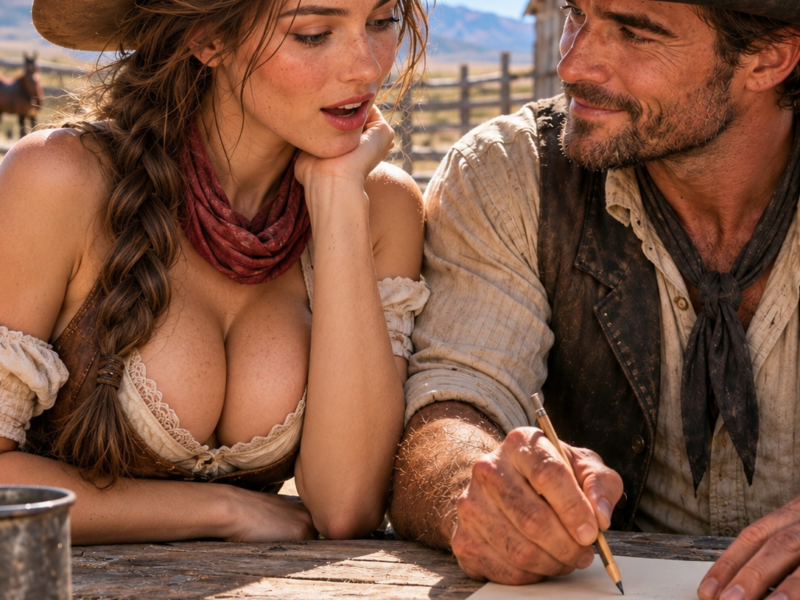
When a 37-Year-Old Cowboy Rode 12 Miles Through a Storm to My Ranch, He Begged Me to Teach Him to Read—Then I Discovered a Banker Was Trying to Seize His Land Over a $940 Debt He Had Already Paid. “I’m Tired of Needing Somebody Else’s Eyes,” He Whispered, Before Writing My Name as His Very First Word. But Weeks Later, When He Finally Read the Bank’s Secret Notation Himself, the Banker Turned Pale—and What We Found in a Dead Man’s Ledger Changed Everything…
When a 37-Year-Old Cowboy Rode 12 Miles Through a Storm to My Ranch, He Begged Me to Teach Him to Read—Then I Discovered a Banker Was Trying to Seize His Land Over a $940 Debt He Had Already Paid. “I’m Tired of Needing Somebody Else’s Eyes,” He Whispered, Before Writing My Name as His Very First Word. But Weeks Later, When He Finally Read the Bank’s Secret Notation Himself, the Banker Turned Pale—and What We Found in a Dead Man’s Ledger Changed Everything…
Part 1
The first time I saw Clay Mercer afraid, he was holding a pencil.
That might not sound like much, but if you had known Clay the way I did, you would understand why the sight nearly broke my heart.
Clay Mercer was thirty-seven years old, with shoulders broad enough to fill a doorway and hands that looked as though they had been carved from Wyoming stone. He had survived cattle stampedes, bitter winters, broken bones, and a gunshot wound that left a white scar beneath his right shoulder. I had once watched him walk into a corral with a furious bull and come out without so much as a scratch.
Nothing seemed to frighten that man.
Nothing, apparently, except five little letters written on a piece of paper.
But I am getting ahead of myself.
My name is Eleanor Hart, though everyone in Willow Creek called me Ellie. I was twenty-nine that autumn, unmarried, and running my late father’s ranch with the help of three hired hands and a stubborn determination I had inherited from him.
Five years earlier, Clay had bought a neglected piece of land twelve miles north of our property. Most men believed he had wasted his savings. The land was rocky, the wells were dry, and the old cabin looked ready to collapse in the next strong wind.
Clay never argued with anyone who doubted him.
He simply went to work.
Seven years of labor had turned twenty-three scrawny cattle into a herd of nearly a hundred. He dug two wells, rebuilt the cabin, and fenced pastures that everyone else had considered worthless.
My father used to say, “That Mercer fellow has more sense in his little finger than most men carry beneath their hats.”
I agreed.
There was something about Clay that made people trust him. He spoke little, listened carefully, and remembered everything.
If you told him the price of a steer in March, he could repeat it in September. If you promised him thirty head of cattle and delivered twenty-nine, he noticed before anyone began counting.
And if you asked him for help, he usually arrived before you finished explaining the trouble.
Yet there was one thing nobody in Willow Creek knew about Clay.
He could barely read.
I discovered his secret on a stormy September evening.
The rain had been falling since sundown, pounding against the roof of our barn. I was finishing the ranch accounts when I heard a horse outside.
A moment later, Clay appeared in the doorway.
His hat dripped water onto the wooden floor. His coat was soaked through, and his expression was so serious that I immediately feared something terrible had happened.
“Clay? What’s wrong?”
He removed his hat.
“Need to ask you something.”
“Of course.”
He glanced toward the hallway.
“Your hands around?”
“Already gone home.”
He nodded, but remained standing.
I had known Clay long enough to recognize when something was troubling him.
“Would you like coffee?”
“No, ma’am.”
“Then sit down before you wear a hole in my floor.”
Normally, that would have earned a smile.
That night, it didn’t.
He sat opposite me and pulled a folded envelope from inside his coat.
The paper was soft and worn, as though he had opened and closed it dozens of times.
“Can you teach me to read?”
For a moment, I thought I had misunderstood him.
“What?”
His jaw tightened.
“Reading. Letters. Words. All of it.”
I stared at him.
Clay looked toward the window, refusing to meet my eyes.
“I know my numbers,” he said. “Can count cattle, figure weights, calculate what a buyer owes me. But words…”
He stopped.
I waited.
“Words never made much sense.”
There was something almost painful about hearing such a capable man admit that.
“Clay, how long have you been struggling with this?”
“Since I was a boy.”
“Why didn’t you go to school?”
His expression changed.
“My father didn’t believe a working boy needed books.”
He spoke without bitterness, but I heard the old wound beneath the words.
“Started hauling feed when I was eight. By ten, I was driving cattle. By twelve, I was earning more than some grown men.”
“And nobody taught you?”
“My mother tried. She died before I turned eleven.”
The room grew very quiet.
I looked at the envelope.
“What’s in the letter?”
“Something from the bank in Cheyenne.”
“Have you asked anyone to read it?”
“No.”
“Why not?”
He finally looked at me.
“Because the last man who read a contract for me charged me forty dollars more than we agreed upon.”
I felt a cold sensation settle in my stomach.
“Did he know you couldn’t read?”
“Afterward, I reckon he did.”
He pushed the letter toward me.
“But I didn’t ride through twelve miles of rain just so you’d read another paper.”
“Then why did you come?”
“Because I’m tired of needing somebody else’s eyes to understand my own business.”
I reached for the envelope.
Clay gently covered it with his hand.
“Not yet.”
I looked up.
“Teach me something first.”
There was pride in his voice, but there was desperation too.
He wanted to prove he could learn before discovering whatever trouble the bank had sent him.
So I put the letter aside and fetched a clean sheet of paper.
“All right,” I said. “We’ll begin with a word.”
He frowned.
“Which one?”
“Something you know well. Something you could never forget.”
Clay stared at the blank paper.
I handed him a pencil.
Those enormous hands, capable of controlling a frightened horse, suddenly seemed clumsy.
He held the pencil too tightly.
“Relax your fingers,” I told him.
He loosened his grip.
Then, slowly, he began writing.
The first letter leaned awkwardly to one side.
The next was too tall.
He stopped twice, staring at the page with such concentration that I was afraid to breathe.
Finally, he set down the pencil.
I looked at what he had written.
ELLIE.
My own name.
For several seconds, I could not speak.
“Clay…”
He looked embarrassed.
“You said something I wouldn’t forget.”
“How did you know how to write it?”
“Seen it on cattle bills. Feed receipts. That sign your father hung on the south gate.”
“You memorized the letters?”
He shrugged.
“I remember things.”
I ran my fingers near the crooked handwriting.
Something shifted inside me.
This man had carried my name in his memory long before he knew how to truly read it.
“Why my name?” I whispered.
Clay looked away.
“Reckon it was the first word that came to mind.”
I suspected there was more to it.
But I did not press him.
Instead, I took another sheet of paper and wrote three words.
LAND.
PAYMENT.
OCTOBER.
“These came from the letter,” I explained. “We’ll learn them tonight.”
For nearly two hours, we worked beneath the lantern.
Clay struggled terribly.
He confused certain letters. He forgot sounds he had understood minutes earlier. Sometimes he gripped the pencil so hard I thought it might snap.
But he never asked to stop.
When he finally recognized the word LAND without my help, his whole expression changed.
It was the look of a man who had spent years staring at a locked door and suddenly discovered he possessed the key.
“Land,” he read aloud.
“That’s right.”
He looked again.
“Land.”
I smiled.
“See? You’re learning.”
His eyes moved toward the unopened envelope.
“Now tell me what the bank wants.”
I unfolded the letter.
At first, everything appeared ordinary.
There were formal greetings, references to his property, and several paragraphs written in the unnecessarily complicated language bankers seemed to favor.
Then I reached the final section.
My smile vanished.
I read it once.
Then again.
“Ellie?”
I looked up.
Clay was watching me carefully.
“What does it say?”
I swallowed.
“Clay, the bank claims you still owe nine hundred and forty dollars on your land note.”
He frowned.
“That’s impossible.”
“Why?”
“Because I paid it.”
“When?”
“June seventeenth. Handed the money straight to Vernon Pike.”
I knew the name.
Vernon Pike managed ranch accounts for a lending office in Cheyenne. He wore expensive suits, polished boots, and the sort of smile that never reached his eyes.
I had disliked him from the moment we met.
“Did Pike give you a receipt?”
Clay’s silence answered.
“He read something to me,” Clay finally said. “Told me it was proof the debt was settled. Then he had me make my mark.”
A sick feeling spread through my chest.
I continued reading.
The bank demanded payment within thirty days.
If Clay failed to pay, the lender intended to seize his ranch.
Everything he had built over seven years could disappear because of a document he had never been able to read.
I put the letter down.
“Clay, I think someone may have cheated you.”
He stared at the paper.
For a long time, he said nothing.
Then he quietly asked, “How do we prove it?”
I looked at the word LAND written in his clumsy handwriting.
And I understood something.
Teaching this man to read was no longer simply an act of kindness.
It might be the only way to save his home.
“We start tomorrow,” I told him.
Clay shook his head.
“No.”
I stared at him.
“No?”
He reached for the pencil.
“We start now.”
And that was when I realized Vernon Pike had made a terrible mistake.
He had chosen to steal from a man who never forgot anything.
Part 2
By the end of that week, Clay could recognize seven words from the bank letter.
Land. Payment. Debt. Due. Note. October. Default.
He hated the last one.
“Sounds like somebody’s blaming me for something I didn’t do,” he muttered.
“That’s exactly what it means,” I answered.
Our lessons became a nightly ritual. Clay rode twelve miles after finishing his chores, and I kept coffee warm until he arrived.
We practiced with cattle bills, newspapers, feed receipts, and old contracts.
Sometimes he became so frustrated that he pushed the papers away.
But he always pulled them back.
One morning, Clay arrived carrying a wooden box filled with every document he had saved from the bank.
We spent hours sorting through them.
Then I discovered something strange.
A statement from May showed a remaining balance of $912.
The foreclosure letter demanded $940.
“Twenty-eight dollars,” Clay said immediately.
“Exactly.”
“Where did that come from?”
“I don’t know.”
He stared at the documents.
Then his expression changed.
“Someone saw me pay Pike.”
My heart jumped.
“Who?”
“Samuel Boyd. Freight driver.”
“Then we need to speak with him.”
Clay lowered his eyes.
“Samuel died in July.”
For a moment, neither of us spoke.
Then Clay looked toward the window.
“But his wife might still have his account books.”
I leaned forward.
“Where does she live?”
“Near Laramie.”
Suddenly, we had our first real lead.
And neither of us knew that Samuel Boyd’s old records would expose something far worse than a single stolen payment.
Part 3
Before we could travel to Laramie, Vernon Pike arrived at Clay’s ranch.
It happened on a Thursday morning, when the frost was still clinging to the fence rails and the cattle were gathering near the eastern watering trough.
I had ridden over shortly after sunrise, bringing several papers Clay needed to practice reading.
We had barely finished breakfast when the sound of carriage wheels came from the road.
Clay stepped onto his porch.
I followed him.
A polished black carriage approached, pulled by two handsome bay horses. It looked absurdly elegant against the weathered buildings and muddy ranch yard.
Vernon Pike climbed down first.
He wore a charcoal suit, spotless gloves, and a smile I immediately distrusted.
Another man emerged behind him.
He was thinner, older, and carried a leather document case.
“Mr. Mercer,” Pike said cheerfully. “A fine morning.”
Clay remained motionless.
“Pike.”
The banker glanced at me.
“Miss Hart. What an unexpected pleasure.”
I said nothing.
Pike gestured toward his companion.
“This is Daniel Cross. He represents a cattle company interested in acquiring this property.”
I felt my stomach tighten.
“Acquiring?” I repeated.
Pike’s smile widened.
“Once the bank completes the foreclosure, naturally.”
Clay took one step forward.
“You’re bringing buyers to my land before the deadline?”
“Mr. Mercer, we must prepare for certain eventualities.”
“I paid you.”
Pike sighed dramatically.
“We’ve discussed this unfortunate misunderstanding.”
“No,” Clay said. “You talked. I listened. Now I’m asking questions.”
The banker seemed surprised.
“Questions?”
“How much money did I hand you on June seventeenth?”
Pike adjusted his gloves.
“According to our records, you made a partial payment of two hundred dollars.”
Clay’s expression did not change.
“Try again.”
“Excuse me?”
“I gave you nine hundred and forty dollars.”
“Your recollection is incorrect.”
“I remember every bill.”
Pike looked toward Daniel Cross as if asking him to witness the absurdity of the situation.
“Mr. Mercer, financial transactions cannot be established by memory alone.”
“Then show me the paper.”
For the first time, Pike hesitated.
It lasted only a second.
But I noticed.
And so did Clay.
“Very well.”
Pike opened the leather case and removed a folded document.
He extended it toward Clay with the indulgent expression of a man offering a toy to a child.
Clay accepted it.
Then he did something that changed everything.
He began reading.
Slowly.
Carefully.
His finger moved beneath each line.
Pike watched with growing impatience.
“Mr. Mercer, perhaps Miss Hart would prefer to explain—”
“Quiet,” Clay said.
The single word stopped him.
Clay continued reading.
I could see the effort it required. Certain words still troubled him, and his lips moved slightly as he worked through unfamiliar combinations.
But he refused to surrender the page.
Finally, he stopped.
“Administrative fee,” he read.
Pike cleared his throat.
“A routine charge.”
“Twenty-eight dollars?”
“Correct.”
Clay looked at me.
I nodded.
That was the missing difference between the two statements.
Clay returned his attention to the contract.
“Two hundred received,” he read.
Pike relaxed slightly.
“Precisely.”
“But below that is another number.”
His finger moved down the page.
“Nine hundred and forty.”
Pike’s face hardened.
“An internal notation.”
I stepped closer.
There was a short word beside the amount, written in darker ink.
Clay squinted.
“Ellie, what’s that?”
I leaned forward.
“Tendered.”
Clay repeated the word.
“Tendered.”
Then he looked directly at Pike.
“That means money handed over, doesn’t it?”
Pike said nothing.
“Nine hundred and forty dollars tendered,” Clay continued. “That’s what this paper says.”
Daniel Cross moved closer.
“May I see that?”
Pike quickly pulled the document toward himself.
“There’s no reason to complicate matters.”
“Actually,” Cross replied, “I think there is.”
For the first time, the two men looked less like partners and more like strangers standing on opposite sides of a dispute.
I examined the handwriting again.
The notation was not written in Pike’s usual sharp, narrow script.
Someone else had added it.
“Who wrote that?” I asked.
Pike snapped the case shut.
“I don’t recall.”
“That’s a strange thing to forget,” Clay said.
Pike’s smile disappeared.
“Mr. Mercer, the bank’s position remains unchanged. You have until the stated deadline.”
He turned toward the carriage.
Then he made the mistake that exposed his fear.
“Miss Hart may have taught you to sound out a few words, Mr. Mercer, but that hardly makes you qualified to challenge a legal document.”
Clay went completely still.
I felt it before I understood why.
He looked at Pike.
“How do you know she’s teaching me?”
Pike stopped.
“Clearly, you’ve received assistance.”
“That wasn’t my question.”
“Mr. Mercer—”
“How do you know Ellie has been giving me lessons?”
Silence fell across the yard.
Our lessons had taken place mostly after dark.
Only a few people knew about them.
Pike had no reason to know.
Unless someone had told him.
Or someone had been watching.
The banker climbed into his carriage without answering.
Daniel Cross remained behind.
“If you uncover evidence of wrongdoing,” he told Clay, “I would appreciate receiving it before any sale proceeds.”
Pike called impatiently from inside the carriage.
Cross ignored him.
“I don’t buy property when ownership is disputed.”
He gave us a respectful nod and climbed aboard.
We watched the carriage disappear down the road.
I finally exhaled.
“That man is hiding something.”
Clay stared at the empty trail.
“More than my money.”
“What makes you think so?”
“Because he knew about the lessons.”
I folded my arms against the cold.
“Perhaps one of our ranch hands mentioned them.”
“Maybe.”
But his expression told me he doubted it.
Then he turned to me.
“We’re going to see Mary Boyd.”
I nodded.
“I’ll get my horse.”
“Ellie, you don’t have to—”
“Don’t finish that sentence.”
He almost smiled.
“It’s thirty miles.”
“I know where Laramie is.”
“The weather’s turning.”
“Then we’d better leave.”
Clay shook his head with a quiet laugh.
“You’re the most stubborn woman I’ve ever met.”
“And yet you keep coming back.”
The words escaped before I could stop them.
His smile faded.
For one suspended moment, he simply looked at me.
“Yes,” he said softly. “I do.”
I felt warmth rise into my cheeks.
Neither of us said anything more.
We left before noon.
The journey took us across miles of open Wyoming country, through rolling grassland and beneath a sky that seemed impossibly wide.
For several hours, we rode in comfortable silence.
Clay had always been easy to be quiet beside.
He didn’t demand conversation or mistake silence for unhappiness.
But that afternoon, I found myself thinking about the first word he had written.
My name.
I wondered how long he had remembered those five letters.
I wondered whether he thought about me when he rode home after our lessons.
And I wondered why the possibility mattered so much.
By sunset, we reached a modest farmhouse outside Laramie.
Mary Boyd opened the door holding a shotgun.
She was a small woman with silver hair and tired blue eyes.
“Evening,” Clay said carefully. “I’m Clayton Mercer. I knew your husband.”
Her face softened slightly.
“Samuel spoke of you.”
“We need to ask about his freight records.”
Something changed in her expression.
“What kind of records?”
“June seventeenth. Cheyenne. A payment I made to Vernon Pike.”
At the banker’s name, Mary’s fingers tightened around the doorframe.
“Come inside.”
Her kitchen smelled of woodsmoke and fresh bread.
She served coffee while Clay explained everything.
Mary listened without interruption.
When he finished, she stared into her cup for a long moment.
“Samuel came home angry that day,” she said.
“Did he tell you why?” I asked.
“He said a banker was taking advantage of men who trusted him.”
Clay leaned forward.
“Did he write anything down?”
Mary stood.
“My husband wrote everything down.”
She disappeared into a back room and returned carrying a canvas bag.
Inside were six thin ledgers, their covers worn and their pages filled with careful handwriting.
She placed them on the table.
“Samuel used to say paper remembers what men choose to forget.”
Clay opened the first book.
We searched by date.
June eleventh.
June thirteenth.
June fifteenth.
Then Clay stopped.
His finger rested beneath an entry.
I recognized his name immediately.
But I said nothing.
I wanted him to read it.
He took a breath.
“Clay… Mercer.”
His finger moved.
“Nine hundred… forty dollars.”
He paused.
Then continued.
“Paid… Pike… full…”
He struggled with the final word.
I waited.
“Balance.”
Clay sat perfectly still.
I looked at the entry myself.
There it was.
A record written in Samuel Boyd’s hand confirming the exact amount Clay had paid.
Below it was another sentence.
I read it aloud.
“Pike refused receipt copy.”
Mary covered her mouth.
“I remember that.”
Clay looked at her.
“What else did Samuel say?”
Mary stared at the ledger.
“He said Pike was going to regret what he’d done.”
“Why?”
“Because he had cheated someone in front of a man who kept better records than he did.”
For the first time since receiving the foreclosure notice, Clay looked as though he could breathe.
But our relief lasted only a moment.
I noticed several names written beneath his payment.
Dawson.
Miller.
Harper.
Each accompanied by an amount.
Each followed by the same name.
Vernon Pike.
“Clay,” I whispered, “I don’t think you were his only victim.”
Mary leaned closer.
Then she said something that made the room turn cold.
“Margaret Dawson lost part of her land last year.”
I looked at Clay.
“And Amos Miller sold forty head of cattle to settle a debt he swore he’d already paid.”
We stared at Samuel’s ledger.
Suddenly, everything looked different.
This was no longer about one ranch or nine hundred and forty dollars.
Someone had been stealing from hardworking families for years.
And if Samuel had recorded enough transactions, we might finally prove it.
But as I closed the ledger, Mary caught my wrist.
“There’s something else you should know.”
Her voice had changed.
“Samuel was frightened before he died.”
Clay straightened.
“Frightened of what?”
Mary glanced toward the window.
“He told me someone had been asking about his account books.”
“Who?”
She swallowed.
“Vernon Pike.”
Part 4
I barely slept that night.
Mary gave us two small rooms at the back of her farmhouse, but every creak of the floorboards made me open my eyes.
I kept thinking about Samuel Boyd.
He had died in July, barely a month after witnessing Clay’s payment.
According to Mary, his wagon had overturned on a narrow mountain road.
The sheriff had ruled it an accident.
Perhaps it was.
Wyoming roads killed good men every year.
But knowing Pike had been searching for Samuel’s records made the coincidence difficult to ignore.
At dawn, I found Clay sitting at Mary’s kitchen table.
The ledger lay open before him.
He was tracing the words with his finger.
“You’re up early,” I said.
“Couldn’t sleep.”
“Neither could I.”
He looked toward the hallway.
“Mary says Samuel kept duplicate entries for important freight deliveries.”
“Where?”
“In a smaller book he carried inside his coat.”
“Did she find it?”
Clay shook his head.
“Never came back after the accident.”
I sat opposite him.
“You think Pike might have taken it?”
“I think Samuel was careful. And I think Pike knew that.”
Clay turned another page.
Then he looked at me.
“Ellie, I need to ask something.”
“Anything.”
“If we get to the bank and I can’t read fast enough, don’t take over.”
The request surprised me.
“Clay—”
“I know you’ll want to help.”
“Of course I will.”
“But I need them to hear it from me.”
I reached across the table.
“Then they’ll hear it from you.”
His eyes dropped to my hand.
For a moment, neither of us moved.
Then his rough fingers closed gently around mine.
It was the first time he had held my hand.
And somehow, despite everything happening around us, I knew I would remember it for the rest of my life.
We left Mary’s farmhouse after breakfast.
She insisted that we take the original ledger to Cheyenne.
“I’ve kept those books long enough,” she said. “Samuel would want the truth known.”
But she made us promise to return them safely.
By the following afternoon, we reached the lending office.
The building stood along a busy street lined with shops, wagons, and hitching posts.
I had been inside before with my father.
The polished counters, brass lamps, and expensive furniture had always made the place seem respectable.
That day, they made me angry.
How many desperate ranchers had walked through those doors believing their money was safe?
How many had signed documents they didn’t fully understand?
And how many had lost everything because nobody questioned the men behind the counter?
Vernon Pike stood near the front desk.
His face changed when he saw us.
Then his eyes settled on the ledger in Clay’s hand.
“What is that?”
Clay approached the counter.
“My receipt.”
Pike gave a short laugh.
“Mr. Mercer, we’ve already established that you don’t possess a receipt.”
Clay opened the book.
“Samuel Boyd did.”
The laughter stopped.
Several customers turned toward us.
Pike leaned forward.
“Where did you get that?”
“From his widow.”
“That book is irrelevant to your account.”
“Then you won’t mind me reading it.”
Clay placed the ledger flat on the counter.
His hand trembled slightly.
I knew how much this moment mattered.
Weeks earlier, he would have stood helplessly while someone else interpreted the words.
Now he was about to read them before an entire room.
He took a breath.
“June seventeenth. Clayton Mercer. Nine hundred forty dollars. Paid Vernon Pike. Full balance.”
His voice was slow, but every word was clear.
Then he read the second entry.
“Receipt copy refused.”
The bank fell quiet.
Pike’s face turned red.
“You’re making a very serious accusation.”
Clay closed the ledger.
“No. I’m reading what Samuel wrote.”
“Samuel Boyd is dead.”
“His handwriting isn’t.”
Pike reached for the book.
Clay moved it away.
“Don’t touch it.”
The banker’s expression darkened.
“You have no right to bring such allegations into this establishment.”
A door opened behind the counter.
An older gentleman stepped into the room.
He had silver hair, a neatly trimmed beard, and the unmistakable expression of someone accustomed to being obeyed.
“What’s going on here?”
I recognized him immediately.
“Walter Finch?”
He turned.
“Miss Hart?”
“My father was Thomas Hart. You handled one of his cattle loans.”
Recognition crossed his face.
“Of course. I’m sorry to hear of his passing.”
“Thank you.”
Pike interrupted.
“Mr. Finch, these people are creating a disturbance over a settled matter.”
Clay looked directly at the bank manager.
“Then maybe you should hear why.”
Finch studied him.
“Go on.”
And Clay told the story.
Every part of it.
The June payment.
The missing receipt.
The false balance.
The twenty-eight-dollar fee.
Samuel’s ledger.
And the foreclosure notice threatening to take his home.
He did not rush.
He did not apologize for needing time to find certain words.
And when Pike interrupted, Walter Finch raised a hand.
“Let the gentleman finish.”
I will never forget Clay’s expression when he heard that.
For perhaps the first time in his adult life, a man in authority was treating his words as something worth hearing.
When Clay finished, Finch requested the original account books.
Pike immediately objected.
“That isn’t necessary.”
Finch looked at him.
“I’ll decide what is necessary.”
Two clerks brought heavy ledgers from a locked cabinet.
We moved into a private office.
Pike stood near the door, his face growing paler by the minute.
Finch opened Clay’s account.
“According to our records, a payment of two hundred dollars was entered on June seventeenth.”
Clay nodded.
“That’s what Pike told me.”
Finch examined the page.
Then he frowned.
“What is this notation?”
I leaned forward.
Beside the payment was a small mark in darker ink.
It matched the notation we had seen on the document Pike brought to the ranch.
Finch turned the page.
Then he opened a second book.
For several minutes, he compared entries without speaking.
Finally, he looked at Pike.
“Where is the corresponding cash receipt?”
Pike cleared his throat.
“I would need to check the archived records.”
“Then check them.”
A clerk hurried away.
Ten minutes later, he returned with another book.
Finch examined it.
His expression changed.
“Mr. Pike, there’s a deposit of nine hundred and forty dollars recorded on June eighteenth.”
Pike swallowed.
“That could belong to another customer.”
“Then whose?”
“I’d have to investigate.”
Finch leaned back.
“Interesting.”
He turned toward Clay.
“Mr. Mercer, do you recognize this number?”
Clay leaned forward.
“Nine hundred forty.”
“Correct. Now look at the date.”
“June eighteenth.”
“The day after your payment.”
Clay nodded slowly.
Finch turned to Pike.
“Why was this amount placed in a temporary holding account instead of being credited to Mr. Mercer’s loan?”
Pike’s mouth opened.
No answer came.
The room grew unbearably still.
Then Finch asked for the accounts of Margaret Dawson, Amos Miller, and Joseph Harper.
Pike objected again.
Finch ignored him.
One by one, the books revealed discrepancies.
Payments entered incorrectly.
Balances carried forward after being settled.
Fees added without clear explanation.
In one case, a widow had paid a debt twice.
In another, a rancher had surrendered cattle to settle an amount the bank had already received.
And every suspicious transaction passed through Vernon Pike’s hands.
I watched his confidence crumble.
At last, Finch closed the ledger.
“Mr. Pike, I believe we’ll require the sheriff.”
Pike moved toward the door.
Two clerks stepped into his path.
“You’re making a mistake,” he snapped.
Finch remained seated.
“Possibly. But unlike you, I intend to examine the evidence before deciding.”
The sheriff arrived before sunset.
Pike was questioned in the manager’s office.
The investigation was far from finished, but the bank immediately suspended Clay’s foreclosure proceedings.
Finch also promised to review the other disputed accounts.
When we finally stepped outside, the winter wind had begun to sweep through Cheyenne.
Clay stood beside me on the boardwalk, holding Samuel’s ledger against his chest.
For several moments, neither of us spoke.
Then he said, “I thought I’d lose everything.”
I looked at him.
“You didn’t.”
He shook his head.
“I almost did.”
“Clay…”
He turned toward me.
“You know what frightened me most?”
“The ranch?”
“No.”
I waited.
His eyes met mine.
“It wasn’t the land. Not really.”
“Then what?”
He looked down at the ledger.
“That I’d spend my whole life working for something, and one day a man with a piece of paper could take it because I couldn’t understand what he’d written.”
My throat tightened.
He continued quietly.
“That feeling… being helpless in front of words. I’ve carried it since I was a boy.”
I reached for his hand.
“You won’t have to carry it alone anymore.”
Clay looked at our joined hands.
Then he asked a question I had never expected.
“Ellie, when this is finished… would you still teach me?”
I stared at him.
“Of course.”
“Even when there’s no bank to fight?”
I smiled through the tears gathering in my eyes.
“Especially then.”
His thumb brushed gently across my fingers.
For one beautiful moment, the noise of Cheyenne disappeared around us.
But that evening, as we prepared to leave, Walter Finch sent a messenger to our boardinghouse.
The investigation had uncovered another document.
A transfer authorization bearing Clay’s mark.
It had been prepared weeks before the foreclosure notice.
And there was something especially troubling about it.
The document did not name Daniel Cross’s cattle company as the buyer.
It named Vernon Pike himself.
Part 5
I remember staring at that document for so long that the letters began to blur.
Vernon Pike had not merely been trying to steal Clay’s money.
He had been preparing to take his ranch.
According to the transfer authorization, Pike had arranged for the property to pass into the ownership of a private investment company that he secretly controlled.
The arrangement was carefully disguised.
Clay’s ranch would supposedly be seized for unpaid debt, sold through a legitimate transaction, and eventually transferred into Pike’s possession.
No one would question how a banker had acquired valuable grazing land at a fraction of its worth.
Not unless someone examined the paperwork.
And until a few weeks earlier, Clay had been unable to do exactly that.
Walter Finch explained everything the next morning.
We sat in his office while he arranged documents across a polished wooden desk.
“The transfer was never completed,” he assured us. “And now that the discrepancies have been discovered, it will not proceed.”
Clay stared at the papers.
“Why my land?”
Finch hesitated.
“Mr. Mercer, your northern pasture borders a proposed cattle transport route. If the route is approved, that property could become considerably more valuable.”
Clay’s expression darkened.
Pike had known.
He had known Clay’s land was worth more than its owner realized.
And he had found a way to obtain it without paying a fair price.
I felt sick.
For years, Clay had struggled to build something lasting.
Every fence post represented labor.
Every well represented sacrifice.
Every calf born during a freezing spring morning represented another reason to keep going.
To Pike, all those years meant nothing.
He had seen only an opportunity.
“Will he go to prison?” I asked.
Finch folded his hands.
“That depends on the sheriff’s findings and the court. But there is sufficient evidence to pursue charges.”
“Will the other families recover their money?”
“We’re reviewing every affected account.”
Clay leaned forward.
“Then start with Margaret Dawson.”
Finch looked surprised.
“Mr. Mercer?”
“She’s been paying on land she shouldn’t owe anything on. Amos Miller sold cattle he needed. Harper borrowed money from his brother to cover charges Pike invented.”
He paused.
“My ranch can wait until you’ve made certain those people are taken care of.”
I looked at him with a feeling so strong it almost frightened me.
Here was a man who had nearly lost everything, yet his first concern was for people who had suffered alongside him.
Finch nodded slowly.
“I’ll see what can be done.”
We returned to Willow Creek two days later.
News traveled quickly.
By the time we reached Hart Ranch, nearly everyone in the valley knew Vernon Pike was under investigation.
Some people came to congratulate Clay.
Others arrived carrying old statements and asking whether he could help them understand their accounts.
He never turned anyone away.
But he refused to pretend he knew more than he did.
“Ellie’s the better reader,” he would say. “I’m still learning.”
Then he would sit beside them and examine whatever documents they brought.
Sometimes he recognized an important word.
Sometimes he needed help.
But he understood something many educated men had forgotten.
There was no shame in asking questions.
The shame belonged to anyone who used another person’s uncertainty as a weapon.
As autumn faded, our lives settled into a new rhythm.
Clay continued visiting after his ranch work was finished.
At first, we practiced reading bank statements.
Then cattle contracts.
Then newspaper articles.
Eventually, I introduced him to stories.
He complained that fiction was a waste of good daylight.
“Why read about things that never happened?” he asked.
“Because sometimes they help us understand things that do.”
He considered that.
Then he picked up the book again.
One evening, I found him smiling at a passage.
“What?” I asked.
He shook his head.
“Nothing.”
“Clay Mercer, you’re smiling at a book.”
“Don’t tell anyone.”
I laughed so hard I nearly spilled my coffee.
He watched me with that quiet expression I was beginning to recognize.
It made my heart behave foolishly.
Winter arrived early that year.
Snow covered the pastures, the creek froze along its edges, and the mountain roads became difficult to travel.
Still, Clay came.
Sometimes he arrived with frost in his beard and snow on his shoulders.
Sometimes he brought fresh meat or firewood.
Once, he appeared carrying a small wooden box.
Inside was a new set of pencils, carefully sharpened.
“What’s this?” I asked.
“Thought your teacher’s supplies were getting low.”
I smiled.
“And what does the student want in return?”
He looked directly at me.
“Another lesson.”
So I gave him one.
But our evenings were changing.
We still studied.
Yet more and more often, we found ourselves talking long after the books had been closed.
He told me about his mother.
How she used to sing while washing clothes.
How she had tried to teach him letters by drawing them in flour on the kitchen table.
How, after her death, he had convinced himself that learning simply wasn’t meant for him.
I told him about my father.
About the empty feeling that followed his passing.
About the fear of running Hart Ranch alone while everyone waited for me to fail.
Clay listened carefully.
Then he said, “Your father would be proud of what you’ve done.”
I looked away.
“I hope so.”
“I know so.”
There was such certainty in his voice that I believed him.
One night, while the wind rattled the windows, I finally asked the question that had remained between us since September.
“Clay, why did you write my name that first evening?”
He stopped turning the pages of his book.
“Already told you.”
“No, you didn’t.”
He looked toward the fire.
For a long time, he remained silent.
Then he closed the book.
“I knew how your name looked before I knew what all the letters meant.”
I waited.
“I saw it on invoices. On signs. In your father’s ledger.”
“That doesn’t explain why you chose it.”
Clay swallowed.
“Because I thought about you more often than I had any right to.”
My breath caught.
He stared at his hands.
“I’d ride past your south pasture and wonder whether you’d be there. I’d see your name on a feed bill and remember how you laughed at something I’d said.”
He gave a nervous little smile.
“Didn’t understand half the words on those bills. But I always knew yours.”
Tears filled my eyes.
“Clay…”
He looked up.
“I didn’t tell you because I figured a woman like you deserved a man who could write her a proper letter.”
I moved around the table.
“You’re a fool, Clayton Mercer.”
He blinked.
“Reckon I might be.”
I took his hand.
“I never needed a perfect letter.”
His fingers tightened around mine.
“Then what did you need?”
I looked into his eyes.
“Someone who meant the words.”
For a moment, I thought he might kiss me.
But Clay had always been a careful man where other people’s feelings were concerned.
He brushed his thumb over my hand and whispered, “I’m working on it.”
And somehow, that promise meant more than a dozen romantic speeches.
Several weeks later, we received word from Cheyenne.
The investigation had uncovered enough evidence to formally charge Vernon Pike with fraud and related financial offenses.
Bank records showed that he had repeatedly diverted payments, falsified balances, and manipulated debt notices.
Several families had been pressured into surrendering property or making unnecessary payments.
The lending office began correcting the accounts.
Margaret Dawson recovered money she had believed was gone forever.
Amos Miller received compensation for the cattle he had been forced to sell.
Joseph Harper’s disputed debt was canceled.
And Clay’s ranch was officially cleared of the false balance.
Walter Finch sent the confirmation by registered mail.
When Clay brought it to my kitchen, he did not ask me to read it.
He sat down, unfolded the letter, and began.
I watched him follow the sentences.
He struggled with several formal phrases.
Twice, he returned to the beginning of a paragraph.
But eventually, he reached the important words.
“Paid in full.”
His voice grew quiet.
He read them again.
“Paid in full.”
Then he looked at me.
“It’s over.”
I smiled.
“It’s over.”
For several seconds, he simply stared at the letter.
Then he folded it carefully and placed it inside his coat.
“Seven years,” he murmured.
“What?”
“Seven years building that ranch. Nearly lost it because I couldn’t read eight lines.”
“You didn’t lose it.”
He shook his head.
“No. Because somebody taught me how to fight with something besides my fists.”
I laughed softly.
“You did all the hard work.”
“Had a good teacher.”
He stood.
Then, to my surprise, he took my hand and kissed it.
It was a simple gesture.
But I felt the warmth of it long after he rode away.
Three evenings later, Clay arrived without his usual stack of books.
He carried only one folded sheet of paper.
I was sitting beside the stove when he entered.
“You’re early,” I said.
“Finished my chores before sundown.”
“Where are your lessons?”
He touched the paper inside his coat.
“Got one here.”
I smiled.
“Another bank statement?”
“No.”
“A cattle contract?”
“No.”
“Then what?”
He sat opposite me.
“Something I wrote.”
My heart gave a strange little leap.
“By yourself?”
“Mostly.”
I raised an eyebrow.
“Mostly?”
“Asked Mrs. Dawson how to spell one word.”
I laughed.
“Which word?”
“Reckon you’ll find out.”
He unfolded the paper.
His hands were shaking.
I recognized that immediately.
They were shaking the same way they had on the stormy night when he first asked me to teach him.
But this time, there was no frightening bank notice between us.
Only his own handwriting.
Large letters.
Uneven lines.
A few crossed-out words.
And a determination that made me want to cry before he had even begun.
“May I read it?” I asked.
He shook his head.
“No, ma’am.”
I looked up.
“I want to read it to you.”
My throat tightened.
“All right.”
Clay took a breath.
Then he began.
“Ellie.”
He paused.
“That one’s always been easy.”
I smiled through gathering tears.
He continued.
“When I first came to you, I was ashamed of something I’d spent my whole life hiding.”
His voice trembled slightly.
“You never laughed. You never made me feel foolish. You showed me that needing help didn’t make me less of a man.”
He swallowed.
“Every evening, I told myself I was riding over because I needed another lesson.”
He looked up.
“But somewhere along the way, that stopped being the whole truth.”
I could barely breathe.
He lowered his eyes to the page.
“I started coming because I wanted to hear your voice. I wanted to see you smile. I wanted to sit across from you even on nights when the words made me angry.”
A tear slipped down my cheek.
Clay’s voice grew steadier.
“You helped me save my land, Ellie. But you gave me something I thought I’d lost long before that.”
He looked directly at me.
“The courage to believe I could become more than the man I used to be.”
He returned to the letter.
Then he read three words.
“I love you.”
The room fell completely silent.
I covered my mouth.
Clay looked terrified.
It was almost absurd.
This man had faced angry cattle, armed strangers, freezing winters, and a dishonest banker trying to steal his livelihood.
Yet three simple words had frightened him more than any of those things.
He looked down at the final sentence.
“If you would allow it, I would like to court you properly.”
Then he folded the letter.
And waited.
I stared at him through my tears.
“Properly?”
He nodded.
“That’s the word Mrs. Dawson helped you spell?”
His mouth twitched.
“Yes, ma’am.”
I laughed.
Then I cried.
Then I laughed again.
Clay looked thoroughly confused.
“Ellie, have I said something wrong?”
I stood.
He rose immediately.
I crossed the kitchen and stopped in front of him.
“Clay Mercer, the first word you ever wrote was my name.”
He nodded.
“Yes.”
“And the first letter you wrote by yourself begins with my name.”
“Yes.”
I took his hands.
“For a man who once believed he couldn’t learn words, you’ve chosen some very dangerous ones.”
His expression grew serious.
“Did I choose the wrong ones?”
I shook my head.
“No.”
Then I stepped closer.
“You chose exactly the right ones.”
And I kissed him.
Not because he had saved his ranch.
Not because he had defeated Vernon Pike.
Not even because he had learned to read.
I kissed him because he was the kindest, strongest, most determined man I had ever known.
And because somewhere between the first crooked letter and the last winter evening, I had fallen hopelessly in love with him.
The months that followed were the happiest I had known.
Spring returned to Wyoming, bringing green grass, newborn calves, and the sweet smell of rain-soaked earth.
Clay continued learning.
Some evenings, he read an entire newspaper page without assistance.
Other nights, a difficult paragraph frustrated him until he threatened to throw the book into the fire.
I never hurried him.
And he never stopped trying.
By June, nearly a year after that first stormy evening, Clay could read his ranch contracts without help.
He could write letters, examine bills, and sign his name with a confidence I had once feared he might never possess.
That June, we stood together in the Willow Creek courthouse.
I wore a simple cream-colored dress.
Clay wore his best dark suit, though he complained that the collar was trying to strangle him.
Several friends attended.
Mary Boyd came from Laramie.
Margaret Dawson brought flowers.
And Walter Finch sent a congratulatory letter that Clay read aloud the night before our wedding.
After the ceremony, the county clerk placed a marriage register on the desk.
“Sign here, Mr. Mercer.”
Then, without thinking, he added, “You can make your mark if you prefer.”
Clay looked at the page.
For a moment, I saw the old fear flicker across his face.
Then it disappeared.
He smiled.
“No, sir.”
He took the pen.
Slowly, carefully, he wrote his full name.
Clayton Mercer.
Every letter was clear.
Every stroke belonged to him.
Then he handed me the pen.
I signed beneath his name.
Eleanor Hart Mercer.
Clay stared at our signatures.
I squeezed his hand.
“What are you thinking?”
He smiled.
“Just remembering something.”
“What?”
“The first word you ever asked me to write.”
I looked at the register.
My name stood beside his.
And suddenly, I understood.
The first word he had struggled to write had been Ellie.
Now, after years of silence and shame, after a fight to protect everything he owned, he had written the beginning of our life together.
Outside, two horses waited beneath the brilliant Wyoming sky.
As we stepped into the sunshine, Clay reached for my hand.
“Ellie?”
“Yes?”
“Think you could teach me one more thing?”
I laughed.
“What haven’t I taught you?”
He leaned close.
“How a man goes about being a good husband.”
I smiled and rested my head against his shoulder.
“Well, Mr. Mercer, that sounds like a rather long lesson.”
He kissed my forehead.
“Good,” he whispered. “I was hoping we’d have plenty of time.”
And we did.
Years later, when our children asked how their father had learned to read, Clay would always smile and tell them about a rainy night, a frightened cowboy, and a patient woman who believed he could learn.
But when they asked what the first word had been, he never answered immediately.
He would look across the room at me.
His eyes would soften.
And he would say, “It was the only word I knew I’d never forget.”
People sometimes believed our story was about a man learning to read.
They weren’t entirely wrong.
But it was also about trust.
About the courage to admit what we do not know.
About standing beside someone without making them feel small.
And about understanding that love does not always arrive with beautiful speeches or perfectly written promises.
Sometimes it arrives at your door in the middle of a storm, carrying a crumpled letter and asking for help.
Sometimes it begins with a trembling hand and a crooked pencil.
And sometimes, the most important words a person will ever write are not the words that save his home.
They are the words that finally give him the courage to open his heart.
Clay eventually learned thousands of words.
But until the end of his days, whenever he saw my name written somewhere, he smiled as though he were reading it for the very first time.