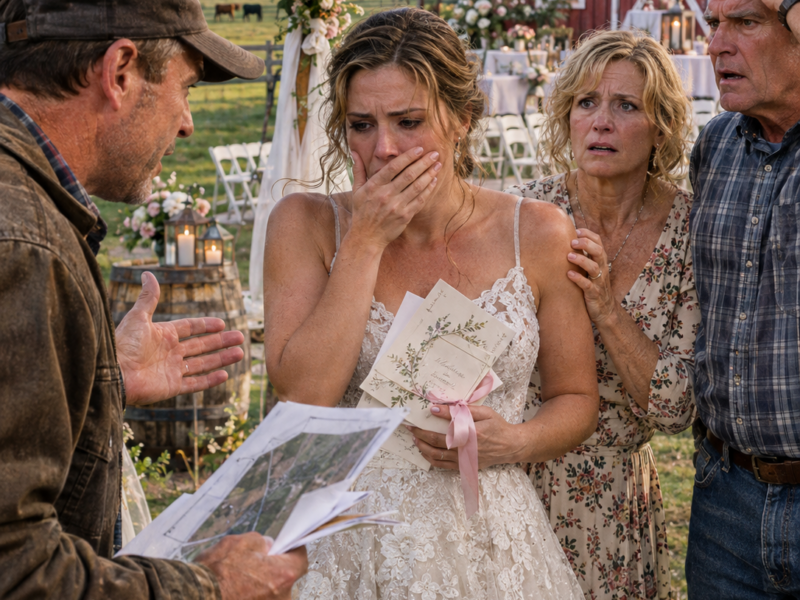
Three Weeks Before My 24-Year-Old Daughter’s Wedding, My Mother Gave Our Family Farm to My Younger Sister for Her Engagement Party and Told Me, “Karen Is Young. She’ll Have Another June.” I Had Spent 10 Years Paying Off $186,000 in Farm Debt, and My Sister Was Already Promising Her Fiancé a $60,000 Renovation Deal. I Didn’t Argue—I Invited Everyone to the Farm That Saturday, Brought My Lawyer, and Placed My Phone on the Table. Then I Pressed Play…
Three Weeks Before My 24-Year-Old Daughter’s Wedding, My Mother Gave Our Family Farm to My Younger Sister for Her Engagement Party and Told Me, “Karen Is Young. She’ll Have Another June.” I Had Spent 10 Years Paying Off $186,000 in Farm Debt, and My Sister Was Already Promising Her Fiancé a $60,000 Renovation Deal. I Didn’t Argue—I Invited Everyone to the Farm That Saturday, Brought My Lawyer, and Placed My Phone on the Table. Then I Pressed Play…
Part 1
Three weeks before my daughter’s wedding, my mother called to tell me that the family farm was no longer available. Not unavailable because of bad weather, construction, or some unexpected emergency. It was unavailable because my younger sister had decided she wanted the same weekend for her engagement party.
“Your sister needs the farm that Saturday,” my mother said, using the same calm voice she used whenever she wanted to make an unreasonable demand sound perfectly normal. “So you’ll need to find somewhere else for Karen’s wedding. Meredith is finally getting engaged, Monica. Surely you can understand that.”
I stood in my kitchen, holding a dish towel in one hand and the phone in the other. On the refrigerator, a calendar displayed the date circled in red. My daughter had drawn a little heart above the number six.
“That’s fine, Mom,” I replied.
There was a brief silence.
Then I added, “But tell Meredith she’ll need to find another farm.”
My mother let out a short, irritated laugh.
“Monica, don’t be dramatic. It’s the family farm. It belongs to all of us.”
“Does it?”
“Of course it does. Your father and I raised you girls on that land.”
“You did,” I said quietly.
Then I ended the call.
My name is Monica Prior. I was forty-four years old, a farmer’s granddaughter, and the mother of a twenty-four-year-old daughter named Karen. For the previous two years, Karen and her fiancé, Luke, had been planning their wedding beneath the enormous oak tree overlooking our family’s back pasture.
It was supposed to be simple and beautiful. White flowers, wooden chairs, music from Luke’s grandfather’s fiddle, and dinner beneath a large white tent. Nothing extravagant, but everything meaningful.
Karen and Luke had even planted twenty young apple trees near the orchard. They wanted their future children to grow up eating apples from the same trees that had witnessed their wedding.
Now, apparently, none of that mattered.
After hanging up, I placed the phone beside the sink, folded the dish towel into thirds, and carefully hung it over the oven handle. Then I walked outside and stood on the back steps until my hands stopped trembling.
Across the field, the sun was disappearing behind the orchard.
I looked at those twenty little apple trees and remembered how excited Karen had been when she planted the first one. Luke had dropped his shovel on his foot, and she had laughed so hard that she nearly fell into the hole.
That was when I understood something.
My mother hadn’t called to ask me a question. She had called to inform me of a decision that had already been made.
Somewhere, in a conversation I hadn’t been invited to, my daughter’s wedding had been deemed less important than my sister’s engagement party.
And what my mother didn’t know was that nobody in my family had told me the truth about the farm in twelve years.
To understand why that phone call changed everything, you need to understand the history of the Prior Farm.
The property consisted of forty-one acres outside a small Ohio town called Milbrook. It was the kind of town where the people working at the gas station knew what you bought for dinner, and the bank manager remembered which families had struggled financially.
My grandfather, Walt, had cleared the backfield himself. He had spent decades turning rough farmland into something beautiful.
My father, Marty, was born in the farmhouse. My mother, Valerie, moved there as a bride and spent the next fifty years telling everyone how fortunate she was to have inherited such a wonderful place.
I grew up there.
I fed chickens before school, stacked hay in August, cleaned the barn, and helped my father repair fences. My hands were usually dirty, my boots were usually muddy, and I learned very early that a farm never stopped needing attention.
My younger sister, Meredith, grew up on the same property.
But she had a different childhood.
She had a beautiful bedroom overlooking the garden, complete with a window seat and matching curtains. I had a room that had once been the sewing room. The sewing machine remained in the corner, and nobody ever bothered moving it.
When I asked my father why we couldn’t switch rooms, he simply said, “You’ll get used to it, Monica.”
And I did.
That was the problem with me. I got used to things.
When I was sixteen, I received an acceptance letter for a summer veterinary program at the state college. It cost six hundred dollars, and I had been dreaming about it for months.
I carried that letter in my back pocket for two weeks.
One evening, I placed it on the kitchen table and showed my mother.
She glanced at it, put it down, and said the money had already been spoken for.
Meredith needed braces, a new pageant dress, and money for the annual Apple Blossom Princess competition.
“Your sister only gets one chance to be young,” Mom explained.
I nodded.
I said I understood.
Then I went to the barn, sat on an overturned bucket, and pressed my thumbnail into my finger until it hurt enough to distract me from crying.
Meredith won the pageant.
I never mentioned the veterinary program again.
By the time we were adults, the difference between us had become even more obvious.
Meredith was five years younger than me. At thirty-nine, she had never held a job for longer than eighteen months. Somehow, every time one of her plans failed, someone else was expected to rescue her.
At twenty-seven, she opened a bridal boutique on Main Street using a loan my father co-signed.
The shop closed fourteen months later.
Unfortunately, the debt remained.
My father eventually took out a second loan against the farm to cover the first one. Then he took out a third.
I discovered the truth when I was thirty-two.
I was working as an office manager at a veterinary clinic, living in a small condominium, and raising my four-year-old daughter, Karen.
One afternoon, I arrived at my parents’ house and found my mother crying at the kitchen table. My father sat opposite her, staring at a bank notice.
The bank was threatening foreclosure.
The debt had reached $186,000.
Meredith wasn’t there. She was enjoying a spa weekend, supposedly recovering from the stress of her failed business.
I remember looking at the bank notice and thinking about my grandfather.
He had spent his entire life building that farm. I couldn’t watch a bank take it away because my sister couldn’t manage a business.
So I sold my condominium.
Every dollar went toward paying off the debt, and I borrowed the remaining amount.
It took me ten years to repay that loan.
Ten years of monthly payments, postponed vacations, repaired cars instead of replaced ones, and carefully calculated grocery bills.
My mother thanked me by telling the church ladies how wonderful it was that our family had pulled together.
My father said very little.
At the time, our lawyer was a quiet man named Maurice. He had handled my grandfather’s estate and had known our family for years.
He called us into his office and explained the arrangement.
The bank would receive full payment. In exchange, my parents would sign the deed to the entire farm over to me.
My name alone would appear as the legal owner.
My parents would retain a life estate, meaning they could continue living in the farmhouse for as long as either of them lived, without paying rent.
I would assume responsibility for property taxes, insurance, maintenance, and everything else.
My father signed first.
My mother signed second.
As she pushed the papers back across the desk, she leaned toward Maurice and said, loud enough for me to hear, “This is only paperwork for the bank. You understand? We’re not actually giving her the farm.”
Maurice looked at her over his glasses.
“Mrs. Prior, this is a recorded deed. It isn’t temporary paperwork.”
My mother waved her hand dismissively.
“Of course. I know what I signed.”
Outside the office, she patted my arm.
“You’re a good girl, Monica. You always know what to do when there’s a mess.”
That was the entire thank-you.
For twelve years, I paid the property taxes, maintained the barn, replaced the roof, repaired fences, and covered the insurance.
My parents continued living in the farmhouse.
And slowly, they began telling people the farm was still theirs.
First, my mother said it was held in a family trust. A few years later, she simply called it the family farm.
I never corrected her.
I didn’t need public recognition. I wanted my parents to have a comfortable home, and I wanted Karen to grow up knowing where her family came from.
I even paid for Meredith’s first wedding reception on the property. That marriage lasted three years, ending with a divorce and an unpaid catering bill.
Still, I said nothing.
I thought keeping the peace was part of being a good daughter.
But standing on those back steps after my mother’s phone call, I finally realized that the peace I’d been protecting had only ever existed because I was willing to pay for it.
That evening, Karen arrived at my house.
She walked into the kitchen holding her phone, her expression unusually serious.
“Aunt Meredith posted something, didn’t she?” she asked.
She turned the screen toward me.
It was a photograph of Meredith standing on the farmhouse porch beside her fiancé, Kirk. Meredith held out her left hand, displaying an enormous engagement ring.
The caption read:
Coming this June to the family farm! Save the date for our engagement celebration!
There were already 112 comments.
Somebody had written, “Finally, another beautiful party at Valerie’s farm!”
Another person commented, “Your parents’ property is absolutely gorgeous!”
Then I noticed the date.
It was exactly the same Saturday as Karen’s wedding.
Not the following weekend.
Not the weekend before.
The same day.
Meredith had announced her engagement party to more than a hundred people before our mother had even called me.
Karen sat down slowly.
“Mom, I’m not going to ask you to fight with Grandma over this.”
I looked at her.
“Luke and I can find another venue. There’s a banquet hall in Worcester that recently had a cancellation. I don’t want you losing your family because of our wedding.”
Something inside my chest tightened.
My daughter was twenty-four years old, and she was already learning the same lesson I had spent forty-four years trying to unlearn.
She was offering to give in before anyone had even asked her to defend herself.
I reached across the table and covered her hand.
“Sweetheart, do you remember planting the first apple tree?”
She smiled faintly.
“Luke dropped the shovel on his foot.”
“He did.”
“And you laughed at him for ten minutes.”
“I remember.”
“You told me you wanted your future children to eat apples from that tree.”
She nodded.
“That was sentimental, Mom.”
“No. That was a promise.”
I looked directly into her eyes.
“Nobody is moving your wedding.”
She started to protest, but I squeezed her hand.
“I need you to trust me. Don’t call your grandmother. Don’t argue with your aunt. Don’t post anything online. Let me handle this.”
“What are you going to do?”
I glanced toward the window, where the old barn stood beyond the yard.
“Mostly, I’m going to stop being polite.”
After Karen left, I put on my work boots, grabbed a flashlight, and walked to the barn.
Two winters earlier, someone had stolen a tractor battery and several expensive tools from the machine shed. At the sheriff’s deputy’s suggestion, I had installed three security cameras.
One watched the entrance lane.
Another covered the machine shed.
The third was mounted high on the barn wall, facing the farmhouse’s back porch.
All three recorded audio.
I had almost forgotten that detail.
I sat in the small office behind the barn, opened the recordings from the previous three weeks, and began listening.
At first, there was nothing unusual.
My father coughing.
My mother humming along to the gospel station she claimed not to enjoy.
Meredith laughing.
The ordinary sounds of people who believed they had nothing to hide.
Then, somewhere around eleven o’clock, I found a recording that made my entire body go cold.
I listened once.
Then twice.
On the third playback, I slowly removed my headphones.
I knew exactly what I needed to do next.
And for the first time in twelve years, I wasn’t going to let anyone convince me to remain silent.
Part 2
The following morning, I copied the recording onto two separate drives and emailed another copy to myself.
Then I sent a message to Maurice, the lawyer who had handled the deed twelve years earlier.
“Are you still practicing? I need the original paperwork.”
His reply arrived six minutes later.
“Never stopped. Come by at eight.”
When I arrived, Maurice placed the original deed on his desk.
He explained that my parents had the legal right to occupy the farmhouse, but they had no authority to rent, lend, book, or promise the surrounding property to anyone.
Meredith had no ownership interest whatsoever.
“Would you like me to prepare a formal notice?” he asked.
“No,” I replied. “I’d rather explain everything in person.”
He studied me for a moment.
“Then I’ll come with you.”
That morning, Meredith called.
She was furious about the argument with our mother, the wedding date, and the $14,000 tent deposit she had already paid.
I listened until she finally stopped shouting.
“Saturday,” I said. “Ten o’clock. Bring Kirk, your parents, and the tent contract. We’re going to settle this properly.”
She laughed.
I could hear the satisfaction in her voice.
She thought I was finally surrendering.
She had no idea what I was bringing to that porch.
Part 3
The next four days were the quietest of my life.
Not because nothing was happening, but because I had finally stopped wasting energy arguing with people who had already decided I was wrong.
For once, I had a plan, and I intended to follow it.
On Monday morning, I called the tent company.
A woman named Patricia answered, and after I explained the situation, she confirmed that the contract was entirely in Meredith’s name.
The deposit was $14,000.
There was also a cancellation clause, which meant Meredith could lose the entire amount if she canceled too late.
I thanked Patricia and ended the call.
It wasn’t my responsibility to rescue my sister from a contract she had signed without permission to use the property.
Next, I called the florist, the caterer, and the string quartet Luke had hired for Karen’s wedding.
I confirmed every detail.
The flowers would still arrive on Friday. The catering company had the final guest count. The musicians had the correct ceremony time.
I also contacted the county office to ask whether an outdoor engagement celebration on agricultural land required special permits.
The woman on the phone was friendly.
“Oh, sure, honey. The property owner needs to sign the application.”
I thanked her.
Then I sat quietly for a moment, realizing that nobody had even bothered to ask who the actual property owner was.
On Tuesday, my mother called twice.
I ignored the first call.
Her voicemail sounded unusually sweet.
“Monica, honey, I think we got off on the wrong foot. Call me when you have a minute. We need to talk like a family.”
The second message was different.
“I don’t know who you think you are, but your father and I are not going to be spoken to like that in our own home. You need to remember who raised you.”
I listened to it twice.
Then I saved it.
Not because I planned to use it against her, but because I wanted to remember exactly how she sounded whenever someone refused to obey her.
On Wednesday afternoon, Luke came to see me.
He was twenty-six, tall, gentle, and worked as a shop teacher at a local high school. He had a small gap between his front teeth and the kind of hands that always seemed to be repairing something.
He stood in my doorway, turning his baseball cap over and over.
“Mrs. Prior, Karen and I talked about everything,” he said. “If this is going to destroy your relationship with your family, we’ll move the wedding. We don’t want that.”
I took the cap from his hands before he could wear a hole through it.
“Luke, look at me.”
He raised his eyes.
“I’m not going to lose my family because of you. I might lose the version of my family I thought I had, but that’s something different.”
He swallowed.
“That’s a hard thing to hear.”
“It’s also the truth.”
I smiled and handed him his cap.
“Your grandfather is still planning to play the fiddle, isn’t he?”
“Yes, ma’am. He’s been practicing for almost a month.”
“Then he’s going to play. Under that oak tree. On that Saturday.”
Luke smiled for the first time.
“Thank you.”
“Don’t thank me yet. Just make sure you eat something and stop worrying.”
After he left, I watched his truck disappear down the lane.
I thought about how often I had mistaken silence for peace.
The calm person in a family isn’t necessarily the person who feels nothing. Sometimes she’s simply the one who has spent years swallowing every disappointment until she finally understands what she is willing to tolerate.
Saturday arrived with clear skies and a mild breeze.
I reached the farm at eight in the morning.
The property was beautiful.
The grass had recently been cut, the apple trees stood in neat rows, and the old oak cast a wide shadow over the pasture.
I walked along the fence, straightened one of the young trees, and then deliberately left it slightly crooked.
Karen and Luke had planted it themselves.
By nine-thirty, the first cars began arriving.
Meredith appeared in a white sedan that Kirk had bought her for Christmas. She wore a blue dress, had her hair professionally curled, and carried a leather portfolio under one arm.
Kirk climbed out behind her.
He was forty-one, a regional sales manager from Indianapolis. I had met him twice before. He seemed like a decent man, although he had a habit of checking his phone whenever he felt uncomfortable.
His parents arrived next.
They were a tidy, silver-haired couple who stepped out of their rental car and looked around with genuine admiration.
I could almost see what Meredith had promised them.
A beautiful farmhouse.
A large barn.
Forty-one acres of picturesque Ohio farmland.
And, apparently, a future family investment.
My parents came out of the farmhouse a few minutes later.
Dad walked slowly with his cane. Mom wore her favorite church dress.
She approached me without even saying hello.
“I hope you’re ready to apologize to your sister.”
“Good morning, Mom. There’s coffee on the table.”
She blinked.
It was such a pleasant response that she seemed unable to find anything to argue with.
Everyone gathered around the long wooden table on the porch.
My grandfather had built it decades earlier. The surface was scarred from years of family meals, and the initials of three generations of children were carved into the wood.
Meredith sat at the head of the table.
Kirk sat beside her.
His parents took the seats opposite them.
Mom and Dad sat together in the middle.
I remained standing near the steps.
At nine-fifty, Karen and Luke arrived.
They parked beside the barn, and Karen walked toward me with a small, nervous smile.
I squeezed her shoulder.
Then Maurice’s old gray Buick pulled into the driveway.
He stepped out wearing a dark suit, carrying a leather briefcase.
Meredith frowned.
“Who is that?”
“My attorney,” I answered.
Her expression changed immediately.
“Why would you bring a lawyer to a family meeting?”
“Because we’re discussing property ownership. I thought it would be helpful to have someone who understands the documents.”
She looked toward our mother.
Mom’s face tightened.
Before anyone could say anything else, Kirk’s mother smiled and folded her hands.
“This is such a beautiful place,” she said. “Meredith has told us so much about it. How long has the family owned the farm?”
“Four generations,” my mother answered immediately. “My husband’s grandfather cleared the land himself.”
Kirk’s father nodded.
“And I understand Meredith and Monica will eventually inherit it?”
There was a pause.
Meredith lifted her chin.
“Yes. We’ve already been discussing some plans.”
I watched her carefully.
She had always been good at speaking confidently when she wanted something.
Kirk smiled.
“We’ve been considering converting the big barn into an event space. Weddings, retreats, private functions. There’s a lot of potential here.”
He glanced at Meredith.
“I told her I’d put sixty thousand dollars into the renovation.”
The number landed heavily on the table.
Sixty thousand dollars.
My mother stared at her coffee.
I looked at Kirk.
“That’s a significant investment.”
He nodded.
“Absolutely. But with the right improvements, the property could generate a good income. Meredith told me everyone was in agreement.”
I took a breath.
“Thank you for explaining that. It actually makes this conversation much more important.”
My mother immediately stiffened.
“Monica, this isn’t the time for one of your lectures.”
“It’s exactly the time.”
I spoke calmly.
“There are three people sitting at this table who aren’t part of our family. They’re being asked to make a financial decision based on something that isn’t true.”
Nobody moved.
I continued.
“Before anyone discusses renovations, contracts, or future investments, I think everyone should understand who legally owns this property.”
Maurice opened his briefcase.
And my sister’s confident smile began to disappear.
Part 4
Maurice removed several documents and placed them carefully on the table.
He handed one copy to Kirk’s father, another to Kirk, and another to my father.
Meredith accepted hers reluctantly.
My mother received the last copy.
She held it without looking down.
“This is the recorded deed to the Prior Farm,” I explained. “It was signed twelve years ago and registered with the county. It identifies one legal owner.”
Meredith looked at the document.
Then she laughed.
“This is ridiculous. It’s a technicality. Everyone knows the farm belongs to the family.”
Maurice adjusted his glasses.
“The deed is legally binding. Miss Prior paid the outstanding mortgage debt using the proceeds from the sale of her condominium and a personal loan that she subsequently repaid.”
He pointed to the relevant section.
“In exchange, her parents retained a life estate in the farmhouse. That gives them the right to continue living in the residence. It does not grant ownership of the land, the barn, or the orchard.”
He paused.
“Neither does it grant them authority to arrange events or enter into commercial agreements involving the property.”
Kirk looked down at his copy.
He read the document once.
Then he read it again.
Finally, he turned toward Meredith.
“You told me this was your inheritance.”
Meredith’s smile disappeared.
“It is. Monica has just been holding everything for now.”
Maurice shook his head.
“That is incorrect. There is no ownership interest belonging to your sister.”
Kirk looked at Meredith again.
“You also told me Monica was basically a silent partner who rarely came around.”
I remained quiet.
My sister’s face turned red.
“She’s making this complicated on purpose. She’s always been jealous of me.”
Then, for the first time that morning, my father spoke.
“It’s true.”
Everyone turned toward him.
He was looking at his hands.
“Monica saved the farm. Your mother and I signed the deed. It was always hers.”
My mother immediately turned toward him.
“Marty, not now.”
Dad shook his head.
“It’s been twelve years, Val. I should have said it at the first Thanksgiving. I should have told everyone.”
His voice trembled.
“I should have thanked her.”
I felt my eyes sting.
It was the first time my father had defended me publicly.
And strangely enough, it hurt almost as much as it comforted me.
My mother wasn’t finished.
She straightened her back and turned toward me with the familiar expression she used whenever she wanted to make herself appear wounded.
“Fine. So the paperwork says what it says. But we’re your parents. Meredith is your sister. Are you really going to take a wedding weekend away from a girl who is finally getting engaged?”
I stared at her.
“A wedding weekend?”
“Karen is young. She has her entire life ahead of her. She can choose another date.”
Karen stepped closer to me.
Her sleeve touched mine.
I didn’t need to look at her to know how upset she was.
“Mom,” I said, “you told me this was a scheduling problem. But it wasn’t, was it?”
She didn’t answer.
I reached into my pocket and removed my phone.
“There is something else everyone needs to hear.”
Meredith immediately frowned.
“What are you doing?”
“Playing a recording.”
I placed the phone in the middle of the table.
The recording began with the sound of a porch swing creaking.
Then Meredith’s voice came through the speaker.
“Kirk thinks Dad’s farm is going to be ours someday. He’s already talking about the barn. I told him it’s basically settled.”
My mother answered in a warm, almost cheerful voice.
“Well, it will be, honey. Monica has always been a good girl about these things.”
Meredith laughed.
“His parents are flying in to see the property. That’s why the engagement party has to be there. Once they see the place and the orchard, they’ll understand why I want to invest in it.”
Then my mother said something that made my stomach turn.
“And Kirk will put in the sixty thousand dollars?”
“I already have a contractor picked out.”
There was a short pause.
Then Meredith asked, “What about Karen’s wedding?”
My mother answered immediately.
“That’s why you need to call Monica and make her move it.”
Meredith laughed again.
“She’ll complain, but she’ll give in. She always does.”
My mother’s voice became quieter.
“And if she doesn’t, your father can sign the deed back over. That document is nothing. He only signed because the bank made him. A mother can fix paperwork.”
Then came the sentence that changed everything.
Meredith laughed and said, “Karen’s young. She’ll have another June.”
I stopped the recording.
For several seconds, nobody spoke.
Kirk’s father slowly removed his glasses.
His mother covered her mouth.
My father closed his eyes.
And my mother sat perfectly still.
I looked at my sister.
“That’s what I found when I reviewed the security footage. I wasn’t looking for conversations about the family. I was checking who had been near the machine shed.”
Kirk pushed his chair backward.
He stood up slowly.
“You told me Monica had agreed to this.”
Meredith reached for his arm.
“Kirk, listen. I can explain.”
He shook his head.
“You asked me for sixty thousand dollars last month. You said it was for a family project. You told me your sister had agreed.”
“It was going to happen eventually!”
“When?”
Meredith opened her mouth.
He continued.
“When Karen got married? After you took the farm? After I signed the renovation contract?”
She looked toward our mother.
Mom said nothing.
Kirk’s voice became quieter.
“Your parents flew here because you told them this family was building something together. My mother helped you choose that ring.”
He reached beneath his shirt.
Until that moment, I hadn’t realized he was wearing a small chain around his neck.
He pulled it over his head.
Attached to it was a beautiful engagement ring.
He had apparently planned to give it to Meredith during the celebration.
Instead, he placed it on the table directly on top of the deed.
“I hope you find whatever it is you’re looking for,” he said.
Meredith stared at him.
“Kirk, please.”
But he was already turning toward the driveway.
His parents followed.
Before leaving, Kirk’s mother stopped beside my chair.
Her eyes were wet.
“Miss Prior, I’m so sorry. Is there anything we can do for your daughter’s wedding?”
I looked at her.
“Just be kind to Meredith. She’s going to need someone, and I don’t think the people sitting at this table will be able to help her right now.”
She nodded.
Then they left.
The sound of their rental car disappeared down the gravel lane.
Meredith remained seated.
For a moment, I thought she might apologize.
Instead, she looked at me with furious eyes.
“You planned this.”
I didn’t answer.
“You deliberately humiliated me in front of Kirk’s parents.”
“You made promises about property you didn’t own.”
“You’re jealous!” she shouted. “You’ve always wanted to ruin everything for me!”
I looked at her for a long moment.
Then I said, “Meredith, I don’t want your life. I never did.”
She started crying.
But even then, she didn’t apologize.
She gathered her portfolio and left.
The white sedan disappeared down the lane.
Nobody at the table moved.
The mockingbird in the maple tree continued singing as if nothing had happened.
My mother eventually stood up and walked toward the farmhouse.
My father remained seated.
And I knew that although the meeting was over, the hardest conversation was still waiting for me.
Part 5
My mother spent most of that afternoon sitting on the farmhouse porch.
I didn’t follow her immediately.
For the first time in my life, I didn’t feel responsible for fixing her emotions.
When I finally approached, she was staring at the orchard.
Without looking at me, she said, “I raised you better than that.”
I pulled out the chair beside her.
“You raised me exactly like that, Mom. That’s why it worked for so long.”
She turned toward me.
I explained that I wasn’t going to evict her or my father. Their life estate would remain intact.
They could keep the farmhouse, their garden, the porch swing, and everything that made the place home.
But they could no longer promise the land to anyone.
No parties, commercial arrangements, renovations, or outside agreements without my written permission.
I handed her a white envelope.
“There’s one more thing.”
She opened it.
Inside was a letter outlining my conditions.
The most important one concerned Karen.
“You will write your granddaughter a letter. By Friday. Handwritten. You will read it to her in person, and you will not use the word misunderstanding.”
My mother stared at the page.
For once, she didn’t argue.
She completed the letter on Thursday evening.
I never asked Karen what it contained. It was something between them, and I wasn’t going to take that away from my daughter.
But a week later, my mother stood in the orchard and publicly acknowledged what she had done.
It wasn’t a perfect apology.
Still, it was the first time I had heard her take responsibility without immediately blaming someone else.
My father came to see me that same Saturday evening.
He stood at the edge of the porch holding his hat.
He looked older than I remembered.
“I’m sorry,” he said.
Then he swallowed.
“I should have thanked you a long time ago.”
I took both his hands.
For a few minutes, neither of us spoke.
We simply stood together as the sun disappeared behind the apple trees.
The wedding took place on the second Saturday in June.
It rained for exactly four minutes at dawn.
Then the clouds cleared, leaving the air fresh and the grass sparkling.
The white tent stood in the pasture. The florist had delivered white peonies and blue delphiniums, and Luke’s eighty-three-year-old grandfather was tuning his fiddle beneath the old oak.
I helped Karen get dressed in the farmhouse.
For the first time in decades, the old sewing room looked different.
I had asked Dad to move the sewing machine the previous week. He spent an entire afternoon carrying it out, cleaning the room, and arranging fresh flowers on the windowsill.
Karen looked at herself in the mirror.
“Mom, you’re about to cry.”
“I’m not crying.”
She smiled.
“You’re terrible at lying.”
I fixed a curl beside her ear.
Then I said something I wanted her to remember.
“Sweetheart, there will be people who tell you that giving in is the same thing as love. It isn’t.”
She turned toward me.
“Love is someone who says, ‘I’ll carry this with you.’ Giving in is someone who says, ‘I’ll carry this alone and call it peace.’ Never confuse the two.”
Karen wrapped her arms around me.
“I won’t, Mom.”
Dad walked her down the aisle.
He kept his cane in the grass and held her arm with his other hand.
When he reached Luke, he whispered something that only the three of them could hear.
Then he returned and sat beside me.
My mother sat behind us in a gray dress, holding a handkerchief.
She didn’t speak during the ceremony.
When the vows were finished and the fiddle began playing, I felt a gentle touch on my shoulder.
I knew it was her.
I reached up, covered her fingers with mine, and held them for three seconds.
Then I let go.
That was all I could offer.
And for once, it was enough.
The reception continued into the evening.
Strings of lights illuminated the orchard, guests danced beneath the trees, and Karen laughed with Luke as they moved across the grass.
I stood near the edge of the dance floor holding a glass of cider.
For a moment, I thought about the sixteen-year-old girl who had once carried a veterinary school acceptance letter in her back pocket.
I wished I could go back and tell her that she would eventually learn to stop sacrificing everything just to keep other people comfortable.
I wished I could tell her that the land she loved would one day belong to her, and that her daughter would marry beneath the same oak tree her grandfather had planted.
But most of all, I wished I could tell her that being a good daughter didn’t mean accepting every injustice quietly.
Somewhere behind me, the old oak rustled in the evening breeze.
I watched Karen spin beneath the lights, surrounded by people who genuinely loved her.
And I finally understood that the farm had never been the most important thing I had saved.
It was the right to decide what happened to the life I had worked so hard to build.
I put down my cider and walked toward my father.
He smiled when he saw me.
“Would you like to dance?” he asked.
I took his hand.
And for the first time in twelve years, I didn’t feel like the person holding everything together.
I felt like someone who was finally allowed to enjoy it.
My sister eventually found another place to live and another job. I heard she had started telling people that the engagement had fallen apart because of a family disagreement.
I never corrected her.
My mother and I slowly rebuilt a relationship, although it was never quite the same. My father began helping me maintain the orchard, and every spring we planted another tree.
Karen and Luke visit whenever they can.
Their first child was born the following year.
When I held my granddaughter beneath the apple trees, I remembered the promise Karen had made when she planted that first tree.
One day, I hope she’ll understand why those trees matter so much.
They aren’t just trees.
They’re reminders that something beautiful can grow when people are willing to nurture it instead of simply claiming ownership of it.
And perhaps that’s the greatest lesson I learned from everything that happened.
For most of my life, I believed that keeping a family together meant being the person who always compromised.
I was wrong.
Sometimes, the only way to protect the people you love is to stop protecting the people who keep hurting them.
If you had been in my position, would you have given Meredith the farm to keep the peace, or would you have played the recording in front of everyone as I did?