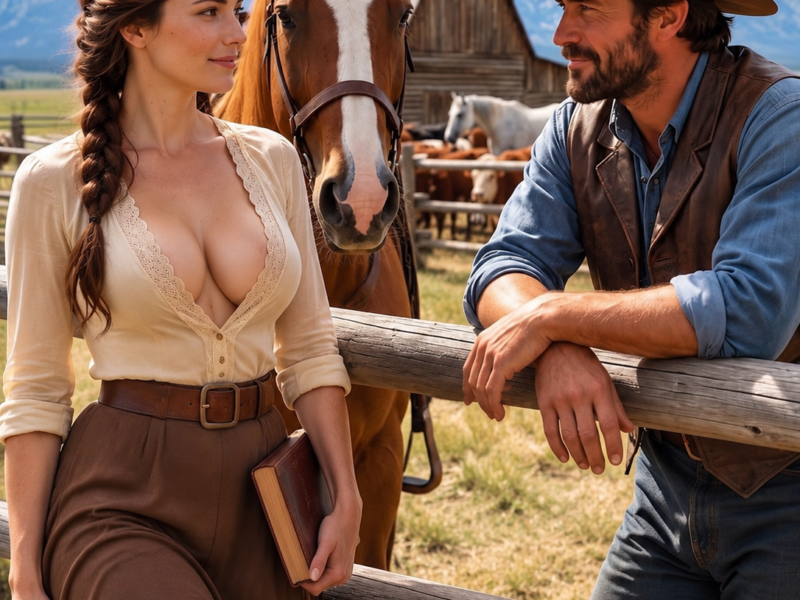
They Sent the Rancher a Worthless Bride to Ruin His Ranch She Built Wyoming’s Greatest Cattle Ranch
They Sent the Rancher a Worthless Bride to Ruin His Ranch She Built Wyoming’s Greatest Cattle Ranch
PART 1
The freight wagon arrived at Thorn Ranch just before noon, kicking up a long cloud of red dust as it rolled into the yard. Silas Thorne was standing beside the south corral, trying to settle six restless steers that had been pushing against the wooden rails since sunrise. He barely glanced toward the wagon until the driver pulled up beside the water pump and called out.
“This is as far as I was paid to take her.”
Silas turned.
A woman was sitting on the driver’s bench, holding a small brown suitcase. She climbed down without asking for assistance, straightened her plain wheat-colored traveling dress, and brushed the dust from her sleeves. Her boots were worn, her face was tired from the journey, and there was nothing about her appearance that suggested she had arrived expecting a grand welcome.
“Mr. Thorne?” she asked.
“That’s me.”
“My name is Ada Mercer.”
Silas looked at the wagon, then at the woman. He had been expecting someone, certainly, but he hadn’t expected her so early. The marriage bureau in Omaha had promised that his future wife would arrive before the end of the month.
The driver had already climbed back onto his seat.
“Wait,” Silas called. “Aren’t you taking her luggage?”
“That’s all she’s got.”
Before Silas could ask another question, the driver snapped his reins and disappeared down the road.
Ada watched him leave. Then she turned toward Silas.
“There’s something you should know before I carry that suitcase into your house.”
Silas folded his arms.
“Go ahead.”
“The marriage bureau that arranged our introduction was paid by Wesley Pike.”
Silas’s expression changed.
He knew that name. Everyone in the Red Butte Basin knew Wesley Pike. Pike owned one of the largest cattle operations in the region, controlled much of the local livestock association, and had spent years buying up smaller ranches whenever their owners ran into financial trouble.
“What does Pike have to do with you?”
“I heard two men discussing the arrangement in the Omaha office. They didn’t know I was listening. Pike wanted a woman who would cost you money, distract you from managing your ranch, and make it easier for him to buy your property before winter.”
Silas stared at her.
“You knew that before you got on the wagon?”
“Yes.”
“And you came anyway?”
Ada tightened her grip on the suitcase handle.
“Because Wesley Pike deciding I’m worthless doesn’t make it true.”
For a moment, Silas said nothing. Behind him, one of the steers struck the corral fence hard enough to make the boards rattle.
He had written to the marriage bureau months earlier. His letter had been straightforward. He wanted a wife who understood that ranch life was difficult, who could work beside him, and who wasn’t expecting a life of luxury. He had never imagined that his request would become part of another man’s scheme.
“You understand that I didn’t arrange any of this,” he finally said.
“I understand.”
“I can pay your fare back to Nebraska. You don’t have to stay.”
Ada looked toward the distant hills.
“I didn’t travel this far to let Wesley Pike decide where I live. And I didn’t answer your letter so he could send me here as a weapon. I’m not his weapon, Mr. Thorne.”
“You came through his arrangement.”
“I came through mine.”
Her voice remained calm, but there was something firm beneath it.
“I read your letter. You said you wanted someone who could work beside you and speak honestly, even when the truth wasn’t pleasant. If you meant those words, give me thirty days.”
“Thirty days for what?”
“To see whether either of us still wants this marriage.”
Silas studied her carefully.
“And what exactly do you expect during those thirty days?”
“A room of my own. Meals. No promises. No ceremony. At the end of the month, either of us can say no and I’ll leave without making trouble.”
He looked at her suitcase.
“That’s a strange way to begin a marriage.”
“Then perhaps we shouldn’t call it a marriage yet.”
Silas almost smiled, though he quickly hid it.
“What would you do here for thirty days?”
Ada looked past the house toward the northern slope. Beyond a broken sandstone shelf, a narrow line of brush marked the place where a small spring emerged from the hillside.
“That depends. Does that spring belong to your property?”
Silas turned to look.
“It does.”
“How much water does it carry?”
“Not enough to matter.”
“How do you know?”
“I’ve lived here fourteen years.”
Ada nodded slowly.
“That isn’t a measurement.”
One of the ranch hands nearby coughed to conceal a laugh.
Silas glanced at him, then returned his attention to Ada. There was something unusual about the way she spoke. She wasn’t trying to impress him, and she wasn’t asking for permission to have an opinion.
He took her suitcase.
“Thirty days,” he said.
“Thirty days.”
By late afternoon, Ada had changed into an older work dress and tied her sleeves above her elbows. Silas found her halfway up the northern slope carrying a hammer, a bundle of twine, and several short cedar stakes.
He stopped beside her.
“What are you doing?”
“Finding the fall.”
“The what?”
“The difference in elevation between the spring and the lower meadow.”
Silas looked downhill. The meadow stretched across several acres of brown grass, scattered rabbit brush, and patches of exposed gravel. For years, his cattle had crossed it on their way to better grazing land. He had never considered it useful enough to justify the labor required to improve it.
“You planning to water all that with a trickle?”
“I’m planning to find out what the trickle can do before I call it useless.”
She drove a cedar stake into the ground and tied the twine between it and another stake farther downhill.
Silas watched her adjust the line.
“You know cattle?”
“Not enough to tell you how to run them.”
That answer surprised him.
“But I know soil. I worked irrigated land in Nebraska for twelve years.”
She crouched and rubbed a little earth between her fingers.
“This slope has enough fall to move water without machinery. The question is whether the ground can hold it long enough to be useful.”
Silas glanced toward the spring. Water emerged beneath the sandstone in a clear ribbon no wider than his hand. Within a few yards, it disappeared into pale gravel.
Even if you could capture it, he thought, there wouldn’t be enough to make a difference.
“You’ll need men,” he said.
“I didn’t ask for men.”
“You will.”
“Then I’ll ask when I can show you why.”
She continued placing stakes.
Silas watched for another minute before heading back toward the yard. Then, without saying anything, he walked to the scrap pile, gathered the remaining cedar pieces, and carried them up the hill.
Ada accepted them.
“Thank you.”
“That doesn’t mean I believe this will work.”
“I know.”
By supper, twenty cedar stakes marked a winding line across the slope.
At the table, Ada asked only a few questions. How much hay did the ranch normally purchase during winter? How much came through Wesley Pike’s suppliers? And how long before the cattle would need to be fed heavily?
Silas answered honestly.
The ranch had become increasingly dependent on outside feed. Prices had risen twice in three years, and Pike’s association controlled the nearest dependable watering point outside Silas’s property. Every year, the Thorne Ranch paid more for resources it couldn’t easily replace.
“About eleven weeks before we start feeding hard,” Silas said.
Ada stopped eating.
“Then we don’t have thirty days to waste.”
At dawn the following morning, she was already at the spring.
Silas climbed the northern slope expecting to find little more than a shallow ditch and another ambitious idea.
Instead, he found cold water moving along the trench Ada had dug the previous evening. It passed three cedar stakes before collecting in a small hollow.
Ada knelt beside it and pressed two fingers into the mud.
Silas followed her gaze toward the lower meadow.
For fourteen years, he had looked at that land and seen nothing but brown grass. Now a thin line of water pointed directly toward it.
The question was no longer whether the spring could be reached.
It was whether they could make enough water stay.
Over the next three days, Silas found himself doing something he hadn’t done in years: considering a possibility he had already dismissed.
He sent two ranch hands to collect flat stones from the dry wash east of the property. Ada marked the first basin beneath the sandstone shelf, explaining that it needed enough surface area to slow the water before it disappeared into the gravel.
Silas studied the outline.
“That hole looks too big.”
“It needs to be.”
“You’re going to bury half my crew digging it.”
“You gave me two men.”
“I’m already regretting it.”
Ada handed him a shovel.
“Then you can regret it while digging.”
He stared at the shovel, then at her. This time, he actually smiled.
By noon, he was working beside her.
The basin took four days. They dug it shallow, shaped its sides by hand, and carried stone until the wagon springs groaned beneath the weight. Silas kept the cattle operation moving while finding time to help. At sunrise, he inspected fences. By midmorning, he hauled stone. Before supper, he checked the herd.
Ada quickly learned his routine. She never demanded that he abandon his responsibilities, but she also never allowed him to use them as an excuse to avoid the work.
On the fifth afternoon, they opened the diversion trench.
Water slipped from the spring, entered the channel, and began filling the basin.
Ada stood ankle-deep in mud, watching the level rise against a small stone marker.
Silas leaned on his shovel.
“Well?”
“Wait.”
“For what?”
“To see whether I’m right.”
They waited.
By sunset, the basin held a broad sheet of clear water that reflected the red sandstone above it. One of the ranch hands whistled.
Silas said nothing, but that evening he brought the winter feed agreement to the table.
The contract was due the following day.
Ada studied it carefully.
“You’re not thinking of refusing this because of one afternoon of water, are you?”
“I’m asking what you think.”
“One full basin isn’t the same as winter hay.”
“That’s a cautious answer.”
“It’s an honest one.”
Silas tapped the contract.
“If this works, I’ll pay Pike for feed I might not need. If it fails, I’ll have to buy from someone else at an even higher price.”
Ada folded her hands.
“Wait three days before signing.”
Silas nodded.
He did.
And the next morning, almost the entire basin had disappeared.
PART 2
Ada stood at the edge of the empty basin, her boots sinking into the damp earth. There was no broken wall or washed-out channel. The water had simply seeped through the gravel beneath it.
Silas examined the ground before finding a patch of dark, heavy soil.
“Clay,” Ada whispered.
She studied the basin again.
“I made it too deep. The clay runs through the slope in narrow bands. We need three smaller basins instead of one large one.”
“You know they’ll work?”
“No. But I think they will.”
Silas placed his hand over the cedar stake she was pulling out.
“Leave them. We learned something.”
That afternoon, they marked three new locations.
Meanwhile, Silas rode to Wesley Pike’s office and refused to sign the winter contract.
Pike smiled when he heard the news.
“Your new bride is giving financial advice already?”
Silas ignored the insult.
“I’m buying what I need when I know what I need.”
He rode home after dark.
But at sunrise, a ranch hand arrived with troubling news. Pike’s men had chained and locked the association watering gate that the Thorne cattle had used for years.
The message was unmistakable.
If Silas wanted independence, Pike intended to make him pay for it.
And the three unfinished basins suddenly mattered more than ever.
PART 3
The new basins took shape faster than the first one.
Not because the work was easier, but because nobody on the ranch needed convincing anymore.
When Ada first arrived, the men had watched her with the kind of curiosity usually reserved for a traveling salesman promising to turn ordinary dirt into gold. They had heard her talk about irrigation, measured slopes, and water channels, but most of them assumed the experiment would end as soon as the first hard problem appeared.
Now they understood that she wasn’t simply trying to prove herself.
She was trying to give the ranch something it had never possessed: a way to survive without asking Wesley Pike for permission.
Silas assigned Ada two men every morning and one wagon in the afternoon. The rest of the crew continued working with the cattle. It was a tight arrangement, but everyone knew there wasn’t time to waste.
Ada marked the clay bands across the slope while Silas hauled stone. They built the upper basin first, packing its floor with the heavy earth they had discovered beneath the gravel. They placed flat stones along the sides and shaped a narrow channel that could direct excess water toward the next basin.
On the evening they opened the channel, Ada stood beside the upper basin with her arms folded.
Silas held the wooden gate.
“Ready?”
“Open it slowly.”
He lifted the gate.
Water entered the basin, spreading across its shallow floor. It moved more slowly than before, gathering against the packed clay rather than disappearing into the earth.
They waited until dark.
At dawn, the water level had dropped less than an inch.
Silas crouched beside the marker stone and examined the damp ground.
“Good?”
Ada rubbed the soil between her fingers.
“Good enough to keep going.”
He stood.
“Then we keep going.”
The second basin took six days. The third took five. Each sat lower than the last, connected by a narrow ditch with simple wooden gates they built themselves.
The first time water passed from the upper basin into the second, Silas followed it on foot.
He watched the little stream travel between the stones, steady and clear.
Ada walked beside him.
“You still think it’s too little?”
“I think winter is bigger than this.”
“That isn’t what I asked.”
Silas looked down at the water.
“No.”
Ada nodded.
It was enough.
They began watering the lower meadow in strips rather than attempting to flood the entire field. Ada wanted the water moving slowly, soaking the soil before traveling farther downhill. Silas wanted the cattle kept away from the new growth.
They argued about fencing for nearly an afternoon.
Silas believed the temporary fence should follow the shortest route across the meadow. Ada argued that it would leave too much grass exposed to trampling near the ditch.
Eventually, Silas moved the fence twenty yards farther south.
Ada didn’t celebrate her victory or remind him that she had been right.
That made him trust the decision more.
The first signs of green appeared during the third week of August.
At first, the grass was barely noticeable. Thin shoots emerged where the ditch crossed the meadow, pushing through the brown soil in scattered patches. A few days later, another strip appeared beside the lower basin.
Silas stood at the edge of the field one evening, watching the wind move through grass that hadn’t existed a month earlier.
Ada approached carrying a wooden ruler.
“You’re measuring grass now?” he asked.
“I’m measuring whether we can cut it.”
“Can we?”
“Not yet.”
Silas looked toward the ranch buildings.
“We’re running out of summer.”
“I know.”
She didn’t offer false reassurance. That was something he had begun to appreciate about her. Ada never promised that a difficult problem would disappear simply because they wanted it to.
The days grew shorter.
Ada checked the water levels before breakfast. Silas adjusted the cattle rotation so the lower meadow remained untouched. When one section began drying too quickly, they changed the water flow rather than forcing the original plan.
The failed first basin was no longer considered wasted labor. Its failure had revealed where the clay ran beneath the ground, allowing them to construct the three smaller basins that now held the spring water.
Late in August, Silas found Ada standing outside the house with a folded calendar page.
“What’s that?”
“My thirty days.”
He looked at the date.
He had forgotten.
Ada hadn’t.
Silas leaned against the porch post.
“You can still leave.”
“I know.”
“And you can stay.”
She looked toward the meadow.
“As what?”
He hesitated.
There were several easy answers. He could tell her that the ranch needed her, that the water system depended on her knowledge, or that the winter would be impossible without her work.
But he knew those answers would make her sound like another resource he needed to keep the property running.
“As yourself,” he said.
Ada looked at him.
“If you decide against the marriage, you still have a place here until you decide what comes next. And the water system is yours to finish if you want to finish it.”
She studied his face.
“You mean that?”
“Yes.”
Ada folded the calendar page and placed it in her pocket.
“Then I’m staying.”
Silas nodded.
“For the water?”
She considered the question.
“For now, let’s say I’m staying.”
The first hay cutting began in early September.
The grass was shorter than Silas wanted, but the meadow had produced enough to make cutting worthwhile. They worked from morning until the light thinned, moving through the field with scythes, wagons, and pitchforks.
By sunset, fresh hay lay in rows across the lower ground.
The smell changed the whole ranch. It was green, warm, and clean, a smell Silas had not expected to experience from that neglected stretch of land.
He stopped beside one of the stacks and pressed his hand into the hay.
“Not enough for the whole winter,” he said.
“No,” Ada replied.
“You knew I’d say that.”
“Yes.”
“How far short?”
“If we waste nothing, less than before.”
Silas looked at her.
“That’s a careful answer.”
“It’s an accurate one.”
Ada pointed toward the upper end of the meadow.
“That section needs another week. If frost waits.”
“And if it doesn’t?”
“Then we use what we have.”
They began a second cutting three days later.
The ranch hands gradually stopped calling it Ada’s project. They began referring to the field as the North Hay Ground.
Silas noticed the change before Ada did.
One afternoon, he was repairing a gate near the corral when she approached.
“We need to decide where the next cutting goes.”
He put down his hammer.
“What do you think we should do?”
Ada paused.
He had asked for her opinion many times, but something about the question felt different.
Not what should you do?
What should we do?
She looked toward the field.
“Cut the west strip first. It dries faster.”
Silas nodded.
“Then that’s what we do.”
The following morning, Wesley Pike rode into the yard.
He stayed mounted, as he always did when visiting a man he considered beneath him.
Silas walked out to meet him. Ada remained beside the pump, brushing dirt from her hands.
Pike glanced toward the green meadow.
“So the bride found herself a garden.”
Silas didn’t react.
“What do you want?”
Pike looked back at him.
“That feed shipment you expected next month won’t be available.”
Silas’s face remained still.
“You confirmed that load in June.”
“Conditions changed.”
“I declined exclusivity. I didn’t cancel the shipment.”
Pike shrugged.
“Business changes.”
Ada stepped closer.
Pike glanced at her.
“Mrs. Mercer.”
“Miss Mercer,” she corrected.
His mouth tightened.
Silas asked how much Pike was offering for the ranch.
The older man smiled.
“For the ranch?”
“You didn’t ride out here to discuss feed.”
The smile disappeared.
Pike gave him a number. It was lower than his previous offer, lower even than what the property had been worth before the improvements.
Silas looked toward the meadow.
“No.”
Pike settled deeper into his saddle.
“You think that strip of hay changes your winter?”
“I think my answer hasn’t changed.”
Pike turned his horse.
“You’ll know by November.”
He rode away without another word.
Ada watched until he disappeared beyond the southern road.
Silas stood beside her.
“The final shipment is gone.”
“I heard.”
“We have standing grass and perhaps ten days before the nights get hard.”
Ada looked toward the upper basin.
“Then we use those ten days.”
But they wouldn’t get ten.
Four mornings later, Ada climbed to the top basin before sunrise.
A thin skin of ice covered the still edge of the water. She broke it with one finger and watched the cold water ripple beneath it.
Silas arrived behind her.
Below them, the last section of hay stood pale beneath the first frost.
“Two days,” he said.
Ada didn’t argue.
Two workable days.
No expected feed shipment. No old watering access. No room left for another failed plan.
By sunset on the second day, winter would begin making the decisions for them.
And for the first time since Ada had arrived, Silas wondered whether all their work would be enough.
PART 4
Before sunrise, Silas had every able hand in the northern meadow.
The first frost still silvered the grass when the cutting began. Ada worked near the lower ditch, clearing water from a section that needed to dry before the blades could pass through it.
Nobody wasted words.
The men understood what was at stake. If they lost the remaining grass, the ranch would enter winter with less hay than it had ever stored. If they cut it too early, the damp hay could spoil. If they waited too long, another frost might destroy what remained.
By noon, dark clouds were gathering over the western ridge.
Silas stopped beside Ada.
“How much?”
“If we finish this and keep the waste low, enough to make winter possible.”
“Possible?”
“I won’t promise more.”
He studied her face.
“That’s why I believe you.”
They worked until darkness made the blades unsafe.
The final wagon reached the hayyard under lantern light. Silas climbed onto the stack and spread the last forkful himself. When he came down, Ada was waiting with a small scrap of paper.
“Counted twice,” she said.
He wiped the haydust from his sleeves.
“And?”
“With what you already stored before I arrived, we can carry the herd if the winter stays ordinary. If it doesn’t, we’ll have to reduce losses wherever we can.”
Silas looked toward the cattle.
Selling part of the herd now would protect the animals that remained. It would also mean surrendering ground they had spent the entire summer fighting to hold.
Ada understood what he was considering.
“I’m not asking you to gamble the ranch.”
“I know.”
“Then don’t make the decision because of me.”
Silas looked at the haystacks.
“I’m making it because of what we built.”
The next morning, he sent no rider looking for replacement feed. He bought nothing from Pike.
Instead, he changed the entire feeding routine.
Hay was weighed before it went out. Loose feed was gathered rather than trampled into mud. The cattle were rotated through sheltered ground so they would burn less energy standing in the wind.
Ada never tried to tell Silas how to manage the cattle.
Silas never again treated the water system as something separate from the ranch.
Three days later, Wesley Pike returned.
He rode alone, stopping beside the hayyard. As always, he remained in the saddle while Silas approached.
Pike looked at the stacks.
“You cut it all.”
“Most of it.”
“Won’t be enough.”
“Maybe.”
Pike studied him for a moment before reaching inside his coat and producing a folded offer.
“I can still make this easy.”
Silas didn’t take the paper.
“What’s the number?”
Pike told him.
It was lower again.
Ada stood a few yards away, brushing chaff from her sleeves. She said nothing.
Silas looked toward the northern meadow.
“Come with me.”
Pike frowned.
“Where?”
“Where you came to buy the ranch. You should see what you’re buying.”
Silas started walking.
Ada followed.
For a moment, Pike remained beside his horse. Then, perhaps out of curiosity or perhaps because he couldn’t stand the thought of being dismissed, he dismounted and followed them.
They climbed toward the sandstone shelf.
The upper basin lay cold and clear beneath the rock. Below it, the second basin overflowed through a narrow stone channel. The third fed the ditch that ran toward the meadow.
Pike stopped.
His eyes moved from one basin to the next.
“You think three ponds make you independent?”
“No,” Silas replied. “The work does.”
Ada stepped toward the upper headgate. The wooden handle was smooth from months of use.
Silas looked directly at Pike.
“You controlled the feed because I depended on you for too much of it.”
Pike folded the offer.
“You still need feed some years. And water that isn’t yours.”
“You’re right.”
Pike seemed surprised.
Silas rested one hand on the headgate.
“My ranch was weak.”
Ada looked at him.
He continued.
“It was weak because too much of it depended on men who wanted it to stay weak.”
Ada lifted the gate.
Water slipped forward.
There was no dramatic flood, no sudden rush of water that transformed the entire valley. It was simply a steady, clear stream finding the channel they had built for it.
Pike watched it travel downhill.
Silas turned toward him.
“The ranch isn’t for sale.”
Pike tucked the offer back into his coat.
“Winter hasn’t happened yet.”
“No,” Silas said. “It hasn’t.”
Pike walked back toward his horse.
No threat followed him. He had used the leverage he possessed, and it had failed.
But Silas knew the real test was still ahead.
Winter arrived hard in November.
For twelve consecutive days, the wind pushed across Red Butte Basin without giving the ranch much rest. Snow collected against the northern fences, and temperatures dropped low enough to freeze the water troughs before sunrise.
The hay disappeared faster than Ada liked.
Silas watched the cattle more closely than ever. Every morning, he walked the feeding ground before the men arrived. Every evening, he checked the remaining stacks and calculated how much they could afford to use the following day.
They adjusted constantly.
When one feeding ground turned to mud, Silas shifted the herd. When the wind became too severe, the cattle were moved to sheltered ground. The men gathered every usable scrap of hay rather than allowing it to disappear beneath the snow.
Ada concentrated on keeping the water system functioning.
The basins froze along their edges, but the connecting channels continued carrying enough water to prevent the entire system from becoming solid ice.
She checked the wooden gates each morning and cleared the channels whenever snow or debris blocked them.
One afternoon, Silas found her standing beside the lower basin, trying to break a thick layer of ice near the outlet.
“You’re going to freeze your hands.”
“They’re already cold.”
He took the iron bar from her and struck the ice.
After several blows, a section broke away, revealing moving water beneath it.
Ada watched the current.
“That should hold.”
Silas glanced at her.
“You say that about everything.”
“Only when I’ve checked it.”
He laughed.
It was a small moment, but it mattered. For the first time in many months, he wasn’t looking at the ranch as a man waiting for something to go wrong. He was beginning to trust the things they had built.
Still, the winter wasn’t easy.
A week later, a young steer became trapped near the northern fence after snow drifted against the rails. Silas and two hands spent hours getting the animal free. Another morning, a section of the lower channel froze completely, forcing Ada to redirect water through the upper gate until the obstruction could be cleared.
There were days when both of them returned to the house too tired to speak.
But they kept going.
By January, the first haystack had been reduced to less than half its original size.
Silas began counting the remaining feed every evening again.
Ada noticed but didn’t comment.
Instead, she reviewed the feeding records and suggested moving part of the herd toward the southern slopes, where the wind exposed patches of grass beneath the snow.
Silas agreed.
The change saved more hay than either expected.
By February, the worst of the winter had passed.
The nights remained bitter, but the days grew longer. Snow began melting along the south-facing hillsides, revealing brown grass beneath the white surface.
One morning, Silas walked into the hayyard and realized he had forgotten to count the stacks the previous evening.
He stood there for a moment, almost suspicious of the feeling.
For months, he had gone to sleep thinking about feed, water, and the possibility of losing everything his family had built.
Now, for the first time, he had allowed himself to sleep without calculating how many days remained.
The ranch had survived.
Not comfortably. Not without losses. But it had survived without selling itself to Wesley Pike.
And the woman who had arrived with one suitcase had helped make that possible.
As March approached, the cattle began nosing through exposed grass on the southern slopes. The remaining hay was enough to carry them until spring grazing became dependable.
One afternoon, Silas found Ada checking the upper basin.
She stood beside the wooden gate, looking at the water moving beneath the thinning ice.
“Still measuring?” he asked.
She turned.
“Always.”
“Does it look all right?”
“For now.”
He stood beside her.
“That’s a careful answer.”
“It’s an honest one.”
They smiled.
Neither said what both had begun to understand.
Their lives had changed long before the winter ended.
PART 5
Spring arrived slowly in the Red Butte Basin.
Snow melted from the rooftops, and muddy water ran through the ranch yard. The horses began shedding their thick winter coats, while the cattle moved more freely across the southern slopes.
The haystacks had lasted.
So had the herd.
One morning, Silas was repairing the same corral gate he had been leaning against on the day Ada first arrived. Meltwater dripped from the barn roof, and the air smelled of wet earth.
Ada approached carrying two cups of coffee.
She handed him one.
“My thirty days are over,” she said.
Silas looked up from the gate.
“By several months.”
“You never asked again.”
He set down the hammer.
“I said either of us could say no.”
Ada stood quietly beside him.
“And if I say yes?”
Silas studied her.
“I don’t want you marrying me because this ranch needs you.”
She waited.
“It doesn’t need saving now,” he continued. “The water system works. We have our own hay ground. We’ve made it through a winter that should have finished us.”
He glanced toward the northern meadow.
“So if I ask you to stay, I want you to understand something. I’m not asking because I need someone to fix my problems.”
Ada looked at him.
“I’m asking because I want you here when there’s nothing left to rescue.”
For a moment, she said nothing.
The wind moved gently through the new grass below the sandstone shelf.
Then she smiled.
“Ask me, Silas.”
He took a breath.
“Will you marry me, Ada Mercer?”
“Yes.”
They married in Red Butte the following week.
There was no grand celebration, no expensive wedding dress, and no elaborate gathering of wealthy ranchers. Two of Silas’s ranch hands stood as witnesses, and the local minister performed the ceremony in a small church.
Ada wore a simple dress, and Silas wore the cleanest suit he owned.
When they returned to the ranch that afternoon, the work waiting for them hadn’t disappeared.
There were fences to repair, cattle to inspect, and spring channels to clear.
But something had changed.
For the first time, they were building a future that belonged to both of them.
The following weeks brought more work.
The lower meadow needed additional fencing to protect the new growth. Ada wanted to extend the irrigation channels toward another patch of ground east of the original field. Silas suggested waiting until they had seen how much water the spring could supply during the summer.
They disagreed, as usual.
But their disagreements no longer carried the uncertainty of two people wondering whether they belonged in the same house.
They had learned to listen.
They also learned that the three basins were only the beginning.
The first year had been about survival. They had needed to capture enough water to produce hay and make it through the winter without depending entirely on Wesley Pike.
Now they could think beyond survival.
Ada began mapping the slopes north of the sandstone shelf. She found two additional areas where the soil held more clay than gravel. Neither had a natural spring, but both could receive water from the existing channels if the gates were adjusted carefully.
Silas studied her measurements.
“You’re planning to turn the whole northern side into a meadow.”
“Not all of it.”
“How much?”
“Enough to make the next winter easier.”
He looked at her.
“That’s what you said last year.”
“And last year I was right.”
He laughed.
“You’re becoming dangerous.”
“Only to men who don’t measure things.”
The expansion began in early summer.
Silas hired two additional hands, not because Ada demanded them, but because he could finally afford to invest in the ranch rather than spend every spare dollar purchasing feed.
They extended the channels, reinforced the existing basins, and planted grass suited to the local soil and climate.
The work was slower than the first project.
There was no desperate deadline hanging over them, and that allowed them to make better decisions.
When a channel proved too steep, they changed its course. When a section of ground received too much water, Ada built a small diversion gate. Silas adjusted the cattle rotation so the new grass could establish itself without being trampled.
By the end of summer, the original North Hay Ground had expanded into a much larger stretch of productive land.
The ranch hands began speaking of the irrigation system as though it had always been part of the property.
But Ada never forgot how it had started.
One evening, she walked to the northern slope and found the original cedar stakes still standing beside the first ditch. They had weathered from brown to gray, and some leaned at odd angles, but they still marked the line she had measured on her first afternoon.
Silas approached carrying a lantern.
“You’ve been up here a while.”
“I was looking at these.”
He followed her gaze.
“The first stakes.”
“You brought me more when I ran out.”
“I remember.”
“And you told me you didn’t believe it would work.”
“I remember that too.”
Ada smiled.
“I think you were right to be cautious.”
Silas looked at her.
“That may be the first time you’ve admitted I was right.”
“Don’t get used to it.”
He laughed and placed the lantern on a flat stone.
For a while, they stood together, looking down at the meadow.
The water moved quietly through the channels. Beyond it, cattle drifted across the grass beneath the fading Wyoming sky.
Silas remembered the day the freight wagon had stopped beside the pump.
He remembered Ada stepping down with one suitcase, no family waiting for her, and no certainty that she would be welcomed.
He had thought she was the unexpected complication in a difficult year.
He hadn’t understood that she was the beginning of something entirely different.
“Do you ever wonder what would have happened if you’d taken the money and gone back to Nebraska?” he asked.
Ada considered the question.
“Sometimes.”
“What do you think?”
“I think Wesley Pike would have found another way to hurt you. He might have succeeded, too.”
Silas nodded.
“And you?”
“I would have found another place to work. Perhaps another farm. Perhaps somewhere I could build something useful.”
“You wouldn’t have missed this?”
Ada looked toward the house.
“I would have missed the people.”
He smiled.
“Even the man who thought your first pond was too big?”
“Especially him. Someone had to teach him that the ground doesn’t care how long you’ve lived beside it.”
Silas shook his head.
Then he reached for her hand.
They remained there until the last light disappeared beyond the western ridge.
Years passed.
The Thorn Ranch grew.
What had once been a struggling operation dependent on expensive outside hay became one of the most productive cattle ranches in the region.
The irrigation system expanded across the northern and eastern meadows. The three original basins remained at its center, feeding a network of channels that Ada continued improving as she learned more about the land.
The ranch began producing enough hay to supply its own cattle through ordinary winters. In better years, it sold the surplus to neighboring operations.
Silas invested the additional income in stronger fences, better equipment, and more reliable water storage.
He also began buying adjoining parcels when smaller ranchers decided to retire.
But he never purchased land simply to make the property larger.
Every addition had to serve a purpose.
Ada insisted on that.
She became known throughout the basin for her understanding of soil, irrigation, and water management. Ranchers who had once laughed at the idea of a woman directing agricultural work began traveling to Thorn Ranch to ask for her advice.
Some arrived with questions about dry fields. Others wanted to know how to make small springs useful or how to prevent water from disappearing into sandy soil.
Ada never pretended to have every answer.
She would walk the land, examine the soil, measure the slope, and tell them what she thought.
Sometimes she was right immediately.
Sometimes she had to revise her plans.
But she never considered changing a failed design an embarrassment.
To her, the land was always teaching something.
Silas learned the same lesson.
He also learned that the strength of a ranch wasn’t measured only by the number of cattle it owned or the acreage written on its deed.
It was measured by how well it could withstand the seasons that didn’t go according to plan.
Wesley Pike eventually discovered that his influence over the Red Butte Basin was no longer what it had been.
He still owned substantial land and controlled several businesses, but smaller ranchers had begun finding alternatives to his feed contracts and watering arrangements.
The success of Thorn Ranch had changed their expectations.
Pike tried several times to persuade Silas to join the association again.
Each offer was more generous than the last.
Silas refused them all.
He never publicly accused Pike of arranging the marriage scheme, and he never needed to.
The man had lost the one thing he had expected to gain: control over a ranch whose owner could no longer be forced into selling.
Years later, when people asked Silas how he had managed to turn the property around, he usually mentioned the water system, the improved hay production, and the changes in cattle management.
He rarely mentioned the woman who had arrived in a dusty wagon.
But Ada always remembered.
She remembered the driver saying he had only been paid to take her that far.
She remembered the look on Silas’s face when she told him about Wesley Pike.
And she remembered the first basin.
That first basin had failed completely.
Four days of labor had disappeared into the ground, and for a moment she had believed she had ruined her chance to prove herself.
Yet Silas had stopped her from pulling out the stakes.
He had told her to leave them because they had learned something.
It was a small act of trust, but it changed everything that followed.
One spring morning, many years after her arrival, Ada and Silas walked to the upper basin together.
The cedar stakes from her first survey still stood along the ditch, weathered gray by countless seasons of sun, rain, snow, and wind.
Silas placed one hand on the wooden headgate.
Ada placed hers beside it.
“Ready?” he asked.
“Open it slowly.”
He lifted the handle.
Clear water moved past the old stakes and traveled down the channel, spreading into the new grass.
Beyond it, cattle drifted across the meadow beneath the Wyoming morning.
Silas watched the water for a long moment.
“Do you remember what you said when you first arrived?”
Ada smiled.
“Which part?”
“That Pike deciding you were worthless didn’t make it true.”
She looked toward the meadow.
“I remember.”
“Seems he was wrong about quite a few things.”
“He was wrong about the ranch, too.”
Silas turned toward her.
“Perhaps he thought he was sending me a worthless bride.”
Ada laughed softly.
“And instead?”
He looked across the land they had built together.
“Instead, he sent me someone who knew how to make something grow where everyone else saw nothing.”
Ada rested her head against his shoulder.
The spring continued flowing.
It had never been a large source of water. It had never produced a spectacular river or filled an enormous reservoir. It was simply a small, steady spring beneath a sandstone shelf.
But in the hands of two people willing to study the land, learn from failure, and work together, it had become the foundation of something extraordinary.
The Thorn Ranch was no longer the struggling property Wesley Pike had expected to purchase cheaply.
It had become one of Wyoming’s greatest cattle operations, built not through inherited wealth or political influence, but through patience, knowledge, and determination.
And the woman who had arrived with a single brown suitcase had become the person who helped build it.
As the morning sun rose over the northern ridge, Ada and Silas watched the water spread through the meadow.
Neither needed to say anything more.
They had spent years building a life that neither of them had originally imagined.
And it had begun with thirty days, one failed basin, and a woman who refused to let another man decide what she was worth.