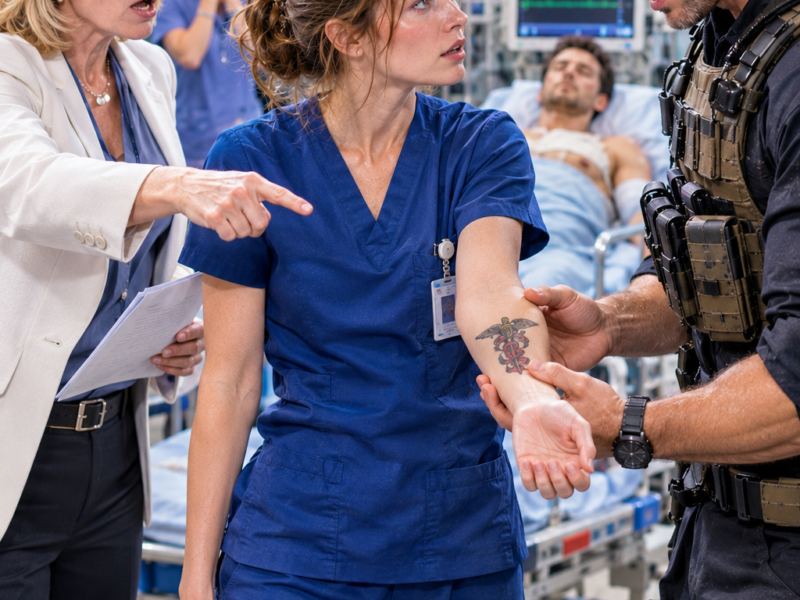
They Fired the ER Nurse for Touching a Navy SEAL—Until His Commander Saw Her Wrist Tattoo
They Fired the ER Nurse for Touching a Navy SEAL—Until His Commander Saw Her Wrist Tattoo
The moment Sarah Jenkins saved a Navy SEAL’s life, she unknowingly destroyed the quiet existence she had spent years trying to build. Within minutes of bringing a dying soldier back from the edge of death, she was stripped of her hospital badge, threatened with the loss of her nursing license, and ordered to leave the building as though she were a criminal. The people who fired her believed they were removing a reckless civilian nurse who had violated military security protocols. What they did not know was that the woman they had just humiliated carried a secret on her wrist, a symbol forged in blood and fire, recognized by only a handful of men who had survived one of the darkest nights in American special operations history.
And when the commander of the wounded Navy SEAL finally arrived at the hospital, that small tattoo would turn an ordinary disciplinary incident into a confrontation no one at San Diego Memorial Hospital would ever forget.
It began on a stormy Friday night, when rain fell across San Diego with a violence that made the streets resemble rivers of black glass. Lightning flickered beyond the windows of San Diego Memorial Hospital, briefly illuminating the ambulances gathered beneath the emergency entrance. Inside, the emergency department was already overwhelmed. A motorcycle collision had brought in two critically injured patients, an elderly man was experiencing cardiac complications, and a young woman injured in a domestic dispute was crying quietly behind a privacy curtain.
Through the chaos moved Sarah Jenkins, a thirty-four-year-old registered nurse whose calmness had become something of a legend among the younger staff.
Sarah had worked at the hospital for five years, although her medical career stretched back considerably further. She was rarely late, almost never complained, and possessed a remarkable ability to remain composed when everyone around her began losing control. Her colleagues knew she could start an intravenous line in nearly impossible conditions, recognize subtle changes in a deteriorating patient, and organize a frantic trauma response without raising her voice.
What they did not know was where she had learned those skills.
Sarah never discussed her past. When someone asked where she had worked before coming to San Diego, she usually answered that she had spent time in military medicine. If they pressed further, she smiled politely and changed the subject.
Most people assumed she had worked at a military hospital, perhaps caring for wounded service members returning from overseas.
They had no reason to imagine anything more.
At eleven o’clock that night, an unfamiliar ringing sound cut through the emergency department.
It came from the secure telephone mounted behind the charge nurse’s desk.
Brenda Caldwell, the director of nursing, answered immediately. Brenda was a woman who believed that control was the foundation of professional success. Her immaculate appearance, perfectly styled hair, and expensive shoes stood in sharp contrast to the exhausted medical personnel working around her. She had built her career through administrative efficiency, and she guarded the hospital’s reputation with an intensity that sometimes seemed to exceed her concern for the patients themselves.
As she listened to the caller, the color gradually disappeared from her face.
Then she straightened.
“Clear trauma bay one,” she ordered. “Immediately. Move the automobile accident patient to bay three. I want the corridor secured, and I want security personnel stationed at both entrances.”
Several nurses looked up in confusion.
Sarah approached the desk.
“What are we receiving?”
Brenda covered the telephone.
“Military emergency. Naval Special Warfare. A critically injured operator is being transported here from Coronado. Their own surgical team is coming, but they need our trauma facilities.”
Sarah glanced toward the trauma bays.
“How serious?”
“Extremely serious. But listen carefully, Sarah. This patient is classified military personnel. No civilian staff member without the appropriate clearance is authorized to touch him. We are providing equipment and facilities. The military team will manage his treatment.”
Sarah stared at her.
“If the patient is critically injured, every qualified medical professional in that room needs to be available.”
“You will follow the instructions you are given.”
“What happens if their team needs help?”
“Then you provide whatever equipment they request. Nothing more.”
Sarah studied Brenda’s expression and realized further argument would accomplish nothing.
She turned toward the supply cart.
Brenda grabbed her arm.
“I am serious, Sarah. The Department of Defense has made the restrictions clear. One unauthorized intervention could expose this hospital to enormous liability. Do not cross the security line.”
Sarah gently removed Brenda’s hand.
“I understand what you said.”
It was not quite the same as agreeing.
Minutes later, the ambulance doors burst open.
A team of men in soaked tactical clothing surrounded a gurney carrying a massive, unconscious patient. The atmosphere changed immediately. These were not ordinary hospital escorts. Their movements were coordinated, their faces hard, and their eyes constantly traveled across doorways and corridors.
On the gurney lay Petty Officer First Class David Miller, a twenty-six-year-old Navy SEAL whose body bore the terrible consequences of a violent fall.
His chest was bruised. Blood stained the sheets beneath him. His skin had taken on a frightening bluish color, and the corpsman accompanying him was struggling to maintain his breathing.
“Severe blunt chest trauma!” the corpsman shouted. “Approximately fifty-foot fall into the water. Respiratory status deteriorating. Oxygen saturation seventy-eight and dropping!”
The military surgeon, Lieutenant Commander Evans, hurried toward the bed.
“Transfer him. Now.”
Sarah moved automatically, helping position equipment while staying outside the designated treatment area.
Evans examined the patient.
“Right-sided breath sounds severely diminished. Possible tension pneumothorax. Prepare for emergency chest decompression.”
Sarah already understood the danger.
Air was accumulating under pressure inside Miller’s chest, compressing his injured lung and interfering with blood returning to his heart. If the pressure was not relieved quickly, his circulation could collapse entirely.
The surgeon requested equipment.
Sarah prepared it.
Then the monitor began shrieking.
“Pressure dropping!”
“Heart rate thirty!”
“Losing pulses!”
The corpsman stared at the screen.
“He’s arresting!”
Evans moved urgently, but his hands hesitated as he struggled with the patient’s distorted anatomy. Blood and seawater covered Miller’s chest, making the landmarks difficult to identify. His specialized surgical training had not prepared him for this particular combination of injuries, urgency, and disorder.
Sarah watched his movements.
She watched the monitor.
And something deep inside her changed.
For five years, she had trained herself to leave a certain part of her life behind. She had practiced speaking softly, following routines, and accepting the ordinary frustrations of civilian medicine. She had told herself that the woman she had been in Afghanistan no longer existed.
But the human body did not care about her attempts at reinvention.
A dying man lay six feet away.
And she knew exactly what that meant.
“He needs immediate decompression,” Sarah said.
Brenda appeared at the doorway.
“Stay where you are.”
Sarah stepped forward.
“Doctor, he is obstructing his own circulation. We need to relieve the pressure now.”
Evans was still struggling.
“I’m working on it!”
The monitor deteriorated further.
Sarah looked at the patient’s motionless face.
For one terrible instant, she saw another face superimposed over his.
A wounded soldier in a burning helicopter.
Blood soaking into snow.
A voice begging her not to let him die.
Sarah’s expression hardened.
“He doesn’t have time.”
She crossed the security boundary.
“Sarah!” Brenda screamed.
Sarah did not stop.
She took the emergency decompression equipment and moved toward Miller’s chest.
One of the armed escorts stepped forward.
“Ma’am, you need to move away!”
Sarah turned her head just enough to look at him.
“Your teammate is dying. Either help me or get out of my way.”
There was something in her voice that made him stop.
It was not desperation.
It was command.
Sarah acted with the speed and certainty of someone who had performed lifesaving interventions in conditions far worse than a modern trauma bay. She relieved the trapped pressure, and the room filled with the sudden rush of escaping air.
“Continue resuscitation,” she ordered.
The corpsman immediately responded.
Evans resumed working, now with the immediate pressure relieved and the team moving together again.
For several agonizing moments, the monitor displayed a rhythm without an effective pulse.
Then a nurse called out.
“I have a pulse!”
Another checked the blood pressure.
“Pressure coming back!”
The oxygen reading began climbing.
Miller’s skin slowly lost its bluish tint.
The corpsman exhaled so sharply that his shoulders sagged.
Evans completed the necessary stabilization and looked toward Sarah.
He knew what had happened.
Without her intervention, the man on the table would almost certainly have died.
Sarah looked at the monitor one final time.
Then she stepped back.
She had saved him.
But when she turned around, the first face she saw belonged to Brenda Caldwell.
And Brenda looked furious.
“Security,” she said, her voice trembling. “Escort Nurse Jenkins to my office.”
The room fell silent.
Sarah glanced at the unconscious patient, then at the two guards moving toward her.
For a moment, she seemed almost amused by the absurdity.
Then she removed her bloodstained gloves and walked out without resisting.
The meeting that followed lasted less than twenty minutes.
Brenda sat behind her desk with Lieutenant Harris, a naval liaison officer who appeared more concerned with the violation of security procedures than with the fact that his fellow service member was alive.
Sarah sat across from them, still wearing her stained scrubs.
Brenda opened a folder.
“Do you understand the seriousness of your actions?”
Sarah answered without hesitation.
“Yes.”
“Then explain why you deliberately ignored a direct order.”
“Because the patient was dying.”
“That is not an acceptable explanation.”
Sarah looked at her.
“It is the only explanation that matters.”
Lieutenant Harris leaned forward.
“You interfered with the treatment of a highly classified military operator. You crossed a restricted security boundary and performed an unauthorized procedure.”
“I performed an emergency intervention on a patient in cardiac arrest.”
“You had no clearance.”
“His lungs didn’t know that.”
Brenda slammed her palm against the desk.
“You are not going to turn this into some heroic performance!”
Sarah remained still.
“I haven’t called myself a hero.”
“You acted recklessly.”
“I acted because waiting would have killed him.”
Brenda’s face reddened.
“Your arrogance is unbelievable.”
Sarah said nothing.
She had been shouted at by insurgent interrogators, watched commanding officers make impossible decisions, and listened to men scream while surgeons tried to save their lives in makeshift operating rooms.
A hospital administrator raising her voice could not frighten her.
But something about the injustice hurt more deeply than Sarah expected.
She had come to San Diego Memorial looking for peace.
For five years, she had worked holidays, covered extra shifts, comforted frightened children, and held the hands of dying strangers.
She had never asked for recognition.
And now, after saving a man, she was being treated as though she had committed a crime.
Brenda slid a document across the desk.
“Effective immediately, your employment is terminated.”
Sarah looked down.
The paper was a formal notice of dismissal.
“We will also submit a report to the state nursing board concerning your conduct,” Brenda continued. “Your professional license may be subject to review.”
Sarah slowly lifted her eyes.
“You are firing me because I saved him.”
“We are terminating you because you violated policy.”
For several seconds, neither woman spoke.
Finally, Sarah stood.
“Then I hope you never find yourself depending on someone who values policy more than your life.”
Brenda pointed toward the door.
“Clean out your locker.”
Sarah walked away.
She did not cry.
Not until she reached the empty locker room did her composure begin to crack.
She stood before her narrow metal locker and stared at its contents. There was a photograph of an old golden retriever she had loved, a spare stethoscope, a cheap coffee mug, several granola bars, and a canvas duffel bag that had traveled with her through more countries than most people would ever visit.
The simplicity of those possessions seemed almost cruel.
This was what remained of the quiet life she had fought so hard to create.
She packed slowly.
As she reached for her bag, her sleeve slipped back.
On the inside of her right wrist, a black tattoo appeared.
It depicted a broken Navy SEAL trident entwined with a combat medic’s cross. Beneath it were words that looked as though they had been carved rather than inked into her skin.
Valkyrie.
Extortion 17.
See You in Valhalla.
Sarah stared at the tattoo.
She remembered a dim room in Kabul.
Four survivors sitting around a battered wooden table.
A tattoo artist working by the light of a flickering generator.
The smell of disinfectant barely masking the lingering odors of smoke, sweat, and blood.
They had made a promise that night.
A promise to remember the men they had lost.
A promise never to abandon one another.
Sarah covered the tattoo.
Then she picked up her bag and left.
Outside, rain hammered against the pavement.
She walked toward her old Jeep Cherokee, climbed inside, and sat behind the steering wheel without starting the engine.
For the first time that night, her hands began to shake.
Not because of Brenda.
Not because she had lost her job.
But because the emergency had awakened memories she had spent years trying to silence.
And somewhere above her, in the intensive care unit, a young Navy SEAL was alive because she had refused to remain silent.
Three hours later, a black military SUV stopped outside the hospital.
Four men emerged into the storm.
At their center walked Lieutenant Commander Richard Hayes.
Rick Hayes was forty-two years old, powerfully built, and carried the unmistakable presence of someone accustomed to making decisions while bullets were flying. A jagged scar crossed the side of his face, extending toward his ear.
His men respected him because he never asked them to endure anything he would not endure himself.
They feared disappointing him more than they feared enemy fire.
And tonight, he was frightened.
One of his best operators had nearly died.
Hayes had received fragmented reports while traveling to the hospital. The initial message described a classified maritime operation, a fall from an aircraft, severe chest trauma, and cardiac arrest.
The second report said Miller had survived.
But the explanation was confusing.
A civilian nurse had apparently intervened when the military surgeon could not stabilize him.
Hayes wanted answers.
Brenda Caldwell stood waiting near the entrance, accompanied by Lieutenant Harris.
“Commander Hayes,” she began with a practiced smile. “Welcome to San Diego Memorial. We are honored—”
“Where is Miller?”
The question cut through her introduction.
“He’s in intensive care,” Harris answered. “Stable. The physicians expect him to recover.”
Hayes nodded.
“Good. Now tell me what happened.”
Brenda quickly began explaining.
“There was an unfortunate breach of protocol involving one of our nurses. She ignored explicit instructions and interfered with the military surgical team.”
Hayes stopped walking.
“Interfered?”
“Yes. She performed an unauthorized emergency procedure.”
“Did the procedure work?”
Brenda hesitated.
“Well, the patient was subsequently stabilized, but that does not excuse—”
“Did it work?”
His voice was quieter this time.
And somehow more intimidating.
“Yes.”
Hayes looked at Harris.
“Who performed it?”
“A civilian registered nurse. Sarah Jenkins.”
Hayes showed no immediate reaction to the name.
“Let me see the medical record.”
Brenda reluctantly obtained a tablet.
Hayes studied the timeline.
His expression grew increasingly serious as he examined the documented collapse and recovery.
He had spent enough years around combat medicine to recognize the difference between guesswork and decisive intervention.
The timing was extraordinary.
The nurse had recognized a lethal complication and acted while everyone else was struggling.
“She knew exactly what she was doing,” he murmured.
Brenda folded her arms.
“That doesn’t change the violation.”
Hayes looked up.
“Where is she?”
“We terminated her employment.”
He stared at Brenda.
“You did what?”
“She was dismissed for gross insubordination.”
Hayes said nothing for several seconds.
Then he spoke.
“Show me the trauma bay footage.”
A few minutes later, he stood inside the security control room.
The recording played across a large monitor.
Hayes watched Miller arrive.
He watched the surgeon struggle.
He watched the monitor deteriorate.
Then a woman in navy-blue scrubs stepped into view.
She moved with extraordinary confidence.
Her posture, the economical precision of her hands, and the way she issued instructions stirred something in Hayes’s memory.
He leaned closer.
“Pause.”
The guard stopped the recording.
“Back five seconds.”
The footage moved backward.
“Play.”
The woman reached across the patient.
Her right sleeve shifted.
Hayes went completely still.
“Pause it again.”
He pointed toward the screen.
“Zoom in on her wrist.”
The guard adjusted the image.
The picture sharpened.
And there it was.
A broken trident.
A combat medic’s cross.
Hayes felt the air leave his lungs.
He recognized that tattoo more clearly than he recognized his own reflection.
For seven years, he had believed the woman who wore it was dead.
“Valkyrie,” he whispered.
Harris frowned.
“Sir?”
Hayes did not answer.
He stepped closer until his face was only inches from the screen.
The woman’s features were older than he remembered, thinner and more guarded, but unmistakable.
He had seen those eyes before.
In Afghanistan.
Through smoke and flames.
When he had been certain he would never see another sunrise.
“Sarah,” he said.
The sound of her name seemed to bring him back to life.
He turned toward Brenda.
“What did you say her last name was?”
“Jenkins.”
Hayes took one step toward her.
“Sergeant First Class Sarah Jenkins?”
Brenda blinked.
“I don’t know anything about a sergeant. She was a registered nurse.”
Hayes looked back at the monitor.
His jaw tightened.
“She was the lead trauma medic of an Army Cultural Support Team attached to special operations missions in Afghanistan.”
Harris straightened.
“Sir, are you saying she served with—”
“She served with us.”
Hayes pointed at the screen.
“That woman has a Silver Star and two Purple Hearts. Seven years ago, she pulled me out of a burning helicopter after an enemy attack. She kept me alive while we were taking fire.”
Brenda’s face lost its color.
Hayes continued.
“She saved three more men before the rescue team reached us. She suffered catastrophic injuries herself. We were told she died afterward.”
He turned toward Brenda again.
“And you fired her?”
Brenda swallowed.
“We had no way of knowing—”
“You knew she saved Miller.”
“She violated—”
“She saved his life!”
His voice thundered through the small room.
The security guard flinched.
Harris looked as though he wanted to disappear.
For several moments, Hayes struggled to control himself.
He had spent seven years carrying the guilt of surviving a helicopter crash that had taken so many others. He had believed Sarah Jenkins had given her life to save him.
Now she was alive.
And the first thing he learned about her new life was that she had been punished for doing exactly what she had once done for him.
“Where is she?” he demanded.
Brenda pointed vaguely toward the parking lot.
“Security escorted her outside.”
Hayes was already moving.
He rushed through the corridor, pushed past the emergency doors, and ran into the storm.
The parking lot was nearly empty.
Water splashed beneath his boots as he searched the rows of vehicles.
Then he spotted an old Jeep Cherokee near the rear exit.
Its headlights came on.
The vehicle began moving.
“Sarah!”
His shout disappeared beneath a crack of thunder.
He ran into the lane and waved both arms.
“Sarah!”
The Jeep stopped abruptly.
Through the rain-streaked windshield, he saw a woman gripping the steering wheel.
She stared at him.
Then her expression changed.
She opened the driver’s door and stepped into the rain.
For a moment, neither of them moved.
The years between Afghanistan and San Diego seemed to collapse into a single heartbeat.
Sarah looked at the familiar scar along his jaw.
She remembered stitching that wound with trembling hands while a helicopter burned behind them.
“Rick?”
His name escaped her lips before she could stop it.
Hayes crossed the distance between them.
He pulled her into his arms.
For the first time in years, the hardened commander allowed himself to tremble.
“I thought you were dead,” he whispered.
Sarah closed her eyes.
“I know.”
“They told us you never recovered. They said the injuries were too severe.”
“I nearly didn’t.”
Hayes pulled back and studied her face.
“Seven years, Sarah. Seven years.”
She looked away.
“I needed to disappear.”
“Why?”
Her eyes filled with tears.
“Because every time I saw someone from the team, I remembered who wasn’t there anymore.”
Hayes fell silent.
He understood.
There were memories neither of them could discuss without feeling as though they were back inside the burning helicopter.
The mission had taken place in a remote Afghan valley where an intelligence operation had turned into a desperate extraction. Their helicopter had been struck during departure and crashed against a mountainside.
The impact killed several men instantly.
The surviving soldiers were trapped amid twisted metal while enemy gunfire echoed across the valley.
Hayes had suffered a devastating leg injury and could barely move.
Sarah had been thrown against the aircraft’s interior, fracturing ribs and injuring her shoulder.
Yet she had managed to free herself.
She had dragged Hayes away from the burning wreckage, treated his catastrophic bleeding, and returned repeatedly to search for survivors.
By the time reinforcements arrived, she had been wounded again.
Hayes remembered her kneeling beside him in the snow.
Her face had been streaked with soot.
Blood ran down her arm.
She had pressed both hands against his injured leg and shouted at him to keep his eyes open.
He remembered asking her to leave him.
And he remembered her answer.
Not while I’m breathing.
Then everything had gone dark.
When Hayes regained consciousness in a military hospital, he was told that Sarah had been critically injured during evacuation.
Weeks later, he received word that she had not survived.
He had never entirely recovered from that loss.
But the truth was different.
Sarah had survived multiple surgeries, a prolonged coma, and months of rehabilitation. Her recovery had been kept quiet because the mission and personnel involved were classified. By the time she was medically discharged, her former team had scattered across assignments and continents.
She had been offered opportunities to remain connected to military medicine.
She refused them.
She wanted ordinary patients.
Ordinary problems.
A world where the sound of a helicopter did not make her heart race.
And for five years, she had almost convinced herself she had found it.
Hayes looked at the duffel bag hanging from her shoulder.
“What happened in there?”
Sarah gave a humorless smile.
“I saved your man. Apparently, that’s grounds for termination.”
“David Miller?”
She nodded.
“He’ll live if there are no further complications.”
Hayes stared at her.
“He has a wife and a little girl. His daughter is six months old.”
Something in Sarah’s expression softened.
“I didn’t know that.”
“You gave that little girl her father back.”
Sarah looked toward the hospital.
“I just did what needed to be done.”
Hayes shook his head.
“You always say that.”
A faint, sad smile crossed her face.
“Someone has to.”
Hayes took out his secure telephone.
“Come back inside.”
Sarah immediately shook her head.
“I can’t. Brenda threatened to have me arrested if I returned.”
Hayes looked toward the brightly illuminated hospital entrance.
“Then she is about to have a very unpleasant conversation.”
“Rick, don’t turn this into a war.”
He looked back at her.
“It already became a war when they punished you for saving one of my men.”
Sarah sighed.
“I don’t need revenge.”
“Neither do I.”
He paused.
“But I am not leaving you standing in the rain while they destroy your career.”
He placed a hand gently on her shoulder.
“We don’t leave our people behind, Valkyrie.”
For a long moment, she could not speak.
Those words belonged to another life.
A life she had tried desperately to forget.
Finally, she nodded.
Together, they walked back toward the hospital.
Inside, Brenda Caldwell was on the telephone with Jonathan Carmichael, the hospital’s chief executive officer.
She was explaining that the situation had been resolved.
“The nurse has been removed,” Brenda said. “The military liaison supports our decision. There should be no further complications.”
Then the sliding doors opened.
Hayes entered first.
Sarah followed beside him.
Brenda lowered the telephone.
Her expression transformed from confusion into outrage.
“What is she doing here?”
Several nurses turned.
A security guard stepped forward uncertainly.
“Ms. Jenkins, you’ve been instructed to leave the premises.”
Hayes positioned himself beside Sarah.
“She is here with me.”
Brenda pointed at Sarah.
“She is no longer an employee of this hospital!”
“I am aware.”
“Then she has no right to be here!”
Hayes looked at her with chilling calm.
“Director Caldwell, I suggest you stop speaking until you understand the situation.”
Brenda ignored him.
“Security, escort her outside!”
The guards hesitated.
Harris emerged from the corridor and immediately recognized the danger of the confrontation.
“Director, perhaps we should discuss this privately.”
“No!” Brenda snapped. “I will not allow a terminated employee to intimidate this hospital!”
Hayes lifted his phone.
“Admiral Collins, are you still on the line?”
The entire lobby went quiet.
A voice answered.
“I am, Commander.”
Hayes activated the speaker.
“Director Caldwell is here.”
“Good,” the admiral replied. “I’d like to speak with her.”
Brenda stared at the device.
The admiral introduced himself and explained that he had reviewed the incident involving Petty Officer Miller.
He confirmed that Sarah Jenkins had served in a highly sensitive medical capacity during classified operations and that her actions that evening were being examined as part of the military’s official medical review.
Then Jonathan Carmichael joined the conversation.
His tone was furious.
“Brenda, why am I hearing from Naval Special Warfare Command that you fired the nurse who saved one of their operators?”
Brenda gripped the desk beside her.
“Jonathan, she violated direct security instructions.”
“And did the patient survive because of her intervention?”
“Yes, but—”
“Then why wasn’t the medical judgment reviewed before you terminated her?”
Brenda struggled to answer.
Carmichael continued.
“The hospital’s legal department has already reviewed your report. Your description of an assault is unsupported by the preliminary clinical record. You made a disciplinary decision without a proper investigation, and now you’ve created a far larger problem.”
“But the protocols—”
“Protocols are not an excuse for falsifying the nature of an emergency medical intervention.”
Every person in the lobby seemed to be listening.
Brenda’s eyes filled with tears.
“Jonathan, I was protecting the hospital.”
“Effective immediately, you are suspended pending formal review. Surrender your badge and report to Human Resources.”
The telephone connection ended.
Brenda stood motionless.
For years, she had wielded authority over the nurses beneath her.
Now she found herself stripped of that authority in front of the very people she had intimidated.
Sarah watched without satisfaction.
She had imagined, during the long walk to her locker, what it might feel like if Brenda were forced to understand her mistake.
But now that the moment had arrived, Sarah felt only exhaustion.
Hayes turned toward her.
“Ready?”
She looked down at the hospital badge she had surrendered earlier.
Then she looked at the frightened young nurses gathered near the station.
Some smiled at her.
Others stared openly at the tattoo that had become visible beneath her damp sleeve.
Sarah realized there was no point in hiding it anymore.
She pushed the sleeve higher.
The broken trident was unmistakable.
“Let’s go see your man,” she said.
Hayes nodded.
They walked together toward intensive care.
By the time Sarah entered room 412, the atmosphere had changed completely.
Military personnel guarded the corridor while medical staff coordinated closely with the naval surgical team.
David Miller lay unconscious beneath a collection of monitors and intravenous lines. A ventilator supported his breathing, and a chest drainage system remained in place.
He looked surprisingly young.
Without the tactical equipment and the blood, he could have been any other young man recovering from a terrible accident.
Lieutenant Commander Evans stood beside the bed.
When Sarah entered, he straightened.
“Sergeant Jenkins.”
She raised an eyebrow.
“It’s been a long time since anyone called me that.”
Evans glanced toward Hayes, then back at her.
“I owe you an apology.”
Sarah waited.
“I lost control of the situation in the trauma bay. I allowed the pressure to overwhelm my judgment. Your intervention gave us the opportunity to stabilize him.”
She studied his face.
There was no arrogance left in it.
Only genuine shame.
“Doctor, you were placed in an impossible situation. You were trained for a different specialty, and suddenly you were responsible for a patient deteriorating faster than anyone expected.”
Evans nodded.
“That doesn’t excuse my hesitation.”
“No,” Sarah agreed. “But it means you can learn from it.”
She stepped toward the monitor.
“How has he been doing?”
Evans summarized the patient’s condition.
The immediate danger had passed. His oxygenation and circulation had improved, although further monitoring was essential because of the severity of the fall and the possibility of additional injuries.
Sarah examined the available information carefully.
Then she checked Miller’s face.
“Any indication of neurological injury?”
“Nothing significant on the initial evaluation. We are continuing observation.”
“Good.”
Hayes stood quietly behind her.
Watching Sarah work felt like opening a door to the past.
He remembered how she moved through battlefield aid stations, how she spoke gently to frightened wounded soldiers, and how she never allowed rank to interfere with urgent medical decisions.
She had always been exceptional.
Yet what he remembered most was not her technical ability.
It was her refusal to give up on people.
Evans eventually left the room.
Sarah remained beside Miller.
For several minutes, she and Hayes listened to the steady rhythm of the machines.
Then she spoke.
“He’s twenty-six?”
Hayes nodded.
“Just turned twenty-six.”
Sarah looked at Miller’s face.
“So young.”
“He doesn’t think so. He thinks he’s indestructible.”
A faint smile appeared.
“They usually do.”
Hayes moved closer.
“He was part of the team conducting the operation tonight.”
Sarah glanced toward him.
“I was told it was a training accident.”
“That was the initial cover explanation.”
Hayes lowered his voice.
The mission had involved a suspected shipment of stolen chemical weapons aboard a vessel operating off the California coast. Miller had been injured during the boarding operation after an unexpected confrontation with armed personnel.
The full details were classified.
Sarah listened without interrupting.
She understood why the situation had been sensitive.
But she also understood something Brenda had failed to grasp.
Secrecy could protect operations.
It could not restore a heartbeat after it stopped.
“Does his wife know?” Sarah asked.
“She knows he was injured on duty. Nothing more yet.”
“Is she coming?”
Hayes nodded.
“She’s on her way.”
Sarah looked toward the window.
Rain continued to fall.
“I hate this part.”
“What part?”
“The families.”
Her voice had changed.
Gone was the certainty she had displayed in the trauma bay.
“I can handle the injuries. I can handle blood and pain and things that would make most people sick. But I never learned how to look into someone’s eyes and tell them their entire life might be about to change.”
Hayes was quiet.
Sarah continued.
“In Afghanistan, the worst moments weren’t always on the battlefield. Sometimes they came afterward, when we had to call home. When we had to explain why someone wasn’t coming back.”
She swallowed.
“I wanted to leave that behind.”
Hayes looked at her.
“Did you?”
She shook her head.
“No.”
He rested a hand on her shoulder.
For a while, neither spoke.
Then the door opened.
A young woman stood in the doorway holding a baby wrapped in a pink blanket.
Her hair was wet from the storm.
Her face was pale.
Her eyes moved immediately to the hospital bed.
“David?”
Hayes approached her.
“Chloe.”
She looked at him desperately.
“Commander, please tell me he’s alive.”
“He’s alive.”
Her knees nearly buckled.
Hayes supported her arm.
“He’s stable. He’s had a very difficult night, but he’s receiving excellent care.”
Chloe hurried to the bedside.
She looked at her husband’s motionless face, the equipment surrounding him, and the tube helping him breathe.
Tears spilled down her cheeks.
“Oh, David.”
She sat beside him and carefully touched his hand.
The baby stirred in her arms.
For several minutes, Chloe could only cry.
Sarah stood quietly near the door, giving the family space.
Eventually, Chloe looked up.
“Who are you?”
Sarah stepped forward.
“Sarah Jenkins. I’m one of the nurses who helped when your husband arrived.”
Hayes shook his head.
“She’s being modest.”
He looked at Chloe.
“Sarah is the medic who recognized what was killing David and helped bring him back.”
Chloe stared at her.
“You saved him?”
Sarah glanced at the bed.
“I was part of the team.”
But Chloe was already standing.
With the baby balanced against one shoulder, she reached for Sarah’s hand.
“Thank you.”
Her voice broke.
“Thank you so much.”
Sarah felt the young woman’s fingers tighten around hers.
“I don’t know what I would have done without him,” Chloe whispered. “Our little girl doesn’t even know how to say Daddy yet.”
Sarah looked at the sleeping child.
The baby’s tiny hand rested against her mother’s collar.
She seemed impossibly small.
Completely unaware of how close the world had come to changing forever.
Something inside Sarah finally gave way.
For five years, she had tried to convince herself that ordinary nursing was merely a way to survive. She had told herself that stepping away from battlefield medicine meant she had abandoned the woman she once was.
Yet here was proof that the skills she carried were not a curse.
They were a gift.
A difficult, painful, demanding gift.
But a gift nonetheless.
Sarah gently squeezed Chloe’s hand.
“You don’t owe me anything.”
Chloe shook her head.
“I owe you everything.”
Sarah looked at David.
Then she looked at the child.
“No,” she said softly. “Just make sure he knows how lucky he is when he wakes up.”
Chloe laughed through her tears.
“I will.”
Sarah smiled.
And for the first time in years, the smile reached her eyes.
The storm began weakening shortly before dawn.
As pale sunlight emerged beyond the eastern horizon, the hospital gradually returned to its familiar routines.
Nurses changed shifts.
Coffee machines hummed.
Ambulances arrived carrying patients who knew nothing about the extraordinary events of the previous night.
But inside intensive care, Sarah’s life continued changing.
At seven o’clock, Jonathan Carmichael arrived with the hospital’s legal counsel.
He requested a private conversation.
Sarah met him in the corridor.
Carmichael looked exhausted.
“Ms. Jenkins, I want to apologize personally.”
Sarah folded her arms.
“I’m listening.”
“What happened last night was unacceptable. Your dismissal was premature and unjustified. We have withdrawn the report Brenda prepared and will ensure no misleading accusations are submitted to the nursing board.”
Sarah nodded.
“I’m glad to hear that.”
“We would also like to offer you reinstatement.”
She remained silent.
Carmichael continued.
“Actually, more than reinstatement. We want to promote you to head nurse of the emergency department. A substantial salary increase, additional leadership responsibilities, and the authority to improve our trauma response procedures.”
Hayes stood a short distance away, listening.
Carmichael smiled hopefully.
“You have demonstrated extraordinary ability. We would be foolish to lose you.”
Sarah looked through the glass wall into Miller’s room.
Chloe sat beside her husband, holding their sleeping daughter.
For a moment, Sarah remembered her first day at San Diego Memorial.
She had arrived with a simple goal.
Work hard.
Help people.
Keep her past buried.
She had believed a quiet life would heal her.
But quiet was not the same as peace.
And hiding was not the same as recovery.
“Mr. Carmichael,” she began, “I appreciate the apology.”
He nodded eagerly.
“But I don’t want the promotion.”
His smile faded.
“May I ask why?”
“Because what happened last night wasn’t only about Brenda.”
Carmichael looked uncomfortable.
Sarah continued.
“It was about a culture where people are so afraid of liability that they’re willing to ignore what is happening directly in front of them. Your nurses need administrators who trust their training and support them when they make difficult decisions.”
“We can change that.”
“I hope you do.”
“Then stay and help us.”
Sarah considered the offer.
It was generous.
It represented stability, respect, and financial security.
Everything she had once wanted.
Yet the thought of spending the next decade in administrative meetings felt strangely unbearable.
She looked at Hayes.
He said nothing.
He simply waited.
Sarah turned back to Carmichael.
“I’ve spent five years trying to become someone who never had to face the past. Last night reminded me that I can’t erase what I’ve learned. And I don’t think I should.”
Carmichael sighed.
“So your decision is final?”
“Yes.”
He studied her for a moment.
Then he extended his hand.
This time, Sarah accepted it.
“I wish you the best, Ms. Jenkins.”
“Take care of your nurses, Mr. Carmichael.”
He nodded.
“I will try.”
After he left, Hayes stepped beside her.
“A six-figure raise?”
Sarah smiled.
“Apparently.”
“Pretty good offer.”
“Not bad.”
“Sure you don’t want to reconsider?”
She looked at him.
“Would you?”
Hayes laughed.
“No.”
They returned to Miller’s room.
By late morning, his condition had improved enough for the medical team to begin reducing his respiratory support under close supervision.
When he was finally awake and able to communicate, the first person he searched for was his wife.
Chloe leaned close.
“I’m here.”
David blinked.
His voice was weak.
“Hey, sweetheart.”
She began crying again.
He managed a small smile.
“Sorry.”
She shook her head.
“Don’t you dare apologize.”
He looked toward the baby sleeping in her arms.
“Is she okay?”
Chloe laughed softly.
“She’s perfect. She’s been better behaved than you.”
Hayes approached the bed.
“Welcome back, Miller.”
David looked at him.
“Boss.”
“Take it easy.”
Miller swallowed.
“The mission?”
Hayes smiled.
“Completed. The threat was contained. You’re the only one who decided to take an unscheduled swim.”
David attempted to laugh, immediately regretted it, and winced.
“Worst vacation ever.”
“Next time, try Hawaii.”
Then Miller noticed Sarah standing near the foot of the bed.
His expression changed.
He studied her face.
“You.”
Sarah moved closer.
“Hello, Petty Officer.”
He looked confused.
“I remember you.”
“That’s good.”
“You were there when I couldn’t breathe.”
She nodded.
His eyes traveled down to her wrist.
The tattoo was fully visible.
He stared at it.
A long silence followed.
Then his expression transformed into astonishment.
“Valkyrie?”
Hayes smiled.
Sarah looked at him, slightly surprised.
“You know that name?”
Miller nodded slowly.
“Everyone knows the story.”
Sarah looked uncomfortable.
“Stories tend to get exaggerated.”
“Not this one.”
His eyes glistened.
“We heard about the medic who pulled the commander out of a burning aircraft. The one who kept going back for the wounded.”
Sarah said nothing.
Miller tightened his grip around her hand.
“They told us you died.”
“So I’ve heard.”
He gave a faint smile.
“Guess they were wrong.”
Sarah smiled back.
“Apparently.”
Miller looked toward his wife and daughter.
Then he returned his attention to Sarah.
“Thank you for bringing me home.”
The simple words struck harder than any military decoration ever had.
Sarah swallowed.
“You’re welcome, David.”
For the first time, she allowed herself to accept the gratitude without deflecting it.
She had saved him.
And it mattered.
Later that morning, preparations began to transfer Miller to a naval medical facility for continued treatment and rehabilitation.
Chloe remained beside him throughout the process.
Before the transport team departed, she approached Sarah one final time.
“I hope we see you again.”
Sarah smiled.
“I think you probably will.”
Chloe embraced her.
The baby made a sleepy noise between them.
Sarah laughed.
“She’s got your husband’s fighting spirit.”
“She certainly has his stubbornness.”
Across the room, Miller called weakly, “I heard that.”
Everyone laughed.
It was a small moment.
Ordinary.
Warm.
Exactly the kind of moment Sarah had once believed she would never experience again.
When the medical transport finally departed, Sarah stood beneath the hospital entrance watching the vehicle disappear into the morning traffic.
The rain had stopped.
Sunlight glimmered on the wet pavement.
Hayes walked toward her carrying two cups of coffee.
He handed her one.
“Black. No sugar.”
Sarah looked surprised.
“You remember?”
“I remember plenty.”
They stood together in silence.
Then Hayes reached inside his jacket and removed a thick envelope.
“There’s something I want you to consider.”
Sarah eyed it suspiciously.
“That sounds dangerous.”
“Only if you hate waking up early.”
He handed it to her.
The envelope bore official Department of Defense markings.
Sarah turned it over.
“What is this?”
“A proposal.”
“For what?”
Hayes looked toward the distant coastline.
“Naval Special Warfare is establishing a new joint trauma training program in Coronado. We want to improve how operators, corpsmen, and medical teams respond to catastrophic injuries under battlefield conditions.”
Sarah listened.
“We need people who understand what happens when the textbook stops being useful. People who know how fear affects judgment. People who can teach others to stay effective when everything goes wrong.”
She looked down at the envelope.
“Sounds ambitious.”
“It is.”
“Who are you considering?”
Hayes turned toward her.
“You.”
Sarah stared at him.
He smiled.
“We need a director of special operations medical readiness. Someone who can develop training scenarios, mentor medical teams, and help build the next generation of battlefield lifesavers.”
She was silent.
“You would be working as a civilian specialist,” Hayes continued. “Your medical discharge doesn’t have to be reversed. Your participation would be voluntary. You would have authority over the training program and access to the resources necessary to do the job properly.”
Sarah ran her thumb along the edge of the envelope.
“You’ve already discussed this?”
“With the people who needed to be involved.”
She raised an eyebrow.
“Rick.”
He shrugged.
“I’ve had a busy night.”
Despite herself, she laughed.
Then her expression grew serious again.
“I don’t know if I can go back.”
Hayes studied her carefully.
“Why?”
“Because the last time I belonged to that world, I lost almost everything.”
He nodded.
“I know.”
“I still have nightmares.”
“So do I.”
“Sometimes I hear that helicopter. Sometimes I wake up thinking I’m back in the valley.”
Hayes looked toward the horizon.
“Sarah, nobody is asking you to pretend those things didn’t happen.”
She swallowed.
“I don’t want to become that person again.”
“You don’t have to.”
He paused.
“You can become someone new. Someone who takes everything she survived and uses it to keep other people alive.”
Sarah closed her eyes.
For seven years, she had believed returning to anything connected with the military meant surrendering herself to the past.
But Hayes was offering something different.
Not another deployment.
Not another battlefield.
A chance to teach.
A chance to transform painful experience into knowledge that might save hundreds of lives.
And perhaps, finally, a chance to forgive herself.
She opened the envelope.
Inside was a formal offer outlining the position, responsibilities, and proposed appointment.
She read it slowly.
When she reached the final page, she looked up.
“When would I start?”
Hayes smiled.
“Monday. Five hundred hours.”
Sarah shook her head.
“Of course.”
“Too early?”
“I’m never late.”
His smile widened.
For a brief moment, he looked years younger.
“Welcome back, Valkyrie.”
Sarah glanced at the tattoo on her wrist.
For years, she had hidden it beneath sleeves and watches, frightened of the memories it carried.
Now she saw it differently.
The broken trident did not represent failure.
It represented survival.
The medic’s cross did not symbolize the lives she had lost.
It represented the lives she had fought to save.
And the words beneath it were not an invitation to death.
They were a promise to remember.
She looked at Hayes.
“There’s one condition.”
His smile faded slightly.
“Name it.”
“I want the program to include psychological recovery. Not just trauma medicine. Not just emergency procedures. I want our people taught how to recognize when someone is struggling after they come home.”
Hayes listened carefully.
“I want them to understand that surviving the mission doesn’t always mean the mission is over.”
He nodded.
“Done.”
“And I want real support for medics who lose patients. Not another lecture about resilience and toughness.”
“Agreed.”
Sarah studied his face.
“You’re agreeing awfully quickly.”
Hayes smiled.
“That’s because I know better than to argue with you.”
She laughed again.
This time, there was no sadness in it.
The following Monday, long before sunrise, Sarah Jenkins drove through the gates of the naval installation at Coronado.
Her old Jeep Cherokee looked painfully out of place among the military vehicles parked nearby.
She had spent the weekend organizing her small apartment, completing administrative paperwork, and preparing herself for a future she had never expected to have.
There had been moments of fear.
There had been nightmares.
But there had also been something she had not felt in years.
Anticipation.
At precisely five o’clock, she entered a training facility where a group of military medical personnel waited.
Hayes stood at the front of the room.
He looked at his watch.
“Right on time.”
Sarah placed her duffel bag on a table.
“Disappointed?”
“Not even slightly.”
He turned toward the assembled personnel.
“Ladies and gentlemen, this is Sarah Jenkins. Some of you know her history. Some of you have heard the stories. But what matters is what she is here to teach you.”
Sarah stepped forward.
She looked around the room.
There were young corpsmen, experienced operators, military physicians, and medical instructors.
Some looked curious.
Others looked skeptical.
A few were watching her tattoo.
She understood their expressions.
She had seen them before.
Years earlier, when she first entered a room full of special operations soldiers who wondered whether a female medic belonged beside them.
She had not won their respect through speeches.
She had earned it when lives were on the line.
Now she stood before a new generation.
And this time, her mission was to make sure they were better prepared than the men and women who had come before them.
“I’m not interested in teaching you how to look impressive,” she began.
The room went silent.
“I’m not interested in perfect performances under perfect conditions. Anyone can follow a checklist when nothing is going wrong.”
She walked slowly toward the first row.
“I want to know what you’ll do when your hands are shaking. When your patient is deteriorating. When someone outranks you and tells you to wait, but your training tells you immediate action is necessary.”
Several men exchanged glances.
Sarah continued.
“I want you to understand that courage isn’t the absence of fear. It’s the ability to think clearly and act responsibly while fear is doing everything it can to control you.”
She stopped near the center of the room.
“And I want you to remember that the people you treat are more than uniforms, ranks, or mission numbers.”
Her eyes moved across the faces.
“They’re husbands. Wives. Sons. Daughters. Mothers. Fathers. They’re people who have someone waiting for them to come home.”
For a moment, she thought of Chloe Miller.
Of a tiny girl wrapped in a pink blanket.
Of David opening his eyes and reaching for his wife’s hand.
Then she thought of the men who had never returned from Afghanistan.
Her voice softened.
“You won’t save everyone.”
The room became still.
“No matter how good you become, no matter how hard you train, there will be people you cannot bring back.”
She paused.
“That doesn’t mean you failed them. It means you’re human.”
Hayes watched from the back of the room.
He had heard countless speeches about courage, sacrifice, and excellence.
But Sarah’s words carried something different.
They came from experience.
From loss.
From a woman who had spent years believing that surviving was somehow less honorable than dying beside her teammates.
And now she was standing in front of a room full of people, teaching them that survival was not something to apologize for.
Sarah looked down at the tattoo on her wrist.
Then she raised her eyes.
“Your job isn’t to become fearless. Your job is to become dependable. The person beside you should know that when everything falls apart, you will still be there.”
She paused once more.
“Because we do not leave our people behind.”
From the back of the room, Hayes gave a slow nod.
The words carried across the training facility.
For some of the younger men and women, they were simply an inspiring statement.
For Sarah and Hayes, they were the memory of a burning helicopter, a frozen valley, and a promise made in blood.
The training began.
Sarah spent the morning challenging the medical teams with difficult scenarios that demanded clear communication, rapid assessment, and disciplined decisions. She encouraged questions, corrected mistakes without humiliation, and reminded everyone that the goal was not to appear heroic.
The goal was to bring people home.
By the end of the day, even the most skeptical students understood why Hayes had chosen her.
She was demanding.
Sometimes intimidating.
But she never asked for perfection.
She asked for honesty, preparation, and the courage to learn.
That evening, after the last students had departed, Sarah stood alone in the empty training room.
Sunlight poured through the windows, casting long golden lines across the floor.
Hayes appeared at the doorway.
“How was your first day?”
Sarah smiled tiredly.
“Better than I expected.”
“Any regrets?”
She considered the question.
Then she shook her head.
“No.”
Hayes stepped beside her.
For a while, they watched the fading light.
“I never got to thank you properly,” he said.
Sarah looked at him.
“For what?”
“For the valley.”
She sighed.
“Rick—”
“No. Let me say it.”
He turned toward her.
“You gave me seven years I wasn’t supposed to have. Seven years with my family. Seven years leading my men. Seven years of sunsets and ordinary mornings. I spent a long time thinking about what I would say if I ever got the chance to see you again.”
Sarah’s eyes filled.
Hayes smiled gently.
“And now that I have the chance, all I can think of is thank you.”
She looked away, struggling to control her emotions.
“You would have done the same for me.”
“Yes,” he said. “I would have.”
He paused.
“But you were the one who did it.”
Sarah wiped a tear from her cheek.
For years, she had carried the memories of everyone she could not save.
Rarely had she allowed herself to think about the lives that continued because of her.
Rick Hayes.
David Miller.
The families who still had someone to hold.
The children who would grow up with a parent at home.
Perhaps those lives deserved space in her memories too.
Perhaps the story of her past did not have to be written entirely in grief.
She looked at Hayes.
“Do you think it ever gets easier?”
He considered the question.
“The memories?”
She nodded.
“I don’t know if easier is the right word.”
He glanced toward the setting sun.
“But I think we learn to carry them differently.”
Sarah followed his gaze.
For the first time in years, she realized she was no longer afraid of what tomorrow might bring.
The ghosts had not disappeared.
They probably never would.
Some nights, she would still hear the helicopter.
Some mornings, she would wake with the names of lost friends on her lips.
But those memories no longer had to define the limits of her life.
They could become part of the strength she offered to others.
That night, Sarah drove home along the California coast.
The ocean stretched dark and endless beyond the highway.
Her window was partly open, allowing the cool air to move through the Jeep.
At a red light, her phone vibrated.
A message appeared from an unfamiliar number.
It contained a photograph.
David Miller sat in a hospital bed, pale but smiling, with Chloe beside him and their little daughter resting against his chest.
Below the photograph was a short message.
She said Daddy today. Thought you should know.
Sarah stared at the screen.
Then she laughed.
And cried.
And laughed again.
When the light turned green, she carefully set the phone aside and continued driving.
Somewhere behind her stood San Diego Memorial Hospital, the place where she had spent five years hiding from her past.
Somewhere ahead lay a future she had never imagined.
And between those two worlds stood one extraordinary night when a dying Navy SEAL had needed help, an administrator had demanded obedience, and a quiet nurse had refused to let a human life become secondary to a rule.
Sarah Jenkins had lost her job that night.
But she had recovered something far more important.
She had recovered her purpose.
The hospital administrators had seen only a civilian nurse who refused to follow orders. They had mistaken her silence for weakness and her modesty for an absence of experience. They had believed authority came from titles, offices, and carefully written policies.
What they had failed to recognize was that true authority sometimes arrives without an announcement.
Sometimes it wears faded scrubs.
Sometimes it carries old scars beneath ordinary clothing.
Sometimes it works quietly for years without ever mentioning the sacrifices that shaped it.
And sometimes, when another human being is dying, it steps forward without waiting for applause, permission, or recognition.
The little tattoo on Sarah’s wrist had never been intended to make her famous.
It was a memorial.
A symbol of people she had loved, people she had lost, and promises she had made when the world around her was burning.
Yet on that stormy night, it became the key that opened the door to a future she had believed was gone forever.
Sarah no longer needed to conceal it.
She no longer needed to pretend the woman who had survived Afghanistan was someone separate from the nurse who had worked in San Diego.
They were the same woman.
A medic.
A survivor.
A teacher.
A friend.
And someone who understood, more deeply than most, that every heartbeat restored meant another chance for a family, another sunrise, another ordinary day that might otherwise have been lost.
As the coastal highway curved beneath the evening sky, Sarah glanced once at the dark ink on her wrist.
The broken trident.
The medic’s cross.
The promise beneath them.
For seven years, she had believed the words See You in Valhalla belonged only to the dead.
Now she understood that they belonged to the living as well.
They were a reminder to honor those who had fallen by protecting those who remained.
Sarah placed both hands on the steering wheel.
The road ahead was open.
And for the first time in a very long time, she was no longer running from the woman she had once been.
She was finally coming home.
THE END