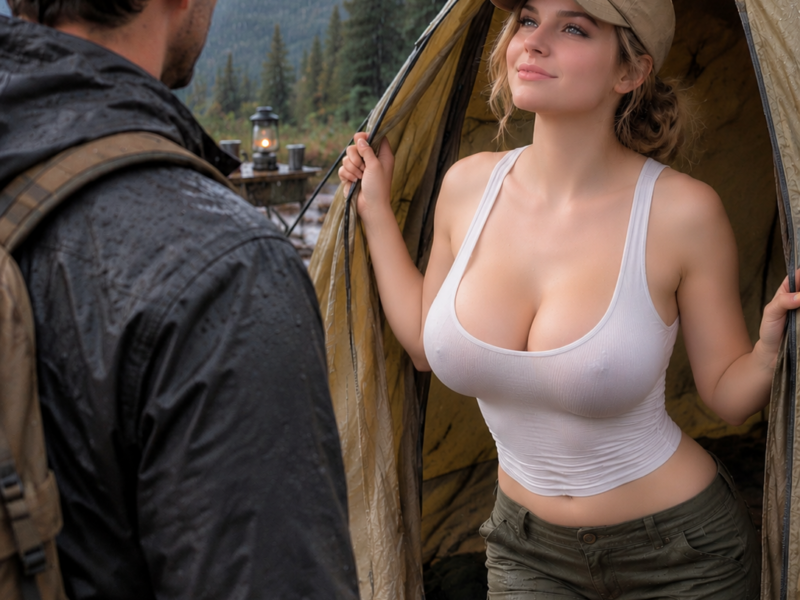
The Storm Took My Tent—She Said, “Stay in Mine.” I Said, “Only If You Promise Not to Regret It.”
My Tent Was Ripped Apart by a Violent Mountain Storm, and the Only Person Who Could Help Was Claire, a Brilliant Scientist Whose Career Was Being Sabotaged by Her Own Dean. She Looked at My Wrecked Shelter and Said, “Stay in Mine.” I Warned Her, “Only If You Promise Not to Regret It.” But After Seven Days Trapped Together, We Discovered Her Boss Had Put Far More Than Her Research at Risk—and When We Finally Returned, I Had Evidence That Could Destroy His Entire Story.
Part 1
The first aluminum pole snapped like a gunshot.
I barely had time to turn my head before the wind caught the side of my observation tent and ripped it open. The reinforced fabric split down the center seam, sending a sheet of rainwater and nylon flying across the clearing. One moment, I was standing inside a shelter that had survived three seasons of mountain storms. The next, I was watching it collapse into the mud as if it had never been built to withstand anything.
The barometric pressure had dropped twelve millibars in less than twenty minutes. I had checked the forecast that morning, reviewed the satellite imagery, and run my models twice. Every indication suggested a powerful weather front approaching the mountain, but none of my calculations had predicted this kind of violence.
The sky had turned almost black. Wind screamed through the trees, bending their upper branches until they looked ready to break. Rain struck the ground so hard that water bounced off the muddy surface.
I dropped to one knee, tightened the waterproof equipment case strapped against my chest, and shoved two backup drives into the dry bag attached to my hip.
My autonomous data loggers were anchored beneath a granite outcrop about twenty yards behind me. They were designed to operate independently, recording atmospheric pressure, wind speed, temperature, and humidity even when nobody was nearby.
At least that part of my research was safe.
My shelter, however, was gone.
I had spent three years building a mountain pressure model that could predict dangerous atmospheric shifts before conventional forecasting systems detected them. This storm was supposed to be my final opportunity to collect the data needed for a major research grant. If the instruments survived and I could retrieve the recordings, I might finally secure another year of funding.
If they didn’t, I would probably have to abandon the project.
But before I could think about my own situation, I heard another violent snap behind me.
Across the clearing, Claire Thomas was fighting to keep her research tent standing.
She was the lead botanical researcher on our mountain expedition, a university scientist who had spent ten years studying how alpine plants adapted to extreme elevations. Her research involved living specimens collected from different sections of the mountain, and the hard-sided containers inside her tent held samples that could not simply be replaced.
I knew how much depended on those containers.
I also knew that Dr. Aris, the dean overseeing her research department, had been looking for an excuse to shut her project down.
For months, he had argued that her field methodology was too expensive, too complicated, and too dependent on unpredictable environmental conditions. He wanted her funding transferred into laboratory research, where results could be controlled and budgets could be justified more easily.
Claire had refused to cooperate.
Her research was built around studying plants in their natural environments, not recreating mountain conditions inside a university building.
If she lost those specimens, Aris would have everything he needed to declare her project unsuccessful.
And he would probably make sure everyone knew it.
Her tent was positioned closer to the tree line than mine had been, which gave it some protection. Unfortunately, one of its northern guy lines had slipped loose. Every gust pushed the fabric inward, threatening to collapse the entire structure.
Claire stood outside in a soaked rain jacket, one arm pressed against several specimen cases.
Her tan field cap was pulled low, and her fingers were wrapped around the containers with such force that her gloves had begun to crease.
I ran toward her.
“North corner!” I shouted. “Your line is slipping!”
She looked up.
“The mud won’t hold the stake!”
“It will if we triangulate it!”
I dropped my equipment pack beside a flat rock and pulled a steel peg and mallet from its side compartment. The first peg disappeared halfway into the mud before catching against something solid.
I drove another one farther down the slope.
Then I pulled military-grade paracord from my emergency kit, threaded it through the tent’s exposed support ring, and secured it around the thick root of a Douglas fir.
Claire watched what I was doing.
She didn’t waste time asking questions or arguing about my approach. She immediately understood the arrangement and moved the specimen containers behind the natural windbreak.
“Give me the loose line!” I shouted.
She handed it over.
Our gloves touched briefly, but neither of us paid attention.
We had more important things to worry about.
I tied a clove hitch, tightened the cord, and drove a third stake behind the tree root. The tent shuddered under another gust, its fabric stretching until I thought the seams would tear.
Then, gradually, the structure settled into a lower position.
The wind still battered it, but the main support held.
“Inside!” I shouted.
Claire grabbed two specimen cases. I lifted the third and followed her through the entrance.
The difference was immediate.
Outside, the storm sounded like an approaching freight train. Inside, it became a relentless drumming against the nylon roof.
The air smelled of damp soil, pine resin, cold fabric, and the faint chemical scent of the preservation materials stored in sealed containers.
A small LED lantern swung from the center pole. Waterproof notebooks were stacked inside a storage bin, and a tarp divider separated the back section from the main sleeping area.
Claire placed the specimen cases on a foam pad and checked every latch.
Only after confirming that nothing had broken did she look at me.
Her eyes moved toward my soaked jacket.
“Your tent?”
“Technically, it used to be a tent.”
She glanced through the entrance at the wreckage.
“That’s unfortunate.”
“I’ve had better evenings.”
“The fire road?”
“Probably flooding already. The lower ranger station is four hours away in good weather.”
She looked at the rain.
“Longer now.”
I nodded.
For several seconds, neither of us spoke.
The situation was obvious. My shelter was destroyed, the mountain road was becoming dangerous, and the nearest permanent structure was too far away to reach safely.
Claire looked at the limited floor space between the specimen containers, equipment boxes, and two sleeping pads.
Then she made a decision.
“Stay in mine.”
I looked at her.
“Are you sure?”
“It’s the only intact shelter. We have enough room if we reorganize the equipment.”
“Only if you promise not to regret it.”
She raised an eyebrow.
“I wake up every few hours to check pressure metrics. My equipment stays dry. I don’t cross the divider. If either of us becomes uncomfortable, we discuss it.”
“Reasonable.”
“And don’t step on the alpine moss incubators.”
“I’ll try to restrain myself.”
“Good.”
She pointed toward the left side of the tent.
“You take that side. I’ll change behind the divider.”
I turned toward my equipment bag while she disappeared behind the tarp.
There was no awkwardness, no unnecessary conversation, and certainly no reason to make a difficult situation more complicated.
When she returned, she wore a dry field fleece over a thermal base layer. Her wet jacket and boots were arranged near the entrance.
She sat beside the specimen cases and opened a waterproof notebook.
“You’re Ethan Scott, aren’t you?”
“Depends who’s asking.”
“Claire Thomas. Apparently, I’m sharing my tent with a meteorologist who has been annoying everyone on the radio for three days.”
I laughed.
“Mark talks too much.”
“Mark keeps this entire camp functioning.”
“That’s also true.”
She returned to her notes.
I opened my tablet and checked the offline topographic map. The information was worse than I expected. Soil saturation along the southern slope had already reached ninety percent before noon.
“If this rainfall continues for another hour,” I said, “the lower road will become a debris-flow channel.”
Claire stopped writing.
“Aris ordered me down that road this morning.”
I looked at her.
“He ordered you to descend now?”
“He ordered me to reach the checkpoint by tomorrow morning. He also canceled my helicopter extraction.”
“Why?”
“Budget concerns, apparently.”
She said it without emotion, but the pencil in her hand was pressing hard enough to leave marks on the page beneath her notebook.
“He knows the road is dangerous?”
“I sent him the latest terrain assessment yesterday.”
“Then why would he insist?”
“Because if I miss the checkpoint, he can file a safety violation and freeze my field account.”
I studied the map.
It was becoming increasingly difficult to believe that her situation was simply an administrative disagreement.
“Why not leave the samples and save yourself?” I asked.
Claire looked at the specimen containers.
“They’re living high-altitude specimens under thermal stress. If they’re unattended for more than forty-eight hours, the adaptation markers begin to degrade. Ten years of work could become useless.”
I understood.
She wasn’t refusing to leave because she was stubborn.
She was trying to preserve something that could not easily be recreated.
I turned the tablet toward her.
“Then we don’t take the fire road.”
She leaned closer to examine the map.
“We hold here tonight. The weather models show a possible lull on day three, long enough to reach the granite ridge. The old survey trail above the southern slope should remain passable, assuming the ground doesn’t shift too badly.”
“And after that?”
“There’s a forestry cabin beyond the ridge. It has an emergency radio repeater and a lockbox. If we reach it, we can contact Mark and arrange extraction through the northern service road.”
“How long?”
“Seven days, if the weather cooperates.”
She stared at the map for several seconds.
“And your equipment?”
“My loggers are autonomous. They’ll keep recording. I can retrieve the data later.”
“Your grant depends on that data.”
“It does.”
“Then why are you helping me?”
I looked at the specimen containers.
“Because your samples need someone to keep them alive. My instruments can work without me.”
For the first time, her expression softened.
She didn’t thank me.
Instead, she pointed toward the ridge.
“Show me the safest route.”
That was how the next two hours passed.
We divided our food into seven days of emergency rations. Claire calculated the temperature requirements for every specimen container, while I marked possible hazards along the route.
We recorded the available supplies, checked the battery reserves, and established a schedule for monitoring the storm.
By midnight, the wind had shifted northwest.
The tent wall bowed inward.
I looked toward the support lines.
“The paracord is holding,” I said. “The ground might not.”
Claire immediately stood.
“I’m coming with you.”
“No.”
Her eyes narrowed.
“That’s not a request.”
“Someone needs to stay inside and make sure the specimen cases don’t slide toward the wet side if the tent shifts.”
She considered that.
“I can check the floor seam.”
“Exactly.”
“Four minutes.”
“Five.”
“Four.”
“Deal.”
I pulled on my gloves and crawled outside.
The rain struck my face like gravel. My headlamp illuminated the paracord, which was vibrating under the force of the wind.
The first anchor was secure.
The second had loosened by almost half an inch.
I drove it deeper, added another cord, and created a triangular support using two spare stakes.
Mud pulled at my boots.
Water ran down my sleeves.
By the time I crawled back inside, my hands were stiff with cold.
Claire had moved my sleeping pad closer to the small heater, carefully keeping it on my side of the tent.
She handed me a towel.
“Four minutes and forty seconds.”
“I negotiated with a rock.”
“Did it win?”
“It compromised.”
A small smile appeared on her face.
It was the first time I had seen her smile since the storm began.
And strangely, it made the cramped shelter feel a little less like an emergency.
I didn’t know then that we would spend the next seven days relying on each other in ways neither of us had anticipated.
I only knew that my tent was gone, her research was still alive, and the mountain outside was preparing to become even more dangerous.
Part 2
By morning, the clearing looked as though the mountain had rearranged it by force. My destroyed tent was wrapped around a stump twenty yards downhill, and the fire road had become a moving ribbon of brown water.
Day two was about survival, not progress.
We checked the specimen temperatures every three hours and monitored the support lines while Mark’s radio transmissions came through in broken bursts.
When Dr. Aris attempted to label Claire’s delayed evacuation as non-compliance, she calmly recorded her objections. I added the rainfall measurements and road conditions to the incident log.
That afternoon, we briefly inspected the clearing. Claire rescued a patch of alpine moss with a plastic spoon while I checked the wind readings.
“You’re documenting moss during a landslide watch?” I asked.
“I’m documenting its stress response.”
“With a spoon?”
“It’s a precise spoon.”
I laughed.
For a moment, we almost forgot the storm.
But at 6:12 the following morning, a deep crack echoed through the valley.
The lower mountain slope began moving.
Within seconds, the fire road disappeared beneath a massive surge of mud, rock, and uprooted trees.
Claire stood beside me, holding the radio.
Then Dr. Aris’s voice cut through the static.
“Thomas, you missed the checkpoint. I’m officially recording your team as non-compliant.”
Claire stared at the destroyed road.
“The route you ordered us to take just collapsed.”
“That will be reviewed after you return.”
I reached for the radio.
“Dr. Aris, this is Ethan Scott. I’m recording this transmission. And before you make another decision about her career, you should know that I have the weather data proving exactly when that road became unsafe.”
The radio went silent.
Then Aris answered with a single sentence.
“Ensure those samples arrive intact.”
I looked at Claire.
He hadn’t asked whether we were alive.
He hadn’t asked how we would get out.
He only cared about the samples.
And that was when I realized the real danger might not be the mountain.
Part 3
The silence after Dr. Aris’s transmission lasted longer than I expected.
Claire stood motionless, looking toward the enormous scar the landslide had carved across the southern slope. The fire road had disappeared beneath a chaotic mixture of mud, boulders, broken trees, and rushing water.
A route that had taken years to establish for forestry vehicles and research teams was now nothing more than a brown channel cutting through the mountain.
I lowered the radio.
“He wanted the road to fail after you committed to it,” I said.
Claire slowly turned toward me.
“He knew?”
“I can’t prove what he knew. But he had your safety assessment. He had the rainfall readings. He had every reason to understand the danger.”
“And he still ordered me down.”
“Yes.”
She looked at the radio in her hands.
“He almost got what he wanted.”
I shook my head.
“No. He got recorded.”
I opened my tablet and saved the transmission time, the pressure measurements, and the latest soil saturation data. My instruments had recorded the entire storm, including the atmospheric conditions that preceded the slope failure.
For the first time, we had something more useful than an argument.
We had evidence.
Claire looked at the tablet.
“Will it be enough?”
“It should be. But we need to get back with the samples before anyone has the opportunity to rewrite the incident.”
She nodded.
Then she checked the specimen cases.
Every container remained sealed. The temperature packs were functioning, although the reserve margin was becoming smaller.
“We should move when the rain slows,” she said.
“Agreed.”
Neither of us mentioned how difficult the journey would be.
We packed what we could carry and left the clearing shortly after the rain weakened. The ridge trail was worse than the map suggested. Mud covered the narrow path, pine needles concealed loose stones, and water flowed across several sections of exposed ground.
I carried the heaviest specimen case on my pack frame.
Claire immediately objected.
“My equipment is my responsibility.”
“Your left shoulder is tightening.”
“It’s fine.”
“You’ve been shifting the strap away from that side for two days.”
She gave me a look that could have cut through the nylon of my jacket.
“I don’t need you taking over.”
“I’m not taking over. I’m moving weight so you can keep walking.”
She remained silent for a moment.
Then she adjusted the lighter case on her pack.
“I dislike how reasonable that sounds.”
“I practice.”
The first mile took nearly two hours.
Every step required concentration. Mud pulled at our boots, branches struck our shoulders, and the slope occasionally shifted beneath the weight of our packs.
Twice, I stopped to compare the terrain with the topographic map.
The third time, Claire caught my sleeve.
“Don’t step there.”
I looked down.
A thin black crack ran beneath the wet pine needles. It was almost invisible from where I stood.
I used my trekking pole to test the soil.
The ground beyond the crack crumbled and slid six feet downhill into the brush.
“Good eye,” I said.
“Plants teach you to notice the ground before the sky.”
“I watch the sky before the ground.”
“That explains why we make a functional team.”
She marked the hazard on the waterproof map with a red pencil.
I watched her for a moment.
Claire was not someone who needed to be rescued from incompetence. She was an experienced scientist who understood her environment and could recognize dangers I might overlook.
What she needed was someone willing to respect her expertise.
I had spent years working alone because I believed collaboration introduced too many variables. People had their own schedules, their own priorities, and their own expectations.
On that mountain, I was beginning to understand that the right person didn’t make the work more complicated.
Sometimes, the right person made survival possible.
By late afternoon, sleet began falling.
We had not reached the granite ridge, and the temperature was dropping faster than my models had predicted.
I checked the barometer.
The secondary weather front had arrived early.
“We need shelter.”
Claire looked at the exposed rocks ahead.
“How far to the overhang?”
“About half a mile.”
“Can we reach it?”
“Yes, but slowly.”
We continued until we found a natural stone formation that extended far enough over the slope to provide some protection.
It wasn’t a comfortable shelter, but it was better than remaining exposed.
I secured a tarp between two rocks while Claire arranged the specimen cases away from the ground.
She checked each temperature pack and recorded the readings.
Then she looked at me.
“Forty hours.”
“Until what?”
“Until the current cold packs begin losing their effectiveness. I might stretch that to fifty-six if I can improve the insulation.”
I glanced at the cases.
“What do you need?”
“Something that can protect them from the cold underneath.”
I looked at my foam sleeping pad.
“No,” she said immediately.
“I haven’t said anything.”
“You were about to.”
“The samples need stable temperatures.”
“So do you.”
“I’ll manage.”
“Ethan, your equipment matters, too. Your grant depends on those measurements.”
“My instruments are recording.”
“Your data still matters.”
I understood her argument.
I also knew that the living specimens had a limited window.
I handed her the sleeping pad.
She stared at it.
Then, without another argument, she took out her field knife and cut the foam into several fitted pieces.
Within minutes, she had created an insulating layer around the specimen containers.
She worked carefully, checking every corner and ensuring that the cases remained secure.
When she finally closed the last latch, she looked at me.
“Thank you.”
“You improved the design.”
“You donated the material.”
“Team effort.”
She nodded.
“Team effort.”
The temperature continued dropping.
By evening, the overhang was surrounded by darkness. Sleet clicked against the tarp, and the wind found its way through every opening.
Without my sleeping pad, the cold rock carried the mountain’s temperature directly into my back.
I slept in short intervals.
Every time the tarp snapped, I woke up and checked the equipment.
By the fourth interruption, Claire noticed.
She reached into her pack and tossed me a folded blanket.
“It’s clean.”
I looked at it.
“You’re using that for the samples.”
“Not anymore. I rearranged the insulation after you gave up your pad. There’s enough margin.”
“I can manage.”
“Ethan.”
I looked across the dark shelter.
She pointed at the blanket.
“Take it. I need you able to walk tomorrow.”
I accepted it.
“Team effort?”
She smiled faintly.
“Field tyranny.”
I unfolded the blanket and tucked it beneath my shoulders.
For a while, neither of us spoke.
The wind continued moving across the mountain, and the temperature kept falling. I could hear Claire checking the thermometer every few minutes.
Eventually, she sat back against her pack.
“Do you ever wonder what happens if we don’t make it?” she asked.
I considered the question.
“I wonder what happens if we make decisions based on fear instead of evidence.”
“That’s not an answer.”
“It’s the one I have.”
She looked toward the dark entrance.
“Ten years,” she said quietly. “That’s how long I’ve worked on this project. Sometimes I think everyone else sees only the budget.”
I remained silent.
“They see expensive equipment, travel costs, specimen containers, and unpredictable results. They don’t see what we’re learning. They don’t understand that these plants are responding to environmental changes that could tell us something important about the future of alpine ecosystems.”
“Then make sure they have to look at the evidence.”
She turned toward me.
“You really believe that?”
“I wouldn’t have spent three years building a weather model if I didn’t.”
For a moment, her expression changed.
Then she closed her notebook.
“Get some sleep, Ethan.”
I did.
Not much, but enough.
The next morning, the sky was clear.
It was the kind of bright, beautiful morning that made the mountain look harmless. Sunlight reflected off wet granite, and the trees glistened with melting sleet.
But I knew better.
Clear skies did not mean safe conditions.
We packed everything and began climbing toward the ridge.
The trail became steeper, and the specimen cases grew heavier with every mile. I adjusted the straps on my pack while Claire checked the map.
She was walking more slowly now.
I noticed the way she protected her left shoulder, but I didn’t mention it.
Instead, I offered to switch the position of the equipment.
She accepted without argument.
That small decision told me more about trust than any conversation could have.
By midday, we reached the first exposed section of granite.
I tested every foothold before moving forward. Claire followed, copying my movements carefully.
Once, she slipped on a patch of black lichen.
Her hand caught my forearm.
I planted both boots and held steady until she regained her balance.
As soon as she was secure, I released her.
She looked at me.
“You make restraint look exhausting.”
“It is a field skill.”
“Not one I’ve seen in a meteorology manual.”
“It should be.”
She laughed.
And for the first time since leaving the clearing, I felt something other than exhaustion.
We were still in danger.
The specimens were still vulnerable.
Aris was still waiting for us to fail.
But we were making progress.
Then my handheld barometer began dropping.
Not dramatically.
Just enough to make me stop walking.
I looked toward the western ridge.
A gray shelf cloud was forming beyond the far mountains. Its underside was unusually flat, and a faint greenish tint had appeared along the horizon.
Hail aloft.
Possible sudden downdraft.
I checked the readings again.
Claire saw my expression.
“How bad?”
“Not lethal if we move now.”
“And if we stay?”
“Very bad.”
“How long?”
“Two hours before the gust front reaches us. Maybe less.”
She looked toward the specimen cases, then at the narrow trail ahead.
“Can we reach the tree line?”
“Yes.”
“Then stop calculating out loud and walk.”
I almost smiled.
“Yes, Doctor.”
We moved immediately.
Behind us, the storm was building.
And ahead of us, the mountain offered only one narrow route toward safety.
Part 4
The storm followed us across the granite ridge like a closing door.
We moved as quickly as the terrain allowed, but speed was dangerous. The exposed rock was slick, and several sections of the trail had disappeared beneath old snow caught in the shadows.
I used my trekking pole to test each foothold.
Claire followed closely, keeping the specimen containers balanced against her back.
Every few minutes, I checked the barometer.
The readings were getting worse.
Thunder rolled across the valley.
Claire glanced over her shoulder.
“Do storms ever scare you?”
“Yes.”
She looked surprised.
“You say that very calmly.”
“Fear is data. Panic is noise.”
She considered the answer while stepping over a fallen branch.
“What do you do with the data?”
“Adjust the route.”
Another thunderclap echoed across the mountain.
This time, she didn’t look back.
We reached the tree line just as the first violent gust struck the ridge.
The trees bent under the wind, and loose branches scattered across the trail.
I pulled the map from my jacket and checked our position.
We had made it past the most exposed section, but the remaining distance to the cabin was longer than I wanted.
“How much farther?” Claire asked.
“Three miles, perhaps four.”
“That’s manageable.”
“Assuming the trail is still there.”
“You’re becoming very optimistic.”
“I’m trying something new.”
She laughed, then adjusted the strap on her pack.
We continued through the trees.
The weather deteriorated rapidly. Rain returned, and the wind drove it sideways through the forest. Several times, we had to stop while I checked the slope for fresh cracks or signs of movement.
Claire was equally alert.
She noticed changes in vegetation, disturbed soil, and small areas where water had begun flowing in new channels.
At one point, she stopped beside a patch of alpine growth.
“Look.”
I followed her gaze.
A group of small plants had survived beneath a layer of wet leaves and debris.
Their stems were bent, but several leaves remained intact.
“Interesting,” I said.
“Very.”
“You want to document them now?”
“I want to remember where they are.”
She made a note on the map.
“North-facing slope. Partial protection from wind. Fresh lateral growth.”
I shook my head.
“You’re going to study plants even if the mountain falls apart.”
“Someone has to.”
That answer stayed with me.
I had always thought of research as something measured in instruments, equations, and data sets. Claire approached it differently. She saw living systems in every patch of ground, every broken stem, and every change in color.
She wasn’t simply collecting samples.
She was trying to understand how life adapted when the environment became hostile.
And perhaps that was why I respected her so much.
We reached a narrow stream shortly before sunset.
The water was higher than it should have been, and the usual crossing had disappeared beneath a fast-moving current.
I searched for another route.
“There’s a fallen tree upstream,” Claire said.
I looked where she was pointing.
A thick trunk had fallen across the stream, creating a natural bridge.
“Good.”
“I’ll go first.”
“Not with the specimen case.”
She frowned.
“I can manage.”
“I know you can. But if you slip, we lose more than your balance.”
She considered that, then handed me the case.
I crossed first and secured the equipment on the opposite bank.
Claire followed carefully.
Halfway across, the trunk shifted.
She froze.
“Don’t move,” I called.
“I wasn’t planning to.”
I reached out and offered my hand.
She took it.
For a moment, the rushing water below us seemed louder than the storm above.
Then she stepped onto solid ground.
I released her hand as soon as she was safe.
“Thank you.”
“You’re welcome.”
She looked at the stream.
“That was unpleasant.”
“I’ll add it to the route assessment.”
“Please do.”
We continued until the forest opened into a small clearing.
And there, through the trees, we finally saw the cabin.
It was built from heavy logs, with a metal roof and a single small window overlooking the slope.
A narrow porch extended along the front.
The building looked abandoned, but I knew it was maintained by the Forestry Service for emergency use.
I found the metal lockbox beneath the porch rail.
My weather-monitoring permit included access to the emergency facilities, and I entered the assigned code.
The lock clicked.
I opened the door.
The cabin was cold, dusty, and completely dry.
Dry was all that mattered.
I placed my pack beside the door and started the wood stove.
My hands were shaking from exhaustion, and the first match broke before it caught.
The second one worked.
Flame climbed through the kindling, and smoke pulled cleanly through the chimney.
Claire placed the specimen cases on the table.
“They made it this far,” she said.
“Yes.”
She looked at the containers.
“We made it this far.”
I nodded.
“Yes, we did.”
I took a dry field fleece from my pack and placed it on a chair near her.
“The back room has a privacy curtain. You can change out of your wet outer layer while I contact Mark.”
She picked up the fleece.
Then she paused.
“Ethan.”
I turned.
“You’ve kept every boundary you named.”
I looked at her.
“I said I would.”
“Most people say things when conditions are easy.”
I understood what she meant.
We had spent nearly a week sharing a confined shelter, enduring exhaustion, cold, and fear. There had been countless opportunities for someone to take advantage of the situation.
Neither of us had.
I turned toward the radio desk.
“Then we keep conditions documented.”
She smiled.
I activated the cabin radio and searched through the available frequencies.
The first two channels produced nothing but static.
The third came alive.
“Ethan?”
Mark’s voice sounded so loud that the speaker distorted.
“Claire? Tell me that’s you.”
“It’s us,” I answered. “Cabin repeater active. Specimens viable.”
There was a pause.
Then Mark practically shouted.
“You have no idea how long I’ve been trying to reach you.”
“We’re safe for now.”
“Where exactly?”
I gave him our coordinates and confirmed that the northern service road appeared accessible.
“We need extraction tomorrow,” I said. “The specimens have limited temperature reserves.”
“Understood. I’ll arrange the tracked vehicle.”
Claire moved closer to the microphone.
“Mark, I need something else.”
“Anything.”
“Log the fact that Dr. Aris ordered our descent through a route that failed. Ethan has the saturation data. I have the specimen temperature records. We need the university board copied before Aris has an opportunity to change the official report.”
Mark was silent for a moment.
Then his voice returned.
“Already started.”
Claire closed her eyes.
“What?”
“I have the mudslide timestamp from Ranger Dispatch. I also have the radio transmission summaries. The incident file is being prepared.”
“Are you sure?”
“Yes. And I’m meeting you at extraction with the paperwork.”
Claire leaned against the table.
For the first time in seven days, she looked genuinely relieved.
We spent the final night in the cabin.
The wood stove gradually warmed the room, and the wet clothes hanging nearby began to dry.
I positioned our boots at a safe distance from the fire, careful not to damage the soles.
Claire cleaned the specimen containers and arranged them according to temperature priority.
Once everything was secure, she opened her notebook.
“You’re still writing?” I asked.
“If I wait until base camp, I’ll forget the field conditions.”
“You nearly fell off a ridge today.”
“And the moss on the northern face showed fresh lateral growth despite ice exposure.”
“Of course it did.”
She glanced up.
“That sounded almost fond.”
“Scientific admiration. Very clinical.”
She smiled and returned to her notes.
I sat at the radio desk and copied my pressure readings into the field log.
The pencil moved across the paper.
The stove popped.
Wind pressed against the cabin walls but couldn’t get inside.
For years, I had treated solitude as a form of protection.
I traveled alone, worked alone, and returned to empty rooms after every expedition. I told myself that independence made the work easier.
No one depended on me.
No one could disappoint me.
No one could ask me to explain why I spent months chasing weather systems across mountains.
But sitting in that cabin, listening to Claire write about alpine moss while my data sheets dried beside her specimen charts, I realized that silence could mean something different.
It didn’t always mean emptiness.
Sometimes it meant that someone was there, working beside you without demanding anything in return.
I looked toward the table.
Claire was concentrating on her notebook, her hair still slightly damp, her expression serious.
She looked exhausted.
But she was still protecting her research.
I added one more line to my field log.
22:30. Cabin secure. Samples viable. Team stable.
Then I closed the notebook.
The following morning, we would have to face Aris.
And for the first time, I suspected that the most difficult part of our journey might happen after we reached safety.
Part 5
The tracked vehicle arrived shortly after sunrise.
The storm had finally moved east, leaving the mountain washed clean beneath a hard blue sky. Pines dripped steadily, and the northern service road was rough but passable.
Mark stood beside the vehicle wearing a bright red field jacket.
He was waving both arms as if he were trying to direct an aircraft toward an emergency landing.
When he saw us stepping out of the cabin, he started laughing.
“You two look terrible!”
Claire adjusted the specimen case in her hands.
“Good morning to you, too.”
“I’ve been worrying about you for seven days. I think I’m entitled to an opinion.”
“Your opinion is noted.”
Mark turned toward me.
“And you look worse.”
“Thank you.”
“You’re welcome.”
I loaded the heaviest specimen case into the tracked vehicle and secured it with two straps.
Mark handed me a sealed folder.
“Incident log. Ranger dispatch. Radio transmission summaries. Everything we could collect.”
I looked at the folder.
“The university board?”
“Waiting at base camp.”
Claire glanced toward him.
“How quickly did Aris respond?”
Mark shrugged.
“Quickly enough to make several phone calls. Apparently, he wants the entire situation handled privately.”
Claire’s expression hardened.
“Of course he does.”
“Don’t worry. The ethics office has already received the preliminary report.”
We climbed into the vehicle.
The ride back was uncomfortable, but neither of us complained.
For the first time in a week, we were moving toward a place where people could help us rather than away from one where the mountain was trying to kill us.
When we reached base camp, Dr. Aris was standing near the command tent.
Two university board members stood beside him, along with a ranger supervisor.
Aris looked exactly as I expected.
He wore a clean jacket, polished boots, and the expression of someone who had prepared a statement but hadn’t expected to need it.
He had probably assumed Claire would return late, injured, or without her samples.
Instead, she stepped out of the vehicle carrying the lead specimen case.
I followed with my weather logs and pressure data.
Aris immediately approached her.
“Dr. Thomas. I’m glad you’re safe. Let me take that case.”
Claire shifted it out of his reach.
“Do not touch my research.”
The entire group fell silent.
Aris forced a thin smile.
“I think we should discuss this privately.”
“No.”
Her voice was calm.
“The field account was frozen publicly. The safety violation was recorded publicly. The correction can be public, too.”
Mark stepped forward and handed the incident folder to one of the board members.
I opened my tablet.
The pressure readings appeared on the screen.
I displayed the atmospheric collapse, the soil saturation curve, and the projection showing the increasing risk of a debris flow.
“The fire road was unsafe before the evacuation deadline,” I explained. “Our measurements show that the slope had already reached critical saturation levels. The road failed at 06:12 on the third morning.”
I brought up the recording of the radio transmission.
“Dr. Thomas refused to enter a dangerous route and preserved the specimens. Her decision prevented a potential fatal accident.”
The ranger supervisor examined the readings.
He nodded slowly.
“We closed that road after the slide. If they had been on it, we would probably be discussing a recovery operation instead of a compliance issue.”
Aris said nothing.
Claire placed the specimen case on the table.
“The samples are viable. The temperature records are intact. My methodology has not failed.”
She opened the case and showed the board members the carefully arranged containers.
“I am formally requesting immediate reinstatement of my field account, removal of the non-compliance notation, and an independent ethics review of Dr. Aris’s evacuation order.”
One board member examined the temperature records.
The other looked toward Aris.
“We’ll take this under review today.”
“Today,” Claire repeated.
“Yes. Today.”
The meeting continued for almost two hours.
Aris attempted to explain that his decision had been based on university safety procedures and budget limitations.
Claire presented the messages in which she had warned him about the road conditions.
I supplied the atmospheric data.
Mark produced the ranger dispatch records.
Every time Aris attempted to describe the evacuation order as reasonable, another piece of evidence contradicted him.
Eventually, he stopped speaking.
By late afternoon, the university board announced its preliminary decision.
Claire’s field account was unfrozen pending formal review.
The non-compliance notation was suspended.
Aris was removed from direct authority over the alpine research project until the ethics investigation was completed.
My weather data was accepted as supporting evidence for the university incident report and my grant application.
It wasn’t a perfect victory.
But it was a real one.
Claire had saved ten years of research.
And Aris could no longer quietly turn her survival into an administrative failure.
I found her near the transport vehicles shortly afterward.
She was holding a new folder.
Not a specimen case.
Not an incident report.
A grant amendment.
“Mark witnessed this,” she said.
I opened it.
The university had approved a temporary consulting arrangement that would allow me to support the alpine research project.
My role would be documented as meteorological logistics consultant, with responsibility for weather monitoring, route assessments, and field safety.
The agreement included a separate payment structure and clearly defined responsibilities.
No personal favors.
No informal arrangements.
No blurred professional boundaries.
I looked at her.
“You prepared this?”
“I did.”
“Before asking me?”
“Of course.”
I smiled.
She had spent seven days proving that she understood boundaries, and now she was making sure the next stage of our relationship began with the same honesty.
“What are you asking now?” I said.
Claire looked toward the mountains.
The ridge was still partially hidden beneath clouds, but the worst of the storm had moved east.
“Dinner.”
I raised an eyebrow.
“That’s the proposal?”
“At base camp tonight. Mark is making something he calls stew.”
“Should I be concerned?”
“Probably.”
She smiled.
“You can say no. The grant amendment remains exactly as written.”
I looked at the folder.
Then I looked at her.
The woman standing in front of me had carried ten years of research through seven days of violent weather. She had protected her work without surrendering her independence, challenged someone who had tried to destroy her career, and somehow still found time to make sure my contribution was recognized fairly.
“No regret clause?” I asked.
Her smile appeared slowly.
“Only if you promise not to insult Mark’s cooking before tasting it.”
“That’s a difficult promise.”
“I know.”
From inside the command tent, Mark shouted.
“If you two are done making contract law romantic, the stew is getting cold!”
Claire laughed.
I picked up the heavier duffel beside her boot.
She raised one eyebrow.
“Moving weight?”
“So you can keep walking.”
This time, she didn’t argue.
We walked toward the command tent together.
The air smelled of wet pine, diesel, wood smoke, and something that might have been food if a person believed hard enough.
Inside, Mark had placed three enamel bowls on a folding table beside a stack of incident reports.
The stew was too thick, too salty, and strangely satisfying after seven days of cold rain.
Claire took one bite and looked at me.
I swallowed carefully.
“It has structural integrity.”
Mark pointed his spoon at me.
“That’s the nicest thing you’ve ever said about my cooking.”
Claire laughed again.
And this time, I didn’t look away.
After dinner, we stepped outside.
The final strip of sunlight was disappearing behind the ridge. The sky had turned deep blue, and the first stars were beginning to appear.
Claire held the grant amendment against her chest.
“Tomorrow I go back to the university,” she said. “Then I’ll return for the specimens and the remaining field records once the access route opens.”
“Planning to disappear into the next storm?”
She looked at me.
“The alpine project still needs a meteorological logistics consultant.”
“Does it?”
“It does.”
“Then I’ll submit a schedule.”
“A schedule?”
“Storms require planning.”
She smiled.
“So does dinner.”
I turned toward her.
“Another dinner?”
“When the final review clears.”
“In town?”
“Yes.”
“No emergency rations?”
“No emergency rations.”
“No weatherproof stew?”
“Absolutely not.”
“And no grant paperwork on the table?”
She considered that.
“That might be negotiable.”
I laughed.
Then the conversation became quieter.
The wind moved gently through the trees. Somewhere behind us, Mark was arguing with the printer because it had jammed on the second page of the ethics report.
Claire looked toward the mountain.
“Do you know what I kept thinking about during the storm?”
“What?”
“That I might never get another chance to finish the research. That everything I’d worked for could disappear because someone who had never stepped onto that mountain decided it wasn’t worth the money.”
I listened.
“But then you showed up,” she continued. “You lost your own shelter, your own equipment, and probably part of your grant opportunity. Yet you still helped me save the specimens.”
I shook my head.
“Your samples needed someone. My instruments were doing their job.”
“That’s not what I mean.”
She turned toward me.
“You could have left me to deal with the tent. You could have taken the safe route away from the mountain. You didn’t have to make my problem yours.”
I looked at the ridge.
“Maybe I was tired of watching people treat everything as a competition. Your research mattered. Mine mattered. Neither had to disappear for the other to survive.”
She remained quiet.
Then she smiled.
“That’s a good answer.”
“It’s the only one I’ve got.”
For a moment, neither of us moved.
I thought about the first night in her tent, when she had offered me a place to sleep because there was no other practical option.
I remembered the clear boundary she had established, the way she had protected her research, and the countless small decisions that had allowed us to survive.
I remembered the blanket she had given me beneath the stone overhang.
The sleeping pad I had surrendered.
The specimen cases we had carried across the ridge.
None of those moments had been dramatic.
They had simply been decisions made by two people who understood that protecting someone didn’t mean taking control of their life.
Claire adjusted the folder beneath her arm.
“I should help Mark with the printer.”
“Of course.”
She took two steps toward the tent, then turned back.
“Ethan?”
“Yes?”
“Don’t disappear into another storm before we have dinner.”
I smiled.
“I’ll check the forecast.”
“That’s not a promise.”
“Then I promise.”
She nodded.
“Good.”
She disappeared inside the command tent.
I remained outside for another minute.
The pressure loggers were safe beneath the granite outcrop. Her specimens were alive. The university had finally begun investigating the decisions that had put her in danger.
And for the first time in years, the silence around weather didn’t feel empty.
It felt like the pause before someone called my name and expected me to answer.
I looked toward the ridge where the storm had nearly taken everything.
Seven days earlier, I had lost my tent and believed the most important thing I could save was my research.
By the time I returned, I understood something I hadn’t expected to learn.
Research could be recovered.
Equipment could be replaced.
Grants could be renewed.
But trust was different.
It was built through small decisions, especially when conditions were difficult. It was built when someone respected your boundaries even when circumstances made it inconvenient. It was built when help came without strings attached, when protection didn’t become control, and when neither person had to become smaller for the other to succeed.
I had gone into that mountain believing that surviving alone was the safest way to live.
I came back understanding that independence and connection were not opposites.
Sometimes, the strongest person in the room was the one who knew when to offer a hand and when to let go.
Inside the tent, Claire was laughing at something Mark had said.
The printer started working again.
I picked up my remaining equipment bag and walked toward the warm light.
The storm had taken my tent.
But the woman who offered me hers had given me something I hadn’t realized I’d been missing.
And this time, I had no intention of disappearing when the weather cleared.