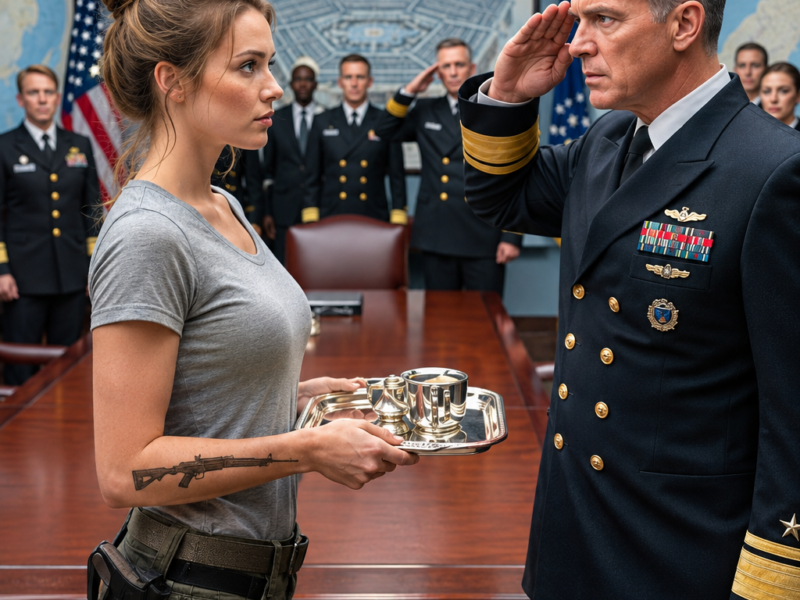
The SEAL Admiral Asked Her Rank As A Joke — Then Realized Her Sniper Tattoo Outranked Him
The SEAL Admiral Asked Her Rank As A Joke — Then Realized Her Sniper Tattoo Outranked Him
The first thing Admiral Jack Thompson noticed about the young woman entering the Pentagon conference room was how little attention she seemed to demand. She was small, dressed in a plain gray service uniform, and carrying a polished silver tray with a teapot, porcelain cups, and neatly arranged packets of sugar. Her dark blonde hair was pulled into a simple bun, and her expression was so carefully composed that she might have been invisible to anyone who wasn’t looking directly at her. Yet before the morning was over, that seemingly unremarkable woman would bring one of the Pentagon’s most powerful military commanders face-to-face with a truth capable of destroying his career, exposing a network of traitors, and reopening the wounds of a deadly operation that the military had desperately tried to put behind it.
It was just after eight o’clock on a cold Washington morning. Inside Conference Room Seven, located deep within Ring E of the Pentagon, twelve senior military officers had gathered around an enormous mahogany table. The atmosphere was tense even before the young woman arrived. Classified satellite photographs covered one end of the table, encrypted laptops displayed operational intelligence, and a large digital screen showed mountainous terrain along the Afghanistan-Pakistan border.
Admiral Thompson stood at the head of the table, his silver hair neatly combed, his decorated naval uniform immaculate. The gold insignia on his shoulders reflected decades of service, and the Navy SEAL Trident on his chest was a reminder of the dangerous missions he had once commanded personally. He was a man accustomed to unquestioned obedience. When he spoke, rooms usually fell silent.
That morning, however, his patience was already wearing thin.
The military had suffered another intelligence failure, and the briefing was intended to determine whether an upcoming operation could proceed without placing more American lives at risk.
Then the conference room door opened.
Briana Mitchell stepped inside with the tea service.
Thompson stopped speaking halfway through a sentence. His eyes narrowed.
“Who authorized her to enter this room?”
The question was loud enough to make several officers turn immediately.
Briana stopped beside the table.
“Good morning, sir. I was instructed to deliver the morning refreshments.”
“I didn’t ask what you were delivering,” Thompson snapped. “I asked who authorized you to enter.”
For a moment, Briana looked toward the identification badge clipped to her uniform, but she didn’t reach for it.
“The service request was approved through the administrative office, Admiral.”
Thompson glanced toward his aide.
“We’re discussing classified intelligence concerning Operation Desert Shield Two. Does anyone know whether this woman has the appropriate clearance?”
Nobody answered.
Colonel Robert Martinez, a broad-shouldered Army officer with a habit of speaking before thinking, leaned back in his chair.
“This is exactly the sort of carelessness that gets people killed,” he muttered. “We can’t have civilian service personnel wandering through secure briefings.”
General William Stevens nodded in agreement.
“Young lady, do you understand what kind of information is being discussed here?”
“Yes, sir.”
Stevens gave a humorless laugh.
“Somehow, I doubt that.”
Across the table, Marine Captain Daniel Rodriguez smiled at another officer.
“Maybe she’s here to help us plan the operation,” he joked. “Perhaps she can tell us whether we’re supposed to shoot uphill or downhill.”
Several men laughed.
Briana didn’t.
She simply lowered her eyes and began setting the cups in front of the officers.
Her movements were controlled and remarkably precise. She placed each cup at the same distance from the edge of the table, turned every handle in the same direction, and moved around the chairs without making a sound.
Sergeant David Williams, who had been assigned to assist with the briefing’s administrative records, noticed something unusual.
Most civilian service workers hurried when surrounded by impatient officers. They became nervous, dropped things, or fumbled with their equipment.
This woman did none of those things.
Her shoulders remained square. Her back was straight. Her weight shifted smoothly with every step, and her eyes moved across the room in brief, purposeful glances.
Williams had spent enough years around combat veterans to recognize military bearing when he saw it.
Something about Briana Mitchell didn’t fit.
But before he could think further, Thompson raised his voice again.
“Miss, I want you out of this room as soon as you’ve finished. We have serious matters to discuss.”
“Understood, sir.”
Her response was quiet, almost submissive.
And that was precisely what everyone in the room believed her to be.
Everyone except Sergeant Williams.
As Briana moved toward the far end of the table, her eyes briefly crossed a satellite photograph displayed on the central screen.
It showed a remote mountain valley near Kandahar.
A narrow road cut through the rocks. Several ruined buildings stood beside a dry riverbed, and a cluster of trees cast dark shadows over an abandoned compound.
To everyone else, it was another intelligence image.
To Briana, it was a graveyard.
Her fingers tightened almost imperceptibly around the handle of the silver tray.
For an instant, she could hear gunfire again.
She could hear frantic voices over a radio, the desperate calls for medical assistance, the sound of men who had trusted one another with their lives realizing that someone had led them into a trap.
Then she pushed the memory away.
Not now.
She had spent six months preparing for this morning.
She would not allow her emotions to ruin it.
Dr. Sarah Parker, a civilian intelligence analyst seated near the middle of the table, noticed the admiral’s growing hostility.
“Admiral, she’s simply completing an approved service assignment. Perhaps we could continue while she finishes.”
Thompson turned sharply toward her.
“Doctor Parker, operational security is not a matter of convenience. People die when protocols are ignored.”
Briana kept arranging the cups.
The irony of those words was almost unbearable.
Because she knew exactly how people died when protocols were ignored.
She had watched seven of them die.
And somewhere in that room, she believed, was a man who knew why.
The briefing resumed, though Thompson continued glancing toward the woman moving quietly along the walls.
Major Christopher Brooks, an experienced Army Ranger, began reviewing the updated intelligence.
“Our original assessment indicated that the enemy acquired the coordinates of Ghost Unit Seven approximately four hours before the ambush.”
At the mention of that name, Briana stopped pouring tea for less than a second.
Nobody noticed.
Brooks continued.
“The unit was conducting a reconnaissance mission in hostile territory. Seven operators were killed, and one survived. Our initial investigation suggested communications interception, but the new evidence points toward a deliberate leak from within the command structure.”
Colonel Martinez shifted in his seat.
“That’s still speculation.”
Brooks looked at him.
“The enemy knew the exact insertion point, the team’s composition, and the scheduled extraction window. That isn’t speculation, Colonel. That’s inside information.”
General Stevens leaned forward.
“How many people had access?”
“Fewer than twenty at the level of detail we’re discussing.”
Thompson folded his arms.
“Then we investigate every one of them.”
Briana placed another cup on the table.
She was close enough to see the expression on Martinez’s face.
His jaw had tightened. His eyes flickered toward the folder in front of him, then toward the door.
A nervous reaction alone proved nothing.
But Briana had seen that same reaction before.
Three months earlier, she had watched him receive a secure message while eating lunch. The moment he read it, he had abandoned his meal, left the building, and made a phone call from a personal device.
Two days later, an unauthorized database access appeared in the security logs.
The timing had never left her mind.
Now she watched him again, pretending to examine the arrangement of the sugar packets.
Admiral Thompson resumed speaking.
“The terrain around the target region complicates our supporting positions. At the elevations involved, our effective engagement distances become difficult to estimate.”
Major Brooks referred to his notes.
“Based on the preliminary calculations, we’re looking at approximately two thousand meters under the assumed conditions.”
From the other side of the room, a soft voice interrupted.
“Closer to twenty-four hundred, sir.”
The entire table went silent.
Thompson slowly turned.
“Excuse me?”
Briana looked up.
“I apologize, Admiral. I shouldn’t have interrupted.”
“No. You clearly have something to contribute. Please, enlighten us.”
His sarcasm was unmistakable.
Briana hesitated.
“The estimate may change when the elevation and atmospheric conditions are included in the model.”
Captain Rodriguez burst out laughing.
“Unbelievable. Our tea server is giving us a ballistics lesson.”
Colonel Martinez shook his head.
“Watching military documentaries doesn’t make someone a tactical expert.”
But Major Brooks was already checking the assumptions behind his calculation.
He studied the figures, adjusted several variables, and frowned.
Then he looked up.
“Admiral, she’s correct about the model we’re using. Our estimate didn’t incorporate the updated environmental data. The revised result is much closer to her figure.”
The laughter disappeared.
Thompson stared at Briana.
“How did you know that?”
She lowered her gaze.
“I read quite a bit about military history, sir.”
“Military history?”
“Yes, Admiral.”
“Interesting hobby for someone serving tea.”
Briana offered no reply.
Thompson studied her more carefully.
He noticed the disciplined stillness in her hands, the measured way she answered questions, and the absence of nervousness despite being challenged by officers who could easily have intimidated an ordinary employee.
Something was wrong.
He simply couldn’t determine what.
For the next several minutes, Thompson deliberately introduced specialized military terminology into the discussion. He mentioned communications procedures, operational classifications, and tactical concepts that few civilians would recognize.
Briana never asked for clarification.
She never reacted with visible confusion.
When Captain Rodriguez made another dismissive joke, she merely continued collecting empty cups.
Then Thompson decided to test her one final time.
“Tell me something, Miss Mitchell. Have you ever even held a military rifle?”
Briana paused.
“Yes, sir.”
Rodriguez laughed.
“At a shooting range?”
“Among other places.”
The answer was so calm that it irritated Thompson even more.
“What rank do you hold, then?” he asked mockingly. “General? Admiral? Supreme commander of the tea service?”
A few officers chuckled.
Briana looked directly at him for the first time.
“I serve where I’m needed, sir.”
Thompson’s expression hardened.
“That wasn’t my question.”
“No, Admiral. It wasn’t.”
The silence that followed was uncomfortable.
Sergeant Williams watched the exchange with increasing concern.
There was no arrogance in Briana’s voice.
Only restraint.
And Williams suddenly understood that the woman wasn’t struggling to remain composed because she was frightened.
She was struggling because she knew something the rest of them didn’t.
He excused himself quietly and moved toward the security terminal near the door.
He entered her name.
Briana Mitchell.
The system requested additional verification.
Williams frowned.
He entered his authorization.
A record appeared.
Then another.
His eyes widened.
He checked the information twice before returning to the table.
“Admiral?”
Thompson turned impatiently.
“What is it, Sergeant?”
“Sir, I’ve verified Miss Mitchell’s access authorization.”
“And?”
Williams swallowed.
“Her clearance and compartmented access have been independently approved through the Inspector General’s office. Her current authorization permits her presence at this briefing.”
Colonel Martinez leaned forward.
“That can’t be right.”
“I verified the credentials, sir.”
Thompson stared at the screen Williams had brought forward.
The authorization was genuine.
And the sponsoring office was one that rarely appeared on ordinary administrative records.
The Inspector General.
Thompson looked back at Briana.
“Who exactly are you?”
Before she could answer, the conference room door opened.
A middle-aged man in a dark suit entered, accompanied by a security officer.
Director Michael Chen.
His position within the intelligence community made him one of the few civilians whose presence could immediately change the atmosphere in a room filled with senior military commanders.
Thompson rose.
“Director Chen. We weren’t informed you would be joining us.”
Chen nodded.
“My office has a direct interest in this briefing, Admiral.”
Then his gaze moved across the room.
It stopped briefly on Briana.
And he gave her a small, unmistakably respectful nod.
Thompson noticed.
So did Sergeant Williams.
Briana responded with the slightest inclination of her head.
There was no surprise in her expression.
She had expected him.
Chen took a seat near the back.
“Please continue, Admiral.”
Thompson remained standing for another moment.
Then he resumed the briefing, although his attention was now divided between the classified intelligence and the mysterious woman standing silently beside the tea cart.
The next report concerned the Ghost Unit Seven ambush.
Major Brooks displayed a reconstruction of the mission’s final minutes.
Satellite imagery showed the unit’s route, the location of enemy positions, and the point where the convoy had been trapped.
Briana kept her eyes on the floor.
She didn’t need the photographs.
She remembered every second.
Seven months earlier, she had been lying on a rocky ridgeline nearly two kilometers from the compound. The night air had been bitterly cold, and she had spent hours watching the valley through the optics of her rifle.
Her radio had carried the familiar voices of her teammates.
Sergeant Michael Chen had been talking about his fiancée. He was twenty-four, newly engaged, and planning a wedding that he insisted would be more complicated than any military operation.
Sergeant James Williams had laughed and reminded him that marriage required better communication than the Army.
Their medic, Sergeant Marcus Jackson, had complained that everyone talked too much.
Briana remembered smiling into the darkness.
They were more than soldiers assigned to the same mission.
They were family.
And that night, every one of them believed they would return home.
The ambush began at 02:17.
There had been no warning.
One moment, the team was moving toward its objective.
The next, explosions illuminated the valley.
A vehicle burst into flames.
Gunfire erupted from positions that should have been empty.
Briana heard her team leader shout for cover.
Then came the words she would remember for the rest of her life.
“They knew we were coming!”
She had provided covering fire, called for extraction, and desperately searched for a way to reach her teammates.
But the enemy had anticipated their movements.
Every escape route was blocked.
Their communications were disrupted.
Their positions had been exposed before the mission even began.
She remained at her overwatch position until the last radio transmission faded into static.
By the time reinforcements arrived, she was the only survivor.
The official report described the disaster as a catastrophic intelligence compromise.
Briana had another word for it.
Murder.
And she had spent every day since trying to discover who had committed it.
Back in the Pentagon, Colonel Martinez was explaining the latest security findings.
“We identified three possible sources with access to the compromised coordinates,” he said. “Each had financial vulnerabilities that could have been exploited.”
“Such as?” General Stevens asked.
“Significant debts. Personal loans. Gambling problems.”
For an instant, Martinez’s voice faltered.
Briana noticed.
So did Director Chen.
Thompson continued questioning the colonel, unaware that the woman by the tea cart was quietly studying every movement.
Then an alert sounded from several secure communication devices.
Officers reached for their phones and tablets.
Briana reached into her own pocket.
Thompson saw the movement.
“Why do you have a secure device?”
She looked at him.
“It’s authorized, sir.”
“By whom?”
“I’m not permitted to discuss that.”
His patience finally snapped.
He stepped toward her and seized her left forearm.
“Listen to me. I don’t know what game you’re playing, but this ends now.”
Briana’s sleeve slid upward.
For one brief moment, black ink became visible beneath the gray fabric.
Thompson saw the unmistakable outline of a long-barreled rifle, surrounded by intricate military symbols.
He had seen countless military tattoos in his career.
This one was different.
The artwork looked less like decoration and more like a personal record.
Briana gently but firmly pulled her arm free.
“Please don’t touch me, Admiral.”
Her voice had changed.
It was no longer the soft, apologetic voice of the service worker.
It carried the calm authority of someone who had given orders under fire.
Thompson stepped back.
“That tattoo. Where did you get it?”
Briana lowered her sleeve.
“Over several years, sir.”
“What does it represent?”
She looked toward Director Chen.
Chen gave a subtle nod.
Briana turned back to Thompson.
“Admiral, you asked about my rank earlier.”
“Yes.”
“You also asked whether I had ever held a rifle.”
Thompson said nothing.
Briana straightened.
Her entire posture changed.
The quiet service worker seemed to disappear before their eyes.
“My name is Briana Elizabeth Mitchell. I’m a Master Sergeant in the United States Army, formerly assigned to a compartmented special operations unit designated Ghost Unit Seven.”
Major Brooks stopped breathing for a moment.
Sergeant Williams rose instinctively.
Briana continued.
“I served as the team’s senior sniper and reconnaissance specialist. I’m currently attached to a joint counterintelligence investigation under the authority of the Inspector General’s office.”
Her eyes moved toward the photograph on the screen.
“And I’m here because seven members of my team were murdered after someone inside this command structure sold their mission coordinates.”
Nobody spoke.
Thompson stared at her.
The woman he had mocked and ordered out of the room was the sole survivor of one of the most devastating special operations failures in recent memory.
And she had been standing among them, listening to every word.
“You’re Silent Angel,” Major Brooks whispered.
Briana looked at him.
“That was my operational callsign, sir.”
Brooks slowly lowered his tablet.
“Your name was removed from the casualty investigation file.”
“For operational reasons.”
Thompson sank into his chair.
“Why were you serving tea?”
Briana answered without hesitation.
“Because people speak freely around someone they believe is beneath their notice.”
Her words seemed to strike every officer in the room.
For months, she explained, she had been moving through secure facilities under an authorized cover assignment. She had delivered refreshments, organized meeting rooms, and performed administrative tasks that allowed her to observe how classified information was handled.
Most people never looked at her twice.
They discussed sensitive operations in her presence.
They left documents unattended.
They shared information with colleagues who lacked a legitimate need to know.
And some of them had done far worse.
“During the last six months,” Briana continued, “I’ve documented repeated unauthorized access to operational databases, numerous improper disclosures, and financial transactions associated with suspected foreign intelligence contacts.”
Colonel Martinez’s face turned pale.
Thompson noticed.
“Colonel, are you feeling unwell?”
“I’m fine.”
But his hands were trembling.
Briana reached into the pocket of her uniform and removed a small device resembling an inventory scanner.
“This meeting has been recorded under an approved investigative authorization. Relevant statements and conduct have been preserved as evidence.”
Rodriguez looked horrified.
“Everything?”
“Everything pertinent to the investigation, sir.”
Thompson stared down at the table.
He thought about the insults.
The condescending remarks.
The moment he had grabbed her arm.
But his embarrassment was insignificant compared with the terrible possibility now taking shape.
Someone inside his command had betrayed American soldiers.
And the survivor had come back to find them.
“Master Sergeant,” he said at last, his voice quieter, “I owe you an apology.”
Briana’s expression remained composed.
“Sir, I’m not here for an apology.”
“Then what do you want?”
She looked directly at him.
“I want the truth.”
The answer silenced the room.
Then she added something that made the moment even heavier.
“And I want the people responsible to hear the names of the soldiers they killed.”
She began speaking slowly.
“Sergeant Michael Chen. Twenty-four years old. Engaged to be married.”
Her voice remained steady.
“Sergeant James Williams. A grandfather who was six months away from retirement.”
“Sergeant Luis Martinez. Saving money to reunite his family in the United States.”
“Sergeant Daniel Rodriguez. A communications specialist who never failed to make his teammates laugh.”
“Sergeant Thomas Thompson. My spotter. He served beside me for three years.”
“Sergeant Marcus Jackson. Our medic. He saved more lives than I can count.”
“Sergeant Andrew Lee. Fluent in four languages. He wanted to become a teacher when he left the military.”
She stopped.
For several seconds, nobody moved.
“Those weren’t numbers on an intelligence report,” she said. “They were people. They had families waiting for them. They had plans for the future. They trusted their command to protect the information that kept them alive.”
Her eyes settled on Martinez.
“And someone sold that trust.”
The colonel lowered his head.
Director Chen stood.
“Admiral, this facility is now operating under a coordinated investigative security hold. Inspector General personnel are arriving to conduct formal interviews.”
Thompson looked toward the door.
“How many people are being investigated?”
Briana answered.
“Everyone who had access to the compromised information is being reviewed. That includes personnel in this room, although suspicion is not proof of wrongdoing.”
Martinez abruptly pushed back his chair.
“I need some air.”
Before he could reach the door, a security officer stepped forward.
“Colonel, please remain here until the investigating officials explain the procedures.”
Martinez froze.
He looked around the room, searching for support.
Nobody spoke.
Moments later, the door opened again.
A woman in her fifties entered with three investigators.
She wore a dark suit and carried a secure tablet.
“I’m Special Agent Sarah Morrison, attached to the Inspector General’s investigative team.”
She introduced her colleagues, explained that formal interviews would follow, and turned toward Briana.
“Master Sergeant Mitchell, are you prepared to present your preliminary findings?”
“Yes, ma’am.”
Briana connected her device to the secure display.
The screen changed.
Gone were the satellite images.
In their place appeared an investigative timeline stretching across six months.
There were access records, photographs, communications logs, and records of suspicious financial activity.
Briana had not spent those months merely observing.
She had been building a case.
She began with evidence of routine security failures.
A photograph showed General Stevens using his personal phone to capture an image of a classified document.
Another showed Admiral Thompson reviewing sensitive operational papers in an unsecured cafeteria.
A third documented an unattended folder containing restricted mission information.
Each image carried a date, location, and supporting record.
Stevens stared at the photograph of himself.
“I was trying to finish a report. I didn’t distribute that picture.”
“That will be examined, General,” Morrison replied. “But the creation and storage of sensitive images on an unauthorized device is itself a serious concern.”
Thompson looked at the photograph of himself in the cafeteria.
He remembered the afternoon perfectly.
He had been rushing between meetings, reviewing documents while eating lunch.
At the time, it had seemed harmless.
Now he understood how easily someone could have observed the contents.
Briana turned toward him.
“Sir, I obtained that image from an ordinary public-facing angle. Someone conducting hostile surveillance might have obtained the same information.”
Thompson lowered his eyes.
For years, he had lectured younger officers about discipline.
Now his own conduct was being used to demonstrate what happened when senior leaders considered themselves exceptions to the rules.
But the photographs were only the beginning.
Briana opened another file.
“During the Ghost Unit Seven investigation, we discovered that the compromised coordinates were accessed through an administrative account shortly before the ambush.”
A record appeared on the screen.
Colonel Martinez stopped moving.
Briana continued.
“That account belonged to an officer with legitimate oversight responsibilities. However, the access occurred outside the normal operational review process.”
Martinez swallowed.
Thompson looked at him.
“Robert?”
The colonel said nothing.
Morrison took over.
“Colonel Martinez, you are not required to respond to allegations without consulting counsel. You will be given the opportunity to provide a formal statement.”
Martinez stared at the screen.
For several seconds, it seemed as though he might remain silent.
Then he looked toward Briana.
And something inside him broke.
“I knew,” he whispered.
Morrison raised her head.
“Colonel?”
“I knew what those coordinates were for.”
The room became deathly quiet.
Martinez covered his face with both hands.
“I told myself it was just intelligence. Just coordinates. I thought they wanted to monitor the operation.”
Thompson stood.
“What are you saying?”
Martinez looked up, tears gathering in his eyes.
“I gave them the coordinates.”
Nobody moved.
Morrison immediately cautioned him about making a voluntary statement without legal counsel.
Martinez listened, then shook his head.
“I want to tell the truth.”
He looked directly at Briana.
“I’m the one who leaked the mission information.”
The confession seemed to drain all the air from the room.
Captain Rodriguez pushed his chair backward.
General Stevens whispered something under his breath.
Thompson stared at the colonel he had known for nearly fifteen years.
“Why?”
Martinez’s voice trembled.
“Money.”
He wiped his eyes.
“I had gambling debts. Two hundred and fifty thousand dollars. I borrowed from people I shouldn’t have. They threatened me. They threatened my family.”
He struggled to continue.
“Then someone approached me. He knew everything. The debts, the creditors, the amount I owed. He offered to make it disappear.”
“In exchange for classified information,” Morrison said.
Martinez nodded.
“At first, it was small things. Administrative details. Scheduling information. Nothing that seemed directly dangerous.”
Briana remained motionless.
“Then they wanted mission coordinates.”
Martinez began crying openly.
“I told myself they wouldn’t attack anyone. I told myself they just wanted to know where our people were operating.”
Briana stepped toward him.
“Colonel, did you know the information concerned an active special operations team?”
He looked at her.
His face was devastated.
“Yes.”
“Did you understand that hostile forces could use that information to locate them?”
“Yes.”
“Then you knew the risk.”
Martinez lowered his head.
“I did.”
For the first time that morning, Briana’s composure nearly failed.
Her throat tightened.
She remembered Thomas Thompson laughing beside her on a transport aircraft. She remembered Michael Chen showing everyone a picture of his engagement ring. She remembered Marcus Jackson giving away the last cup of coffee because someone else needed it more.
Seven men.
Seven lives.
Destroyed because a colonel valued his secrets more than their safety.
She could have shouted.
She could have told him what she had endured, how many nights she had awakened believing she could still hear her teammates calling for help.
Instead, she spoke quietly.
“Do you know what Sergeant Chen’s fiancée did after the funeral?”
Martinez shook his head.
“She kept their wedding date on the calendar. For months, she couldn’t bring herself to delete it.”
Tears rolled down his face.
“Do you know what Sergeant Williams’s granddaughter asked at his memorial?”
Martinez could barely breathe.
“She asked why her grandfather couldn’t come home if he had promised to be there for her birthday.”
Briana paused.
“Those are the consequences of what you sold.”
Martinez broke down completely.
“I’m sorry.”
Briana watched him.
“I believe you regret what happened, Colonel. But regret cannot bring them back.”
Morrison motioned for the investigating officers to escort Martinez to a separate room, where his statement could be properly documented.
As he stood, Martinez looked back at Briana.
“I’ll tell them everything. Every contact. Every payment. Every message. I promise.”
Briana nodded once.
“Then start telling the truth.”
He was led away.
But the investigation was far from finished.
Morrison returned her attention to the screen.
“Master Sergeant, your preliminary report suggests the colonel wasn’t recruited by chance.”
“That’s correct, ma’am.”
Briana displayed a second timeline.
It showed suspicious contacts involving personnel across several commands.
Some had financial problems.
Others were experiencing family crises, serious career difficulties, or personal circumstances that could make them vulnerable to coercion.
Seven individuals had been approached through similar methods.
Several had encountered men claiming to represent defense contractors.
Others had received offers of lucrative consulting positions.
In at least one case, an officer had been threatened with exposure of private information.
“Someone is identifying vulnerabilities before approaching these people,” Briana explained. “That suggests either extensive surveillance or access to sensitive personnel records.”
Director Chen moved closer.
“We have reason to believe the recruitment network is operating across multiple installations.”
Thompson stared at the display.
“So this was never just one compromised mission.”
“No, Admiral,” Briana replied. “Ghost Unit Seven was one consequence of a much larger operation.”
Captain Rodriguez suddenly cleared his throat.
“There’s something I need to report.”
Everyone turned.
He looked deeply uncomfortable.
“About six months ago, I met a man at a bar near the installation. He said he worked for a defense contractor.”
Agent Morrison studied him.
“What did he want?”
“He asked questions about my work. Security procedures. Access requirements. The kinds of assignments Marines might receive overseas.”
“Did you answer?”
“Not directly. I thought he was being nosy. But he mentioned a consulting opportunity after retirement. Good money.”
Briana nodded.
“Your encounter was already identified through an authorized investigation of that individual.”
Rodriguez stared at her.
“You knew?”
“Yes, sir.”
“Did I give him anything?”
“The available recording indicates that you avoided answering his most sensitive questions. You’ll still need to provide a full statement.”
Rodriguez exhaled shakily.
He looked toward Thompson.
“I should have reported it.”
“Yes,” Thompson said quietly. “You should have.”
There was no anger in his voice.
Only the recognition that the failures in his command had been far more widespread than he had imagined.
Additional investigators arrived, including personnel from the FBI’s counterintelligence division and the National Security Agency.
They began reviewing the evidence.
As the room filled with quiet conversations and the sounds of equipment being prepared, Admiral Thompson approached Briana.
For a long moment, he seemed unable to find the right words.
Finally, he looked at her left arm.
“May I ask about the tattoo?”
Briana studied him.
Then she slowly rolled up her sleeve.
The room seemed to fall silent again.
Covering most of her forearm was an intricate black-and-gray tattoo.
At its center was a beautifully detailed Barrett M82A1 sniper rifle, surrounded by a series of military-inspired symbols, deployment markers, and the outline of an angel’s wings.
Beneath the rifle was a memorial design.
Seven names.
Seven dates.
And a single inscription:
They held the line. I carry them home.
Thompson stared at the names.
His eyes stopped on one.
Sergeant Thomas Thompson.
The coincidence of the shared surname struck him with unexpected force.
“Your spotter,” he said.
Briana nodded.
“He was more than that. He was my closest friend.”
Her voice softened.
“He knew when I was tired before I knew it myself. He could tell what I was thinking from a single glance. We served together through three deployments.”
She touched the tattoo gently.
“On our last mission, he told me that when we got home, he was going to take his family fishing. He had already bought the boat.”
Thompson looked away.
Briana lowered her arm.
“The tattoo isn’t a rank insignia, Admiral. It doesn’t give me authority over anyone. My rank is Master Sergeant. The records on my service are in the proper channels.”
She looked at him steadily.
“But these names tell you who I answer to when I wake up every morning.”
Thompson nodded slowly.
“I understand.”
Briana shook her head.
“With respect, sir, I hope you never have to understand it the way I do.”
He had no answer.
For the first time in many years, Admiral Jack Thompson felt that his decorations, his experience, and his authority could offer him no protection from the weight of his own failures.
He had commanded men in combat.
He had faced enemy fire.
He had made decisions that affected thousands of lives.
Yet that morning, he had failed to recognize courage because it arrived carrying a tray of tea.
And worse, he had helped create an environment where the careless handling of classified information had become routine.
“Master Sergeant,” he said, straightening, “I want to apologize for how I treated you.”
Briana remained still.
“I was arrogant,” he continued. “I assumed your position told me everything I needed to know about you. I humiliated you in front of my officers. I put my hands on you without permission. And I failed to follow the procedures I demand from everyone under my command.”
He took a breath.
“None of that is acceptable.”
Briana studied him for several seconds.
“Thank you for acknowledging it, Admiral.”
He nodded.
Then she continued.
“But the most important thing you can do now is cooperate fully with the investigation and ensure those failures never happen again.”
“I will.”
“Then that’s where accountability begins.”
For the first time that morning, Thompson understood that she wasn’t interested in humiliating him in return.
She had no desire to prove herself superior.
Her purpose had always been larger than personal recognition.
She wanted to prevent another family from receiving the telephone call that changed everything.
Another mother from opening her front door to find uniformed officers standing outside.
Another child from asking why a parent wasn’t coming home.
Another soldier from dying because someone in a safe office had treated classified information like an inconvenience.
The interviews began shortly afterward.
Each officer was escorted to a separate room.
Some would face administrative consequences.
Others would face more serious scrutiny.
Colonel Martinez’s confession would become a central part of a criminal investigation, but his cooperation also gave federal agents information about the people who had recruited him.
The intelligence network was still active.
And now investigators possessed something they had lacked for months.
A direct account from someone who had worked with it.
By early afternoon, the conference room was nearly empty.
Briana stood beside the table, collecting the remaining documents and evidence devices.
The silver tea tray was still there.
So were the porcelain cups.
Everything looked strangely ordinary.
Director Chen approached her.
“You handled yourself well.”
Briana gave a tired smile.
“I nearly lost control when Martinez confessed.”
“But you didn’t.”
“I wanted to.”
Chen nodded.
“I know.”
For a moment, she looked toward the satellite image that had been restored on the wall display.
The mountain valley was still there.
Cold.
Remote.
Silent.
“I thought hearing him admit it would make me feel better,” she said.
“Did it?”
She shook her head.
“No.”
Chen waited.
“It doesn’t change what happened. It doesn’t change the last thing I heard over the radio. It doesn’t bring anyone home.”
“No,” Chen said quietly. “It doesn’t.”
Briana swallowed.
“But at least their families will know they weren’t forgotten.”
Chen looked at her with genuine respect.
“That’s more than you realize.”
He explained that her investigation had already helped identify additional security vulnerabilities and possible recruitment attempts.
The joint agencies intended to expand the operation, using her findings to strengthen protective measures and investigate the remaining contacts.
There was also a proposal for Briana to lead a specialized task force focused on identifying foreign intelligence recruitment attempts within the military.
Under ordinary circumstances, the opportunity would have been an extraordinary career achievement.
But Briana barely reacted.
She looked down at her tattoo.
“I’d trade every promotion I’ve ever been offered to have them back.”
Chen nodded.
“I know you would.”
Outside the conference room, Sergeant Williams was waiting.
He straightened when he saw her.
“Master Sergeant.”
“Sergeant.”
He hesitated.
“I just wanted to say that I recognized something about you when you first walked in.”
Briana raised an eyebrow.
“Did you?”
“Your posture. The way you watched the exits. The way you moved.”
She smiled faintly.
“Old habits.”
“I wasn’t sure what I was seeing.”
“You were right not to make assumptions.”
Williams looked embarrassed.
“I wish I’d spoken up when they started making those comments.”
Briana shook her head.
“You verified the clearance rather than relying on appearances. You did your job.”
He nodded, then glanced at her forearm.
“I saw the names.”
Her expression softened.
“One of them shared your surname.”
“Yes, ma’am.”
“He was a good man,” she said. “Never met a difficult situation he couldn’t make better with a terrible joke.”
Williams smiled sadly.
“Sounds like someone I would’ve liked.”
“You would have.”
For a moment, the two soldiers stood in silence.
Then Williams came to attention and saluted.
Briana returned the gesture.
It was brief.
No audience.
No speeches.
But somehow, it meant more to her than the apologies she had received all morning.
Later that afternoon, Briana stepped outside the Pentagon.
The winter air struck her face, sharp and clean.
Traffic moved along the surrounding roads. People walked toward their cars, checking phones and discussing ordinary problems.
The world continued as it always had.
She stood beneath the gray sky and allowed herself a moment of stillness.
For six months, she had lived behind another identity.
She had endured insults, suspicious glances, and the daily frustration of watching people dismiss the very precautions that might have saved her team.
She had done it because the truth mattered.
Now part of that truth had finally emerged.
Colonel Martinez had confessed.
The investigation was expanding.
And the men who died in that Afghan valley were no longer merely names buried beneath a classified report.
Their story was being heard.
Briana reached into her pocket and removed an old photograph.
It showed eight soldiers standing beside a transport aircraft.
They were dirty, exhausted, and smiling.
Michael Chen had one arm around James Williams.
Marcus Jackson was holding a coffee cup.
Andrew Lee was making a ridiculous expression at the camera.
Thomas Thompson stood beside Briana, grinning as though he knew something the rest of them didn’t.
She stared at the picture.
Then she whispered, “We got him.”
Her eyes filled with tears.
“I told you I wouldn’t stop.”
For several seconds, she allowed herself to grieve.
Not as an investigator.
Not as a sniper.
Not as Silent Angel.
Just as Briana.
A woman who missed her friends.
Her secure phone vibrated.
She wiped her eyes and answered.
“Mitchell.”
A familiar voice came through the line.
“Master Sergeant, this is Colonel Harrison at Central Command.”
“Go ahead, sir.”
“We have a development in the counterintelligence investigation.”
Briana straightened instinctively.
“What kind of development?”
A pause.
“One of the individuals identified through the financial records has a direct connection to your former unit.”
Her heart began beating faster.
“Who?”
Another pause followed.
“General Richard Morrison.”
Briana felt the cold air catch in her throat.
General Morrison.
The officer who had recommended her for advanced sniper training.
The man who had encouraged her when senior commanders questioned whether she belonged in special operations.
The mentor who had personally supported her assignment to Ghost Unit Seven.
She remembered sitting across from him years earlier, listening as he told her that the military needed people who could remain calm when everyone else panicked.
“You have the discipline for it, Mitchell,” he had said. “Don’t let anyone convince you otherwise.”
And now his name had appeared in a counterintelligence investigation.
“Sir,” she said carefully, “what evidence do we have?”
“Financial irregularities. Suspicious contacts. Possible access to compromised personnel records.”
Briana closed her eyes.
“Is he considered a suspect?”
“He’s a person of investigative interest. Nothing has been established yet.”
She took a slow breath.
“What do you need from me?”
“You have a scheduled meeting with him tomorrow morning at seven. He’s expecting an internal briefing related to your investigation.”
Briana frowned.
“Does he know I’m assigned to this case?”
“Not the full extent of your role. We’re reviewing the meeting’s security arrangements before deciding how to proceed.”
She looked at the photograph in her hand.
The smiling faces stared back at her.
For months, she had believed Martinez was the answer.
Now she understood that he might have been only one piece of something far larger.
“Colonel,” she said, “if General Morrison had anything to do with this, I need to know.”
“I understand. But don’t mistake suspicion for proof.”
“I won’t, sir.”
The call ended.
Briana remained outside for another moment.
The wind moved across the pavement.
In the distance, an aircraft passed overhead.
She looked once more at the photograph, then carefully returned it to her pocket.
For the first time since the ambush, she felt something beyond grief and determination.
She felt the frightening possibility that the betrayal had begun much closer to her than she had ever imagined.
The man who had helped build her career might also have known the people who destroyed her team.
And if that was true, the investigation was about to become more painful than anything she had endured before.
She began walking toward the security entrance.
Her steps were steady.
Her face was composed.
The same quiet discipline that had carried her through combat, loss, and six months of undercover work now carried her toward whatever came next.
Inside the Pentagon, Admiral Thompson was beginning his formal interview, confronting the consequences of a morning he would never forget.
Colonel Martinez was providing investigators with names, accounts, and details that might expose an entire espionage network.
Federal agents were preparing operations to identify the people who had targeted vulnerable military personnel.
And somewhere beyond those secure walls, others who had profited from betrayal still believed their secrets were safe.
They had no idea that the quiet woman they might have overlooked was no longer simply searching for the person who had leaked a set of coordinates.
She was searching for everyone who had made that betrayal possible.
Briana knew the road ahead would be dangerous. She knew it might lead to people she trusted, men whose service she had respected, and institutions she had devoted her life to protecting.
But she also knew something that no investigation, promotion, or apology could change.
Seven soldiers had trusted her to watch over them that night.
She had survived when they had not.
And although she could never bring them home, she could still honor the promise she had made beside their graves.
She would remember their names.
She would protect the people they had died serving.
And she would follow the truth, no matter where it led.
As she disappeared through the Pentagon’s security doors, nobody passing her paid much attention to the small woman in the plain gray uniform.
They saw an ordinary employee finishing an ordinary day.
They didn’t see the decorated combat veteran beneath the fabric.
They didn’t see the sniper’s tattoo that carried seven lost lives across her arm.
They didn’t see the investigator who had just exposed a traitor inside one of the most powerful military institutions in the world.
And that, Briana Mitchell knew, was exactly why she was so effective.
Because real courage did not always announce itself.
Sometimes it entered a room carrying a tray of tea.
Sometimes it listened while powerful men laughed.
Sometimes it remained silent until the evidence was undeniable.
And sometimes the person everyone considered the least important turned out to be the only one brave enough to demand the truth.
But Briana’s story was not finished.
Far from it.
The next morning, she would face a man she had once trusted with her future.
And somewhere inside the classified records of Ghost Unit Seven, another secret was waiting to be uncovered.
A secret that could explain not only how her teammates had been betrayed, but why they had been sent into that valley in the first place.
For the seven men whose names were forever written on her arm, Briana had only one promise left to keep.
She would not stop until every last piece of the truth came to light.
THE END