The Old Woman Sat Alone With Her Dead Son’s Military K9 — Until One Nurse Stopped
The Old Woman Sat Alone With Her Dead Son’s Military K9 — Until One Nurse Stopped
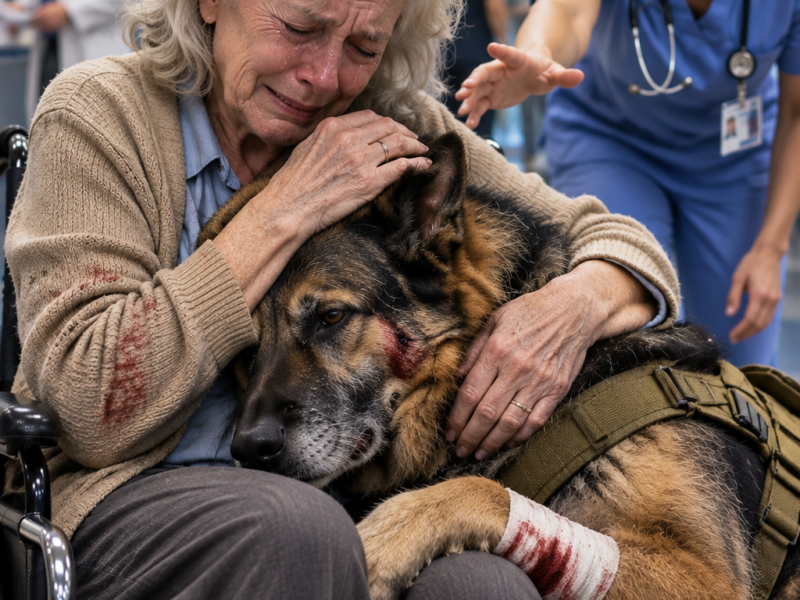
At exactly 9:14 on a rain-soaked Tuesday morning, a seventy-four-year-old woman sat alone in a wheelchair beneath the harsh fluorescent lights of St. Vincent’s Regional Hospital. Her silver hair was carefully tucked behind her ears, her thin shoulders were wrapped in a beige cardigan, and a faded canvas bag rested across her lap. Water dripped from the edges of her worn shoes onto the polished floor. Beside her sat an aging German Shepherd, his graying muzzle lifted, his scarred ears alert, and his dark eyes following every person who entered the emergency department.
For forty-five minutes, nobody had asked the woman why she was there.
Nobody had noticed that her hands were trembling.
And nobody had understood that the dog sitting faithfully beside her was carrying a secret that had remained buried for seven years.
The woman’s name was Margaret Bell. The German Shepherd was Briggs, a retired military working dog who had once served alongside her only son, Army Staff Sergeant Daniel Mercer.
Daniel had been dead for seven years.
At least, that was what the official documents said.
Margaret had spent those seven years learning how to live with an absence that seemed to grow larger instead of smaller. She had learned to prepare dinner for one, to stop expecting Sunday phone calls, and to walk past her son’s bedroom without opening the door. But she had never learned how to stop listening for his footsteps.
And neither had Briggs.
Even after all those years, the dog sometimes slept facing the front door, as though some small part of him still believed his handler might return.
That morning, however, something had changed.
At three o’clock, Margaret had awakened to an unfamiliar sound. Briggs was whining in the hallway, a low, desperate sound she had not heard since the first months after Daniel’s death.
When she found him, he was standing outside Daniel’s bedroom, his body rigid and his nose pressed toward the closed door.
“Briggs, sweetheart,” she had whispered, “what’s wrong?”
The dog did not turn.
Margaret opened the door.
Immediately, Briggs entered the room and walked toward the old military duffel bag she had kept beneath Daniel’s bed. He sat beside it and refused to move.
She tried offering him water. She tried coaxing him with his favorite biscuits. She even opened the back door, thinking he needed fresh air.
Nothing worked.
Eventually, she pulled the bag into the hallway.
Only then did Briggs stand.
He followed her all the way to the kitchen, never taking his eyes off the canvas. When Margaret placed the bag on the table, he rested his head against her knee and released a long, trembling breath.
It frightened her more than she cared to admit.
Briggs was nearly thirteen years old now. His movements had slowed, and sometimes his hind legs stiffened after long walks. Margaret knew he would not live forever. She had already buried the most important person in her life, and the possibility of losing the last living companion who had known her son was almost unbearable.
That was why she had driven nearly an hour through the pouring rain to St. Vincent’s.
She had come because she thought Briggs needed help.
She had also come because the trembling in her own hands had grown worse, and she had felt dizzy while getting dressed.
But after nearly an hour in the emergency department, the only attention she had received came from three different receptionists.
The first told her to wait.
The second asked whether she had an appointment.
The third pointed toward Briggs and explained that animals were not permitted inside the emergency department without appropriate authorization.
“He isn’t a pet,” Margaret had replied.
The receptionist barely looked up.
“Ma’am, those are the rules.”
“He’s a military working dog.”
“Retired?”
“Yes.”
“Then I’m afraid that doesn’t automatically make him a service animal.”
Margaret had fallen silent.
She knew the woman was only doing her job. She also knew that Briggs had never been trained to provide civilian disability assistance. She simply had not known where else to take him, and she had been too frightened to leave him alone.
Now she sat beneath the cold lights, holding his leash with one hand and the canvas bag with the other.
The emergency department moved around her like a river around a stone.
A young father hurried past carrying a crying child. Two paramedics wheeled an elderly man toward the examination rooms. A doctor spoke urgently into a telephone. Somewhere behind the reception desk, someone laughed at a joke.
Margaret watched them all.
It was strange, she thought, how the world continued moving after someone died.
The sun still rose.
Bills still arrived.
People complained about the weather.
And a mother could spend seven years waking up every morning with a hole in her chest while everyone around her carried on as though nothing extraordinary had happened.
She lowered her eyes toward Briggs.
“He isn’t coming back, sweetheart.”
The dog looked up at her.
“I know you miss him.”
Briggs leaned closer.
Margaret touched the old metal identification plate hanging beneath his collar. The lettering had become faint with age, but she could still make out his name and former military designation.
She traced the plate with her thumb.
“He loved you so much,” she whispered.
Briggs rested his chin on her knee.
At the opposite end of the emergency department, twenty-nine-year-old nurse Elena Ward emerged from an examination room carrying a stack of medical charts.
She had been working since six that morning.
Her feet ached. Her coffee had gone cold. She had already assisted with a serious motor vehicle injury, comforted a frightened teenager, and spent twenty minutes searching for a doctor who seemed determined to be everywhere except where he was needed.
Elena was not the kind of nurse people noticed.
She spoke quietly, avoided workplace gossip, and rarely volunteered information about herself. Other nurses knew she had transferred to St. Vincent’s almost two years earlier, but very few knew where she had worked before that.
She preferred it that way.
Her colleagues described her as dependable.
Some considered her reserved.
A few assumed she was inexperienced because she seldom challenged senior staff openly.
None of them knew that Elena had once treated wounded soldiers beneath the sound of incoming fire.
None of them knew about the scars hidden beneath her scrubs.
And none of them knew that seven years earlier, she had watched a man named Daniel Mercer fight desperately to save the German Shepherd now sitting beside an elderly woman in their waiting room.
Elena was halfway toward the medication station when she noticed Briggs.
She stopped.
Something about the dog’s posture caught her attention.
He was not behaving like an ordinary animal in a strange place. His back was straight, his ears moved independently toward different sounds, and his eyes continually assessed the room.
He watched doors.
He watched hands.
He watched the distance between strangers and the woman beside him.
Elena knew that posture.
She had seen it in military working dogs trained to remain alert under conditions where a moment of distraction could cost a human life.
Her gaze moved to the faded black harness.
Then to the white scar crossing the dog’s left ear.
Her chest tightened.
For one impossible second, she felt as though she had stepped backward through time.
She remembered a dusty road.
A burning vehicle.
A dog screaming somewhere in the darkness.
And a wounded soldier shouting, “Don’t leave him!”
Elena blinked.
The hospital returned around her.
She took three steps toward the medication station.
Then stopped again.
Briggs had turned his head.
He was looking directly at her.
Not casually.
Not with the curiosity of a dog noticing a stranger.
He was watching her with an intensity that made her skin prickle.
Elena slowly walked toward the wheelchair.
“Ma’am?”
Margaret raised her head.
“Yes?”
“Have you been waiting long?”
The older woman looked surprised.
“Oh. About forty-five minutes, I suppose.”
Elena glanced at the registration bracelet around Margaret’s wrist.
“Has anyone checked your blood pressure or taken your vital signs?”
Margaret shook her head.
“I don’t believe so.”
Elena frowned.
“Are you feeling unwell?”
“A little dizzy earlier. My hands have been shaking.” Margaret hesitated. “But I’m mostly worried about him.”
She glanced toward Briggs.
Elena crouched slightly beside the wheelchair.
“What’s happening with Briggs?”
Margaret stared.
“How did you know his name?”
Elena looked at the worn lettering on the harness.
“I can still read a few things.”
Margaret smiled faintly.
It was the first genuine smile she had offered anyone that morning.
“He was my son’s dog.”
Elena nodded carefully.
“Your son served?”
“In the Army.”
“How long?”
“Nine years.”
“And Briggs?”
“Eight.”
Elena looked more closely at the German Shepherd.
“Was your son his handler?”
Margaret’s smile disappeared.
“Yes.”
There was a pause.
“He died seven years ago.”
Elena felt something cold move through her stomach.
“What was his name?”
Margaret tightened her grip on the leash.
“Daniel. Staff Sergeant Daniel Mercer.”
For a moment, Elena could not hear the emergency department.
Daniel Mercer.
The name she had tried to forget.
The name that appeared in her nightmares.
The name that had once been written across an official report she had never believed.
She forced herself to breathe.
“I’m sorry,” she said quietly.
Margaret studied her face.
“You knew him?”
Elena hesitated.
She could have said no.
She had spent years avoiding conversations about her military service, and she had become remarkably skilled at recognizing questions that might lead into places she did not want to revisit.
But before she could answer, Briggs stood.
The movement was sudden enough to startle Margaret.
The dog stepped toward Elena, his nose lifting as though searching for a scent hidden beneath the familiar hospital smells.
Elena remained perfectly still.
“Easy, Briggs,” she whispered.
The dog stopped.
Then his tail moved.
Just once.
Margaret stared.
“He hasn’t done that with a stranger in years.”
Elena swallowed.
“I may not be a stranger.”
The words escaped before she could stop them.
Margaret leaned forward.
“What do you mean?”
Before Elena could answer, a senior nurse called from the corridor.
“Ward! Room twelve needs you.”
Elena glanced over her shoulder.
“I’m coming.”
She turned back to Margaret.
“I’m going to ask someone to check your blood pressure immediately. And I want you to stay here until I return.”
Margaret nodded.
“Of course.”
Elena stood.
Then she looked down at Briggs.
The dog was still watching her.
A memory flashed across her mind.
Daniel sitting on the ground beside a damaged transport vehicle, laughing as Briggs tried to steal food from Elena’s medical pack.
“He likes you,” Daniel had said.
“He likes my food.”
“No,” Daniel had answered with a grin. “He knows the difference.”
Elena had laughed.
It was one of the last peaceful moments she remembered before everything changed.
Now, standing in a hospital seven years later, she felt the weight of that memory settle over her.
She turned and hurried down the corridor.
Inside room twelve, Elena helped stabilize a patient suffering from severe dehydration. She moved with practiced efficiency, monitoring vital signs, preparing fluids, and reassuring the frightened woman on the examination bed.
But her thoughts kept returning to Margaret.
And Briggs.
Especially Briggs.
During her eight years in the Navy, Elena had served as a corpsman attached to a joint military medical support team. She had deployed overseas twice and had worked closely with Army units operating in dangerous areas.
She had treated blast injuries, gunshot wounds, broken bones, and the kind of invisible psychological wounds that followed people home.
She had also treated injured working dogs.
One of those dogs had been Briggs.
Seven years earlier, during a disastrous mission, she had pressed her hands against a deep wound beneath his collar while Daniel Mercer begged her to save him.
She remembered the blood.
She remembered the trembling muscles beneath her fingers.
And she remembered Daniel’s voice.
“Please, Elena. He trusts you.”
At the time, she had promised him she would do everything she could.
She had kept that promise.
But she had failed to bring Daniel home.
Twenty minutes later, Elena returned to the waiting area.
Margaret’s wheelchair was empty.
The canvas bag was gone.
And Briggs stood alone beside the chair, his leash carefully secured around the armrest.
Elena’s pulse quickened.
She hurried toward him.
“Briggs?”
The dog turned.
Immediately, he pulled against the leash.
Not toward the entrance.
Toward her.
Elena reached down and placed a hand against his collar.
The moment her fingers touched his neck, she felt a narrow ridge of scar tissue beneath the fur.
Her heart seemed to stop.
She remembered that scar.
She had stitched the wound herself.
“Dear God,” she whispered.
Briggs lowered his head against her hand.
Elena knelt beside him.
“It’s really you.”
The dog pressed closer.
For a few seconds, the noise of the emergency department disappeared.
She saw him as he had been seven years earlier—young, powerful, covered in dust, refusing to abandon the wounded man beside him.
She remembered Daniel shouting over the gunfire.
“Take Briggs!”
She remembered answering, “He won’t leave you!”
And Daniel, bleeding heavily, had grabbed her arm.
“Then make him!”
Elena closed her eyes.
She had obeyed.
She had dragged Briggs toward the evacuation vehicle while the dog fought against her.
She had told herself she was saving his life.
For seven years, she had wondered whether Daniel had died believing she had abandoned him.
Now the dog was standing in front of her again.
Alive.
Older.
Still carrying the scar she had treated.
And somehow, he had found her.
“Where is she?” Elena whispered.
Briggs turned toward the elevators.
A moment later, Margaret appeared with a hospital aide pushing her wheelchair. Her blood pressure had finally been checked, and the aide was returning her to the waiting area while arranging further evaluation.
Margaret noticed Elena kneeling beside Briggs.
Her expression changed.
“You do know him.”
Elena slowly stood.
“Yes.”
Margaret looked from the nurse to the dog.
“How?”
Elena took a trembling breath.
“I was there when he was injured.”
The older woman’s eyes widened.
“Overseas?”
Elena nodded.
“I served with a Navy medical unit attached to your son’s operation.”
Margaret gripped the armrests of her wheelchair.
“You knew Daniel?”
“Yes.”
The words seemed to strike Margaret harder than either woman expected.
For seven years, she had wanted to speak to someone who had known her son during his final deployment.
Someone who might remember his laughter.
Someone who might explain why his final messages had sounded so strange.
Someone who might tell her whether he had been frightened.
But the military had provided little beyond official statements and condolences.
Now, by some extraordinary coincidence, a woman who had known him was standing directly in front of her.
Margaret covered her mouth.
“Were you there when he died?”
Elena looked away.
“I was there before the incident they said killed him.”
Margaret lowered her hand.
“What do you mean?”
Elena hesitated.
There were conversations that changed lives.
She knew this was one of them.
“The official report said Daniel died in a vehicle accident during a transfer between bases.”
Margaret nodded.
“Yes.”
Elena looked directly at her.
“Margaret, that isn’t what happened to us.”
The old woman became motionless.
Outside, rain struck the hospital windows.
“What are you saying?”
Elena lowered her voice.
“Our convoy was attacked.”
Margaret’s face drained of color.
“Attacked?”
“Yes.”
“But they told me—”
“I know what they told you.”
Margaret shook her head.
“No. They said the road was dangerous because of the weather. They said a vehicle overturned.”
Elena felt the familiar weight of guilt pressing against her ribs.
“There was an ambush. We lost communications. Several people were injured. Daniel was one of them.”
Margaret closed her eyes.
“Was he alive?”
“When I last saw him, yes.”
“And Briggs?”
“He was beside him.”
The older woman began trembling.
Elena quickly called for another nurse to finish Margaret’s medical assessment, and the two women were moved to a quieter consultation area.
Margaret received the attention she should have received when she first arrived. Her vital signs were monitored, and a physician examined her. Her symptoms appeared related to dehydration, exhaustion, and emotional distress, though the doctor advised follow-up care.
Once she was medically cleared, Elena returned.
Margaret was sitting with Briggs beside her.
The canvas bag rested on the table.
“You said Daniel was alive,” Margaret whispered.
Elena sat opposite her.
“He was injured, but he was speaking.”
Margaret’s eyes filled.
“What did he say?”
Elena stared at her hands.
For seven years, she had replayed that night in fragments.
The flames.
The explosions.
The sound of Briggs barking.
The sudden silence after the radios failed.
And Daniel lying beside a damaged vehicle, blood darkening his uniform.
“He asked about you.”
Margaret pressed one hand against her chest.
“Me?”
Elena nodded.
“He wanted to know whether you would understand how much he loved you.”
Margaret began to cry.
Quietly at first.
Then with the terrible exhaustion of someone who had spent years holding back words that could no longer reach the person they were meant for.
“I knew,” she whispered. “Of course I knew.”
Elena reached across the table.
Margaret took her hand.
“My son used to call every Sunday,” she said. “Even when he was busy. Even when he had nothing to say. Sometimes he would talk for five minutes about what he’d eaten for breakfast because he knew I worried.”
She laughed through her tears.
“He was a terrible cook.”
Elena smiled faintly.
“He once tried to heat a can of soup without opening it.”
Margaret looked up.
“He did?”
“We heard the explosion from the next room.”
For the first time, both women laughed.
Briggs lifted his head, watching them.
Then Margaret’s expression changed.
“If Daniel didn’t die in an accident, why did they tell me he did?”
Elena’s smile vanished.
“I’ve been asking myself that question for seven years.”
Margaret looked toward the canvas bag.
“Then maybe this has something to do with it.”
She pulled the bag closer.
Elena watched as she unfastened the worn straps.
Inside were several neatly folded uniforms, an old notebook, photographs, a pair of military boots, and a brown envelope.
Margaret lifted the envelope carefully.
“I found this in Daniel’s belongings after they were returned. I never opened it.”
“Why not?”
Margaret looked embarrassed.
“I suppose I was afraid.”
“Of what?”
“Of finding something that would make losing him hurt all over again.”
Elena understood more than she wanted to admit.
She examined the envelope.
There was no address.
No official stamp.
Only a short handwritten marking.
7-10.
Something about the numbers seemed familiar.
“May I?”
Margaret nodded.
Elena carefully opened the envelope.
Inside was a single folded sheet.
She unfolded it.
Six handwritten words stared back at her.
If anything happens, find Samuel Ward.
Elena stopped breathing.
Margaret noticed.
“What does it say?”
Elena read the message aloud.
Margaret frowned.
“Who is Samuel Ward?”
Elena’s fingers tightened around the paper.
“A retired Navy captain.”
“Do you know him?”
“Yes.”
“Is he related to you?”
Elena nodded slowly.
“He’s my uncle.”
Margaret stared.
For several seconds, neither spoke.
Elena had not spoken to Captain Samuel Ward in seven years.
He had once been the officer she trusted more than anyone else in the military.
He had guided her through her first deployment, helped her recover after a serious injury, and taught her that courage sometimes meant telling the truth when everyone else preferred silence.
But after Daniel’s death, something had happened.
Samuel Ward had been removed from his assignment.
A formal investigation had been closed.
Elena had been instructed not to discuss the operation.
And her uncle had disappeared from her life.
His final message to her had contained only one warning.
Do not contact me. Not until you know who you can trust.
She had obeyed.
Until now.
“Why would Daniel tell someone to find him?” Margaret asked.
“I don’t know.”
Elena folded the paper.
“But I think he knew something we didn’t.”
Before Margaret could answer, a man in a dark hospital jacket appeared outside the consultation room.
He was middle-aged, with neatly combed hair and an identification badge turned backward against his chest.
“Ms. Ward?”
Elena looked up.
“Yes?”
“Dr. Hensley would like to speak with you.”
“About what?”
“He didn’t say.”
The man glanced at the canvas bag.
It was a small movement.
Almost unnoticeable.
But Elena had spent years learning to recognize when someone was looking at an object without wanting to appear interested.
“I’ll speak to him shortly,” she said.
“It’s important.”
“So is this.”
The man’s expression hardened.
“Ms. Ward, hospital policy requires—”
“Then have Dr. Hensley call me directly.”
For a moment, the man said nothing.
Then he nodded and walked away.
Elena waited until he disappeared around the corner.
Margaret leaned toward her.
“What was that about?”
“I’m not sure.”
But Elena was no longer thinking about hospital policy.
She was thinking about the way the stranger had looked at Daniel’s bag.
She removed her phone.
There was a number she had never deleted.
A number she had promised herself she would never dial.
Her uncle’s.
She stepped a little away from the table and called.
The phone rang twice.
Then a man’s voice answered.
“Who is this?”
Elena closed her eyes.
“It’s Elena.”
Silence.
Then a sharp intake of breath.
“Elena Ward?”
“Yes.”
“You shouldn’t be calling this number.”
“I know.”
“Where are you?”
“At St. Vincent’s Regional Hospital.”
Another pause.
“Are you safe?”
Elena looked toward Margaret and Briggs.
“I think so.”
“Elena, listen carefully. Whatever brought you to call me—”
“I found something Daniel Mercer left behind.”
The silence that followed was different.
Heavier.
“What did you find?”
“A message.”
“What message?”
Elena glanced at the folded paper.
“It says that if something happened to him, someone was supposed to find Samuel Ward.”
She heard movement on the other end of the line.
A door closing.
Then her uncle spoke.
“Who has the message?”
“I do.”
“Who else knows?”
“Daniel’s mother.”
“Elena.”
His voice had changed.
She recognized the tone.
It was the same voice he had used when giving orders during emergencies.
“Do not discuss this with anyone at the hospital.”
“Why?”
“Because if that message has surfaced, someone may already know.”
“Know what?”
A long silence.
Then Samuel Ward said four words that made her blood run cold.
“They know you’re alive.”
The call ended.
Elena stood staring at the screen.
For several seconds, she could not move.
Then Briggs barked.
Three short, sharp barks.
Elena spun around.
A man stood beside Margaret’s wheelchair.
He wore a dark jacket.
His badge was still turned backward.
And his hand was reaching toward the canvas bag.
“Step away from her,” Elena said.
The man looked up.
For one instant, their eyes met.
Then he turned and hurried toward the emergency exit.
Elena moved quickly to Margaret.
“Did he take anything?”
Margaret shook her head.
“I don’t think so.”
“What did he say?”
“He asked whether the bag belonged to my son.”
Elena looked toward the exit.
“Anything else?”
“He said someone from the hospital needed to check its contents.”
Elena’s stomach tightened.
She examined the bag.
The envelope was still there.
So was the notebook.
But Briggs had positioned himself between the wheelchair and the exit, his body tense, his attention fixed on the door.
Margaret reached toward him.
“Briggs?”
The dog did not move.
Elena remembered that alert.
She had heard it in the field.
Briggs was not simply frightened.
He had recognized danger.
Elena contacted hospital security, reported the encounter, and requested that the consultation room be secured. She also informed the supervising physician that Margaret needed a safe place to remain while the situation was investigated.
Within minutes, an officer from hospital security appeared.
Elena described the man.
The officer checked the visitor logs.
Nobody matching that description had been authorized to enter the consultation area.
When he reviewed the available camera footage, his expression grew serious.
“The man entered through the staff corridor,” he said.
“Do you recognize him?” Elena asked.
“No.”
“Can you identify him?”
“We’ll preserve the footage and notify the police.”
Margaret sat silently.
Her hand rested against Briggs’s head.
Finally, she whispered, “Why would anyone be interested in my son’s things after seven years?”
Elena looked at the old notebook inside the bag.
“I think we need to find out.”
She opened it.
Most of the pages contained ordinary notes.
Dates.
Vehicle numbers.
Supply movements.
Locations abbreviated in military shorthand.
But near the end, Daniel’s handwriting changed.
The letters became smaller.
The lines crowded closer together.
On the final page were three sentences.
SC-17. Transfer delayed.
Someone changed the route.
Trust no one wearing our patch.
Elena felt the room tilt.
She knew SC-17.
It was the designation associated with the convoy attacked seven years earlier.
She remembered that the route had been changed at the last minute.
At the time, everyone had assumed the alteration came from higher command.
But Daniel’s notes suggested something else.
Someone had deliberately redirected them.
Margaret read the page over her shoulder.
“What does it mean?”
Elena looked up.
“It means your son suspected someone inside his own unit.”
Margaret shook her head.
“No. Daniel trusted his people.”
“He did.”
“Then why would he write that?”
Elena closed the notebook.
“Because something happened that made him stop trusting them.”
Margaret looked toward the dog.
“Someone betrayed him.”
Elena said nothing.
There was nothing useful she could say.
Margaret slowly pulled one of Daniel’s uniforms from the bag.
She held it against her chest.
“He was thirty-two years old,” she whispered. “He had plans. He wanted to buy a house near the lake. He kept telling me he’d build a porch big enough for Briggs to sleep on.”
Elena looked down.
“He talked about that porch.”
Margaret raised her eyes.
“He did?”
“All the time.”
“He told you about me?”
Elena smiled sadly.
“Margaret, he talked about you so much that half the unit knew your favorite pie was apple.”
The older woman laughed through her tears.
“Peach.”
Elena frowned.
“What?”
“My favorite pie is peach. Daniel hated peach pie.”
For a moment, Elena was confused.
Then she remembered.
Daniel had once insisted that his mother baked apple pie better than anyone alive.
He had brought photographs of it.
He had even argued with another soldier about the correct amount of cinnamon.
Margaret shook her head.
“He was always telling people things like that. He thought it was funny.”
Elena laughed softly.
And in that moment, something painful shifted inside her.
For years, Daniel had existed in her memory as a wounded soldier on a dark road.
But Margaret remembered a different man.
A boy who played practical jokes.
A son who called his mother.
A young man who dreamed of a quiet home and a porch overlooking the water.
Elena realized she had allowed the worst night of Daniel’s life to become the only version of him she remembered.
Then Briggs moved.
He stepped toward the bag and nudged the uniform with his nose.
Once.
Then again.
Margaret looked down.
“What is it, sweetheart?”
Briggs pushed his nose beneath the folded fabric.
Elena gently lifted the uniform.
Beneath it was a small equipment pouch.
The kind used to carry spare components for a working dog’s gear.
Margaret frowned.
“I don’t remember seeing that.”
Elena opened the pouch.
Inside was a sealed plastic sleeve.
And inside the sleeve was a memory card.
For several seconds, neither woman spoke.
Elena held it carefully between her fingers.
Margaret whispered, “What is that?”
“I don’t know what’s on it.”
“Could it be Daniel’s?”
“Yes.”
“Can we look?”
Elena glanced toward the locked consultation-room door.
She understood that whatever the card contained might be evidence.
It needed to be preserved properly.
She photographed the card and its packaging, documented where it had been found, and contacted her uncle again from a secure location with a security officer nearby.
This time, Samuel answered immediately.
“Elena?”
“We found a memory card.”
He did not speak.
“It was hidden in Briggs’s equipment pouch.”
Samuel released a long breath.
“Daniel actually did it.”
Elena gripped the phone.
“Did what?”
“He said he’d find somewhere to hide it that nobody would think to search.”
“What is on it?”
“The truth.”
Elena looked at Margaret.
“What truth?”
Samuel’s voice became quiet.
“The reason your convoy was attacked.”
That afternoon, with hospital security and local authorities involved, Elena and Margaret met with an investigator who arranged for the card to be examined without altering the original evidence.
The first accessible recording was copied for review.
It began with a shaky image of a young man sitting inside a military vehicle.
His uniform was dusty.
There was a small cut above his eyebrow.
His face looked tired.
But when he glanced toward the camera, he smiled.
Margaret stopped breathing.
“Daniel.”
The young man on the screen adjusted the recording device.
Then he looked directly into the lens.
“Hey, Mom.”
Margaret covered her mouth.
His voice.
After seven years, she was hearing his voice again.
Not through a memory.
Not in a dream.
But clearly, unmistakably, from a recording he had made before his death.
“I know I told you most of my work was boring,” Daniel continued. “And I guess some of it really is. Lots of waiting around. Too much paperwork. Bad food.”
He smiled.
“But there’s something I haven’t told you.”
Margaret began crying.
Elena sat beside her, unable to look away.
Daniel glanced outside the vehicle.
Then back at the camera.
“I found something wrong with our movement schedules. At first, I thought it was a mistake. Routes were being changed. Convoys were leaving at times that didn’t match the original orders. And somehow, people who shouldn’t have known where we were going seemed to know exactly where we’d be.”
His smile disappeared.
“I checked three separate operations.”
He paused.
“All three were compromised.”
Elena felt her fingers go cold.
Daniel continued.
“I reported what I found. I thought somebody would investigate. But instead, I started getting questions about why I was looking into it.”
He leaned closer.
“Mom, if anything happens to me, don’t accept the first explanation they give you.”
Margaret whispered his name.
“I don’t know how much time I have to sort this out,” Daniel said. “But I need you to know that I tried to do the right thing.”
His voice softened.
“And I need you to know something else.”
He smiled again.
“I love you. I know I don’t say it enough. And I know you worry about me. But I love you more than anything.”
Margaret reached toward the screen.
“My baby.”
Daniel looked down briefly.
Then he lifted his head.
“And take care of Briggs, okay? He’s a good boy. Better than most people I’ve met.”
The recording ended.
For several moments, nobody moved.
Margaret was crying so hard she could barely breathe.
Elena placed an arm around her shoulders.
Briggs rose and pressed his head against Margaret’s knee.
The old woman touched him.
“He knew,” she whispered.
Elena looked at her.
“He knew something might happen.”
“Yes.”
“And he still went.”
Elena nodded.
“Because he believed he could stop it.”
A second recording was examined.
This one showed Daniel seated beside an older Navy officer.
Captain Samuel Ward.
He looked younger than Elena remembered, but she recognized him immediately.
Samuel spoke directly to the camera.
“Staff Sergeant Mercer has documented unauthorized changes to operational movement schedules. We attempted to report those changes through established channels.”
He paused.
“Our concerns were dismissed.”
Daniel leaned forward.
“The changes weren’t random. Someone with access to internal operational information was passing it outside the unit.”
Samuel nodded.
“We believe the individual responsible may also have influence over the process intended to investigate the leak.”
Elena stared at the screen.
She had suspected something was wrong for years.
But suspicion was different from proof.
The recording continued.
Daniel placed a small notebook on the dashboard.
“If we can’t get this reviewed through normal channels, we’re keeping copies. Dates, routes, transfer orders, everything.”
He looked toward Samuel.
The officer nodded.
Then Daniel spoke again.
“If this goes wrong, I want someone to know we didn’t just drive into an accident.”
The video ended.
Elena sat motionless.
Margaret stared at the blank screen.
Then she asked the question that had haunted her for seven years.
“Who killed my son?”
Elena shook her head.
“I don’t know yet.”
“But somebody knows.”
“Yes.”
Margaret looked at Briggs.
The old dog stood beside her, his tired eyes fixed on the table.
She stroked his gray muzzle.
“Then we’re going to find out.”
That evening, Elena received the first threatening message.
It arrived from an unknown number.
Stop looking.
A second message followed.
You survived once. Don’t make us reconsider.
Then a third.
Mercer died because he trusted you.
Elena stared at the words.
For a moment, she could smell burning fuel again.
She could hear Daniel shouting.
She could feel Briggs pulling against her hands.
The old guilt returned with such force that she had to sit down.
Margaret noticed immediately.
“What is it?”
Elena showed her the messages.
The older woman read them carefully.
Then she looked up.
“Do you believe that?”
Elena said nothing.
“Do you believe my son died because he trusted you?”
Elena swallowed.
“I was supposed to get him out.”
“Did you try?”
“Yes.”
“Did you save Briggs?”
“Yes.”
“Did Daniel ask you to?”
Elena closed her eyes.
“Yes.”
Margaret leaned toward her.
“Then listen to me.”
Her voice was quiet, but there was something unshakable beneath it.
“My son trusted people because he saw good in them. That was who he was. If he trusted you with Briggs, then he believed you would do what needed to be done.”
Elena shook her head.
“I left him there.”
“You saved the life he asked you to save.”
Tears gathered in Elena’s eyes.
“I should have gone back.”
Margaret reached across the table.
“You’re alive. Briggs is alive. And now, because of both of you, I know more about my son’s last days than I have known in seven years.”
She squeezed Elena’s hand.
“Don’t let the people who hurt him decide what you should feel about surviving.”
Elena looked down.
For years, she had believed that surviving meant carrying responsibility for everyone who had not.
She had never allowed herself to consider that Daniel might have wanted her to live.
Margaret wiped her tears.
“Are you going to stop looking?”
Elena raised her eyes.
“No.”
“Good.”
Margaret sat straighter.
“Because neither am I.”
The threatening messages were turned over to investigators.
Samuel Ward provided his own preserved records, including correspondence documenting concerns about compromised operational information.
An independent military investigative team became involved.
Within two weeks, Daniel Mercer’s case was formally reopened.
The original accident report was placed under review.
Investigators compared movement orders, communications records, witness statements, and the material recovered from Daniel’s belongings.
They discovered inconsistencies that should have raised questions seven years earlier.
The convoy had been redirected shortly before the attack.
The recorded justification for the change did not match the conditions reported by personnel on the ground.
Several important communications had been omitted from the official summary.
And the investigation into earlier security breaches had been handled by people whose own access required examination.
What followed was a long, difficult process.
Two officers were questioned.
Then four.
Then seven.
The investigation eventually uncovered evidence that sensitive operational information had been passed through an outside contractor with access to military intelligence support systems.
Money had changed hands.
Routes had been exposed.
And personnel who attempted to raise concerns had been discouraged, reassigned, or discredited.
Daniel Mercer had not been the first person to notice the irregularities.
But he had been among the few willing to document them.
His notebook and recordings helped investigators establish a pattern that had previously been concealed.
The more they uncovered, the clearer one terrible fact became.
Daniel’s death had not resulted from the accident described in the original report.
He had been wounded during a hostile attack on a convoy whose movements had been compromised.
The official account had concealed critical circumstances surrounding that attack.
And someone had gone to considerable lengths to prevent those circumstances from becoming public.
For Margaret, the truth was both a relief and another heartbreak.
She had spent seven years believing her son died in a tragic accident.
Now she knew that he had tried to expose wrongdoing.
He had recognized danger.
He had attempted to warn others.
And he had paid for it with his life.
One afternoon, investigators came to Margaret’s house to review additional belongings and confirm the chain of custody for the recovered materials.
Elena accompanied them.
Briggs followed Margaret through the hallway, moving slowly but determinedly.
Before the investigators entered Daniel’s bedroom, Margaret stopped beside the door.
She looked at Elena.
“Will any of this change what happened?”
Elena shook her head.
“No.”
“Will it bring Daniel back?”
“No.”
Margaret nodded.
“I know.”
For a moment, she stared at the closed bedroom door.
Then she whispered, “I just wanted somebody to tell the truth about my boy.”
Elena placed a hand on her shoulder.
“Now they will.”
Margaret opened the door.
The room had remained almost exactly as Daniel left it.
There were photographs on the dresser.
A stack of books beside the bed.
An old baseball glove in the closet.
And above the desk, a photograph of Daniel standing beside Briggs in front of a military vehicle.
He was smiling broadly.
Briggs looked younger, stronger, and almost impossibly proud.
Margaret walked toward the photograph.
“He was ten when he told me he wanted to join the Army.”
Elena smiled.
“Ten?”
“Yes. He had watched a documentary about military dogs. For weeks afterward, he tried teaching our neighbor’s golden retriever to crawl under chairs.”
“Did it work?”
“Not even once.”
They laughed.
Margaret sat on the edge of the bed.
“When he was little, he used to bring injured birds into the kitchen. Every spring, I found myself caring for something with a broken wing.”
Elena looked toward Briggs.
“That sounds like him.”
“He couldn’t stand seeing anything frightened or hurt.”
Margaret smiled through her sadness.
“Once, he came home with a stray dog. It was muddy, hungry, and missing half the fur on its tail. I told him we couldn’t keep it.”
“What happened?”
“He slept on the kitchen floor beside it for three nights.”
Elena laughed softly.
“And you kept it.”
“Of course we kept it.”
Margaret looked toward the window.
“I suppose I was never very good at saying no to him.”
Elena sat beside her.
For the first time since Daniel’s death, Margaret began talking without feeling that she needed to stop herself.
She told Elena about his childhood.
About the time he fell out of an apple tree and apologized to the tree for breaking a branch.
About the homemade Mother’s Day cards he kept making long after he was old enough to buy gifts.
About the Christmas he burned an entire turkey and insisted that the blackened skin was simply “extra crispy.”
Elena listened.
And slowly, the Daniel she remembered began changing.
He was no longer only a wounded soldier lying beside a burning vehicle.
He became a boy with scraped knees.
A teenager with impossible dreams.
A young man who loved terrible jokes, who called his mother every Sunday, and who believed that protecting others was worth personal sacrifice.
Elena realized that the military had taught her how to remember the dead by their ranks, assignments, and final actions.
But Margaret was teaching her how to remember them as people.
Weeks passed.
The investigation continued.
The authorities identified individuals responsible for mishandling reports and concealing evidence. Further proceedings were initiated against those implicated in the illegal transfer of operational information.
The process was neither quick nor simple.
There were hearings.
Interviews.
Newspaper reports.
Questions that could not be answered immediately.
And there were days when Margaret felt more exhausted than she had before the investigation began.
But she was no longer facing those days alone.
Elena visited regularly.
Sometimes she brought groceries.
Sometimes she helped Margaret with appointments.
Sometimes they simply sat in the kitchen while Briggs slept beneath the table.
On Sundays, Elena began calling.
At first, she did it because she remembered that Daniel used to call his mother every Sunday.
Eventually, she did it because she wanted to.
Margaret looked forward to those calls.
She would prepare tea, settle into her favorite chair, and tell Elena about Briggs’s latest habits.
Sometimes he refused breakfast until Margaret sat beside him.
Sometimes he stole socks from the laundry basket.
Once, he carried one of Daniel’s old slippers into the garden and buried it beneath the rosebushes.
Elena laughed so hard that Margaret had to hold the phone away from her ear.
And slowly, without either woman noticing exactly when it happened, their relationship became something more than a connection formed through tragedy.
They became family.
One evening, Elena arrived to find Margaret sitting on the back porch.
Briggs lay beside her.
The sun was setting behind the trees, filling the yard with warm golden light.
Margaret looked toward Elena.
“Come sit.”
Elena lowered herself into the chair beside her.
For a while, neither spoke.
Then Margaret said, “I used to think that if I stopped grieving, it would mean I was forgetting him.”
Elena looked at her.
“Do you still think that?”
Margaret shook her head.
“No.”
She smiled faintly.
“Some days I laugh now. Real laughter. Not the kind you force because somebody tells you to cheer up.”
Elena nodded.
“And afterward, I don’t feel guilty anymore.”
She looked down at Briggs.
“I think Daniel would have wanted that.”
Elena watched the old dog sleeping peacefully.
“He would.”
Margaret turned toward her.
“What about you?”
“What about me?”
“Are you happy?”
Elena looked surprised.
It was such a simple question.
And she had no simple answer.
For years, happiness had seemed like something reserved for people whose pasts did not follow them into every quiet room.
“I don’t know,” she admitted.
Margaret waited.
“I left the Navy because I thought getting away from the uniform would make everything stop.”
“The memories?”
Elena nodded.
“The nightmares. The guilt. The feeling that every time I closed my eyes, I was back on that road.”
“Did leaving help?”
“For a while.”
“And now?”
Elena looked toward Briggs.
“Now I think I was trying to outrun something I needed to understand.”
Margaret reached for her hand.
“You don’t have to forget Daniel to live your life.”
Elena lowered her eyes.
“I know.”
“Do you?”
Elena smiled sadly.
“I’m learning.”
Six months after that rainy Tuesday morning, Margaret returned to St. Vincent’s Regional Hospital.
The day was gray.
Rain tapped gently against the glass.
But this time, when she entered the emergency department, things were different.
A receptionist looked up and smiled.
“Good morning, Mrs. Bell.”
Margaret smiled back.
“Good morning.”
A nurse approached and asked whether she needed assistance.
Another staff member greeted Briggs by name.
The hospital had arranged an appropriate space for the retired working dog during Margaret’s visit, and staff who had heard about her story treated both visitors with warmth.
Nobody hurried past without acknowledging them.
Nobody made Margaret feel invisible.
She sat near the same window where she had waited six months earlier.
Briggs rested beside her.
His muzzle had become almost completely gray, and his breathing was slower now, but his eyes remained attentive.
A few minutes later, Elena emerged from the corridor carrying two cups of coffee.
“There you are,” she said.
Margaret smiled.
“I was wondering if you were ever going to come rescue me.”
Elena laughed.
“I brought reinforcements.”
She handed Margaret a cup and sat beside her.
Briggs immediately lifted his head and placed his chin against Elena’s knee.
“Oh, I see how it is,” Elena said. “I’ve been replaced.”
Margaret laughed.
“He always did have excellent taste.”
Elena scratched Briggs behind the ears.
The old dog closed his eyes.
For a moment, the three of them sat quietly.
Outside, the rain grew heavier.
Margaret looked toward the window.
“Do you remember the first day we met?”
Elena nodded.
“Of course.”
“You almost walked past me.”
Elena smiled.
“I did.”
“What made you stop?”
Elena looked down at Briggs.
“Him.”
Margaret followed her gaze.
“He was watching you.”
“Yes.”
“And you knew him.”
Elena nodded.
“I knew that scar. I knew how he sat. But I think some part of me recognized him before I understood why.”
Margaret smiled softly.
“Daniel always said Briggs could read people better than most humans.”
Elena laughed.
“He wasn’t wrong.”
Margaret reached into her purse.
“I have something for you.”
She pulled out a small envelope.
Elena looked surprised.
“What’s this?”
“Something I found in Daniel’s desk.”
Elena hesitated.
“Margaret—”
“Open it.”
Inside was an old photograph.
Daniel stood beside Briggs in a dusty military compound.
He looked young.
Healthy.
Happy.
One arm rested around the dog’s shoulders.
On the back, written in Daniel’s familiar handwriting, were several words.
For whoever finds him after me.
Elena felt her throat tighten.
Beneath that first line were two more.
He doesn’t need someone to command him.
He needs someone who understands why he stayed.
Elena stared at the photograph.
She read the words again.
And again.
Then she looked at Briggs.
For seven years, she had believed that the dog had simply survived an awful event.
Now she began to understand that survival itself had been part of Daniel’s final wish.
Briggs had stayed beside his handler when everyone else was trying to escape.
He had resisted being taken away.
He had mourned.
He had waited.
And somehow, through all those years, he had continued carrying the last things Daniel entrusted to him.
Not only the memory card.
Not only the evidence.
But the memory of being loved.
Elena lowered the photograph.
“He knew Briggs would need someone.”
Margaret nodded.
“Yes.”
“He knew you would take care of him.”
“Yes.”
Elena’s eyes filled.
“And maybe he hoped Briggs would take care of you.”
Margaret looked toward the old dog.
“I think he did.”
Elena turned the photograph over once more.
There was something almost unbearable about seeing Daniel’s handwriting after so many years.
The words were ordinary.
The ink had faded.
But the man who wrote them had once been alive, holding a pen, thinking about the dog he loved and the people he might leave behind.
Elena pressed the photograph carefully against her chest.
“Thank you.”
Margaret reached over and squeezed her hand.
“You’ve given me something much greater.”
Elena shook her head.
“No.”
“You gave me answers.”
“Daniel did that.”
“You gave me someone who remembered him.”
Elena looked away.
Margaret continued.
“And you gave Briggs someone he recognized.”
The old dog lifted his head as though hearing his name.
Margaret smiled.
“Look at him. He found you.”
Elena reached down and touched the scar beneath his collar.
For years, that scar had existed only in her memory.
A reminder of blood.
Fear.
Failure.
Now it meant something different.
It meant that a life had been saved.
It meant that Daniel’s final request had been honored.
And it meant that even in the middle of tragedy, something good had survived.
Elena looked at Margaret.
“I think he saved me, too.”
Margaret’s expression softened.
“How?”
Elena thought for a moment.
“Because I spent seven years believing that the worst thing that ever happened to me was the only thing that mattered.”
She looked toward the crowded emergency department.
“I forgot why I became a medic in the first place.”
Margaret waited.
“I wanted to help people. I wanted to be there when somebody was frightened and needed someone to notice.”
Her voice trembled.
“And then, after Daniel died, I became so afraid of remembering that I stopped allowing myself to feel connected to anyone.”
She looked down at Briggs.
“But he remembered me.”
The old dog rested his head against her knee.
“He remembered that I helped him. And he trusted me again, even after everything.”
Margaret smiled through her tears.
“Dogs are remarkable that way.”
Elena nodded.
“They don’t measure love by how perfectly we handle every moment. Sometimes they just remember who stayed when it mattered.”
For a while, neither woman spoke.
The emergency department continued moving around them.
Doctors hurried between rooms.
Nurses answered calls.
Patients waited.
Wheelchairs rolled across the polished floor.
Nothing about the hospital itself had changed.
And yet everything felt different.
Because six months earlier, Margaret had sat in that very place believing she was alone.
She had been frightened of losing Briggs.
She had been carrying a bag full of her son’s belongings without understanding what was hidden inside.
And she had been surrounded by strangers who did not know that her entire world had once been contained in the smile of a thirty-two-year-old soldier.
Now she had answers.
Not all of them.
There were still legal proceedings ahead. There were still people who needed to be held accountable. There were still questions about the decisions made during Daniel’s final operation.
But the official record no longer told the false story of a simple accident.
Daniel’s courage had been acknowledged.
His efforts to expose wrongdoing had been documented.
And his mother had finally heard his voice tell her that he loved her.
None of that brought him back.
Justice could correct a record.
It could expose lies.
It could punish those responsible.
But it could not make a dead son walk through the kitchen door.
It could not bring back Sunday phone calls.
It could not return all the ordinary moments that had been stolen.
Margaret knew that.
Elena knew it, too.
But they had discovered something that made the grief easier to carry.
They did not have to carry it alone.
As the afternoon grew late, a young nurse approached the waiting area.
“Mrs. Bell?”
Margaret looked up.
“Yes, sweetheart?”
“Do you need anything before you leave?”
Margaret glanced at Elena.
Then at Briggs.
She smiled.
“No, thank you. I think I have everything I need.”
The nurse smiled and walked away.
Elena looked at Margaret.
“You know, Daniel would have been proud of you.”
Margaret laughed softly.
“He would have told me I was being stubborn.”
“He would have been right.”
“Then he would have apologized and brought me flowers.”
Elena laughed.
Margaret looked down at Briggs.
“And he would have brought this old boy something to eat.”
At the sound of the word eat, Briggs opened one eye.
Both women burst into laughter.
It was a small moment.
Ordinary.
Almost forgettable.
But Margaret knew she would remember it.
Because grief had once convinced her that happiness belonged only to the past.
Now, sitting beside a young nurse and an old military dog, she realized that life could still contain beautiful moments even after terrible losses.
She did not need to stop missing Daniel.
She did not need to pretend the pain had disappeared.
She only needed to allow herself to live alongside it.
Eventually, Elena stood.
“I have to get back to work.”
Margaret nodded.
“I know.”
Elena leaned down and hugged her.
Margaret held her tightly.
For a few seconds, neither woman let go.
Then Margaret whispered, “Thank you for seeing me.”
Elena pulled back.
She looked at the older woman’s face.
Then at the dog resting beside the wheelchair.
A quiet smile appeared.
“No,” she said. “Thank him.”
Margaret frowned.
“Why?”
Elena knelt beside Briggs one final time.
She placed her hand against his gray muzzle.
The old German Shepherd looked directly into her eyes.
And for a moment, Elena could almost hear Daniel’s laughter again.
She could almost see him standing in the sunlight beside his dog.
She could almost hear him saying, He knows the difference.
Elena smiled through her tears.
“Because he saw me first.”
Briggs’s tail tapped gently against the floor.
Once.
Then again.
Margaret laughed softly.
Elena stood and began walking toward the emergency corridor.
Halfway there, she stopped and looked back.
Margaret was still sitting beside the window.
Her silver hair caught the pale afternoon light.
One hand rested on the old canvas bag.
The other rested on Briggs’s head.
And for the first time, Elena understood that Daniel’s final gift to his mother had never truly been the recordings.
It had not been the evidence hidden inside the equipment pouch.
It had not even been the truth about his death.
His final gift had been the love that remained after he was gone.
It had remained in a dog who continued waiting beside a bedroom door.
It had remained in a mother who refused to forget her son.
And it had remained in a young nurse who had spent seven years trying to escape the memory of the man she could not save.
Daniel had been gone for seven years.
But the consequences of his love were still moving through the world.
Still bringing people together.
Still helping them heal.
Still reminding them that a life does not become meaningless simply because it ends.
Elena turned and continued down the corridor.
She was no longer just the quiet nurse nobody knew much about.
She was no longer only the former Navy medic who carried invisible scars beneath her uniform.
She was a woman who had finally begun forgiving herself for surviving.
And behind her, near a rain-covered hospital window, Margaret Bell sat with the last living companion who had served beside her son.
Briggs rested his chin on her knee.
She stroked his fur.
Outside, the rain continued falling.
But the old dog was no longer watching the entrance.
He was no longer searching every doorway.
For the first time in a very long time, he closed his eyes and slept peacefully.
Perhaps he had finally understood that Daniel was not coming back.
Perhaps he had simply grown tired.
Or perhaps, after seven years of carrying memories no animal should have been expected to bear, he had finally found the people who could help carry them.
Margaret looked down at him.
“Good boy,” she whispered.
His tail moved once.
And somewhere in the quiet space between sorrow and peace, the old woman smiled.
Because love does not always disappear when a person leaves this world.
Sometimes it survives in a photograph tucked inside a drawer.
Sometimes it lives in handwriting on the back of an old envelope.
Sometimes it returns unexpectedly through the voice of someone you thought you would never hear again.
And sometimes, it takes the form of a faithful old dog sitting patiently beside a lonely woman in a hospital waiting room, refusing to abandon the last person his handler loved.
The world may overlook such quiet devotion.
Busy people may walk past without noticing.
But love has a way of finding its own path through silence, through time, and even through the deepest grief.
On that rainy morning, Margaret had believed she was bringing Briggs to the hospital because he needed someone to save him.
She never imagined that he was leading her toward the truth.
She never imagined that one exhausted nurse would recognize the scars beneath his collar.
And she certainly never imagined that a dog who had spent seven years waiting for a dead soldier would become the reason two grieving women finally found their way back toward life.
But that was what happened.
Not because the world suddenly became kinder.
Not because the past could be changed.
And not because every injustice received a perfect ending.
It happened because one nurse stopped walking.
She noticed an elderly woman.
She recognized an old soldier’s dog.
And instead of continuing down the corridor like everyone else, she chose to ask a simple question.
“Have you been waiting long?”
Sometimes, the most extraordinary stories begin with moments that seem too small to matter.
A stranger offering a hand.
A tired person choosing to listen.
A dog lifting his head.
A woman finally being seen.
And sometimes, all it takes to change the direction of someone’s life is the quiet courage to stop, look closer, and recognize that the person sitting alone in front of you may be carrying a story the rest of the world has forgotten.
For Margaret, that moment gave her back the truth about her son.
For Elena, it opened the door to a future she had almost stopped believing she deserved.
And for Briggs, the faithful military working dog who had never forgotten his handler, it meant that his long and lonely watch was finally over.
He had done his duty.
He had protected what Daniel left behind.
He had brought the truth home.
And now, surrounded by the people who loved the same man he had loved, he could finally rest.
THE END