The K9 Let No One Near the Unconscious SEAL — Until the Nurse Revealed His Unit Tattoo
The K9 Let No One Near the Unconscious SEAL — Until the Nurse Revealed His Unit Tattoo
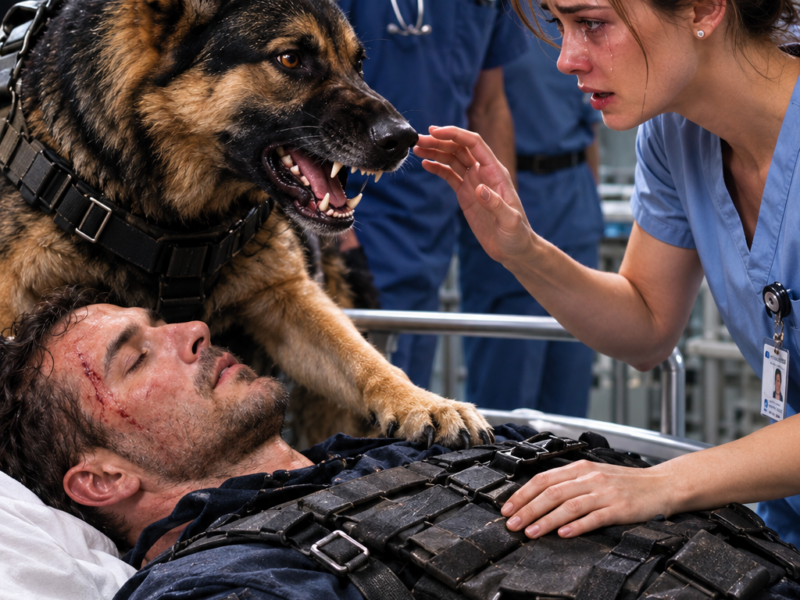
The German Shepherd had allowed three doctors to examine his unconscious handler, two nurses to check his pulse, and a paramedic to cut away the bloodstained straps of his tactical vest. But the instant a surgeon reached for the wounded Navy SEAL’s wrist, the dog stepped between them, lowered his head, and released a growl so deep that every person in the emergency room froze.
It was not the frantic barking of a frightened animal. It was a warning, deliberate and controlled, from a dog who had spent nearly his entire life learning the difference between danger and safety.
And somehow, he had decided that the man standing over his handler was not someone he could trust.
“Get that animal out of here,” Dr. Samuel Price ordered, his voice cutting through the frantic noise of the emergency department. “We cannot operate on a critically injured patient while an aggressive dog is guarding the stretcher.”
The dog did not retreat.
He stood beside the motionless soldier, his powerful body positioned between the surgeon and the hospital bed. His dark eyes never left Dr. Price, and one ear remained angled toward the injured man’s face, as though he were listening for a voice that had guided him through countless dangerous situations.
On the stretcher lay Captain Gabriel Foster, a forty-year-old Navy SEAL whose uniform was soaked with rain, dirt, and blood. His face was almost colorless beneath the fluorescent lights. A deep bruise spread across his ribs, and his breathing was shallow enough that the medical team kept watching his chest to make certain it continued moving.
The heart monitor sounded an urgent warning.
His pulse was climbing.
His blood pressure was falling.
And somewhere inside his body, an injury no one could yet see was threatening to kill him.
“Captain Foster needs immediate treatment,” Dr. Price insisted, reaching for another pair of gloves. “If that dog bites someone, we lose precious minutes.”
A security officer moved toward the animal.
The German Shepherd shifted his weight.
Nobody needed to hear another growl to understand what would happen if they tried to drag him away.
Then, from the doorway, a woman’s quiet voice interrupted the confrontation.
“Please. Don’t touch him.”
Everyone turned.
Nurse Evelyn Shaw stood just inside the emergency room, holding a stainless-steel tray of medical supplies. She was thirty-five years old, with dark chestnut hair pulled into a neat bun, gray-blue eyes, and a faint scar near her right eyebrow. Her navy scrubs were wrinkled after a long overnight shift, and exhaustion had settled beneath her eyes.
For almost seven years, Evelyn had worked at Northfield Regional Medical Center in Richmond, Virginia. Her colleagues knew her as a remarkably composed nurse, someone who rarely raised her voice even when the emergency department was overflowing with patients.
But the moment she saw the German Shepherd, the tray trembled in her hands.
She recognized the black saddle marking across his tan back.
She recognized the small notch in his left ear.
And when the dog turned slightly, revealing a thin white scar beneath his collar, Evelyn felt as though the floor had disappeared beneath her.
“Bruno?” she whispered.
The German Shepherd’s head snapped toward her.
For several seconds, he simply stared.
Then something extraordinary happened.
His rigid posture softened. His ears shifted forward, and his tail moved once, slowly, as though he were uncertain whether the person standing before him could possibly be real.
Evelyn placed the tray on a nearby counter.
She lowered herself onto one knee, keeping her hands visible.
“Easy, boy,” she murmured. “It’s me.”
The dog took one hesitant step toward her.
Then another.
Evelyn extended her hand.
Bruno pressed his nose against her fingers, inhaled deeply, and released a faint sound from the back of his throat.
It was not a warning this time.
It was recognition.
One of the younger nurses stared at them in disbelief.
“You know this dog?”
Evelyn swallowed.
“I trained with him a long time ago.”
Dr. Price looked impatiently toward the monitor.
“That’s wonderful, Nurse Shaw, but unless you can convince him to move, this patient is going to die before we discover what’s wrong with him.”
Evelyn stood.
“Then let me help.”
She stepped toward the stretcher, Bruno following closely beside her.
Only when she reached the injured man’s face did she see the identification patch on his uniform.
FOSTER.
Her heart seemed to stop.
She leaned closer.
Despite the bruising, the blood, and the years that had changed his appearance, she recognized him immediately.
“Gabriel?”
The name escaped her almost soundlessly.
Captain Gabriel Foster.
The man she had not seen in seven years.
The man who had once carried an injured soldier through a storm while Evelyn desperately tried to stop the bleeding.
The man who had been standing beside her on the night Corporal Matthew Ellis died.
Evelyn gripped the edge of the stretcher.
For a moment, the emergency room vanished around her.
She could almost hear rain hammering against a military vehicle.
She could smell wet earth and diesel fuel.
She could hear a frightened man’s voice asking her not to leave.
Then the monitor alarm sounded again, dragging her back into the present.
Evelyn looked at Gabriel’s abdomen.
Something was wrong.
Very wrong.
“His abdomen is distended,” she said sharply. “How much external blood loss have we documented?”
“Not enough to explain his pressure,” another nurse answered.
Evelyn examined the readings.
“He’s bleeding internally.”
Dr. Price stepped closer.
“We haven’t confirmed that.”
“Then we need to confirm it now. His heart rate is compensating, but his pressure is collapsing. He’s running out of time.”
The surgeon studied her face for a fraction of a second.
Then he turned to the team.
“Get the ultrasound. Activate the trauma protocol. Prepare blood products.”
The emergency room erupted into purposeful movement.
Evelyn placed her palm against Bruno’s shoulder.
“Bruno, settle.”
The dog looked up at her.
She lowered two fingers toward the floor.
It was a simple hand signal, one that had once been used during joint military medical exercises to instruct working dogs to remain calm while their handlers received treatment.
Bruno hesitated.
Then he sat.
A stunned silence briefly passed among the staff.
“Good boy,” Evelyn whispered.
She moved beside Gabriel and began helping the team prepare him for the ultrasound.
Within minutes, the examination revealed free fluid in his abdomen.
The injury was far more serious than anyone had initially realized.
Gabriel had suffered significant internal bleeding, and he needed emergency surgery.
Immediately.
As the team prepared to transfer him, Bruno rose and pressed his muzzle against Gabriel’s motionless hand.
His nose remained there for several seconds.
Evelyn watched the movement, and an old ache opened somewhere deep inside her chest.
Seven years earlier, she had watched the same dog press his nose against another injured soldier’s hand.
That soldier had never returned home.
Evelyn crouched beside Bruno.
“Listen to me,” she whispered. “Gabriel needs help. We have to take him somewhere you can’t follow.”
Bruno looked toward the operating room doors.
His tail was motionless.
“I know,” Evelyn said, her own voice beginning to break. “I know you don’t want to leave him.”
She repeated the familiar settling signal.
This time, Bruno obeyed immediately.
He lowered himself onto the floor beside her feet, but his eyes followed every movement as Gabriel disappeared through the surgical doors.
When the doors finally closed, Bruno stood and walked to the empty space where the stretcher had been.
He sniffed the floor.
Then he lay down.
His head settled between his front paws, and he stared at the doors through which his handler had vanished.
Evelyn remained beside him longer than she intended.
Because she understood something about that kind of waiting.
She had spent seven years doing almost exactly the same thing.
Waiting for an answer from someone who would never come back.
Before Evelyn became a civilian nurse, she had served as a Navy hospital corpsman attached to military medical support units. Her work had taken her to remote training grounds, temporary treatment stations, and evacuation sites where the line between life and death was often measured in minutes.
She had learned to recognize shock from the color of a man’s skin.
She could identify dangerous bleeding before laboratory results confirmed it.
She knew how to work with limited equipment, how to remain calm while someone screamed in pain, and how to tell frightened soldiers that she was doing everything she could without promising they would survive.
Yet none of that training had prepared her for losing Matthew Ellis.
Matthew was twenty-eight when he died.
He was the sort of man who could find humor in almost any miserable situation. He complained about military coffee but drank more of it than anyone else. He volunteered for unpleasant assignments, then spent the entire time describing how much he hated them.
He was stubborn, generous, frequently late, and incapable of walking past damaged equipment without trying to repair it.
Most importantly, he was Evelyn’s friend.
They had met during a medical support exercise, when Matthew noticed her struggling to repair a malfunctioning field radio.
Without introducing himself, he sat beside her, took the radio apart, and somehow made the problem worse.
Evelyn had stared at the scattered components.
“You’ve destroyed it.”
Matthew grinned.
“Technically, I’ve made the problem easier to identify.”
She had laughed despite herself.
That was how their friendship began.
Over the following months, they shared exhausting training days, late meals, and long conversations about the lives they hoped to build once their military careers ended.
Matthew wanted a small house near the mountains.
He wanted a garage where he could repair old motorcycles.
He wanted to adopt a dog that would spend its days sleeping in the sun.
Evelyn used to tease him that he was far too restless for such a quiet life.
“Maybe,” he would answer. “But I’d like the chance to find out.”
Gabriel Foster had been part of that same military world.
He was older than Matthew, more reserved, and accustomed to making difficult decisions under pressure. His reputation was built on discipline and reliability rather than dramatic speeches.
Bruno, then a younger German Shepherd, had been assigned to him as a military working dog.
During joint training exercises, Gabriel and Evelyn had worked together to teach Bruno how to remain composed around injured personnel.
The dog was exceptionally intelligent but protective of his handler, especially when Gabriel was lying down or unable to issue commands.
Evelyn developed a simple hand signal to settle him during medical simulations.
Two fingers lowered toward the ground.
Gabriel used to joke that Bruno obeyed Evelyn more readily than he obeyed him.
“Maybe he recognizes competent leadership,” Evelyn would reply.
Matthew would laugh so hard that Gabriel eventually stopped making the joke.
Those were the memories Evelyn rarely allowed herself to revisit.
Because they belonged to a time before the storm.
The accident happened during a nighttime training exercise on a remote mountain road.
Heavy rain had been falling for hours.
The road was narrow, its shoulders weakened by runoff, and visibility had deteriorated until headlights reflected back from a curtain of water.
A military transport vehicle carrying several servicemen approached a damaged roadside barrier.
The driver attempted to correct his course after the tires slipped.
The vehicle struck the barrier, twisted sideways, and came to rest partly across the road.
Several men were injured.
One was trapped near the rear compartment.
That man was Matthew Ellis.
Gabriel had been traveling with another support team when the emergency call came through.
He and Bruno reached the scene before the medical evacuation vehicle.
By the time Evelyn arrived, Gabriel was kneeling in the mud beside Matthew, pressing a dressing against a severe wound.
“He’s losing blood,” Gabriel shouted over the rain.
Evelyn dropped to her knees.
Matthew was pale, but still conscious.
He recognized her.
“Well,” he managed weakly, “this is embarrassing.”
Evelyn cut away the fabric around his injury.
“Save your energy.”
“I’ve had worse days.”
“No, you haven’t.”
Matthew tried to smile.
“Fair point.”
She worked quickly.
The rain soaked through her gloves.
Mud covered her sleeves.
Every time she thought the bleeding was controlled, fresh blood appeared.
Gabriel remained beside her, applying pressure and following instructions.
Bruno stayed a few feet away, alert to the confusion surrounding them.
For a brief moment, Evelyn believed Matthew might survive.
Then the road began to collapse.
Water had undermined part of the embankment.
A section of the damaged barrier shifted, and stones tumbled down the slope.
The evacuation team ordered everyone to move toward a safer collection point farther along the road.
There were several injured servicemen, but only one evacuation vehicle immediately available.
Gabriel was also hurt, though he had initially concealed the severity of his injuries. He had struck his side during the rescue and was beginning to struggle to remain upright.
Another serviceman near the access road had serious injuries requiring urgent transport.
The evacuation team had to make decisions quickly.
Matthew was moved toward the collection point with the help of Gabriel and the medics, but his condition continued deteriorating. A separate team was preparing to receive him while Evelyn was directed to help evacuate another casualty.
She remembered Matthew catching her sleeve.
“Hey, Shaw.”
She turned.
“What?”
He looked at her for a moment.
His voice was unusually serious.
“Don’t do anything stupid.”
Evelyn squeezed his shoulder.
“That’s your department.”
He gave her a faint smile.
Then someone called her name.
She turned toward the second injured man.
Within minutes, the situation became chaotic.
A section of the access road was declared unsafe.
The medical team was ordered to withdraw from the exposed area until engineers could confirm another route.
Evelyn protested.
Matthew was still in danger.
He needed definitive treatment.
She wanted to return.
The team leader refused.
“Shaw, you have another casualty to move. That’s an order.”
Evelyn remembered shouting that Matthew could not wait.
She remembered being told that another team was already attending him.
She remembered the rain, the darkness, and the unbearable feeling of leaving unfinished work behind.
Eventually, she followed the order.
She helped move the second casualty.
She assisted Gabriel, whose injuries had become more apparent.
She reached the safe collection area.
Matthew never did.
He died after being transferred to another medical team.
The official investigation found no misconduct. The evacuation had been conducted under dangerous conditions, and the personnel involved had followed the instructions and information available to them.
But that conclusion meant almost nothing to Evelyn.
She had heard Matthew’s voice.
She had seen his face.
She had promised him they would get him out.
And he had died.
For months afterward, she replayed the evacuation in her mind.
What if she had refused to withdraw?
What if she had found another vehicle?
What if she had stayed beside him?
What if she had challenged the order sooner?
The questions became relentless.
She stopped sleeping properly.
She avoided gatherings with former colleagues.
She no longer enjoyed the memories that once made her smile.
Eventually, she left military service and retrained as a civilian nurse, hoping that a different environment might create enough distance between her and the night that haunted her.
It did not.
Even after she built a new life in Richmond, part of her remained on that rain-soaked road.
She never told her coworkers why she sometimes stayed with critically ill patients long after her shift ended.
She never explained why she could not bear to leave a frightened family waiting alone for news.
She had quietly convinced herself that if she worked hard enough, if she saved enough people, perhaps one day she might feel that she had made up for failing Matthew.
But the guilt never disappeared.
Until the night Gabriel Foster arrived at Northfield Regional Medical Center.
Nearly three hours after he was taken into surgery, Dr. Price emerged from the operating suite.
Evelyn was standing near the nurses’ station.
She had completed her charting, assisted with two new admissions, and checked on several patients, but her eyes had repeatedly drifted toward the surgical corridor.
The moment she saw the surgeon, she approached him.
“How is he?”
Dr. Price removed his surgical cap.
“We found significant internal bleeding caused by abdominal trauma. We controlled it, but he’d lost a substantial amount of blood before reaching us.”
Evelyn felt her stomach tighten.
“Is he going to survive?”
“He’s stable for now. The next twenty-four hours are important, but I’m cautiously optimistic.”
She released a shaky breath.
“Thank you.”
Dr. Price studied her.
“You know him, don’t you?”
Evelyn hesitated.
“We served together.”
The doctor nodded.
“And the dog?”
“We trained together, too.”
Before he could ask another question, a man in a dark military uniform approached them.
He was tall, silver-haired, and carried himself with the unmistakable bearing of someone accustomed to command.
“Excuse me,” he said. “I’m Lieutenant Colonel Peter Lang. I’m looking for Nurse Evelyn Shaw.”
Evelyn turned.
“That’s me.”
The officer’s expression changed.
“Captain Foster asked that you be contacted if he became conscious.”
A cold sensation passed through her.
“He asked for me?”
“Yes.”
“Why?”
Lang hesitated.
“He’s been trying to find you for several months.”
Evelyn stared at him.
“That doesn’t make sense.”
“He attempted to reach you through military channels, but the contact information in your former service records was outdated.”
“How did he know I worked here?”
“He didn’t. Not until recently.”
Evelyn folded her arms.
“Why was he coming to Richmond?”
Lang looked toward the recovery corridor.
“Captain Foster was traveling to meet someone who might help him resolve a matter from an old military evacuation. He became unwell during the journey after suffering an injury earlier that day. His condition deteriorated rapidly.”
“What kind of matter?”
The officer studied her expression.
“Corporal Matthew Ellis.”
The name struck her harder than she expected.
For several seconds, she could not speak.
Then she whispered, “What about him?”
Lang reached inside his jacket and removed a sealed envelope.
Evelyn’s name was written across the front in familiar handwriting.
“Captain Foster gave me this before we left. He said that if anything happened to him, I should make certain you received it.”
She accepted the envelope.
Her fingers felt strangely numb.
“What is it?”
“I believe you’d better read it.”
Lang stepped away, leaving Evelyn alone beside the corridor.
She stared at the envelope.
For seven years, she had tried to bury the past.
Now it was standing in front of her, written in the handwriting of a man who had witnessed the worst night of her life.
She broke the seal.
Inside was a single sheet of paper.
The message was short.
Evelyn, I know you have spent years believing you left Matthew behind. But there are things you never knew about that night. Things he said after you were evacuated. I need to tell you what happened, and I need you to hear it from someone who was there. Please don’t decide what it means until we’ve spoken. Gabriel.
Evelyn read the note again.
Then a third time.
She felt her throat tighten.
What could Matthew possibly have said?
Had he been angry?
Had he asked why she had left?
Had he called for her when she was already gone?
Her mind immediately filled the silence with the answers she had feared for years.
A faint whine interrupted her thoughts.
Bruno was watching from the supervised waiting area where hospital staff had settled him.
His ears were raised, and his eyes followed her every movement.
Evelyn approached him.
The dog stood and pressed his muzzle against her palm.
“Do you remember that night?” she whispered.
Bruno looked toward the surgical corridor.
Evelyn rested her hand against his head.
“Of course you do.”
The following morning, shortly after six, Lieutenant Colonel Lang found Evelyn near the nurses’ station.
“Captain Foster is awake.”
She looked up immediately.
“Is he stable?”
“Yes. He’s weak, but his doctors are pleased with his progress.”
Evelyn placed her pen on the desk.
“Did he ask to see me?”
Lang nodded.
“He did.”
She had barely slept.
Her shift was nearly over.
But she knew there was no possibility of going home without hearing what Gabriel had come to tell her.
When she entered his recovery room, Gabriel was sitting slightly upright against several pillows.
He looked older than she remembered.
There were faint lines around his eyes, and a few strands of gray had appeared at his temples. His face was pale, and the effort of speaking seemed to require more energy than he wanted to admit.
Beside his bed, Bruno lay on a padded mat.
The dog immediately lifted his head.
Evelyn managed a small smile.
“Good morning, troublemaker.”
Bruno rose and approached her, pressing his shoulder against her leg.
Gabriel watched them.
“He hasn’t greeted anyone like that in years.”
“He’s always had good taste.”
A tired smile touched Gabriel’s face.
“Some things never change.”
For a moment, the room felt almost familiar.
Then Evelyn remembered why she was there.
She pulled a chair beside the bed.
“Gabriel, why did you come looking for me?”
His expression grew serious.
“Because I found something about Matthew.”
She held up the letter.
“I read your note.”
“I know.”
“What did he say?”
Gabriel took a slow breath.
“Before I tell you, I need you to understand something. I didn’t come here to reopen an investigation or accuse anyone of making the wrong decision.”
Evelyn looked down.
“The official review already established that.”
“I know. But the official review didn’t include everything.”
He paused to gather his strength.
“After you left the evacuation site, Matthew was treated by another medic. The communication systems were damaged, and several reports from that night were stored separately.”
Evelyn leaned forward.
“Go on.”
“Last year, during a review of archived unit records, we found a written account from the medic who stayed with Matthew.”
Her hands tightened in her lap.
“What did it say?”
Gabriel looked directly at her.
“Matthew kept asking whether you’d made it out safely.”
Evelyn blinked.
“What?”
“He wanted to know if you’d reached the collection point.”
She stared at him.
“Why?”
“Because the road was collapsing. He knew you wanted to come back. He was afraid you might try.”
Tears gathered in her eyes.
Gabriel continued.
“When the medic told him you were safe, Matthew was relieved.”
Evelyn shook her head slowly.
“No.”
“Yes.”
“Gabriel, I left him.”
“You followed an evacuation order.”
“He needed me.”
“He knew that you were helping another injured man.”
Her voice began trembling.
“But he died.”
Gabriel looked at her with quiet sadness.
“He did.”
The simple acknowledgment made it harder to hold back her tears.
For seven years, people had tried to reassure Evelyn by telling her she had done everything she could.
She had hated those words.
They sounded like excuses.
They sounded like something people said because they couldn’t bear to discuss the truth.
But Gabriel did not try to erase what had happened.
He did not pretend Matthew’s death was anything less than a tragedy.
He simply reached toward a folder on his bedside table.
“Read this.”
Evelyn opened it.
The first pages contained familiar details of the evacuation.
Then she found a handwritten statement from a medic named Daniel Mercer.
The paper had been copied from an archived notebook.
The handwriting was cramped and uneven, but the account was clear.
Corporal Ellis repeatedly asked whether Petty Officer Shaw had reached the safe area. When informed that she had evacuated with another casualty, he appeared visibly relieved. He stated that Shaw had followed her instructions and requested that she not be held responsible for his condition or the outcome of the evacuation.
Evelyn read the paragraph several times.
Her vision blurred.
She closed the folder.
“I thought he hated me.”
Gabriel looked startled.
“Matthew?”
“I thought he died believing I abandoned him.”
“No, Evelyn.”
“I kept imagining him asking where I was.”
Gabriel shook his head.
“He was asking whether you were safe.”
That was when Evelyn began to cry.
Not loudly.
Not dramatically.
The tears simply appeared, slipping down her cheeks as she sat beside the bed and struggled to understand how seven years of certainty could suddenly become so fragile.
Gabriel waited.
Bruno approached her chair and rested his muzzle against her knee.
Evelyn placed a trembling hand on his head.
“I don’t understand,” she whispered. “Why didn’t anyone tell me?”
“Because no one connected the medic’s account to your original records until much later. It was filed under a different treatment team.”
“And you spent months looking for me?”
Gabriel nodded.
“Once I found the statement, I remembered how you looked when you left the evacuation site.”
She raised her eyes.
“What do you mean?”
“You were desperate to go back. Even after the road was declared unsafe, you kept trying to find another way.”
Evelyn remembered the argument.
The shouted orders.
The exhaustion.
The moment she realized she had no choice but to withdraw.
Gabriel continued.
“I never forgot that. And I couldn’t stand the thought that you might still believe you’d failed him.”
She pressed her palms against her eyes.
“Did you blame me?”
“No.”
“Not even for a moment?”
Gabriel was silent for a second.
Then he answered carefully.
“I blamed myself.”
Evelyn looked at him.
“Why?”
“Because I couldn’t help him more. I was injured, but I kept thinking that if I’d been stronger, if I’d been able to stand, maybe I could have carried him farther.”
He gave a small, humorless smile.
“I spent years asking myself the same questions you did.”
Evelyn stared at him.
Gabriel looked toward the window.
“Eventually, I realized something. Feeling responsible for someone doesn’t mean you controlled what happened to them.”
The room became quiet.
Then he added, “Matthew knew we cared about him. He knew we were trying.”
Evelyn looked down at the folder.
For the first time in seven years, she allowed herself to consider a possibility that had always seemed impossible.
Perhaps Matthew’s final thoughts had not been filled with disappointment.
Perhaps he had understood.
Perhaps he had trusted her.
That afternoon, Lieutenant Colonel Lang returned with another piece of information.
An old field recorder had been recovered from the damaged equipment used during the evacuation.
The audio was badly distorted, but technicians had managed to restore several sections.
Some of the voices remained unintelligible.
Others were unmistakable.
One belonged to Matthew Ellis.
When Lang explained this, Evelyn felt the familiar fear return.
Gabriel had not yet listened to the entire recording.
He wanted them to hear it together.
Evelyn agreed.
Later that day, she returned to Gabriel’s room carrying the restored audio file on an approved device.
Bruno lay beside his handler’s bed.
As she entered, he lifted his head and watched her.
Gabriel noticed the device.
“Are you ready?”
Evelyn sat down.
“No.”
He nodded.
“Neither am I.”
For a moment, neither moved.
Then Evelyn pressed play.
Static filled the room.
A faint voice gave instructions about moving a casualty.
Another voice answered, distorted almost beyond recognition.
There was a burst of interference.
Then Matthew spoke.
“Vehicle is clear. We’ve got one moving now.”
Evelyn closed her eyes.
Seven years had passed, but she knew that voice instantly.
She had heard it laughing over terrible coffee.
She had heard it teasing her during exhausting exercises.
She had heard it making jokes even while injured.
Now it was coming from a recording made only minutes before his death.
The audio crackled again.
Then Matthew’s voice returned.
“Tell Shaw not to come back for me.”
Evelyn’s eyes opened.
Gabriel sat motionless.
“The route isn’t safe,” Matthew continued.
There was another burst of static.
A second voice answered, but the words were lost.
Then Matthew spoke again.
“If she can get the other man out, that’s what matters. Don’t send anyone back just because I asked.”
Evelyn covered her mouth.
Her chest tightened painfully.
She could barely breathe.
The recording continued.
Matthew’s voice sounded weaker now.
“She’ll blame herself.”
A pause.
“She always thinks there’s another thing she could’ve done.”
Evelyn began crying.
Then came the words that would remain with her for the rest of her life.
“Tell her I said she did enough.”
The recording crackled.
A faint voice responded.
Then Matthew spoke one final time.
“That’s an order, not a suggestion.”
The audio ended.
For several seconds, neither Evelyn nor Gabriel said anything.
The hospital room seemed impossibly quiet.
Outside, footsteps passed along the corridor. Someone laughed near the nurses’ station. A cart rolled over the tiled floor.
Ordinary life continued.
But Evelyn felt as though the world she had inhabited for seven years had shifted beneath her feet.
Matthew had known.
He had known exactly what she would do.
He had known she would blame herself.
And even while fighting for his own life, he had tried to protect her from the burden she would eventually carry.
Evelyn lowered her head.
“I kept thinking I should have gone back.”
Gabriel reached for a tissue box and placed it beside her.
“He knew you would.”
She laughed weakly through her tears.
“That sounds like him.”
“It does.”
“He was always telling people what to do.”
Gabriel smiled faintly.
“Usually when nobody asked.”
For a moment, they both laughed.
Then Evelyn looked toward the silent recorder.
“I still wish he had survived.”
Gabriel’s expression softened.
“So do I.”
“I don’t think that feeling will ever go away.”
“It doesn’t have to.”
She looked at him.
He continued quietly.
“You can wish we’d saved him without believing you failed him. Those aren’t the same thing.”
Evelyn sat silently for a long time.
She had expected the truth to erase her guilt.
Instead, it did something more complicated.
It gave her permission to remember Matthew differently.
Not only as the man who had died.
But as the friend who had known her well enough to understand the impossible burden she would place upon herself.
Over the following days, Gabriel slowly recovered.
His color returned.
He began taking short walks along the hospital corridor, first with assistance and later on his own, under the supervision of his medical team.
Bruno remained nearby whenever hospital arrangements allowed.
The older dog had settled into a calmer routine, but his devotion never wavered.
Whenever Gabriel stood, Bruno stood.
Whenever Gabriel sat, Bruno positioned himself beside the chair.
Whenever a nurse entered with medication, Bruno watched with the serious expression of an inspector evaluating an unfamiliar employee.
Evelyn began visiting them when her duties allowed.
At first, their conversations focused on the evacuation.
They talked about the road, the rain, the rescue, and the confusion that had followed.
But gradually, the past stopped occupying every moment.
Gabriel told her about his years of military service and the injuries that had finally forced him to consider a quieter future.
He described Bruno’s gradual transition away from full-time operational duties.
The dog was getting older.
His muzzle had turned gray, and his joints were becoming stiff after long walks.
Yet Gabriel insisted that Bruno still believed retirement was a disciplinary punishment.
“He refuses to let me leave the house without him,” Gabriel said one afternoon.
Evelyn scratched Bruno behind his left ear.
“Maybe he doesn’t trust you to make good decisions alone.”
“After what happened to me, he may have a point.”
Their laughter came more easily with each passing day.
Evelyn told Gabriel about her work at Northfield Regional.
She spoke about the elderly patients who reminded her of her grandparents, the children who left drawings at the nurses’ station, and the families whose gratitude sometimes arrived in handwritten cards months after a loved one had recovered.
She admitted that some nights were still difficult.
Gabriel did not try to fix that.
He simply listened.
One evening, while Bruno slept beside the bed, Gabriel asked her a question.
“Have you ever considered returning to military medicine?”
Evelyn shook her head.
“Not seriously.”
“Why not?”
She considered the answer.
“For a long time, I thought leaving the military was the only way I could stop thinking about Matthew.”
“Did it work?”
She looked toward the window.
“No.”
Gabriel nodded.
“Maybe you weren’t trying to escape the military.”
“What was I trying to escape?”
He looked at her gently.
“The version of yourself you believed you’d become that night.”
Evelyn said nothing.
His words stayed with her long after she left the room.
On the morning of Gabriel’s discharge, Evelyn found him sitting on the edge of his bed while another nurse reviewed his recovery instructions.
Bruno stood beside him in his working harness.
The dog looked pleased to be preparing for departure.
Gabriel looked exhausted but relieved.
Evelyn smiled.
“Ready to get out of here?”
“More than you know.”
“Try not to end up back in my emergency room.”
“I’ll do my best.”
She was about to leave when Gabriel called her name.
“Evelyn.”
She turned.
“There’s something else.”
His expression had become serious.
He opened the bedside cabinet and removed a small envelope.
Unlike the first letter, this envelope was old.
Its edges were worn, and the paper had yellowed slightly with age.
Evelyn noticed her name written across the front.
But it was not Gabriel’s handwriting.
She knew the writing immediately.
Her breath caught.
“Where did you get that?”
Gabriel held the envelope carefully.
“Matthew’s sister sent it to me last year.”
Evelyn stared.
“Why?”
“She was sorting through some of his personal effects. The envelope had been returned to the family after the investigation. She didn’t know whether it had ever been delivered.”
He paused.
“When she saw your name, she remembered that Matthew used to mention you.”
Evelyn slowly reached for it.
“Did you read it?”
“No. It’s addressed to you.”
Her hands trembled as she turned the envelope over.
Beneath her name, Matthew had written another line.
For Evelyn, if she ever forgets what she did right.
She pressed her fingers against the words.
For several seconds, she could not speak.
Then she sat down.
Gabriel remained beside her.
Bruno moved closer, resting against the side of her chair.
Evelyn carefully opened the envelope.
Inside was a folded letter.
The handwriting was unmistakable.
Matthew had always pressed too hard with his pen, leaving faint impressions on the reverse side of the paper.
His letters leaned forward as though even his handwriting was impatient.
She unfolded the page.
And began to read.
“Evelyn, if you’re reading this, somebody finally convinced you to stop carrying the entire world on your shoulders for five minutes.”
A broken laugh escaped her.
She covered her mouth.
“That’s him.”
Gabriel smiled.
“Sounds like it.”
She continued.
“You keep telling everyone that a good medic never leaves someone behind. I know why you believe that. You’ve seen things most people never have to see. You’ve watched people suffer, and you think that if you work hard enough, stay long enough, and make the right decision every single time, you can somehow guarantee that nobody else will die.”
Evelyn stopped.
Her eyes filled.
She took a breath and continued reading.
“But you can’t control everything, Shaw. None of us can. We train because we want to give people the best possible chance, not because we can promise the ending.”
The next lines were written more heavily.
“That night, I knew the route was becoming unsafe. I knew another casualty needed help. And I knew you were going to argue with anyone who told you to leave.”
Evelyn smiled through her tears.
Matthew had known her too well.
“If you’d come back for me, I would’ve used whatever strength I had left to send you away again. Not because I didn’t want to live. Believe me, I did. But because I didn’t want somebody else getting hurt trying to change something we couldn’t control.”
Evelyn pressed the paper against her chest.
She closed her eyes.
Gabriel waited patiently.
After a moment, she opened the letter again.
“You didn’t abandon me. You did the job we trained for. You got someone to safety, and you trusted the others to do their part. If things go wrong for me, I need you to remember that.”
Her tears fell onto the page.
She moved the letter slightly to protect the writing.
Then she read the paragraph that changed something deep inside her.
“Don’t turn one terrible night into the measure of every good thing you’ve ever done. Don’t leave medicine because you’re afraid of failing somebody again. The people who need you tomorrow deserve the medic you are, not the person you think you should have been.”
Evelyn stopped breathing for a moment.
She had left military medicine because she believed Matthew’s death proved she was not good enough.
She had spent seven years working harder than everyone around her, desperately trying to become the person she thought might deserve forgiveness.
And Matthew, somehow, had understood exactly what she would do.
The final paragraph was shorter.
“If I don’t get the chance to tell you this myself, let this letter do it. You were a good friend, Evelyn. You were a good medic. You did enough. Matthew.”
Evelyn lowered the page.
For a long time, she could not speak.
The morning sunlight moved slowly across the hospital floor.
Bruno rested his head against her knee.
Gabriel remained beside her, allowing the silence to belong to Matthew.
Finally, Evelyn whispered, “I don’t know what to do with this.”
Gabriel looked at her.
“You don’t have to do anything with it today.”
She looked down at the letter.
“I thought finding out what he said would make everything better.”
“Did it?”
She considered the question.
“No.”
Gabriel nodded.
Then Evelyn added, “But it made something different.”
“What?”
She looked at him through her tears.
“For the first time, I can remember that night without wondering whether Matthew hated me.”
Gabriel’s eyes softened.
“That’s a beginning.”
Evelyn folded the letter carefully.
“I wish he were here.”
“So do I.”
Neither spoke for a while.
They understood that the letter had not changed the past.
Matthew was still gone.
The accident had still happened.
There would still be birthdays he never celebrated, places he never visited, and ordinary moments he never had the chance to experience.
But the letter had changed the meaning Evelyn attached to his absence.
It had given her a memory of Matthew that was not built entirely around death.
Later that morning, Evelyn walked Gabriel to the hospital entrance.
Bruno remained close beside his handler, moving more slowly than he had seven years earlier but with the same quiet determination.
Outside, the sky was clear.
Sunlight fell across the pavement.
Gabriel stopped near the waiting vehicle.
“I should’ve found you sooner.”
Evelyn shook her head.
“You found me when you could.”
He looked at her for a moment.
“Are you going to be all right?”
For years, Evelyn had answered that question automatically.
Of course.
I’m fine.
Don’t worry about me.
But this time, she chose to tell the truth.
“Some days are still going to hurt.”
Gabriel nodded.
“I know.”
“And I think I’ll always miss him.”
“Me too.”
She looked down at the envelope in her hand.
“But I don’t think I’m going to punish myself for every difficult day anymore.”
Gabriel smiled.
“Matthew would’ve liked that.”
Evelyn laughed softly.
“He would’ve told me I was being dramatic.”
“Definitely.”
Bruno stepped toward her.
She crouched and wrapped one arm around his shoulders.
The old dog pressed his head against her chest.
She scratched the familiar spot behind his notched ear.
“You did well, old boy.”
His tail moved slowly.
Gabriel watched them.
“He remembered you before I even knew you were here.”
Evelyn smiled.
“Some dogs never forget the people who matter.”
Gabriel looked down at Bruno.
“Or maybe he just remembered who used to sneak him extra treats.”
She laughed.
And for the first time in years, laughter did not immediately bring guilt.
They said goodbye without dramatic promises.
Gabriel still faced a long recovery.
Evelyn still had grief to work through.
Matthew would remain absent from every future conversation in which they wished they could hear his voice.
But something had changed.
As Gabriel and Bruno walked toward the waiting vehicle, Evelyn no longer felt as though she were watching someone leave a place where she should have remained.
She was simply saying goodbye to a friend.
In the weeks that followed, Evelyn kept Matthew’s letter in the top drawer of her bedside table.
At first, she read it almost every night.
Sometimes she cried.
Sometimes she smiled at his familiar humor.
Sometimes she sat quietly, tracing the shape of his handwriting with one finger.
Eventually, she stopped feeling that she needed to read it constantly.
The letter was still there.
The truth was still there.
And slowly, she began learning how to live without putting herself on trial every time she remembered Matthew.
Her colleagues noticed small changes.
She still worked hard.
She still stayed with frightened patients and offered comfort to families receiving difficult news.
But she began taking her breaks.
She stopped volunteering for every extra shift.
When a patient died despite the medical team’s best efforts, she allowed herself to feel sorrow without immediately searching for a mistake she might have made.
One afternoon, she cared for a middle-aged man recovering from a serious traffic accident.
He had been driving when his vehicle struck a barrier, injuring both himself and his wife.
Although his wife’s injuries were healing, the man was overwhelmed by guilt.
He refused to look at her when she visited.
He believed he had destroyed their lives.
Evelyn found him staring silently at the hospital window.
“Your wife was here again this morning,” she said gently.
He looked away.
“I don’t deserve her.”
Evelyn adjusted his pillow.
“You don’t have to decide what you deserve while you’re still recovering.”
He frowned.
“You don’t understand. I made a terrible mistake.”
She sat beside him.
“Maybe you did.”
The answer surprised him.
She continued.
“Taking responsibility for a mistake matters. But deciding that one terrible moment is the entire story of who you are doesn’t help anyone heal.”
The man looked toward the door.
“My wife says she forgives me.”
“Have you listened to her?”
He lowered his eyes.
“I don’t know how.”
Evelyn thought of Matthew’s letter.
“Maybe start by believing she knows her own heart.”
The man was quiet for a long time.
Then he asked whether Evelyn could call his wife.
She did.
And when the woman returned, Evelyn stepped outside the room, leaving them to speak privately.
Standing in the corridor, she realized how much had changed.
She had spent years offering others the compassion she refused to give herself.
Now, at last, she was learning to accept some of it.
Two months after Gabriel’s discharge, a letter arrived at Northfield Regional.
Inside was a photograph.
Gabriel stood in a sunlit backyard, looking healthier, though still slightly stiff in his posture.
Beside him sat Bruno.
The German Shepherd wore an ordinary collar instead of his working harness.
His ears were raised, and his expression was so serious that Evelyn laughed the moment she saw him.
On the back of the photograph, Gabriel had written a message.
“The doctors say I’m making good progress. Bruno has appointed himself director of rehabilitation and is extremely strict about walking schedules. I hope you’re doing well. And I hope you’re giving yourself some of the patience you’ve spent your life giving everyone else.”
Evelyn smiled.
She placed the photograph beside Matthew’s letter.
For the first time, she realized that remembering Matthew did not have to mean returning to the worst night of her life.
She could remember the man who had once ruined a perfectly repairable radio.
The friend who complained about coffee but drank it constantly.
The soldier who dreamed of repairing motorcycles in a little house near the mountains.
The man who had understood her better than she understood herself.
She began looking at old photographs again.
She contacted people she had avoided for years.
She even attended a small gathering of former service members.
At first, the familiar faces and conversations brought back painful memories.
But then someone mentioned Matthew.
Another veteran remembered how he once repaired a broken generator using parts that supposedly belonged to a coffee machine.
Someone else described a disastrous cooking attempt during a field exercise.
Soon, everyone was laughing.
Evelyn found herself laughing with them.
And for once, she did not feel that the laughter diminished what they had lost.
It honored the life Matthew had lived.
That evening, she returned home and opened the drawer containing his letter.
She unfolded it under the bedside lamp.
Near the bottom of the page, beneath his signature, she noticed a faint line written in smaller letters.
She had overlooked it before.
“And Evelyn, when you help someone tomorrow, don’t do it because you owe me. Do it because they’re here, and you are too.”
She read the sentence twice.
Then she sat very still.
For seven years, she had believed that every life she helped save was part of a debt she owed Matthew.
But he had never wanted to become a debt.
He had wanted her to live.
He had wanted her to keep helping people because that was who she was.
Not because she needed to pay for something.
That winter, Evelyn joined a regional volunteer program supporting retired military working dogs and their handlers.
The organization helped former service members and their animals adjust to civilian life, providing practical resources, access to veterinary care, and support during the transition away from military routines.
Evelyn did not believe that dogs could magically erase trauma.
She knew better.
But she also understood the extraordinary comfort that could come from the quiet presence of an animal who had shared years of danger, uncertainty, and loyalty.
During her first volunteer session, she met a retired German Shepherd named Ranger.
The dog stood rigidly beside his handler while a veterinarian examined an old leg injury.
The handler apologized repeatedly.
“He’s not usually like this.”
Evelyn crouched a comfortable distance away.
“He’s somewhere unfamiliar. Give him time.”
She did not reach for the dog.
She did not demand his trust.
She simply waited.
After several minutes, Ranger approached her and cautiously sniffed her fingers.
Evelyn smiled.
“Hello, handsome.”
The dog’s tail moved.
His handler released a relieved breath.
“You seem to understand him.”
Evelyn thought of Bruno standing guard beside Gabriel’s stretcher.
She remembered the notch in his ear, his gray muzzle, and the moment he recognized her after seven years apart.
“I understand that trust matters,” she answered.
As the months passed, Evelyn continued volunteering.
She helped organize support sessions, coordinated with experienced trainers, and spoke with families adjusting to life after military service.
She discovered that the transition could be difficult for both handlers and dogs.
Some animals struggled with unfamiliar routines.
Some veterans found it hard to let go of the structure that had defined their lives.
Others carried memories they rarely discussed.
Evelyn learned to listen without assuming she understood every experience.
She did not tell people that time would heal everything.
She did not promise their sadness would disappear.
She simply tried to help them feel less alone.
One afternoon, after a volunteer session, she sat on a bench outside the training center.
She opened an old photograph on her phone.
Matthew stood beside a military medical vehicle, grinning toward someone outside the frame.
His sleeves were rolled up, and his uniform was dusty.
For years, Evelyn had avoided that photograph because it reminded her of everything he had lost.
Now she studied his smile.
She remembered how alive he had been.
How stubborn.
How ridiculous.
How kind.
“I’m trying, Matthew,” she whispered.
There was no answer.
She did not expect one.
She simply put the phone away and returned to work.
A year after Gabriel’s emergency admission, Evelyn received another message.
It contained a photograph of Bruno lying in a broad patch of afternoon sunlight.
His gray muzzle rested against a folded blanket, and a pair of muddy walking boots stood nearby.
Gabriel had written, “He still thinks he’s responsible for every decision I make. Retirement has changed absolutely nothing.”
Evelyn laughed and typed a reply.
“Tell him he’s earned the right to take a day off.”
Gabriel answered almost immediately.
“I tried. He ignored me.”
She smiled at the screen.
Then she glanced toward the bedside drawer.
Matthew’s letter was inside.
She no longer needed to open it every time the past returned.
Some nights were still difficult.
Certain dates still brought tears.
Occasionally, a sudden storm would remind her of rain striking the roof of a military vehicle, and for a moment she would feel the old fear gathering inside her.
But those moments no longer swallowed every other memory.
She had learned that grief could remain without becoming punishment.
That love could continue without demanding suffering.
And that surviving a terrible night did not mean she had to spend the rest of her life living inside it.
Months later, Evelyn received an invitation to a small gathering celebrating the retirement of several military working dogs.
Gabriel and Bruno would be there.
She accepted.
The event took place on a quiet afternoon in a park outside Richmond.
Families gathered beneath the trees.
Veterans stood beside dogs who had served faithfully for years.
Some of the animals were still energetic, pulling toward unfamiliar smells and wagging their tails at anyone willing to offer attention.
Others moved slowly, their age visible in every careful step.
Evelyn spotted Gabriel near a wooden bench.
He looked healthier than he had in the hospital.
Bruno sat beside him, wearing a plain leather collar.
The moment the dog noticed Evelyn, his ears rose.
Then he stood.
Gabriel looked down.
“What is it, boy?”
Bruno began walking toward her.
Evelyn crouched with a smile.
“Well, look who remembers me.”
The old German Shepherd approached, pressed his head against her shoulder, and allowed her to wrap both arms around his neck.
She closed her eyes.
For a moment, she remembered the emergency room.
The alarms.
Gabriel’s pale face.
The dog standing guard.
She remembered how close they had come to losing another friend.
Then she opened her eyes and saw Gabriel walking toward them.
“He’s been looking for you,” Gabriel said.
Evelyn smiled.
“Has he?”
“Every time someone arrives, he checks.”
She looked at the dog.
“Still on duty, aren’t you?”
Bruno wagged his tail.
They spent the afternoon talking.
Gabriel told her about his continued recovery, his plans for retirement, and the small routines he and Bruno had developed together.
Evelyn spoke about her volunteer work and the patients who had changed her understanding of forgiveness.
Eventually, Gabriel asked about Matthew.
“Do you still read his letter?”
“Sometimes.”
“Does it help?”
Evelyn thought for a moment.
“Yes. But not in the way I expected.”
Gabriel waited.
“I used to think healing meant reaching a day when I wouldn’t miss him anymore.”
She looked toward the trees.
“Now I think it means being able to miss him without forgetting everything else.”
Gabriel nodded slowly.
“That sounds right.”
Evelyn watched Bruno settle in the grass.
The dog stretched his front paws and lowered his head into the sunlight.
“He brought us back together,” she said.
Gabriel smiled.
“He certainly picked a dramatic way to do it.”
She laughed.
“That’s true.”
For several minutes, they sat quietly.
Children played in the distance.
A gentle breeze moved through the trees.
Bruno slept at their feet.
And Evelyn found herself thinking about how strange life could be.
Seven years earlier, she had walked away from a rain-soaked road believing she had failed someone she loved.
Seven years later, a loyal German Shepherd had refused to leave his injured handler’s side, forcing her to confront a past she had spent years avoiding.
The dog had not understood the records, the letters, or the complicated burden of human guilt.
He had simply recognized someone he trusted.
And that recognition had opened a door Evelyn never believed she would walk through again.
As the afternoon drew to a close, Gabriel stood and clipped Bruno’s leash onto his collar.
The dog rose slowly.
Evelyn knelt one last time.
She rested a hand against his chest.
“Thank you, old friend.”
Bruno leaned against her.
His tail moved once.
Gabriel watched them with a quiet smile.
Then Evelyn stood and looked toward the fading sunlight.
For years, she had believed that the only way to honor Matthew was to remember the moment she lost him.
Now she understood that she could honor him by remembering the life he had lived.
By carrying forward his kindness.
By allowing herself to laugh at his jokes.
By helping people because they needed help, not because she owed a debt to the dead.
And by accepting that even the most devoted medic, the most courageous soldier, and the most loyal friend cannot control every ending.
As Gabriel and Bruno walked toward the parking area, Evelyn watched them disappear beneath the trees.
This time, the sight of someone leaving did not fill her with regret.
She felt gratitude.
For the friend who had returned.
For the dog who had remembered.
And for the man whose final words had reached her across seven years of silence.
That night, Evelyn returned home, placed her keys on the kitchen counter, and opened the drawer beside her bed.
She took out Matthew’s letter.
The paper had become soft along its folds.
She read the final paragraph once more.
“You were a good friend, Evelyn. You were a good medic. You did enough.”
Then she folded the letter carefully and returned it to its place.
For the first time, she did not feel compelled to read it again.
She turned off the light.
Outside her window, Richmond settled into the quiet rhythm of another evening.
Somewhere in the city, ambulances were carrying patients toward hospitals.
Families were waiting for news.
Nurses were beginning long shifts.
People were facing moments they had never imagined would happen to them.
And tomorrow, Evelyn Shaw would return to the emergency department.
She would walk through the same doors where Bruno had once stood guarding his wounded handler.
She would check monitors, comfort frightened patients, and make difficult decisions with the knowledge that she could never guarantee every outcome.
But she would no longer measure the value of her life by the one person she could not save.
Matthew had trusted her.
Gabriel had believed in her.
And Bruno, the aging German Shepherd who had carried the memory of their friendship across seven long years, had somehow helped her find her way back to herself.
Evelyn had not forgotten the soldier who died on that terrible night.
She never would.
She had simply learned that remembering him did not require abandoning herself.
Because sometimes healing does not arrive as a miracle.
Sometimes it comes through a letter discovered years too late, an old friend’s courage to speak the truth, or a faithful dog who refuses to leave the person he loves.
And sometimes the most important life a rescuer must learn to save is the one she has spent years believing does not deserve to be saved.
For Evelyn Shaw, that realization had taken seven years, one extraordinary German Shepherd, and the final words of a friend who had understood her heart better than she ever understood it herself.
The grief remained.
The love remained.
But the blame, at last, had begun to fade.
And in the quiet hours before another morning, Evelyn finally allowed herself to rest.
THE END