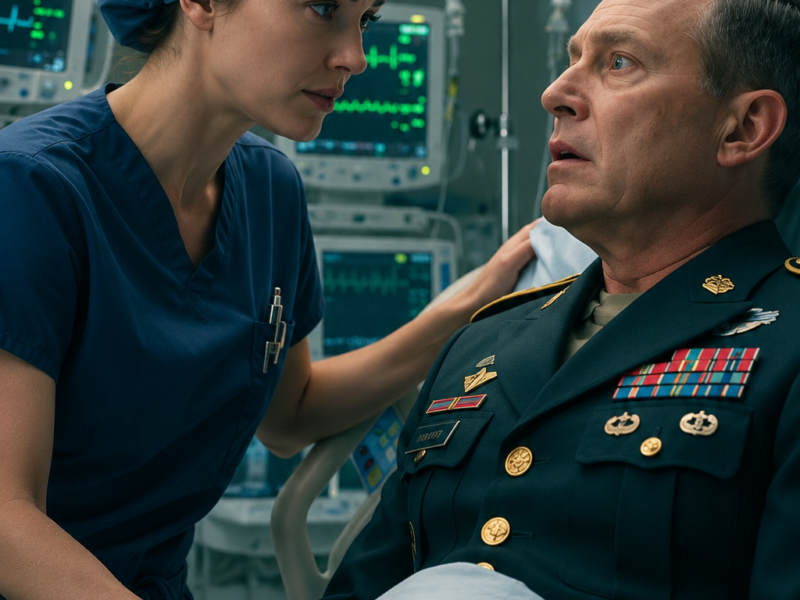
The General Asked for the Hospital’s Top Surgeon – And Froze When She Walked Into the Room
The General Asked for the Hospital’s Top Surgeon – And Froze When She Walked Into the Room
The first thing Dr. Richard Brennan noticed about the woman standing at the far end of the conference room was that she did not appear nervous.
That alone was unusual.
Most surgeons who appeared before the hiring committee at Walter Reed National Military Medical Center displayed at least some trace of anxiety. They adjusted their ties, cleared their throats, rearranged their resumes, or attempted to fill uncomfortable silences with explanations nobody had requested.
Dr. Elena Vulkov did none of those things.
She stood perfectly still, her hands clasped behind her back, her shoulders square, and her amber eyes fixed calmly on the man who had spent the past fifteen minutes questioning whether she deserved to practice medicine at all.
Outside the tall windows, the early morning sunlight stretched across Bethesda, Maryland. Inside, the atmosphere had become considerably colder.
“Two years,” Brennan repeated, tapping a finger against the thin folder lying open before him. “Two years between 2019 and 2021, with no publications, no verified references, and no documented surgical appointments. And you expect this committee to accept that you were performing humanitarian work?”
Elena did not blink.
“I was performing surgery in conflict zones, Doctor.”
“Which conflict zones?”
“Syria. Iraq. Afghanistan.”
“And the organizations responsible for those assignments?”
“Some of that information remains protected by confidentiality agreements.”
Brennan leaned back in his leather chair.
“How convenient.”
The other four committee members exchanged uncomfortable looks.
Everyone in that room understood the importance of documentation. A surgeon’s professional history was not merely a collection of accomplishments. It was evidence of competence, accountability, and trust. Hospitals could not allow physicians to operate on patients simply because they claimed to possess extraordinary experience.
But something about Brennan’s tone suggested that this interrogation had become more personal than professional.
He was sixty-one years old, a respected cardiothoracic surgeon with decades of experience, and a man who believed that medical excellence was inseparable from discipline, hierarchy, and established procedure.
His department was his kingdom.
And the woman standing before him was an unknown quantity.
He studied her again.
Her dark brown hair was secured in a tight bun. Her navy scrubs were immaculate. A temporary identification badge hung from her collar, identifying her as a contractor. She wore no jewelry, no watch, and nothing that suggested an interest in attracting attention.
Yet there was something unmistakably commanding about her presence.
Brennan disliked that almost as much as he disliked the gaps in her resume.
“You graduated at the top of your class from Johns Hopkins,” he continued. “Your residency at Massachusetts General Hospital was exemplary. Your early evaluations described you as exceptionally gifted. Then you essentially disappeared. Do you understand how suspicious that looks?”
“Yes.”
“Then explain it.”
“I have explained what I am authorized to explain.”
Brennan removed his glasses.
“That’s not an answer.”
“It’s the only answer I can give.”
A long silence followed.
At the opposite end of the table, Dr. Jennifer Park watched the exchange with growing fascination.
Park was thirty-one, a senior surgical resident who had spent enough years around exceptional physicians to recognize the difference between confidence and arrogance.
Elena displayed neither the insecurity of an inexperienced surgeon nor the vanity of someone trying to impress an audience.
She seemed almost indifferent to Brennan’s opinion.
Not careless.
Simply accustomed to being judged by circumstances far more consequential than a hiring committee.
As Elena shifted slightly, the sleeve of her scrubs rose above her right wrist.
Park noticed a tattoo.
It consisted of numbers and symbols arranged in two precise lines.
Coordinates.
Before Park could examine them more closely, Brennan spoke again.
“According to your application, you continued performing complex procedures throughout this undocumented period.”
“Yes.”
“Without institutional oversight?”
“In circumstances where conventional oversight was not always available.”
“Without formal surgical records?”
“Some procedures were documented. Those records are not publicly accessible.”
Brennan let out a humorless laugh.
“Dr. Vulkov, medicine is not a battlefield where people improvise according to their instincts.”
Something changed in Elena’s eyes.
It lasted less than a second.
Then her expression returned to its usual calm.
“No, Doctor,” she replied. “But sometimes a battlefield is the only place where medicine can still make a difference.”
The room went silent.
Brennan regarded her for several seconds.
“You have an answer for everything.”
“Not everything.”
“What don’t you have an answer for?”
Elena looked at the folder in his hands.
“The names of everyone I couldn’t save.”
Park felt a chill move through her.
Brennan appeared momentarily unsettled, but he recovered quickly.
“Emotional statements do not establish surgical competence.”
“I agree.”
“Then why should I hire you?”
“Because your hospital needs trauma surgeons. Because I have the skills to help your patients. And because I’m willing to begin with whatever assignments you consider appropriate.”
Brennan folded his arms.
“You expect me to believe that someone with your supposedly extensive background would be satisfied performing routine procedures?”
“I didn’t come here looking for recognition.”
“Then what did you come looking for?”
For the first time that morning, Elena hesitated.
“Something quieter.”
The answer seemed to irritate Brennan even more.
Yet Walter Reed was experiencing a genuine staffing crisis. Three experienced surgeons had retired within four months. Several departments were operating under exhausting schedules, and the hospital continued receiving complicated military and civilian trauma patients.
Brennan could not afford to reject a potentially competent surgeon without a stronger reason.
“Fine,” he said at last. “Ninety-day probationary contract. Routine cases only. Hernias, appendectomies, uncomplicated gallbladder procedures. Every operation will be supervised. You will have no independent authority over major trauma cases until you’ve demonstrated your abilities.”
“Understood.”
“And one more thing.”
His gaze dropped to Elena’s forearm.
“Whatever that tattoo represents, keep it covered. This is a professional hospital.”
Elena looked down.
The numbers were barely visible beneath her sleeve.
36°12′23″N.
37°09′47″E.
A location outside Aleppo.
A place she had spent years trying to forget.
“Yes, Doctor,” she said.
The interview ended at 7:42.
As the committee members gathered their documents and filed into the corridor, Park remained behind.
“Dr. Vulkov?”
Elena stopped beside the doorway.
“Yes?”
“Those coordinates. Are they from Syria?”
Elena studied her for a moment.
“They are.”
“Why would you tattoo them on your arm?”
Elena’s gaze drifted toward the window.
“Because some places change you so completely that you need a reminder of who you were before you arrived.”
Park waited.
But Elena offered nothing more.
She stepped into the corridor and disappeared among the morning staff.
Park remained in the empty conference room, wondering what kind of experience could leave a woman with such a composed expression and such extraordinary sadness behind her eyes.
She had no idea that, before the day was over, she would witness something that would transform everything she believed about courage, medicine, and the difference between knowing how to save a life and refusing to surrender one.
By eight o’clock, Elena was standing before locker 147 in the surgical changing area.
She placed her belongings inside, checked the daily operating schedule, and studied the first patient assigned to her.
David Morrison.
Forty-five years old.
Scheduled for an elective inguinal hernia repair.
The chart contained nothing immediately alarming.
He had been experiencing intermittent discomfort for several months. His preoperative examination was reassuring, his vital signs were stable, and his laboratory results revealed no obvious contraindications.
For most surgeons, it was an ordinary case.
For Elena, it represented something she had not experienced in years.
An operation that would begin at a scheduled time, in a properly equipped room, with reliable electricity, trained staff, and no expectation that the building might come under attack.
She stared at the chart longer than necessary.
Then she closed it.
From somewhere beyond the changing room came the soft electronic chime of a hospital announcement.
For one irrational instant, her body prepared for an incoming casualty report.
Her shoulders tightened.
Her attention sharpened.
She listened for distant explosions that did not exist.
Then she recognized the ordinary sounds around her.
Footsteps.
Conversation.
A cleaning cart moving down the corridor.
She released a slow breath.
This was what she had wanted.
Normal medicine.
A normal life.
No weapons.
No classified operations.
No decisions about which wounded soldier would receive the last available unit of blood.
She opened her locker once more and looked at a photograph tucked into the inside pocket of her bag.
It showed seven people standing outside a temporary surgical facility. They wore dusty uniforms, mismatched medical equipment, and exhausted smiles.
Three of those people were dead.
Elena touched the photograph with one finger.
Then she shut the locker.
Across the hall, the resident lounge smelled of burnt coffee and fatigue.
Marcus Chen, a second-year resident, was discussing the morning’s hiring committee meeting with Amanda Foster when Jennifer Park entered.
“I’m telling you,” Marcus said, “there’s something wrong with that woman’s story.”
Amanda poured coffee into a paper cup.
“Two missing years?”
“Exactly. People don’t just disappear from elite surgical careers and return without references.”
“Maybe she took time off.”
“Then why not say that?”
Park placed her tablet on the table.
“Because perhaps it’s none of our business.”
Marcus turned toward her.
“You were in the interview. You heard what Brennan said.”
“I heard him ask questions. I also heard her answer what she could.”
“You actually believe the conflict-zone story?”
“I don’t know what to believe.”
Amanda shook her head.
“She’s either hiding something or exaggerating.”
Park thought of the tattoo.
Of Elena’s stillness.
Of the strange sentence about the people she could not save.
“Maybe both of you should wait until you see her work,” she replied.
Marcus laughed.
“Fine. Let’s see what the mysterious contractor can do with a hernia.”
At 8:55, the operating room was ready.
David Morrison lay under anesthesia while Dr. Ramon Gutierrez monitored his breathing, blood pressure, and cardiac rhythm.
Linda Hayes, the scrub nurse, checked the instruments for the third time.
She had worked in operating rooms for fifteen years and possessed the practical instincts of someone who could distinguish between genuine skill and theatrical confidence within minutes.
When Elena entered, Linda immediately noticed how little attention she paid to anything unnecessary.
She checked the patient identification.
Confirmed the planned procedure.
Reviewed the available imaging.
Verified the equipment.
Then she introduced herself to the team.
There was no elaborate speech.
No attempt to establish dominance.
Just clear, economical communication.
Brennan arrived moments later.
He had not originally planned to observe the entire operation, but curiosity and suspicion had persuaded him otherwise.
“Remember, Dr. Vulkov,” he said, positioning himself near the table, “this is a straightforward repair. I expect you to follow standard technique.”
“Of course.”
“And if you encounter anything unusual, you will discuss it before proceeding.”
“Yes, Doctor.”
Elena accepted the scalpel.
The first incision was smooth and controlled.
Linda watched the movement with immediate interest.
There was something different about Elena’s hands.
They did not merely demonstrate familiarity with the instruments.
They seemed to know exactly where each instrument needed to go before anyone requested it.
Her movements were efficient without being rushed.
Her dissection was deliberate.
Her attention never drifted.
As the procedure progressed, even Brennan found himself studying her technique more closely.
The woman was good.
Very good.
Possibly better than her incomplete resume suggested.
But he was not prepared to acknowledge that yet.
Then Elena stopped.
It happened so suddenly that Linda looked up from her instrument tray.
Elena leaned forward slightly.
“Dr. Brennan.”
“What is it?”
“I’d like you to examine this.”
He stepped closer.
Elena indicated a small area of exposed bowel near the hernia defect.
“Notice the color.”
Brennan examined the tissue.
“It appears mildly congested.”
“It’s more than congestion.”
“The bowel has been under tension.”
“The pattern isn’t consistent with tension alone.”
Brennan narrowed his eyes.
“Explain.”
Elena pointed to several subtle areas of discoloration.
“Those patches are concerning for reduced perfusion. I’d like to assess mesenteric blood flow before completing the repair.”
“The preoperative imaging was normal.”
“I know.”
“His vital signs are stable.”
“I know that too.”
“Then what exactly are you suggesting?”
“That he may have an evolving vascular problem unrelated to the original surgical indication.”
Brennan looked irritated.
“Based on a color change?”
“Based on the distribution, appearance, and my experience with early intestinal ischemia.”
For several seconds, neither spoke.
Then Brennan said, “You understand that expanding an operation requires a defensible clinical reason.”
“Absolutely. That’s why I’m asking for additional evaluation.”
Linda glanced toward the anesthesiologist.
Gutierrez nodded.
“Patient remains stable.”
Brennan considered the situation.
Finally, he stepped aside.
“Bring in the Doppler ultrasound.”
The equipment arrived several minutes later.
Elena examined the vascular flow carefully, making repeated measurements rather than relying on a single reading.
What appeared on the screen changed the atmosphere of the room.
There was evidence of impaired arterial flow.
The findings were concerning enough to warrant immediate specialist assessment.
Brennan stared at the display.
“How did you recognize that?”
Elena continued examining the images.
“I’ve seen bowel lose its blood supply before the monitors showed anything wrong.”
“Where?”
“Places where imaging wasn’t available.”
Brennan said nothing.
After an urgent consultation with the available vascular team, the operation was expanded with appropriate authorization. Elena worked alongside the specialists to expose the affected vessels and address the obstruction.
The procedure became far more complicated than the original hernia repair.
Yet Elena remained calm.
She anticipated instruments before they were requested.
She recognized anatomical landmarks quickly.
She worked with the quiet certainty of someone whose hands had been trained by repetition under conditions no operating-room simulation could reproduce.
Above the surgical suite, Jennifer Park stood in the observation gallery beside Marcus and Amanda.
All three watched the monitors in silence.
Finally, Marcus whispered, “She’s not supposed to know how to do that.”
Park did not take her eyes from the screen.
“Apparently she does.”
Amanda leaned closer.
“Look at her suturing.”
The vascular repair required extraordinary precision.
Elena’s stitches were evenly spaced, her movements measured, and her hands remarkably steady.
As the obstruction was cleared and circulation improved, the affected bowel gradually regained a healthier appearance.
Linda watched the change.
“Well,” she murmured, “that’s something.”
Brennan glanced toward Elena.
“You were right.”
She shook her head slightly.
“We were fortunate to investigate early.”
There was no triumph in her voice.
No satisfaction at having embarrassed him.
Only relief that the patient had received treatment before the damage became irreversible.
After the original hernia repair was completed and Morrison was transferred toward recovery, Brennan approached Elena outside the operating room.
“That was impressive work.”
“Thank you.”
“Your vascular technique is exceptional.”
“I’ve had considerable practice.”
“In what kind of facility?”
Elena removed her surgical cap.
“One where every minute mattered.”
Brennan studied her.
“You understand why I keep asking questions.”
“Yes.”
“Then you must understand why I find your answers frustrating.”
Elena met his gaze.
“Imagine how frustrating it is to know the answers and be unable to give them.”
She walked away before he could respond.
Brennan remained standing beside the doorway.
For the first time that morning, he wondered whether the real problem with Elena Vulkov’s resume was not that it contained too little experience.
Perhaps it contained too much.
By early afternoon, the hospital had returned to its familiar rhythm.
Elena finished her postoperative documentation, reviewed several patient charts, and answered routine questions from nursing staff.
At 2:37, the overhead speakers interrupted everything.
“Trauma alert. Multiple gunshot casualties inbound from a training incident at Quantico. Two critical patients, three stable. Estimated arrival four minutes. All available trauma personnel report immediately.”
Conversations stopped.
Chairs scraped against floors.
Doctors moved into corridors.
The sudden transformation of the hospital from routine activity to emergency response seemed dramatic to everyone around Elena.
To her, it felt terrifyingly familiar.
She closed her tablet.
For an instant, she was somewhere else.
A dusty compound.
A radio crackling through static.
Someone shouting that another helicopter was five minutes away.
Then she returned to the present.
Walter Reed.
Maryland.
A hospital with reinforced walls, dependable equipment, and more supplies than she had once possessed in an entire field surgical unit.
She moved toward the trauma department.
Dr. Brennan was already organizing the response.
“Park, bay three. Chen, bay four. Foster, assist with the second critical casualty. I’ll take the thoracic injury.”
He noticed Elena standing nearby.
“Dr. Vulkov, bay five. Through-and-through gunshot wound to the thigh. Stable patient.”
“Understood.”
The first transport team arrived moments later.
Captain Miguel Santos, twenty-nine years old, United States Marine Corps, was wheeled into trauma bay one.
His uniform had been cut away around the chest.
Blood stained the remaining fabric.
His skin was pale.
His breathing was shallow and labored.
The flight medic delivered the report while the team transferred him.
“Penetrating injury to left anterior chest. No confirmed exit wound. Progressive hypotension. Significant concern for intrathoracic hemorrhage or cardiac involvement.”
Brennan immediately began examining him.
Across the room, Elena approached the young lance corporal assigned to her.
The Marine had a gunshot wound through the soft tissue of his thigh. He was conscious, frightened, and trying unsuccessfully to hide it.
“What’s your name?” Elena asked.
“Lance Corporal Tyler Brooks, ma’am.”
“Tyler, I’m Dr. Vulkov. We’re going to take care of you.”
“Am I going to lose my leg?”
She examined the wound and assessed circulation and movement below the injury.
“I don’t see evidence of that right now. We’re going to make sure.”
He swallowed.
“Okay.”
She continued her assessment.
But then she heard Brennan speak from the opposite bay.
“Prepare for chest drainage.”
Elena looked up.
Santos’s blood pressure was falling.
His neck veins appeared unusually prominent.
The trajectory of the injury concerned her immediately.
She had seen the combination before.
Once in Afghanistan.
Twice in Iraq.
And more times than she wanted to remember in Syria.
“Dr. Brennan,” she called.
He did not look toward her.
“Not now.”
“Please assess for cardiac tamponade.”
Brennan glanced at her.
“We’re evaluating the chest injury.”
“The hypotension and neck findings are concerning. The wound could involve the heart.”
“I’m aware of the possibilities.”
Elena waited.
Then she returned her attention to Brooks.
She cleaned the wound and continued arranging the necessary imaging and treatment.
But every alarm sounding from bay one seemed to pull against something deep inside her.
She tried to concentrate.
She reminded herself that Brennan was an experienced cardiothoracic surgeon.
She reminded herself that she was a temporary contractor.
She reminded herself that hospitals had chains of responsibility for good reasons.
Then she heard someone shout.
“Pressure sixty over thirty!”
A different voice answered.
“Get ultrasound here now!”
Elena looked over.
Santos’s eyes had opened briefly.
They moved across the trauma bay, unfocused, searching.
Then they stopped.
On her.
For one strange moment, the dying Marine appeared to recognize her.
His lips moved beneath the oxygen mask.
The flight medic leaned closer.
“What did you say, Captain?”
Santos struggled to speak.
“That doctor.”
“Which doctor?”
“Over there.”
The medic followed his gaze.
“Elena?” he asked, reading the name on her badge from a distance.
Santos tried to nod.
“Aleppo.”
The word seemed to drain the remaining strength from his body.
“She was there.”
The medic bent closer.
“What happened in Aleppo?”
Santos swallowed.
“The children. The gas. She saved us.”
Then his eyes rolled backward.
An alarm erupted.
The monitor showed a rapidly deteriorating rhythm.
“Cardiac arrest!”
Brennan moved immediately.
The resuscitation team began working.
Commands flew through the room.
Equipment was repositioned.
Medication was prepared.
The anesthesiologist secured the airway.
Chest compressions continued as the team searched for reversible causes.
Elena stood beside Brooks, suddenly unable to hear anything except the sound of the cardiac monitor.
Aleppo.
Santos had said Aleppo.
She remembered a young Marine lying on a stretcher beneath a canvas roof.
A frightened face.
A torn uniform.
Someone calling his name while she worked over another patient.
Miguel.
She had not remembered the surname.
But now she remembered the eyes.
And the voice.
And the way he had helped carry wounded children through the doorway even while bleeding himself.
“Dr. Vulkov?”
Brooks was looking at her.
She forced her attention back.
“Yes?”
“Is that guy going to die?”
Elena glanced toward bay one.
“I hope not.”
But her instincts were telling her something else.
The team was fighting the consequences of a problem that had not yet been definitively corrected.
The ultrasound machine had been moved into position.
Someone reported findings concerning for blood around the heart.
Brennan’s expression tightened.
He understood immediately.
“Prepare for emergency surgical intervention.”
The trauma bay shifted again.
But Santos was deteriorating rapidly.
His circulation had failed.
The resuscitation seemed to stretch endlessly.
One minute.
Three.
Five.
A nurse announced the elapsed time.
Brennan reviewed the monitor, the patient’s response, and the increasingly desperate situation.
His face had grown pale.
Elena knew that expression.
It was the face of a physician confronting the limits of what could reasonably be done.
She had worn it herself.
Too many times.
“Dr. Brennan,” she said.
He looked toward her.
“We need to act.”
“We are acting.”
“He needs immediate relief of the cardiac compression and repair of the injury.”
Brennan’s voice sharpened.
“Dr. Vulkov, return to your assigned patient.”
Elena looked at Santos.
Then at the monitor.
Then back at Brennan.
“Please.”
The single word sounded almost painfully quiet.
Brennan stared at her.
There was something in her expression he had not seen during the interview or even during the morning’s operation.
Not arrogance.
Not defiance.
Recognition.
As if the woman standing before him had watched this exact tragedy unfold before and could not bear to witness it again.
“What are you proposing?” he demanded.
“An emergency resuscitative thoracotomy, with the trauma team prepared to correct the underlying injury.”
“You understand the risks?”
“Every one of them.”
“The chances are extremely poor.”
“I know.”
“Then why are you insisting?”
Elena looked directly into his eyes.
“Because poor chances are not the same as no chances.”
Silence spread through the trauma bay.
Brennan looked at Santos.
Then at Elena.
The earlier operation flashed through his memory.
The subtle discoloration nobody else had noticed.
The vascular obstruction.
The extraordinary precision.
The calm certainty.
He made his decision.
“Prepare the surgical team,” he ordered.
Elena moved into position.
Jennifer Park stepped forward to assist.
Jake Miller, a sixty-two-year-old veteran nurse who had served as a combat medic for two decades before transitioning into hospital nursing, arrived with the necessary equipment.
When he saw Elena’s face, he stopped for a fraction of a second.
He had seen that expression before.
On military surgeons working beneath artillery fire.
On medics treating casualties while evacuation helicopters circled overhead.
On people who had learned that fear could not be allowed to control their hands.
“You’ve done this before,” Jake said quietly.
Elena looked at him.
“Yes.”
“How many times?”
“Enough.”
He nodded.
“Then tell me what you need.”
The following minutes would remain etched into the memories of everyone who witnessed them.
The surgical team opened the chest under emergency conditions.
The findings confirmed the terrible suspicion.
Blood had accumulated around the heart, compressing it and preventing effective circulation.
There was also a penetrating ventricular injury.
Elena’s voice remained calm as she coordinated the repair with Brennan and Park.
She worked quickly, but not carelessly.
Every movement had purpose.
Every instruction was brief.
Every person in the room knew exactly what was expected.
Brennan assisted with the concentration of a man who understood that his pride had become irrelevant.
Park followed Elena’s instructions with unwavering attention.
Jake anticipated equipment needs with the instincts of a veteran.
And through it all, Elena never raised her voice.
She knew panic was contagious.
But so was composure.
As the immediate pressure on the heart was relieved and the injury was repaired, the team continued resuscitation.
For several agonizing moments, there was no reassuring response.
Santos remained profoundly unstable.
The seconds passed.
Then the monitor changed.
A signal appeared.
Another followed.
The anesthesiologist leaned forward.
“Organized activity.”
Elena did not move.
“Confirm circulation.”
A moment passed.
Then a voice broke through the silence.
“We have a pulse.”
Nobody cheered.
Not yet.
Everyone understood how fragile the moment was.
Blood pressure began to return.
The team continued correcting blood loss and stabilizing Santos for transfer to definitive care.
Elena watched the monitor as though willing every number to improve.
Slowly, they did.
Park’s eyes filled with tears above her mask.
Brennan stared at the surgical field, then at Elena.
He had spent decades performing complicated operations.
He had witnessed remarkable recoveries.
Yet something about this woman unsettled him beyond anything he could explain.
Not merely her skill.
Her absolute refusal to lose focus, even when the situation appeared hopeless.
When the patient was stable enough for transfer, Elena stepped back.
“Contact intensive care. He’ll need close neurological monitoring, temperature management according to the critical care team’s assessment, and ongoing cardiac evaluation.”
Brennan nodded.
Then he asked the question that had been building in his mind all day.
“Who are you?”
Elena slowly removed her gloves.
For a moment, she seemed to consider refusing to answer.
Then she looked toward the gurney carrying Santos away.
“He recognized me.”
Park stepped closer.
“He said he knew you from Aleppo.”
Elena closed her eyes.
Only briefly.
When she opened them again, the professional distance in her expression had changed.
“My name is Colonel Elena Vulkov,” she said quietly. “Former United States Army Medical Corps. Six years attached to special operations medical missions. I served in Syria, Iraq, and Afghanistan.”
Brennan stared.
Park did not speak.
Elena continued.
“I was part of surgical teams supporting high-risk operations, including missions involving Delta Force and Naval Special Warfare personnel. Some of those assignments are still classified.”
Jake lowered his head slightly.
As if confirming something he had suspected since the moment he first saw her.
“I performed hundreds of trauma surgeries,” Elena said. “Many in forward medical facilities. Some during active attacks. Most without the resources we take for granted here.”
Brennan swallowed.
“And Aleppo?”
Elena looked down at her tattoo.
“Twenty-three surgeries during an eleven-hour period in 2020. Forty-one people survived because of the work our team performed that night.”
Her voice grew quieter.
“Three soldiers didn’t.”
The room remained silent.
Then Park asked gently, “What happened?”
Elena looked toward the door through which Santos had been taken.
“A chemical attack. A field hospital overwhelmed with casualties. More injured people than we could treat. Not enough ventilators. Not enough medication. Not enough hands.”
She paused.
“There were children.”
No one interrupted.
“Seventeen of them. Some no older than four. They were convulsing, struggling to breathe, dying in front of us.”
Her fingers tightened around the edge of the counter.
“Three soldiers arrived with severe exposure injuries. Men I knew. Men I had eaten with, worked with, and trusted with my life.”
“What did you do?” Brennan asked.
Elena looked at him.
“I made the triage decisions I believed offered the greatest chance of saving lives.”
“And the soldiers?”
“They died.”
For the first time, her voice broke.
Only slightly.
But everyone heard it.
“I saved children that night. I saved civilians. I saved soldiers. But every time I closed my eyes afterward, I saw the three men I couldn’t bring home.”
Brennan looked down.
The woman he had ridiculed for an incomplete resume had been carrying the weight of decisions he could scarcely imagine.
He remembered his dismissive questions.
His remarks about her tattoo.
His assumption that an unexplained employment gap represented professional failure.
And shame settled heavily over him.
Elena turned away.
“I came here because I wanted to be a doctor again without being a colonel. Without people expecting miracles. Without someone telling me how many lives depended on a mission.”
She looked toward the surgical corridor.
“I wanted something ordinary.”
Park spoke softly.
“And today?”
Elena’s eyes returned to the door.
“Today reminded me that the patients don’t care what kind of life we were hoping to have.”
The story spread through Walter Reed with extraordinary speed.
By late afternoon, residents were whispering about the contractor who had detected a dangerous vascular problem during a routine operation, then helped rescue a critically wounded Marine after an extended cardiac arrest.
Some exaggerated what they had witnessed.
Others repeated fragments of Elena’s military history.
A few claimed she had performed impossible operations in secret locations.
Elena ignored the rumors.
She washed her hands.
Changed her scrubs.
Completed her documentation.
And walked toward the intensive care unit.
Captain Santos was alive.
But she knew that surviving the initial emergency was only the beginning.
There could be neurological complications.
There could be cardiac dysfunction.
There could be infection, organ failure, or unexpected setbacks.
She had learned long ago not to confuse a successful procedure with a complete recovery.
At the ICU observation window, she stood silently watching the monitors.
Park approached.
“You should be resting.”
Elena shook her head.
“I’ve rested enough.”
“You’ve been working almost twelve hours.”
“I know.”
Park stood beside her.
For a while, neither spoke.
Then Park asked, “Were you afraid?”
Elena looked at her.
“During the surgery?”
“Yes.”
“Of course.”
Park appeared surprised.
“You didn’t show it.”
“Fear doesn’t disappear because you’re experienced. You simply learn not to let it decide what your hands do.”
Park considered that.
“I want to learn how to work like you.”
Elena looked back through the glass.
“Then learn how to think before you learn how to move fast.”
“What does that mean?”
“Speed is useful only when you understand what you’re doing. Otherwise, you’re just making mistakes faster.”
Park smiled faintly.
“That sounds like something worth writing down.”
Elena’s expression softened.
“Then write it down.”
The next morning, Brennan summoned Elena to his office.
She arrived at precisely eight o’clock.
His office overlooked the hospital entrance. Diplomas and professional certifications covered one wall, while shelves of medical journals occupied another.
Everything was orderly.
Everything had its place.
Elena noticed that the folder containing her application was now accompanied by a much thicker file.
Brennan stood behind his desk.
“Thank you for coming.”
“You asked to see me.”
“Please sit.”
“I’d rather stand.”
He studied her for a moment.
Then he remained standing himself.
“I made several calls yesterday.”
Elena’s expression changed.
“To whom?”
“Contacts in military medicine.”
“That was unnecessary.”
“Perhaps. But after what happened, I wanted to understand the person working in my department.”
He opened the folder.
“Much of your service record remains restricted. What I could confirm was extraordinary.”
Elena said nothing.
“Combat surgeon. Multiple deployments. Exceptional trauma experience. Commendations you never mentioned.”
“They weren’t relevant to the position.”
Brennan looked up.
“They were extremely relevant.”
“Not if you intended to assign me uncomplicated hernia repairs.”
The response was so dry that Brennan almost smiled.
Then his expression grew serious.
“I owe you an apology.”
Elena remained silent.
“I judged you before I understood your circumstances. I assumed your missing documentation represented an absence of experience. I spoke to you in a manner that was unprofessional.”
She watched him carefully.
“Why are you telling me this?”
“Because I was wrong.”
Those four words seemed difficult for him.
But he said them clearly.
Elena nodded.
“Apology accepted.”
Brennan drew a breath.
“I’m offering you a permanent appointment as a senior trauma surgeon.”
For the first time, Elena appeared genuinely surprised.
“That’s a significant change from yesterday.”
“It is.”
“Yesterday you weren’t certain I remembered how to hold a scalpel.”
“Yesterday I hadn’t seen you work.”
She looked toward the window.
Brennan continued.
“You have skills this hospital needs. More importantly, you have experience our younger surgeons could learn from.”
Elena said nothing.
“I’d like you to help build a program integrating lessons from military trauma care into our civilian and military surgical training.”
She turned back.
“A training program?”
“Yes.”
“Not just an appointment?”
“Both.”
Elena considered the proposal.
There was a time when such an offer would have delighted her.
Now, it frightened her.
Not because she doubted her abilities.
Because leadership meant responsibility.
Responsibility meant decisions.
And decisions meant the possibility of carrying more names into the darkness.
“I left the military to get away from that,” she said.
Brennan nodded.
“I know.”
“Do you?”
“I think I’m beginning to.”
She folded her arms.
“I don’t want to create another system that teaches surgeons to value speed over judgment.”
“Neither do I.”
“I don’t want young physicians believing heroism means ignoring every rule.”
“Agreed.”
“And I won’t accept a position that turns combat experience into entertainment for people who’ve never had to live with its consequences.”
Brennan met her gaze.
“Then help us do it properly.”
The office fell silent.
Finally, Elena spoke.
“I have conditions.”
“I’m listening.”
“First, the program must include support for military physicians transitioning into civilian practice. Many of them have exceptional experience but struggle because their records are difficult to interpret or their qualifications don’t fit conventional expectations.”
Brennan nodded.
“Reasonable.”
“Second, any new trauma protocols must be evidence-based. Battlefield techniques aren’t automatically superior. We need to identify what works, understand the risks, and train people to recognize when an approach is appropriate.”
“Agreed.”
“Third, psychological support must be part of the program. Not something offered after a surgeon falls apart. Something built into the culture.”
Brennan’s expression softened.
“You’re speaking from experience.”
“Yes.”
“And the fourth condition?”
Elena looked at the folder.
“Captain Santos. I want to remain involved in his recovery.”
Brennan nodded.
“You will.”
She drew a slow breath.
“Then I accept.”
He extended his hand.
This time, when Elena shook it, there was no trace of the hostility that had defined their first meeting.
Only professional respect.
As she turned toward the door, Brennan spoke again.
“May I ask you something?”
“Yes.”
“Why didn’t you tell us who you were during the interview?”
Elena paused.
“Because I needed to know whether I was still a good surgeon without the rank.”
Brennan frowned.
“You’ve never had reason to doubt that.”
She looked back at him.
“You’d be surprised what people begin to doubt when they spend enough nights remembering the ones they couldn’t save.”
Then she left.
Over the following weeks, the hospital began changing in ways few people had anticipated.
Elena did not arrive with grand speeches or a desire to overturn everything Brennan had built.
Instead, she asked questions.
Why were certain emergency supplies stored so far from the trauma bays?
Why did junior surgeons receive extensive instruction in procedures but comparatively little training in prioritizing multiple deteriorating patients?
Why were military physicians entering civilian practice evaluated almost entirely through conventional employment records?
And why did so many healthcare professionals treat psychological exhaustion as something shameful rather than a predictable consequence of repeated exposure to suffering?
Her questions were uncomfortable.
But they were practical.
Park became her closest collaborator.
Together, they reviewed emergency response workflows, designed simulation exercises, and developed training sessions that emphasized communication, clinical reasoning, and coordinated action.
Marcus Chen attended the first simulation reluctantly.
He had spent weeks feeling embarrassed about his earlier comments regarding Elena’s missing years.
During one exercise, his team was given three simulated casualties arriving almost simultaneously.
Equipment malfunctioned.
A supply cabinet had been deliberately left incomplete.
The clinical information was ambiguous.
Marcus became frustrated.
He made several rushed decisions and overlooked a critical change in one patient’s condition.
When the exercise ended, he removed his gloves angrily.
“That wasn’t realistic.”
Elena stood beside the observation monitor.
“Which part?”
“The broken equipment. The missing supplies. All of it.”
She considered him.
“Have you ever worked a night shift when the emergency department was overcrowded?”
“Yes.”
“Have you ever waited for equipment that another team was using?”
“Yes.”
“Have you ever received three critically ill patients with too few available staff?”
Marcus hesitated.
“Not exactly.”
“Then perhaps the exercise wasn’t unrealistic. Perhaps it was unfamiliar.”
He looked down.
Elena softened her tone.
“Marcus, the purpose isn’t to humiliate you. It’s to expose the limits of your preparation while there’s still time to learn.”
He nodded slowly.
“Understood.”
“Good. Tomorrow we’ll do it again.”
Over time, Marcus became one of the program’s most enthusiastic participants.
Amanda Foster helped develop psychological support initiatives.
Jake Miller contributed the perspective of a combat medic who had spent years translating between battlefield necessity and hospital procedure.
Even Brennan changed.
He remained demanding.
He still believed deeply in standards.
But he became more willing to question whether a process existed because it genuinely improved patient care or simply because no one had challenged it in years.
Three months after Elena’s arrival, the newly established Combat-Civilian Trauma Integration Unit occupied a dedicated area of the hospital.
The unit was not merely a collection of training rooms.
It was a place where military physicians could receive mentorship during their transition into civilian practice, where surgical teams could rehearse difficult emergency scenarios, and where clinicians could speak openly about the emotional consequences of their work.
Its first twelve participating veteran physicians had successfully entered civilian clinical roles.
For Elena, that achievement meant more than any personal award.
She remembered arriving at Walter Reed with a temporary badge and a resume that made people suspicious.
She remembered how it felt to stand before strangers who believed the missing details of her career made her less competent.
She did not want anyone else to face that experience unnecessarily.
One afternoon, Park found her reviewing architectural plans for a larger simulation laboratory.
“If we relocate the ultrasound equipment here,” Park said, pointing to the diagram, “we can shorten the distance between the primary resuscitation area and the imaging station.”
Elena studied the layout.
“Good. What about access during multiple simultaneous casualties?”
Park adjusted the plan.
“We can keep a clear corridor along this side.”
“Better.”
Park smiled.
“You know, six months ago, I would’ve been terrified to suggest changing your design.”
Elena raised an eyebrow.
“Why?”
“Because I thought experienced surgeons were supposed to have all the answers.”
Elena shook her head.
“The dangerous ones think they do.”
Before Park could respond, the door opened.
Brennan entered carrying an official-looking folder.
“Elena, there’s something you need to see.”
She glanced up.
“What is it?”
“A message from General James Cordell.”
Her expression became guarded.
“What does he want?”
“He’s requested a meeting.”
“I’m not interested in returning to active service.”
“He knows.”
“Then why?”
Brennan placed the folder on the table.
“Because a portion of the investigation into the Aleppo incident has been declassified.”
Elena stopped moving.
The room seemed to grow very quiet.
She stared at the folder.
For years, that investigation had existed somewhere beyond her reach.
She knew certain findings.
She knew fragments of the operational timeline.
She knew that three men had died.
But there were details she had never been permitted to see.
“What exactly has been released?”
Brennan opened the folder.
“Enough to clarify what happened to Williams, Chen, and Rodriguez.”
Elena’s fingers tightened around the edge of the table.
Staff Sergeant Marcus Williams.
Corporal Daniel Chen.
Private First Class James Rodriguez.
She had spoken those names to herself every night for years.
Sometimes in prayer.
Sometimes in apology.
Sometimes simply to make sure she would never forget them.
“Tell me,” she whispered.
Brennan looked toward Park, then back at Elena.
“The three soldiers entered a contaminated area against orders.”
“I knew that.”
“They were attempting to rescue children trapped in a damaged school.”
Elena’s breath caught.
Brennan continued.
“They had intercepted reports that several children remained inside. Their team leader ordered them to wait until chemical hazards could be assessed. They chose to enter anyway.”
Elena slowly lowered herself into a chair.
“They rescued four children,” Brennan said. “The exposure they sustained during that rescue was severe.”
Her eyes filled.
“Four?”
“Yes.”
She looked at the report.
“Four children?”
Brennan nodded.
“They successfully brought them to safety.”
For several seconds, Elena could not speak.
She remembered the three soldiers arriving at the field hospital.
Williams had been struggling to breathe.
Chen had been barely conscious.
Rodriguez had tried to speak before losing consciousness.
She remembered searching their faces for signs that they might recover.
She remembered the children waiting nearby.
The desperate shortage of resources.
The impossible decisions.
And she remembered believing that, somewhere in those eleven hours, she had failed the men who trusted her.
Brennan turned another page.
“The investigation concluded that their exposure was so severe that immediate treatment was unlikely to have changed the outcome.”
Elena covered her mouth.
Park moved beside her.
“The report also found that your triage decisions were consistent with the best available medical judgment under the circumstances,” Brennan continued.
Elena shook her head.
Not in disagreement.
In disbelief.
For four years, she had replayed every moment of that night.
She had imagined alternate decisions.
Alternate treatment sequences.
Alternate outcomes.
In some versions, she saved the soldiers.
In others, the children died.
Sometimes she imagined that if she had simply worked faster, if she had been more skilled, if she had somehow become a different person, everyone might have survived.
Now she was looking at evidence that the three men had already made a choice long before they reached her operating table.
They had chosen to save four children.
And that choice had cost them their lives.
“I thought I abandoned them,” she whispered.
Park placed a hand on her shoulder.
Elena stared at the report.
“I thought they died because I chose the children.”
Brennan spoke gently.
“They died after risking their lives to save children. That’s not the same thing.”
For the first time since arriving at Walter Reed, Elena began to cry.
There was no dramatic collapse.
No desperate sobbing.
Just tears moving silently down her face while she sat before the documents that had finally given shape to a tragedy she had carried for years.
Park remained beside her.
Brennan said nothing.
He understood that this was not a moment for speeches.
After several minutes, Elena wiped her face.
“Does General Cordell know I have this?”
“Yes.”
“What does he want from me?”
“He wants to present the Silver Star you declined after the incident. And he wants to personally apologize for how long you were left without the full findings.”
Elena looked down.
“A medal doesn’t change anything.”
“No,” Brennan replied. “It doesn’t.”
She looked at him.
“But knowing what happened might.”
He nodded.
“Perhaps.”
Elena turned the pages slowly.
There were names.
Dates.
Descriptions of rescue actions.
Medical assessments.
A record of courage, loss, and decisions made under circumstances no ordinary person should ever have to face.
Finally, she closed the folder.
“Tell the general I’ll meet him tomorrow.”
“At the Pentagon?”
“No.”
She looked around the training room.
“Here.”
Brennan smiled faintly.
“I thought you’d say that.”
That evening, Elena visited the intensive care unit.
Captain Santos had spent weeks recovering from his injuries.
The damage to his heart had required careful treatment, and his rehabilitation had been long and difficult. Yet his neurological recovery had exceeded the early concerns, and he had gradually regained his strength.
When Elena entered his room, he was sitting upright with a rehabilitation therapist.
He looked toward the doorway.
Then he smiled.
“Colonel.”
Elena returned the smile.
“Captain.”
“You know, most people knock before entering.”
“Most people don’t spend their afternoons trying to avoid physical therapy.”
Santos laughed.
The movement made him wince slightly.
“Fair point.”
The therapist finished her session and excused herself.
Elena moved to the bedside.
“How are you feeling?”
“Like someone shot me in the chest.”
“That would be an accurate assessment.”
“And like someone gave me another chance.”
Elena glanced at the monitoring equipment.
“You’ve worked hard for your recovery.”
Santos studied her.
“You really don’t like taking credit, do you?”
“I prefer seeing people recover.”
“Then you’ll be pleased to know my wife says I’m officially becoming annoying again.”
“That is encouraging.”
He laughed.
Then his expression grew serious.
“I remember you from Aleppo.”
Elena stopped smiling.
“I know.”
“You were operating on Sergeant Hayes.”
She nodded.
“He had significant chest injuries.”
“You saved him.”
“The team saved him.”
Santos shook his head.
“I was there. I remember.”
Elena looked toward the window.
“How is he?”
“He’s home. He’s got a daughter now. Four years old. He talks about her constantly.”
Elena felt something warm and painful move through her chest.
She remembered Hayes lying unconscious beneath the surgical lights.
She remembered the uncertainty.
She remembered wondering whether he would ever see home again.
Now he was raising a little girl.
Living an ordinary life.
Doing ordinary things.
And somehow, that seemed more extraordinary than any military commendation.
“I’m glad,” she whispered.
Santos watched her carefully.
Then he said, “I heard they finally released the investigation.”
Elena looked at him.
“You knew?”
“Some of it.”
“About Williams, Chen, and Rodriguez?”
He nodded.
“They were good men.”
“Yes.”
“They knew what they were doing when they went into that school.”
Elena sat down.
“I spent years believing I should have saved them.”
Santos’s voice softened.
“Colonel, those men wouldn’t have wanted you to carry their deaths like a punishment.”
She looked away.
“They saved four children,” she said.
“I know.”
“I didn’t know until yesterday.”
Santos leaned back against his pillow.
“Then maybe it’s time someone told you what those children are doing now.”
Elena turned toward him.
“What?”
“The four they rescued. Two boys and two girls. The last I heard, all four were alive. Their families were relocated after the attack.”
Elena stared at him.
“Alive?”
“Yes.”
He smiled.
“Growing up. Going to school. Arguing with their parents. Doing all the things kids are supposed to do.”
Tears returned to Elena’s eyes.
Santos continued quietly.
“Williams used to say the whole point of being a soldier was making sure other people got to live ordinary lives.”
Elena laughed through her tears.
“That sounds like Marcus.”
“He was stubborn.”
“Terribly.”
“And he would’ve hated knowing you spent four years blaming yourself.”
She wiped her face.
“I know.”
For a while, they sat in silence.
Then Santos reached toward his bedside table.
“There’s something else.”
He picked up his phone.
“My wife is pregnant.”
Elena smiled.
“You mentioned that.”
“Two months until the baby arrives.”
“Congratulations.”
“We’ve been talking.”
“That sounds dangerous.”
He grinned.
“Usually is.”
Then his expression became unexpectedly earnest.
“We’d like you to be our daughter’s godmother.”
Elena stared.
“Miguel…”
“I know it’s a lot to ask.”
“I don’t think you understand.”
“I understand perfectly.”
He leaned forward slightly.
“You gave me the chance to meet her. To hold her. To be her father. I don’t know how to repay that.”
“You don’t owe me anything.”
“I know. That’s why I’m not trying to repay you.”
He smiled.
“I’m asking you to be part of our family.”
Elena looked at the young Marine before her.
He was alive.
He was healing.
He had a wife who loved him and a daughter waiting to be born.
For so long, her memories had been dominated by the people who never made it home.
Now she was sitting beside someone who had.
Someone whose future extended beyond a battlefield.
Beyond a hospital bed.
Beyond the moment when his heart had nearly stopped forever.
“I’d be honored,” she said.
Santos smiled broadly.
“Good. Because my wife already picked out a gift for you.”
Elena laughed.
It was a small sound.
But it was genuine.
And for the first time in years, she felt the possibility that the future might contain more than responsibility and regret.
Six months after Elena Vulkov walked into Walter Reed carrying an incomplete resume, she stood before an audience of nearly two hundred physicians, residents, military medical officers, and healthcare administrators.
The hospital auditorium was filled to capacity.
At the front of the room, a presentation screen displayed the results of the Combat-Civilian Trauma Integration Program.
During its first six months, the initiative had expanded training opportunities, supported dozens of transitioning military physicians, and introduced new simulation-based approaches to emergency surgical education.
Internal hospital evaluations reported promising improvements in trauma-care performance and outcomes, although Elena was careful to emphasize that sustained data collection and independent assessment would be necessary to establish which changes were responsible.
She refused to exaggerate.
She had seen too often what happened when confidence became certainty without evidence.
Standing at the podium, she looked across the room.
Brennan sat in the front row.
Park was beside him.
Marcus and Amanda occupied seats near the aisle, both carrying notebooks.
Jake stood near the back, his arms folded, looking quietly pleased.
General Cordell had traveled to attend the event.
Elena took a breath.
Then she began.
“When people think about military trauma medicine, they often imagine extraordinary procedures performed under extraordinary circumstances.”
The auditorium fell silent.
“They imagine surgeons working under fire, medics treating wounded soldiers in helicopters, and emergency teams improvising solutions when conventional resources are unavailable.”
She paused.
“Those experiences can teach valuable lessons. But they can also create dangerous assumptions.”
Several physicians leaned forward.
“Courage is not a substitute for knowledge. Improvisation is not automatically innovation. And ignoring established procedures does not make someone a better doctor.”
Brennan smiled faintly.
He remembered the woman who had challenged him during her first operation.
“Protocols exist because people have spent decades studying what works,” Elena continued. “They protect patients. They help teams coordinate. They reduce preventable errors.”
She changed the slide.
“But good clinicians must also recognize when the situation in front of them does not match the assumptions behind a standard pathway. That recognition requires knowledge, judgment, teamwork, and the humility to seek another perspective.”
She looked toward Park.
“Our goal is not to train reckless surgeons. It is to train prepared ones.”
The next slides showed new simulation facilities.
Training stations.
Cross-disciplinary exercises.
Programs designed to help military medical professionals transition into hospital systems.
Elena explained how teams were learning to manage resource shortages, multiple casualties, communication failures, and rapidly changing clinical conditions.
Then she turned to a subject that mattered deeply to her.
“There’s another problem we’ve ignored for too long.”
The room quieted further.
“The psychological cost of caring for people in extreme circumstances.”
She placed both hands on the podium.
“Doctors and nurses are often expected to absorb suffering without showing its effects. We’re told to remain strong, professional, and composed. Those qualities matter. But they cannot mean that we never ask for help.”
She looked across the audience.
“Some of the most capable physicians I’ve known were also carrying grief that nobody around them could see.”
Her voice remained steady.
“I was one of them.”
Brennan lowered his gaze.
Park watched with quiet pride.
Elena continued.
“For years, I believed that being a good surgeon meant remembering every person I couldn’t save. I thought if I stopped blaming myself, I would somehow be dishonoring them.”
She paused.
“What I’ve learned is that accountability and guilt are not the same thing. We must examine our decisions. We must learn from our mistakes. But we must also recognize the limits of what any human being can control.”
There was no sound in the auditorium.
“Healthcare professionals need support before they reach the point of collapse. They need colleagues who listen, institutions that take psychological health seriously, and leaders who understand that asking for help is compatible with competence.”
She looked at the screen one final time.
“The purpose of this program is simple. We want more patients to survive, more physicians to remain in practice, and more teams to be prepared when ordinary circumstances become extraordinary.”
When she finished, the audience rose.
Applause filled the auditorium.
Elena stood motionless for a moment.
She had received military commendations.
She had stood before commanding officers.
She had been praised for decisions she barely remembered making.
But this felt different.
No one was celebrating a battlefield.
No one was counting enemies defeated.
They were celebrating an effort to make medical care better.
To help people live.
And that, Elena realized, was what she had wanted all along.
After the presentation, physicians gathered around her to discuss the program.
Several hospitals expressed interest in adapting the training model.
Veteran medical officers asked about reintegration opportunities.
Younger surgeons wanted to know how they could participate.
Eventually, General Cordell approached.
“Colonel Vulkov.”
Elena turned.
“General.”
He extended his hand.
“Outstanding presentation.”
“Thank you, sir.”
“I have something for you.”
He handed her a formal envelope.
Elena glanced at it.
“What is this?”
“A proposal from the Department of Defense, the Department of Veterans Affairs, and federal emergency management partners.”
She opened it.
Inside was an invitation to lead a national trauma training initiative.
The proposal outlined a two-year program intended to expand evidence-based emergency medical training across hundreds of hospitals and provide advanced education to thousands of physicians.
Elena read the first page carefully.
“This is ambitious.”
“It needs to be.”
“It will require substantial coordination.”
“We know.”
“And it can’t be built around one person.”
Cordell smiled.
“That’s exactly why we want you.”
She looked up.
He continued.
“You’ve demonstrated that the most important thing about your experience isn’t what you can personally accomplish in an operating room.”
“What is it, then?”
“What you can teach other people to accomplish.”
Elena looked across the auditorium.
Park was explaining a simulation technique to a small group of residents.
Marcus was answering questions from a visiting physician.
Amanda was speaking with two military nurses about psychological support programs.
Brennan was discussing resource allocation with a hospital administrator.
None of them was waiting for Elena to tell them what to do.
They had taken what they learned and made it their own.
For a moment, she simply watched.
Then she looked back at Cordell.
“Would Walter Reed remain the headquarters?”
“Yes.”
“And the existing program?”
“It would continue expanding.”
She nodded slowly.
“I’ll review the details.”
Cordell smiled.
“That’s all I’m asking.”
He walked away.
Elena remained beside the auditorium window, holding the envelope.
Outside, ambulances moved along the hospital entrance.
A family crossed the courtyard together.
Two young service members laughed beside a bench.
Ordinary life continued.
Her phone vibrated.
She looked down.
A message from Miguel Santos.
There was a photograph attached.
A newborn baby wrapped in a pale pink blanket.
Below it was a message.
Sophia Grace Santos. Born at 8:47 this morning. Eight pounds, six ounces. Mother and daughter are doing great. Your goddaughter can’t wait to meet you.
Elena stared at the photograph.
The child was tiny.
Her eyes were closed.
One miniature hand rested beside her cheek.
She looked peaceful, unaware of everything that had happened before her arrival.
Unaware of a gunshot wound.
A desperate operation.
A father who had nearly died.
Unaware that her existence had become part of a story involving two battlefields, a hospital, and a surgeon who had spent years believing she could never escape the past.
Elena smiled.
Then she laughed softly.
Park appeared beside her.
“Good news?”
Elena turned the phone toward her.
Park’s face lit up.
“Oh, she’s beautiful.”
“Her name is Sophia.”
“Captain Santos must be thrilled.”
“He is.”
Park studied Elena’s expression.
“You look happy.”
Elena considered that.
“I think I am.”
They stood together for a while.
Then Park glanced at the envelope in Elena’s other hand.
“So, are you taking the national position?”
Elena looked down at it.
“I haven’t decided.”
“You will.”
“That confident?”
Park smiled.
“You taught me to recognize the difference between uncertainty and fear.”
Elena raised an eyebrow.
“And which one is this?”
“A little of both.”
Elena laughed.
“Fair.”
Park looked out the window.
“Six months ago, you walked into this hospital hoping no one would notice you.”
“Yes.”
“Now you’re being asked to change how trauma medicine is taught across the country.”
“That wasn’t the plan.”
“Plans change.”
Elena glanced at the coordinates on her forearm.
For years, those numbers had represented a place she could never escape.
They reminded her of smoke-filled corridors.
Of wounded children.
Of three soldiers who had never returned home.
Of moments when every decision felt like a betrayal of someone.
But now, when she looked at the tattoo, she remembered something else.
Four children rescued from a school.
Seventeen children who survived the hospital.
Twenty-four adults who received treatment.
A Marine who lived long enough to become a father.
A surgeon who had learned that she could carry the memory of the dead without surrendering her future to them.
She touched the tattoo.
“Do you know why I chose coordinates instead of names?” she asked.
Park shook her head.
“No.”
“Because I was afraid that if I put names on my skin, I’d spend the rest of my life feeling as though I was leaving someone out.”
Park listened.
“So I chose the place. One location to remember everyone.”
“Does it still hurt to look at?”
Elena considered the question.
“Sometimes.”
“And now?”
“Now it reminds me that what happened there didn’t end with the people we lost.”
She glanced at the photograph on her phone.
“Some of the people who survived are raising families. Some are going to school. Some are growing old. Their lives continued long after I stopped seeing them.”
Park smiled.
“That’s a good thing to remember.”
“Yes.”
Elena looked again at the national program proposal.
Then she made her decision.
“I’ll accept.”
Park grinned.
“I knew it.”
“But I have conditions.”
“Of course you do.”
“Funding for psychological support, strong clinical oversight, independent outcome evaluations, and a leadership team that doesn’t depend on me being everywhere at once.”
Park laughed.
“You really have changed.”
Elena turned toward her.
“How?”
“Six months ago, you seemed convinced that if you weren’t personally there to save someone, everything would fall apart.”
Elena looked thoughtful.
“And now?”
“Now you’re building a system where other people can save them.”
Before Elena could answer, her pager sounded.
A trauma alert.
Multiple casualties from an explosion at an embassy facility.
The announcement echoed through the auditorium corridors.
Elena and Park exchanged a brief look.
Then both began moving.
By the time they reached the emergency department, Brennan was already organizing the response.
Three critical patients were expected.
Each would require rapid assessment.
Each would require coordinated care.
And each represented a family somewhere waiting for news.
“Elena, trauma one,” Brennan called.
“Park, trauma two. Chen, trauma three. Foster, coordinate additional support.”
Everyone moved immediately.
There was no confusion about responsibilities.
No unnecessary argument.
No wasted effort.
Jake prepared the equipment while the nurses arranged blood products, imaging access, and resuscitation supplies.
The doors opened.
The first patient arrived.
A man in his early thirties, pale and struggling to breathe, with penetrating injuries to his chest and abdomen.
Elena stepped forward.
“I’m Dr. Vulkov. We’re taking care of you.”
She began assessing him while the team worked around her.
Across the room, Park led her own resuscitation with calm authority.
Marcus communicated clearly with the anesthesiology team.
Amanda coordinated support and ensured that information moved efficiently between the trauma bays.
Brennan watched them for a brief moment.
Six months earlier, this department had been exhausted and understaffed.
Its residents had talent but limited exposure to unpredictable crisis scenarios.
Its procedures were carefully designed but sometimes too rigid.
Now the team operated with a different kind of confidence.
Not because they believed nothing could go wrong.
Because they had practiced what to do when things did.
Elena looked up from her patient.
“Blood pressure?”
“Seventy over forty.”
“Activate the surgical team. We need definitive hemorrhage control.”
The nurse confirmed the request.
Elena continued working.
There was no dramatic speech.
No declaration that death would be defeated.
Only clinical decisions, clear communication, and a group of people doing everything within their power to give a stranger another chance.
An hour later, the first patient had been stabilized sufficiently for transfer to surgery.
Park’s patient was responding to treatment.
Marcus’s patient had been transferred to a higher level of care with a coordinated plan.
The emergency department remained busy, but the immediate crisis was under control.
Elena stepped into the corridor.
Her scrubs were stained.
Several strands of hair had escaped her bun.
Her shoulders ached.
She had not eaten since morning.
Yet she felt something she had not expected to feel when she first arrived at Walter Reed.
Peace.
Not because the work had become easier.
Not because people had stopped dying.
Not because she had somehow erased the memories of war.
But because she no longer believed she had to face every impossible moment alone.
Jake approached with a supply cart.
He looked at her and nodded.
“Good work, Colonel.”
Elena smiled.
“Just Elena is fine.”
Jake chuckled.
“Some habits are hard to break.”
“Tell me about it.”
He glanced toward the trauma bays.
“You’ve built a good team.”
“We’ve built a good team.”
He nodded again.
“Fair enough.”
As he continued down the corridor, Elena took out her phone.
Sophia Grace’s photograph was still on the screen.
She enlarged it slightly.
The baby’s tiny fingers curled toward her palm.
Elena thought about Miguel, who was now beginning the exhausting, wonderful work of fatherhood.
She thought about Sergeant Hayes and his four-year-old daughter.
She thought about the children rescued from Aleppo.
She thought about Williams, Chen, and Rodriguez.
For the first time, she imagined them not as three men lying on stretchers in a devastated field hospital, but as the men they had been before that night.
Williams laughing at a terrible joke.
Chen complaining about the coffee.
Rodriguez showing everyone a photograph of his family.
She could almost hear their voices.
The memory hurt.
But it no longer felt like a verdict.
It felt like remembrance.
Park came through the trauma doors.
“Everything okay?”
Elena slipped the phone into her pocket.
“Yes.”
“You looked a million miles away.”
“Just remembering someone.”
Park nodded.
Then she looked toward the surgical wing.
“Another case is coming in.”
Elena straightened.
“Let’s go.”
They walked together through the brightly lit corridor.
Two surgeons.
One experienced.
One still learning.
Both aware that medicine would always confront them with uncertainty.
Both understanding that there would be days when their best efforts would not be enough.
And both committed to being ready for the days when those efforts could make all the difference.
As Elena passed a reflective window, she caught a glimpse of herself.
The same dark hair.
The same amber eyes.
The same small tattoo beneath her sleeve.
But something was different.
When she had first walked into Walter Reed, she had wanted to disappear into routine.
She had believed that becoming an ordinary doctor might allow her to leave behind the colonel, the battlefield, and the unbearable memories attached to both.
Instead, she had discovered something more valuable.
She did not have to erase one part of herself to become another.
The soldier and the surgeon could coexist.
The woman who had witnessed terrible loss could still experience joy.
The person who remembered the dead could still dedicate herself to the living.
And the experience she had once considered a burden could become a gift to others when shared with care, humility, and purpose.
At the end of the corridor, the operating-room doors opened.
Elena paused for just a second.
Beyond them waited another patient.
Another frightened family.
Another uncertain outcome.
She touched the coordinates on her arm.
Not as a superstition.
Not as a plea for a miracle.
But as a reminder.
There had been a night in Aleppo when she believed the darkness would never end.
A night when her hands had trembled after eleven hours of surgery.
A night when she had walked outside into smoke and rubble, convinced that the lives she could not save would define everything she became.
She had been wrong.
Those lives would always matter.
But so would the people who survived.
So would the people she taught.
So would the children who grew up because someone had reached them in time.
So would the doctors who became better prepared because she chose to share what she knew.
And so would every patient waiting beyond the next set of doors.
“Elena?” Park called.
She looked up.
“We’re ready.”
Elena smiled faintly.
Then she stepped forward.
There would be no applause inside that operating room.
No medals.
No generals.
No cameras.
Only a patient who needed help and a team prepared to provide it.
That was enough.
It had always been enough.
And somewhere beyond the hospital walls, a newborn girl named Sophia Grace Santos was sleeping safely in her mother’s arms, while her father watched over her with a heart that had once stopped and now beat steadily again.
Elena would meet that little girl soon.
She would hold her.
She would watch her grow.
She would tell her stories one day, perhaps, about courage and kindness and the extraordinary things ordinary people could accomplish when they refused to turn away from someone in need.
But she would not begin those stories with medals or military ranks.
She would begin with the people.
Because that was what she had finally learned.
A life was never just another number in a medical report.
A saved patient was a future.
A future filled with birthdays, arguments, laughter, mistakes, forgiveness, and ordinary afternoons that nobody thought to celebrate.
A future of children who might one day become parents.
Of soldiers who might grow old.
Of families who might never know just how close they had come to losing everything.
And if Elena Vulkov’s life had taught her anything, it was that those ordinary futures were worth fighting for.
She entered the operating room.
The doors closed behind her.
And the next story began.
THE END