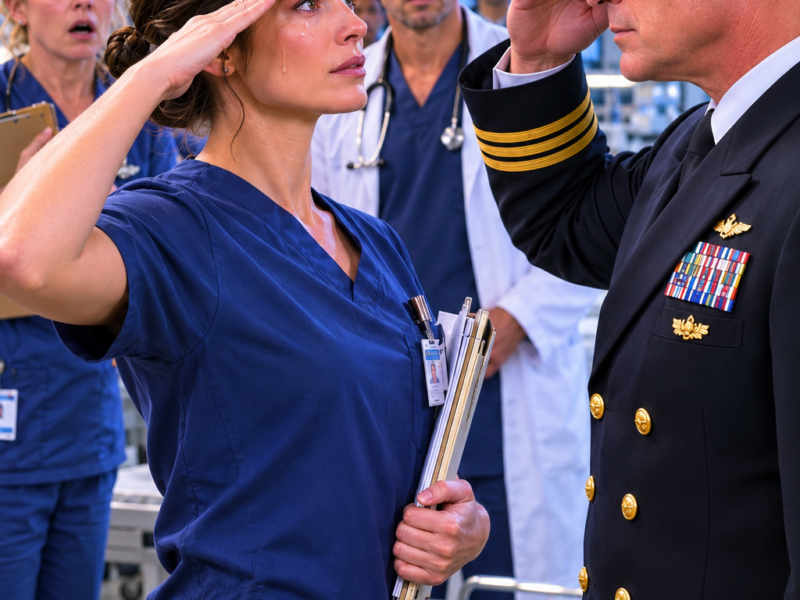
The ER Staff Mocked the New Nurse—Until a Navy Helicopter Landed and Called Her Name
The ER Staff Mocked the New Nurse—Until a Navy Helicopter Landed and Called Her Name
Taran Beckett had spent twelve years learning how to keep people alive in places where help might never arrive. She had treated wounded soldiers beneath collapsing roofs, stopped catastrophic bleeding in the back of moving vehicles, and listened for heartbeats while explosions shook the ground beneath her feet. She had endured four combat zones, survived situations that military investigators would later describe as extraordinary, and earned commendations she rarely mentioned even to the people who knew her best.
Yet none of those experiences prepared her for the humiliation of being treated like an incompetent beginner in a civilian emergency room.
For two weeks, the doctors and nurses at Harbor Crest Medical Center had laughed at her suggestions, questioned her judgment, and assigned her the least demanding tasks they could find. They saw a quiet woman with an unfamiliar employment history and assumed she had very little to offer. They never asked why she remained calm when everyone else was overwhelmed. They never wondered why she noticed dangerous symptoms before experienced physicians did. And they certainly never imagined that the woman they sent to restock supplies had once held nine wounded people alive through an entire night without reinforcements.
Then, on a storm-battered Friday evening, a military helicopter descended onto the hospital rooftop without warning.
Minutes later, a Navy captain entered the emergency department, surveyed the crowded room, and demanded to know where Senior Chief Beckett was.
Nobody answered.
The nurses looked toward the physicians. The physicians exchanged confused glances. The charge nurse assumed there had been a mistake.
And then Taran stepped out of a hallway, still holding a patient’s chart.
What happened next would change the way everyone in that hospital understood courage, authority, and the dangerous consequences of judging someone before knowing their story.
But the events that brought that helicopter to Harbor Crest had begun long before the storm arrived.
When Taran first entered the hospital’s emergency department, she had made a deliberate choice to leave her past behind.
She was thirty-eight years old, with dark hair usually pulled into a practical bun and an expression that revealed very little unless someone knew how to read it. Her posture was straight without appearing rigid, and she moved with a quiet economy that made even ordinary tasks seem carefully considered.
On her first day, she had arrived fifteen minutes early, introduced herself to the receptionist, and waited patiently for her orientation.
Her employment records described years of medical service in federal facilities, extensive emergency care experience, and a collection of certifications that the hospital’s human resources department had verified before hiring her.
What those documents did not fully explain was where she had acquired her experience.
They did not describe the desert nights when she had performed emergency procedures beneath red tactical lights. They did not mention the helicopters that had evacuated her patients under hostile fire or the remote outposts where she had been the only experienced medical professional available.
Her military service had been summarized in language that was accurate but deliberately restrained.
That was how she wanted it.
After leaving the Navy, Taran had decided that she wanted to build a life in which her worth was not immediately determined by rank, commendations, or the stories people told about her.
She wanted ordinary work.
She wanted predictable mornings, a small apartment, and the ability to walk home without wondering whether someone halfway across the world was waiting for her to make a life-or-death decision.
Most importantly, she wanted to be treated as a person rather than a legend.
Unfortunately, Harbor Crest had decided she was something else entirely.
Marlene Voss, the department’s charge nurse, had been working at the hospital for eleven years. She was an efficient administrator, a formidable personality, and someone who believed that authority existed primarily to establish who was allowed to speak.
She had built her reputation by handling difficult shifts, confronting demanding physicians, and maintaining order in an environment where disorder could quickly become dangerous.
Over time, however, the confidence that had once made her effective had hardened into an unwillingness to be questioned.
She trusted people who had already earned her approval. Everyone else was expected to remain quiet until she decided they deserved attention.
Taran had attracted Marlene’s suspicion almost immediately.
During orientation, she had asked several detailed questions about the hospital’s disaster response procedures, backup communication systems, and contingency plans for electrical failures.
Marlene had listened with growing irritation.
“We have established protocols for those situations,” she had replied.
“I understand,” Taran said. “I was just wondering how the department handles simultaneous failures.”
Marlene had narrowed her eyes.
“You’re new here, Ms. Beckett. Learn the procedures before you start looking for problems with them.”
Taran had nodded and returned to her paperwork.
By the end of the first week, Marlene had decided that the new nurse was either unusually anxious or trying to impress people with questions she had no business asking.
The other nurses quickly learned which interpretation was safer to repeat.
Some joked that Taran had probably spent her previous employment filing paperwork in a government clinic. Others suggested that she had taken too long to enter civilian medicine because she lacked the confidence to work in a real emergency department.
Taran heard more than they realized.
She heard the laughter when she walked into the break room. She noticed conversations stop when she approached the nurses’ station. She saw the way certain staff members exchanged amused looks whenever she volunteered an observation.
She never confronted them.
Not because their behavior did not hurt, but because she had learned long ago that reacting to every insult could consume energy better spent on something important.
Still, there were evenings when she returned to her apartment, removed her shoes, and sat alone at the kitchen table for several minutes before turning on a light.
During those moments, she sometimes wondered whether leaving the Navy had been a mistake.
She had expected civilian medicine to be different.
She had not expected to feel invisible.
The first serious incident occurred during her second week.
A forty-six-year-old shipyard worker named Daniel Mercer arrived with a badly injured leg after heavy machinery shifted unexpectedly and pinned him against a loading platform.
His lower leg was swollen and discolored. He was sweating heavily and repeatedly insisting that he was fine.
Dr. Adrien Pike, the attending trauma surgeon, examined the injury and ordered imaging.
Pike was thirty-eight, confident, and widely respected within Harbor Crest. His technical ability was considerable, and his colleagues often described him as one of the department’s brightest physicians.
He knew it.
That knowledge had gradually become a problem.
He had developed the habit of interpreting questions from junior staff as challenges to his judgment rather than opportunities to reconsider it.
When Taran approached the bed, she noticed something that troubled her.
Daniel’s leg was clearly injured, but his face told another story.
His skin had taken on an unhealthy gray tone. His breathing was shallow and unusually controlled, and he seemed to be protecting his chest whenever he shifted.
Taran glanced at the vital signs, then examined the man’s posture.
“Mr. Mercer,” she asked gently, “did anything strike your upper body when the equipment fell?”
He hesitated.
“I don’t know. Maybe the side of the platform. Everything happened fast.”
“Does it hurt when you take a deep breath?”
“A little.”
He attempted a breath and stopped halfway through.
Taran looked toward Dr. Pike, who was already preparing to leave.
“Doctor, I think we should reassess his chest.”
Pike turned.
“Why?”
“His perfusion and respiratory pattern don’t seem consistent with an isolated leg injury. He may have sustained additional trauma that wasn’t identified during transport.”
Pike stared at her.
Then he glanced at the other nurses.
“You’ve been here what, ten days?”
Taran kept her expression neutral.
“Yes, Doctor.”
“Then here’s some advice. Don’t practice medicine when you haven’t been asked to.”
The remark drew a brief laugh from someone near the medication cart.
Taran felt the familiar sting of being dismissed, but she did not look away.
“I’m concerned about internal bleeding,” she said.
Pike’s expression hardened.
“I’ve assessed the patient.”
He turned and left.
For the next few minutes, Taran remained close enough to monitor Daniel while continuing her assigned duties.
Then his blood pressure began to fall.
At first, the change was modest.
Seconds later, it became alarming.
Daniel’s breathing deteriorated, his face lost its remaining color, and the bedside monitor began sounding warnings.
The resident rushed to summon Pike.
Within minutes, the emergency department was mobilizing around a problem Taran had already identified.
Further assessment revealed significant internal injuries that required urgent intervention.
The team stabilized Daniel and transferred him for specialized treatment.
His life was saved, but the delay had nearly cost him dearly.
Afterward, one of the younger nurses asked Pike whether there had been any warning signs.
“Trauma patients can deteriorate unpredictably,” he answered.
Then he glanced toward Taran.
“She happened to guess correctly. That doesn’t make it a diagnosis.”
A few people laughed.
Taran continued restocking intravenous supplies without saying a word.
But that evening, as she changed out of her scrubs, she stood in front of her locker longer than usual.
Inside was a small, gray metal box secured with a combination lock.
She opened it.
There were several military photographs, a folded flag patch, a few personal letters, and a commendation bearing the official seal of the United States Navy.
One photograph showed nine wounded service members gathered around a woman whose face was exhausted, dirty, and almost unrecognizable beneath the streaks of dried blood.
That woman was Taran.
She touched the edge of the photograph.
For a moment, the fluorescent lights of the changing room seemed impossibly bright.
She remembered a night when the only light had come from a damaged emergency lantern. She remembered the smell of smoke, the sound of someone begging her not to let him die, and the terrible silence that followed when the radio stopped responding.
She closed the box.
Whatever Harbor Crest thought of her, she reminded herself, she had not come there to prove the existence of her past.
She had come to build a future.
The following Friday began with deceptively pleasant weather.
Port Alder’s annual harbor festival had transformed the waterfront into a sprawling celebration of food, music, and local traditions.
Families wandered between brightly illuminated stalls. Children carried balloons and paper bags filled with sweets. Musicians performed beneath decorative lights, while crowds gathered around a temporary stage overlooking the water.
By early evening, several thousand people had arrived.
The forecast had warned of possible coastal storms, but the sky remained clear enough that most visitors ignored the possibility.
At Harbor Crest, the emergency department prepared for an ordinary busy Friday night.
Marlene stood behind the central nurses’ station, assigning responsibilities with her usual confidence.
“Taran, secondary intake tonight. Minor injuries, basic assessments, and supply support.”
Taran nodded.
“Understood.”
Marlene added, “And please don’t decide you’re running trauma coordination again.”
Two nurses smiled.
Taran picked up her assignment sheet.
“No problem.”
Across the room, paramedic Cole Ramsay noticed the exchange.
Cole was thirty-five, broad-shouldered, and quiet in a way that made people underestimate how closely he observed his surroundings.
Years earlier, he had worked with a military humanitarian response unit overseas. He had seen temporary hospitals assembled inside abandoned warehouses and medical teams operating under conditions far removed from the orderly procedures taught in classrooms.
Something about Taran had interested him from the beginning.
She never seemed uncertain about what was happening around her.
Even while performing routine tasks, she watched the department as though she were tracking several conversations at once.
Cole had seen that kind of awareness before.
It belonged to people who had learned that danger rarely announced itself politely.
But he had no reason to question her about it.
At 8:43 that evening, everything changed.
A violent gust swept across the waterfront.
The first people to notice were the workers securing temporary signs along the pier. Then the decorative flags began snapping sharply in the wind.
A few spectators looked toward the sky.
The clouds had darkened with remarkable speed.
On the main festival stage, the suspended lighting structure began swaying.
A technician shouted for the performance to stop.
Before the musicians could respond, a metal support beam fractured.
The noise sounded like a gunshot.
The upper lighting rig tilted, pulling cables and additional supports with it.
People screamed.
Some began running toward the exits.
Then the second support failed.
Several hundred pounds of metal equipment crashed toward the crowd.
The structure struck the edge of a temporary seating platform, causing a long section of aluminum bleachers to collapse beneath dozens of spectators.
The entire sequence lasted less than half a minute.
When it ended, the music had stopped, the stage was dark, and the waterfront was filled with terrified voices calling for help.
At 8:51, Harbor Crest received its first emergency notification.
Multiple injuries at the festival.
Possible structural collapse.
Casualty count unknown.
By 9:05, the situation had escalated.
Dispatch estimated more than thirty injured people, several of them critically.
Ambulances were arriving from every available station.
Private vehicles were bringing additional casualties.
Road closures and an unrelated traffic accident had trapped several hospital employees away from the building.
Marlene activated the department’s mass-casualty response procedures.
Within minutes, every available trauma bay was occupied.
A woman with a fractured pelvis lay beside a man suffering severe respiratory distress. A child with a broken arm cried for his mother. A festival security worker arrived with deep lacerations caused by falling metal.
The air filled with the sounds of alarms, hurried footsteps, and overlapping instructions.
Pike moved rapidly between patients.
He performed with impressive technical confidence, but as the number of casualties increased, the department’s organization began deteriorating.
Nurses were repeatedly reassigned before completing their previous tasks.
Patients who initially appeared stable remained unattended too long.
Equipment was carried from one treatment area to another without a consistent system.
Taran noticed the pattern almost immediately.
She had seen similar failures during overseas mass-casualty responses.
The danger was not that the staff lacked ability.
The danger was that everyone was using their abilities independently.
Without clear divisions of responsibility, the loudest emergency would always receive attention, while quieter emergencies developed unnoticed.
Taran completed her secondary intake assessments while monitoring the central department.
Then she saw the teenager in Bay Seven.
His name was Evan Miller.
He was seventeen years old and had been standing near the festival stage when the lighting structure collapsed.
A metal bracket had struck the side of his head.
Field responders had controlled the bleeding, bandaged the wound, and classified him as a serious but initially stable patient.
When Taran first passed his bed, Evan was lying motionless with his eyes half closed.
Something about his stillness troubled her.
She approached.
“Evan?”
No response.
She gently touched his shoulder.
“Evan, can you hear me?”
He murmured something unintelligible.
Taran examined his pupils.
The left was slightly larger than the right.
She checked again.
The difference was subtle, but unmistakable.
Her stomach tightened.
She looked at the triage information, then at the time documented on his last assessment.
Fifteen minutes had passed.
Long enough for a dangerous head injury to worsen.
She approached another nurse.
“Bay Seven needs immediate reassessment. His responsiveness has decreased, and I’m seeing unequal pupils.”
The nurse glanced at the chart.
“He’s yellow priority.”
“He was yellow when he arrived. His neurological condition has changed.”
“I’ll let someone know.”
The nurse hurried away.
Taran returned to Evan.
His breathing had become irregular.
She checked his response to verbal stimulation again.
Then his left arm extended involuntarily.
Taran recognized the movement immediately.
It was a warning sign she had encountered in wounded service members whose head injuries were becoming catastrophic.
She pressed the emergency call button.
Nobody appeared.
For several seconds, she watched Evan’s chest rise and fall.
Then she made a decision.
She pulled back the curtain and called across the room.
“I need immediate assistance in Bay Seven! Suspected intracranial hemorrhage with neurological deterioration!”
Her voice changed.
It was no longer the soft, restrained voice of the new nurse who had spent two weeks avoiding conflict.
It carried a calm authority that cut through the surrounding noise.
Two nurses turned at once.
“Bring the attending physician,” Taran instructed. “We need urgent imaging and neurosurgical escalation. Prepare for airway support. His condition is deteriorating.”
The nurses moved.
Taran continued her neurological assessment, communicated the findings, and coordinated the immediate bedside response within the emergency team’s protocols.
She did not hesitate.
Her hands moved with the practiced certainty of someone who had performed similar assessments under conditions far worse than these.
Marlene arrived and stopped at the entrance.
For a moment, she simply watched.
This was not the hesitant beginner she had assigned to supply carts.
Taran was communicating clearly, anticipating problems, and organizing personnel without a trace of panic.
Pike arrived minutes later.
He assessed Evan and immediately understood the danger.
“Get him to imaging. Notify neurosurgery.”
He looked at Taran.
“How long has he been deteriorating?”
“His last documented neurological assessment was approximately fifteen minutes before I noticed the pupil discrepancy. The abnormal extension began less than two minutes ago.”
Pike stared at her for half a second.
Then he turned toward the team.
“Move.”
Imaging revealed a rapidly expanding epidural hematoma.
Evan was taken to surgery.
Later, the neurosurgical team would confirm that the early recognition of his deterioration had been critical to his survival.
Back in the emergency department, Taran was already preparing the next patient for assessment.
Cole approached her near the medication cart.
“That was impressive.”
She looked up.
“The boy needed help.”
“That’s not what I meant.”
She waited.
Cole lowered his voice.
“I’ve worked in field hospitals. I’ve seen people take control of a crisis when everyone around them was losing track of the bigger picture.”
Taran said nothing.
“You’ve done this before,” he continued.
“Every nurse here has handled emergencies.”
“Not like that.”
For the first time, something resembling amusement touched her expression.
“Then maybe you should ask the other nurses to surprise you.”
Cole smiled faintly.
He understood that she was not ready to explain.
He also understood that she was deliberately avoiding the subject.
The next hour only deepened his suspicion.
Taran began recognizing organizational problems that others were too overwhelmed to see.
She noticed that critically injured patients were arriving faster than they could be distributed.
She saw nurses repeatedly crossing the entire department to retrieve equipment that could have been consolidated.
She identified a growing backlog of patients requiring reassessment.
Finally, she sketched a simple floor plan on the back of a triage form.
She divided the available treatment areas into three sectors based on urgency and available resources.
Then she brought it to Marlene.
“We need dedicated teams assigned to each section,” she explained. “Right now, we’re losing time every time someone gets redirected to a different area. Patients who appear stable aren’t being reassessed consistently.”
Marlene looked at the drawing.
Her expression darkened.
“I’ve been running this department for eleven years.”
“I know.”
“Then perhaps you should respect the fact that I understand how it operates.”
“This isn’t about your experience. It’s about the number of incoming patients.”
Marlene placed the paper face down on the desk.
“I don’t need a two-week employee explaining disaster management to me.”
Taran glanced toward the crowded hallway.
For an instant, she considered pushing the argument further.
She could see the consequences developing almost minute by minute.
But Marlene had already made her decision.
And Taran knew that a prolonged confrontation would only take attention away from the patients.
She stepped back.
“Understood.”
When she raised the same concern with Pike, he gave her an equally dismissive answer.
“Stay within your responsibilities, Nurse Beckett.”
Taran looked at him steadily.
“These are patient-safety concerns.”
“And the department has people responsible for managing them.”
He walked away.
Cole, however, had overheard enough.
A few minutes later, he found Taran near the ambulance entrance.
“Show me your plan.”
She looked at him.
“Why?”
“Because the hallway is filling up, the critical bays are overloaded, and everybody keeps running toward whichever monitor is making the most noise.”
Taran studied him briefly.
Then she unfolded a copy of her sketch.
Cole examined it.
“Three zones,” he murmured.
“Separate reassessment responsibilities,” she said. “Clear communication between them. And someone needs to track patients whose status changes after their initial triage.”
Cole nodded slowly.
“This would work.”
“It would help.”
He handed the paper back.
“Then let’s use what we can.”
They could not formally reorganize the department without authorization, but they could coordinate their own work and make sure relevant information reached the people who needed it.
Cole began directing incoming transport teams toward the appropriate intake areas.
Taran communicated reassessment priorities more consistently.
Several other nurses noticed that their coordination reduced confusion and began participating.
It was not an official command structure.
It was simply a small group of professionals choosing to cooperate intelligently.
And slowly, the department became more manageable.
Then the storm struck the hospital itself.
At 10:19, lightning hit an electrical transformer north of Harbor Crest.
A deep metallic sound echoed through the building.
Several overhead lights went dark.
Computer monitors flickered.
The emergency department lost portions of its normal electrical supply.
Backup lighting activated, but several monitoring stations temporarily lost network connectivity.
A surgical preparation area was left without adequate illumination.
For a few terrible seconds, confusion spread through the department.
A nurse shouted that a monitor had stopped responding.
Someone called for technical support.
Another employee hurried toward the electrical control panel.
Taran was already moving.
She reached for a flashlight, verified that the patients nearest her were receiving necessary support, and helped coordinate manual observation where monitoring equipment had been disrupted.
“Check the equipment on independent backup power,” she instructed a nearby nurse. “Report any patient whose support has been affected.”
Her voice remained steady.
The strange thing was how natural the darkness seemed to her.
It brought back memories she had spent years trying to contain.
A medical shelter illuminated by a single failing battery.
The smell of wet canvas.
A wounded man asking whether the evacuation helicopter was coming.
A radio operator shaking his head.
No signal.
No confirmation.
No one knew how long they would be alone.
Taran forced the memory away.
Harbor Crest was not that place.
Here, there were additional physicians, trained nurses, functioning emergency systems, and people who could share responsibility.
She was no longer alone.
Pike watched her from the opposite side of the room.
For the first time, he found himself wondering whether the woman he had repeatedly dismissed understood certain emergencies better than he did.
That thought unsettled him.
Not because he doubted his own abilities, but because he had never seriously considered the possibility that her abilities might come from experiences he knew nothing about.
The electrical system partially recovered.
The staff resumed their work.
Then, at 10:47, Cole looked through the rain-covered window near the ambulance entrance and froze.
Above the hospital, emerging from the storm clouds, was a helicopter.
Its shape was unmistakable.
It was not a civilian air ambulance.
It was a military utility aircraft, gray against the black sky, descending toward the rooftop landing pad.
Cole stepped closer to the window.
“What in the world?”
Marlene approached.
“What’s happening?”
“Military helicopter.”
She looked outside.
“Did anyone authorize an incoming transfer?”
“No notification came through.”
Marlene reached for the telephone.
“We don’t have room for another critical patient.”
But the helicopter was already landing.
Its rotors cut through the rain, sending sheets of water across the rooftop.
Inside, the emergency department continued operating under strained conditions.
Six minutes later, the main doors opened.
A man in a Navy captain’s uniform entered with two naval personnel and a medical transport team.
He was in his early fifties, with short silver hair and the measured posture of someone accustomed to making decisions under pressure.
His name was Captain Grant Ellison.
He did not hesitate at the entrance.
Instead, he scanned the department, taking in the crowded beds, the exhausted staff, and the scattered equipment.
Then he spoke.
“Where is Senior Chief Beckett?”
The question carried across the emergency room.
Several nurses looked up.
Marlene frowned.
“I’m sorry?”
Ellison repeated himself.
“Senior Chief Taran Beckett. I was informed she works here.”
Pike stepped forward.
“We have a nurse named Taran Beckett.”
Ellison turned toward him.
“Then please find her.”
Pike hesitated.
“Captain, I think there’s been a misunderstanding. Nurse Beckett is a relatively new employee.”
Ellison’s expression remained unchanged.
“I’m not asking how long she’s worked here, Doctor. I’m asking where Senior Chief Beckett is.”
A strange silence settled over the nearby staff.
Marlene stared at the captain.
“Senior Chief?”
Before Ellison could answer, footsteps sounded in the hallway.
Taran emerged carrying a chart.
She had been assisting in the east wing and had heard the unusual helicopter approach.
The moment she saw Ellison, she stopped.
The captain turned.
Their eyes met.
Something passed between them that nobody else in the room could understand.
Recognition.
Relief.
And the weight of a history far larger than the crowded emergency department around them.
Ellison straightened.
“Senior Chief Beckett.”
He raised his hand in a formal salute.
Taran returned it instinctively.
The movement was precise and effortless.
Around them, people stared.
Marlene’s clipboard slowly lowered.
Pike looked from Taran to the captain and back again.
Cole remained near the ambulance entrance, watching with an expression that suggested a long-standing suspicion had finally been confirmed.
Taran lowered her hand.
“Captain Ellison.”
“It’s good to see you.”
“I wasn’t expecting you.”
“I know.”
She looked toward the doors.
“Who’s hurt?”
Ellison’s expression changed.
That single question confirmed something he had never doubted.
Even after everything she had endured, Taran’s first concern was still the patient.
“We have a critically injured service member,” he said. “His name is Julian Cross. Penetrating chest trauma. Our original receiving facility couldn’t accept the flight because of the weather. We were diverted, and I learned you were here.”
Taran glanced toward Pike.
“Then let’s get him inside.”
Marlene stepped forward.
“Wait a moment. Who exactly is she?”
Ellison turned slowly.
For the first time, his expression carried a hint of disbelief.
“You’ve been working with her and you don’t know?”
Marlene said nothing.
Ellison looked around at the gathered staff.
“Senior Chief Beckett served twelve years in some of the most demanding medical environments our personnel encounter.”
He paused.
“Much of her service involved forward operations. Some details aren’t appropriate for public discussion.”
Pike watched Taran’s face.
She seemed distinctly uncomfortable.
Ellison continued.
“But I can tell you something I witnessed personally.”
His voice softened.
“Three years ago, a medical position was cut off during a hostile engagement. Communications failed. Supplies were nearly exhausted. Nine wounded personnel were unable to evacuate.”
Taran looked down.
“Captain—”
Ellison acknowledged her with a slight movement of his head.
“I won’t discuss anything you don’t want discussed.”
Then he turned back to the room.
“When support finally reached that position, all nine were alive. Senior Chief Beckett had kept them that way for nearly ten hours.”
Nobody spoke.
“The conditions were beyond anything I would wish on a medical professional. She had little equipment, limited supplies, and no reliable confirmation that help was coming.”
His eyes returned to Taran.
“She kept working anyway.”
Marlene’s face had gone pale.
Pike felt a heavy sensation settle in his stomach.
He remembered Daniel Mercer.
He remembered the teenager in Bay Seven.
He remembered telling Taran to stay within her responsibilities.
For the first time, he understood how absurd those words might have sounded to someone who had spent years handling emergencies he had never encountered.
Ellison looked toward the transport team.
“We didn’t come here for a reunion.”
The doors opened again.
A stretcher rolled into the department.
Julian Cross was thirty-one years old, with a severe penetrating injury to his upper right chest.
His military uniform had been cut away to allow treatment.
The field medical team had managed the immediate threats as well as possible, but his condition remained critical.
His skin was pale.
His blood pressure was dangerously low.
He required definitive surgical care.
Pike moved into position immediately.
“I’m the attending trauma surgeon,” he said.
Taran nodded.
“Then he’s your patient.”
Pike looked at her.
There was no challenge in her voice.
No attempt to take control of his role.
She was simply stating the next step.
“I’ll help keep him stable while you prepare for surgery,” she added.
Pike held her gaze.
Then he nodded.
“All right. Let’s move.”
They began transferring Julian toward the intervention area.
Almost immediately, another problem struck.
The overhead lights flickered.
A second electrical failure affected portions of the backup system.
The room fell into near darkness before emergency lighting stabilized.
Then a nurse rushed in from the south wing.
“We have a problem with blood storage. Part of the backup system has failed, and our available supply for major trauma is critically reduced.”
Pike’s expression tightened.
The evening’s mass-casualty event had already consumed significant resources.
Julian needed urgent treatment, but so did many other patients.
Marlene appeared near the doorway.
“We still have eleven patients in the hallway waiting for complete reassessment.”
Pike looked at the available information.
His jaw tightened.
“We can’t save everyone the same way.”
For Taran, the words landed with terrifying familiarity.
Suddenly, she was no longer standing inside Harbor Crest.
She was back in a darkened medical shelter three years earlier.
The wounded lay close together because there was nowhere else to put them.
A radio hissed uselessly beside her.
A young service member with a fractured leg kept asking about his brother.
Another man had stopped speaking entirely.
Outside, distant gunfire rose and faded.
She remembered counting her remaining supplies.
Remembered realizing that there was not enough of everything for everyone.
Remembered the impossible responsibility of deciding what needed to happen first.
Even after leaving the Navy, she had never truly escaped the weight of that night.
There were faces she still saw in dreams.
Voices that returned unexpectedly when a room became too quiet.
And beneath all of it was a fear she rarely admitted.
The fear of becoming the only person responsible again.
At Harbor Crest, Julian’s monitor sounded another warning.
Taran forced herself back into the present.
She looked around the room.
Cole was standing nearby.
Several nurses waited for instructions.
Pike was watching her.
For the first time in years, she understood something she had struggled to believe.
She was not alone in a remote medical shelter.
She was surrounded by capable people.
They simply needed a coordinated plan.
“We can’t save everyone the same way,” she repeated.
Pike looked at her.
“Then what do you suggest?”
“We stop treating this as one enormous emergency and organize the response into separate priorities.”
She turned toward Marlene.
“Give me the current staffing count, available blood inventory, and remaining treatment spaces.”
Marlene hesitated.
Then she nodded.
For the first time since Taran had arrived at Harbor Crest, the charge nurse followed her request without argument.
Taran spread the triage plan across the counter.
“We need dedicated responsibility for critical cases, urgent reassessments, and stable patients who still require observation. Everyone needs to know exactly who is responsible for each group.”
Cole stepped closer.
“I can coordinate incoming transports and help track the reassessment assignments.”
“Good.”
Taran looked toward the remaining nurses.
“We need continuous communication between the sectors. Nobody disappears into the hallway without someone knowing who is responsible for them.”
Pike examined the plan.
It was simple.
Practical.
Built around the people and resources they actually had rather than the staffing levels they wished were available.
He looked up.
“Do it.”
The words changed the atmosphere.
Not because Taran had suddenly become more capable.
She had been capable all along.
But now the department was finally willing to listen.
Cole moved to coordinate the floor.
Marlene began handling staffing assignments.
The nurses reorganized their work around the available treatment areas.
And inside the intervention bay, Julian’s condition deteriorated.
At 10:59, his heart stopped.
The monitor alarm sounded.
For a heartbeat, the room seemed to contract around the bed.
Then Pike called for resuscitation.
The team responded immediately.
Taran remained at the head of the bed, supporting airway management and communicating the changes she observed.
Her voice was calm, precise, and entirely focused on Julian.
Pike directed the medical response.
He was fast, technically skilled, and capable of making difficult decisions under extreme pressure.
But this time, he listened carefully whenever Taran spoke.
She had identified dangerous developments before others noticed them twice already.
He was not going to make the mistake of dismissing her a third time.
As the team worked, Taran noticed something concerning in Julian’s physiological response.
She shared the observation immediately.
“Doctor, I think we may be dealing with an additional source of bleeding. The presentation isn’t fully explained by the injury we’ve identified.”
Pike reassessed.
Further evaluation supported her concern.
The team adjusted its intervention accordingly, addressing a secondary injury that had been difficult to recognize during transport.
Minutes passed.
The work continued.
Then Julian’s heart regained a rhythm.
It was weak at first.
Unstable.
But it was a rhythm.
Someone exhaled sharply.
Taran checked the monitor and looked toward Pike.
“We have a chance.”
Pike nodded.
“Then let’s use it.”
The next forty minutes demanded everything the medical team could provide.
Julian remained critically unstable.
Pike focused on definitive treatment of the chest injuries, while the surrounding clinical team worked to maintain his circulation and respiratory support.
Taran anticipated changes, reported observations, and helped coordinate the ongoing response.
The two of them worked with increasing efficiency.
There was no room for ego.
No room for arguments about seniority.
Only the immediate problem and the person whose life depended on their cooperation.
At one point, Julian’s blood pressure began dropping again.
Pike looked toward Taran.
“What are you seeing?”
She summarized the changes and the support measures she believed should be reviewed.
Pike considered her observations, made the necessary clinical decisions, and directed the next adjustments.
The team responded.
Slowly, Julian’s condition began to stabilize.
Outside the intervention area, Cole’s coordination was producing results.
The eleven patients who had remained in the hallway were reassessed and redistributed.
Critical resources were tracked more effectively.
The immediate danger of patients being overlooked diminished.
Marlene worked alongside the others.
She said little.
Her usual commanding manner had disappeared, replaced by a strained concentration.
She had spent years believing that effective leadership meant being the person everyone obeyed.
Now she was watching a different kind of leadership succeed.
Taran did not need to humiliate anyone.
She did not need to remind people of her experience.
She identified what needed to happen, explained it clearly, and trusted competent people to perform their responsibilities.
The contrast was impossible to ignore.
Inside the intervention area, Julian’s heart rate finally settled.
His blood pressure improved.
The immediate crisis began to ease.
Pike studied the monitor.
He waited a few seconds, unwilling to trust improvement too quickly.
Then he looked at Taran.
“He’s going to make it.”
She checked the readings.
A small breath escaped her.
“Good.”
Pike almost smiled.
After everything they had done, he expected something more emotional.
Relief.
Exhaustion.
Perhaps a moment of triumph.
Instead, Taran turned toward the circulating nurse.
“How many critical patients are still waiting on the main floor?”
Captain Ellison, standing outside the intervention area, heard the question.
He smiled faintly.
It was exactly the response he remembered.
Years earlier, after nearly ten hours of keeping wounded personnel alive without assistance, Taran’s first question when the rescue team arrived had not been whether she would receive recognition.
She had asked whether everyone had been accounted for.
Some things, he realized, had never changed.
By four in the morning, Harbor Crest was beginning to recover.
The storm was moving east.
Rain still struck the windows, but the violent wind had weakened.
Most of the patients from the harbor festival had been stabilized at Harbor Crest, while four had been transferred to specialized facilities for care their injuries required.
Evan Miller had survived emergency surgery.
Daniel Mercer, the shipyard worker from earlier in the week, was recovering at another medical facility.
And Julian Cross was alive in intensive care.
The emergency department looked like a place that had survived a battle.
Empty packaging filled disposal containers.
Staff members moved with the stiff exhaustion of people who had been standing for far too many hours.
Coffee sat untouched beside computer terminals.
The ordinary rhythm of hospital work was slowly returning.
At 4:15, Dr. Malcolm Brier, Harbor Crest’s chief medical officer, arrived.
He had been informed of the mass-casualty response, the electrical failures, and the unexpected military transfer.
But the reports he received on arrival suggested that something else had happened.
Something involving the newest nurse on the emergency department’s roster.
Brier began reviewing the night’s events.
He spoke with Pike.
Then Cole.
Then several nurses who had participated in the response.
The accounts were remarkably consistent.
Taran had recognized a deteriorating neurological patient before his condition was widely understood.
She had identified organizational weaknesses during the mass-casualty response.
She had helped coordinate care through electrical disruptions.
And she had contributed significantly to the successful treatment of a critically injured military patient.
Brier asked to see the triage documentation.
Among the papers was a handwritten floor plan divided into three sections.
He examined it carefully.
“Who designed this?”
One of the nurses answered.
“Taran Beckett.”
“Was it part of the original disaster response protocol?”
“No, sir.”
“Then why wasn’t it used immediately?”
Nobody answered.
Brier looked around the room.
He had been responsible for hospital administration long enough to recognize when silence meant more than ignorance.
He began asking additional questions.
What he discovered concerned him.
Taran had repeatedly been assigned duties below her demonstrated capabilities.
Her clinical observations had been publicly dismissed.
Several staff members described an ongoing pattern of ridicule and exclusion.
Pike acknowledged his own role.
“I underestimated her,” he said.
Brier looked at him.
“How seriously?”
Pike took a breath.
“Seriously enough that I nearly ignored a warning about a patient who subsequently deteriorated.”
Brier remained silent.
Pike continued.
“She recognized the problem before I did. I dismissed her because I thought she lacked experience.”
“And now?”
Pike looked through the glass toward the emergency department.
“Now I know I should have listened.”
At five in the morning, Marlene was called into Brier’s office.
The meeting was brief.
He informed her that she was being suspended from her charge nurse duties pending a formal investigation into her conduct and the department’s management practices.
Marlene sat motionless.
For eleven years, she had considered Harbor Crest her territory.
She knew the staff, the procedures, and the unwritten rules that governed every shift.
Now she was being told that some of those unwritten rules had created an environment where patient safety concerns could be ignored because of who raised them.
She attempted to explain.
She spoke about stress.
About staffing shortages.
About the need to maintain discipline.
Brier listened.
Then he asked a simple question.
“When Nurse Beckett identified a possible problem, did you evaluate the concern on its merits, or did you evaluate the person who brought it to you?”
Marlene opened her mouth.
No answer came.
Eventually, she looked down.
Brier continued.
“A hospital cannot function safely when employees are afraid to speak or when their concerns are rejected because of their position in the hierarchy.”
Marlene left his office shortly afterward.
She collected her belongings.
Then she walked out through the main entrance without speaking to anyone.
Taran was completing documentation when she heard the doors close.
She did not look up.
Twenty minutes later, Pike approached her.
For several seconds, he stood beside the workstation without speaking.
Taran finished entering a note.
“Something you need, Doctor?”
Pike glanced at the screen, then at her.
“An apology.”
She turned slightly.
He continued before she could respond.
“I owe you one.”
Taran waited.
“Two weeks ago, I decided what kind of nurse you were before I had any real evidence.”
His voice was quiet.
“I saw a new employee. I saw an unfamiliar work history. And I assumed I understood your limitations.”
Taran watched him.
Pike swallowed.
“When you warned me about Daniel Mercer, I dismissed you. When you raised concerns about the triage system, I dismissed you again.”
He paused.
“Tonight, you showed me how dangerous that attitude can be.”
Taran leaned back slightly.
“You’re a very good surgeon, Dr. Pike.”
He looked surprised.
She continued.
“I watched you work tonight. You’re capable of making difficult decisions, and you don’t panic when a patient deteriorates.”
Pike said nothing.
“But you have a habit of deciding who’s worth listening to before they’ve finished speaking.”
He lowered his eyes.
“You’re right.”
“You don’t have to agree with everyone. You don’t even have to like everyone. But when someone raises a patient-safety concern, listen to the concern.”
Pike nodded.
“I will.”
Taran picked up her pen.
“Then that’s a good place to start.”
He remained there another moment.
“Thank you for what you did tonight.”
She gave him a small nod.
“We all did our jobs.”
Pike looked at her with an expression that combined embarrassment and respect.
“Some of us learned how to do them better.”
Then he walked away.
A little after 5:30, Cole found Taran near the ambulance bay.
The first pale light of morning was beginning to appear beyond the hospital windows.
He carried two cups of coffee.
“Thought you might need this.”
She accepted one.
“Thanks.”
They stood quietly for several moments.
Outside, the pavement shone beneath the remaining streetlights.
Cole took a sip.
“I knew there was something different about you.”
Taran smiled faintly.
“Did you?”
“Not exactly what. But I knew you weren’t inexperienced.”
She looked toward the empty ambulance parking area.
“You never asked.”
“I figured you’d tell me if you wanted to.”
She nodded.
Cole hesitated.
“There’s something I need to say.”
Taran turned.
“I watched people dismiss you for two weeks. I noticed it. And I didn’t do much about it.”
“You didn’t participate.”
“That’s not the same thing.”
She studied his face.
Cole continued.
“I’ve spent enough years in emergency work to know that silence can make a bad situation worse.”
Taran looked down at her coffee.
“I’ve been silent about things myself.”
“Still.”
She nodded slowly.
“Then next time, say something sooner.”
Cole smiled.
“Deal.”
They stood together for another minute, watching the sky gradually lighten.
Then Cole glanced at her.
“For what it’s worth, you were the reason we got through tonight as well as we did.”
Taran shook her head.
“There were a lot of good people working.”
“Sure. But good people still need someone to help them see the whole situation.”
She looked at him.
He continued.
“You didn’t make anyone feel small. You just made the next right decision easier to understand.”
For a moment, Taran could not find an answer.
It was an unfamiliar kind of recognition.
Not a medal.
Not a citation.
Not a senior officer praising her performance.
Just another exhausted medical professional telling her that her work had mattered.
Finally, she nodded.
“Thank you, Cole.”
He smiled.
“See you next shift?”
“Unless you find a quieter hospital.”
“Not likely.”
They parted with the comfortable familiarity of people who had survived a difficult night together.
When Taran reached the rooftop access corridor, Captain Ellison was preparing to leave.
The helicopter waited outside, its crew completing final checks beneath the clearing sky.
Ellison turned when she approached.
“How’s Cross?”
“Stable in intensive care.”
“Good.”
He watched her for a moment.
“You look exhausted.”
“So do you, Captain.”
He laughed softly.
“Fair enough.”
They moved closer to the doorway, where the sound of the aircraft was less intense.
Ellison looked out toward the harbor.
“I heard about what happened here tonight.”
Taran folded her arms.
“Which part?”
“The part where you reorganized an overwhelmed emergency department while helping keep a critically injured man alive.”
“That description gives me too much credit.”
“Somehow, I expected you to say that.”
She smiled.
Ellison’s expression became more serious.
“You know the Navy would take you back.”
Taran looked toward the helicopter.
For a long moment, she did not speak.
The aircraft’s running lights blinked steadily in the dawn.
Once, that sound and those lights had represented everything familiar in her life.
Orders.
Deployments.
Emergency communications.
The rush of preparing to receive casualties.
The responsibility of knowing that someone, somewhere, might be depending on her ability to act when everything else failed.
For twelve years, she had lived inside that world.
Leaving it had been one of the hardest decisions she had ever made.
Not because she regretted serving.
She did not.
But because the responsibility had begun following her into every quiet moment.
There had been nights when she woke convinced that someone was calling for a medic.
Mornings when ordinary silence felt suspicious.
Afternoons when she stood in a grocery store, surrounded by people choosing fruit and bread, and wondered how the world could be so peaceful while somewhere else a medical team was fighting to keep someone alive.
She had needed time to learn that living did not require constant vigilance.
She had needed a place where she could help people without carrying the entire mission alone.
And, perhaps more than anything, she had needed to discover whether her identity could exist beyond her rank.
Ellison seemed to understand.
“I’m not here to recruit you,” he said.
“I know.”
“I just wanted you to know the door remains open.”
Taran watched the helicopter crew finish their preparations.
Then she looked back toward the hospital entrance.
Behind that door were exhausted nurses, recovering patients, and a department that still had much to learn.
There were people who had treated her unfairly.
There were also people who had begun to see her clearly.
And there was work worth doing.
“I think I’ve found where I belong,” she said.
Ellison followed her gaze.
“Here?”
She nodded.
“Here.”
He smiled.
“Then they’re fortunate to have you.”
Taran shook her head gently.
“I’m fortunate to have another chance to do this differently.”
Ellison extended his hand.
She shook it.
For a moment, neither spoke.
They had known each other through circumstances that did not require explanations.
Finally, Ellison said, “Take care of yourself, Senior Chief.”
“You too, Captain.”
He stepped toward the helicopter.
Taran remained at the doorway until he disappeared inside.
Then she turned back toward the hospital.
The emergency department looked different in the morning.
Not because the furniture had changed or the lighting had improved.
It looked different because the people inside it were beginning to behave differently.
Nurses who had previously ignored her now greeted her.
Staff members asked questions instead of making assumptions.
Several people thanked her for the previous night’s work.
Taran accepted their words politely.
But she did not linger over them.
At the nurses’ station, a young nurse named Cassie approached.
Cassie had been working at Harbor Crest for less than a year. She was eager, hardworking, and often intimidated by the more experienced staff.
During Taran’s first two weeks, Cassie had occasionally joined the laughter when others made jokes.
Not because she genuinely disliked Taran.
Because she was afraid of becoming the next target.
Now she stood uncertainly beside the workstation.
“Senior Chief Beckett?”
Taran looked up.
“Just Taran.”
Cassie shifted uncomfortably.
“I wanted to say I’m sorry.”
Taran waited.
“For the way people treated you. And for laughing sometimes.”
The words came out quickly.
“I know that doesn’t make it better.”
Taran considered her.
“Why did you laugh?”
Cassie’s cheeks reddened.
“Because everyone else did.”
Taran nodded.
“That’s an honest answer.”
Cassie looked down.
“I should have known better.”
“Probably.”
The younger nurse looked startled by the directness.
Taran’s expression softened.
“But knowing better matters most when you do something different next time.”
Cassie raised her eyes.
“I will.”
“Good.”
Taran picked up a chart.
“Now, can you help me check on the patient in Bay Three?”
Cassie blinked.
“Of course.”
They walked toward the treatment area together.
As they passed the central desk, Cassie glanced at Taran.
“Can I ask you something?”
“Sure.”
“Were you really in combat zones?”
Taran smiled faintly.
“Yes.”
“Were you scared?”
The question surprised her.
Not because it was unusual, but because it was sincere.
Taran considered her answer.
“Many times.”
Cassie looked at her.
“But you always knew what to do?”
Taran shook her head.
“No.”
The younger nurse seemed confused.
“I thought people like you always had answers.”
Taran stopped walking.
“That’s one of the most dangerous things you can believe about experienced people.”
Cassie listened carefully.
“Experience doesn’t mean you never feel afraid. It means you’ve learned how to work responsibly even when you’re afraid. It also means understanding when you need help.”
Cassie nodded slowly.
Taran continued.
“And no matter how experienced someone is, they can still miss something. That’s why we have teams.”
For the first time, Cassie smiled naturally.
“That makes me feel a little better.”
“It should.”
They entered Bay Three.
The patient was an elderly man recovering from complications related to a chronic condition.
He looked up as they approached.
“Morning, ladies.”
“Good morning,” Taran replied.
She began reviewing his chart.
And just like that, she returned to the work she had come to Harbor Crest to perform.
In the days that followed, the story of the Navy helicopter spread through the hospital.
Some versions grew increasingly dramatic.
People claimed that Taran had been a secret military commander or that an entire special operations unit had arrived to retrieve her.
Others insisted that she had personally performed impossible procedures beneath enemy fire.
Taran corrected the exaggerations whenever she heard them.
She had no interest in becoming the subject of hospital mythology.
The truth was complicated enough.
The leadership team began reviewing the emergency department’s staffing practices, escalation procedures, and disaster preparedness.
The investigation into Marlene’s conduct continued through the appropriate administrative process.
Pike began making a conscious effort to invite observations from nursing staff, especially when patient conditions were changing.
He was not transformed overnight.
Habits built over years do not disappear because of one difficult shift.
There were still moments when his impatience surfaced.
But now, when a nurse raised a concern, he stopped.
He listened.
And sometimes, when the concern turned out to be correct, he acknowledged it aloud.
Cole continued working closely with the emergency department, helping develop more effective communication between ambulance teams and hospital staff.
Cassie became noticeably more confident about reporting changes in patients’ conditions.
And Taran gradually stopped standing so close to the walls.
Her work remained much the same.
She assessed patients, monitored vital signs, assisted physicians, reassured frightened families, and handled the countless ordinary responsibilities that kept the department functioning.
But something important had changed.
She no longer felt that revealing her competence would automatically return her to the life she had left behind.
She could be an experienced military medical professional and a civilian nurse.
She could remember the past without allowing it to control every moment of the present.
She could lead when leadership was needed and follow when someone else was better positioned to make a decision.
She could accept recognition without surrendering her privacy.
Most importantly, she could belong somewhere without pretending to be less than she was.
Several weeks after the storm, Taran received a letter.
It came in a plain envelope addressed to her at the hospital.
Inside was a handwritten message from Evan Miller’s mother.
She wrote about how frightened she had been when she learned her son required emergency brain surgery.
She described sitting in the waiting room, watching the doors, trying to understand how a night at a music festival had turned into the worst experience of her life.
Then she explained that the surgeon had told her someone had noticed Evan’s deterioration early enough to make a crucial difference.
That someone was Taran.
The letter ended with a simple sentence.
Thank you for noticing my son when he couldn’t ask for help himself.
Taran read the words twice.
Then she folded the paper carefully.
That afternoon, she opened the gray metal box in her locker.
The military photographs were still there.
The commendation remained tucked beneath them.
For years, she had kept those objects separate from her civilian life, as though the woman who had earned them belonged to a different existence.
Now she placed Evan’s mother’s letter inside the box.
It rested beside the photographs of the nine wounded service members she had kept alive three years earlier.
Taran looked at the collection for a long moment.
The objects represented very different places.
A battlefield medical shelter.
A civilian emergency department.
A night of extraordinary violence.
A teenager injured at a waterfront festival.
But the meaning connecting them was the same.
In every place, beneath every title, the work had always been about someone who needed help.
She closed the box.
Then she returned to the emergency department.
At the nurses’ station, Cassie was speaking with a physician about an elderly patient’s changing condition.
The physician was listening carefully.
Cole was discussing an incoming ambulance with the triage nurse.
Pike was reviewing laboratory results and asking a younger nurse whether she had noticed any additional symptoms.
None of it was remarkable enough to attract attention.
That was what made it meaningful.
The department was beginning to function as a place where people could speak, question, and contribute without first proving that their names deserved respect.
Taran stood quietly for a moment.
Then the ambulance radio sounded.
Another patient was coming.
Another family was frightened.
Another life was about to become the most important thing in the room.
She picked up a clean pair of gloves and moved toward the entrance.
There was no military helicopter overhead.
No captain calling her name.
No audience waiting to applaud.
Only an ambulance approaching through the morning traffic and a team preparing to receive someone who needed them.
Taran smiled slightly.
This, she thought, was exactly where she wanted to be.
Because the most important thing about Taran Beckett had never been the rank she carried, the commendations she earned, or the extraordinary circumstances she survived.
It was the person she chose to be when nobody knew any of those things.
Before the helicopter arrived, she had already recognized a hidden internal injury.
Before the captain saluted her, she had already helped save a teenager whose worsening condition others overlooked.
Before anyone understood her history, she had already seen how an overwhelmed emergency department could function more effectively.
The uniform did not create her abilities.
The salute did not grant her authority.
The recognition did not make her valuable.
Those things merely forced other people to confront a truth that had been standing directly in front of them for two weeks.
They had mistaken quietness for weakness.
They had confused humility with inexperience.
And they had allowed the label on a person’s badge to become more important than the evidence of their actions.
Perhaps the most remarkable part was that Taran never demanded that they feel ashamed.
She expected something more useful.
She expected them to learn.
Because in a hospital, arrogance is not merely an unpleasant personality trait. It can become a barrier between a warning and the person who needs to hear it.
And outside hospitals, the same mistake happens every day.
People are dismissed because they are new.
Ignored because they are quiet.
Underestimated because they do not advertise their accomplishments.
Sometimes the most capable person in a room is the one who asks the fewest questions about recognition and the most questions about what needs to be done.
Sometimes the person standing beside the supply cart has already survived experiences that would overwhelm everyone judging them.
And sometimes the greatest proof of strength is not making people acknowledge who you used to be.
It is continuing to do what is right even when they refuse to see who you are.
Taran Beckett did not return to Harbor Crest because everyone finally respected her.
She returned because the patients still needed care, her colleagues still needed support, and she had found a way to serve without losing herself.
The next emergency would not arrive with a dramatic announcement.
There would be no captain to explain her accomplishments.
No helicopter to reveal her past.
But when the doors opened and another stretcher came through, Taran would be there.
Quiet.
Prepared.
Watching closely.
And ready to notice the thing everyone else might miss.
Because a person’s true worth is not determined by how loudly the world announces their name.
Sometimes it is revealed in the simplest moment of all.
When someone needs help, and the person everyone overlooked is the first one to step forward.
THE END