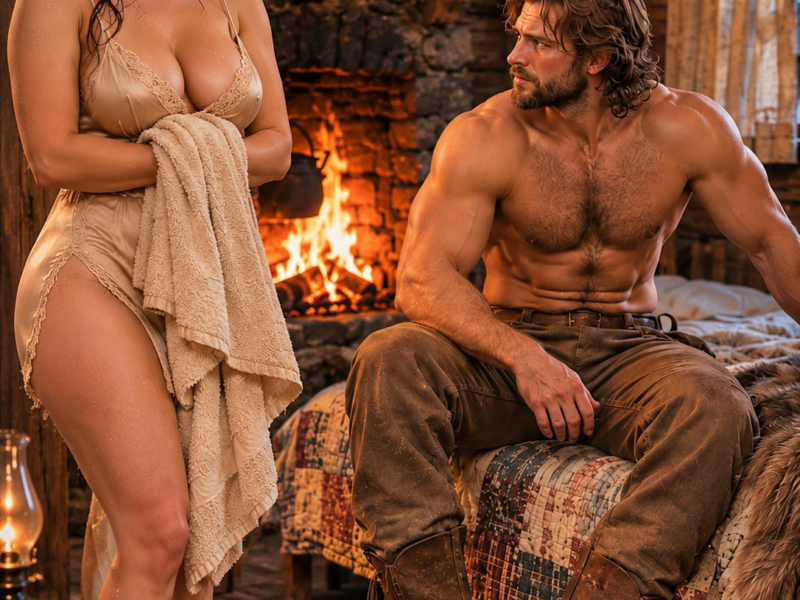
The Cold Mountain Man Thought His Bride Was a Stranger—Until Night Fell
The Cold Mountain Man Thought His Bride Was a Stranger—Until Night Fell
PART 1
The sleet came down like shattered glass, slicing through the air as it swept off the northern ridges and struck Mave Lindell’s face. Her dark hair clung to her cheeks, her boots slipped against the frozen boardwalk of Barrow’s Ferry, and her fingers were so badly cracked from the cold that even closing them into fists made her wince.
But she refused to hide her hands.
Thirty men had gathered in the muddy settlement lane that afternoon, and every one of them was watching her. Some were miners returning from the silver pits. Others were teamsters, trappers, and men who had spent too many winters drinking away whatever decency they might once have possessed.
They were not there to help her.
They were there to watch her lose everything.
“Three hundred and forty dollars in unpaid freight,” Thaddius Vance announced, raising a leather-bound ledger above his head. “That’s what your father left behind, girl. Three hundred and forty dollars, signed, sealed, and recorded.”
He stood on the mercantile porch wearing a broadcloth coat that had belonged to Mave’s father only three weeks earlier.
Ezra Lindell had been a respected freight operator, a hardworking man who had built the depot, hired local workers, and supplied half the mining settlements in the territory. He had taught Mave to read ledgers before she was old enough to properly hold a pen. He had also taught her that a man’s word was worth more than his money.
Unfortunately, Ezra had trusted the wrong man.
Thaddius had spent years drinking whiskey on credit, borrowing supplies, and manipulating the company’s accounts. When Ezra became ill and eventually died, Thaddius produced a ledger claiming that the entire business was bankrupt.
Mave knew the numbers were false.
She knew because she had helped her father maintain the original accounts.
But the original books had disappeared, and the only ledger presented before Magistrate Keller was the one Thaddius held in his hands.
“The freight company cannot feed an idle mouth through four months of hard winter,” he continued. “The law permits the transfer of labor to satisfy outstanding debts. Alternatively, should some enterprising gentleman here possess five double eagles, he may purchase a domestic contract and settle the matter.”
A low rumble of laughter moved through the crowd.
Mave stared at him.
“My father built the freight depot you’re standing on, Thaddius. The timber was felled by his own crew. And that ledger you’re holding is half-written in his handwriting, recording the six months of whiskey you took on credit and never paid for.”
For a moment, Thaddius’s smile disappeared.
Then he stepped closer.
“Your father is six feet under frozen shale, girl. And you have until sundown before I sign you over to the district workhouse at Black Kettle Gulch.”
His voice dropped.
“Eighty convict miners need someone to scrub their equipment and empty their slop buckets. You’ll be doing that until you’re forty unless you get on your knees and ask me kindly to let you keep the salt shed.”
Mave felt the cold settling into her bones.
She had spent four nights sleeping on a wooden bench inside that salt shed. Her stomach had been empty since the previous morning, and the only possessions she had left were a canvas satchel, two pairs of stockings, her mother’s brass thimble, and her father’s pocket watch.
Still, she lifted her chin.
“I would sooner freeze beneath the open sky than eat scraps from your porch.”
Thaddius laughed.
“Did you hear that, boys? Pride! Pure mountain pride from an orphan girl without a dry crust of bread.”
He turned toward the crowd.
“Who wants a wife who looks down her nose while you break your back in the silver pits? Thirty silver dollars to the company chest, gentlemen. That’s all it takes.”
A teamster wearing a greasy leather vest stepped forward.
“I’ve got fifteen silver and two cords of split birch. She can cook salt pork, can’t she?”
Another man laughed from near the livery barn.
“Give her here. I’ll teach her to keep her chin down before the first snow covers the roof.”
The crowd erupted.
The teamster reached for Mave’s shawl.
Her right hand moved instinctively toward the small cobbler’s knife hidden inside her petticoat. She had no intention of allowing anyone to drag her away without a fight.
Then something changed.
The laughter stopped.
Behind the hitching rail, a massive shadow had appeared.
A man stepped through the falling sleet, wearing a heavy wolf-trimmed coat over smoked buckskin. His shoulders were broad enough to fill a doorway, and his boots were wrapped in oiled elkhide reinforced with square iron nails.
A battered Hawken rifle hung across his back.
A long-handled axe rested at his hip.
His beard was dark, his jaw square, and a pale scar ran down his left cheek. Beneath the shadow of his broad-brimmed hat, his eyes were a cold gray-green, resembling river ice just before the autumn freeze.
He did not hurry.
He simply walked past the teamster, brushing the smaller man’s shoulder with enough force to send him stumbling into the mud.
The stranger stopped at the bottom of the mercantile steps.
Thaddius immediately recognized him.
“Silas Thorne,” he said, suddenly less confident. “Didn’t expect you down from Deadfall Ridge before the freeze.”
Silas looked at the ledger.
“You’re making noise.”
His voice was deep and rough, like stones grinding beneath a frozen river.
Then he reached inside his coat and removed a heavy buckskin pouch.
Without another word, he dropped it onto the ledger.
The impact nearly knocked the book from Thaddius’s hands.
“Forty Spanish silver dollars,” Silas said. “And six prime beaver pelts under oilcloth in my wagon. That clears Ezra’s freight account and leaves enough for the magistrate’s fee.”
Thaddius stared at the pouch.
“Now, hold on. There are damages, storage charges, and additional expenses—”
Silas leaned forward.
“The Iron River Company issued those papers. The company went bankrupt in August. Your paper is worthless. This is solid silver.”
He paused.
“Take it and sign the clearance, or put the book down and settle the balance with me in the timber behind the livery.”
Nobody laughed.
Thaddius swallowed.
“She’s an intractable piece of baggage, Thorne. Her father spoiled her with books and bookkeeping. She won’t last three weeks on that mountain.”
“That’s my concern.”
Silas turned away from him and looked directly at Mave.
“The cabin is five days north, above the tree line at Deadfall Ridge. Snow will be five feet deep by the turn of the moon. I leave at the change of the hour.”
He offered no smile.
“No neighbors. No doctor. No church bells. You’ll salt venison, dress hides, carry water, and keep the fire burning. I don’t want a pet, and I don’t want a weeping girl.”
Mave studied him carefully.
There was no kindness in his expression, but neither was there the greasy amusement she had seen in the other men’s faces.
He looked at her as though he were assessing whether she could survive a difficult journey.
“I can bake bread from dried acorns if the flour runs out,” she answered. “I can stitch leather, skin a deer, and shoot a wolf through the heart with my father’s carbine.”
Silas’s jaw moved slightly.
“I don’t weep, Mr. Thorne.”
He nodded once.
“Get your boots. The magistrate is waiting.”
The marriage took less than four minutes.
Magistrate Keller read the frontier civil contract inside the dry goods office, standing beside a barrel of salted pork. Silas signed first. His handwriting was heavy and deliberate.
When Mave took the pen, her fingers trembled from the cold.
She pressed the nib firmly against the parchment and wrote her name.
Mave Lindell Thorne.
Outside, Thaddius watched them prepare the horses.
“Enjoy the high country, Mrs. Thorne!” he called. “Make sure you ask your new husband what happened to the last girl who went up to Deadfall Ridge. They say her bones are still beneath his floorboards!”
Mave felt a chill that had nothing to do with the weather.
Silas did not turn around.
Instead, as he passed the hitching post, his shoulder struck the six-inch cedar timber.
The post cracked at its base and collapsed into the mud.
“Secure your pack,” he told Mave. “The wind is shifting northeast.”
Three hours later, Barrow’s Ferry disappeared behind the gorge.
The trail north was little more than a narrow elk track carved into the side of the mountain. Snow replaced sleet, and the temperature dropped with every hundred feet they climbed.
Silas walked ahead, leading the black gelding while Mave rode the pack mare. He rarely spoke and never asked whether she was comfortable.
By late afternoon, the trail began to disappear beneath fresh snow.
Then Silas suddenly raised his fist.
“Dismount.”
Mave obeyed.
The next instant, a grinding sound rolled through the mountain.
Twenty yards ahead, the frozen ledge broke apart.
A hundred tons of slate, gravel, and hemlock crashed into the gorge. The trail vanished, leaving a sheer drop where solid ground had existed only seconds earlier.
The pack mare panicked.
Her hind legs slipped over the edge, and the lead rope snapped tight.
Silas lunged toward the falling animal.
“Hold the gelding!”
Mave wrapped both arms around the black horse’s neck, digging her boots into the icy ground. The animal fought against her, but she refused to release her grip.
Behind her, Silas caught the mare’s harness with one hand and wrapped his other arm around a small spruce tree growing from the cliff.
His muscles strained beneath his coat.
With a terrible growl, he hauled the horse back onto the ledge.
When he finally turned, Mave was still holding the gelding.
Her face was pale, her lips blue, and her boots stood less than two feet from the abyss.
Silas approached slowly.
He placed one enormous hand on her shoulder.
For several seconds, he simply looked at her.
“Not as a burden purchased to balance a book,” he said quietly. “You held him when the mountain tried to take him.”
Mave swallowed.
“I told you I didn’t weep.”
Something shifted in his expression.
It was not quite a smile, but it was the first time she had seen anything resembling respect in his eyes.
Then a long hunting howl rose from the dark crags above them.
Silas’s hand moved toward his axe.
“Mount up,” he ordered. “Night is coming, and the mountain knows we’re here.”
They reached Deadfall Ridge after midnight.
The cabin stood against a shelf of black granite, surrounded by towering pines and endless snow. It was built from enormous lodgepole logs, with a stone chimney and a small attached shelter for the horses.
Silas cared for the animals before lighting the hearth.
Only when their blankets were secured and their mangers filled did he open the cabin door.
Inside, there was a rough wooden table, a single bunk covered in buffalo hides, two spare rifles, bundles of dried herbs, and a stone fireplace blackened by years of smoke.
There was no decoration.
No softness.
No evidence that anyone had ever expected visitors.
Silas pointed toward the bunk.
“Sleep.”
Mave looked at the narrow bed.
“And you?”
He unrolled an elk hide on the stone floor.
“I sleep here.”
She said nothing.
For the first time in weeks, she had a roof over her head and enough warmth to feel her fingers again.
She expected fear to keep her awake.
Instead, exhaustion pulled her into sleep almost immediately.
When she opened her eyes the following morning, Silas was already outside splitting wood.
A tin cup of hot corn coffee sat on the table beside three slices of fried salt pork and a piece of bannock bread.
Next to the plate was something unexpected.
A small axe.
Its handle had been scraped smooth and rubbed with linseed oil. Its weight was balanced for someone much smaller than Silas.
Mave ate, pulled on her boots, and stepped outside.
She did not ask what he expected her to do.
She began carrying firewood.
By noon, the woodbox was full. By evening, she had hauled enough water from the northern spring to fill the iron boiler.
Silas watched her from the woodpile.
When she passed him with the fourth heavy bucket, he reached out and quietly supported its handle.
“That’s enough.”
“The tallow needs rendering,” she replied. “And the horse blankets won’t wash themselves.”
He released the handle.
“The wolves run the creek bed when the snow crusts. Stay inside the tree line.”
“I have my knife.”
“A knife is good for skinning a hare. A wolf takes your throat before you clear the sheath.”
He returned to his axe.
For fourteen days, their life became a relentless routine of wood, water, meat, and fire.
Mave learned how to manage the stove, render bear fat, preserve venison, and repair leather hunting clothes. Her hands hardened until the skin split and healed into thick scars.
They spoke fewer than twenty words a day.
Yet small things began to change.
Silas started placing extra wood near her side of the hearth. Mave began leaving a clean shirt warming on the stone bench whenever he returned from hunting in freezing weather.
Neither acknowledged these gestures.
One evening, while she sharpened her cobbler’s knife, Mave finally asked the question that had been troubling her since Barrow’s Ferry.
“Thaddius said there was another girl.”
Silas stopped cleaning his rifle.
For a long moment, the cabin remained silent.
Then he answered.
“Her name was Clara.”
He looked toward the fire.
“She was my sister.”
PART 2
“She died five winters ago,” Silas continued. “The lung sickness took her when the snow blocked the gorge until May. I buried her myself, three feet into the granite, with black powder and a hand drill.”
Mave lowered her knife.
“I’m sorry.”
“Don’t be. Just understand something, Mave. This mountain doesn’t care about your father’s debts, and it doesn’t care about your pride. One mistake is all it takes.”
He rose and checked the door latch.
Outside, the wind had begun to change.
Neither of them knew that three days later, Silas would return to that cabin barely alive, carrying a wound that would nearly kill him.
And the woman he had once purchased to settle a debt would become the only person standing between him and the grave.
PART 3
The storm arrived without warning.
Three days after Silas spoke about Clara, the temperature dropped so violently that the cabin logs began cracking in the cold. The horses kicked at their stalls, the chimney struggled against the wind, and dark clouds rolled over Split Horn Ridge like an approaching wall.
Silas had left before sunrise.
He maintained a series of deadfall traps three miles north, where the timber was thick and the animals traveled through narrow passages between the rocks.
“If the storm reaches the ridge, the triggers will freeze,” he had explained while fastening his snowshoes. “I’ll be back before the light fails.”
Mave watched him disappear into the timber.
By two in the afternoon, the light had already begun to fade.
By four, the blizzard was screaming against the cabin.
Mave banked the fire, melted snow for drinking water, and prepared a pot of corn porridge. She kept glancing at her father’s pocket watch.
Five o’clock.
Then six.
The wind struck the western wall with such force that dust sifted from the roof.
Silas had not returned.
Mave pulled on her father’s oversized wool coat, wrapped a deer-hide shawl around her head, and lit the heavy iron lantern.
She was reaching for the door when something struck it from outside.
It was not a knock.
It sounded like a body collapsing against the wood.
She lifted the iron crossbar.
The door flew inward.
A mass of frozen wool and leather rolled across the threshold, carried by the wind.
“Silas!”
Mave threw herself against the door, managed to close it, and secured the heavy bar.
Then she turned toward the motionless figure.
Silas lay face down in the snow that had blown into the cabin.
His wolfskin coat was shredded along the left side, and dark blood had frozen across his clothing. His hands were almost white, his beard was covered in ice, and his breathing came in ragged, bubbling whistles.
She dropped beside him.
“Silas, can you hear me?”
She rolled him onto his back.
His face was gray.
His skin radiated a frightening feverish heat, yet his limbs trembled uncontrollably. Beneath his torn shirt, a six-inch wound stretched from his lower ribs toward his hip.
The flesh around it was swollen and dark.
His left collarbone was visibly displaced.
“Clara,” he whispered.
Mave leaned closer.
“It’s Mave. Listen to me. You’re home.”
His eyes opened briefly, but they could not focus.
“The ice… the trigger broke…”
Then his head rolled sideways.
Mave felt a terrible stillness settle inside her.
There was no doctor within a hundred miles. No neighbor would cross the ridge in this weather. If she waited for help, Silas would die.
She looked at the wound.
Then at the fire.
Then at the heavy man lying helplessly on her floor.
She had spent months learning how to survive beside him.
Now she would have to prove that she had learned enough to keep him alive.
She dragged a leather strap beneath his arms, braced her boots against the hearth, and pulled.
Every inch was agony.
Her back screamed, her knees slipped against the stone, and her vision blurred. But she continued until Silas lay close enough to the fire to receive its warmth.
She cut away his frozen clothing with her cobbler’s knife.
The wound was worse than she had imagined.
A broken deadfall timber or iron trap spike had torn through his side, leaving a deep, jagged opening. The surrounding flesh was inflamed, and dark streaks had begun spreading beneath his skin.
Mave had watched her father stitch a mule’s neck after a cougar attack. She had helped her mother bind farmhands injured by scythes.
But she had never treated a wound this severe.
She forced herself to remain calm.
First, she heated water.
Then she tore clean linen into strips, using the finest cloth she had brought from Barrow’s Ferry. She found the strong corn liquor Silas kept behind the salt barrel and used it to clean the wound as best she could.
The moment the liquid touched his injured flesh, Silas convulsed.
A scream tore from his throat.
His right hand shot upward and clamped around her wrist.
His grip was so powerful that pain shot through her bones.
“Hold on to me,” Mave ordered. “You can squeeze as hard as you need, but you must stay still.”
For a moment, his fever-clouded eyes found hers.
Then his grip tightened.
Mave threaded a curved sail needle with boiled linen twine.
She remembered her father’s hands, steady and patient, repairing damaged harnesses. She remembered her mother’s voice explaining how to keep frightened animals still.
Pierce.
Pull.
Tie.
She worked slowly, drawing the ragged edges of the wound together. When the bleeding finally slowed, she applied the medicinal preparations she had available, including crushed yarrow and clean charcoal, then wrapped his torso firmly with linen.
Eight tight stitches crossed his side.
His shoulder was immobilized against his ribs.
She had just finished securing the bandage when something shattered near the dry sink.
A ventilation shutter splintered.
A gray muzzle pushed through the opening.
Black lips peeled backward, revealing long yellow teeth.
A wolf had smelled the blood.
It was trying to force its way into the cabin.
Mave heard another howl outside.
Then another.
The pack had found them.
Silas stirred.
“The iron,” he whispered.
Mave looked toward the rifle hanging above the fireplace.
She lifted the Hawken rifle from its brackets.
It was nearly five feet long and weighed more than she was accustomed to carrying. She checked the powder, cocked the hammer, and rested the barrel against the dry sink frame.
The wolf snarled through the broken opening.
Mave took one breath.
“Get off my porch.”
She fired.
The cabin exploded with sound.
A blinding flash illuminated the room, followed by thick gray smoke that filled her lungs. The wolf screamed and disappeared backward into the snow.
Outside, the pack scattered.
Mave did not celebrate.
She immediately reloaded the rifle.
Only after the weapon was ready did she return to Silas.
His condition had worsened.
His fever had begun to break, but his body was now dangerously cold. His breathing was shallow, and his skin had taken on the clammy appearance of someone losing a battle against the elements.
The fire could not warm him quickly enough.
There were no dry blankets left.
Mave looked at the narrow bunk.
Then she made a decision.
She removed her heavy outer clothing, climbed onto the bed beside him, and carefully pulled his enormous body against her.
His frame was so much larger than hers that she could barely shift him into position.
She wrapped her arms around his chest, pressed her legs against his, and tucked his head beneath her chin.
Then she pulled the buffalo robes over them both, sealing every opening where precious warmth might escape.
Silas groaned.
Mave pressed her cheek against his temple.
“Quiet. I have you. I have the rifle. I have the door. You rest.”
His right hand moved beneath the fur.
Slowly, almost unconsciously, it found the small of her back.
His fingers curled into the thin fabric of her linen shirt.
He held her as though she were the last solid thing left in a world of ice.
Mave stayed awake.
Every few minutes, she checked his breathing. She listened to his heartbeat and watched the fire through the narrow gap between the blankets.
Outside, the wolves circled the cabin.
The storm battered the walls.
But Mave did not move.
She had been told all her life that a woman needed a strong man to protect her.
That night, she discovered that strength had nothing to do with the size of someone’s hands or the width of their shoulders.
Sometimes strength meant refusing to surrender when everyone else had already given up.
Just before dawn, Silas’s breathing began to change.
The ragged whistles grew smoother.
His shivering gradually stopped.
And when the first pale light entered through the parchment window, his eyes opened.
He stared at the ceiling for several seconds before turning his head.
Mave was still beside him.
Her cheek rested against his chest, her hair had fallen loose, and a smear of black powder marked one side of her face.
Her right hand remained wrapped around the rifle stock.
Silas looked at her as though he could not understand what he was seeing.
Then his scarred hand rose.
His thumb gently brushed the soot from her cheek.
“You held the line,” he whispered.
Mave opened her eyes.
“I told you,” she answered hoarsely. “I don’t weep.”
For the first time in twelve years, Silas Thorne smiled.
It was small, almost invisible.
But it was real.
The fever did not return.
The danger, however, was far from over.
Silas could barely move, and winter still held Deadfall Ridge in its frozen grip.
For the next six weeks, Mave would become the one responsible for keeping their entire world alive.
And as the days passed, the mountain man would discover something more frightening than any storm or wolf pack.
He was beginning to need someone.
Not because he could not survive without her.
But because, for the first time, he no longer wanted to.
PART 4
The first ten days of Silas’s recovery were miserable.
His collarbone had been badly damaged, and the wound along his side remained painful despite the stitches Mave had placed. Every time he attempted to stand, his body reminded him that he was no longer the strongest man on the mountain.
For a man who had spent twelve years relying on his own strength, the helplessness was almost unbearable.
But Mave refused to let him turn his frustration against himself.
She took over the work.
At dawn, she carried wood from the splitting pile. She hauled water from the spring, checked the snare lines, fed the horses, and prepared meals.
When Silas tried to rise from the bench, she ordered him to sit.
“You need rest.”
“I’ve rested enough.”
“You can barely lift your left arm.”
“I can still use the right.”
“And I can still use my voice. Sit down.”
Silas stared at her.
Then, to his own surprise, he obeyed.
For the first time in years, someone had given him an order without fear in their voice.
He discovered that he liked hearing it.
Mave became increasingly skilled at the work.
She learned to split frozen hemlock by reading the grain rather than striking blindly. She repaired the leather harnesses, rendered the remaining bear fat, and organized their supplies so carefully that Silas could find anything without having to search.
He watched her through the greased parchment window.
Whenever she returned from the snow carrying an armload of wood, the fire was waiting with fresh coals.
Whenever she came back from the spring, a warm meal sat on the table.
He did not praise her constantly.
He simply began finding ways to make her work easier.
He sharpened her axe.
He repaired the broken strap on her boots.
He fashioned a better handle for the water buckets so the weight would not cut into her palms.
One evening, as she changed the dressing on his side, Mave noticed that the wound had finally begun to heal.
The eight stitches had left a raised purple scar across his ribs.
She spread a little salve along the surrounding skin.
Silas sat perfectly still.
“Does it hurt?” she asked.
“Not as much as before.”
“That’s because you’re finally allowing it to heal.”
His eyes remained on her hands.
They were no longer the soft hands of a freight clerk’s daughter. They were scarred, rough, and strong from weeks of labor.
“Your hands are different,” he said.
Mave glanced down.
“They have work to do.”
“A woman raised around ledgers shouldn’t have hands like an ironworker.”
“A woman raised around ledgers would have frozen in the snow three weeks ago.”
Silas looked at her.
“Perhaps.”
She finished wrapping the wound and began gathering the used linen.
Then his hand rose.
His fingers hovered beside her face before gently touching her cheek.
“These hands keep the fire lit,” he murmured. “They kept me alive.”
Mave felt her breath catch.
She looked into his gray eyes and saw something she had not seen before.
Not pity.
Not obligation.
Something far more dangerous.
Affection.
His thumb moved along her cheekbone, brushing away a loose strand of hair.
Mave leaned into his palm.
Neither spoke for a long time.
Eventually, Silas rested his forehead against hers.
They did not kiss.
They simply remained there, sharing the quiet warmth of the cabin while the wind moved across the roof.
It was enough.
By the middle of March, the deep freeze finally began to weaken.
A warm wind came from the southwest, carrying the scent of damp earth and distant pine. Snow retreated from the southern slopes, and the streams began roaring beneath the melting ice.
Silas could finally remove his sling.
His collarbone had healed slightly crooked, but his strength was returning.
Together, they opened the underground storage pit beneath the cabin floor.
Inside were hundreds of pelts they had collected throughout the winter.
Three hundred and forty-four prime marten skins.
Twelve fisher pelts.
Four gray wolf hides.
Six dense beaver pelts.
They were worth a considerable amount of money.
Mave examined the inventory and made a careful list.
Silas watched her write.
“You’ve kept better records than most trading posts.”
“My father taught me.”
“Then he taught you well.”
She looked up.
For the first time since arriving at Deadfall Ridge, she smiled without forcing herself to.
Silas felt something tighten in his chest.
He had seen her angry, frightened, exhausted, and determined.
He had never seen her simply happy.
He wanted to see that expression again.
The following morning, they prepared to descend to Barrow’s Ferry.
They needed seed potatoes, flour, salt, iron bars, and supplies for the coming summer.
But Mave had another reason for wanting to return.
“Thaddius Vance will have assumed we’re dead,” she said while tightening her saddle.
Silas pulled the final rope through the pack frame.
“He may have.”
“He’ll try to claim my father’s land.”
Silas looked at her.
“Then he’ll discover that the dead sometimes come home.”
They started down the mountain.
The journey was difficult, but the trail was no longer hidden beneath endless snow. By late afternoon, the rooftops of Barrow’s Ferry appeared through the trees.
A bell was ringing.
The settlement alarm.
Something had happened.
When they rode into the muddy clearing, forty people had gathered outside the mercantile.
At the center stood Thaddius Vance.
He wore a new bottle-green wool coat, and a gold watch chain crossed his stomach. In his hands was a brass surveyor’s instrument.
Magistrate Keller stood beside him with a deputy sheriff.
“The Lindell estate has three unpatented timber claims filed in 1862,” Thaddius was announcing. “The debt was never properly settled, and the girl is presumed dead after ninety days without appearing before this court.”
He pointed toward the magistrate’s ledger.
“The land rights therefore revert to the company. I am filing the patent today.”
Mave listened without moving.
Thaddius continued.
“There’s no reason to delay. Sign the deed, Keller.”
The magistrate raised his pen.
“Hold the quill.”
The voice came from the entrance to the lane.
Every head turned.
Silas sat tall in his saddle, his rifle resting across his arm.
Beside him was Mave.
The crowd fell silent.
The girl they remembered had been thin, exhausted, and shivering in a worn gray dress.
The woman who had returned was different.
Her face was bronze from the mountain sun. Her shoulders were straight, her hair tightly braided, and her eyes were steady.
She wore her father’s old wool coat, patched with deerhide.
At her hip hung the small cobbler’s knife.
Thaddius stared.
“Mave?”
She dismounted.
“I believe you were expecting me to remain dead.”
His mouth opened.
Then he forced a smile.
“Well, now. This is a miracle. We all thought the mountain had taken you.”
“I survived.”
“Come inside. The law allows certain frontier contracts to be annulled under duress. I’ll have your father’s house opened. You can return to proper society, find a respectable husband, and leave that wild mountain man behind.”
Mave looked at him for several seconds.
Then she reached inside her coat and removed a small leather-bound notebook.
It was not her father’s ledger.
It was hers.
“This is the inventory of Deadfall Ridge,” she announced. “Three hundred and forty-four marten pelts, twelve fisher skins, four gray wolf hides, and six beaver pelts. All cured, salted, and delivered today. Their estimated value is four hundred and ten dollars.”
She opened another page.
“My father’s freight debt was three hundred and forty dollars. Silas Thorne paid that debt in full before this court, using forty Spanish silver dollars and additional merchandise.”
She turned toward Magistrate Keller.
“The original timber claims were patented in 1866 by Ezra Lindell and bonded through the territorial surveyor at Fort Bridger. They were never unpatented, as Mr. Vance claims.”
Thaddius’s face began to change.
“That’s impossible.”
Mave continued.
“The original patent documents were sewn into the lining of my mother’s satchel. They came with me to Deadfall Ridge. I have them here.”
She produced the folded documents.
Keller examined the seals.
His expression changed.
Thaddius stepped forward.
“She’s lying! She’s an ignorant girl being manipulated by—”
“Quiet, Thaddius.”
Mave did not shout.
She did not need to.
“I am Mave Lindell Thorne. I am the lawful wife of Silas Thorne, married under the seal of this court. My father’s debt has been paid. His land belongs to our household.”
She looked directly at Thaddius.
“And if you ever attempt to take one step onto Lindell timber again, you will answer to me.”
The crowd began murmuring.
Several miners stepped forward.
One older man spoke up.
“I worked for Ezra. He never owed that much. Vance altered those accounts.”
Another nodded.
“He did the same thing to my brother.”
Thaddius looked toward the sheriff.
“Arrest them!”
But the deputy did not move.
Silas dismounted.
He walked through the crowd, carrying his splitting axe.
He stopped beside Mave and leaned the axe against the porch steps.
The heavy iron head struck the wood with a sound that made the entire platform shudder.
“The lady gave you her answer,” he said.
Thaddius stared at the axe.
Silas’s voice remained quiet.
“Take your surveyor’s instrument and get off these boards.”
Thaddius stumbled backward.
His heel caught against the doorway, and he nearly fell before scrambling inside the mercantile.
The door slammed behind him.
Magistrate Keller examined the patents once more, then crossed out the fraudulent claim in his ledger.
“The Lindell timber claims remain valid,” he announced. “The debt is settled. The documents are witnessed and recorded.”
Mave released a breath she had been holding for months.
Then she turned toward Silas.
He was looking at her with an expression she had never seen before.
Pride.
Not the distant approval he had shown when she carried wood or held the frightened gelding during the landslide.
This was something deeper.
He extended his arm.
Not to lead her.
Not to claim ownership.
Simply to stand beside her.
Mave placed her hand against his forearm.
And together, they turned away from Barrow’s Ferry.
But before they left, Mave glanced once toward the mercantile window.
Thaddius was standing behind the glass.
For the first time, he looked like a man who understood what it meant to lose everything.
PART 5
The journey back to Deadfall Ridge was unlike the one they had made months earlier.
The snow had retreated from the lower slopes, revealing dark earth, scattered stones, and the first signs of spring. Mountain streams rushed through the valleys, carrying fragments of winter ice toward the distant river.
Wildflowers had begun appearing beneath the pine trees.
Mave rode beside Silas rather than behind him.
They stopped several times along the trail, allowing the horses to drink from the clear streams.
During one of those stops, Silas dismounted and walked toward a small clearing.
Mave followed.
He stood beside a tall pine, looking down at the valley.
“What is it?” she asked.
“Nothing.”
She waited.
Silas was not a man who spoke simply to fill silence. When he said something mattered, it usually did.
After a moment, he turned toward her.
“I thought you would hate me when I brought you up here.”
Mave frowned.
“Why?”
“Because you had no choice. Because I offered you a contract when you were hungry and frightened. Because I knew the mountain would be hard on you.”
She looked at the ground.
Then back at him.
“You did not force me to stay.”
“I could have made it difficult to leave.”
“But you didn’t.”
Silas nodded slowly.
Mave stepped closer.
“You paid my father’s debt. You gave me shelter. You taught me how to survive here. And when you were helpless, I had the chance to do the same for you.”
She touched his scarred hand.
“I don’t regret coming.”
Silas looked down at their joined fingers.
“Neither do I.”
They continued the journey.
When they reached Deadfall Ridge, the cabin stood exactly where they had left it.
But it no longer looked like a fortress built to withstand an endless winter.
The roof was dry beneath the afternoon sunlight. The moss between the logs had hardened into neat seams, and the chimney released a thin ribbon of blue smoke.
The horses were turned into the small meadow behind the spring.
Mave entered the cabin first.
She opened the ventilation shutters, allowing the smell of fresh mountain air to replace the lingering scent of winter smoke and medicine.
She placed flour, salt, and seed potatoes on the table.
Then she began preparing bread.
Silas remained outside for some time.
He repaired the pack frames, checked the animals, and inspected the woodpile. When he finally entered, he carried a small object wrapped in a piece of leather.
He placed it beside her plate.
Mave looked down.
It was a smooth cedar board, carefully carved around the edges.
Two names had been engraved into its surface.
Silas and Mave Thorne.
Beneath them were three simple words.
Deadfall Ridge.
Mave traced the letters with her fingertips.
“You made this?”
“Over the last two days.”
She smiled.
“It’s beautiful.”
Silas pulled a stool beside hers.
For years, he had eaten alone at the opposite end of the table. He had believed that silence was easier than conversation, solitude safer than attachment, and a locked door better than an open heart.
Now he sat beside a woman whose presence had changed the meaning of his home.
They ate fresh bread and drank mountain mint tea.
For a while, neither spoke.
Then Silas looked toward the window.
“Tomorrow, we start clearing timber for the southern extension.”
Mave nodded.
“We’ll need two more stalls if we’re bringing cattle up from the valley.”
“And a garden plot.”
“Before the full moon.”
Silas turned toward her.
“We’ll have plenty of work.”
Mave smiled.
“We will do it together.”
He repeated the word softly.
“Together.”
His hand reached across the table and covered hers.
There were scars on both their palms now.
His came from years of axes, traps, rifles, and rough mountain timber.
Hers came from the woodpile, the water buckets, the rifle recoil, and the stitches she had pulled through his injured flesh.
Their hands were different in size, but neither was gentle anymore.
And somehow, that made the touch feel even more meaningful.
Silas stood and drew her gently toward him.
Mave stepped into his arms.
She could smell the familiar scent of cedar smoke, leather, and pine pitch.
It was the smell of the mountain.
The smell of the cabin.
The smell of the place where she had learned that survival was not simply about enduring hardship.
Sometimes it was about finding someone willing to endure it beside you.
Silas lowered his head.
His lips touched hers.
The kiss was slow and certain, carrying everything they had never managed to say during those long winter months.
It held the memory of the landslide, the nights beside the hearth, the blood on the floorboards, and the morning when he had opened his eyes to find her still holding his rifle.
When they finally parted, he rested his forehead against hers.
“I expected a cold house,” he whispered. “I thought a wife was simply another pair of hands to salt meat and watch the fire.”
Mave smiled.
“And what did you find?”
Silas looked around the bright cabin.
Then he looked at her.
“A fire.”
His voice grew quieter.
“One that I don’t ever want to lose.”
Mave rested her hands against his chest.
“Then don’t.”
He held her closer.
Outside, the spring wind moved through the pine branches, and the stream below the cabin rushed over the stones.
For the first time in twelve years, Silas Thorne no longer felt that he was merely occupying a place on the mountain.
He was home.
The following morning, they began building the southern extension.
Silas felled the timber while Mave measured the beams and recorded the supplies. She used the same careful handwriting her father had taught her, but the pages were no longer filled with freight debts and unpaid accounts.
They contained plans.
Measurements.
Lists of seeds.
And ideas for a life neither of them had expected to have.
They cleared a patch of earth near the spring and planted potatoes, onions, and mountain beans.
Mave insisted on building a proper shelf for her mother’s brass thimble and her father’s pocket watch.
Silas constructed a second bunk, although he never again slept on the floor.
As the months passed, the cabin changed.
A small porch appeared on the eastern side, facing the sunrise. A new stable stood behind the woodpile. The garden grew, and the meadow became home to several cattle purchased from the valley.
The two of them worked from sunrise until evening.
Sometimes they argued.
Mave occasionally accused Silas of being too stubborn to accept help. Silas complained that she carried more than she should.
But they always found their way back to the same table.
The same fire.
The same shared silence.
One evening, as the last sunlight disappeared behind Split Horn Ridge, Mave sat outside with a blanket around her shoulders.
Silas came out carrying two tin cups of coffee.
He handed one to her and sat beside her.
For a while, they watched the mountains.
Then Mave asked a question she had never thought to ask during that first winter.
“Do you ever miss Clara?”
Silas looked toward the distant ridge.
“Every day.”
Mave took his hand.
He stared at their joined fingers.
“I used to think keeping the cabin exactly as it was would keep her memory alive,” he said. “I didn’t want to change anything. Didn’t want another person here. Didn’t want to hear someone else’s footsteps.”
He paused.
“Then you arrived.”
Mave lowered her eyes.
“I wasn’t exactly invited under ordinary circumstances.”
A quiet laugh escaped him.
“No. You weren’t.”
He looked toward the cabin.
“But you brought life back into it.”
Mave leaned against his shoulder.
“Clara would have liked the garden.”
“She would have.”
“Then perhaps we should plant something for her.”
Silas considered the suggestion.
The next morning, they chose a place near the spring and planted a small row of mountain lilies.
Silas dug the ground while Mave placed the bulbs carefully into the soil.
They worked without speaking.
When they finished, Silas stood beside her and looked down at the dark earth.
“She used to grow these in a wooden box outside her window,” he said.
Mave slipped her hand into his.
“Then we’ll keep them growing.”
Spring gradually turned into summer.
The mountains filled with wildflowers, the streams ran clear, and the long evenings allowed them to work outside until the stars appeared.
They received occasional visitors from the valley, mostly traders and neighboring trappers.
Word eventually spread that Silas Thorne had taken a wife who could split wood, shoot straight, and manage accounts better than most men in the settlement.
Some visitors were surprised to discover that the feared mountain man had become less severe.
He still carried his rifle.
He still wore his wolfskin coat when the weather demanded it.
And he still spoke very little.
But now there was often a smile at the corner of his mouth when Mave entered the room.
One afternoon, a young teamster arrived with a damaged wagon.
He had heard that Silas could repair almost anything made from wood or iron.
While Silas examined the broken axle, the young man glanced at Mave.
“Must be difficult living so far from town, ma’am. A woman like you probably misses proper company.”
Mave looked at him.
“Not particularly.”
He laughed.
“Well, I suppose the old mountain man keeps you busy.”
Before Mave could answer, Silas looked up from the axle.
“She keeps herself busy.”
The teamster blinked.
Silas returned to his work.
“She’s the reason this place runs.”
Mave looked at her husband.
He did not seem to realize that he had said anything unusual.
But she smiled for the rest of the afternoon.
By autumn, the cabin had become something neither of them would have recognized during their first winter together.
It was no longer a shelter against death.
It was a place where life was being built.
One evening, Mave opened her father’s pocket watch.
The gold-plated hands still moved, although the glass had a small crack near the edge.
She remembered carrying it into the mountains in her little canvas satchel, believing it was the last piece of her old life she would ever possess.
Now she understood that the past did not always need to be abandoned.
Sometimes it could be carried forward.
She placed the watch beside the cedar board Silas had carved.
Then she walked to the doorway.
He was outside splitting wood.
The evening sun illuminated his broad shoulders, and the pale scar on his cheek looked almost silver.
“Silas?”
He rested the axe against the stump.
“What is it?”
“Come inside. Supper is ready.”
He looked toward the cabin.
Then at her.
“Coming.”
He walked toward her, leaving the axe behind.
Mave waited in the doorway.
When he reached her, he took her hand.
Neither of them said anything.
They did not need to.
Far below, the river continued its journey toward the valley. The wind moved through the pines, and the last golden light settled across the granite peaks.
The world had once tried to convince Mave Lindell that she was worth no more than the debt her father had left behind.
It had tried to sell her, frighten her, and send her away.
But she had survived.
And the man who had purchased her freedom had discovered that he had received something far more valuable than he could ever have imagined.
He had found a partner.
A friend.
A woman who could stand against the fiercest winter and still find warmth in her heart.
And Mave had found something she had never possessed before.
A home that no dishonest ledger could take from her.
A man who did not ask her to kneel.
And a future she could build with her own two hands.
As darkness settled over Deadfall Ridge, Silas closed the cabin door behind them.
The fire was burning brightly.
Two plates waited on the table.
And outside, beneath the endless mountain sky, the last wild lilies moved gently in the evening breeze.
The mountain had tested them both.
It had taken their strength, challenged their courage, and brought them to the edge of death.
But it had also brought them together.
And in the heart of that frozen wilderness, they had built something stronger than stone, stronger than fear, and stronger than any debt.
They had built a life.
A life that belonged to them.
A fire that would burn as long as the mountain stood.