“That’s Falcon Six”: 7-Year-Old Points at Quiet Nurse—SEAL Dad Freezes in Disbelief
“That’s Falcon Six”: 7-Year-Old Points at Quiet Nurse—SEAL Dad Freezes in Disbelief
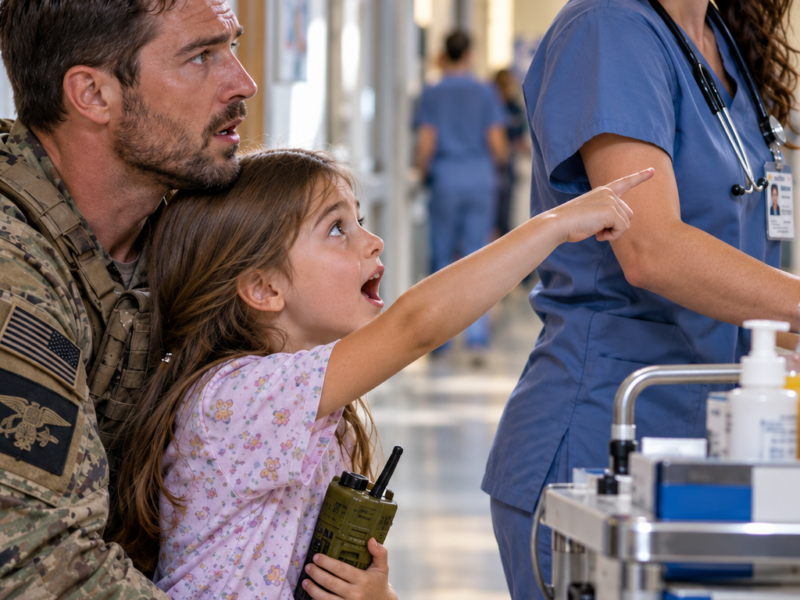
The little girl was only seven years old, but the moment she pointed across the hospital corridor and called out two words, a secret that had remained buried for fourteen years began to unravel.
“Dad, that’s Falcon Six.”
Commander Marcus Cole stopped moving.
For a moment, he thought he had misunderstood his daughter. The name she had just spoken belonged to another lifetime, another continent, and a night so violent that even fourteen years had not managed to silence its echoes. It was not a name anyone in this hospital should have recognized. It was not written on any public record, and it certainly wasn’t something a second-grade girl should have been shouting in the middle of a pediatric rehabilitation ward.
Yet Maya was pointing straight toward a quiet nurse pushing a medication cart down the hallway.
And the nurse had stopped walking.
Her hands tightened around the stainless-steel handle. Her shoulders became rigid. Slowly, almost reluctantly, she turned her head.
Marcus felt a cold sensation move through his chest.
He knew that reaction.
He had seen it in soldiers who heard a forgotten command, in veterans suddenly confronted by the sounds of battle, and in men who believed their past had finally stopped following them.
But he had never expected to see it on the face of a civilian nurse wearing ordinary blue scrubs.
“Sweetheart,” Marcus said carefully, lowering himself to his daughter’s height, “what did you just say?”
Maya looked at him with the innocent certainty that only children seemed capable of possessing.
“That lady,” she replied. “She’s Falcon Six. The one from your mountain story.”
Across the hallway, the nurse slowly closed her eyes.
And Marcus Cole, a decorated Navy SEAL commander who had faced enemy gunfire without hesitation, suddenly found himself unable to speak.
It was 3:12 on a warm afternoon at the West Los Angeles Naval Medical Pavilion. Sunlight spilled through the tall windows, painting pale rectangles across the polished floors. Outside, palm trees moved gently in the California breeze. Inside, the pediatric rehabilitation department continued its quiet rhythm of treatment, recovery, and hope.
A young boy was learning to walk again between parallel therapy bars. A mother whispered encouragement to a daughter recovering from surgery. Nurses moved from room to room, checking medications, adjusting monitors, and offering reassurance to families whose lives had been interrupted by illness.
Among those nurses was thirty-six-year-old Elena Vance.
Most people who worked alongside Elena knew very little about her.
They knew she arrived early, rarely complained, and had an extraordinary ability to calm frightened children. They knew she could recognize a patient’s distress before the monitors sounded an alarm. They knew that when emergencies occurred, Elena seemed to become even quieter, her movements controlled and precise while everyone around her struggled to remain calm.
What they did not know was that she had once performed emergency medical procedures in freezing darkness while explosions shook the ground beneath her.
They did not know she had carried wounded soldiers through hostile terrain.
And they certainly did not know that, fourteen years earlier, her voice had been the last connection between six trapped American servicemen and the possibility of returning home.
At the hospital, she was simply Nurse Vance.
That was exactly how she wanted it.
Four years earlier, when she began working at the facility, Elena had made herself a promise. Whatever she had been in the military would remain behind her. She would no longer allow her worth to be measured by missions completed, decorations awarded, or decisions made under fire.
Her patients would know her only as the woman who helped them heal.
That afternoon, she had been reviewing medication records when she passed room 414.
Inside sat Commander Marcus Cole, forty-two years old, broad-shouldered and visibly exhausted despite his carefully composed expression.
His daughter Maya had fainted during recess at her elementary school in Brentwood.
The incident had lasted only seconds, but those seconds had frightened Marcus more than many dangers he had faced during his military career.
He had received the call while attending a briefing. By the time the school administrator finished explaining what had happened, he was already reaching for his car keys.
At the hospital, the doctors had assured him that Maya’s initial examinations showed nothing immediately dangerous. They believed dehydration and exhaustion might have contributed to the episode, but they wanted to monitor her overnight.
Marcus accepted the explanation, asked every question he could think of, and remained beside his daughter’s bed.
He was accustomed to protecting people.
He was not accustomed to sitting helplessly while someone else protected his child.
Maya, meanwhile, seemed considerably less worried than her father.
She sat on the examination bed wearing a pale yellow shirt and pink sneakers, turning an old plastic walkie-talkie over in her hands.
The toy had once belonged to Marcus.
Its olive-green casing was scratched, the antenna was cracked, and the numbers painted beside its buttons had faded almost beyond recognition.
He had kept it for years on a shelf in his home office, not because it was valuable, but because it reminded him of an old promise.
Years earlier, one of his surviving teammates had given him the toy as a joke after a reunion. It looked vaguely like the communications equipment they had once depended upon, and the gift had carried a message Marcus understood immediately: some voices were impossible to forget.
Maya had discovered it during a rainy afternoon when she was five.
Since then, she had repeatedly asked why her father kept such a broken-looking toy.
Eventually, he told her a story.
Not the whole story, of course.
Only the part he could bear to remember aloud.
He told her about a mountain far away, a dangerous storm, six men who became trapped, and a mysterious woman whose calm voice guided them through the darkness.
He called that woman Falcon Six.
Maya loved the story.
She imagined Falcon Six as a fearless figure who could see through storms and hear people calling for help from miles away.
Marcus never corrected her imagination.
He had never seen Falcon Six’s face.
During the mission, their communications had been routed through a tactical support operator whose real identity was restricted. Later, when Marcus attempted to locate her, the records led nowhere.
To him, Falcon Six remained a voice.
A voice that had given him a second chance at life.
“How are you feeling, pumpkin?” Marcus asked, gently brushing a strand of hair away from Maya’s forehead.
“Better,” she said.
“Still dizzy?”
“No.”
“Headache?”
“No, Daddy.”
“Anything hurting?”
Maya gave him an exaggerated sigh.
“You already asked me all those things.”
Marcus smiled despite himself.
“Then I guess I’ll stop asking.”
“You said that before.”
He laughed quietly.
For the first time since receiving the school’s telephone call, some of the tension eased from his shoulders.
Then Maya looked through the glass partition.
Her smile vanished.
She sat perfectly still, staring into the corridor.
Marcus noticed immediately.
“What is it?”
Maya lifted one finger.
“That lady.”
Marcus followed her gaze.
A nurse was pushing a supply cart toward the station.
“What about her?”
Maya’s eyes widened.
“She knows you.”
Marcus frowned.
“I don’t think so, sweetheart.”
But Maya shook her head.
“No. She does.”
Before he could ask another question, Maya slid off the bed and hurried toward the doorway.
“Maya, slow down.”
The little girl stopped just outside the room and raised the battered walkie-talkie.
“Falcon Six!”
The nurse froze.
Marcus’s heart seemed to miss a beat.
The name struck him with an almost physical force.
He stood.
“Maya,” he said sharply, “where did you hear that?”
“From you.”
The nurse remained motionless.
Maya pointed again.
“That’s her, Dad.”
Marcus stepped into the hallway.
The nurse was now turning toward them.
She had dark chestnut hair pulled into a practical ponytail, hazel eyes, and a face that carried the quiet exhaustion of someone who had learned to conceal pain behind ordinary routines.
Her badge read ELENA VANCE, RN.
Nothing else.
No military insignia.
No reference to a tactical unit.
No sign that she had ever worn anything other than hospital scrubs.
Yet the moment she looked at Marcus, something in her expression changed.
Recognition.
Not surprise at seeing a uniformed officer.
Not confusion at hearing a strange name.
Recognition so immediate and unmistakable that Marcus felt as though the hospital floor had shifted beneath him.
“Commander Cole,” she said quietly.
His jaw tightened.
“How do you know my name?”
Elena glanced toward his daughter.
“Maya should probably return to her room.”
Maya’s face brightened.
“See? She knows my name too!”
Marcus stared at the nurse.
“Who are you?”
She remained silent.
He took one step closer.
“That call sign hasn’t been used in fourteen years.”
“I know.”
His breath caught.
“Then tell me how you know it.”
Elena looked at the old walkie-talkie.
For a moment, she seemed somewhere else entirely.
Somewhere cold.
Somewhere wet.
Somewhere filled with voices fighting to be heard through radio static.
Then she lifted her eyes.
“Because,” she whispered, “it used to belong to me.”
The words landed between them with devastating simplicity.
Marcus searched her face, trying to connect the woman before him to a voice he had heard through a damaged headset on a mountain in Afghanistan.
“Falcon Six?” he asked.
Elena nodded.
“Yes, Commander.”
He opened his mouth, but no words came.
For fourteen years, he had searched for the person who saved his team.
He had written letters that went unanswered, made inquiries through military channels, and questioned officers who offered nothing but vague explanations about sealed records and personnel transfers.
Eventually, he had been told to stop looking.
But he had never forgotten.
And now she was standing directly in front of him, wearing a nurse’s uniform, holding the handle of a medication cart.
“I’ve been looking for you,” he said.
Elena’s expression softened.
“I know.”
Marcus blinked.
“You knew?”
“Someone told me a commander from the operation had been making inquiries.”
“Then why didn’t you answer?”
Her gaze dropped.
“Because I didn’t know what I could say.”
Maya stepped between them, looking up at Elena.
“Daddy said you saved six men.”
Elena’s face tightened.
“He remembers the ones who came home,” she answered gently.
Maya considered that.
“Were there people who didn’t?”
The question silenced both adults.
Marcus slowly lowered his eyes.
Elena looked away toward the courtyard windows.
For a long moment, neither spoke.
Then Maya noticed something beneath Elena’s sleeve.
A narrow braided black cord was wrapped around her left wrist. Attached to it was a small silver charm, worn smooth with age.
It was shaped like a falcon.
“Dad!” Maya exclaimed. “Look! It’s the bird!”
Marcus’s gaze dropped to the bracelet.
His expression changed again.
He remembered that emblem.
The angular wings.
The narrow beak.
The tiny slash across the body representing the lightning bolt used by their former tactical support team.
He had seen it painted on equipment cases and stitched into an unofficial unit patch.
It belonged to the people who had guided his team through the worst night of their lives.
“Where did you get that?” he whispered.
Elena closed her fingers around the charm.
“It was given to me before the mission.”
“Who gave it to you?”
Her voice became almost inaudible.
“Tyler Brooks.”
Marcus stopped breathing.
Petty Officer Tyler Brooks had been the youngest member of his team.
Twenty-four years old.
A newly married man from Oregon who carried photographs of his wife everywhere he went and talked constantly about the little house they intended to buy after his deployment.
Tyler had died during the mountain operation.
At least, that was what the official report stated.
Marcus had spent fourteen years carrying the guilt of losing him.
“How did you know Tyler?” he asked.
Elena’s eyes filled.
“He was my friend.”
“Why wasn’t that in the records?”
“Because there were things they didn’t want recorded.”
Marcus stared at her.
Before he could respond, Maya reached for Elena’s hand.
“Why did Falcon Six go away?”
Elena looked down.
The little girl’s question carried none of the suspicion or frustration that Marcus felt.
Only curiosity.
And somehow that made it harder to answer.
“Because,” Elena said after a long silence, “sometimes people go somewhere new when remembering the old place hurts too much.”
Maya tilted her head.
“Were you sad?”
“Yes, sweetheart.”
“Are you still sad?”
Elena glanced at Marcus.
“Sometimes.”
Maya squeezed her fingers.
“My dad gets sad when he talks about the mountain too.”
Marcus closed his eyes.
He had not realized how much his daughter understood.
He thought he had hidden his memories from her.
But children often notice what adults believe they have concealed.
Before anyone could speak again, hurried footsteps echoed from the far end of the hallway.
A young Navy canine handler appeared, his working uniform slightly disheveled.
“Commander Cole?”
Marcus turned.
“Yes?”
The handler looked past him toward Elena.
His expression shifted from urgency to astonishment.
“Ma’am,” he said, “are you Elena Vance?”
She nodded.
“What happened?”
The handler swallowed.
“We have a retired military working dog in the recovery wing. He arrived for a final assessment this morning. He’s been refusing examinations, growling at the veterinary staff, and barely responding to his current handler.”
Elena frowned.
“What does that have to do with me?”
The young man hesitated.
“We were reviewing his old service records. Someone mentioned a former handler’s call sign over the intercom.”
Marcus felt a strange pressure building in his chest.
The handler continued.
“The moment he heard it, the dog stood up. He started barking and searching the room.”
Elena’s hand tightened around her bracelet.
“What call sign?”
The handler looked directly at her.
“Falcon Six.”
For the first time since Marcus encountered her, Elena seemed genuinely unsteady.
She gripped the medication cart.
“What’s the dog’s name?”
The handler took a breath.
“Shadow.”
Elena covered her mouth.
Her eyes widened with disbelief.
“No,” she whispered.
Marcus looked between them.
“Shadow?”
The handler nodded.
“A German Shepherd. Former tactical working canine. His records show he served with your unit.”
Elena shook her head slowly.
“That can’t be right.”
“He’s here, ma’am.”
“How old is he?”
“Seventeen, according to the surviving records. He has severe arthritis and poor vision, but his heart is still strong.”
Elena stared down the corridor.
Fourteen years collapsed into a single moment.
She remembered Shadow as a young, muscular German Shepherd with endless energy and a stubborn refusal to sleep anywhere except near her boots.
She remembered him moving through darkness beside her, alert to dangers she could not see.
She remembered his warm body pressed against hers when she crouched behind rocks during gunfire.
And she remembered the last time she had seen him.
Blood on his fur.
Rain running down his muzzle.
His body trembling with exhaustion as the evacuation helicopter lifted them from the mountain.
She had believed he was transferred to another unit after she was removed from active operations.
No one had told her where he went.
Eventually, she stopped asking.
Now, fourteen years later, he was somewhere inside the same hospital complex.
“Can I see him?” she asked.
The handler nodded.
“That’s why I came.”
Marcus gently touched her shoulder.
“Elena, you don’t have to do this.”
She looked at him.
“He’s still alive.”
“Yes.”
“Then I have to see him.”
Her voice trembled.
“I thought I’d never get another chance.”
Maya stepped closer.
“Can I come too?”
Elena managed a small smile.
“You can watch from the window.”
They walked toward the adjoining animal care facility, where military working dogs received specialized treatment.
The journey took only a few minutes, but for Elena it felt much longer.
With every step, another memory returned.
The smell of wet canvas.
The sound of rotor blades.
The weight of medical equipment against her shoulders.
Tyler’s voice.
Shadow’s bark.
And a mountain she had spent fourteen years trying to forget.
At the observation window, the handler stopped.
“That’s him.”
Inside the kennel lay an elderly German Shepherd.
His once-dark muzzle had turned almost entirely silver. One ear tilted slightly outward, marked by an old injury. His hind legs were thin, and the powerful body Elena remembered had become stiff and tired.
He rested on a thick mat, facing the back wall.
His faded collar carried a brass identification tag.
Elena pressed one hand against the glass.
“Shadow.”
The old dog did not move at first.
She swallowed.
“Hey, boy.”
One ear twitched.
The handler leaned forward.
“He hasn’t reacted like that to anyone today.”
Elena’s voice broke.
“It’s me.”
Shadow slowly lifted his head.
His nose moved.
Once.
Twice.
He turned toward the window.
For several seconds, the dog stared at the woman beyond the glass.
Then his tail moved.
A single uncertain sweep.
Then another.
His front paws pushed against the mat.
He struggled upright, his joints trembling beneath him.
“Elena,” Marcus whispered.
But she was no longer listening.
The old German Shepherd walked toward the glass, slowly at first, then with growing urgency.
When he reached the partition, he pressed his nose against it.
Elena covered her face as tears streamed down her cheeks.
“Oh, Shadow.”
The handler stared in disbelief.
“He hasn’t wagged his tail since he arrived.”
Shadow made a low sound deep in his throat.
Not a growl.
Not a warning.
A whimper.
The kind of sound a dog makes when longing and recognition become too powerful to contain.
Elena pressed her palm against the glass.
The dog leaned his head toward it.
For a moment, neither moved.
Marcus watched silently.
He had seen emotional reunions before. He had witnessed wounded soldiers returning to their families, children embracing parents after long deployments, and hardened servicemen breaking down when they finally reached safety.
Yet something about this moment was different.
The woman before him had spent years believing her past was beyond recovery.
And the animal who had once followed her into gunfire was showing her that some bonds survived even the longest separations.
The veterinarian approached quietly.
“If you’re comfortable, you can go inside. We’ll supervise.”
Elena nodded.
The handler unlocked the kennel door.
She entered slowly, keeping her hands relaxed and her posture low.
Shadow stood several feet away.
His ears moved.
His nose lifted.
“Elena,” Marcus called gently from behind the window, “be careful.”
But she knew this dog.
She knew the way his body tightened before he moved.
She knew the sound he made when he was uncertain.
And she knew that beneath the white muzzle and aching joints remained the same loyal animal who had once trusted her with his life.
“Come here, old man,” she whispered.
Shadow stepped forward.
Then another step.
When he reached her, he lowered his head against her chest.
Elena’s knees buckled.
She sank onto the floor and wrapped both arms around him.
There was no attempt to remain composed.
No professional distance.
No carefully practiced expression.
She buried her face in his fur and cried.
“I thought you were gone,” she whispered. “I thought I’d lost you too.”
Shadow pressed closer.
His tail moved slowly against the floor.
He licked her cheek, then rested his heavy head against her shoulder as though he had finally reached the place where he belonged.
Elena laughed through her tears.
“You stubborn old thing.”
Shadow gave a soft huff.
“You still remember me.”
For several minutes, the room remained quiet except for Elena’s broken breathing and the soft movement of the dog’s tail.
Maya watched through the window.
“Daddy?”
Marcus looked down.
“Yeah, sweetheart?”
“Why is she crying?”
He considered the question carefully.
“Because she missed him very much.”
“But he’s here now.”
Marcus nodded.
“Sometimes people cry when they get something back that they thought was gone forever.”
Maya watched Elena stroke Shadow’s ears.
“Did you miss Falcon Six too?”
Marcus looked through the glass.
“Yes,” he said softly. “I did.”
“Even when you didn’t know her name?”
“Especially then.”
The veterinarian eventually entered to complete Shadow’s examination.
Earlier attempts had been difficult. The dog had resisted being touched, particularly around his injured legs, and had become agitated whenever the staff approached with unfamiliar equipment.
Elena immediately understood.
“He never liked metal examination tables,” she explained. “They make him nervous.”
The veterinarian sighed.
“We’ve been struggling with him all day.”
“Put a soft mat on the floor. Let him stay beside me.”
They followed her suggestion.
With Elena gently holding his head, Shadow allowed the doctor to examine his eyes, check his heart, and assess the arthritis in his joints.
When a painful leg needed to be lifted, Elena spoke softly into his ear.
“Easy, boy. I’ve got you.”
Shadow remained still.
The veterinarian looked up in amazement.
“I don’t think I’ve ever seen a dog change this quickly.”
Elena smiled faintly.
“He trusts me.”
And then, after a pause, she added, “He always did.”
Later, while Shadow slept comfortably nearby, Marcus and Elena sat in a small consultation room.
Maya occupied a chair near the window, drawing pictures of the old dog and the mysterious mountain from her father’s stories.
Marcus leaned forward.
“Elena, I need to know what happened after our extraction.”
Her expression became guarded.
“You read the report.”
“I read what command wanted us to read.”
She said nothing.
Marcus watched her carefully.
“I’ve lived with that night for fourteen years. I remember being told Tyler was killed during the initial ambush. I remember the helicopter lifting off. And I remember hearing something over the radio just before the signal disappeared.”
Elena lowered her eyes.
“What did you hear?”
Marcus swallowed.
“A man’s voice.”
She became still.
“Calling for help.”
Elena closed her eyes.
“Tyler.”
Marcus stared at her.
“He was alive?”
She nodded.
The room seemed to grow colder.
Marcus slowly leaned back.
For years, he had imagined Tyler’s final moments based on the official account.
According to that report, Tyler had died instantly during the ambush.
There had been nothing anyone could do.
No opportunity to save him.
No decision that might have changed the outcome.
That explanation had become the fragile foundation on which Marcus built his ability to live with the loss.
Now Elena was telling him it wasn’t true.
“He survived the initial attack,” she said quietly.
Marcus felt his hands begin to tremble.
“How long?”
“Long enough for Shadow to hear him.”
“Explain.”
Elena looked toward the sleeping dog.
“After your team reached the primary extraction point, we received orders to withdraw. Weather conditions were worsening, enemy movement was increasing, and the evacuation window was closing.”
Marcus remembered.
The freezing rain.
The darkness.
The frantic voices over the radio.
He remembered two teammates supporting a third between them.
He remembered believing that everyone still alive had reached the helicopter.
“Shadow was restless,” Elena continued. “He kept looking toward the eastern ridge. At first, I thought he was reacting to movement. Then he started pulling away.”
She paused.
“I heard something through the tactical channel.”
“Tyler?”
“Yes.”
Marcus’s face tightened.
“He was asking for help.”
Elena nodded.
“The signal was weak. He could barely speak. But he gave enough information for me to understand where he was.”
“What did command say?”
“They told me to remain at the staging area.”
Marcus closed his eyes.
“And you didn’t.”
“No.”
She looked down at her scarred hands.
“I couldn’t.”
The memories came back with terrible clarity.
Fourteen years earlier, Elena had stood in driving rain beside the evacuation zone while wounded soldiers were loaded into a helicopter.
She had been exhausted, bleeding from a shallow wound, and struggling to maintain communication with support personnel.
Then Shadow pulled against his harness.
He knew something was wrong.
Elena followed the direction of his attention.
The eastern ridge disappeared into thick darkness.
Over the radio came a faint burst of static.
Then a voice.
“Anyone… hear me?”
Elena froze.
She recognized Tyler immediately.
She called his name.
For several seconds, there was nothing.
Then he answered.
“Falcon… I’m still here.”
She looked toward the helicopter.
The crew was preparing to depart.
Command ordered her to board.
But Tyler was still breathing.
And Elena could not make herself abandon him.
She grabbed additional medical supplies, secured her radio, and followed Shadow into the darkness.
The ground was slippery with mud and loose stones.
Gunfire echoed across the ridge.
Twice, she had to shelter behind rock formations while rounds struck nearby.
Shadow moved ahead, stopping periodically to make sure she followed.
Eventually, his barking led her to a shallow depression beneath a damaged rock wall.
Tyler lay there.
His uniform was soaked with blood.
His breathing was shallow.
But his eyes were open.
When he saw Elena, he managed the smallest smile.
“Knew you’d come,” he whispered.
She dropped beside him.
“Don’t talk. Save your strength.”
He tried to laugh.
“Always giving orders.”
Elena quickly examined his injuries.
They were severe.
Far worse than she had hoped.
She used everything she carried to stabilize him, applying dressings, controlling what bleeding she could, and protecting him from the cold.
Shadow remained close, occasionally lifting his head toward sounds in the darkness.
Tyler grabbed her sleeve.
“Did the others get out?”
“Yes.”
“Marcus?”
“He’s safe.”
Tyler’s eyes filled with relief.
“Good.”
Elena leaned closer.
“We’re getting you out too.”
But Tyler shook his head.
Even in the darkness, she could see he understood how badly he was injured.
“Tell him…”
“No.”
“Elena…”
“Save your strength.”
He looked at her with an expression she would remember for the rest of her life.
“Tell him he was a good leader.”
She forced herself to keep working.
“Tell him yourself.”
Then she began moving him toward the secondary extraction point.
The distance was brutal.
The terrain was steep and broken.
Every movement caused Tyler pain.
She pulled him over rocks, through mud, and across stretches of open ground while Shadow remained nearby.
At one point, an explosion sent fragments of stone and metal through the air.
Elena felt a sharp impact against her shoulder.
Another struck her leg.
She fell.
For several seconds, she could barely breathe.
Then she looked at Tyler.
He was still alive.
So she got up.
She dragged him farther.
She called repeatedly for evacuation support.
And when her radio failed, she continued moving toward the coordinates she remembered.
By the time rescue personnel reached the secondary zone, Elena had lost a dangerous amount of blood.
Her arms shook.
Her injured leg barely supported her.
But she refused treatment until Tyler and Shadow were secured.
Tyler died despite their efforts to save him.
His last moments remained with Elena long after she left the military.
Back in the consultation room, Marcus sat motionless.
“She went back for him,” Maya said softly from her chair.
Neither adult had realized she was listening.
Elena turned toward the girl.
“Yes, sweetheart.”
“Did you try really hard?”
Elena’s eyes filled.
“With everything I had.”
Maya stood and approached her.
“Then why do you look so sad?”
Elena struggled to answer.
“Because sometimes trying isn’t enough.”
Maya thought about that.
Then she rested a small hand on Elena’s arm.
“My teacher says doing the right thing doesn’t always mean everything turns out right.”
Elena looked at her.
Maya continued.
“But you still did the right thing.”
For a moment, Elena seemed unable to breathe.
Those were words she had spent fourteen years needing to hear.
And they had come from a seven-year-old girl wearing pink sneakers.
Marcus lowered his face into his hands.
He had spent years questioning the decisions made on that mountain.
He had blamed himself for Tyler’s death.
Now he understood that another person had carried an even heavier burden.
“Elena,” he said eventually, “why wasn’t any of this included in the final report?”
Her expression hardened.
“Because the people responsible for ordering the withdrawal didn’t want it known that an American serviceman was alive when they authorized the evacuation.”
Marcus stared at her.
“They knew?”
“They were informed.”
“And they still ordered everyone out?”
Elena nodded.
“The official narrative said Tyler died during the initial ambush. I was instructed to sign a statement supporting that version.”
“Did you?”
“No.”
Her answer was immediate.
“I wrote my own account. I documented everything, including the time of Tyler’s final radio transmission and the medical treatment he received.”
“What happened?”
“My statement was rejected. I was reassigned. My security clearance was suspended pending review. Eventually, I was given a choice between accepting the official version and ending my operational career.”
Marcus shook his head.
“They destroyed your career.”
Elena looked at Shadow.
“They tried to make me deny what happened.”
“That’s not the same thing.”
“No,” she said. “It isn’t.”
She paused.
“But I couldn’t change their minds. I couldn’t bring Tyler back. And I couldn’t keep fighting people who had already decided what they wanted the truth to be.”
Marcus felt anger rising.
The kind of anger he had once directed toward enemies.
But now it was directed toward men who had worn the same uniform he did.
“I’m going to find out who authorized that report.”
Elena looked at him sharply.
“Marcus, please.”
“They had no right.”
“I know.”
“Then why should they get away with it?”
“Because I don’t want you to spend the rest of your life fighting a battle that already took enough from both of us.”
He fell silent.
She looked directly into his eyes.
“I didn’t come here to be Falcon Six again. I came here to become someone who could help people without having to carry a weapon.”
Marcus glanced toward the hospital corridor.
“And you have.”
Elena gave a tired smile.
“I try.”
That evening, after Maya had been cleared to return to her room, she asked to visit Shadow once more.
The dog was resting behind the observation window.
Maya held her old walkie-talkie against the glass.
“Hello, Shadow,” she whispered. “This is Maya.”
She pressed the transmission button.
A burst of crackling static escaped the damaged speaker.
Shadow lifted his head.
His ears twitched.
Then he stood.
Elena, who had been speaking to the veterinarian, turned immediately.
The sound was familiar.
Painfully familiar.
The same harsh crackle had filled her headset on the mountain fourteen years earlier.
Maya pressed the button again.
“Falcon Six, can you hear me?”
Shadow approached the window and barked.
Maya laughed.
“He knows!”
Elena slowly walked toward the glass.
The old dog looked at her, his tail moving.
She felt tears gather again.
Not because the sound brought back the gunfire.
Not because it reminded her of the cold.
But because something beautiful had survived the darkness.
A familiar voice.
A loyal companion.
And the extraordinary possibility of finding peace with memories she had once believed would destroy her.
Marcus stood beside her.
“I used to think that sound would haunt me forever,” he said.
Elena looked at the toy.
“Maybe it doesn’t have to.”
He watched Shadow settle beside the glass.
“Maybe not.”
The following morning, Marcus requested access to the historical records of the operation.
He made the request through the proper military channels, using the authorization available to him as an officer who had participated in the mission.
The process took longer than he wanted.
But eventually, an archivist located a supplemental document that had been withheld from the standard after-action summary.
It was labeled Page 17.
Marcus opened the file.
What he read left him shaking.
The appendix confirmed that Tyler Brooks had survived the initial ambush.
It recorded that a canine asset, Shadow, had located him on the eastern ridge.
It confirmed that operative Falcon Six had returned under hostile fire and administered emergency medical treatment.
It documented her injuries.
And it described how she had refused evacuation until the wounded serviceman and the dog had been secured.
The final paragraph was devastating.
It stated that Falcon Six had repeatedly placed the safety of others above her own medical needs despite injuries that required immediate treatment.
Marcus stared at the screen.
For fourteen years, Elena’s courage had existed only in memories and a suppressed document.
The official version had turned Tyler’s last minutes into a convenient conclusion.
It had concealed the desperate attempt to save him.
And it had erased the sacrifice of a woman who refused to leave him behind.
Marcus printed the authorized copy of the appendix and carefully placed it inside a folder.
He found Elena outside the rehabilitation ward later that morning.
She was helping a young boy adjust his crutches.
Marcus waited until the child had gone.
Then he approached her.
“Elena.”
She looked up.
Something in his expression immediately concerned her.
“What happened?”
He held out the folder.
“I found Page 17.”
Her face went pale.
For a moment, she did not reach for it.
“Marcus…”
“I know what you did.”
She looked away.
He continued.
“I know you were wounded. I know you kept moving Tyler after you could barely stand. And I know you refused treatment until everyone else was accounted for.”
Elena closed her eyes.
“You shouldn’t have gone searching for that.”
“I needed to understand.”
She looked at him.
“Why?”
“Because I spent fourteen years believing you were just a voice that helped guide us home.”
His voice broke.
“But you were out there carrying one of my men while the rest of us were already in the air.”
Elena remained silent.
Marcus stepped closer.
“Why didn’t you get on the first helicopter?”
She met his eyes.
Her answer came quietly, without hesitation.
“Because people shouldn’t have to earn the right to be brought back.”
Marcus felt the words settle deep inside him.
They contained no anger.
No demand for recognition.
Only a belief so firmly held that she had nearly died defending it.
He lowered his head.
“I should have known.”
“You couldn’t have.”
“I was the commander.”
“And you were wounded, exhausted, and following the information you were given.”
Marcus shook his head.
“That doesn’t make it easier.”
“No,” Elena agreed. “It doesn’t.”
From a nearby bench, Maya looked up from her coloring book.
“Are you talking about the mountain again?”
Marcus managed a faint smile.
“We are.”
Maya studied Elena.
“Is that why you stopped being a soldier?”
Elena walked over and knelt beside her.
“Partly.”
“Because you got hurt?”
“Yes.”
Maya glanced at the nurse’s badge.
“But you’re still helping people.”
Elena smiled.
“I am.”
“Then you didn’t really stop doing your job.”
Elena tilted her head.
“What do you mean?”
Maya pointed at her.
“You used to help people on mountains. Now you help people in hospitals.”
She shrugged as though the answer were obvious.
“You just changed where you do it.”
Elena stared at her.
For fourteen years, she had regarded her departure from military service as the closing of a painful chapter.
She had believed the woman known as Falcon Six had disappeared.
But Maya saw no such division.
To the child, a person who protected frightened people in battle and a nurse who comforted frightened patients were not different individuals.
They were the same person, doing the same essential work in different places.
Elena slowly smiled.
“You know something, Maya?”
“What?”
“I think you’re right.”
Maya beamed.
“My teacher says I’m good at figuring things out.”
Marcus laughed.
“I think your teacher’s right too.”
In the days that followed, the hospital returned to its ordinary rhythm.
Maya completed her observation period and was discharged with instructions to rest, remain hydrated, and attend a follow-up appointment.
Shadow continued receiving treatment for arthritis and age-related complications.
Elena returned to her patients.
But something had changed.
She no longer felt the same need to disappear whenever the past approached.
She began speaking more openly with Marcus about the operation.
Not all at once.
Not without difficult silences.
But enough for them to understand each other.
Marcus learned about Elena’s injuries, the months she spent recovering, and the years she struggled to adjust to civilian life.
He learned that she had originally considered leaving medicine entirely.
For a time, every emergency reminded her of the mountain.
Every patient who deteriorated brought back Tyler’s face.
Every failed resuscitation made her wonder whether she should have done more.
Eventually, however, she discovered something unexpected.
Helping others did not erase her grief.
But it gave her grief somewhere useful to go.
She began working with children because they reminded her that fear did not have to be the end of a story.
A frightened child might walk into the hospital believing the world was dangerous and unpredictable.
With patience, reassurance, and proper care, that child might leave feeling safe again.
Elena found meaning in that transformation.
She could not change what happened on the mountain.
But she could change what happened in the next room.
And the room after that.
And the one after that.
One afternoon, Marcus found her sitting alone in the courtyard beneath a eucalyptus tree.
He joined her on a low stone wall.
“Can I ask you something?”
She smiled.
“You’ve asked me about a hundred things already.”
“One more.”
“Go ahead.”
“Do you regret leaving the Navy?”
Elena looked toward the sunlight filtering through the leaves.
“Sometimes I regret how it ended.”
“That’s not what I asked.”
“I know.”
She thought for a moment.
“No. I don’t regret choosing another life.”
Marcus nodded.
“But I spent a long time believing that choice meant I had failed.”
“Failed who?”
She looked at him.
“Tyler. The team. Myself.”
Marcus remained quiet.
Then he said, “You gave Tyler something the report never acknowledged.”
“What?”
“You made sure he wasn’t alone.”
Elena’s eyes filled.
Marcus continued.
“I’ve spent years wondering whether he was frightened at the end. Whether he thought we’d abandoned him.”
She looked down.
“He was frightened.”
Marcus closed his eyes.
“But he knew someone came back,” she added. “And he knew the others were safe.”
Marcus breathed deeply.
“That matters.”
“Yes,” Elena whispered. “It does.”
A few days later, the hospital administration arranged a small recognition gathering.
Elena initially refused.
She did not want cameras, speeches, or public attention.
She worried that patients would begin seeing her as a military figure rather than a nurse.
But Marcus assured her that the gathering would be private, with only staff members, veterans, and colleagues who had been involved in supporting her and Shadow.
Eventually, she agreed.
On the afternoon of the ceremony, Elena walked into the staff auditorium wearing her usual blue scrubs.
She had no medals on her chest.
No ribbons.
No decorations.
Only her identification badge and the small silver falcon bracelet at her wrist.
Marcus stood near the front in his military dress uniform.
Maya sat beside him, holding the battered walkie-talkie.
The hospital director approached the microphone.
“Most of us know Elena Vance as an exceptional nurse,” he began. “We know her patience, her professionalism, and her quiet dedication to people who need help.”
He paused.
“But recently, we learned that long before she came to this hospital, Elena served in circumstances that demanded an extraordinary kind of courage.”
Elena lowered her eyes.
The director continued.
“Her former call sign was Falcon Six.”
A hush settled across the room.
“She helped bring wounded service members home. She protected a military working dog who depended on her. And when asked to accept an account of events she believed was untrue, she refused to compromise her integrity.”
He looked directly at Elena.
“Yet perhaps the most remarkable thing about her story is not what she did in uniform. It is what she continued to do after leaving it behind.”
Several nurses glanced toward Elena.
Some had tears in their eyes.
The director smiled gently.
“She continued protecting people. She continued caring for the frightened. She continued giving others hope.”
Elena’s hands trembled.
“And today,” he concluded, “we simply want her to know that those things have not gone unnoticed.”
The audience stood.
Applause filled the auditorium.
Elena instinctively shook her head.
“Please,” she whispered. “You don’t have to.”
But nobody sat down.
Marcus approached her.
For a moment, he simply looked at the woman whose voice had once guided him through the darkness.
Then he stepped back, straightened his shoulders, and raised his hand in a formal salute.
Elena stared at him.
Her eyes filled with tears.
Fourteen years earlier, she had left military service believing the truth no longer mattered to anyone except herself.
Now, standing inside a hospital auditorium, she saw the commander whose life she had helped save acknowledging the part of her story that had been erased.
Slowly, she raised her own hand.
And returned the salute.
Marcus lowered his arm.
“Thank you for giving me tomorrow,” he whispered.
Elena swallowed.
“You made something good out of it.”
He glanced toward Maya.
“Yes,” he said. “I did.”
From the front row, Maya suddenly lifted her walkie-talkie.
“Falcon Six!”
A gentle ripple of laughter moved through the room.
Elena smiled through her tears.
“Yes, Maya?”
The little girl pressed the transmission button.
Static crackled from the old speaker.
Then she announced proudly, “Mission complete!”
Elena laughed.
“Mission complete, sweetheart.”
At that exact moment, a sharp bark sounded near the back of the auditorium.
Everyone turned.
Shadow stood beside his handler, his gray muzzle lifted and his tail moving steadily.
Maya gasped with delight.
“He agrees!”
The laughter grew warmer.
Even Marcus couldn’t help smiling.
For the first time in years, the sound of a dog barking beside a military gathering did not bring him back to Afghanistan.
It brought him completely into the present.
Not long afterward, the veterinary team confirmed that Shadow was stable enough to leave the medical facility.
His advanced age and arthritis meant he would need a quiet home, soft bedding, regular treatment, and someone willing to let him move at his own pace.
A retirement placement had been arranged in the foothills above Malibu, with experienced caregivers who specialized in elderly working dogs.
Elena visited before his departure.
So did Marcus and Maya.
On the morning the transport arrived, the sky was bright and clear.
Shadow stood on the grass outside the animal care wing, wearing a comfortable harness.
His steps were slow, but his tail moved whenever Elena approached.
Maya knelt beside him.
In her hands was the old walkie-talkie.
She placed it carefully between his paws.
Marcus looked down.
“Sweetheart, are you sure you want to give him that?”
Maya nodded.
“He should have it.”
“But you love that toy.”
“I know.”
“Then why give it away?”
Maya looked at Shadow.
“Because he was there, Dad.”
Marcus smiled gently.
“He was.”
“He doesn’t need you to tell him the story.”
Elena laughed softly.
Maya stroked Shadow’s gray fur.
“He remembers it himself.”
Marcus felt his throat tighten.
Elena knelt beside the old dog.
She rested her forehead against his.
For a moment, she remembered the young German Shepherd who had once bounded through training fields, stolen food when nobody was looking, and slept faithfully beside her boots.
Then she looked at the elderly animal before her.
Time had changed him.
It had changed her too.
But it had not erased what they meant to each other.
“You take care of yourself, old friend,” she whispered.
Shadow pressed his muzzle against her cheek.
Elena closed her eyes.
“I’ll remember.”
The dog gave a soft whine.
Then his handler gently guided him toward the transport.
Elena watched as Shadow climbed into the padded compartment and settled onto his blanket.
The driver secured the door.
The engine started.
Maya waved both hands.
“Bye, Shadow!”
Marcus raised his hand.
Elena stood quietly beside them.
As the vehicle moved down the driveway, she lifted one hand in farewell.
This time, she did not feel the crushing grief that had followed her out of Afghanistan.
She felt sadness, certainly.
But it was a peaceful sadness.
The kind that accompanies gratitude.
Shadow was safe.
He had been loved.
And he would spend his remaining years in comfort.
Marcus looked at Elena.
“Do you know what Maya told me this morning?”
Elena smiled.
“What?”
“She said Falcon Six never really disappeared.”
Elena glanced at the little girl.
“Oh?”
Marcus nodded.
“She said you just found a different place to protect people.”
Elena looked toward the hospital entrance.
Families walked through the glass doors.
A father carried a sleeping toddler.
An elderly woman leaned on her husband’s arm.
A young boy followed his mother toward the rehabilitation wing.
Every person entering that building carried a story Elena did not yet know.
Some were frightened.
Some were grieving.
Some were hoping for good news.
All of them deserved kindness.
She looked back at Marcus.
“Maybe Maya understands something we’ve been making too complicated.”
Marcus smiled.
“She usually does.”
Over the following months, Elena’s life continued changing in small but meaningful ways.
She began joining Marcus and Maya for occasional lunches after the girl’s follow-up appointments.
Maya insisted that Elena tell her stories about Shadow, especially the funny ones.
Elena told her about the time he stole a sandwich from a senior officer’s desk, the morning he refused to leave a muddy training field, and the way he always seemed to know when someone needed comfort.
Maya laughed until her cheeks hurt.
Marcus listened with a smile he had not worn while discussing the old mission in years.
The mountain slowly became more than a place of loss.
It became part of a larger story.
One that included loyalty, friendship, impossible decisions, and people who refused to give up on one another.
Elena also began corresponding with members of the surviving team.
Some wrote long letters.
Others sent only a few lines.
One veteran mailed a photograph of six young servicemen standing beside a helicopter, their uniforms dusty and their expressions full of confidence.
On the back, he had written a simple message.
We made it home. We never forgot your voice.
Elena kept the photograph in her bedside drawer.
She no longer treated it as something shameful.
It was a reminder that the people she helped had continued living.
They had built homes.
Raised children.
Shared birthdays.
Weathered ordinary troubles.
They had experienced countless tomorrows.
And somewhere inside those ordinary lives existed a part of the meaning she had once lost.
Months after the reunion, the hospital placed a modest photograph near the entrance of the pediatric rehabilitation pavilion.
In the picture, Elena stood wearing blue scrubs.
Shadow rested beside her, his silver muzzle lifted toward the camera.
Marcus stood on one side in uniform.
Maya stood on the other, smiling with her arm around the old dog’s neck.
Beneath the photograph was a small brass plaque.
It read:
“Some people leave the uniform behind. They never leave the people they were meant to protect.”
Elena passed that photograph almost every morning.
At first, she felt uncomfortable seeing herself displayed so prominently.
Then one day, she noticed a frightened little boy standing in front of it with his mother.
He had recently undergone surgery and was reluctant to begin physical therapy.
The boy pointed at Shadow.
“Is that dog real?”
Elena smiled.
“Very real.”
“Was he brave?”
“Extremely.”
The boy looked at her.
“Was he ever scared?”
Elena considered the question.
“I’m sure he was.”
“Then how was he brave?”
She knelt beside him.
“Because being brave doesn’t mean you never feel afraid.”
The boy frowned thoughtfully.
“What does it mean?”
“It means you do what you can, even when you’re afraid.”
He looked toward the therapy room.
“I’m scared to walk.”
Elena nodded.
“I know.”
“What if I fall?”
“Then we’ll help you get back up.”
He studied her face.
“Promise?”
Elena smiled.
“Promise.”
The boy reached for her hand.
And together, they walked toward the therapy room.
Elena did not think about Afghanistan as they crossed the hallway.
She did not think about the investigation, the hidden report, or the career she had lost.
She thought only about the child beside her and the steps he was about to take.
Later that afternoon, when her shift ended, she paused beside the photograph.
Sunlight from the tall windows fell across the polished frame.
She looked at Shadow’s familiar face.
Then at Marcus.
Then at Maya.
And finally at the small silver falcon bracelet resting against her wrist.
For years, she had believed that the name Falcon Six belonged to a person who no longer existed.
She had tried to bury that identity because remembering seemed inseparable from suffering.
But the truth was far simpler.
The woman who guided frightened soldiers through darkness was the same woman who guided frightened children through hospital corridors.
The woman who refused to abandon Tyler was the same woman who refused to give up on a patient struggling through rehabilitation.
The woman who knelt in freezing mud beside a loyal dog was the same woman who knelt beside a frightened child and promised to help him stand.
She had changed uniforms.
She had changed her surroundings.
She had changed the shape of her life.
But she had never changed the part of herself that mattered most.
Her courage had not disappeared.
It had simply become quieter.
And perhaps that was why the world had nearly forgotten her.
People often imagined heroes standing beneath bright lights, receiving medals, or delivering grand speeches.
They rarely imagined heroes checking medication charts, adjusting pillows, helping frightened patients breathe through pain, or spending an extra ten minutes beside someone who needed reassurance.
But courage did not always announce itself.
Sometimes it wore ordinary shoes.
Sometimes it carried a stethoscope.
Sometimes it appeared in the calm voice of a woman who understood exactly how terrifying darkness could be because she had once helped six men find their way through it.
Elena touched the silver charm.
For the first time in fourteen years, she did not feel the need to cover it.
She smiled faintly and continued down the hallway.
There were patients waiting.
Children who needed encouragement.
Families who needed hope.
And another ordinary day filled with opportunities to make someone’s world a little less frightening.
Far away, in a peaceful retirement home overlooking the California coast, an elderly German Shepherd slept on a soft blanket.
Beside him rested a battered olive-green walkie-talkie.
Its antenna was cracked.
Its buttons were worn.
Its speaker barely worked.
But every so often, when a caregiver picked it up and pressed the transmission button, a familiar burst of static filled the room.
And Shadow would lift his silver head.
His ears would twitch.
His tail would move slowly against the blanket.
Perhaps he remembered rain falling across a distant mountain.
Perhaps he remembered a young woman’s voice telling him to stay close.
Or perhaps he simply remembered the feeling of being safe beside someone he trusted.
Whatever passed through the old dog’s mind, one thing was certain.
Fourteen years had not erased that bond.
And in a hospital corridor miles away, Elena Vance continued doing what she had always done.
She helped people find their way home.
Because Falcon Six had never truly vanished.
She had simply learned that sometimes the greatest acts of bravery happen long after the fighting ends, when a person chooses to keep loving, keep caring, and keep showing up for others despite everything life has taken away.
And all it had taken to remind her was one little girl, one forgotten name, and an old dog who had never stopped remembering the woman who came back for him.
THE END