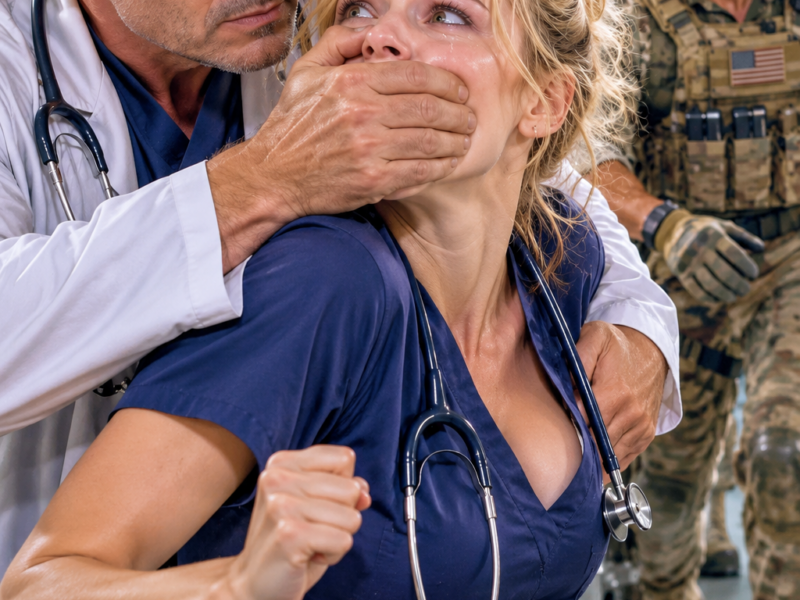
Surgeon Tried to Silence a New Nurse—Until Her Secret Air Force Past Saved the Ranger
Surgeon Tried to Silence a New Nurse—Until Her Secret Air Force Past Saved the Ranger
The surgeon’s hand came down on Nora Callahan’s shoulder just as she was about to warn him for the third time.
“Step away from my patient.”
Dr. Grant Holloway did not shout. He had never needed to. At Crestwood Regional Medical Center, his authority was so deeply established that even the smallest change in his tone could bring an entire trauma bay to silence.
And that was exactly what happened.
The nurses stopped moving. A young resident froze with a medication syringe in his hand. Two security officers stood in the doorway, waiting to see whether the woman in blue scrubs would obey the order.
On the gurney between them lay Captain Marcus Trent, a thirty-one-year-old Army Ranger whose body had been broken in a nighttime training accident. His oxygen saturation was falling. His neck was swelling. And with every passing second, the airway keeping him alive was becoming more difficult to protect.
Nora looked at the monitor.
Eighty-one percent.
A minute earlier, it had been eighty-three.
She had seen this pattern before, thousands of feet above hostile territory, inside an aircraft shaking so violently that keeping a needle steady had required two hands. She had seen it beside wounded soldiers whose lives depended on decisions made faster than most people could comprehend.
And she knew something that the surgeon standing in front of her had not yet accepted.
If they moved Captain Trent into the corridor for the CT scan, he might never come back alive.
For twenty-three days, Nora had worked at this hospital without telling anyone who she really was. She had accepted ordinary assignments, followed instructions, and kept her military past buried beneath an unremarkable résumé.
But now a man was dying in front of her, and the price of remaining silent had become greater than the price of being discovered.
She stepped back as ordered.
Then, before anyone could move the gurney, she stepped directly into its path.
A broad-shouldered soldier standing against the far wall turned toward her.
“Ma’am,” he asked quietly, “who are you?”
Nora did not take her eyes off the monitor.
“Shadow Hawk Six requests sixty seconds.”
The soldier went completely still.
For three long seconds, he stared at her as though he had just heard a voice from a battlefield that was supposed to exist only in memory.
Then Sergeant Major Dylan Case straightened, turned toward the surgeon, and spoke with a calmness that carried more authority than shouting ever could.
“Everyone stand down.”
What happened during the next sixty seconds would save a Ranger’s life, expose a dangerous failure inside one of Virginia’s busiest trauma departments, and force a woman who had spent eighteen months running from her own past to finally confront the person she had been trying to forget.
But to understand why those two words changed everything, it is necessary to go back to the beginning.
Twenty-three days earlier, Nora Callahan had walked through the glass entrance of Crestwood Regional Medical Center in Ashford, Virginia, carrying a canvas bag, a folder of employment documents, and a determination to be as ordinary as possible.
At thirty-eight, she had already lived through experiences that many medical professionals would never encounter in an entire career.
She had spent eleven years in the United States Air Force, most of them working in critical care evacuation medicine. Her assignments had taken her across deserts, mountains, temporary airstrips, and operating environments that never appeared in public deployment summaries.
She had treated catastrophic injuries inside aircraft where equipment was limited, communication was unreliable, and the nearest surgical facility might be hours away.
She had learned to recognize the smallest changes in a patient’s condition because sometimes those changes were the only warnings she would receive.
Her military call sign had been Shadow Hawk Six.
Among the people who knew what that designation represented, it carried a reputation built on discipline, clinical precision, and an extraordinary ability to remain composed when everyone else was struggling to keep up.
But Nora had not come to Crestwood to build another reputation.
She had come to disappear.
Eighteen months earlier, during an evacuation mission near the Libyan border, the aircraft carrying her medical team had suffered a catastrophic failure and crash-landed in a narrow valley.
Nora survived with a fractured wrist, two broken ribs, and a concussion that left her disoriented for several minutes.
Three soldiers remained trapped inside the damaged aircraft.
Despite her injuries, she spent the next six hours stabilizing them while the surviving crew coordinated extraction.
Two eventually made it home.
Sergeant Travis Bowen did not.
His death became the dividing line in Nora’s life.
Before the crash, she had believed that enough preparation, enough vigilance, and enough determination could carry her through almost any medical emergency.
Afterward, she understood that skill could improve the odds without ever guaranteeing the outcome.
Her commanding officer offered her a promotion fourteen months later. He told her that the Air Force needed people like her, that younger flight nurses depended on her experience, and that leaving would mean abandoning an extraordinary career.
Nora listened politely.
Then she resigned.
She never told him that she had begun waking in the middle of the night hearing Travis Bowen’s voice.
She never explained how exhausting it had become to carry the memory of a man who had trusted her to save him.
Instead, she packed away her uniforms, military photographs, awards, and the embroidered patch bearing the words Shadow Hawk Six.
She left the patch at her parents’ house, three states away, and moved to Virginia.
Her résumé mentioned eleven years of Air Force medical service but gave little information about the complexity of her assignments.
The hiring committee assumed she had worked in a military hospital.
Nora did not correct them.
She was hired as a trauma nurse and assigned to the emergency department under Beverly Strand, a veteran charge nurse who valued punctuality, discipline, and people who did not create unnecessary problems.
Beverly had been managing hospital floors for fourteen years. She had developed an instinct for identifying new employees quickly.
Some were eager but inexperienced. Some were talented but difficult. Others needed constant supervision.
Nora appeared to belong to the simplest category.
Quiet. Competent. Cooperative.
Beverly considered her a reliable addition to the department, although not someone likely to distinguish herself immediately.
For Nora, that assessment was perfect.
She arrived early, completed her work, and rarely participated in the personal conversations that filled the staff break room.
When she noticed that certain emergency supplies were regularly running low, she reorganized the storage system without requesting recognition.
When a medication calculation appeared incorrect during her second week, she quietly asked the attending physician to review it.
The error was corrected.
Nobody made a speech about it.
That was how Nora preferred things.
There was one person, however, whose presence made her instinctively cautious.
Dr. Grant Holloway.
At forty-three, Holloway was Crestwood’s lead trauma surgeon, a gifted physician whose reputation extended beyond the hospital. He was respected for his surgical speed, his ability to manage complicated injuries, and his willingness to make difficult decisions.
He had saved countless lives.
Unfortunately, years of success had gradually convinced him that questioning his decisions was usually a sign of inexperience rather than valuable clinical input.
Residents spoke carefully around him.
Nurses learned when to raise concerns and when to remain quiet.
Holloway did not insult people openly. His dismissals were often delivered so politely that challenging them made the other person appear unreasonable.
Nora recognized the pattern almost immediately.
She had encountered similar physicians during military deployments.
They were often excellent at their jobs until something unexpected happened. Then the confidence that made them effective could become an obstacle to recognizing information that contradicted their original assessment.
During her first three weeks, Nora avoided direct confrontations with Holloway.
She documented carefully, phrased observations professionally, and gave him no reason to notice her.
Then, shortly before midnight on an October night, the helicopter arrived.
The emergency notification reached Crestwood twelve minutes before landing.
Three soldiers had been injured during a nighttime navigation exercise at a nearby Army installation. A tactical vehicle had overturned on uneven terrain, leaving its occupants trapped beneath equipment and damaged structural components.
Two patients had moderate injuries.
The third was critical.
Captain Marcus Trent, an Army Ranger, had suffered significant trauma to his chest and neck. He had been unconscious when rescue personnel reached him, and his condition had deteriorated during extraction.
The emergency team immediately began preparing.
Beverly assigned positions. Residents gathered equipment. Respiratory staff checked ventilators. Blood products were requested as a precaution.
Nora was placed at the secondary monitoring station.
Her job was to watch vital signs, document interventions, and communicate changes to the treating physicians.
It was not the most prestigious position in the room.
For a nurse still considered new, however, it was predictable.
At 11:59 p.m., the helicopter landed.
Minutes later, the trauma bay doors opened and the injured soldiers arrived.
Captain Trent was first.
He was tall, muscular, and heavily built, but his physical strength offered little protection against the damage inside his body.
A military medic maintained ventilation while Dr. Eli Marsh, the Army flight surgeon who had accompanied the evacuation, delivered his report.
“Male, thirty-one. Blunt thoracic trauma, suspected pulmonary contusion, unstable cervical injury, extensive soft tissue involvement of the lower neck. Hemodynamics improved during transport but remain concerning.”
Holloway listened, studying the numbers on the monitor.
Behind the medical team came a man wearing an Army uniform.
He was broad through the shoulders, with closely cropped hair and the still expression of someone accustomed to dangerous situations.
Beverly intercepted him.
“Military personnel need to wait outside during treatment.”
The man produced identification.
“Sergeant Major Dylan Case. I’m staying with my captain.”
“This is a restricted medical area,” Holloway replied.
“I understand. I’ll stand against the wall. I won’t interfere.”
Holloway considered arguing, then apparently decided that the distraction was not worthwhile.
“Against the wall, Sergeant Major. And stay out of the way.”
Case complied.
Nora barely noticed the exchange.
Her attention was already on Captain Trent.
The oxygen saturation reading was lower than she wanted to see. The ventilator pressures were rising. More importantly, the swelling around his neck appeared uneven.
She leaned forward, studying the exposed skin above the transport dressing.
Something was wrong.
The swelling was not behaving like ordinary bruising.
It appeared firm, asymmetrical, and progressively more pronounced near the lower cervical region.
Nora remembered a patient she had treated years earlier during an evacuation flight over North Africa. He had arrived with what looked like a relatively minor injury beneath the jaw.
Forty minutes later, an expanding hematoma had nearly destroyed his airway.
The progression had begun with the same subtle signs she was seeing now.
She entered her observations into the medical record.
Asymmetrical cervical swelling. Increasing ventilator pressures. Declining oxygenation. Concern for expanding hematoma.
Then she looked toward Holloway.
“Doctor, I’m concerned about the patient’s airway.”
He was studying a portable chest image.
“Give me a moment.”
Nora waited.
The saturation dropped again.
“Dr. Holloway, the neck swelling appears to be increasing. I’m concerned there may be active bleeding compressing the airway.”
Holloway turned.
“I see the neck, Nurse Callahan. I’m evaluating his chest because the pulmonary injury is the more immediate concern.”
“I understand, but the swelling is progressing.”
“We’re taking him for imaging. We’ll assess the full extent of the injuries there.”
Nora glanced at the monitor.
“Transport and scanning will take several minutes. If the airway deteriorates before then—”
“Document your concern.”
The words were delivered with finality.
“That is why you’re at the monitoring station.”
Nora remained silent for a moment.
Then she returned to her computer and documented the exchange.
Beverly appeared beside her.
“When Dr. Holloway makes a clinical decision, we work within that decision.”
“I understand.”
“You’ve only been here three weeks.”
“Yes.”
“This is not the time to challenge the attending.”
Nora turned toward her.
“I’ve documented the changes and communicated them. I’ll continue watching.”
Beverly studied her expression, perhaps looking for fear or frustration.
She found neither.
“Then keep monitoring.”
Nora did.
Over the next several minutes, the numbers continued moving in the wrong direction.
The saturation fell through the high eighties.
The ventilator alarms became more frequent.
At the head of the bed, anesthesiologist Dr. Philip Okafor began reassessing the patient.
He was an experienced physician with a quiet manner, and he noticed something that immediately troubled him.
The neck was firmer than it had been during the initial examination.
He touched the swollen region carefully, studying the distorted anatomical landmarks.
“Grant,” he said, “we have a problem.”
Holloway turned.
“What kind?”
“The neck. The swelling is increasing, and the midline anatomy has shifted.”
Holloway approached.
The monitor sounded another warning.
Nora stood.
“We need to stop preparing for transport,” she said.
Holloway looked at her sharply.
“Callahan.”
“The airway may not remain stable long enough for imaging.”
“We are assessing that.”
“Then please assess it here before moving him.”
The young resident, Dr. Patel, stood close enough to hear every word.
He had noticed the swelling himself. He had also seen Nora’s earlier documentation.
But Holloway was the department’s senior trauma surgeon, and Patel was only in his second year of residency.
He remained silent.
Nora approached Dr. Okafor.
“The swelling has increased significantly since arrival. The ventilator pressure trend matches the progression. The anatomical displacement is getting worse.”
Holloway stepped forward.
“You are not responsible for making this decision.”
“I know.”
“Then return to your station.”
“I’m giving Dr. Okafor the observations I’ve recorded.”
“You have been here three weeks.”
Nora looked directly at him.
“And Captain Trent’s oxygen saturation is still falling.”
The room became uncomfortably quiet.
Holloway’s expression hardened.
“Beverly, have security escort Nurse Callahan out.”
Beverly hesitated.
Security officers appeared in the doorway.
A nurse quietly moved the transport equipment closer to the gurney.
The saturation alarm sounded again.
Eighty-one.
Nora understood that another argument would accomplish nothing.
She also understood that obeying would allow the patient to be moved before the danger had been properly addressed.
So she stepped into the path of the gurney.
Holloway placed a hand on her shoulder.
“Step away from my patient.”
Nora stepped back once.
Then she faced the gurney again.
Across the room, Sergeant Major Case straightened.
He had watched soldiers die from injuries that initially appeared survivable. He understood the difference between an emotional objection and a trained professional recognizing imminent danger.
Something about Nora’s posture caught his attention.
There was no panic in her movements.
No uncertainty.
She looked like someone who had already calculated the risks and accepted the consequences.
“Ma’am,” he asked, “what’s your name?”
Nora answered without looking at him.
“Shadow Hawk Six requests sixty seconds.”
Case stopped breathing for half a heartbeat.
Shadow Hawk Six.
He knew that designation.
Years earlier, stories had circulated through military medical and special operations units about an Air Force evacuation specialist who had kept critically wounded soldiers alive after a transport aircraft crashed near the Libyan border.
The stories were not elaborate.
Military professionals rarely needed elaborate stories to understand exceptional performance.
They remembered the important details.
A damaged aircraft.
A fractured wrist.
Six hours of emergency treatment.
Soldiers who survived because a flight nurse refused to abandon them.
And one man who did not.
Case studied Nora’s face.
Then he turned toward Holloway.
“Everyone stand down.”
The surgeon stared at him.
“This is a hospital, Sergeant Major. You do not have authority over my staff.”
“I understand that.”
“Then step back.”
“I’m asking you to give her sixty seconds.”
“We don’t have sixty seconds to waste.”
Case looked at the monitor.
“That is exactly why I’m asking.”
There was something about the way he said it that changed the atmosphere.
Holloway turned toward Okafor.
“Philip, reassess the airway.”
Nora immediately moved to the anesthesiologist’s side.
She delivered her observations quickly, in the concise language she had used during military evacuations.
She described the swelling on arrival, the progression, the pressure changes, and the corresponding decline in oxygen saturation.
Okafor listened while continuing his examination.
Then his expression changed.
“She’s right,” he said.
Holloway stared at him.
“The swelling is compressing the airway. We should not transport him.”
“How much time do we have?”
Okafor looked at the monitor.
“Not enough to be comfortable.”
The next several minutes unfolded with the terrible intensity of an emergency that had crossed from possibility into reality.
The team stopped preparing for CT.
Holloway ordered additional airway equipment and surgical backup. Okafor coordinated the immediate airway response. Beverly organized medications and support staff.
Patel moved quickly, suddenly focused on tasks that mattered more than the fear of making a mistake in front of his attending.
Nora remained beside the monitoring board.
She called out changes in oxygenation and pressure, anticipated equipment requests, and kept track of the sequence of interventions.
At one point, distorted anatomy made the airway management attempt more difficult than expected.
Okafor adjusted his approach, using additional equipment while Holloway prepared for emergency surgical access if necessary.
Nora helped coordinate supplies and relayed what she had observed about the direction of the swelling.
The room seemed to shrink around the patient.
Then, finally, the team achieved a secure, functioning airway.
The ventilator pressures began to improve.
The oxygen saturation, which had dropped into the seventies, slowly climbed.
Seventy-eight.
Eighty-one.
Eighty-six.
Nobody celebrated.
The numbers were still dangerous.
But they were moving in the right direction.
A few minutes later, the saturation reached ninety-two.
Okafor exhaled slowly.
“We have him.”
Beverly pressed a hand against the edge of the medication cart.
Patel looked as though he had forgotten how to breathe until that moment.
Nora returned to the monitor and recorded the intervention.
Across the room, Holloway stood very still.
He had helped manage the emergency. His surgical judgment and experience had been essential once the team recognized the problem.
But something else had become impossible to ignore.
The new nurse he had repeatedly dismissed had identified the danger before anyone else.
She had warned him.
Twice.
And she had documented those warnings before the emergency occurred.
Holloway understood exactly how that would appear in a formal review.
He also understood that every person in the trauma bay had witnessed the sequence.
Dr. Okafor approached Nora.
“Good work,” he said quietly.
She nodded.
“Thank you, Doctor.”
The surgical team transferred Trent for treatment of the expanding hematoma and associated injuries.
The immediate airway crisis had passed, but he remained critically injured.
Nora spent the next hour completing her documentation.
She recorded every relevant observation, communication, and intervention as accurately as possible.
She did not write that Holloway had been arrogant.
She did not describe how close the situation had come to disaster.
She wrote what the records could establish.
The patient’s condition.
The changes she observed.
The warnings she communicated.
The response she received.
And the emergency that followed.
Afterward, she walked toward the supply alcove, hoping to collect herself before the next assignment.
Sergeant Major Case was waiting.
He stood several feet away, giving her space.
For a moment, neither spoke.
Then he asked a single question.
“Where?”
Nora knew what he meant.
“Africa, mostly.”
“Near the Libyan border?”
“Yes.”
Case nodded.
“I heard about an Air Force flight nurse who survived a crash and spent hours keeping wounded soldiers alive.”
Nora looked down.
“People tend to exaggerate those stories.”
“I heard you worked with a broken hand.”
“Wrist,” she corrected.
Something resembling a smile briefly appeared on his face.
Then he grew serious.
“Who was the one you lost?”
Nora was silent.
She could have refused to answer.
She had refused that question many times.
But there was something in Case’s voice that suggested he already understood what the answer would cost.
“Sergeant Travis Bowen.”
Case lowered his head slightly.
“I know the name.”
Nora swallowed.
“He was a good man.”
“I’m sure he was.”
For several seconds, the hum of the hospital filled the silence between them.
Then Case said, “His name is honored here tonight.”
Nora looked away.
She had spent eighteen months trying not to hear words like that.
Before she could respond, footsteps approached.
Holloway appeared with a tablet in his hand.
Beverly followed him.
“Nurse Callahan,” he said, “I need your identification badge.”
Nora turned.
“Why?”
“I am initiating an administrative review regarding your conduct during the trauma response.”
Beverly’s expression tightened.
Holloway continued.
“You disregarded a physician directive, interfered with patient transport, and assumed a position outside your assigned responsibilities. You are suspended from clinical duties pending investigation.”
Nora looked at him.
For one brief moment, she considered explaining everything.
The medical evidence.
The documentation.
The fact that the patient might have lost his airway in the corridor.
Then she realized Holloway was not asking for an explanation.
He was establishing a position.
She unclipped her badge and placed it in his hand.
“Understood.”
“You’ll receive written notice.”
He walked away.
Beverly remained.
“Nora—”
“I documented everything.”
“I know.”
“The timestamps are in the electronic record. Dr. Okafor can confirm his findings. Dr. Marsh witnessed the airway response. Sergeant Major Case was present.”
Beverly stared at her.
Then she asked, quietly, “What exactly did you do in the Air Force?”
“Critical care evacuation medicine.”
“For eleven years?”
“Yes.”
Beverly exhaled.
She looked toward the corridor Holloway had disappeared down.
“I should have asked more questions during your orientation.”
Nora offered no reply.
Beverly touched her arm briefly.
“Go home. I’ll contact you when I know more.”
Case walked beside Nora toward the elevators.
“You know what happens next?” he asked.
“Yes.”
“He writes the report first. He establishes the narrative. By the time anyone reviews the medical record, your actions have already been described as a disciplinary problem.”
Nora pressed the elevator button.
“That’s possible.”
“It’s more than possible.”
She looked toward him.
“Captain Trent has been under your command for six years?”
“Yes.”
“Then you know what kind of man he is.”
Case held her gaze.
“I do.”
“And you know whether stopping that gurney was worth whatever happens next.”
The elevator doors opened.
Nora stepped inside.
Case remained outside.
Just before the doors closed, he said, “You don’t have to disappear again.”
She looked at him.
Then the doors shut.
For the first time that night, Nora felt something beneath her carefully maintained composure begin to fracture.
She took the stairs down instead.
Outside, the October air was cold.
She sat in her car for several minutes before starting the engine.
The hospital lights glowed behind her.
Somewhere upstairs, Captain Trent was fighting his way through surgery.
And somewhere inside the same building, the surgeon whose decision she had challenged was preparing to make her the problem.
During the eighteen-minute drive home, Nora thought about Travis Bowen.
She remembered his terrible jokes, his habit of checking whether exhausted medics had eaten, and the way he could recognize when someone needed company without demanding a conversation.
She remembered the crash.
The wreckage.
The blood.
The relentless struggle to keep three men alive.
Most of all, she remembered the moment when Travis stopped responding.
She had performed every intervention available.
She had fought until there was nothing left to do.
And then she had carried the memory home.
Leaving the Air Force had been supposed to make things easier.
Instead, it had simply given her more silence in which to remember.
At her apartment, Nora sat at the kitchen table with a glass of water.
Her phone displayed several messages.
One came from the hospital staffing office.
Another came from Beverly, asking her to call in the morning.
The third was from a military number she did not recognize.
She ignored it initially.
Then, shortly after two in the morning, another message appeared.
Captain Trent is out of surgery. Serious but stable. The team knows what happened. Whatever you decide about the review, you saved his life.
Nora read it twice.
She set the phone down.
Then she picked it up again and opened the hospital’s formal review request page.
For eighteen months, she had been walking away from things that hurt.
She had left the Air Force.
She had left people who wanted to help.
She had avoided conversations that might force her to acknowledge how much of herself still belonged to the world she had abandoned.
Now she was facing another opportunity to disappear.
She could accept the suspension, resign quietly, and find another hospital.
She could move to another city.
She could start over again.
But Captain Trent would still have a medical record.
And that record deserved to tell the truth.
At 3:08 a.m., Nora submitted a formal request for review.
She attached references to her clinical documentation and described the sequence without accusation or unnecessary emotion.
When she finished, she went to bed.
Five hours later, Beverly called.
“Holloway filed his incident report this morning,” Beverly said.
“I expected that.”
“He’s describing last night as repeated insubordination by a probationary nurse.”
Nora stared at her coffee.
“Is he requesting a patient safety review?”
“No. He’s trying to keep it within the disciplinary process.”
“That matters.”
“Yes,” Beverly replied. “It matters a great deal.”
A disciplinary investigation would focus on Nora’s conduct and whether she had followed instructions.
A patient safety review would examine the clinical decisions, the warnings, and the sequence that nearly resulted in a catastrophic outcome.
The same night could be interpreted very differently depending on which questions were asked.
Beverly lowered her voice.
“Dr. Marsh has submitted an independent witness statement.”
Nora sat straighter.
“He did?”
“Early this morning. He also contacted the hospital’s patient safety office.”
For the first time since waking, Nora felt a small measure of relief.
Marsh had been standing near the doorway during the airway crisis.
He had heard the exchanges.
He had watched the response.
And unlike the people employed by Crestwood, he had no professional reason to protect Holloway’s authority.
Beverly continued.
“Your documentation is strong, Nora.”
“Thank you.”
“I mean exceptionally strong. The timeline is clear, and the observations were recorded before the deterioration. That is going to matter.”
Nora remained quiet.
Then Beverly said something unexpected.
“I was wrong about you.”
Nora looked toward the window.
“You didn’t know my background.”
“I didn’t ask.”
There was a pause.
“I should have.”
Nora thanked her.
After the call, she opened the incident report Holloway had submitted.
It was carefully written.
He described a nurse who repeatedly challenged physician authority during a rapidly evolving emergency.
He emphasized the danger of delaying urgent imaging.
He portrayed the successful airway intervention as evidence that the medical team had appropriately responded to an unpredictable complication.
Nothing in the report was an obvious fabrication.
That made it more troubling.
He had selected facts that supported his interpretation while minimizing those that contradicted it.
Nora read the document slowly.
Then she opened her own notes.
The contrast was unmistakable.
Her warnings preceded the emergency.
His report treated the emergency as though it had emerged independently of those warnings.
She understood that proving the difference would require more than indignation.
It would require evidence.
Late that morning, Sergeant Major Case called.
“Marsh’s report has reached Army Medical Command,” he said.
Nora closed her eyes briefly.
“That complicates things.”
“It does.”
“Did you ask him to submit it?”
“No. He did it because he believed it was necessary.”
Nora considered that.
“Is Trent awake?”
“Intermittently. He’s improving.”
“Good.”
Case paused.
“They’re going to learn about your military background.”
“I know.”
“You comfortable with that?”
“No.”
He made a small sound of acknowledgment.
“Doesn’t mean it isn’t time.”
Nora said nothing.
Case continued.
“You know what I think?”
“What?”
“I think you’ve spent a long time treating survival like something you need to apologize for.”
The words landed harder than she expected.
Before she could respond, he added, “Trent wants to meet you when he’s strong enough.”
Nora looked at the sunlight falling across her kitchen table.
“I’ll come.”
That afternoon, she met Rachel Vu, the hospital’s quality review coordinator.
Rachel listened without interruption while Nora walked through the events.
She asked precise questions about when the swelling had first been observed, what had been communicated, and how the response had been documented.
At the end of the interview, she closed her notebook.
“The electronic timestamps support your account,” Rachel said.
Nora nodded.
“The quality review will proceed independently of the disciplinary process.”
“Understood.”
“You may be asked to testify before a committee.”
“I’m prepared.”
Rachel studied her.
“I believe you are.”
As Nora left the administrative wing, she encountered Dr. Eli Marsh near the elevators.
He was wearing civilian clothes and holding a folder.
“Ms. Callahan.”
“Dr. Marsh.”
“I wanted you to know I submitted a statement.”
“I heard.”
“I documented what I witnessed. The warnings, the clinical response, and the deterioration.”
“Thank you.”
He shook his head.
“I didn’t do it as a favor. Captain Trent deserves an accurate medical record.”
Nora understood.
Marsh hesitated.
“And I recognized the call sign.”
She looked at him.
“Shadow Hawk Six.”
“Yes.”
“I’d prefer that not become the focus.”
“I agree,” he said. “Your observations should stand on their own.”
He paused.
“But I also think the people reviewing this case deserve to understand the experience behind those observations.”
Nora looked away.
“Those are two different things.”
“Yes,” Marsh replied. “And both can be true.”
By late afternoon, the hospital had received formal correspondence from Army Medical Command requesting review of the circumstances surrounding Captain Trent’s treatment.
Crestwood’s senior leadership became involved.
The chief medical officer issued instructions to preserve all relevant records and cooperate with the investigation.
Holloway, who had expected an internal disciplinary proceeding, was now facing questions from people beyond his immediate professional circle.
That evening, Nora received a call from Colonel Diane Hartwell, an Army medical officer overseeing the external review.
They met in a parking structure near the hospital.
Hartwell was in her early fifties, with the composed bearing of a career officer who had spent years making difficult decisions without displaying unnecessary emotion.
She invited Nora into her parked car.
“Captain Trent was conscious for a short period today,” Hartwell began.
Nora turned toward her.
“How is he?”
“Still serious, but improving.”
Hartwell opened a folder.
“He remembered something from the trauma bay.”
Nora waited.
“He said he heard a woman telling someone not to move him.”
For several seconds, Nora did not speak.
Hartwell continued.
“He said he couldn’t see her clearly. He couldn’t understand everything that was happening. But he remembers the voice.”
Nora looked down at her hands.
“He asked the staff to tell you that he heard you.”
The silence inside the car became very deep.
After everything Nora had survived, after all the patients whose final moments still lived in her memory, she had never expected those words to affect her so strongly.
He heard you.
And he was alive.
Hartwell allowed the silence to remain.
Then she continued.
“I reviewed the accessible portions of your Air Force service record.”
Nora looked up.
“Then you know why I left.”
“I know about the crash.”
“That isn’t the same thing.”
“No,” Hartwell agreed. “It isn’t.”
She closed the folder.
“Your record shows years of highly specialized critical care work under extremely difficult conditions. What happened in that trauma bay was consistent with the experience you developed.”
“I don’t want this investigation to become a celebration of my past.”
“Neither do I.”
Hartwell leaned back.
“I want it to establish why a documented clinical warning was repeatedly dismissed.”
Nora met her eyes.
“That is what matters.”
“Then we agree.”
The colonel paused.
“There’s something else you should know. Dr. Holloway has a consulting arrangement with the Army medical network. His contract is approaching renewal.”
Nora frowned.
“Are you telling me his career is at risk?”
“I’m telling you the review will be independent, and any findings will have consequences.”
Nora considered that carefully.
“I don’t want revenge.”
“I didn’t suggest you did.”
“I want the record corrected. And I want the next nurse who recognizes something dangerous to be heard before a patient reaches the edge of dying.”
Hartwell nodded.
“Then that is what you should say.”
The review hearing took place two mornings later.
Nora arrived eight minutes early.
She wore a dark jacket over a simple blouse and carried a folder containing her notes.
Beverly waited outside the conference room.
“You look calm,” Beverly said.
“I’m not.”
“Good. I was beginning to wonder.”
They shared the briefest smile.
Inside, Holloway sat beside his attorney.
Dr. Okafor was present, along with the hospital’s chief medical officer, nursing representatives, Rachel Vu, and Colonel Hartwell.
The atmosphere was formal and tense.
Dr. Henry Falk, Crestwood’s chief medical officer, opened the proceedings.
He explained that the disciplinary and patient safety findings would be considered separately, although both reviews would rely on testimony gathered during the session.
Holloway spoke first.
He described the night as a complicated trauma response requiring rapid decisions under pressure.
He acknowledged the airway emergency but maintained that his initial focus on the chest injury had been clinically reasonable.
He also argued that Nora’s physical interference with transport had introduced unnecessary risk.
His tone was measured.
His language was careful.
When he finished, several people around the table took notes.
Then Falk turned toward Nora.
“Ms. Callahan, please describe your involvement.”
Nora placed her hands on the table.
She did not begin by describing her Air Force career.
She did not mention Shadow Hawk Six.
She began with the patient.
She described her assignment, the initial observations, the change in neck swelling, and the deterioration in oxygenation.
She explained when she had communicated her concerns and what responses she had received.
She described the moment when she believed transport would create unacceptable risk.
“I did not attempt to assume a physician’s authority,” she said. “I communicated clinical observations that were within my nursing responsibilities. When the patient’s condition deteriorated further, I requested additional assessment before transport.”
Holloway’s attorney leaned forward.
“Would you agree that you physically positioned yourself to prevent the gurney from moving?”
“Yes.”
“Despite being instructed otherwise?”
“Yes.”
“Then how do you distinguish that from refusing a direct order?”
Nora looked at him.
“Because my concern was that the patient would lose his airway during transport before the team had adequately assessed the developing obstruction.”
The attorney paused.
“You believed your judgment was superior to the attending surgeon’s?”
“No. I believed the documented changes required attention.”
There was a moment of silence.
Then Dr. Okafor spoke.
“I can confirm that Ms. Callahan’s observations were clinically significant.”
Every face turned toward him.
“She identified a pattern of deterioration that was subsequently confirmed during my assessment. Her warning changed what I examined and when I examined it.”
Holloway looked down.
Okafor continued.
“The patient’s airway was compromised. Moving him without further intervention would have created substantial danger.”
Falk nodded slowly.
Ellen Park, the nursing representative, addressed Nora.
“Why didn’t you tell Dr. Holloway about your specialized military experience?”
Nora considered the question.
“Because my résumé wasn’t the issue.”
“Could you explain?”
“The patient had measurable signs of deterioration. I documented them. Those observations should have been evaluated based on their clinical relevance, not on whether the person reporting them had an impressive background.”
Park watched her carefully.
Nora continued.
“If a nurse with two years of experience notices a dangerous change, that observation deserves consideration. If a nurse with twenty years of experience makes the same observation, it deserves the same consideration. The patient’s condition should determine the urgency.”
Colonel Hartwell leaned forward.
“That brings us to an important point.”
She turned toward Holloway.
“Were you aware of Ms. Callahan’s specialized experience in critical care evacuation medicine?”
“No.”
“Would that have changed how you responded to her warning?”
Holloway hesitated.
His attorney shifted beside him.
Finally, Holloway said, “I can’t answer a hypothetical question with certainty.”
Hartwell nodded.
“Then perhaps the more useful question concerns how the hospital recognizes specialized expertise among newly hired staff.”
She opened a document.
“Ms. Callahan has extensive experience managing unstable patients in transport environments, including cases involving rapidly progressing airway compromise. Yet that experience was not meaningfully incorporated into her assignment or orientation.”
Falk looked toward Rachel Vu.
Hartwell continued.
“An institution cannot benefit from expertise it does not recognize. And it cannot safely manage emergencies if professional hierarchy prevents relevant information from reaching the people making decisions.”
Nobody interrupted.
For the first time, the hearing was no longer centered only on whether Nora had disobeyed a surgeon.
It had become a question about the system itself.
During a short recess, Beverly stood beside Nora in the hallway.
“That changed the room,” she said.
Nora nodded.
“The system matters.”
“So does what Holloway did.”
“I know.”
“Do you want him removed?”
Nora thought for a moment.
“I want the consequences to reflect the evidence.”
“That’s a careful answer.”
“It’s the only one I have.”
When the session resumed, Holloway spoke again.
This time, his tone was different.
“I focused on the injury I believed posed the greatest immediate threat,” he said. “The airway complication progressed faster than I anticipated.”
He looked toward Nora.
“The concern Nurse Callahan raised was valid. I should have reassessed it sooner.”
It was not a complete apology.
But it was a direct acknowledgment entered into the record.
Nora understood its importance.
When her turn came, she said only that the patient had survived, the documentation supported the sequence, and she hoped the review would result in changes that made future warnings harder to dismiss.
The hearing concluded.
In the hallway afterward, Holloway approached her.
For several seconds, he seemed unsure how to begin.
Then he said, “I should have listened the second time.”
Nora looked at him.
“Yes.”
He swallowed.
“I don’t know whether that means anything to you.”
“It means something to Captain Trent.”
Holloway nodded.
Then he walked away.
Nora stood alone for a moment before heading toward the elevators.
Her phone vibrated.
A message from Case appeared.
Trent is awake. He’s asking for you.
Nora looked toward the hospital entrance.
She could leave.
Her hearing was finished. The investigation would continue without requiring her constant presence.
But there was someone upstairs who had been waiting to meet the woman whose voice he remembered.
She turned around.
In the intensive care unit, Captain Trent lay surrounded by monitors and intravenous lines.
His face was pale, and his movements were limited by pain and exhaustion.
But his eyes were open.
When Nora entered, he looked toward her.
For several seconds, he studied her face.
Then he lifted one hand slightly.
A nurse reminded him not to disturb the oxygen equipment.
He lowered his hand.
Nora pulled a chair beside the bed.
“Captain Trent.”
His eyes remained on her.
She smiled faintly.
“You’ve had a difficult few days.”
He attempted to speak, but the effort was uncomfortable.
“You don’t have to say anything,” she told him.
He closed his eyes briefly.
Then he opened them again.
There was something in his expression Nora recognized.
She had seen it in wounded soldiers who woke after evacuation and discovered they were no longer in danger.
Relief.
Confusion.
The fragile recognition that the world had continued while they were unconscious.
And gratitude that had not yet found words.
She remained beside him in silence.
For once, silence did not feel like something she was using to hide.
It felt appropriate.
After eleven minutes, the ICU physician arrived to assess Trent, and Nora excused herself.
Case was waiting nearby.
“How did it go?” he asked.
“He’s recovering.”
“He is.”
They sat together.
For a while, neither spoke.
Then Case said, “The team knows who you are now.”
Nora looked at him.
“I expected that.”
“People are talking.”
“I can manage it.”
“I know.”
He paused.
“But you don’t always have to manage everything alone.”
Nora turned toward him.
Case continued.
“You spent eleven years being the person everyone depended on. Maybe it’s time you let some people stand beside you.”
She looked toward the ICU corridor.
For a moment, she thought of Travis Bowen.
Then she nodded.
Two days later, Rachel Vu called with the preliminary findings.
The review concluded that a serious patient safety event had occurred because documented nursing observations had not been adequately incorporated into physician decision-making.
It identified communication failures and weaknesses in the hospital’s process for evaluating specialized clinical backgrounds.
The committee recommended Nora’s immediate reinstatement, updated orientation procedures, and mandatory interdisciplinary communication training.
The disciplinary allegations against her were dismissed.
When Rachel finished reading the findings, Nora remained quiet.
“Ms. Callahan?”
“I’m here.”
“You’ve been cleared to return to clinical duties.”
“Thank you.”
“And for what it’s worth, the review committee found your documentation exceptionally thorough.”
Nora glanced at the notebook beside her.
“That’s how it should be.”
Rachel paused.
“Welcome back.”
Beverly called less than an hour later.
“I need you Monday morning,” she announced.
Nora almost smiled.
“Good morning to you, too.”
“We’re short on experienced trauma staff.”
“I thought I was still considered inexperienced.”
Beverly sighed.
“I deserved that.”
Nora laughed softly.
It was the first spontaneous laugh she had heard from herself in days.
“I’ll be there at seven.”
“Your assignment will be different.”
“Beverly?”
“Yes?”
“The monitoring station was not the problem.”
“I know.”
“The problem was that nobody listened to what came from it.”
Beverly was silent for a moment.
Then she said, “That’s something we’re going to change.”
Nora returned to work the following Monday.
She had expected awkwardness.
There was some.
Staff members who had barely acknowledged her before now watched her with curiosity.
A few asked indirect questions about the Air Force.
Others seemed uncertain whether to treat her differently.
Nora continued doing her job.
She checked patients, reviewed medications, assisted with procedures, and documented her observations.
She did not become louder.
She did not demand attention.
But when she saw something concerning, she spoke clearly.
And people listened.
The hospital’s performance review of Holloway continued.
Investigators examined his handling of Captain Trent’s case and discovered two earlier incidents in which nursing concerns had been documented but inadequately addressed.
Neither had resulted in a fatality.
Both had contributed to avoidable complications.
The review concluded that the problem was not an isolated lapse in judgment.
It was a pattern.
Holloway was removed from trauma leadership and placed under formal performance supervision. His documentation and communication practices became subject to additional review, and he was required to complete structured training.
His Army consulting arrangement was not renewed during that review period.
He retained his medical license and surgical privileges, but his professional standing changed.
For a physician who had built his identity around authority, the consequences were substantial.
Nora did not celebrate.
She understood too well how complicated professional mistakes could become.
But she also understood that accountability meant nothing if it disappeared the moment the immediate crisis passed.
One afternoon, Dr. Patel approached her at the nursing station.
He looked nervous.
“I filed a report,” he said.
Nora looked up.
“About the night Captain Trent came in?”
“Yes.”
She waited.
“I should have spoken when you raised the concern. I saw the information. I knew something was wrong.”
“Why didn’t you say anything?”
Patel looked down.
“Because I was afraid of Holloway.”
Nora gave him time to continue.
“I was thinking about my career. My evaluations. Whether challenging him would affect my future.”
He swallowed.
“And I forgot that there was a patient in the middle of all of it.”
Nora regarded him carefully.
“You recognized that afterward.”
“Yes.”
“And now you’ve documented it.”
“Yes.”
She nodded.
“Then learn from it.”
Patel looked surprised.
“That’s all?”
“What else would you like me to say?”
“I don’t know. I expected you to be angry.”
“I was disappointed. There’s a difference.”
He remained silent.
Nora continued.
“One day you’ll be the senior physician in a room. Someone younger will notice something you missed. Remember how this felt when you were afraid to speak.”
Patel nodded.
“And make sure they never have a reason to feel the same way around you.”
He stood a little straighter.
“I will.”
Nora watched him return to his rounds.
For the first time, she began to understand that what had happened in the trauma bay might become something more than a painful incident.
It could change how people practiced medicine.
Soon afterward, the nursing director asked whether Nora would participate in revising the trauma department’s orientation program.
The request eventually grew into a proposal for a structured clinical communication initiative.
Experienced nurses would participate more directly in training.
Specialized backgrounds would be documented and considered.
Teams would practice responding to concerns raised by anyone, regardless of rank or seniority.
And urgent safety observations would have clearer pathways for escalation.
The proposed program needed a leader.
The nursing director wanted Nora.
When Beverly told her, Nora stared at the document.
“I’ve only been here a little over a month.”
Beverly folded her arms.
“And apparently that was enough time to discover something the department should have addressed years ago.”
“I don’t know whether I want a leadership position.”
“It’s not a title for the sake of a title.”
“What is it?”
“A chance to build the kind of system you needed that night.”
Nora looked down at the proposal.
That was harder to dismiss.
She accepted the opportunity to help develop it.
Around the same time, she received another offer.
Raymond Aldous, the director of a regional Air Force Reserve medical program, contacted her about a part-time advisory position supporting communication standards between military evacuation teams and civilian hospitals.
The work would not require her to return to full-time military service.
Instead, it would allow her to apply her experience to training and coordination.
Nora spent an evening reviewing the proposal.
For years, she had believed that moving forward required leaving her military life behind.
Now two institutions were asking her to use precisely the experience she had been trying to bury.
She called Aldous the following afternoon.
“I’m interested,” she told him.
“Excellent.”
“I have some questions about the responsibilities.”
“I expected you would.”
She asked about scheduling, authority, expectations, and the limitations of the advisory role.
He answered directly.
Finally, she asked whether the position required her to return to active operational duties.
“No,” Aldous replied. “Your role would be advisory.”
Nora was quiet.
“Then I accept.”
After the call, she sat at her kitchen table for several minutes.
Nothing dramatic happened.
No sudden feeling of transformation arrived.
She simply understood that she had made a decision she would not have been ready to make a month earlier.
She was no longer trying to separate the woman who had served in the Air Force from the woman who now worked at Crestwood.
They were the same person.
And perhaps they always had been.
Captain Trent continued recovering.
Nine days after the accident, he left intensive care.
On the tenth day, Nora visited him during her lunch break.
He was sitting upright, breathing with minimal oxygen support, and looking considerably more irritated by his restrictions than by his injuries.
Case was in the room when Nora arrived.
He stood immediately.
“I’m going to find coffee,” he announced.
Trent looked at him.
“You already have coffee.”
“Then I’ll find better coffee.”
He left before either of them could respond.
Nora pulled a chair beside the bed.
“How are you feeling?”
“Like a truck tried to fold me in half.”
“That seems medically consistent.”
Trent gave a rough laugh, then winced.
“Don’t make me laugh.”
“I’ll do my best.”
He studied her.
“You’re smaller than I imagined.”
Nora raised an eyebrow.
“From what?”
“Your voice.”
She smiled faintly.
“Aircraft are loud.”
He nodded.
“Case told me about your background.”
“I suspected he would.”
“He also told me about the hearing.”
Nora looked toward the window.
“That’s finished.”
“Not all of it.”
“No.”
Trent adjusted his position carefully.
“Can I ask you something?”
“Of course.”
“Why did you leave the Air Force?”
Nora felt the familiar tightness in her chest.
She had developed several answers to that question over eighteen months.
Some were short.
Some were technically accurate.
Most were designed to end the conversation.
This time, she decided not to use any of them.
“I lost someone,” she said.
Trent waited.
“A man I was responsible for. He died during an evacuation after our aircraft crashed.”
“I’m sorry.”
Nora nodded.
“Afterward, I stopped trusting myself to be the person standing between someone and the worst thing that could happen to them.”
Trent looked at her for a long moment.
“Did leaving help?”
“No.”
He turned his eyes toward the window.
“I’ve lost people, too.”
“I know.”
“Sometimes you make every decision you can, and it still isn’t enough.”
Nora looked down.
“Yes.”
Trent continued.
“But that doesn’t erase the times it is enough.”
She slowly lifted her eyes.
He gestured toward himself.
“I’m one of those times.”
Nora did not answer.
She had spent eighteen months remembering the patient she could not save.
Here was a man who was alive because she had refused to remain silent.
Both truths existed.
Neither canceled the other.
Trent reached toward the bedside table and picked up a small folded piece of paper.
“Case wrote down Bowen’s name for me.”
Nora froze.
“He told me what happened.”
She looked toward him.
Trent spoke carefully.
“I wanted you to know that his name matters to us, too.”
Nora pressed her lips together.
For a long moment, she could not find words.
Finally, she whispered, “Thank you.”
Trent nodded.
Then, with the blunt simplicity that seemed natural to him, he said, “I’m glad you came back to nursing.”
“So am I,” she replied.
And this time, she realized she meant it.
Over the next several months, Nora’s life changed through a series of small decisions rather than one extraordinary moment.
She began helping new nurses understand how to communicate urgent concerns clearly.
She worked with physicians to develop structured responses that required acknowledgment of significant clinical observations.
She participated in simulations designed to test not just medical knowledge but the ability of a team to listen under pressure.
She discovered that teaching was different from directing an emergency.
It required patience.
It required allowing people to make mistakes in environments where those mistakes could become lessons instead of tragedies.
Most of all, it required believing that other people could learn to carry responsibilities she had once felt compelled to shoulder alone.
Holloway attended the communication training as part of his performance improvement plan.
At first, his presence made the room uncomfortable.
He sat quietly, listening more than speaking.
During one simulation, the team was presented with a fictional patient whose condition deteriorated despite apparently appropriate treatment.
A junior nurse identified a discrepancy in the monitored data.
The senior physician initially dismissed it.
The exercise stopped.
The facilitator, Dr. Paula Weeks, asked what should have happened differently.
Holloway spoke.
“The physician should have formally acknowledged the concern before continuing.”
Weeks looked toward him.
“Why?”
“Because the concern may contain information that doesn’t fit the physician’s current assessment.”
“And what prevents that acknowledgment?”
Holloway was quiet.
Then he said, “Sometimes the physician has already decided what the problem is.”
Nora watched him from the opposite side of the room.
It was not an apology.
But it was evidence that he was beginning to understand something important.
After the session, Holloway approached her.
“I reviewed your service record,” he said.
Nora nodded.
“I understand now what you did before Crestwood.”
“That wasn’t what made the warning correct.”
“I know.”
He looked down briefly.
“I’m trying to learn how to recognize that distinction sooner.”
Nora studied him.
“Then the training is doing what it should.”
He nodded.
They returned to work.
There was no dramatic reconciliation.
There did not need to be.
The hospital had changed, and both of them had responsibilities within that change.
In December, Nora visited her parents for the first time in eighteen months.
Her mother hugged her longer than usual.
Her father asked about the hospital with the careful curiosity of someone who had heard enough to know there was more to the story.
Nora told them what had happened.
She did not hide the conflict.
She did not minimize the investigation.
And when she described Captain Trent walking out of intensive care, she found herself smiling.
The next morning, she entered her childhood bedroom and opened the closet.
The box containing her military belongings was still where she had left it.
Inside were photographs, old documents, and the embroidered Shadow Hawk Six patch.
Nora sat on the edge of the bed and held it.
For a long time, she simply looked at the familiar stitching.
She remembered the aircraft.
The heat.
The noise.
The wounded men.
Travis Bowen.
The person she had been.
The person she had become.
She had once believed that leaving the patch behind would make the memories less powerful.
Now she understood that the memories had never depended on the patch.
They had traveled with her.
So had the skills.
So had the responsibility.
And so had the capacity to help people survive.
She placed the patch in her bag.
When she flew back to Virginia, it came with her.
In February, Captain Trent returned to Crestwood.
This time, he arrived in uniform and walked through the main entrance without assistance.
Beside him were his wife, Angela, and their fourteen-year-old daughter, Ray.
Nora met them in the lobby.
Angela took her hand.
“My husband has told us what happened.”
Nora glanced toward Trent.
“I’m sure he left out a few details.”
Angela smiled.
“He usually does.”
Ray looked at her father.
“He said he was almost fine when they brought him in.”
Nora raised an eyebrow.
“Did he?”
Trent sighed.
“I may have been optimistic.”
“Extremely,” Nora replied.
Angela laughed.
Then her expression softened.
“I wanted to thank you.”
Nora shook her head.
“The whole team worked very hard.”
“I know,” Angela said. “And I’m grateful to all of them. But I also wanted to meet the woman who kept speaking when people told her to stop.”
Nora looked down.
Angela gently squeezed her hand.
“Because of that, my daughter still has her father.”
The words nearly broke through Nora’s composure.
She looked toward Ray, who stood beside Trent with one hand gripping his sleeve.
The girl was watching her carefully.
“Thank you,” Ray said.
Nora swallowed.
“You’re welcome.”
For years, Nora had measured her past by one death.
Now, standing in the hospital lobby, she was looking at a family whose future had nearly been taken away.
Angela would go home with her husband.
Ray would grow older with her father present.
There would be birthdays, arguments, ordinary mornings, and countless small moments that would never make their way into a medical record.
That was what survival meant beyond the monitors and procedures.
It was the life that continued afterward.
When the family finally prepared to leave, Trent stood beside Nora near the entrance.
“Case sends his regards,” he said.
“How is he?”
“Transferred to another assignment. Still convinced he can run the entire Army by himself.”
“That sounds familiar.”
Trent smiled.
“He also said to tell you Bowen would have been proud.”
Nora turned toward the parking lot.
For several seconds, she could not speak.
Then she said, “I hope so.”
Trent looked at her.
“I think you know so.”
She watched him return to his family.
Angela said something that made Ray laugh.
Trent opened the passenger door for his daughter, then walked around the car with the careful gait of a man still recovering.
They drove away.
Nora remained at the window until their car disappeared.
Then she returned upstairs.
By April, the hospital’s first full interdisciplinary communication training program was complete.
Seven nurses, several residents, and attending physicians had participated.
The final simulation involved multiple casualties, incomplete information, and rapidly changing conditions.
A young nurse named Yolanda, who had previously worked in pediatric critical care, was assigned to secondary monitoring.
During the exercise, she noticed that one patient’s condition did not match the initial injury assessment.
She documented the discrepancy.
Then she spoke.
“I need the team to reassess this patient. The monitored trend doesn’t fit our current plan.”
The senior resident stopped.
He reviewed the information.
Then he changed the treatment plan.
Afterward, Dr. Weeks asked the group what had made the difference.
Yolanda looked uncertain.
“I had the documentation,” she said. “I could see the trend changing, so I thought I should speak.”
“And what happened when you did?”
“The team listened.”
Nora sat quietly at the back of the room.
Nobody mentioned Captain Trent.
Nobody mentioned the hearing.
Nobody needed to.
The answer was there in the simulation.
A new nurse had recognized a problem.
She had spoken.
The team had listened.
And the patient, even though fictional, had benefited from the decision.
Across the room, Holloway watched with his hands folded.
After the session, he approached Nora.
“I’ve been thinking about the airway case,” he said.
She waited.
“About the time between your first warning and when I finally responded.”
Nora said nothing.
“I keep wondering what would have happened if I’d listened sooner.”
“That question is worth asking.”
He nodded.
“I know.”
For a moment, they stood in silence.
Then Holloway returned to his duties, and Nora began collecting the training materials.
She had once believed that accountability required a dramatic ending.
A dismissal.
A public confrontation.
A clear division between right and wrong.
Now she understood that meaningful change often looked less satisfying from the outside.
It looked like people continuing to work.
Continuing to learn.
Continuing to face uncomfortable truths.
It looked like a physician attending training he once would have considered unnecessary.
It looked like a resident admitting that fear had prevented him from speaking.
It looked like a charge nurse changing how she evaluated new employees.
And it looked like a young nurse at a monitoring station discovering that her voice mattered.
On the last Friday in April, Nora remained at Crestwood after her shift to finish the program’s final documentation.
The trauma department had grown quiet.
Beverly appeared beside her shortly before nine.
“You know this can wait until Monday.”
“I’m almost finished.”
“You said that twenty minutes ago.”
Nora smiled.
“Then I’m closer now.”
Beverly shook her head.
“You’re impossible.”
“Efficiently impossible.”
“That remains under review.”
They shared a laugh.
Beverly put on her coat.
“Go home, Nora.”
“I will.”
“And try doing something that doesn’t involve a hospital.”
“I’ll consider it.”
Beverly gave her one last look.
Then she walked away.
At 9:03 p.m., Nora saved the document and logged out.
She collected her bag and made her way toward the main entrance.
Halfway down the corridor, she passed the junction leading to the administrative wing.
Months earlier, she had walked through that same corridor without a badge, uncertain whether she would ever return to the trauma floor.
Now she passed it without slowing.
Near the lobby, a glass display case held photographs of hospital employees who had received recognition awards during the previous year.
Nora stopped.
She had walked past the case dozens of times without reading the inscriptions.
There were nurses, technicians, pharmacists, physicians, and support staff.
Each photograph represented someone who had done something important during an ordinary working day.
One pharmacist had caught a dangerous medication interaction.
A nurse had recognized subtle signs of deterioration.
A technician had identified an equipment problem before it affected patient care.
Their achievements were described using words like dedication, excellence, and commitment.
Nora studied the photographs.
Then she smiled faintly.
She understood what the plaques were trying to say.
People mattered because of what they noticed, what they knew, and what they chose to do when circumstances required them to act.
Not because every action made them famous.
Not because every correct decision earned recognition.
But because somewhere, beyond the hospital walls, there were people whose lives continued because someone had been paying attention.
Nora stepped away from the display case.
Outside, the April air was cool and clear.
The parking lot lights reflected on the pavement.
Across the street stood a small restaurant where she had begun eating dinner occasionally, a hardware store she now recognized by name, and a dry cleaner with a handwritten sign in the window.
For the first time since moving to Ashford, the neighborhood felt familiar.
Not temporary.
Not like a place she would eventually abandon.
Like somewhere she belonged.
She walked to her car and placed her bag on the passenger seat.
Inside the front pocket was the Shadow Hawk Six patch.
She no longer carried it constantly.
She no longer needed to.
It was part of her history, not a burden she had to prove she could hold.
The drive home took eighteen minutes.
She made tea, sat at the kitchen table, and looked out the window at the neighboring apartment building.
There were no urgent messages.
No emergency calls.
No reports demanding an immediate answer.
For once, she did not feel compelled to fill the silence.
She thought briefly about Captain Trent, now recovering at home with his wife and daughter.
She thought about Patel, who had begun speaking with greater confidence during clinical reviews.
She thought about Beverly, who now asked incoming nurses what specialized experience they brought rather than assuming their years at Crestwood defined their abilities.
She thought about Holloway, who was learning to listen in situations where he once would have expected unquestioning obedience.
And she thought about Travis Bowen.
For a long time, remembering him had meant returning to the final moments of a failed evacuation.
Tonight, another memory came instead.
Travis sitting beside her after an exhausting mission, holding two cups of terrible coffee and telling a joke so bad that she had laughed despite herself.
She could almost hear his voice.
She smiled.
The grief was still there.
It would always be there.
But it no longer occupied every part of the memory.
There was room for the man he had been, not only for the way he had died.
Nora lifted her tea and watched the lights beyond the window.
She had spent eleven years learning how to save people in impossible circumstances.
She had spent eighteen months trying to escape the weight of those years.
And she had spent one extraordinary night discovering that the knowledge she carried could not be separated from the person she was.
The most important lesson, however, had not come from her military service, the hospital investigation, or the recognition that followed.
It had come from a simple realization.
Being the most powerful person in a room did not mean being the person with the most important information.
Experience did not always announce itself.
Wisdom did not always wear a white coat.
Sometimes it stood quietly at a monitoring station, watching numbers change while everyone else was looking somewhere different.
Sometimes it belonged to a person who had been underestimated, dismissed, or told to remain silent.
And sometimes the difference between a life saved and a life lost depended on whether someone had the courage to speak when silence would have been easier.
Nora knew she would encounter difficult decisions again.
There would be more emergencies.
More uncertainty.
More moments when she had to decide whether raising her voice was worth the consequences.
She could not guarantee that every patient would survive.
She could not undo what happened near the Libyan border.
She could not bring Travis Bowen home.
But she could honor everything she had learned by refusing to make herself smaller simply because the world had once made her feel powerless.
And perhaps that was what healing really meant.
Not forgetting the worst thing that happened.
Not pretending it had made her stronger in some simple, comforting way.
But learning to carry the memory without allowing it to decide the rest of her life.
The tea had grown cool.
Nora finished it, washed the cup, and turned off the kitchen light.
Tomorrow would bring another shift.
Another set of patients.
Another chance to notice something that mattered.
She was no longer afraid of being seen.
She was no longer trying to disappear.
And somewhere in the quiet space between the woman who had survived that terrible crash and the nurse who had stood in front of a Ranger’s gurney, Nora Callahan had finally found her way home.
THE END