“Sir, I Found Your Daughter By The Road!” A Trucker Called At Midnight. Then He Told Me To Call 911…
“Sir, I Found Your Daughter By The Road!” A Trucker Called At Midnight. Then He Told Me To Call 911…
The phone call that changed my life came twelve minutes after midnight, on a Friday when the entire world seemed to have gone to sleep. I was seventy-two years old, sitting alone in my study, reading an old aircraft engineering manual beneath the yellow glow of a desk lamp. Outside my home in the suburbs east of Los Angeles, the Santa Ana winds whispered through the eucalyptus trees, carrying dry leaves across the driveway. Everything was peaceful. Everything was familiar. And within seconds, everything I believed I knew about my family would begin to collapse.
My phone vibrated against the wooden side table. The number was unfamiliar, with a 760 area code. I almost ignored it. At my age, most calls after midnight bring either terrible news or someone trying to sell you something you do not need.
For reasons I still cannot explain, I answered.
“Sir, my name is Jebediah Rawlins. I’m a truck driver. I found your daughter on the side of the highway. She’s safe in my cab right now.”
For several seconds, I could not breathe.
My daughter, Lorelai, was forty-four years old. Five years earlier, a terrible automobile accident had left her with a traumatic brain injury that changed the course of her life. The woman who had once managed corporate projects, traveled independently, and argued passionately about everything from politics to the proper way to cook spaghetti could no longer safely manage her finances or navigate unfamiliar places without assistance.
And now a stranger was telling me that she had been found beside a highway in the middle of the night.
“Where are you?” I demanded, already reaching for my car keys. “Tell me exactly where you are. I’m coming immediately.”
The truck driver hesitated.
There was something unsettling about that silence. I could hear an engine humming in the background, the faint whistle of wind, and what sounded like someone breathing softly.
Then his voice dropped.
“Mr. Whitlock, I think you need to call the police.”
I stopped moving.
“Why?”
Another pause.
“Because I don’t think your daughter got here by herself. And I have something on my camera that you need to see.”
Those words chilled me more deeply than anything I had heard in seventy-two years.
My name is Adrian Whitlock. For thirty years, I worked as an aerospace engineer, designing guidance and navigation systems for commercial aircraft. I built my career on the principle that every significant failure leaves evidence before it becomes catastrophic. A faulty sensor, an unexpected signal, a deviation too small for an untrained eye to recognize—these things tell stories if you know how to read them.
But nothing in my professional life had prepared me for what I was about to discover.
Before leaving the house, I called my oldest friend, Corbin McAllister.
Corbin and I had known each other since 1976. He had spent forty years with the California Highway Patrol, most of them working the highways between Los Angeles and Las Vegas. He was retired now, with a bad knee and a collection of stories that could fill a library, but his instincts remained sharper than those of most active investigators.
He answered on the second ring.
“Adrian?”
“I need your help. Lorelai has been found at a rest stop off Interstate 15. Something is wrong.”
I heard the scrape of a chair.
“Send me the location. I’m coming.”
There were no unnecessary questions. That was Corbin.
I drove north through nearly empty streets, the headlights cutting across pavement littered with dry leaves. Once I reached the freeway, the city gradually disappeared behind me, replaced by the enormous darkness of the Mojave Desert.
My thoughts kept returning to Lorelai.
When she was seven, she had been fearless. She climbed trees higher than I thought reasonable, brought injured birds home in shoeboxes, and once announced that she intended to become an astronaut because she wanted to find out whether the moon smelled like vanilla.
Her mother, Margaret, used to say that Lorelai had been born with more curiosity than caution.
Margaret had been gone for nine years. Cancer had taken her before the accident that changed our daughter’s life. Sometimes I wondered whether that was a mercy. Other times, I wished desperately that she were still here, because Margaret had always understood Lorelai in ways that escaped me.
I glanced at the dashboard clock.
12:38 a.m.
Somewhere ahead, my little girl was waiting in the darkness.
The rest stop appeared twenty minutes later, its orange lights glowing faintly against the desert. Several tractor-trailers stood in the gravel parking area, engines idling.
At the far end was a red Peterbilt with a small American flag mounted near the driver’s window.
A large man climbed down as I approached.
He wore a heavy canvas jacket, a wool cap, and a gray beard cut close to his face.
“Mr. Whitlock?”
“Yes.”
“She’s inside. I’ve kept her warm.”
I started toward the passenger door, then stopped.
Something about his face was familiar.
“Jebediah?”
The man’s expression changed.
“You remember me?”
I stared at him.
Thirty years earlier, Jebediah Rawlins had been a seventeen-year-old foster child who wandered into my garage looking for work. He had a juvenile record, no stable home, and an extraordinary understanding of mechanical systems. I had hired him to sweep floors and organize tools. Within six months, he was rebuilding engines better than men twice his age.
I had not seen him in person for years, although we had stayed in occasional contact. Six months earlier, I had helped him install a sophisticated camera system on his truck.
Now he stood before me, older and broader, but with the same earnest eyes I remembered.
“Of all the people in California,” I whispered.
He gave a faint, humorless smile.
“Funny how the road works sometimes.”
I climbed onto the running board and looked inside.
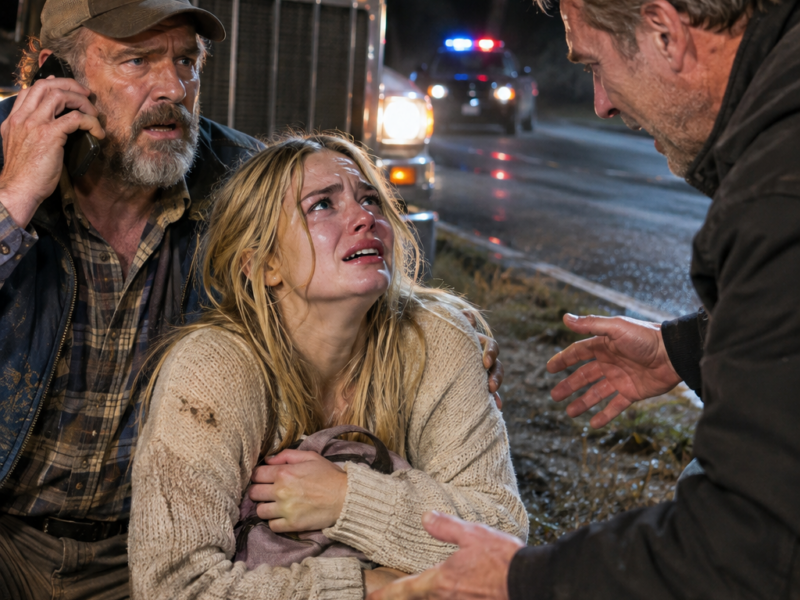
Lorelai was curled into the passenger seat beneath a thick plaid blanket. She wore pale-blue pajamas. Her bare feet were tucked beneath her legs, and her dark hair lay tangled against the headrest.
Her hands were wrapped around a paper cup.
She was asleep.
I touched her cheek.
It was cool, but not dangerously cold.
“Daddy?” she murmured.
“I’m here, sweetheart.”
She opened her eyes and smiled.
“I waited.”
Those two words nearly broke me.
I had taught her years earlier that if she became lost, she should stay somewhere safe and wait for help. She had remembered the instruction even when so much else had become difficult.
“You did exactly right,” I whispered.
Behind me, Jebediah cleared his throat.
“Mr. Whitlock, you should see the recording before we go anywhere.”
Corbin arrived moments later, his truck crunching across the gravel.
Together, we followed Jebediah around to the driver’s side.
The camera system mounted above his windshield recorded continuously, using infrared technology capable of capturing clear images in near-total darkness. I knew its capabilities intimately because I had designed much of the system myself.
Jebediah brought up the recording from shortly after ten o’clock.
A dark Range Rover appeared on the screen.
I recognized it instantly.
It belonged to my son-in-law, Alaric Kincaid.
He had married Lorelai three years earlier, presenting himself as a successful financial consultant who loved her unconditionally despite the difficulties caused by her injury.
Alaric was handsome, articulate, and effortlessly charming. He wore expensive suits, remembered birthdays, and spoke with the polished confidence of someone who believed every room existed for his benefit.
I had never liked him.
Until that moment, however, I had never possessed proof that my discomfort was justified.
The video showed Alaric stepping out of the SUV.
He walked around to the passenger side and helped Lorelai onto the gravel.
She wore the same pajamas she had on now.
No coat.
No shoes.
He guided her toward a wooden bench beside the restroom building and sat her down.
Then he embraced her.
It was a long, deliberate hug.
Lorelai patted his shoulder three times.
I recognized that gesture. She had used it since childhood to tell people everything was all right.
Alaric returned to the SUV.
A woman leaned out from the passenger window and dropped a green canvas tote beside the bench.
Then the Range Rover drove away.
Lorelai remained sitting beneath the fluorescent light, watching the taillights disappear into the darkness.
She did not run after him.
She did not scream.
She simply waited.
Corbin swore quietly.
Jebediah looked away.
I watched the recording again.
And then a third time.
The same conclusion remained unavoidable.
My son-in-law had deliberately abandoned my cognitively impaired daughter in the desert.
But one detail troubled me even more than the abandonment.
The green tote.
Why leave a bag beside her?
Why make certain that whoever discovered Lorelai would also discover whatever was inside it?
I asked Jebediah whether he had picked it up.
He nodded toward the cab.
“She had a purse, too. The tote was lying on the ground beside her. I brought both because I thought they might have her identification.”
I looked at Corbin.
“This isn’t just about abandoning her.”
He studied my face.
“What are you thinking?”
“Someone wanted her found. And someone wanted that bag found with her.”
Corbin looked back toward the dark highway.
“Then we’d better find out why.”
We took Lorelai to Cedars-Sinai Medical Center, where the emergency staff began treating her for mild hypothermia and dehydration.
A nurse named Patricia Okafor recognized immediately that Lorelai needed special care. She spoke gently, explained everything before touching her, and made certain she was warm and comfortable.
When the nurse asked whether Lorelai remembered what had happened, my daughter looked toward me.
“Alaric said to wait,” she explained. “He said someone would come.”
I felt my hands tighten.
“Did he tell you where he was going?”
She thought about it.
“He said it was a surprise.”
“What kind of surprise?”
Her expression clouded.
“I don’t remember.”
I kissed her forehead.
“That’s all right, sweetheart.”
But it was not all right.
Nothing about that night was all right.
Corbin remained at the hospital while I returned home with the green tote.
By three o’clock in the morning, I was sitting at my kitchen table beneath the bright overhead lights, examining its contents.
I found Lorelai’s identification first.
Her driver’s license, Social Security card, insurance information, and copies of several medical records were arranged neatly inside a leather holder.
Everything necessary to identify her.
Everything necessary to connect her to whatever came next.
Beneath those documents were three thick packets of corporate paperwork.
Kestrel Holdings LLC.
Meridian Vantage Corporation.
Obsidian Peak Partners.
I had never heard of any of them.
Each set of documents contained incorporation records, banking authorizations, and operating agreements.
And on page after page, beneath the words “Chief Executive Officer,” appeared the same signature.
Lorelai Ann Kincaid.
I stared at it.
My daughter could barely understand a bank statement.
She could not distinguish legitimate financial transactions from fraudulent ones.
Yet somehow, according to these papers, she was the executive officer of three corporations handling enormous sums of money.
At the bottom of the tote, inside a small interior pocket, I discovered a black banking security token bearing the emblem of a Swiss private financial institution.
Someone had written a figure on the back.
$5,012,340.
I placed it beside the corporate documents.
My breathing slowed.
The fear I had felt in the desert began transforming into something harder.
Understanding.
Three weeks earlier, Alaric had visited my house to deliver paperwork related to Lorelai’s medical care. He had borrowed my laptop, claiming that his phone was dead.
He had left a private cloud account signed in.
At the time, I barely noticed.
Now I opened the laptop and found the account still accessible.
What I discovered inside was not the kind of thing a father ever wants to learn about the man his daughter married.
There were spreadsheets, transaction records, correspondence, and travel documents.
The three corporations were shells used to move illicit proceeds from an underground gambling operation based in Flushing, Queens.
Money entered one company, passed through another, and eventually reached accounts connected to a Swiss banking institution.
Alaric had designed the network.
An accountant named Bramwell Finch handled the paperwork.
And Lorelai was listed as the person responsible for everything.
My daughter was not simply being exploited.
She was being prepared to take the blame.
I opened a folder labeled “Travel.”
Inside was a flight reservation from San Diego to Mexico City under the name Marcus Reeve.
The departure was scheduled for the following morning.
The passport photograph attached to the reservation showed Alaric Kincaid.
I leaned back in my chair.
There it was.
The final piece.
Alaric intended to disappear, leaving Lorelai abandoned with evidence that could connect her to millions of dollars in financial crimes.
If she were discovered, she would appear to be the person directing the corporations.
If she were questioned, she could not explain the transactions.
And if law enforcement began investigating, the real architect of the scheme would already be outside the United States.
What Alaric did not know was that I had spent fourteen months quietly preparing for the possibility that he was exploiting my daughter.
Fourteen months earlier, the Superior Court of California had formally established a conservatorship, granting me responsibility for Lorelai’s personal and financial affairs.
The order documented her inability to make certain financial decisions independently.
Alaric believed the application was still pending.
I had never told him otherwise.
I took the order from my desk and placed it beside the forged corporate records.
My daughter had been used as a paper shield.
But the existing court order gave investigators powerful evidence that Alaric knew—or should have known—that she could not authorize the transactions he had attributed to her.
I checked the time.
4:02 a.m.
I picked up my phone and called Special Agent Troy Bassett of IRS Criminal Investigation.
Eight months earlier, I had approached Bassett with concerns about unusual financial activity connected to Alaric. He had treated my suspicions seriously but explained that investigators needed substantially more evidence before pursuing a federal case.
Now I had it.
Bassett answered almost immediately.
“Mr. Whitlock?”
“Troy, my son-in-law abandoned my daughter in the desert tonight.”
There was a pause.
“Is she safe?”
“Yes. But I found the companies.”
His voice changed.
“Which companies?”
“Kestrel. Meridian Vantage. Obsidian Peak.”
Silence.
Then he said, “Don’t touch anything else. I’m coming.”
By sunrise, my kitchen had become an unofficial command center.
Corbin returned from the hospital with reassuring news. Lorelai was stable and would recover physically.
Bassett joined us by phone while coordinating the federal response.
Detective Rosa Medina, an LAPD financial-crimes investigator who had been tracking the California side of the gambling operation, arrived shortly afterward.
She examined the papers and looked at me with sharp, calculating eyes.
“We’ve been trying to identify the person controlling these corporations for over a year.”
“Now you know.”
“Yes,” she replied. “And your daughter may have just given us the evidence we need to expose the entire network.”
At seven minutes past seven, my phone rang.
Alaric.
He had already called twice.
I answered and put the call on speaker.
“Dad!” he cried.
His voice trembled with what sounded like grief.
“Something terrible happened.”
I looked at Corbin.
He remained perfectly still.
“What happened, son?”
“We stopped for gas last night, and Lorelai wandered away. I went inside for five minutes, and when I came back, she was gone. I’ve been searching all night. I called the Highway Patrol. I don’t know what to do.”
The lie was delivered beautifully.
I almost admired the performance.
Almost.
“Where are you now?” I asked.
“Still driving around. I haven’t stopped.”
I glanced at my laptop.
Eleven months earlier, I had arranged for a GPS tracking system to be installed in Lorelai’s Range Rover as part of monitoring her assets.
The vehicle had been parked at the Hotel del Coronado since shortly before eleven the previous night.
Alaric was not searching the desert.
He was enjoying the comfort of a luxury hotel while his wife had been left barefoot beside a highway.
I kept my voice gentle.
“We’ll find her, son.”
“Thank you, Dad. I knew I could count on you.”
When the call ended, I stared at the screen for several seconds.
Corbin finally spoke.
“You okay?”
“No.”
I looked at him.
“But I’m going to be.”
Detective Medina leaned forward.
“We can arrest him for what happened at the rest stop. But the financial conspiracy is bigger. If we move too early, his partners may destroy the evidence.”
I nodded.
“We need him to lead us to it.”
“And we need him to reveal what he knows,” Bassett added.
I looked at the banking token lying on the kitchen table.
An idea began forming.
In engineering, one of the most useful ways to understand a complex system is to identify the component upon which everything else depends.
For Alaric, that component was money.
He had sacrificed his marriage, his integrity, and my daughter’s safety for the promise of five million dollars.
There was little doubt about what he would do if he believed he was about to lose it.
So we decided to make him believe exactly that.
The investigators began obtaining the necessary legal authorizations while coordinating surveillance around the Swiss bank’s Los Angeles office.
Meanwhile, Corbin contacted federal authorities about the passport and flight reservation bearing Alaric’s alias.
By midmorning, the attempted international departure had been stopped, and investigators were tracking Alaric’s movements.
He had lost his first escape route.
But he did not yet understand how much danger he was in.
There was another person we needed.
Bramwell Finch.
For two years, Finch had maintained the accounting records that gave Alaric’s operation its appearance of legitimacy.
He controlled the original ledgers, transfer records, and organizational paperwork.
Without those records, investigators would face a longer and more complicated process of reconstructing the money trail.
With them, the financial conspiracy could be exposed from beginning to end.
Under a carefully planned operation directed by Bassett, Finch received what he believed was an urgent message from Alaric, instructing him to bring all original records to the bank.
The investigators arranged the communication so Finch would believe his position in the operation depended on following the instruction.
He agreed.
One more piece moved into place.
That afternoon, I deliberately triggered the bank account’s security alert under the investigators’ supervision.
Then I called Alaric.
He answered almost instantly.
“Dad? Any news about Lorelai?”
“She’s been found.”
There was a pause.
“Thank God.”
“I need to tell you something else.”
His breathing became audible.
“What?”
“The authorities found financial documents with her. Something about a bank account. I was told the account might be frozen tomorrow morning.”
He said nothing.
I continued.
“They mentioned the private banking office on South Figueroa Street. I thought you should know.”
The silence changed.
When Alaric finally spoke, his voice no longer carried the trembling grief of a worried husband.
“Which branch?”
I gave him the address.
“How early can someone get inside?”
“Before eight, I believe.”
“Okay.”
He was thinking quickly now.
“Thanks, Dad. I’ll handle it.”
After the call ended, I sat quietly in my study.
Through the window, I could see two hawks circling above the eucalyptus trees.
I had spent decades learning that patience could accomplish things force never would.
Now I needed patience more than ever.
Surveillance soon confirmed that Alaric contacted a woman named Vesper Langdon.
Vesper was an attorney, intelligent and controlled, and she had been secretly involved with Alaric while helping manage portions of the financial operation.
She had also been the woman in the passenger seat of the Range Rover when Lorelai was abandoned.
She was not an innocent companion.
She was part of the plan.
But Alaric had made one mistake that would eventually destroy their partnership.
He had booked only one seat on his escape flights.
One passenger.
Marcus Reeve.
There was no reservation for Vesper.
He intended to abandon her, too.
Investigators made certain she became aware of the booking, and her confidence in Alaric began to fracture.
When the pair left San Diego and headed toward Los Angeles, their relationship was already deteriorating.
During the drive, a tire failure forced them to abandon the Range Rover and continue by taxi.
The unexpected delay created even more tension.
At one point, Vesper demanded to see their international travel confirmation.
Alaric evaded the question.
Eventually, evidence of the single-passenger reservation became impossible for her to ignore.
She contacted a criminal defense attorney.
By the following morning, the woman who had helped plan Lorelai’s abandonment was considering how to save herself from the consequences.
At 5:47 a.m. Sunday, Detective Medina called me.
“They’re moving,” she said.
“Toward the bank?”
“Not yet. First they’re going home.”
The Beverly Hills residence Alaric shared with Lorelai had already become the subject of federal asset-restraint proceedings.
When Alaric arrived, he found official notices and law enforcement personnel outside the property.
He stood on the sidewalk for several minutes, staring at the house.
The beautiful residence, the financial accounts, the expensive vehicles, and the carefully constructed identity of a successful businessman were slipping beyond his reach.
Everything depended on reaching the remaining money.
And that meant going to the bank.
At 7:19 that morning, I entered the private banking offices at 445 South Figueroa Street.
The fourteenth floor was an extraordinary place.
Pale marble covered the floors. Sculptures stood beneath carefully positioned lights. The chairs were upholstered in fabrics that looked expensive enough to require their own insurance policies.
It was the kind of environment designed to convince wealthy clients that their fortunes were permanent.
I found that ironic.
Bassett had arranged a meeting room at the end of a quiet corridor.
The operation had been coordinated with the institution and the appropriate federal authorities. Evidence collection and recording equipment were in place, and additional agents waited nearby.
I remained in a separate office with a monitor showing the hallway.
At 7:41, the elevator doors opened.
Alaric emerged wearing a charcoal suit.
His hair was neatly combed.
He carried a leather document bag and walked with his usual confidence, as though nothing in the previous thirty-six hours had disturbed him.
Vesper followed two steps behind.
Her expression was composed, but her shoulders were tense.
I watched them enter the meeting room.
Bassett introduced himself as a senior banking official and invited them to sit.
Alaric smiled.
“I understand there’s an issue with the account.”
“Yes,” Bassett replied. “We need to review some authentication concerns.”
Alaric produced the security token.
The discussion proceeded for several minutes.
Then Bassett placed his federal credentials on the table.
“My name is Special Agent Troy Bassett, IRS Criminal Investigation.”
Alaric went completely still.
“Mr. Kincaid, we’re investigating a financial network involving three California companies, offshore accounts, and proceeds from an illegal gambling operation.”
Alaric looked at the credentials.
Then at Vesper.
Then back at Bassett.
“I want an attorney.”
“Of course,” Bassett replied. “You have that right.”
The door opened.
A man entered carrying a large cardboard box.
Bramwell Finch.
His face was flushed, and he was breathing heavily.
“Alaric, I brought everything,” he announced. “Every original ledger, all the transfer records, the operating agreements—”
He stopped.
He saw Bassett’s identification.
Then he saw Alaric’s face.
The color drained from his cheeks.
“What is this?”
Bassett stood.
“Mr. Finch, please place the box on the table.”
Finch looked desperately at Alaric.
“You told me to bring everything.”
“Don’t say another word,” Alaric snapped.
“But you called me!”
“That wasn’t me!”
Finch stared at him.
His expression shifted from confusion to horror.
Slowly, he lowered the box.
Inside were the original records investigators had been seeking for months.
Every transaction.
Every fraudulent authorization.
Every connection between the shell corporations.
The elaborate financial structure Alaric had constructed was beginning to collapse.
Vesper watched in silence.
Then she spoke.
“I would like to discuss cooperation.”
Alaric turned toward her.
“Vesper, don’t.”
She ignored him.
“I have information about additional accounts and individuals involved in this operation.”
Bassett regarded her carefully.
“Were you present when Mrs. Kincaid was abandoned at the Mojave rest stop?”
Vesper hesitated.
That was when I entered.
I had been waiting in the corridor, listening to the authorized recording of their exchange.
Now I walked to the table and placed a small audio recorder in front of her.
“Perhaps this will help you remember.”
Vesper stared at it.
The recorder had been concealed in the lining of Lorelai’s tote. I had installed the device months earlier as part of my effort to document suspicious activity affecting my daughter’s possessions.
Its legal status would require careful review, and I had already turned the original recording over to investigators.
But its contents were unmistakable.
I pressed play.
Eight seconds of audio filled the room.
A woman’s voice, clear and contemptuous, said:
“Dump the idiot here. The money is ours.”
The words seemed to linger long after the recording stopped.
I looked at Vesper.
“For ninety minutes, my daughter sat on a bench in the desert wearing pajamas. She had no shoes, no coat, and no understanding of why the man she trusted had left her there.”
Vesper said nothing.
“She believed her husband was coming back.”
I turned toward Alaric.
“He told her to wait.”
For the first time since I had known him, the man had no answer.
Vesper slowly lowered her eyes.
Then she said, “I want my attorney. And I want to negotiate a cooperation agreement.”
Alaric laughed bitterly.
“You’re going to betray me?”
She looked at him.
“You bought one plane ticket.”
The room became still again.
“One ticket, Alaric. You were going to leave me behind.”
He opened his mouth.
She continued before he could speak.
“You planned to put all the responsibility on Lorelai. Then you intended to leave me with whatever remained. You thought you could use everyone and walk away.”
Bramwell Finch stared down at the box he had carried into the room.
“You were going to leave me, too,” he murmured.
Nobody answered.
For years, Alaric had surrounded himself with people whose loyalty depended on the promise of wealth, status, or protection.
Now those promises were worthless.
And the people who had helped him were turning against him one by one.
When Vesper’s attorney arrived, negotiations began through the appropriate federal channels.
She offered information about hidden accounts, cash reserves, and the identities of the people who originated the illegal funds.
She identified a storage unit in Koreatown containing hundreds of thousands of dollars.
She described an account in the Cayman Islands.
She provided names connected to the gambling operation in Queens.
The investigators had already been building cases against many of those individuals.
Her disclosures helped complete the picture.
Alaric watched the last pieces of his operation disappear.
Then he looked directly at me.
“How long?” he asked.
“How long what?”
“How long have you been planning this?”
I considered my answer.
“I began questioning your intentions the day you married my daughter.”
His jaw tightened.
“Then why didn’t you stop me?”
That question struck more deeply than he probably intended.
Because there had been moments when I could have confronted him.
Moments when I could have shouted, threatened, or demanded that he stay away from Lorelai.
Instead, I had watched, documented, and sought professional help, hoping to build a case that would withstand scrutiny.
I had also hoped, perhaps foolishly, that he would change.
“I wanted to believe there was something decent in you,” I said quietly.
He stared at me.
“I gave you every opportunity to prove it.”
“And you were just waiting?”
“No,” I replied. “I was hoping.”
Before he could answer, Detective Medina entered with federal marshals.
The time for discussion was over.
Alaric was about to be taken into custody.
But one final, unexpected moment changed the atmosphere of the room.
Jebediah appeared in the doorway.
And behind him stood Lorelai.
She had been released from the hospital after observation and follow-up arrangements, and Jebediah had brought her to meet me, accompanied by the support she needed.
She wore a pale-green sweatshirt, dark jeans, and borrowed sneakers.
Her hair had been brushed carefully.
She looked around the room with the open curiosity I had known all her life.
Then she saw Alaric.
Her reaction was immediate.
She stepped backward and gripped Jebediah’s arm.
A frightened sound escaped her throat.
Her entire body began trembling.
Jebediah turned and wrapped his arms protectively around her.
“It’s okay,” he whispered. “You’re safe.”
But Lorelai could not take her eyes off her husband.
I crossed the room.
“Sweetheart?”
She turned toward me and clung to my neck.
“Daddy, I want to go home.”
I held her tightly.
“I know. We’re going home.”
Across the table, Alaric watched us.
“She doesn’t understand,” he began.
Detective Medina cut him off.
“She doesn’t need to explain what happened, Mr. Kincaid. The evidence does.”
Lorelai buried her face against my shoulder.
At that moment, I realized how badly I had misunderstood something.
For months, I had believed that victory meant exposing the fraud, recovering the money, and ensuring the guilty were held responsible.
But the only thing my daughter wanted was to leave that room.
She wanted safety.
She wanted familiarity.
She wanted to go home.
Nothing in the world mattered more.
As the marshals approached, Alaric suddenly shoved the heavy conference table sideways.
A chair overturned.
Someone shouted.
He lunged through a rear service door and disappeared into the corridor.
For a moment, the room erupted.
But I did not run.
I knew the building’s service layout.
I also knew what waited outside.
Earlier that morning, Jebediah had positioned his red Peterbilt in the service area as part of the operation’s security arrangements.
The truck stood near the loading dock, its enormous steel body blocking one of the obvious vehicle routes out.
At the opposite end of the alley, Corbin and additional officers were covering the exit.
Alaric burst through the loading area and stopped.
The red truck was in front of him.
Federal officers were moving into position behind him.
Concrete walls rose on either side.
There was nowhere to go.
Jebediah sat silently behind the Peterbilt’s windshield.
He looked down at the man who had abandoned Lorelai in the desert.
Alaric looked up at him.
Neither spoke.
The truck driver who had saved my daughter was now witnessing the capture of the man who had left her to die.
Seconds later, Alaric raised his hands.
The marshals secured him without further resistance.
When Corbin returned, he stood beside me and looked toward the alley.
“That’s a good truck,” he said.
I watched Jebediah climb down from the cab.
“It’s a better man.”
Corbin nodded.
For an instant, I believed the worst was behind us.
I was wrong.
As investigators continued examining the digital records, Detective Medina discovered an email exchange between Alaric and Vesper that had nothing to do with money laundering.
The first message was six months old.
Alaric had written that the “old man” was becoming a liability.
He asked too many questions.
He watched too carefully.
If he discovered the operation before they could leave the country, they would need a contingency.
Vesper’s reply was brief.
“Old men who live alone in houses with long driveways have accidents.”
I read the sentence three times.
There are moments when the human brain understands words before the heart accepts their meaning.
This was one of those moments.
The old man was me.
They had discussed arranging my death.
Not in anger.
Not in the heat of an argument.
Calmly, methodically, as though planning a business expense.
I sat down.
For the first time since the phone rang Friday night, I felt truly old.
Not because of my age.
Because I suddenly understood how close I had come to losing everything.
Had Jebediah not stopped at the rest area, Lorelai might have suffered a far worse fate.
Had the camera not been running, Alaric might have claimed she wandered away.
Had the financial evidence remained hidden, my daughter could have faced years of legal confusion and hardship.
And had their plan continued long enough, I might not have been alive to protect her.
Corbin came to stand beside me.
He read the emails, then rested a hand on my shoulder.
“Adrian.”
I shook my head.
“I thought I knew how dangerous he was.”
“You knew enough to act.”
“Not enough to protect everyone.”
Corbin looked at me.
“You can’t control every decision another person makes.”
I looked toward the door.
Beyond it, Lorelai was sitting quietly with Jebediah.
“But we can choose what we do when we discover the truth.”
“That,” Corbin said, “is something we can control.”
The newly discovered messages were forwarded to the prosecutors for review, and the investigation expanded.
Before leaving the building, I saw Alaric one final time.
He stood between two marshals near the elevators, his suit jacket torn, his wrists restrained, his face exhausted.
When he noticed me, he stopped.
“You destroyed everything I built,” he said.
His voice held no theatrical anger.
Only bitterness.
I looked at him for a long moment.
“You built it on my daughter’s name.”
He lowered his eyes.
“She didn’t know anything.”
“No,” I replied. “She didn’t.”
“She thought I was taking care of her.”
Those words struck harder than any accusation he could have made.
“Yes,” I said. “She did.”
The elevator doors opened.
Before the marshals led him inside, I spoke once more.
“You were her husband, Alaric. You had the chance to be someone she could trust. That’s what you threw away.”
He said nothing.
The doors closed.
And he disappeared from my life.
Outside, the Los Angeles morning was bright and warm.
I found Lorelai sitting on the concrete steps near the side entrance, watching a small pigeon struggle with a piece of pretzel.
Jebediah sat beside her.
For a while, I watched them without interrupting.
Thirty years earlier, I had taken a chance on a troubled teenager who needed someone to believe in him.
I had taught him to repair engines.
I had encouraged him to finish school.
When he bought his first truck, I helped him examine the financing because I did not want him trapped by a predatory loan.
I had never thought of those decisions as investments.
They were simply things a person should do when given the opportunity to help someone.
Yet three decades later, the man I had once helped was the person who had saved my daughter’s life.
I sat beside him.
“Thank you, Jeb.”
He looked at me.
“You don’t need to keep saying that.”
“I think I do.”
He smiled faintly.
“Thirty years ago, you told me every broken machine can be repaired if you start with the right part.”
“I remember.”
He looked at Lorelai.
“I think people are a little different.”
I followed his gaze.
My daughter was laughing softly because the pigeon had finally succeeded in carrying away its prize.
“Yes,” I said. “They are.”
“Sometimes you can’t fix what happened,” Jebediah continued. “You can only make sure the next thing that happens is better.”
For a while, neither of us spoke.
Then Lorelai turned toward me.
“Daddy?”
“Yes, sweetheart?”
“Can we go home now?”
I smiled.
“Absolutely.”
The legal proceedings continued for months.
The financial records, testimony from cooperating witnesses, and evidence concerning the abandonment formed the foundation of a broad prosecution.
Alaric eventually pleaded guilty to several serious offenses involving money laundering, fraud, exploitation, and conspiracy.
He received a lengthy federal prison sentence.
Vesper Langdon cooperated with investigators and received a reduced sentence, though her legal career was effectively destroyed.
Bramwell Finch also cooperated and received a prison term.
Investigators traced millions of dollars through the companies and offshore accounts. The recovered assets became the subject of forfeiture and restitution proceedings, with substantial resources ultimately directed toward supporting people living with acquired neurological disabilities.
I found that outcome more meaningful than I expected.
Money that had been accumulated through the exploitation of my daughter could now help people facing challenges similar to hers.
It did not erase what happened.
Nothing could.
But it gave the ending a purpose beyond punishment.
Jebediah eventually sold his truck.
After spending thirty years on the road, he decided that he wanted to be closer to home.
He began working with a disability-support organization, helping coordinate transportation, residential placements, and practical assistance for vulnerable adults.
He was exceptionally good at it.
That did not surprise me.
Some people spend their lives developing skills.
Others spend their lives developing character.
Jebediah had done both.
Lorelai came to live with me permanently.
We rearranged the house so she could have a bright bedroom facing east, where the morning sun rose above the San Gabriel Mountains.
She loved that room.
Every morning, she opened the curtains and watched the changing colors of the sky.
Sometimes she remembered details from before her accident.
Other times, she forgot what we had discussed only minutes earlier.
We learned to live with both.
I stopped measuring her days by what she could no longer do.
Instead, I began paying attention to what still brought her happiness.
The smell of fresh coffee.
A familiar song.
The sound of rain against the windows.
Birds gathering in the garden.
Sunday dinners with Corbin.
And, increasingly, quiet evenings with Jebediah.
He came to the house often.
After dinner, he and Lorelai would sit on the back porch in the two wooden chairs facing the garden.
Sometimes they talked.
Sometimes they simply watched the sunset.
I often stood inside the kitchen, listening to their voices drift through the screen door.
There was a peacefulness in those moments that I had not felt in years.
One evening, Lorelai asked me a question while we were washing dishes.
“Daddy, was Alaric a bad person?”
I turned off the faucet.
How do you answer something like that?
How do you explain betrayal to someone whose trust has survived more suffering than most people experience in a lifetime?
“He made some very bad choices,” I said carefully.
She considered this.
“Did I do something wrong?”
My throat tightened.
“No, sweetheart. You didn’t do anything wrong.”
“Then why did he leave me?”
I put down the dish towel.
Because he valued money more than love.
Because he saw your vulnerability as an opportunity.
Because he believed he could build his future by destroying yours.
Those were the answers.
But they were not answers she needed to carry.
“He was thinking about himself instead of taking care of you,” I said. “And that was wrong.”
She nodded slowly.
Then she asked, “Jebediah wouldn’t do that, would he?”
I looked through the window.
Jeb was outside fixing a loose hinge on the garden gate.
“No,” I said. “I don’t believe he would.”
Lorelai smiled.
“Good. He makes me feel safe.”
I turned away before she could see my eyes fill with tears.
Three weeks after Alaric’s arrest, another Friday evening arrived.
The temperature had dropped slightly, and Lorelai was curled on the sofa wearing Jebediah’s canvas jacket over her shoulders.
Jeb sat in the armchair nearby, watching a documentary about old locomotives.
I was on the back porch when my phone rang.
An unfamiliar number.
909 area code.
The Inland Empire.
For a moment, I stared at the screen.
Then I answered.
“Mr. Whitlock?”
The voice belonged to a man I did not know.
“My name is Daniel Hayes. I’m a truck driver. I got your number from a card belonging to an elderly woman I found at a rest area near Cabazon.”
I stood up.
“She says she got separated from her family a couple of hours ago,” he continued. “She’s confused, but she’s safe in my cab. The card says Disability Support Helpline, and someone told me you help with situations like this.”
I looked through the screen door.
Lorelai was laughing at something Jebediah had said.
The house glowed warmly behind them.
Outside, the eucalyptus trees moved gently in the evening wind.
I knew exactly how that truck driver was feeling.
The uncertainty.
The concern.
The responsibility of suddenly being the only person standing between a vulnerable stranger and whatever danger might be waiting outside.
“Mr. Hayes,” I said, “thank you for stopping.”
“No problem, sir. I just didn’t want to leave her out here alone.”
I reached for my keys.
“I’m going to help you get her somewhere safe. But first, please contact the police and let them know exactly where you are.”
There was a pause.
“Do you think something happened to her?”
“I don’t know,” I admitted. “And that’s why we need to be careful.”
He agreed.
I ended the call and walked into the living room.
Jebediah looked up.
“Everything all right?”
I held up the keys.
“There’s a woman at a rest stop who needs help.”
He was on his feet before I finished speaking.
“I’ll drive.”
Lorelai looked from one of us to the other.
“Are you going to help somebody?”
“Yes, sweetheart.”
She smiled.
“Like Jeb helped me?”
I looked at the man standing beside her.
“Exactly like that.”
She stood and walked over to us.
Then she took my hand.
“Tell her not to be scared,” she said. “Sometimes the good people come.”
For a moment, I could not speak.
I had spent most of my life believing that the world could be made safer through preparation, intelligence, and carefully designed systems.
I still believed in those things.
Evidence mattered.
Planning mattered.
Justice mattered.
But the events of that terrible weekend had taught me something no engineering manual ever could.
The most important safeguards in life are often human.
A retired police captain who answers his phone in the middle of the night.
A nurse who recognizes that a frightened woman needs compassion as much as medical attention.
An investigator who refuses to dismiss an elderly father’s concerns.
A truck driver who notices someone sitting alone beside a highway and decides that her suffering is not somebody else’s problem.
And a daughter who, despite everything that has been taken from her, still believes that good people will come.
That belief is not foolishness.
It is a reminder of the responsibility we carry toward one another.
Alaric had built his entire life around acquiring things.
Money.
Property.
Power.
Control.
He believed wealth could protect him from consequences, and that people existed to be manipulated whenever necessary.
In the end, everything he thought made him powerful became evidence against him.
The companies collapsed.
The accounts were frozen.
His partners betrayed him.
His carefully maintained reputation disappeared.
And the one thing he had never truly understood—human loyalty—became the force that defeated him.
Jebediah, on the other hand, had spent thirty years working long days on lonely highways.
He never owned a mansion.
He never managed millions of dollars.
He never wore expensive suits or spoke about financial empires.
But when he encountered a frightened woman in the desert, he stopped.
He gave her his blanket.
He gave her warmth.
He stayed with her.
And because he stayed, a family survived.
That night, before Jebediah and I left to help the elderly woman near Cabazon, Lorelai came to the door.
She hugged him first.
Then she hugged me.
“Come back soon,” she said.
“We will,” I promised.
She stepped backward and smiled.
It was the same smile she had worn in the photograph on my study desk, when she was seven years old in a yellow dress her mother had sewn by hand.
The same smile that had survived an accident, betrayal, abandonment, and the frightening uncertainty of a desert night.
I realized then that I had spent too many years looking at that photograph as a reminder of the daughter I had lost.
The little girl in the picture was not gone.
She was standing before me.
Changed, certainly.
Wounded in ways I wished I could undo.
But still curious.
Still loving.
Still capable of bringing unexpected joy into a room.
And still my daughter.
I kissed her forehead.
“Lock the door behind us, sweetheart.”
She nodded solemnly.
Then she looked at Jebediah.
“Don’t forget your jacket.”
He smiled.
“You keep it. I’ll get it next time.”
She wrapped it more tightly around her shoulders.
“Okay.”
We stepped into the cool evening air.
As we drove toward the freeway, the lights of Los Angeles stretched ahead, endless and shimmering against the mountains.
Somewhere beyond them, another person was waiting for help.
Another family might be searching.
Another stranger had made the simple decision not to look away.
And for the first time in a very long time, I felt something stronger than fear.
Hope.
Because I understood now that protecting the people we love is not a task we finish.
It is a choice we make repeatedly, in ordinary moments and extraordinary ones.
Sometimes that choice means asking difficult questions.
Sometimes it means confronting someone we once trusted.
Sometimes it means calling the police, preserving evidence, or standing beside a person who cannot speak for themselves.
And sometimes it means pulling a truck onto the shoulder of a dark highway because someone sitting alone on a bench looks cold.
I was seventy-two years old when I learned that lesson.
I had nearly lost my daughter.
I had discovered that a man welcomed into my family was capable of betraying us in ways I could scarcely imagine.
I had watched an elaborate criminal operation collapse under the weight of its own greed.
And I had learned that a kindness offered to a seventeen-year-old boy thirty years earlier could return, decades later, as the act that saved my child’s life.
There is no equation that explains such things.
No guidance system precise enough to predict them.
No design capable of guaranteeing that the people we love will never suffer.
But there is something we can do.
We can be the person who stops.
We can be the person who answers the phone.
We can be the person who stays.
As Jebediah guided the car onto the eastbound freeway, I glanced at him.
“Jeb?”
“Yes, sir?”
“Thirty years ago, when you came into my garage, did you ever imagine we’d end up here?”
He thought for a moment.
Then he shook his head.
“No, sir.”
“Neither did I.”
The lights of the city slipped behind us.
After a while, he spoke again.
“You know something, Adrian?”
“What?”
“I think your daughter was right.”
“About what?”
He kept his eyes on the road.
“Sometimes the good people come.”
I looked out through the windshield at the long ribbon of highway disappearing into the dark.
And I smiled.
Because this time, we were going to be those people.
THE END