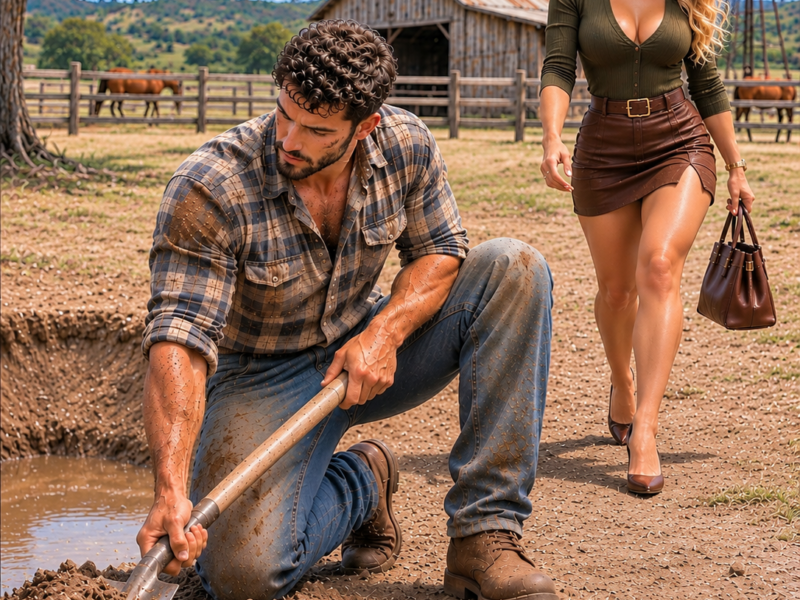
SINGLE DAD DUG A POND ON HIS DRY RANCH—EVERYONE LAUGHED UNTIL A MILLIONAIRE MADE AN OFFER
I Was a 39-Year-Old Single Father Fighting to Save My Late Wife’s Ranch When I Spent Nearly Every Dollar I Had Digging a Pond During the Worst Drought in Texas. My Neighbors Laughed, Calling It “The Most Expensive Hole in the County,” and One Even Told Me I Couldn’t Dig My Way Into a Raincloud. But After One Terrifying Storm Proved My Idea Worked, a Millionaire Arrived With an Engineer and Made an Offer That Could Change Everything—Then She Revealed There Were Two Very Different Deals on the Table…
PART 1
The first time someone offered to buy Cal Hart’s ranch, the pond he had spent nearly every dollar building was finally holding water.
The man who had laughed hardest at the project stood only a few feet away, staring at the water as though he couldn’t quite believe what he was seeing. A few months earlier, that same spot had been nothing more than cracked earth, dry weeds, and a shallow depression that everyone in Dry Creek County, Texas, had called a ridiculous waste of money.
Now, a narrow band of water reflected the late afternoon sky.
It wasn’t a lake. It wasn’t going to end the drought or turn the surrounding fields green overnight. But it had accomplished something nobody in the county had expected. It had caught the first serious rainfall in months, slowed the rushing water, and prevented another destructive flood from tearing through the lower pasture.
Cal leaned against the wooden fence, his weathered hands resting on the top rail. Beside him stood his nine-year-old daughter, Clara, holding a metal cup with both hands.
Across from them, Savannah Reed closed the leather portfolio she had carried from her expensive SUV.
She was a millionaire, a successful businesswoman who had built and sold a farm logistics company before investing in rural infrastructure and land restoration. People in Dry Creek County knew her as someone who could recognize an opportunity long before anyone else noticed it.
She looked at the pond, then at Cal.
“I want to make you an offer,” she said.
Behind Cal, Wade Boon let out a loud laugh.
“An offer? For that hole in the ground?”
Two other ranchers chuckled along with him.
Cal didn’t laugh. He had learned that an offer could be an opportunity or a trap. Sometimes the difference wasn’t obvious until it was too late.
“What exactly are you offering to buy?” he asked.
Savannah met his eyes.
“Nothing you don’t choose to sell. That’s why this offer is different.”
Cal glanced at Clara. She was looking at the water, apparently more interested in the small ripples moving across its surface than in the conversation between the adults.
To understand why that moment mattered, it was necessary to go back to the week when Cal Hart’s ranch nearly ran out of water.
The ranch sat beyond the last paved road in Dry Creek County, where the Texas landscape stretched beneath an unforgiving sun. During better years, the property had been surrounded by tall grass, healthy cattle, and the familiar sounds of wind moving through the fence lines.
But those better years seemed to belong to another lifetime.
For months, the region had suffered through an unusually severe drought. The grass had turned the color of old straw, the creek beds had dried up, and dust rose from the ground whenever a truck passed.
Cal was thirty-nine years old. He had broad shoulders, dark curls that stubbornly escaped beneath his baseball cap, and a short beard that made him look older than he really was. His hands were rough from repairing machinery, fixing gates, and working with pumps.
The ranch had belonged to his father before it passed to him and his wife, Mara.
After Mara died, Cal had considered selling everything.
He had thought about it more than once, especially during the long nights when the house felt too quiet and every corner reminded him of the woman who should have been there.
But Clara had been born on that property. Her first steps had been taken across the kitchen floor. Her first birthday had been celebrated beneath the old oak tree beside the barn.
Leaving would mean taking away the only home she had ever known.
So Cal stayed.
He worked at an equipment repair shop during the day, fixing tractors, irrigation pumps, and agricultural machinery for other people. In the evenings, he returned to the ranch to take care of what remained of his cattle and maintain the property.
It wasn’t an easy life, but it was the life he knew.
One Tuesday morning, Clara followed him toward the stock tank.
She was small for her age, with freckles across her nose and chestnut hair she usually braided herself. She had inherited her mother’s curiosity and had developed a habit of asking difficult questions precisely when Cal was trying hardest not to think about them.
“Dad?”
Cal looked up from the pump housing.
“What is it, sweetheart?”
“Is the tank supposed to look like that?”
He followed her gaze.
The stock tank had once held enough water for the cattle and two horses. Now, its muddy bottom showed through in a wide crescent. The remaining water was shallow, cloudy, and disappearing faster than he could replace it.
The pump had stopped twice in four days.
The well was still functioning, but the water level had fallen so low that the pump occasionally drew air whenever the windmill slowed.
“No,” Cal answered.
“Can you fix it?”
“I can fix the pump.”
He looked toward the cracked ground beyond the tank.
“But I can’t make it rain.”
Clara nodded thoughtfully.
Then she took the last of the water from her bottle and poured it into the trough for the ranch dog.
Cal watched her carry the empty bottle back toward the house.
Children often understood the seriousness of a situation without knowing how to describe it. Clara hadn’t complained about the heat, asked for expensive things, or demanded that her father spend more time with her.
She simply adjusted.
And somehow, that made Cal feel worse.
On the kitchen table lay a letter from the bank.
He had opened it twice already, although he knew every sentence by heart.
His loan renewal was due in thirty-eight days. Without a workable plan for the coming season, the bank wouldn’t extend the same terms.
The balance was larger than anything he could repay through his equipment shop wages and occasional cattle sales.
Mara’s medical bills had accumulated over several years. There had been hospital payments, treatment expenses, and bills that seemed to arrive long after the appointments themselves.
Cal had sold a trailer.
Then two horses.
Then a strip of pasture he had once promised his father he would never sell.
Every decision had bought him a little more time, but time was becoming expensive.
That afternoon, Wade Boon drove his dusty pickup up the ranch road.
Wade was sixty, thick around the middle, with a sun-reddened face, a gray mustache, and a faded denim jacket. He had known Cal’s father for decades and considered himself an authority on nearly everything related to ranching.
He stopped beside the gate and looked toward the dry stock tank.
“Still hauling water?”
“Twice this week.”
Wade shook his head.
“You can buy a lot of water for what you owe on this place.”
“I’m not selling the ranch.”
“Then you need another plan.”
Cal glanced toward the low ground below the windmill.
“I have one.”
Wade followed his gaze.
For a moment, he said nothing.
Then his expression changed.
“If you’re thinking about digging a pond, don’t.”
Cal hadn’t told him about the idea.
Apparently, the rumors had already reached Wade.
“You can’t dig your way into a raincloud,” the older man continued. “A hole doesn’t create water.”
“I know.”
“Then what are you building?”
“A place to keep some of the water that already runs off this land.”
Wade stared at him.
Then he laughed.
Not quietly. Not politely.
He laughed loudly enough for two ranch hands working near the barn to hear.
“You’re going to catch a storm with a shovel?”
Cal didn’t answer.
The idea had come from an old notebook he found in his father’s workshop.
The notebook had been hidden behind a drawer full of bent nails, old screws, and forgotten pieces of equipment. Most of its pages contained measurements for gates and fence posts.
But one page was different.
It showed the northern slope of the ranch in faint pencil lines. Three shallow channels converged into a low basin below the windmill.
Beside the sketch, his father had written a sentence.
“Don’t fight the water. Slow it down and give it somewhere safe to rest.”
Cal remembered watching summer rain sweep across that slope when he was a boy. Water would travel over the hard ground in brown sheets, gathering speed as it moved toward the old wash before disappearing downstream.
His father had taught him to notice where the ground remained darker after rainfall, where the grass grew slightly thicker, and where silt collected after a storm.
The land had been showing them where water wanted to go for generations.
Perhaps it was time to listen.
The next morning, Cal took the notebook to the county office.
He didn’t pretend to be an engineer. He knew enough about machinery and irrigation to understand that digging a hole without understanding the ground could create more problems than it solved.
A drainage specialist named Elena Ruiz agreed to inspect the property.
She walked the slope, examined the natural runoff channels, checked the nearby road ditch, and studied the soil.
“You can build a small catchment basin here,” she finally said.
Cal waited.
“But there are conditions. You’ll need a controlled overflow. You can’t redirect water toward neighboring properties, and the county needs to approve the finished plan before you move any significant amount of earth.”
“What about the clay?”
“That’s the next question. You’ll need a soil test. If the underlying layer isn’t suitable, the basin could lose water too quickly.”
“So you’re saying it might not work.”
“I’m saying we need to find out before you spend your money.”
It wasn’t the encouraging answer Cal had hoped for.
But it was an honest one.
The soil test eventually revealed a heavy clay layer beneath the topsoil. It didn’t guarantee the pond would hold water, but it made the project worth considering.
Cal took the results and a construction estimate to the bank.
The manager listened patiently as he explained his plan.
When he finished, she looked at the estimate and tapped her pen against the desk.
“You’re asking for more money to build a pond that may never fill.”
“I’m asking for a small construction line that I can repay in stages.”
“And if it stays empty?”
Cal looked down at his hands.
“Then I’ll be in a worse position than I am now.”
The manager didn’t disagree.
She approved a smaller loan than he had requested, with strict conditions. Cal would have to submit receipts, inspection notes, and proof that the construction had followed the county-approved plan.
It was enough to rent an excavator and purchase gravel for the overflow channel.
Everything else would have to be done by Cal himself.
He accepted.
He didn’t have the luxury of waiting for a perfect opportunity.
Two days later, he marked the basin with survey flags.
Wade returned with two neighbors.
One of them took a photograph and posted it in the county group chat.
The caption read:
“Hart’s new swimming pool.”
By lunchtime, half the county seemed to have seen it.
Cal pretended not to care.
But he felt every joke.
For years, people had introduced him as Mara’s husband, then as Clara’s father, then as the man who could repair almost any pump but somehow couldn’t get ahead financially.
Now he was becoming the man digging an expensive hole in the middle of a drought.
That evening, Clara found him sitting on the tailgate of his truck.
“Are they laughing at the pond?”
“Mostly.”
“Are they laughing at us?”
Cal put down the survey rod.
He looked at his daughter.
“They don’t know us well enough to laugh at us.”
She considered his answer.
“I think they know the pond even less.”
Cal laughed for the first time that day.
Then he spread a piece of cardboard across the tailgate and began drawing.
He showed Clara the inlet, the settling area where mud would collect, and the overflow channel that would guide excess water toward a grassy swale instead of allowing it to rush toward the road.
“It’s like a bowl?” she asked.
“Something like that. But it has a safe place for extra water to leave.”
“So it doesn’t spill everywhere?”
“That’s the idea.”
She studied the drawing.
“What if it never rains?”
Cal looked toward the empty sky.
“Then we’ll have learned something expensive.”
Clara leaned against his shoulder.
“But if it does rain, we’ll be ready.”
For a moment, Cal couldn’t find an answer.
He simply put an arm around her and watched the last light disappear behind the ridge.
The excavator arrived two days later.
Cal had rented it for five days, the longest period he could afford.
Elena checked the approved markings before the first bucket touched the earth.
Cal worked slowly, following the contour lines instead of digging straight down toward the deepest point.
He wanted a broad, shallow basin that livestock could safely approach. The inlet needed a settling area, and the overflow had to be reinforced so that a strong storm wouldn’t destroy the edges.
The work was harder than he expected.
The soil changed from dusty topsoil to sticky clay. The excavator slipped once on the slope, forcing him to stop and reposition the machine. He lost half a day moving the spoil pile farther away from the natural drainage path.
At night, his arms trembled from hours on the controls.
His back ached.
His bank balance grew smaller.
But every morning, he returned to the unfinished basin.
Clara came after school with a cooler and a pair of gloves that were much too large for her hands.
She picked stones from the spillway, counted wheelbarrow loads, and recorded the day’s observations in a little notebook.
Her entries were simple.
“Wind from the west.”
“Clouds came but passed.”
“Dad says the clay looks good.”
On the fourth day, a thin storm crossed the county.
It lasted less than an hour.
Water ran down the northern slope, entered the basin, and left a muddy pool no deeper than Cal’s boot.
He stood beside it, waiting.
By morning, most of the water had disappeared.
The sun had dried the edges into a pale ring.
Wade stopped by the fence.
“There’s your investment.”
Cal stared at the waterline.
He had known the first rain would be a test, not a miracle. Still, watching the little pool shrink felt like someone had reached into his chest and squeezed.
Clara crouched near the edge and touched the damp soil.
“It stayed longer than the water in the wash.”
Cal looked down.
“That’s true.”
“Maybe the next storm will leave more.”
He wanted to tell her not to get her hopes up.
Instead, he nodded.
“Maybe.”
He was tired, short on money, and uncertain whether the basin would survive a serious storm.
But one thing was clear.
The first rain had gone exactly where they had intended.
It hadn’t washed out the road.
It hadn’t flooded the lower pasture.
And for the first time in months, Cal felt that perhaps the land was giving him a chance.
He just didn’t know that someone else had begun watching.
PART 2
The black SUV appeared outside the ranch gate the following week.
Savannah Reed stepped out wearing a forest-green blouse, a tailored brown skirt, and dark tan boots. Her honey-blonde hair fell over her shoulders, and a leather portfolio rested beneath one arm.
“I’m Savannah Reed,” she introduced herself. “I’d like to see your basin.”
Cal studied her carefully.
“Why?”
“Because I’ve heard three different explanations of what you’re building, and none came from you.”
He walked her down the slope.
For nearly an hour, Savannah listened as he explained the drainage channels, the clay layer, and the controlled overflow. She asked questions about every detail, including how much water had disappeared after the first rainfall.
She didn’t laugh.
She didn’t promise anything.
Before leaving, she looked toward the empty fields.
“You’ve thought this through.”
“I’ve had plenty of time to think.”
Savannah nodded and returned to her vehicle.
For two weeks, Cal occasionally spotted her SUV on the county road, but she never stopped.
Then the radio announced a severe storm watch.
Cal moved his cattle to higher ground and inspected the overflow channel.
That evening, as dark clouds gathered above the ridge, he noticed Savannah’s vehicle approaching the ranch again.
This time, she wasn’t alone.
And the storm that was about to hit Dry Creek County would change everything.
PART 3
The rain began shortly after dark.
At first, it was little more than a steady tapping against the metal roof of the barn. Cal stood near the doorway, watching lightning illuminate the distant ridge.
Then the wind changed.
Within minutes, rain hammered the ranch so hard that the ground seemed to disappear beneath a moving sheet of water.
Cal pulled on his rain jacket and grabbed a flashlight.
Before heading outside, he called Clara from the kitchen.
“Stay inside tonight, sweetheart. Don’t come out unless I come get you.”
She stood beside the table in her pajamas, clutching her little notebook.
“Is the pond going to fill?”
“We’ll see.”
“Be careful.”
“I will.”
Cal stepped into the darkness.
Wade’s pickup was already parked near the lower fence. The older rancher stood beneath the shed roof, holding a powerful flashlight.
“You shouldn’t be out here alone,” Wade shouted over the rain.
Cal glanced at him.
“Didn’t expect you to come.”
“Don’t get sentimental. I moved my cattle to the north pasture. If this storm gets worse, your lower fence could be in trouble.”
Cal nodded.
There was something about Wade’s presence that surprised him. The older man had spent weeks making jokes about the pond, but he had never been cruel enough to want Cal’s cattle drowned.
Together, they drove along the fence line with their headlights cutting through the rain.
Water was coming down the northern slope in several narrow streams, carrying leaves, dust, and small branches.
Cal watched the runoff approach the basin.
For a moment, he couldn’t breathe.
The water entered the inlet and spread into the settling area. Mud dropped out as the flow slowed, allowing the cleaner water to continue into the main basin.
The pond began to rise.
Not slowly, as it had during the previous rainfall.
This time, the water climbed visibly against the marked stakes.
Cal turned toward the overflow channel.
It was working.
The extra water moved through the reinforced outlet and into the shallow grass swale, exactly as Elena’s approved plan had intended.
Wade pointed toward the inlet.
“Something’s caught there!”
A large branch had lodged against the screen, restricting the flow.
Cal grabbed a hook from the truck.
“I’m going in.”
“You’re crazy.”
“Hold the light.”
Cal stepped into the rushing water.
The rain soaked through his jacket almost immediately. His boots slipped against the muddy ground, but he managed to reach the obstruction and pull it free.
Wade kept the flashlight trained on him.
For several seconds, neither man spoke.
Then the water began flowing freely again.
They worked together until the strongest part of the storm passed.
By dawn, the ranch looked different.
Clouds still hung low over the fields, but the rain had finally weakened.
Cal walked toward the pond.
He stopped at the edge.
The basin held more water than he had ever seen on the property.
It wasn’t full, but it had reached the first marked line.
The lower pasture remained intact.
The road ditch hadn’t been washed away.
And the old wash below the windmill carried significantly less water than it had during previous storms.
For the first time in months, Cal felt his shoulders relax.
Clara came outside wearing her rain boots and carrying her notebook.
She stared across the water.
Then she looked at her father.
“It worked.”
Cal watched the surface.
“It held,” he corrected gently. “That’s what we know so far.”
She smiled.
“That’s a pretty good start.”
Wade stood behind them, leaning against the fence.
For once, he had no joke ready.
He looked across the pond for a long time before speaking.
“Your father would have liked seeing this.”
Cal turned toward him.
Wade rarely mentioned his father unless he was telling an old story.
“You think so?”
“He always believed the land had more to teach us than we were willing to learn.”
Cal looked back at the water.
“Yeah. He did.”
That afternoon, Savannah arrived with a drainage engineer named Paul Chen.
Paul wore work boots and carried a measuring instrument in a protective case. Unlike Savannah, he seemed entirely uninterested in the appearance of the ranch. He went straight to the inlet and began examining the water marks.
He checked the overflow, studied the outlet, and compared the actual water level with the original measurements.
After nearly an hour, he approached Cal.
“The basin performed as designed.”
Cal let out a breath he hadn’t realized he was holding.
“Any problems?”
“One minor issue. The outlet would benefit from a small stone apron to reduce erosion. The inlet screen also needs a slightly different arrangement to prevent branches from collecting in one corner.”
“Can it be fixed?”
“Absolutely.”
Savannah had been listening.
“I’d like to meet you at the county hall this evening,” she said.
Cal frowned.
“Why?”
“Because I have a proposal, and I’d rather make it in front of the people who have been discussing your project than let rumors keep telling the story.”
Cal wasn’t sure he liked the sound of that.
He didn’t want to become some kind of public example. He had built the pond because his daughter needed a home and his ranch needed water. He hadn’t done it to prove a point to his neighbors.
But Clara looked up from her notebook.
“You can tell them what happened, Dad.”
He glanced at her.
“You don’t have to tell them everything,” she added.
Cal smiled.
“All right. We’ll go.”
That evening, a dozen ranchers gathered in the county meeting room.
Wade sat near the back with his arms crossed. A few of the men who had laughed at the original photograph were also present.
Savannah stood beside a large map.
It wasn’t one of those glossy presentations designed to impress wealthy investors. The map showed actual ranch boundaries, existing stock tanks, natural drainage paths, and several locations that might be suitable for small catchment basins.
She began by explaining her company’s work in agricultural infrastructure.
“We’ve spent years studying the problem of water management in rural communities,” she said. “Most people assume the only solution to drought is finding more water. Sometimes, however, the problem is that the water we do receive moves too quickly through the land.”
One rancher raised his hand.
“You’re talking about building more ponds?”
“Not exactly. We’re talking about a network of carefully designed catchment sites. Each one would be evaluated individually, with local engineering approval.”
She pointed to Cal’s property.
“This project demonstrates something important. A relatively modest basin can slow runoff, store some water for livestock, and reduce the amount of water rushing through vulnerable areas.”
Another man leaned forward.
“Are you saying one pond can save a ranch?”
“No,” Savannah answered. “I’m saying one well-designed pond can give a rancher more time and more control. That’s a meaningful difference.”
Then she turned toward Cal.
“I want to make him an offer.”
The room became quieter.
Savannah explained that her company would fund the next phase of construction and approved improvements. She would pay Cal to manage the site, maintain the equipment, inspect the basin, and record its performance.
The ranch would retain ownership of the land and the pond.
Nobody would be allowed to draw water without Cal’s permission.
The county would review every proposed site before construction.
A man near the aisle chuckled.
“You’re going to pay him to watch a pond?”
Savannah didn’t look away from Cal.
“I’m offering to pay for the skill he used to build it.”
She placed a document on the table.
The proposed contract included a covered storage tank, two measuring gauges, and reinforced stonework around the overflow.
It also included a paid maintenance agreement for one year, with an option to renew.
The project would publish its results, including failures, so that other ranchers could make informed decisions.
Cal listened carefully.
Then Savannah mentioned a second proposal.
She was willing to purchase the entire ranch.
The offer would cover his outstanding bank loan, provide enough money for him to start again somewhere else, and allow him and Clara to remain in the house for six months while they found another place.
The room fell silent.
Even Wade stopped shifting in his chair.
The number was substantial.
It was the kind of money that could erase years of financial pressure in a single afternoon.
Cal looked down at the document.
He imagined the bank account finally showing a positive balance. He imagined not waking up at night wondering how much the next repair would cost.
He could pay off Mara’s remaining medical bills.
He could put money aside for Clara’s education.
He could find a smaller property where he wouldn’t have to worry about cattle, broken fences, or unpredictable rainfall.
It would be easy to say yes.
But then he looked at Clara.
She was sitting beside him, drawing the pond from memory in the margin of her notebook.
Cal thought about the first storm, the branch that had blocked the inlet, and the way Wade had held the flashlight while he stood knee-deep in rushing water.
He remembered his father teaching him to read the land.
He remembered Mara standing on the porch years earlier, telling him that the ranch was worth keeping because it was more than a collection of buildings and fences.
It was their family’s story.
“I won’t sell the ranch,” Cal said.
Savannah nodded.
She didn’t appear offended, although her expression tightened slightly.
“Then let’s make the first offer stronger.”
Cal picked up the map.
He studied the proposed locations and placed one finger on the lower pasture.
“I’ll manage the pond and the inspection schedule. But the water stays for this ranch first.”
“Agreed,” Savannah said.
“Any use by another property needs a written agreement. No exceptions.”
She nodded.
“And I don’t want another basin built upstream unless the people living there understand the plan and choose to participate.”
Savannah turned toward Paul.
“Can we do that?”
“It will take longer,” the engineer answered. “But yes. And it will make the project more credible.”
Cal continued.
“I also want a local engineer signing off on every site. Not just someone working for your company.”
Savannah considered his request.
Then she smiled.
“That’s reasonable.”
Wade raised one hand.
“What if this project takes water that would otherwise reach my stock tank?”
Cal answered before Savannah could.
“Then we don’t build it.”
The older man looked surprised.
Cal pointed toward the map.
“The plan has to show where the water comes from and where it goes. If something changes your natural flow, you get a say.”
Wade studied the map for several seconds.
“I’d want my own engineer to read it.”
“Good,” Cal said. “So would I.”
For the first time that evening, nobody laughed.
And when the meeting ended, the men who had once called Cal’s pond a swimming pool approached him with questions instead of jokes.
But the real test of the partnership was still ahead.
PART 4
The agreement took three weeks to complete.
Cal refused to rush it.
He hired an attorney to review the terms, and Elena Ruiz examined the revised drainage plans. Savannah returned several times with updated documents and answers to questions that Cal hadn’t even thought to ask during their first meeting.
There were details that mattered more than the amount of money involved.
The contract had to guarantee that the pond remained part of the ranch. Savannah’s company couldn’t sell access to it, transfer its rights to another investor, or use the water for commercial purposes without Cal’s written approval.
Every construction project required county authorization.
If an inspection revealed that the overflow system had become unsafe, work would stop until the problem was corrected.
Savannah accepted those conditions.
She could have insisted on stronger control.
Instead, she seemed to understand that Cal’s knowledge of the property was worth more than anything a contract could give her.
One afternoon, she arrived carrying coffee and a pair of work gloves.
Clara was sitting on the porch with her notebook open.
Savannah noticed it immediately.
“Is that where you’ve been recording the rainfall?”
Clara nodded.
“Everything?”
“Mostly. I write down when it rains, how high the water gets, and when it goes down again.”
Savannah pulled out a chair.
“May I see?”
Clara handed her the notebook.
The pages were filled with small handwriting, simple drawings, and dates. Some entries included weather observations. Others recorded how long the pond had held water after each storm.
Savannah stopped at the first rainfall.
“You wrote down when the water disappeared.”
“I wanted to know how long it lasted.”
Savannah looked at her.
“That’s actually very important.”
Clara shrugged.
“Dad says guessing doesn’t help.”
Savannah laughed softly.
“Your dad is right.”
Cal watched them from the barn.
He had expected a wealthy investor to arrive with answers, instructions, and a team of people who knew better than everyone else.
Instead, Savannah kept returning with questions.
She listened when Cal explained why one section of the pasture couldn’t be disturbed. She changed plans when Elena pointed out a drainage concern. She even postponed construction when Paul recommended another soil inspection.
It wasn’t the kind of behavior Cal associated with people who had made fortunes by getting what they wanted.
And slowly, he began to trust her.
The improvements started the following month.
A stone apron was installed around the overflow outlet. Two measuring gauges were placed along the basin, and the inlet screen was redesigned to reduce blockages.
The company also funded a covered storage tank.
It wasn’t intended to replace the pond. It provided a safer way to keep a portion of the collected water available for livestock without leaving everything exposed to evaporation.
Cal learned how to record the measurements and submit them to Paul.
The next storm raised the water level only a few inches.
There was no dramatic rescue, no overflowing basin, and no crowd of neighbors gathering to celebrate.
It was simply another rainfall.
Cal recorded the gauge, checked the inlet, and adjusted the screen where leaves had gathered.
That was when he began to understand what Savannah had been trying to accomplish.
The project wasn’t about creating one spectacular success.
It was about building something reliable enough to make a difference over time.
Meanwhile, Wade had become increasingly interested.
At first, he insisted that he was only watching.
He asked for copies of the engineering drawings and hired his own engineer to examine the proposed site on his property.
The initial plan placed a small catchment basin near the northern fence.
Wade rejected it.
“That outlet is too close to my neighbor’s drainage channel.”
Paul examined the concern and agreed.
The design was revised, moving the outlet farther onto Wade’s land and adjusting the overflow route.
Elena reviewed the new plan.
Only after the changes were approved did Wade agree to participate.
His property became the first shared site.
On the morning construction began, Wade arrived with his tractor.
Cal was surprised to see him.
“Thought you were only coming to inspect.”
Wade climbed down and adjusted his cap.
“I want to see whether it works.”
Clara, who had been carrying a small bucket of stones, looked up.
“That’s what Dad said.”
Wade frowned.
“What?”
“People say that when they don’t want to admit they were wrong.”
Cal nearly laughed.
Wade shook his head.
“You’re getting too clever for your own good.”
Clara grinned and returned to work.
The older man climbed back into his tractor.
For the next several hours, he worked alongside the construction crew.
Nobody made a speech about changing opinions.
Nobody demanded an apology.
The tractor simply moved earth, the workers installed the drainage structures, and Wade occasionally asked Paul questions about the measurements.
But Cal noticed something.
The older rancher had stopped calling the project a hole in the ground.
By the end of the season, three ranches had small catchment sites.
Each one was individually designed and inspected. The owners signed agreements describing how the collected water could be used, what happened during emergencies, and how maintenance responsibilities would be handled.
The shared system wasn’t complicated.
When one ranch experienced an unusually dry period, neighboring owners could arrange emergency livestock water under the terms of their agreements.
Nobody had unlimited access.
Nobody could take water simply because they needed it.
The purpose was cooperation without surrendering control of individual properties.
The results were modest but meaningful.
The basins didn’t make rain.
They didn’t refill every well or turn dry fields green.
But they gave the ranchers a little more time when storms arrived and a little more control when the weather refused to cooperate.
Cal’s maintenance contract covered the loan payments and most of the repair expenses.
He kept his job at the equipment shop three days a week.
On the remaining days, he managed the basin network, inspected the structures, and worked with Paul on maintenance schedules.
Most importantly, he could be home when Clara’s school bus arrived.
For the first time since Mara’s death, Cal felt that his life was becoming something other than an endless attempt to keep everything from falling apart.
Savannah also began spending more time in Dry Creek County.
When she attended meetings, she still wore tailored clothes and carried her leather portfolio. But she kept a pair of work boots in her SUV.
Whenever they walked the property, she changed into them without making a show of it.
She learned the names of the ranchers, remembered which families had children, and began asking about the problems they faced beyond water.
One evening, after a project review meeting, she remained on Cal’s porch while he repaired a loose gate hinge.
Clara had gone inside to finish her homework.
Savannah watched him work for a moment.
“You could have sold,” she said.
Cal tightened a screw.
“So could you.”
“I suppose I could have.”
“You could have bought a larger property and built the whole project your way.”
Savannah looked toward the pond.
“I could have.”
“Why didn’t you?”
She was quiet for several seconds.
“Because the first time I saw your pond, I realized I was about to make the same mistake I tell my team to avoid.”
Cal stopped working.
“What mistake?”
“We were pricing land before we understood the people who knew it.”
He leaned against the gate.
“That mistake would have cost you.”
“It would have cost everyone.”
Savannah looked at the ranch house.
“When I started my first company, I spent years trying to convince people that I knew what I was doing. I thought success meant having an answer before anyone asked a question.”
“And now?”
“Now I think it’s knowing which questions you haven’t asked yet.”
Cal smiled.
“That’s probably a better way to do business.”
She laughed.
Then she looked back toward the pond.
“I almost bought this place because I thought it would make the project easier. But I would have lost something important.”
“What?”
“The reason the project should exist in the first place.”
Cal didn’t answer.
He opened the gate, and Savannah stepped through.
For a moment, her hand rested lightly on his arm.
Neither of them moved away too quickly.
It wasn’t a declaration or a promise.
Just a quiet moment between two people who had begun to understand each other.
Inside the house, Clara called out that she couldn’t find her mathematics workbook.
Cal smiled apologetically.
“That’s my cue.”
Savannah laughed.
“I think I should let you handle that emergency.”
As she walked toward her SUV, Cal watched her for a moment before returning to the house.
The ranch was still struggling.
The drought hadn’t disappeared, and the cattle still needed careful management.
But the difference was that Cal no longer felt completely alone.
And he was beginning to realize that the greatest thing Savannah had offered him wasn’t money.
It was the chance to build something that could outlast a single season.
PART 5
One year after the first excavation, the ranch still looked dry from the county road.
Anyone passing by might have assumed that very little had changed.
The grass remained thin in several fields. The old windmill still creaked when the wind blew from the west. Dust continued to collect along the fence posts, and the surrounding hills had not suddenly become green.
But the pond was still there.
It held water from two substantial storms and had gradually dropped during the hottest weeks.
It wasn’t a miracle.
It was a practical place where water could wait.
And for Cal Hart, that was enough.
The project had become more established over the year.
Paul continued monitoring the basins, while Elena reviewed proposed drainage changes and inspected the completed sites.
Savannah’s company provided funding for approved equipment and technical support.
Cal coordinated maintenance and helped other ranchers understand how to recognize suitable locations.
He never presented himself as an expert.
When someone asked whether a catchment basin would work on their property, he gave the same answer Elena had once given him.
“We need to examine the soil, understand the drainage, and get the engineering right before we move any dirt.”
Some properties weren’t suitable.
Others required expensive improvements that didn’t make financial sense.
A few ranchers decided against participating.
Cal respected every decision.
He had learned that convincing people wasn’t the same as helping them.
At the county meeting that spring, he was invited to explain the project’s results.
The room was fuller than it had been during Savannah’s original presentation.
People from neighboring communities had come to listen.
Cal stood beside a map and described what had happened over the previous twelve months.
He explained how much water the basins had collected, how the overflow channels had performed, and what maintenance problems they had encountered.
He also talked about the limitations.
Some storms produced very little usable runoff.
The summer heat caused significant evaporation.
One inlet had required repeated adjustments because of debris.
A proposed location had been rejected after an inspection revealed unsuitable soil conditions.
Cal didn’t hide any of it.
He had learned that pretending a project was perfect was the fastest way to make people distrust it.
When he finished, an older rancher raised his hand.
“Would you recommend building one on every property?”
Cal shook his head.
“No. I’d recommend having someone look at the land first. Every property is different. You need to know where the water comes from, where it naturally travels, and where it can safely go.”
Wade, sitting in the front row, leaned forward.
“And don’t forget the overflow,” he added.
A few people turned toward him.
Wade continued.
“Everybody gets excited about how much water a pond can hold. But if you don’t plan for the extra water, you’ll create a bigger problem than the one you started with.”
Cal looked at him.
“That’s right.”
Wade nodded.
Nobody laughed.
After the meeting, several ranchers approached them with questions.
One woman wanted to know whether a basin could be built near an existing irrigation channel.
A younger man asked about the cost of soil testing.
Another rancher wanted to know whether the shared emergency water agreement could be adapted for two neighboring properties.
Savannah remained near the map, speaking with Paul and distributing information about the evaluation process.
Cal watched the room for a moment.
A year earlier, most of those people would have been standing outside the fence, laughing at him.
Now they were asking how they could learn from his experience.
It was a strange feeling.
He wasn’t angry.
He didn’t need an apology.
He simply felt grateful that something useful had come out of a difficult season.
When the meeting ended, Clara was waiting near the county truck.
She had grown an inch since the previous year and had started wearing her chestnut hair in two braids.
The notebook was tucked beneath her arm.
“Ready to go?” Cal asked.
She nodded.
They walked toward the truck together.
Halfway across the parking lot, Clara slowed down.
“Dad?”
“Yeah?”
“Do you think Mom would have liked the pond?”
Cal stopped.
The question caught him off guard.
He looked toward the distant hills, where the evening sun was beginning to disappear.
For a moment, he could almost picture Mara standing beside the old windmill, her hair moving in the breeze, asking him whether he had remembered to repair the fence.
Mara had always liked practical things.
She appreciated anything that helped people without needing attention or applause.
She would have wanted to know whether the pond was safe, whether the overflow had been inspected, and whether the cattle could reach the water without getting stuck in the mud.
Cal smiled faintly.
“I think she’d have asked where the overflow went.”
Clara laughed.
“That’s true.”
“And she would have asked whether anyone checked the fence after the last storm.”
“I checked it.”
“I know you did.”
Clara opened her notebook.
“I also wrote down how much the water went down last month.”
Cal looked at the page.
There were dates, measurements, and a small drawing of the pond.
“You’ve been keeping all of that?”
“Of course.”
“Why?”
She shrugged.
“Because if we don’t write it down, how will we know whether it’s getting better?”
Cal stared at her.
For a moment, he heard his father’s voice in her words.
Don’t fight the water. Slow it down and give it somewhere safe to rest.
He realized that the lesson had become bigger than the pond.
It was about paying attention.
About understanding what you could control and accepting what you couldn’t.
About making preparations even when everyone around you insisted there was no point.
Savannah approached them near the truck.
She had brought a folder to the meeting, but it was now tucked inside her SUV.
“How did it go?” she asked.
“Better than I expected,” Cal answered.
“People seemed interested.”
“They were.”
Clara looked up at her.
“Did you bring the new measurements?”
Savannah smiled.
“I did. But I thought I’d let you and your dad look at them tomorrow.”
Clara nodded approvingly.
“Good. Dad likes to check everything twice.”
“I’ve noticed,” Savannah replied.
The three of them stood near the gate, looking toward the distant ranch road.
Savannah had become a familiar presence on the property.
She no longer arrived only to inspect the project or discuss contracts. Sometimes she stopped by to bring paperwork. Other times she came to walk the basin with Cal or ask Clara how school was going.
She had also become involved in the community.
She attended county meetings, listened to local concerns, and encouraged her company to hire regional contractors whenever possible.
It wasn’t always easy.
Some investors wanted faster results and larger projects.
They preferred impressive numbers and photographs that could be used in presentations.
Savannah had learned to resist those pressures.
A network of small, carefully designed basins wasn’t as exciting as a massive reservoir.
But it was more realistic for the communities they were trying to help.
And she had Cal to thank for reminding her that the people living on the land had to remain part of every decision.
One evening, several weeks later, Savannah arrived just as Cal was finishing repairs on the old barn gate.
Clara was inside working on a school project.
Savannah stepped out of her SUV and changed into her boots.
“Still fixing that gate?” she asked.
“It has been giving me trouble for three weeks.”
“Maybe it doesn’t like being repaired.”
“Could be.”
She laughed.
Then she walked toward the pond.
Cal joined her.
The late sunlight stretched across the water, turning its surface a deep copper color.
For a while, neither spoke.
Finally, Savannah said, “I’ve been thinking about the next phase.”
Cal looked at her.
“More basins?”
“Possibly. But I don’t want to move too quickly. I’d like to spend more time training local property owners to maintain their own sites.”
“That’s a good idea.”
“I also want to create a small fund for emergency repairs. Some ranchers can manage regular maintenance, but a damaged outlet during a major storm could become expensive very quickly.”
Cal nodded.
“That would help.”
She turned toward him.
“I’d like you to help design the training program.”
Cal looked surprised.
“Me?”
“Who else?”
“I’m not an engineer.”
“I know. That’s why I’d like an engineer involved. But you’re the person who knows what it’s like to build something while worrying about the next bank payment, the next cattle sale, and whether your daughter will have enough water for the animals.”
Cal looked down at his hands.
“I don’t know if I’m the right person to teach anybody.”
Savannah smiled.
“You don’t have to teach them everything. You just have to show them what you learned.”
Cal considered the offer.
He thought about the years he had spent trying to keep the ranch alive.
He remembered the bank letter, the nearly empty stock tank, and the photograph of the unfinished pond that had spread through the county group chat.
He remembered how ashamed he had felt when people laughed.
And he remembered Clara standing beside him, insisting that the next storm might leave more water.
“All right,” he said.
Savannah smiled.
“All right?”
“I’ll help.”
“Good.”
She looked toward the ranch house.
“Clara seems to be doing well.”
“She is.”
“She’s a remarkable girl.”
Cal smiled.
“She gets that from her mother.”
Savannah nodded.
“I wish I could have met her.”
Cal was quiet for a moment.
Then he said, “I think she would have liked you.”
Savannah looked at him.
“Why?”
“Because you listen.”
Something changed in her expression.
She looked away toward the pond, but not before Cal noticed the small smile that appeared on her face.
They stood together until Clara called from the porch.
“Dad! Are you coming inside?”
Cal turned.
“In a minute!”
Savannah laughed.
“Sounds like someone is in charge.”
“She always has been.”
Clara appeared in the doorway, holding a sheet of paper.
“I need you to check something!”
Cal looked at Savannah.
“Emergency number two.”
“Go ahead,” she said.
But before he walked away, Savannah touched his arm.
“Cal?”
He turned.
“Thank you.”
“For what?”
“For refusing to sell.”
Cal glanced toward the house, then at the pond.
He thought about how differently his life might have turned out if he had accepted the first offer.
He might have paid off the debt and moved away.
He might have found a comfortable house somewhere else.
But Clara would have lost the place where she had grown up, and the county would have lost the chance to build something that belonged to the people who needed it.
“I wasn’t brave enough to refuse because I knew what would happen,” he said. “I just knew I wasn’t ready to leave.”
Savannah nodded.
“Sometimes that’s enough.”
Cal walked toward the house.
Behind him, the pond reflected the last light of the evening.
It hadn’t made him rich.
It hadn’t erased the drought.
And the millionaire’s offer hadn’t bought his ranch.
But it had given him a way to keep the land, pay his bills, and turn one stubborn idea into something that mattered beyond his own fence line.
The people who had laughed at him had believed he was trying to make water appear from dry ground.
They had misunderstood the entire idea.
Cal had never believed he could create rain.
He had simply believed that when rain finally arrived, it shouldn’t have to rush away before anyone had a chance to use it.
His father had understood that.
Elena had helped him prove it.
Savannah had recognized its value.
Wade had eventually learned to respect it.
And Clara had understood something even the adults had overlooked.
Sometimes, the most important thing you can do is prepare for something everyone else is convinced will never happen.
The following morning, Cal woke before sunrise.
He made breakfast, packed Clara’s lunch, and checked the weather forecast.
No rain was expected.
The drought would continue.
The ranch would still need work, and there would be more repairs, more measurements, and more difficult decisions.
But when he drove Clara to school, he took the longer route past the pond.
She leaned against the passenger-side window.
“Look, Dad.”
Cal followed her gaze.
A thin layer of mist hovered above the water.
The rising sun touched the surface, turning it gold.
Clara smiled.
“It’s beautiful.”
Cal nodded.
“Yeah. It is.”
She opened her notebook and wrote the date.
Then she added a small observation beneath it.
The pond still has water.
Cal read the sentence when she showed him.
It was such a simple thing.
But he knew exactly what it meant.
A year earlier, he had been thirty-eight days away from losing the ranch.
He had been drowning in debt, watching his cattle struggle, and wondering how he could explain to his daughter that the place she called home might soon belong to someone else.
Now, he had a sustainable maintenance contract, a growing network of cooperating ranchers, and a businesswoman who had become one of the most trusted partners in his life.
He still had problems.
But he also had a future.
And that future had begun with a decision that everyone else had called foolish.
Cal turned onto the school road.
Behind him, the pond remained quiet beneath the morning sky.
It was only a small basin in a dry Texas pasture.
But sometimes a good idea doesn’t need to be enormous to change someone’s life.
Sometimes it only needs one person willing to believe that the land still has something to offer.
And sometimes, the people who laugh at you today are the same people who will ask for your help tomorrow.
Cal Hart had learned that the hard way.
He had also learned something more important.
You don’t have to prove everyone wrong.
You only have to build something worth keeping.
And as the sun rose over Dry Creek County, the little pond continued holding the water that had once rushed past it unnoticed.