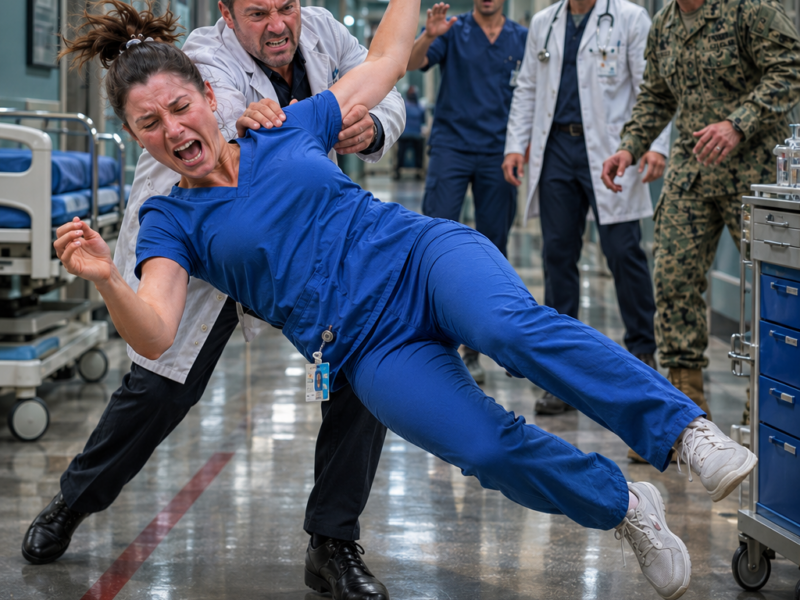
She Was Attacked and Humiliated From Behind — Until They Discovered She Was a 5-Star Navy SEAL
She Was Attacked and Humiliated From Behind — Until They Discovered She Was a 5-Star Navy SEAL
The first thing Grace Holloway felt was the pressure of a man’s hand closing around the back of her neck. The second was the familiar, terrible certainty that she could end the confrontation in less than three seconds if she chose to.
But she did not move.
Not when his thumb pressed beneath her ear. Not when his fingers tightened against the vulnerable muscles of her throat. And certainly not when his voice, smooth with arrogance, whispered a warning that would have made almost anyone else tremble.
“Don’t move.”
The east corridor of Coronado Naval Medical Center was nearly deserted. Fluorescent lights hummed overhead, casting a cold, unforgiving brightness across the polished floors. The sharp scent of disinfectant lingered in the air, mixing with the faint salt carried inland from the Pacific. Behind Grace, a cleaning bucket rested against the wall. In her arms was a stack of freshly folded hospital linens.
She looked exactly like what her identification badge said she was: Grace Holloway, registered nurse, temporary assignment.
Thirty-six years old. Quiet. Unassuming. Almost painfully ordinary.
And that was precisely how she wanted the world to see her.
Dr. Evan Kessler leaned closer, his expensive cologne cutting through the hospital’s sterile smell. He was a celebrated trauma surgeon, the sort of man whose name appeared on fundraising brochures and whose mistakes rarely appeared in official reports.
“You ignored me twice today,” he murmured. “That was disrespectful.”
Grace stared at the opposite wall.
She noticed the hairline fracture in the plaster, the reflection of the emergency exit sign, and the security camera at the far end of the corridor. Its lens had been turned away from the hallway forty-eight hours earlier.
She had noticed that the morning it happened.
She noticed everything.
“I was attending to a patient,” she answered evenly.
Kessler gave a humorless laugh.
“You think that excuses your attitude?”
His grip tightened.
Grace could feel the precise location of his fingers, the direction of his weight, and the careless position of his right elbow. There were several ways to free herself. Some would hurt him. One would leave him unable to use his hand for months.
Instead, she lowered her gaze.
The man mistook restraint for surrender.
It was a mistake other men had made before him.
Earlier that afternoon, Grace had questioned a medication order for a patient with a documented severe allergy. Kessler had dismissed her warning in front of two residents. When she refused to administer the medication, he accused her of undermining his authority.
The patient had survived because she refused.
Kessler had apparently decided that her refusal required punishment.
“Look at me.”
Grace raised her eyes.
For a moment, something in her expression made him hesitate. It was not defiance in any ordinary sense. It was a terrible stillness, the kind possessed by someone who had already calculated the worst possible outcome and accepted it.
Then he slapped her.
The sound cracked through the empty corridor.
Her head turned sharply, and the linens spilled across the floor. A pillowcase drifted beneath a supply cart. Two towels landed near his polished shoes.
Grace remained standing.
Her cheek burned. A small ringing filled her left ear.
Kessler smiled.
“Now perhaps you’ll remember your place.”
A door opened nearby.
Dr. Malcolm Pierce emerged from the residents’ lounge, carrying a paper cup. He stopped when he saw Grace’s reddened face, the scattered linens, and Kessler standing close enough to touch her.
For an instant, Grace thought he might say something.
Pierce merely glanced down.
“Everything all right?”
“Your nurse dropped the supplies,” Kessler replied.
Pierce hesitated, then nodded.
“Please keep the corridor clear, Nurse Holloway.”
He walked away.
Grace watched him leave without changing her expression. She had witnessed men abandon responsibility in places far more dangerous than a hospital hallway, but somehow this particular cowardice made her feel profoundly tired.
Kessler pointed at the linens.
“Pick them up.”
Grace knelt.
One towel. Another towel. Three pillowcases.
Her left hand shook slightly.
The tremor was deliberate.
She had discovered long ago that people became careless when they believed another person was afraid. They revealed things. They stepped too close. They spoke without guarding their thoughts.
Kessler crouched in front of her.
“There. That’s better.”
Grace noticed a narrow smear of fresh blood along his shoe.
Not the kind usually left by an operating room spill. It looked as though he had stepped through blood and dragged one edge of his sole across another surface.
She filed the observation away.
Then she rose.
“I expect an apology,” he said.
Grace folded the last towel carefully.
“I’m sorry a patient nearly received medication that could have killed him.”
His smile vanished.
Before she could step away, he seized the front of her scrubs and drove her against the wall.
Pain exploded behind her eyes.
And deep inside her, something that had slept uneasily for eleven years opened its eyes.
For one heartbeat, she was no longer standing in a hospital.
She could smell burning fuel.
She could hear helicopter rotors chopping through heavy rain.
She could feel cold seawater closing around her waist while someone screamed her call sign over a damaged radio.
Wraith.
The name passed through her mind like a ghost.
She returned to the corridor as Kessler tightened his grip.
“You think you’re clever?”
Grace studied him.
His weight rested too heavily on his leading foot. His wrist was exposed. His balance was poor.
She could have ended the confrontation immediately.
But there were reasons she had buried that part of herself.
Reasons involving bodies in black water, vanished reports, and orders that should never have been given.
“No, Doctor,” she said.
Footsteps approached.
Two corpsmen appeared with an empty gurney. Kessler released her instantly.
“Nurse Holloway became dizzy,” he announced.
Grace said nothing.
The men exchanged uncomfortable looks and continued walking.
A young nurse named Molly Parks appeared near the medication room. Her expression was filled with horror.
“Grace,” she whispered when Kessler finally disappeared. “I saw what he did.”
“No, Molly.”
“He hit you.”
“Go back to your unit.”
“He’s done it before. Olivia reported him. Jenna tried to. Everyone knows.”
Grace turned.
“Everyone?”
Molly nodded miserably.
“Administration buried the complaints. He’s too important.”
Grace looked toward the trauma wing.
Important.
She had heard that word used to excuse more evil than almost any other.
Before she could answer, the overhead announcement system crackled.
“Trauma team to Bay One. Incoming military casualty. Estimated arrival three minutes.”
Something changed in Grace’s face.
The softness vanished.
Outside, an ambulance siren wailed through the night. Beneath it came a second sound: several heavy engines approaching in close formation.
Grace recognized the pattern.
She had heard convoys like that in countries whose names never appeared on her personnel records.
The ambulance entrance burst open.
Four armed men in unmarked tactical equipment surrounded a stretcher. Their uniforms were soaked with rain, their boots coated in mud. The man lying between them had suffered devastating injuries. Blood covered his torso and soaked through the dressings around his left thigh.
Kessler rushed forward.
“I have the patient. Move!”
One operator shouted the report.
“Male, thirty-nine. Blast exposure. Penetrating trauma. Severe blood loss. Airway deteriorating.”
Grace remained near the entrance.
Then the wounded man’s face turned toward her.
Her breath stopped.
He was older than she remembered. Gray threaded his beard. A familiar scar crossed one eyebrow. His skin had become pale beneath the blood.
But she knew him.
Chief Nathaniel Rourke.
Preacher.
The man who had once dragged her through freezing surf while bullets struck the water around them.
The man who had watched her disappear after Operation Blue Lantern.
The man who believed she had died eleven years earlier.
His lips moved beneath the oxygen mask.
The words were nearly inaudible.
“Blue Lantern Three.”
Grace gripped the edge of a supply cart.
No.
Not those words.
That phrase belonged to an operation erased from official history. Five people had known it. Three were dead. One was on the stretcher.
And the fifth was standing in blue nursing scrubs.
Rourke whispered again.
“Blue Lantern Three.”
An operator beside him stiffened.
“What did he say?”
Nobody answered.
Grace’s heart began beating slowly, heavily, as if something inside her chest had turned to stone.
Blue Lantern Three was not a call for medical assistance.
It was a warning.
Internal betrayal.
The enemy was already inside the supposedly safe perimeter.
Inside Trauma Bay One, alarms began sounding.
Rourke’s oxygen levels fell dangerously. Kessler attempted to secure his airway while Pierce called out declining blood pressure readings.
Grace watched from the doorway.
Something was wrong.
The left side of Rourke’s chest was barely moving. His condition was deteriorating faster than blood loss alone could explain.
She recognized the emergency immediately.
They were overlooking a life-threatening chest injury.
“Check his left chest,” she said.
Kessler did not look up.
“Get out of my trauma bay.”
Grace stepped forward.
“He has a tension pneumothorax. You need to relieve the pressure before you lose him.”
Kessler straightened angrily.
“You are not assigned here.”
“His oxygen is falling. Look at his chest.”
“Security!”
Rourke’s eyes fluttered open.
For a brief instant, they focused on her face.
Recognition flashed across them.
His lips moved.
“Wraith.”
The word changed everything.
One of the tactical operators turned sharply.
“What did he call her?”
Kessler grabbed Grace’s wrist.
“You will leave when I tell you to leave.”
Grace looked down at his hand.
This time, she did not lower her eyes.
She rotated his wrist with a movement so small and precise that nobody understood what had happened until Kessler dropped to one knee, gasping.
Grace freed herself and moved directly toward the patient.
“Prepare emergency chest decompression,” she ordered. “Now.”
Something in her voice cut through the confusion.
People moved.
The room had spent the last several minutes obeying Kessler because of his title.
Now they obeyed Grace because her instructions carried the absolute certainty of someone who had done this while the world was falling apart.
With emergency intervention and coordinated assistance from the trauma team, the pressure in Rourke’s chest was relieved.
His oxygen levels began to improve.
But the danger was far from over.
His airway remained compromised by blood. His pulse was weakening. The wound near his pelvis continued bleeding despite the field dressings.
Grace took control of the immediate priorities, directing the team through airway management, resuscitation, and hemorrhage control.
Pierce handed her equipment almost without thinking.
Molly followed her instructions with newfound confidence.
The respiratory therapist called out improving oxygen readings.
Kessler stood against the wall, holding his injured wrist.
He looked furious.
He also looked increasingly irrelevant.
Grace examined the pressure dressing around Rourke’s upper thigh.
“The bleeding source is higher than the dressing,” she said.
Pierce looked alarmed.
“How can you tell?”
“Because he’s still losing blood.”
She exposed the wound sufficiently to identify the continuing hemorrhage and directed the team to maintain pressure while the surgical team was summoned.
“Where did you learn to do this?” Pierce asked.
Grace did not answer.
A tall operator approached from the doorway.
He had a close beard, severe eyes, and the unhurried posture of someone accustomed to command.
“Who are you?” he asked.
“Grace Holloway. Registered nurse.”
“That isn’t what he called you.”
“Your patient is confused.”
“He called you Wraith.”
Grace looked up.
For the first time, the operator saw the expression beneath her carefully constructed civilian identity.
It was enough to make him reconsider his next question.
Captain Elise Ward arrived with the emergency surgical team. Grace delivered a concise assessment of Rourke’s condition, the interventions performed, and the injuries requiring immediate surgery.
Ward listened without interruption.
Then she stared at Grace.
“Who trained you?”
Grace removed her gloves.
“Someone who believed minutes mattered.”
Ward studied her for another second before ordering immediate transfer to surgery.
As the stretcher moved toward the operating rooms, the operator approached Grace again.
“Commander Jack Vale,” he introduced himself. “Naval Special Warfare.”
Grace nodded.
“Commander.”
“Chief Rourke is under operational protection. This hospital was notified that a classified casualty might arrive.”
Grace looked toward Kessler.
“Then someone failed to prepare.”
Vale followed her gaze.
His expression darkened.
Kessler stepped forward, still clutching his wrist.
“This nurse assaulted me and performed unauthorized procedures. I want her removed from the building.”
Vale glanced at him.
“Your wrist still works, Doctor?”
Kessler stared.
“Excuse me?”
“Then I suggest you use it to write an accurate incident report.”
A few staff members looked away to conceal their reactions.
Grace did not smile.
She was watching the operating room doors.
Rourke was alive.
For the moment.
And his warning meant the danger had already crossed the hospital’s threshold.
Within half an hour, Grace was standing inside Hospital Director Warren Lyle’s office.
Lyle was a silver-haired administrator whose expensive suit and polished desk advertised his proximity to important people. Framed photographs showed him shaking hands with admirals, politicians, and medical executives.
He listened to Kessler’s version of events without inviting Grace to explain.
Then he announced her immediate suspension.
“Unauthorized intervention, physical assault against a senior physician, and disruption of classified medical operations,” he said. “You will surrender your identification.”
Grace removed her badge.
For eight months, that small rectangle of plastic had allowed her to disappear into an ordinary life.
She placed it on the desk.
“Understood.”
Vale stepped forward.
“Director, this woman helped save a protected casualty.”
“She violated hospital policy.”
“Your staff almost lost him.”
“My investigation will determine what happened.”
Grace looked at Lyle carefully.
Something about his confidence felt rehearsed.
“You received advance notification about the casualty,” she said.
Lyle frowned.
“Yes.”
“Yet the trauma team wasn’t properly briefed. The security camera in the east corridor was turned away. Someone with access to surgical areas left blood where there shouldn’t have been any.”
Vale looked at her.
“What blood?”
“On Dr. Kessler’s shoe. Before the ambulance arrived.”
Lyle’s expression changed.
Only slightly.
But Grace noticed.
“You are making reckless accusations,” he replied.
“No. I’m describing observations.”
His voice hardened.
“Get her out.”
Before anyone moved, Vale’s phone vibrated.
He read the message.
Then he looked at Grace.
“Rourke survived surgery.”
For the first time that night, she visibly exhaled.
“He’s awake,” Vale continued. “And asking for Wraith.”
The room fell silent.
Lyle went pale.
Grace saw it immediately.
The director knew that name.
Or feared someone who did.
Vale’s expression sharpened.
“Rourke says the hospital is compromised.”
Grace reached across the desk and retrieved her badge.
Lyle attempted to stop her.
She looked directly into his eyes.
“If someone tried to kill that man before he entered your hospital, Director, then your suspension can wait.”
Vale stepped beside her.
“Nobody touches her.”
They left together.
But he did not take her directly to intensive care.
Instead, he guided her into an empty stairwell and closed the door.
“Who are you?” he asked.
Grace leaned against the concrete wall.
“You already know my name.”
“I know a name on a hospital badge. I also know that a decorated SEAL recognized you after eleven years and used a classified call sign.”
He unfolded a single page.
It contained an old photograph of a younger woman wearing operational equipment. Her hair was shorter. Her expression was colder. Several sections of the document were blacked out.
One word remained visible.
WRAITH.
Grace stared at the photograph.
The woman looking back at her had believed that loyalty, courage, and sacrifice could overcome almost anything.
She had learned otherwise.
“Where did you get that?”
“From a classified archive that officially doesn’t exist.”
“Then someone made a mistake.”
“Apparently several people have.”
Vale waited.
Grace knew silence would no longer protect her.
“Blue Lantern was an extraction protocol,” she finally said. “Three meant internal compromise. Someone inside the friendly command structure had betrayed the mission.”
“Which mission?”
Grace looked past him toward the narrow stairwell window.
“A mission called Meridian.”
The name seemed to make the air colder.
“Eleven years ago,” she continued, “our team was sent to extract intelligence personnel and local assets from a maritime facility. The evacuation route was compromised before we arrived. The enemy knew our timing, our signals, and our planned rendezvous.”
“How?”
“Because someone sold the route.”
Vale’s jaw tightened.
“Who?”
Before she could answer, the stairwell door opened.
A young corpsman named Jimmy Hale appeared, holding two coffees and looking as though he regretted every decision that had brought him there.
“Commander, Chief Rourke is asking for her again.”
“Anything else?”
Jimmy swallowed.
“He says the man who attacked him smelled like the almond soap stocked in the east corridor.”
Grace straightened.
The hospital had changed cleaning suppliers recently.
Only certain departments used that particular product.
She remembered the scent near Kessler.
And the blood on his shoe.
“Take me to Rourke,” she said.
Chief Nathaniel Rourke looked like a man who had negotiated with death and won only because death had become exhausted by the argument.
His torso was bandaged. Medical equipment surrounded his bed. His skin remained unnaturally pale.
But his eyes were open.
When Grace entered, those eyes found her immediately.
For several seconds, neither spoke.
Then he managed a crooked smile.
“You got old.”
Grace approached the bed.
“You got careless.”
His smile widened painfully.
“Still charming.”
“Still impossible.”
He reached for her hand.
For one brief moment, the years disappeared.
She was back in the surf, hearing gunfire over the waves, feeling his grip around her arm as he dragged her toward safety.
He had refused to leave her.
And she had refused to leave him.
Vale stepped closer.
“Chief, who attacked you?”
Rourke’s humor vanished.
“A man wearing surgical clothes. Knew our route. Knew the ambulance transfer point. Called me Chief before he cut me.”
“Did you recognize him?”
“No.”
“Anything else?”
Rourke looked at Grace.
“He gave me a message.”
Her fingers tightened around the bedrail.
“What message?”
Rourke swallowed.
“Tell Wraith the water remembers.”
Grace closed her eyes.
The phrase was more than a threat.
It was a promise from the past.
“What happened at Meridian?” Vale asked.
Rourke looked toward him.
“An extraction route was sold. People died. Records vanished. The officer responsible was promoted.”
Grace spoke the name.
“Thomas Arlen.”
Vale went still.
“Rear Admiral Thomas Arlen?”
“He was a captain then,” Grace said.
Rourke nodded.
“He buried her report. Said she was unstable. Said she couldn’t distinguish enemy fire from friendly confusion.”
Grace remembered the hearing eleven years earlier.
The faces around the table.
The questions designed to humiliate rather than investigate.
The suggestion that her trauma had made her unreliable.
She had dragged two men from the wreckage that night. One was Rourke. The other was Samir Haddad, an interpreter whose family had trusted the Americans to protect them.
Samir had died after the extraction.
His official record had been altered until his sacrifice looked like betrayal.
Grace had submitted evidence.
The evidence disappeared.
Then her identity began disappearing too.
She had been removed from operational service, placed under classified restrictions, and quietly encouraged to build another life.
She had obeyed.
Until tonight.
Rourke tightened his grip on her hand.
“I found the list.”
“What list?”
“Everyone who survived Meridian. Everyone who could prove what Arlen did.”
Vale leaned forward.
“Where is it?”
“North Pier locker. But I sent another copy through the old channel.”
Grace shook her head.
“I never received it.”
“Then someone intercepted it.”
Rourke’s breathing became labored.
“Arlen’s people are cleaning up witnesses. They found me. They’ve found you.”
Grace’s phone vibrated.
An unknown number had sent a message.
Basement laundry room. Ten minutes. Come alone, or Rourke dies twice.
Vale read it.
“Absolutely not.”
Grace slipped the phone into her pocket.
“They already know where I am.”
“We send a team.”
“They’ll be watching for one.”
Rourke struggled to raise his head.
“Grace. Don’t do something stupid.”
She looked at him.
“You’ve known me long enough to understand how little that narrows things down.”
Jimmy made an involuntary choking sound that might have been laughter.
Vale rubbed his forehead.
Then he began planning.
Grace would approach visibly. Shore patrol would secure the exits without revealing their positions. Vale would coordinate the response, and Jimmy, who knew the service corridors better than most officers, would assist with communications.
Jimmy looked horrified.
“I would like to clarify that knowing where the vending machines are is not the same as tactical training.”
“It will do,” Vale said.
Grace studied the young corpsman.
“Stay away from direct confrontation.”
Jimmy nodded eagerly.
“That is my favorite kind of confrontation.”
Ten minutes later, Grace entered the basement laundry corridor alone.
Industrial dryers rumbled behind steel doors. Steam hissed through aging pipes. The smell of detergent and damp fabric filled the passage.
Her blue scrubs were still stained with Rourke’s blood.
She wore no visible weapon.
“I’m here,” she called.
A man emerged from the shadows.
Maintenance jacket. Surgical mask. Dark cap.
His appearance was deliberately forgettable.
But Grace noticed his operating room shoes.
And the faint scent of almond soap.
He carried a pistol.
“Hands where I can see them.”
Grace raised her hands.
“You attacked Rourke.”
The man’s eyes narrowed.
“You’re calmer than I expected.”
“People keep telling me that.”
He stepped closer.
“Open the dead drop. Give me the file.”
“I don’t have it.”
“Then you’ll find it.”
Grace studied him.
His left knee was stiff. His right shoulder carried tension from an old injury.
He held the pistol with professional confidence.
Not an amateur.
“Who sent you?”
He gave a faint smile.
“Someone who wants the past to remain buried.”
“Arlen.”
His expression answered before his mouth did.
“You should have stayed dead, Wraith.”
For the first time, Grace felt anger.
Not the wild anger of humiliation.
Something much colder.
“You people keep making that mistake,” she said.
A faint sound came from above.
Jimmy, moving somewhere through the maintenance access.
The armed man noticed Grace’s eyes shift.
His pistol rose.
And the confrontation exploded.
Grace sent a heavy linen cart into his injured leg just as he fired. The bullet struck an industrial dryer, sending sparks across the floor.
She moved through the opening created by the collision, forcing the weapon away from her body as the man struggled to regain his footing.
He was trained.
Strong.
Dangerous.
He slammed her against the wall, driving pain through an old injury in her side.
For an instant, she saw the black water of Meridian again.
Then she heard Jimmy shout from above.
“Grace! Down!”
A large bundle of wet laundry dropped through the service chute and crashed into the attacker.
He staggered.
Grace seized the opportunity, disarmed him, and forced him to the floor.
Vale and shore patrol entered seconds later.
“Weapon secure!”
Jimmy’s voice echoed from the ceiling.
“And for the record, I never want to crawl through another vent again!”
Vale pulled the man’s mask away.
His expression changed.
“Lieutenant Owen Rusk.”
Grace looked up.
“Who?”
“NCIS liaison. Base security review.”
Rusk laughed against the floor.
“Always a little too late, Commander.”
Vale leaned closer.
“Who authorized this?”
Rusk turned his head toward Grace.
“Ask her what she stole.”
Grace’s expression hardened.
“I stole people away from death. That’s all.”
“No,” Rusk whispered. “You stole Arlen’s future.”
He smiled.
“The admiral arrives at eight. He wants his ghost alive.”
By dawn, Coronado Naval Medical Center no longer resembled an ordinary hospital.
Security personnel controlled every entrance. Investigators sealed the laundry room and collected evidence from the east corridor. Staff members who had spent months pretending not to notice misconduct now found themselves questioned by officers carrying classified credentials.
Kessler could not be located.
Lyle refused to cooperate beyond the minimum required.
Rourke remained under guarded medical care.
And Grace stood in a secure conference room staring at a damaged dive watch inside an evidence bag.
It belonged to Rourke.
She knew the watch.
He had worn it during Meridian.
“He never trusted electronic messages,” she said.
Vale watched her.
“What are you thinking?”
“That he would never rely on a single dead drop.”
With the evidence team supervising, they examined the watch and discovered a concealed waterproof storage device.
Jimmy leaned forward.
“Of course he hid intelligence inside a watch. I once hid emergency chocolate in a ceiling tile and thought I was clever.”
The device was connected to a secure offline reader.
A video appeared.
Rourke’s face filled the monitor.
He looked exhausted but uninjured, suggesting the recording had been made before the attack.
“If you’re watching this, Grace, I’m probably dead. Or close enough that you’ll be angry with me.”
Grace barely moved.
Rourke continued.
“You were right about Meridian. Arlen sold the extraction route. I have payment records, altered transfer orders, witness lists, and evidence linking his people to the cleanup operations.”
His expression darkened.
“Samir Haddad was deliberately discredited after his death. Your report was erased. And your placement at Coronado wasn’t an accident.”
Grace felt the room shift around her.
“Director Lyle arranged your hiring after your civilian credentials triggered a surveillance match. Kessler was encouraged to provoke you. They wanted to confirm that Grace Holloway was still Wraith.”
Jimmy stared at her.
“They made your entire job a trap.”
Grace watched the frozen image of Rourke’s face.
She remembered every cruel remark.
Every ignored complaint.
Every moment Kessler had tried to force her into an uncontrolled reaction.
It had not merely been a predator abusing a vulnerable employee.
It had also been an experiment.
They had wanted her to reveal herself.
The video resumed.
“There is a second file. Opening it may alert Arlen. But leaving it closed means he wins.”
Rourke leaned toward the camera.
Then he spoke the phrase that had governed everything Grace once believed.
“No one left in the water.”
The recording ended.
Silence filled the room.
Vale looked at the keyboard.
“We need to secure the evidence before doing anything else.”
Grace shook her head.
“We need to see what’s inside.”
After the investigators established a protected copy, the encrypted file was opened using the old phrase.
Forty-three names appeared.
Some were marked deceased.
Others were listed as located, contained, or pending.
Grace found her own name.
Grace Holloway. Wraith. Identity confirmed. Action pending.
Further down were communications records, payment instructions, surveillance notes, manipulated medical assessments, and workplace harassment reports.
One document was titled Public Discredit Option.
Its contents chilled everyone in the room.
The plan was simple.
Present Grace as a psychologically unstable former covert operator who had assaulted hospital personnel and invented a conspiracy during a traumatic episode.
Discredit her first.
Then eliminate whatever remained of her credibility.
Jimmy looked sick.
“They were going to make you look insane.”
Grace stared at the document.
“No.”
Vale turned toward her.
She continued quietly.
“They were going to make telling the truth look dangerous.”
Before anyone replied, the conference room phone rang.
Director Lyle’s voice came over the speaker.
“Commander Vale, Rear Admiral Arlen has arrived. He requests all department heads in the auditorium.”
A second voice entered the call.
Smooth.
Measured.
Unmistakably familiar.
“Bring Nurse Holloway.”
Grace closed her eyes.
Eleven years disappeared.
She was once again standing before Captain Thomas Arlen, trying to explain why American personnel had been abandoned to die.
She stepped toward the speaker.
“Hello, Captain.”
Silence.
Then the voice answered.
“That was a long time ago, Wraith.”
“Not long enough.”
“You sound tired.”
“You sound alive. That continues to surprise me.”
His tone sharpened.
“Auditorium. Ten minutes.”
The line disconnected.
Vale looked at Grace.
“He wants to control the audience.”
Grace picked up Rourke’s watch.
“Then we make sure they hear the truth.”
By eight-thirty, the hospital auditorium was full.
Doctors, nurses, corpsmen, security personnel, administrators, and senior officers occupied nearly every seat.
Rear Admiral Thomas Arlen stood on the stage in immaculate dress blues.
He looked every inch the respected officer.
Decorations gleamed on his chest. His silver hair was perfectly combed. His expression carried the untroubled confidence of a man accustomed to being believed.
Grace entered from the side door.
She wore the same bright blue scrubs.
Blood had dried along one sleeve. The bruise on her cheek had deepened. A faint mark remained near her throat.
The room turned toward her.
Whispers spread.
Arlen smiled.
“Nurse Holloway. Please sit.”
Grace remained standing.
“I’m comfortable.”
His smile tightened.
“Your cooperation would be wise.”
Vale moved beside her.
“Admiral, this is an active investigation.”
Arlen lifted one hand.
“As of this morning, command has determined that Nurse Holloway presents a security concern. She will be removed from clinical duties and placed under medical evaluation pending further review.”
A murmur swept through the auditorium.
Arlen continued.
“Last night, this employee assaulted a physician, interfered with a classified casualty, attacked a federal liaison, and made unsubstantiated allegations against senior military personnel.”
Grace studied him.
There it was.
The same strategy he had used eleven years earlier.
Discredit the witness before anyone heard the testimony.
“You always liked that word,” she said.
Arlen stopped.
“What word?”
“Unstable.”
The auditorium quieted.
“You used it when I refused to abandon the survivors at Meridian.”
A few officers exchanged looks.
Arlen gave a gentle, almost sympathetic smile.
“I don’t know what fantasy you’re describing.”
Grace withdrew Rourke’s watch.
His gaze dropped to it.
Just for an instant.
But she saw the fear.
“Chief Rourke recorded a statement before he was attacked. He identified you as the officer who compromised the extraction route. We also recovered documents showing payments, altered personnel records, and a list of surviving witnesses targeted for removal.”
Arlen chuckled.
“A traumatized nurse and a heavily medicated SEAL are hardly credible sources.”
Grace nodded toward Jimmy.
“Then perhaps you’d prefer to see the records.”
Jimmy connected the secure presentation system.
For one agonizing second, the auditorium screen remained dark.
He whispered toward the laptop.
“Please don’t betray me now.”
The display appeared.
Rourke’s recorded face filled the screen.
His voice echoed through the auditorium.
He named Meridian.
He described the compromised route.
He identified Arlen.
He explained the altered reports, the concealed payments, the surveillance operation, and the deliberate attempt to provoke Grace into exposing her identity.
By the end, nobody spoke.
Grace stepped forward.
“This hospital was used to locate and discredit witnesses. Chief Rourke was attacked before reaching medical care. I was placed here so they could determine whether I was still the operator they believed they had buried.”
She looked toward the front row.
Director Lyle stared at his hands.
“Complaints were ignored because abusive behavior served their purpose. Dr. Kessler was allowed to threaten nurses because the people above him found that useful.”
Lyle abruptly stood.
“That is a distortion!”
Grace turned toward him.
“Sit down.”
He hesitated.
Then sat.
Arlen’s face hardened.
“You have no authority here.”
Grace looked at him.
“Neither did you when you ordered us to leave those men behind.”
His composure cracked.
“Meridian protected national interests.”
“Meridian protected your career.”
“You have no understanding of what command requires.”
“I understand exactly what command requires,” Grace replied. “It requires responsibility. Something you’ve spent eleven years avoiding.”
Vale stepped toward the stage.
“Rear Admiral Arlen, you are being detained pending investigation.”
One of Arlen’s armed security men moved.
Grace saw it before anyone else.
The man’s hand descended toward his holster.
She reacted.
A nearby chair struck his arm before the pistol cleared. A shot discharged into the ceiling.
Plaster burst overhead.
People screamed and dropped beneath their seats.
Vale tackled a second guard.
Shore patrol flooded through the entrances.
Grace moved toward the stage as a third man attempted to escort Arlen through the rear door.
She intercepted the guard, stopped his attack, and forced him away from the exit.
Arlen reached the doorway.
It opened.
And standing on the other side was Chief Nathaniel Rourke.
He wore a hospital gown, a blanket draped around his shoulders, and the furious expression of a man who had escaped intensive care against medical advice.
An exasperated nurse stood behind him.
“He refused to stay in bed,” she announced.
Rourke leaned against the doorframe.
“Going somewhere, Admiral?”
Arlen stopped dead.
For the first time that morning, genuine fear entered his eyes.
Not because Rourke looked powerful.
He looked half dead.
But because a man who should have disappeared was standing directly in his path.
Grace reached his side.
“You should be in intensive care.”
Rourke glanced at her.
“You should be retired.”
“I was.”
“How’s that working?”
“About as well as your recovery.”
Vale arrived with two officers.
Arlen straightened his uniform.
“You have no idea what you’re doing.”
Rourke stared at him.
“You sold our route.”
“I made a difficult decision.”
Grace stepped closer.
“No. You made a profitable one.”
Arlen looked from her to Rourke.
For a moment, the admiral seemed prepared to speak.
Then he saw the officers approaching.
His shoulders lowered.
He had spent eleven years building a world in which his authority could silence every inconvenient witness.
Now the witnesses were alive.
The evidence was preserved.
And the audience he had summoned had heard everything.
The officers escorted him away.
Nobody applauded.
Nobody needed to.
The sound of his polished shoes crossing the auditorium floor was enough.
By noon, the entire hospital knew that Grace Holloway was not the frightened temporary nurse they had believed her to be.
Rumors traveled faster than official announcements.
Some claimed she had been a highly classified Navy SEAL operator. Others described a secret medical specialist whose work alongside Naval Special Warfare teams had been erased from public records.
The truth was more complicated.
Grace had served within a classified special warfare medical program, supporting operations so sensitive that even many officers had never been cleared to know her assignments. Her expertise had been earned through years of brutal training, battlefield medicine, and missions where survival depended on decisions made under impossible pressure.
Her call sign had been Wraith.
And for eleven years, the woman behind that name had tried to become someone else.
Now she sat beside Rourke’s hospital bed, adjusting his blanket while he complained.
“You’ve become bossier.”
“You’ve become older.”
“I was wounded.”
“Apparently that didn’t affect your ability to be irritating.”
An ICU nurse checked his monitor.
“I’m documenting that this patient is impossible.”
Rourke closed his eyes.
“Classified information.”
Grace almost smiled.
Vale entered carrying a folder.
“Arlen is in secure custody. Rusk has started cooperating. Kessler was intercepted attempting to leave the base. Lyle has been suspended pending criminal investigation.”
Grace looked toward the window.
“And Meridian?”
Vale opened the folder.
“The original investigation is being reopened. Your report is being restored.”
He hesitated.
“There’s something else.”
Grace turned.
“Samir Haddad’s family has been located.”
Her entire body went still.
For years, she had carried the memory of Samir begging her not to let his wife believe he had betrayed anyone.
She remembered his terrified eyes.
His shaking hands.
The terrible effort it had taken to keep him alive long enough to reach extraction.
“His family?” she whispered.
“His wife and daughter. They’re in Michigan. His record will be corrected, and his family’s benefits and protected status will be reviewed.”
Grace pressed her lips together.
There were victories that felt like triumph.
This one felt like the first breath after years underwater.
Rourke reached for her hand.
“We got one back.”
Grace looked down.
“Not enough.”
“I know.”
The next day, Grace testified before a military review panel.
She did not wear a dress uniform.
She did not wear a suit.
She wore bright blue scrubs.
She wanted the people reviewing her testimony to see the person who had been dismissed, threatened, and humiliated.
She told them about Meridian.
About the compromised extraction route.
About the withdrawal order.
About the two men she refused to abandon.
About the report that disappeared because the truth threatened a powerful officer.
When one senior officer asked why she had disobeyed the withdrawal order, Grace answered without hesitation.
“Because it was wrong.”
No speech followed.
None was necessary.
The review restored the original Meridian evidence to the investigation, established protections for Grace’s civilian employment, and initiated corrective action for the falsified records.
But returning to the hospital proved more difficult than facing the hearing.
When Grace entered the main doors that afternoon, conversations stopped.
Nurses stared.
Corpsmen straightened instinctively.
Two young sailors even began to stand at attention.
Grace held up a hand.
“Please don’t do that in the hallway.”
They looked embarrassed.
“Yes, ma’am.”
She walked past the trauma board.
Kessler’s name had been removed.
Lyle’s office was sealed.
Someone had taped a handwritten notice above the complaint box.
Every report will be read.
Grace stopped.
Molly Parks appeared beside her.
“I made it,” the younger nurse confessed.
Grace studied the sign.
Then looked at Molly.
“Good.”
Molly swallowed.
“I should have spoken sooner.”
“You were afraid.”
“I was.”
Grace nodded.
“Next time, speak anyway.”
Three days later, Rourke was transferred out of intensive care.
He complained about the wheelchair, the food, the television, and the hospital’s refusal to let him interrogate Rusk personally.
Jimmy arrived carrying a pudding cup.
“Emergency supplies,” he announced.
Grace looked at it.
“He’s on dietary restrictions.”
Jimmy froze.
Rourke pointed accusingly.
“Traitor.”
Jimmy took one cautious step backward.
“I was never here.”
Grace confiscated the pudding.
Rourke stared at the ceiling.
“I survived Meridian, and now I’m being defeated by hospital nutrition.”
“Medical progress,” Grace replied.
But later that afternoon, when Jimmy had gone and the room was quiet, Rourke handed her a folded document.
It was a proposal from Admiral Hensley.
A new program.
Tactical Clinical Response and Integrity.
Civilian leadership. Independent reporting authority. Advanced emergency training. Direct protections for personnel who raised safety concerns.
Grace read the proposal twice.
“They want me to run it.”
Rourke nodded.
“You’re very good at telling people when they’re wrong.”
“That’s not a qualification.”
“In this building, it might be the most important one.”
Grace looked down at the document.
“I won’t put on a uniform again.”
“You don’t have to.”
“I won’t return to that life.”
“Then don’t.”
He leaned back against his pillows.
“Build something better.”
She stared at him.
Rourke smiled faintly.
“You always hated leaving people behind. Maybe this is how you stop having to.”
One week after the attack, Grace stood on the auditorium stage again.
The bullet hole had been repaired, though the fresh paint still looked slightly different from the surrounding ceiling.
This time there were no armed men.
No threats.
No admiral trying to destroy her.
Only doctors, nurses, corpsmen, cleaners, clerks, and hospital staff waiting to hear what she would say.
Grace looked across the room.
A week earlier, many of them had believed she was weak.
Some had laughed when Kessler humiliated her.
Others had looked away.
She did not pretend to have forgotten.
“A week ago,” she began, “some of you believed I was weak because I was quiet.”
Nobody moved.
“Some believed I was difficult because I questioned unsafe decisions. Some believed I was dangerous because people with authority told you that I was.”
She paused.
“But quiet is not consent. Documentation is not betrayal. And rank is not character.”
A nurse in the third row wiped her eyes.
Grace continued.
“What happened here was possible because people stopped questioning authority. Complaints were ignored. Harassment was excused. Staff were taught that protecting powerful people mattered more than protecting patients or each other.”
Her voice remained steady.
“That changes now.”
She explained the new reporting protections and independent review procedures.
She described the emergency training program.
She promised that no complaint would disappear simply because the accused person possessed a prestigious title.
Then she looked toward Molly.
“If someone threatens you for telling the truth, report it. If someone makes you afraid to protect a patient, speak anyway.”
She let the words settle.
“Courage isn’t the absence of fear. It’s refusing to let fear decide who you become.”
For several seconds, the auditorium remained silent.
Then Dr. Amelia Cross stood.
Molly rose next.
One by one, nurses, corpsmen, physicians, and support staff stood around them.
There was no thunderous applause.
Only a room full of people quietly making a choice.
And somehow, that meant more.
Two months later, Grace opened the first Tactical Clinical Response class in a training room above the emergency department.
The students included nurses, physicians, military medical personnel, and security officers.
The tables held emergency medical equipment, communications devices, incident forms, and training materials.
Jimmy sat in the back with a notebook labeled Vent Hero.
Grace noticed.
She chose not to comment.
Her first lesson was simple.
“Listen to the person closest to the danger.”
She taught them how to recognize emergencies, coordinate under pressure, communicate without wasting critical time, and preserve accurate documentation when institutional pressure threatened the truth.
But the most important lesson had nothing to do with medicine.
She taught them not to confuse obedience with integrity.
After class, a young nurse approached hesitantly.
She admitted that Kessler had cornered her months earlier.
She had never filed a complaint.
She was ashamed.
Grace pulled out a chair.
“Sit with me.”
The nurse began crying.
“I don’t know what to write.”
“Start with what happened.”
“What if they don’t believe me?”
Grace placed an incident form on the table.
“Then we’ll make sure they explain why.”
She stayed beside the woman until every detail had been recorded.
No judgment.
No pressure.
No one left in the water.
A year passed.
Coronado Naval Medical Center did not become perfect.
No institution ever did.
There were still exhausted nurses, difficult shifts, budget arguments, impatient surgeons, and vending machines that stole Jimmy’s money.
But the hospital had changed.
The camera in the east corridor faced the correct direction.
Complaint reports were reviewed independently.
Emergency teams trained together.
Staff learned that speaking up about patient safety could save lives rather than end careers.
Kessler was convicted for offenses uncovered during the investigation. Lyle accepted a plea agreement. Rusk cooperated in identifying additional conspirators. Arlen lost his rank and faced the consequences of the Meridian cover-up.
Samir Haddad’s name was restored to the official record.
His family finally received acknowledgment of the truth.
Rourke recovered enough to walk without a cane, though he insisted his rehabilitation had been easy.
Nobody believed him.
Vale received a commendation and looked miserable throughout the ceremony.
Jimmy earned a safety award for his improvised assistance during the basement confrontation. He complained that the official citation did not mention the laundry bag.
And Grace remained exactly where she had chosen to be.
In bright blue scrubs.
One morning, she walked through the east corridor alone.
Sunlight filtered through the high windows. A housekeeping employee pushed a supply cart past her. Two nurses laughed near the medication room.
Grace stopped at the exact place where Kessler had grabbed her neck.
For months, she had avoided standing there.
Now she stood still.
She remembered his hand.
The slap.
The scattered linens.
The faces that had turned away.
But she also remembered Rourke opening his eyes.
Vale’s quiet determination.
Molly finding her courage.
Jimmy dropping a bag of wet laundry on an armed attacker.
Samir’s name being restored.
The room full of hospital workers rising to their feet.
The past was still there.
She knew it always would be.
But for the first time, it did not feel like a prison.
A young corpsman approached.
“Ma’am? Are you all right?”
Grace turned toward him.
“Yes.”
And she meant it.
Then an alarm sounded from the emergency department.
“Incoming trauma!”
The corpsman’s eyes widened.
Grace moved immediately.
“Breathe,” she told him. “Then move.”
He followed.
Inside Trauma Bay One, a young sailor had arrived with severe injuries from a machinery accident. The team was already working, but the situation was deteriorating quickly.
Grace entered.
“Status?”
A nurse delivered the report.
Another prepared the necessary equipment.
A physician requested surgical support.
There was urgency, but no panic.
Grace moved alongside them, offering experienced guidance and helping coordinate the response.
Nobody asked why she was speaking.
Nobody questioned whether a nurse should recognize danger before a doctor.
They listened because they trusted her.
Together, the team stabilized the sailor sufficiently for emergency surgery.
He left the trauma bay alive.
Afterward, Grace washed the blood from her hands.
The water turned pink, then clear.
She stared at it for a moment.
Once, the sight of blood washing down a drain had returned her to Meridian.
To the black water.
To the voices calling for extraction.
To the terrible silence after the radio stopped responding.
Today, she heard only the ordinary sounds of a working hospital.
Vale appeared in the doorway carrying two coffees.
“Another life saved.”
Grace accepted one cup.
“The team saved him.”
“You built the team.”
She looked toward the nurses’ station.
“They chose to become one.”
Vale considered that.
Then nodded.
Across the department, Jimmy waved a pudding cup triumphantly while Rourke followed him, pretending not to limp.
Grace shook her head.
For the first time in years, the sight made her laugh.
Not a forced smile.
Not a cautious expression.
A real laugh.
Rourke heard it and stopped walking.
He looked at Vale.
“Did you hear that?”
Vale nodded solemnly.
“Unusual event.”
“Someone document it.”
Grace pointed toward the nurses’ station.
“Both of you, out of my emergency department.”
Jimmy lifted the pudding cup.
“Can I finish this first?”
“No.”
Rourke sighed.
“Still the meanest woman I’ve ever met.”
Grace smiled.
“Still alive, aren’t you?”
He looked at her for a long moment.
Then his expression softened.
“Yeah,” he said. “We are.”
The words settled between them.
They had survived storms and gunfire, betrayal and exile, grief and the long loneliness of carrying a truth no one wanted to hear.
They had been erased from reports, declared unreliable, and hunted by men who believed power gave them ownership over other people’s lives.
But they were still here.
And the people who had tried to silence them were gone.
Grace turned back toward the trauma department.
Somewhere inside, another patient needed help. Another nurse was learning to trust her judgment. Another frightened young corpsman was discovering that courage often began with a single step forward.
That was the future Grace had chosen.
Not fame.
Not revenge.
Not the return of Wraith as some untouchable legend.
She had chosen something harder.
She had chosen to remain.
To teach.
To protect.
To make sure the next quiet woman standing in a hospital corridor would never have to wonder whether anyone would come when she called for help.
Years earlier, Grace had believed strength meant surviving anything the world could do to her.
Meridian had taught her the terrible cost of that belief.
The hospital had taught her something different.
Strength was not only the ability to fight.
Sometimes it was the courage to remain gentle after cruelty.
Sometimes it was a trembling hand signing a complaint.
Sometimes it was a young nurse refusing an unsafe order.
Sometimes it was a doctor admitting a mistake.
Sometimes it was a commander choosing truth over a superior’s career.
And sometimes it was a woman in bright blue scrubs who had every reason to become bitter, yet chose to build a place where others could feel safe.
Grace Holloway had spent eleven years trying to bury Wraith.
Eventually, she understood that she did not have to destroy one identity to survive the other.
The operator who had refused to abandon wounded men in black water and the nurse who refused to abandon frightened patients were not enemies.
They had always been the same woman.
The same conviction had guided both lives.
No one left behind.
No one forgotten.
No one left in the water.
And when Grace walked into Trauma Bay One that morning, the room did not fall silent because the people inside feared her hidden past.
It became focused because they trusted the person standing before them.
That was the respect Kessler had never understood.
It could not be demanded by rank, purchased through influence, or extracted through humiliation.
It was earned through choices made when no one important was watching.
Through the truth spoken when silence would be easier.
Through the hand extended when turning away would be safer.
Through the refusal to abandon another human being merely because someone powerful said they were no longer worth saving.
Once, a cruel man had grabbed Grace Holloway from behind because he believed her silence made her weak.
He had looked at a quiet nurse and seen someone he could control.
He never imagined that beneath those ordinary blue scrubs lived a woman who had walked through war, defied betrayal, and returned from a past designed to bury her.
But the greatest mistake he made was not underestimating her training.
It was misunderstanding her character.
Grace had not remained quiet because she lacked the strength to fight.
She had remained quiet because, after a lifetime of fighting, she had desperately wanted peace.
And when the moment came to choose between protecting that peace and protecting another life, she chose exactly as she always had.
She chose the person who needed her.
Because some heroes are not recognized by the medals they wear or the titles attached to their names.
Some are recognized by what they refuse to leave behind.
And sometimes, the most extraordinary person in the entire room is the quiet nurse everyone has already decided is ordinary.
THE END