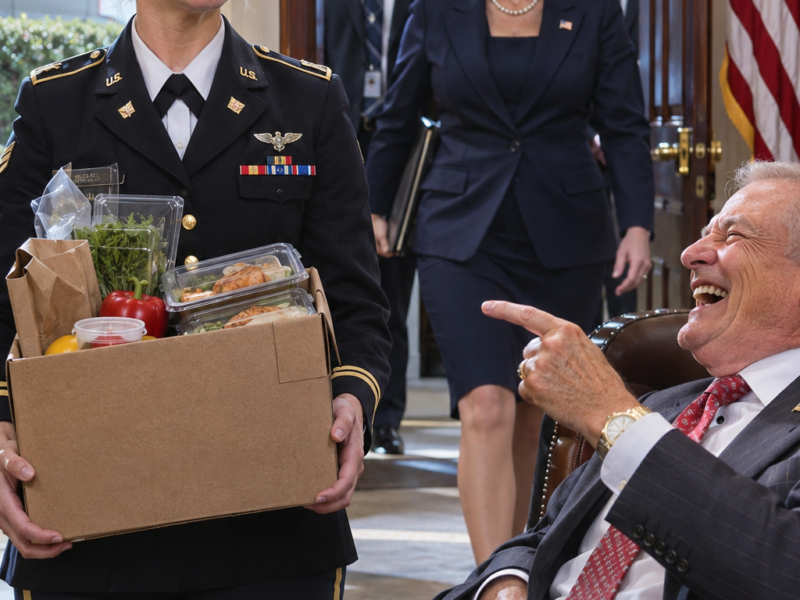
“She Delivers Meal Kits In A Van!” Dad Laughed. Then The Secretary Of State Walked In And…
“She Delivers Meal Kits In A Van!” Dad Laughed. Then The Secretary Of State Walked In And…
The first time my father laughed at my job in front of strangers, I was standing in a mansion worth more than most people earn in a lifetime, wearing a faded navy-blue dress my sister had specifically chosen because she thought it made me look poor. He had a glass of expensive wine in one hand and the satisfied expression of a man who believed he had finally found his place among Washington’s wealthy elite.
“She delivers meal kits in a truck,” he announced, chuckling as though he had just told the funniest joke of the evening. “That’s our Alicia. Always driving somewhere, always hauling boxes. We keep telling her to find a proper career, but she never listens.”
The laughter that followed was polite at first, then louder as my younger sister joined in. I stood perfectly still, looking at the faces surrounding me. Lawyers, executives, political donors, and people who had inherited more money than they could possibly spend were smiling at my expense.
None of them knew that less than twelve hours earlier, I had supervised the secure transfer of a witness whose testimony could dismantle an international trafficking network. None of them knew that the battered black truck my sister had ordered me to park six blocks away was an armored federal vehicle. And certainly none of them knew that the woman they were mocking had spent fifteen years protecting American diplomats in some of the most dangerous places on earth.
My name is Alicia Cooper. I was forty-one years old, a senior special agent with the United States Diplomatic Security Service, and one of the people responsible for keeping the Secretary of State alive.
But in my family’s version of reality, I was an unsuccessful delivery driver who couldn’t afford a decent dress.
For years, I had believed that the best response to their contempt was silence. I told myself that I didn’t need recognition, that my work spoke for itself, and that explaining my accomplishments to people who had already decided I was a failure would accomplish nothing.
I had no idea that before the evening ended, the Secretary of State himself would walk through those mansion doors, look directly at me, and reveal everything my family had spent fifteen years refusing to see.
And the most astonishing part was that I hadn’t arranged any of it.
It began the previous afternoon, in the quiet kitchen of my townhouse outside Washington, D.C.
I was seated at the granite island, carefully maintaining my service pistol. There was something reassuring about the routine. Every piece had its purpose. Every movement demanded attention. Unlike family relationships, mechanical systems didn’t change their rules depending on who wanted something from you.
My SIG Sauer P229 rested on a cleaning mat beside a bottle of solvent and a folded cloth. I had just finished inspecting the slide when my phone began vibrating across the countertop.
The screen displayed my younger sister’s name.
Kay.
I considered letting the call go unanswered.
Then I remembered that her engagement party was scheduled for the following evening, and I knew she would keep calling until I picked up.
“Hello, Kay.”
“Alicia! Finally!”
Her face appeared on the screen, framed by perfectly styled blonde hair. Behind her was the immaculate living room of the condominium she shared with her fiancé. Everything was beige, cream, polished, or carefully arranged. Even the books on her shelves appeared to have been selected for their colors rather than their contents.
“Are you doing that mechanic stuff again?” she asked, noticing the cloth in my hand.
“I’m cleaning some equipment.”
She wrinkled her nose.
“Whatever. Listen, I have an appointment in twenty minutes, so we need to discuss tomorrow.”
I leaned back in my chair.
“What about tomorrow?”
“The party, Alicia. Obviously.”
“I know about the party.”
“Seven o’clock sharp. The Whitley estate in Chevy Chase. Gerald’s parents are hosting, and there will be some extremely important people there.”
“Understood.”
“And I’ve been thinking about your outfit.”
I closed my eyes briefly.
There it was.
“What’s wrong with my outfit?”
“Nothing yet, because I haven’t seen it. But please don’t wear one of those black suits you always wear. You look like you’re applying for a security job.”
I glanced at the dark jacket hanging beside the kitchen door. It was tailored, professional, and considerably more expensive than anything Kay imagined I owned.
“I was planning to wear something appropriate.”
“Do you still have that navy-blue dress you wore to Aunt Linda’s funeral?”
I stared at the phone.
“That was three years ago.”
“I know, but it was simple. Unpretentious. I think that would be perfect.”
The dress she meant was an inexpensive polyester garment I had bought in a hurry between overseas assignments. It was comfortable enough for a funeral, but hardly suitable for an elegant engagement celebration.
“You want me to wear a funeral dress?”
“Oh, don’t be dramatic. Nobody will remember. Besides, the Whitleys are very traditional people. They appreciate humility.”
Humility.
I had heard that word from Kay many times. It was usually her preferred substitute for humiliation.
“Fine,” I said.
“Wonderful. And one more thing.”
I waited.
“Please don’t bring that enormous truck into the driveway.”
“Why?”
“Because it’s hideous, Alicia. Gerald’s parents have a Bentley, two Mercedes, and a Porsche. The neighbors are influential people. Your truck looks like something that belongs at a construction site.”
I looked through the window at the vehicle parked outside.
To anyone unfamiliar with it, my black Ford F-150 looked worn and ordinary. The paint carried scratches from years of demanding assignments, the tires were oversized, and the exterior had deliberately been kept unremarkable.
Beneath that appearance, however, was reinforced armor, specialized communication equipment, and modifications that made it capable of operating in situations where an ordinary vehicle would be dangerously inadequate.
It was not a delivery truck.
It was an instrument of national security.
“Where would you prefer I park?” I asked.
“Somewhere down the street. Maybe around the corner. You don’t mind walking, do you?”
“No.”
“Perfect. And Alicia?”
“Yes?”
“When people ask what you do, please don’t make things complicated. Just say you work in logistics or transportation. Nobody needs a long explanation about government deliveries.”
I looked down at the federal badge lying beside my equipment.
“You want me to tell them I work in logistics.”
“Exactly. It’s technically true, isn’t it?”
“In a manner of speaking.”
“And please don’t embarrass me by talking about those boxes you transport. Gerald’s father knows senators. These are sophisticated people.”
I almost laughed.
Sophisticated people.
If Kay knew how many senators, ambassadors, cabinet officials, and foreign dignitaries I had worked beside, she might have reconsidered the word.
Instead, I said, “I’ll keep it simple.”
“Good. Love you!”
The call ended.
For several minutes, I remained seated in silence.
Then I stood and walked toward the small hallway where several framed commendations hung above a narrow wooden table.
The most important was an award from the State Department recognizing my actions during a dangerous overseas evacuation. There were others, too: certificates of exceptional service, photographs of teams I had served with, and a formal letter acknowledging a successful protective operation.
My parents had seen those frames.
They had simply never bothered to read them.
During one visit, my mother had actually suggested taking them down.
“They make the room look too official,” she had complained. “Why not put up some family photographs instead?”
I remembered looking at the citation beneath the largest frame and wondering whether she understood what it meant.
Then I remembered that understanding would have required her to ask.
And asking questions about my life had never been a priority in the Cooper household.
The misunderstanding had begun fifteen years earlier, when I was twenty-six and newly graduated from the Federal Law Enforcement Training Center in Glynco, Georgia.
I can still remember driving home with my credentials carefully secured in my bag, feeling an excitement I could barely contain.
The training had been exhausting. I had pushed myself through physical evaluations, demanding examinations, tactical exercises, and long days that tested my judgment as much as my endurance.
I had earned something that mattered deeply to me.
I wanted to tell my family.
When I arrived at my parents’ house that Sunday afternoon, my father was watching football in his favorite recliner.
“Dad,” I said, standing in the doorway. “I did it.”
He barely looked away from the television.
“Did what?”
“I graduated. I got the appointment. I’m officially a special agent.”
“That’s good, sweetheart.”
I waited for him to turn around.
He didn’t.
“It’s with the State Department,” I continued. “Diplomatic Security. Federal law enforcement.”
He reached for his beer.
“Government job?”
“Yes.”
“Good benefits?”
“Dad, it’s more than—”
“Does it have a pension?”
I hesitated.
“Yes.”
He nodded approvingly.
“Then you’re set. Stick with it. Government jobs are steady.”
I tried explaining the kind of work I would be doing, but he was already watching the television again.
Then Kay entered the room.
She was twenty-four, studying law, and already convinced that her future career would place her above everyone else in the family.
“What’s all the excitement?” she asked.
“Alicia got a government security job,” Dad answered.
I corrected him.
“I’m a federal agent.”
Kay laughed.
“An agent? Like James Bond?”
“Not exactly.”
“So what do you do? Stand outside embassies and check identification?”
“No. I protect diplomats and investigate threats.”
“Right,” she said, smiling. “You’re basically a fancy security guard.”
“Kay—”
“Oh, relax. There’s nothing wrong with honest work.”
My father chuckled.
“Just make sure you get that life insurance, Alicia.”
Then he turned the volume back up.
That was the entire celebration.
There was no dinner, no photograph, no proud announcement to the relatives.
When Kay passed the bar examination several years later, my parents threw a party with nearly fifty guests and gave her an expensive watch.
For my graduation, I had received a brief hug and a reminder to enroll in the retirement plan.
I wish I could say that the difference didn’t matter.
It did.
Not because I needed expensive gifts, but because I had wanted my parents to be curious about the person I was becoming.
Over the following years, Kay slowly took control of the story my family told about me.
When I traveled overseas to support embassy security operations, she told our relatives I had been assigned to transport government paperwork.
When I joined protective details involving senior officials, she explained that I was driving government employees around Washington.
When my work took me to dangerous locations, she told everyone I was doing courier assignments.
Eventually, the distinction between secure transportation, diplomatic protection, and ordinary delivery work disappeared completely.
To my parents, I became a woman who drove a truck and delivered packages.
I tried correcting them in the beginning.
Every attempt ended the same way.
Kay would roll her eyes.
My mother would say, “You don’t have to make your job sound more important than it is.”
And my father would remind me that there was dignity in every occupation.
I agreed with that last part.
There was dignity in every honest occupation.
What bothered me wasn’t their belief that I drove a delivery truck.
It was their conviction that such work made me inferior.
Eventually, I stopped correcting them.
There were aspects of my assignments I couldn’t discuss anyway. Silence was easier than repeatedly trying to distinguish classified work from the ordinary responsibilities my family had invented for me.
But silence carries a price.
Three months before the engagement party, my mother mailed me an envelope filled with coupons.
There were discounts for fast-food restaurants, an oil change, and inexpensive groceries.
Attached was a handwritten note.
Alicia, honey, I know money must be tight with all that driving. I hope these help. Don’t be too proud to accept assistance. Love, Mom.
I stood in my kitchen holding a coupon for a six-dollar sandwich while my protective equipment rested on a chair nearby.
For a moment, I almost called her.
I almost explained everything.
Then I imagined the conversation.
She would question my explanation, Kay would contradict me, and somehow I would end up apologizing for making everyone uncomfortable.
So I placed the coupons in a drawer.
And I kept living my life.
The morning of the engagement party began before sunrise.
At approximately five o’clock, I was standing on a secured section of the tarmac at Dulles International Airport.
Freezing rain drifted across the concrete, and the air smelled of jet fuel.
Our team was receiving a protected witness connected to a major international trafficking investigation. His cooperation had made him a target, and the transfer needed to be handled without incident.
I stood beside an armored vehicle, monitoring the operation as aircraft lights flickered through the darkness.
“Perimeter secure,” a voice reported through my earpiece.
“Copy,” I answered. “Maintain coverage until the transfer is complete.”
The aircraft’s rear ramp lowered.
Several armed personnel escorted the witness toward our convoy. He was a middle-aged man with a pale face and the exhausted expression of someone who had spent too many nights expecting to die.
I stepped forward.
“I’m Agent Cooper. You’re coming with us.”
He looked at me nervously.
“Am I safe?”
“That’s what we’re here to make sure of.”
Something in my voice appeared to reassure him.
He climbed into the vehicle.
The transfer proceeded without incident, and our convoy moved away from the aircraft as the first light of dawn appeared beyond the airport.
Several hours later, after the witness had been safely delivered and our team had completed its immediate responsibilities, my supervisor approached me.
Jerry was an experienced security officer who rarely wasted words.
“Excellent work, Cooper.”
“Thank you, sir.”
“You kept everybody focused. That’s why these operations go smoothly.”
I nodded.
He studied me for a moment.
“You know what the team calls you?”
I raised an eyebrow.
“Should I be worried?”
“The Iron Shield.”
I laughed softly.
“That’s dramatic.”
“Maybe. But you’ve earned it.”
Those words stayed with me.
Not because I needed an impressive nickname, but because Jerry understood the work.
He had seen what I could do. He knew the risks, the responsibility, and the countless hours of preparation that went into protecting another human being.
With him, I never had to explain why my job mattered.
As I left the airport, my personal phone vibrated.
A message from my mother appeared.
Alicia, can you pick up drinks for tonight? Five cases of sparkling water and five cases of Diet Coke. Since you have that big truck, there’s no reason to pay for delivery. Please bring them to Kay’s condo before lunch.
I stared at the message.
Then I laughed.
Not because it was funny.
Because the contrast was almost impossible to comprehend.
I had just completed a sensitive federal assignment, and the first thing my mother wanted to know was whether I could save the family a delivery fee.
I considered refusing.
Instead, I took an approved personal vehicle, stopped at a warehouse store, and purchased the drinks.
By the time I reached Kay’s condominium, I was exhausted.
She opened the door wearing a silk robe, her freshly painted fingernails held carefully in front of her.
“Oh, thank goodness,” she said. “Put everything by the bar cart.”
“Hello to you, too.”
“Don’t be sensitive, Alicia. I’ve had such a stressful morning.”
I glanced at her manicure.
“Clearly.”
She ignored the sarcasm.
I carried the heavy cases through her immaculate entrance hall.
“Careful!” she cried. “The floors were refinished last week.”
“I’ve got them.”
“And don’t scrape the boxes against the wall.”
I placed the first load beside the bar cart and returned for the rest.
Kay remained in the doorway, watching.
“Honestly, you’re a lifesaver,” she said when I finished. “Having someone in the family who can transport things is so convenient.”
I wiped my forehead.
“Anything else?”
“No. Just remember tonight. Seven sharp. And please wear the blue dress.”
I looked at her for a long moment.
She was my younger sister.
There had been a time when I had helped her with homework, defended her against school bullies, and listened to her cry after her first boyfriend broke her heart.
Now she could barely look at me without finding something to criticize.
“See you tonight,” I said.
She was already checking her reflection when I left.
By seven o’clock, I was walking through the quiet streets of Chevy Chase in the dress she had chosen.
The neighborhood looked like an advertisement for inherited wealth.
Large brick houses stood behind iron gates. Old oak trees stretched over wide driveways. Soft landscape lighting illuminated carefully maintained gardens.
The Whitley estate was impossible to miss.
Luxury cars lined the driveway, and valet attendants moved briskly between the entrance and the parking area.
I had obeyed Kay’s instructions and parked far enough away that nobody would associate my truck with the party.
As I approached the entrance, a security guard stepped into my path.
“Excuse me, ma’am. Catering entrance is around the side.”
I stopped.
“I’m a guest.”
He looked at my dress, then at my shoes.
“This is a private function.”
“I know.”
“Name?”
“Alicia Cooper.”
He examined his clipboard.
His expression changed slightly when he found my name.
“Right. You’re on the list.”
He stepped aside.
There was no apology.
I entered the mansion.
The foyer was breathtaking.
A crystal chandelier illuminated the marble floor. Fresh flowers filled enormous porcelain arrangements. A jazz trio played near the staircase, and servers circulated with champagne and delicate hors d’oeuvres.
Everyone seemed to be wearing something that cost more than my monthly mortgage payment.
Then I saw Kay.
She stood beside the fireplace in a shimmering silver dress, surrounded by guests who laughed at everything she said.
When she noticed me, she immediately excused herself.
“Alicia,” she whispered sharply. “You made it.”
“Yes.”
She looked me over.
“Good. You wore the dress.”
“I followed instructions.”
She didn’t notice my tone.
“Come on. Gerald and Patricia want to meet you.”
I followed her across the room.
Gerald Whitley was a tall, silver-haired businessman with the expansive confidence of a man accustomed to being obeyed.
His wife, Patricia, wore cream-colored designer clothing and pearls that looked large enough to require their own insurance policy.
Kay smiled brightly.
“This is my sister Alicia.”
Patricia studied me.
Her eyes traveled from my hair to my dress and finally to my shoes.
“Alicia,” she said. “How lovely.”
“It’s nice to meet you.”
I offered my hand.
She shook it briefly.
“Kay tells us you’re quite the traveler.”
“I travel for work.”
Gerald laughed.
“Driving all over America, apparently. Must see some interesting things.”
“Occasionally.”
“Good for you. The open road. Freedom. I sometimes envy people with simple lives.”
Kay touched his arm.
“Alicia has always been independent. She’s never been interested in the kind of career structure we have.”
I nearly smiled.
My entire professional life was built on structure, discipline, and responsibility.
Patricia tilted her head.
“Well, ambition isn’t for everyone. Some people are happier without pressure.”
“That’s one way of looking at it,” I replied.
Gerald patted my shoulder.
“Society needs people who move things from place to place. Nothing wrong with honest labor.”
I looked at his hand.
“Of course not.”
He smiled approvingly, apparently satisfied that I understood my position.
Then he turned away to greet a wealthy donor.
Kay followed him.
I was left holding a glass of sparkling water in a room full of people who had already decided I wasn’t worth speaking to.
For several minutes, I wandered between groups, listening to conversations about vacation homes, investment portfolios, and political connections.
Then a man named Brad approached me.
He was a friend of Kay’s, a corporate attorney who appeared to have mistaken arrogance for personality.
“So you’re the famous delivery sister.”
I looked at him.
“I’m Alicia.”
“Right. Kay says you’re in distribution.”
“Secure logistics.”
He chuckled.
“Secure logistics. That’s a sophisticated way of saying delivery driver.”
Two of his friends laughed.
I took a sip of water.
“Words have different meanings depending on the context.”
Brad grinned.
“Fair enough. So tell me something. When people don’t answer their doors, do you get to keep their meal kits?”
Another man laughed.
“That’s a pretty good employee benefit.”
A woman in a red dress joined in.
“Do you get free groceries?”
I stared at them.
That morning, I had escorted a frightened witness through a tightly controlled transfer.
Now I was being questioned about leftover vegetables by people who thought their jokes were clever.
“The cargo I transport isn’t available for personal use,” I said.
Brad winked.
“Very professional answer.”
The laughter continued.
Then I heard my father’s voice.
“Actually, she’s always been stubborn.”
For one foolish second, I thought he had come to defend me.
Instead, he stepped into the circle with his wineglass and smiled at Brad.
“We tried to get Alicia into something stable. Nursing, maybe. Administrative work. Even paralegal training. But she prefers driving trucks.”
“Dad,” I said quietly.
He ignored me.
“Her sister is a successful lawyer, of course. But Alicia always wanted to do things her own way.”
The guests nodded sympathetically.
Brad raised his glass.
“Well, every family has one.”
My father laughed.
And something inside me went very still.
I had been insulted by strangers before.
I had been underestimated by people who knew nothing about me.
But hearing my father volunteer my humiliation for the entertainment of wealthy guests hurt in a way I hadn’t expected.
“You know, Dad,” I said, “my work requires considerable judgment and responsibility.”
He waved a hand.
“Of course, sweetheart.”
“One mistake in my profession can have consequences far beyond a missed delivery.”
Brad’s smile faltered slightly.
For a moment, nobody spoke.
Then Gerald appeared and placed a heavy hand on my shoulder.
“Now, now. Let’s not get defensive.”
He smiled benevolently at the group.
“There’s honor in knowing one’s place. Not everybody needs to lead organizations or make important decisions. Some people do the practical work that keeps society functioning.”
He looked down at me.
“And Alicia, my dear, people like you are necessary. You should take pride in that.”
I stared at him.
He thought he was being generous.
In his mind, he had offered a poor, unsuccessful woman a moment of recognition from someone important.
“Thank you,” I said quietly.
“That’s the spirit!”
He released my shoulder and turned back to his guests.
Within seconds, the conversation had moved on.
But I remained where I was.
I was beginning to understand that the problem had never been my family’s ignorance.
It was their willingness to feel superior to someone they believed had less.
Then my phone vibrated.
I glanced down.
The secure alert on the screen changed everything.
It was a priority call from my operations center.
I immediately stepped away from the crowd and entered a quiet hallway.
“Cooper.”
Jerry’s voice came through the earpiece.
“We have an emergency.”
I straightened.
“Go ahead.”
“The Secretary’s motorcade has been attacked near Rockville Pike. The lead vehicle is disabled. Protective personnel have secured the principal, but the situation is unstable.”
For an instant, the noise of the party disappeared from my awareness.
“Casualties?”
“Several injuries reported. The Secretary is conscious. We’re coordinating with local police, but we need another secure extraction vehicle.”
“Where’s the nearest available team?”
“Too far out. You’re the closest qualified agent with access to an armored vehicle.”
I looked at my watch.
“I’m nearby.”
“We know. Can you respond?”
“Yes.”
“Cooper, the threat may not be over.”
“Understood.”
I disconnected and turned toward the entrance.
The shift inside me was immediate.
A moment earlier, I had been standing in a room wondering why my father couldn’t be proud of me.
Now there was a life to protect.
A job to do.
And no time for anything else.
I moved quickly through the ballroom.
Gerald was preparing to make a toast. Guests were gathering around the cake, and the jazz musicians had paused.
I was almost at the front door when my mother stepped in front of me.
“Alicia! Where are you going?”
“I have to leave.”
She stared at me.
“Gerald is about to speak.”
“I know. I’m sorry. It’s an emergency.”
Her expression hardened.
“An emergency?”
“Yes.”
“What kind of emergency?”
“I can’t discuss it.”
She looked around, embarrassed.
“Oh, honestly. Did somebody forget their dinner?”
“Mom, please move.”
She didn’t.
“Your sister has worked for months on this evening. You cannot just walk out whenever one of your customers calls.”
I could feel my patience thinning.
“I need to go now.”
“Can’t it wait until after the cake?”
“No.”
She raised her voice.
“Is somebody going to starve because their meal kit arrives ten minutes late?”
Nearby conversations stopped.
I saw Kay watching us from beside the fireplace.
My father turned around.
Gerald lowered his glass.
Everyone was looking.
I considered telling them the truth.
I could have said that the Secretary of State was in immediate danger and that I had been called to assist.
But what would that have achieved?
They had spent fifteen years refusing to believe I was a federal agent.
An explanation now would only create another argument.
So I looked into my mother’s eyes.
“Yes,” I said. “The customer is very important.”
She gave a bitter laugh.
“Then go. But don’t expect us to save you a piece of cake.”
I stepped around her.
Behind me, I heard her addressing the guests.
“I’m terribly sorry. Alicia has always struggled with priorities.”
I didn’t turn around.
Outside, the cool night air struck my face.
I slipped off my heels and ran.
The distance to my truck seemed much longer than it had earlier.
When I finally reached it, I opened the door, retrieved my authorized equipment, and prepared to respond.
The engine started with a deep growl.
I contacted the operations center.
“Agent Cooper responding. I’ll approach from the north.”
“Copy. Police units are establishing emergency access.”
I activated the vehicle’s emergency equipment and pulled away.
Traffic was heavy, but the coordinated response had already begun clearing a route.
As I approached Rockville Pike, flashing lights appeared ahead.
The scene was chaotic.
Several vehicles had been stopped across the roadway. Police officers were directing civilians away from the area, and emergency crews were assisting injured personnel.
One of the protective vehicles sat at an awkward angle, steam rising from its damaged hood.
I stopped near the secured perimeter and identified myself to the officers.
A young policeman initially moved to stop me.
“Ma’am, this area is restricted.”
I presented my credentials.
“Diplomatic Security. I’m responding to the Secretary’s detail.”
He immediately stepped aside.
“Yes, ma’am.”
I moved toward the damaged motorcade.
A familiar agent named Johnson approached me.
“Cooper, thank God.”
“Status?”
“Principal’s secure. We need to get him out before this situation deteriorates.”
“Bring him to my vehicle.”
Johnson nodded.
Within moments, the rear door of the damaged limousine opened.
Secretary Thomas J. Preston stepped out, surrounded by protective personnel.
He was a silver-haired man in his early sixties, usually composed and dignified in public appearances. Tonight his suit was rumpled, his tie loosened, and exhaustion showed in his eyes.
When he saw me, his expression changed.
“Agent Cooper.”
“Mr. Secretary.”
“I’m glad to see you.”
“We’re getting you somewhere safer, sir.”
He gave a tired smile.
“I was told a nearby agent was coming. I should have guessed it would be you.”
We moved quickly toward the armored truck.
I helped him into the protected passenger compartment while Johnson coordinated with the other security personnel.
Then my personal phone lit up on the dashboard.
A message from Kay.
You are an absolute disgrace. Mom is crying because you humiliated us in front of everyone. Don’t bother coming back. Nobody wants you here.
I read it once.
Then I turned the screen facedown.
“Everything all right?” the Secretary asked.
“Yes, sir.”
He glanced at me.
“You sure?”
“Everything that matters right now is under control.”
We moved away from the damaged motorcade with a protective escort.
But the original destination had become difficult to reach. Road closures and the ongoing threat complicated the extraction plan.
Jerry came over the radio.
“Cooper, alternate location required. Support team is regrouping.”
I considered our options.
We needed a secure temporary location nearby where the Secretary could remain protected while additional personnel arrived.
Then I remembered the Whitley estate.
Its walls.
Its gated entrance.
Its expansive grounds.
And its proximity to our current position.
I almost couldn’t believe what I was about to suggest.
“Central, I have a possible temporary shelter in Chevy Chase.”
“Describe it.”
“Private estate. Gated access. Large structure. Limited street visibility. I know the property.”
“Is it available?”
I looked through the windshield.
“That may require some negotiation.”
The Secretary heard the exchange.
“Where is it?”
I hesitated.
“My sister’s future in-laws’ residence, sir.”
He turned toward me.
“Your sister?”
“Yes.”
“Is there a problem?”
I thought about my father’s laughter.
My mother’s accusation.
Kay’s message.
Gerald Whitley’s speech about knowing my place.
“Nothing operational,” I answered.
The Secretary studied me for a moment.
“Then let’s go.”
Ten minutes later, the black Ford F-150 returned to the Whitley estate.
The gate was open as several guests were preparing to leave.
I drove into the courtyard and stopped near the entrance.
The valet attendants stared at the truck as though a military vehicle had materialized in the middle of their carefully arranged evening.
Protective personnel arrived with us and began coordinating the temporary security arrangements.
I stepped out wearing my tactical vest, badge, radio, and duty equipment.
The navy-blue dress was still beneath the vest.
My shoes had been replaced by boots.
I hurried toward the mansion.
Inside, the party had quieted considerably.
The remaining guests were gathered near the fireplace, discussing the evening’s drama.
Kay was the first to see me.
Her eyes widened.
Then her face twisted with anger.
“You!”
I raised a hand.
“Kay, I need you to listen carefully.”
“You have some nerve coming back here!”
“This is an emergency.”
“Oh, not that again!”
She looked at my tactical vest.
“What on earth are you wearing?”
“Federal protective equipment.”
She laughed.
“Alicia, this is pathetic.”
Gerald appeared behind her.
His face darkened when he saw the truck outside.
“Ms. Cooper, what is the meaning of this?”
“I need your cooperation for a temporary security operation.”
“A what?”
“There has been a serious incident nearby. We need to secure this property for a short period.”
Gerald stared at me.
Then he laughed angrily.
“Absolutely not.”
“Mr. Whitley—”
“You’ve already caused enough trouble tonight. Now you come barging into my home dressed like some sort of soldier?”
Patricia appeared beside him.
“Gerald, call the police.”
My mother hurried toward us.
“Alicia, please. Stop embarrassing yourself.”
“Mom, this isn’t about the party.”
“Then what is it about?”
“I am working.”
My father stepped forward.
His eyes were filled with anger.
“Working? You call this working?”
“Yes.”
He pointed toward the door.
“You’ve made this family look ridiculous. Your sister is marrying into a respectable family, and here you are acting like a lunatic because you can’t accept that she’s more successful than you.”
I looked at him.
He continued.
“You drive a truck delivering lunchboxes, Alicia. That’s your job. There’s no shame in it, but pretending you’re some kind of important government official is another matter.”
The room fell silent.
For fifteen years, I had tried not to let his opinion define me.
For fifteen years, I had hoped that one day he would ask enough questions to discover the truth.
Now he was standing before me, openly declaring that I was a disgrace.
I took a slow breath.
“Dad, I am not here for money. I am not here to compete with Kay. And I am certainly not here to discuss my career.”
Gerald pulled out his phone.
“I’m calling the police.”
“Local authorities are already involved,” I replied.
He looked startled.
“Don’t try to intimidate me.”
“I am trying to protect someone.”
Kay folded her arms.
“Who? Another customer?”
Before I could answer, the front door opened.
Two members of the protective detail entered, immediately followed by Secretary Thomas J. Preston.
The room changed.
There is no better way to describe it.
One moment, the guests were glaring at me.
The next, every face turned toward the doorway.
The Secretary stepped inside, surrounded by the unmistakable presence of federal protective personnel.
His silver hair was slightly disheveled, his suit jacket dusty, and his expression serious.
Gerald Whitley froze.
His phone slipped from his hand onto the rug.
“Mr. Secretary?”
The words came out as a whisper.
The Secretary glanced at him.
“Mr. Whitley, I presume.”
Gerald’s mouth opened and closed.
“Yes. Yes, sir.”
“I apologize for this unexpected intrusion. My motorcade encountered a serious security incident, and your property has been identified as a temporary protected location.”
Gerald looked from the Secretary to the agents behind him.
Then his eyes moved toward me.
Confusion spread across his face.
The Secretary followed his gaze.
“Agent Cooper,” he said, “is everything secure?”
“Yes, Mr. Secretary. We’re coordinating with the arriving team.”
“Excellent.”
He stepped toward me and rested a hand on my shoulder.
“Outstanding work tonight, Alicia. You made the right decisions under tremendous pressure.”
I nodded.
“Thank you, sir.”
He smiled faintly.
“I knew I was in good hands when I saw you at the scene.”
Silence spread through the room.
Kay stood motionless.
My mother had one hand over her mouth.
My father was staring at the badge hanging from my vest.
Gerald finally found his voice.
“Agent?”
The Secretary turned.
“Yes. Senior Special Agent Alicia Cooper.”
Gerald blinked.
“Senior Special Agent?”
“One of the finest officers I’ve had the privilege of working with,” the Secretary replied.
He looked around the room.
“Agent Cooper has spent years protecting diplomatic personnel and managing some exceptionally demanding security operations. Her judgment tonight may well have prevented further casualties.”
Nobody spoke.
I watched Kay’s expression.
Her eyes moved from my badge to the Secretary, then back to me.
The story she had repeated for fifteen years was collapsing in front of her.
“But…” she whispered.
The Secretary looked at her.
“Yes?”
Kay swallowed.
“She works in logistics.”
He smiled.
“Among many other responsibilities. Secure logistics is a critical component of diplomatic security.”
He turned toward me.
“Cooper has coordinated protective movements for sensitive international engagements. She knows exactly what she’s doing.”
My father took a step backward.
I saw the realization entering his face, slowly and painfully.
He remembered the graduation I had tried to celebrate.
The badge he had barely examined.
The travel assignments he had dismissed.
The conversations he had refused to hear.
And now the Secretary of State was standing in a mansion, publicly praising the daughter he had called a disgrace.
Gerald looked physically ill.
“Mr. Secretary,” he stammered, “I must say, we had absolutely no idea.”
The Secretary raised an eyebrow.
“No idea?”
“About Ms. Cooper’s position.”
He glanced at me.
“She’s never been one to advertise her accomplishments.”
The Secretary’s expression softened.
“That’s often the mark of a good professional.”
Then he returned his attention to the security personnel.
For the next several minutes, the mansion ceased to be a party venue.
The jazz musicians stopped playing.
Guests were guided away from the areas needed by the protective team.
The remaining Whitley family members stood together, stunned and unusually quiet.
I continued working.
There were communications to handle, arriving personnel to coordinate, and decisions that required my attention.
I didn’t have time to enjoy the revelation.
And strangely, I didn’t want to.
I had imagined many times what it would feel like if my family finally learned the truth.
I had pictured satisfaction.
Perhaps vindication.
Maybe even triumph.
Instead, I felt tired.
Because the important thing had become painfully clear.
My family hadn’t treated me badly because they misunderstood the technical details of my profession.
They had treated me badly because they believed I was beneath them.
And discovering that I held a respected federal position didn’t erase the years in which they had been comfortable humiliating me.
Eventually, additional protective vehicles arrived.
The Secretary’s team completed the transfer arrangements, and the immediate emergency began to settle.
Before departing, Secretary Preston approached me once more.
“Cooper.”
“Yes, sir?”
“Excellent judgment tonight.”
“Thank you.”
He paused.
“Get some rest when you’re relieved. You’ve had a long day.”
“I intend to.”
He smiled.
“And next time you’re in the office, remind me that I owe you coffee.”
“I’ll remember that, sir.”
He shook my hand.
Then he left with the protective detail.
For several moments, the sound of engines filled the driveway.
Red and blue lights reflected against the mansion’s brick walls.
Then the vehicles disappeared through the gates.
The estate became quiet again.
I stood beside my truck, feeling the adrenaline finally drain from my body.
My back ached.
My legs were tired.
The dress beneath my vest was wrinkled and uncomfortable.
I wanted nothing more than a hot shower and several hours of uninterrupted sleep.
Then I heard footsteps behind me.
“Alicia?”
It was Gerald.
He approached carefully, no longer looking like the commanding patriarch who had lectured me about knowing my place.
His face was pale.
He held his hands together nervously.
“Ms. Cooper,” he began, correcting himself. “I would like to apologize.”
I said nothing.
“There has obviously been a terrible misunderstanding.”
I looked at him.
“Has there?”
He swallowed.
“Of course. We had no idea about your position. If we had known, we would certainly have treated you differently.”
That sentence told me everything.
I studied him for a moment.
“Mr. Whitley, you don’t seem to understand the problem.”
He frowned.
“I beg your pardon?”
“You’re telling me that if you’d known I was a federal agent, you would have treated me with respect.”
“Certainly.”
“But when you believed I was a delivery driver, you thought it was acceptable to humiliate me.”
His face tightened.
“That’s not what I meant.”
“It’s exactly what you meant.”
He looked away.
I continued.
“Someone who delivers food deserves respect, Gerald. Someone who drives a truck deserves respect. The people who clean your house, serve your meals, and maintain your gardens deserve respect.”
I gestured toward the mansion.
“You don’t need to know whether someone has a government badge to treat them like a human being.”
He opened his mouth.
Then closed it.
For once, Gerald Whitley had nothing to say.
My mother came down the steps next.
Her eyes were red.
“Alicia, sweetheart.”
I turned toward her.
She began crying.
“Why didn’t you tell us?”
I stared at her.
“I did.”
She shook her head.
“No, you didn’t. Not really. We thought you were struggling.”
“I told you when I became an agent.”
“That was years ago.”
“I told you when I received promotions.”
“You were always so vague.”
“I showed you my commendations.”
She looked uncomfortable.
“We didn’t understand them.”
“Because you never asked.”
Her tears continued.
“We were worried about you.”
I thought about the coupons.
The humiliating remarks.
The birthday dinners spent listening to Kay’s accomplishments while mine were ignored.
“Were you worried about me,” I asked, “or embarrassed by what you thought I did for a living?”
She looked down.
“I only wanted what was best for you.”
“Then why did you laugh when you thought I was a delivery driver?”
Her mouth trembled.
“I didn’t mean—”
“Why did you tell people I lacked education? Why did you stop me from leaving when I said there was an emergency?”
She began crying harder.
“I didn’t know.”
I nodded slowly.
“No. You didn’t.”
My father stood several feet behind her.
He looked older than he had that morning.
For the first time, I noticed how much gray had appeared in his hair.
“Alicia,” he said quietly.
I turned toward him.
He struggled for words.
“I had no idea you were doing all that.”
“You could have.”
He stared at me.
“What?”
“You could have known.”
His expression changed.
I continued.
“Fifteen years ago, I came home after graduating from federal law enforcement training. I was excited. I wanted to show you my badge.”
He looked down.
“You remember what you said?”
He didn’t answer.
“You asked whether the job had dental benefits.”
His face tightened.
“Sweetheart—”
“You were watching football. I tried explaining what I had accomplished, and you couldn’t be bothered to turn off the television.”
He rubbed his forehead.
“I don’t remember that.”
“I do.”
The words settled between us.
“I remember every second.”
For a moment, I saw something resembling genuine regret in his face.
But regret was not the same thing as accountability.
He looked at my badge.
“You really are a special agent.”
“Yes, Dad.”
“And you’ve been doing this all these years?”
“Yes.”
He shook his head slowly.
“I guess I never realized.”
“No,” I said. “You never wanted to.”
Then Kay approached.
Her silver dress was wrinkled now. Her mascara had smudged slightly beneath one eye.
She looked at me with an expression I couldn’t immediately identify.
Anger.
Embarrassment.
Jealousy.
Perhaps all three.
“Alicia.”
I waited.
“You could have told me.”
I almost laughed.
“Kay, you told everyone I delivered meal kits.”
“Because that’s what you made it sound like!”
“I told you I worked for the State Department.”
“You said logistics!”
“Because my work involves logistics.”
She shook her head.
“You let me look like an idiot.”
There it was.
Not concern for my safety.
Not an apology for years of ridicule.
She was upset because she had been embarrassed.
I looked at her.
“Kay, I was called away because the Secretary of State was in danger. You sent me a message saying I was a disgrace.”
She opened her mouth.
“I didn’t know that was happening.”
“You didn’t need to know.”
She blinked.
“What?”
“You didn’t need to know exactly what I was doing to believe that I had a legitimate reason to leave.”
She folded her arms.
“Well, you still ruined my engagement party.”
I stared at her.
Then I shook my head.
“Your engagement party wasn’t ruined because I left early.”
She looked offended.
“Excuse me?”
“It was ruined because you cared more about appearances than people. Because you needed me to look unsuccessful so you could feel important. Because you spent years turning my life into a joke.”
Her face reddened.
“That’s ridiculous.”
“Is it?”
She looked toward Gerald, apparently hoping he would defend her.
He remained silent.
For the first time in her life, Kay had an audience that wasn’t automatically willing to agree with her.
I took off my tactical vest and placed it carefully inside the truck.
The night air felt cool against my skin.
When I turned around, my family was still standing there.
Waiting.
Perhaps they expected me to cry.
Perhaps they expected forgiveness.
Perhaps they imagined that learning the truth would transform fifteen years of neglect into one dramatic reconciliation.
But I had no desire to perform another role for them.
“I need to go home,” I said.
My mother stepped forward.
“Please stay. We can talk.”
“We can talk another time.”
“When?”
I thought carefully before answering.
“When you’re ready to listen without deciding in advance who I am.”
She lowered her eyes.
My father looked as though he wanted to say something, but the words wouldn’t come.
Kay stood rigidly beside the steps.
And Gerald, who had begun the evening explaining that some people existed to serve others, watched me without speaking.
I opened the truck door.
“Alicia,” my father called.
I paused.
He took a breath.
“I’m proud of you.”
For fifteen years, those had been the words I wanted most to hear.
I had imagined them in airport terminals, hotel rooms, and lonely overseas postings.
I had wanted to hear them when I received my first commendation, when I survived dangerous assignments, and when I returned home exhausted after months away.
Now he was finally saying them.
But something had changed.
I no longer needed those words to believe in myself.
I looked at him.
“Thank you, Dad.”
His face softened.
Then I added, “I wish you could have been proud of me before the Secretary of State told you to be.”
He looked away.
I climbed into my truck and closed the door.
For a while, I simply sat there.
The dashboard glowed softly.
The engine idled.
Beyond the windshield, the mansion stood illuminated against the night sky.
My family remained gathered on the steps.
From a distance, they looked almost small.
I thought about all the years I had spent trying to make myself easier for them to accept.
I had avoided discussing promotions.
I had downplayed difficult assignments.
I had tolerated jokes about money, education, and ambition.
I had carried groceries, moved furniture, and agreed to inconvenient favors simply because refusing would create conflict.
I had believed that keeping the peace was a form of love.
But peace that requires one person to accept humiliation isn’t peace.
It’s surrender.
And I had surrendered enough.
I pulled out my phone.
There were several missed calls and messages.
One was from Jerry.
Outstanding job tonight. Team is secure. Get some sleep, Iron Shield.
I smiled.
Another message was from a colleague asking whether I needed anything after the operation.
Then there was Kay’s earlier message.
You are a disgrace to this family.
I read those words again.
For a moment, I considered deleting them.
Instead, I saved the message.
Not because I wanted to hold on to anger forever, but because I knew how easily people could rewrite the past once the consequences became uncomfortable.
Someday, Kay might insist that she had always supported me.
My parents might claim they had always known I was successful.
Gerald might tell guests that he had recognized my importance the moment we met.
But I would remember.
I would remember the blue dress.
The six-block walk.
The laughter.
The cake knife in my mother’s hand.
The way my father had used my supposed failure to entertain strangers.
And I would remember the strange silence that followed when a man they considered important treated me with the respect they had refused to offer.
I placed the phone beside me and began driving.
The estate gates opened.
I passed beneath the old oak trees and turned onto the quiet road.
For the first time all evening, my shoulders relaxed.
There was no audience.
No judgment.
No need to explain myself.
Just the familiar sound of the engine and the open road ahead.
I drove home beneath a sky beginning to lighten at the edges.
By the time I reached my townhouse, exhaustion had settled into every muscle.
I parked, secured my equipment, and stepped inside.
The house was quiet.
I removed the navy-blue dress and folded it carefully.
For several moments, I stared at it.
It had become a symbol of everything my family believed about me.
Cheap.
Unimportant.
Something to hide.
Then I placed it in a donation bag.
I didn’t need to keep wearing the costume they had chosen.
I showered, made coffee, and stood in the hallway looking at my awards.
The brass plate on the largest plaque caught the morning light.
Special Agent Alicia Cooper.
My name.
My work.
My life.
For years, those things had existed independently of my family’s approval.
That morning, I finally understood they always would.
In the weeks that followed, my family tried contacting me repeatedly.
My mother sent long messages about how much she loved me.
My father asked whether we could have dinner.
Kay initially demanded that I explain why I had deliberately kept my career secret, then gradually shifted toward apologizing after I stopped responding to her accusations.
I didn’t cut them off completely.
I also didn’t pretend nothing had happened.
I established boundaries.
I stopped accepting demands disguised as family obligations.
I refused to attend gatherings where I was expected to serve as the convenient target of everyone’s jokes.
And when my father finally invited me to dinner, I told him something I had never said before.
“I’ll come because I want a relationship with you. But I’m not coming to prove that I’m successful enough to deserve one.”
He was quiet for a long time.
Then he said, “I understand.”
I wasn’t sure he did.
Understanding takes longer than one conversation.
Sometimes it takes years.
Sometimes it never happens.
But for the first time, I was willing to let that be his responsibility rather than mine.
My career continued.
There were new assignments, new risks, and new people who depended on my judgment.
I remained the same woman I had been before the engagement party.
I still drove an unremarkable truck.
I still preferred comfortable clothes to expensive dresses.
I still valued quiet evenings and simple routines.
And I still believed that every honest job deserved dignity.
The only thing that had changed was my willingness to accept disrespect from people simply because we shared the same blood.
Looking back, I understand that the most important moment of that evening wasn’t when the Secretary of State entered the mansion.
It wasn’t when Gerald dropped his phone.
It wasn’t when Kay realized that the sister she had mocked was a senior federal agent.
And it wasn’t even when my father finally said he was proud.
The most important moment came afterward, when I walked away without needing anyone to follow me.
For most of my life, I had confused being understood with being valued.
I had believed that if I could finally explain myself clearly enough, my family would recognize my worth.
But the truth was that my worth had never depended on their understanding.
I had been valuable when my father thought I was a security guard.
I had been valuable when Kay called me a delivery driver.
I had been valuable when my mother mailed me coupons.
And I would have been just as valuable if I really had spent my days delivering meal kits.
Because dignity isn’t something bestowed by wealth, titles, uniforms, or powerful connections.
It’s something every person deserves.
The Secretary of State hadn’t made me worthy of respect by praising me.
He had simply revealed how wrong my family had been to withhold it.
And that distinction changed everything.
Sometimes I still think about that night.
I remember standing in the Whitley ballroom, surrounded by strangers who believed they could determine my value by looking at my shoes.
I remember my father laughing.
I remember Kay smiling.
And I remember how small I felt, even though I had faced dangers far greater than anything inside that mansion.
But I also remember stepping outside when duty called.
I remember the cold air in my lungs.
The engine starting.
The urgent voices on the radio.
The Secretary’s relieved expression when he saw me.
And the moment I realized that the life I had built was real, regardless of whether my family chose to acknowledge it.
There are people who will only respect you after someone important tells them that you matter.
There are people who will misunderstand you because the truth threatens the story they prefer to believe.
And there are people who will call their criticism love while expecting you to become smaller so they can feel bigger.
You cannot spend your entire life trying to convince those people to see you clearly.
Sometimes the healthiest decision is to stop arguing with their version of you.
Let them believe what they want.
Let them tell their stories.
Let them laugh.
Then continue building a life you can respect.
I am Alicia Cooper.
I am a daughter, a sister, a federal agent, and a woman who spent too many years confusing silence with strength.
I have made mistakes.
I have felt lonely.
I have wanted approval from people who seemed incapable of giving it freely.
But I have also learned that the strongest people aren’t always the loudest ones in the room.
Sometimes they are the people nobody notices until the moment everything goes wrong.
Sometimes they are the ones who keep showing up, keep doing their work, and keep protecting others without demanding applause.
And sometimes they are the ones who finally recognize that walking away from disrespect isn’t an act of cruelty.
It’s an act of self-respect.
That night, my family thought they were watching a failed delivery driver leave an engagement party in disgrace.
They had no idea I was driving toward an emergency that would expose fifteen years of lies.
But the greatest revelation wasn’t theirs.
It was mine.
I finally understood that I didn’t need my father’s admiration, my mother’s approval, or my sister’s permission to be proud of the woman I had become.
I already knew who I was.
I had always known.
And as the first pale light of morning spread across the Washington skyline, I realized that for the first time in my adult life, knowing was enough.
THE END