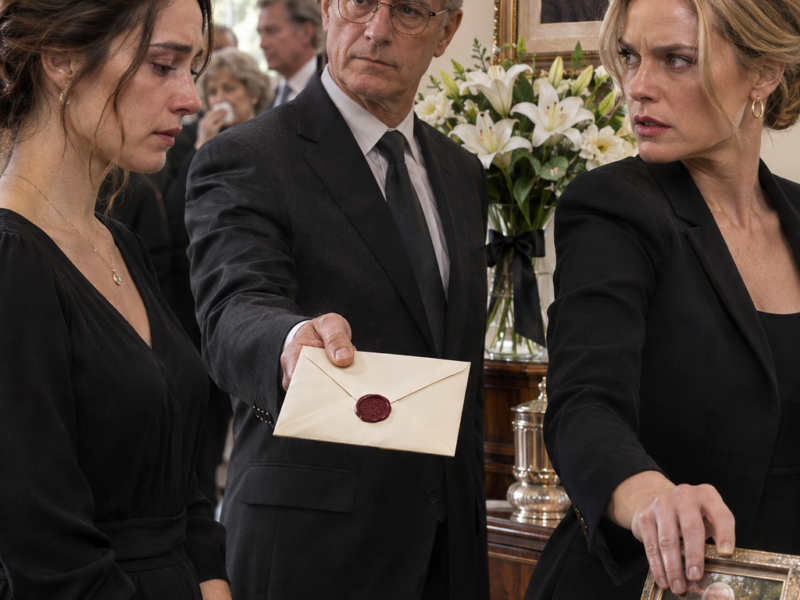
Right After Grandpa’s Funeral, Sister Erased Me From the Family I Stayed Silent Grandpa Didn’t
Right After Grandpa’s Funeral, Sister Erased Me From the Family I Stayed Silent Grandpa Didn’t
My sister waited until I had my hand on the back of the chair to tell me I couldn’t sit there.
“Find another table, Nicole. This one’s for family.”
Then, in case anybody in the back room of Marco’s had missed what she meant, she added, “We don’t need the hired help sitting with us.”
My mother set her purse on the seat. I remember the click of the clasp better than I remember the sound of the earth hitting my grandfather’s coffin that morning. The room smelled of coffee and gravy. My brother-in-law, Matt, shifted the baby to his other hip. I was still looking at my mother’s purse when I caught Danny Marco’s eye.
“Could you seat them somewhere else, please?”
“Of course, ma’am.” Danny came around the end of the table. He spoke loudly enough for the people by the door to hear him. “Your grandfather said you’d decide where everybody sits. The room’s paid for. You’re hosting today.”
My sister Jess stood there a moment, as if Danny might hear himself and take it back. Rosie, who’d worked at Marco’s for thirty years, pulled out a chair at the long table under the windows. Mom lifted her purse without looking up. Matt followed them with the baby, who reached over his shoulder for the lights strung above the door.
I sat down where I’d meant to sit in the first place. Danny put a cup of coffee in front of the empty chair beside mine.
In July, when I’d gone in to reserve the room, he’d told me there was already a booking under my name. Grandpa had paid for his own funeral lunch a month before he died. I’d spent the morning of the funeral trying to remember what else I was supposed to do. It hadn’t occurred to me that he’d remembered the seating, too.
“She’s hosting on his money,” Jess said at the other table. “That’s what the help does.”
By Monday, she’d put a price on it. Seven thousand two hundred dollars, and until the fifteenth of September to get out of his house.
I was seventeen the first time I heard that my job was to help him. My mother, Denise, had just married Keith Beck and was moving to his place in Cranberry Township. Jess was twenty-one. Wherever Mom went, Jess went. I had one year left at Ambridge High, and I wanted to finish it with the people I’d started with.
I got as far as “Could I stay with Grandpa—” before he said, “She stays. I’ll fix up the back room.”
Mom had her keys in her hand. “You’ll be fine with Grandpa, honey. Help him with the stairs. He won’t ask. Call me Sundays.”
I stood at the iron gate with my palm against the hot metal and watched her car go. I could smell Grandpa’s cigarette behind me. He stood there until she turned the corner, then asked if I wanted the bed against the wall or under the window.
The next morning, Rosie set a plate in front of me at Marco’s. “Your mom says you’re staying to help him. Good girl.”
“Yes, ma’am,” I said. I thought she was complimenting me.
Grandpa’s name was Frank Varga. He’d welded at the Bridgeworks and fixed boilers at the hospital in Sewickley. At six-thirty every morning, he ate kielbasa and eggs on the third stool from the door at Marco’s. His coffee went down as he sat, and he read the sports page back to front. When I moved in with him, the fourth stool became mine. It wobbled whenever I reached for the sugar. Without looking up from the paper, he’d steady it with one hand until I sat back.
When I was six, Steve Marco had decided the old stools were going to the curb. Grandpa came back after closing with his welding rig in the trunk of the Buick and rebuilt the legs on the third one. Steve asked him to do the fourth while he was at it.
“Not yet,” Grandpa said.
I was nineteen when I failed the practical exam for my nurse aide certification. I knew the steps, and my hands shook so badly that I couldn’t do them in order. Grandpa drove me to Pittsburgh to take it again. He waited three hours in the Buick at the far end of the parking lot with his newspaper. When I came out, he looked at my face and put the car in reverse. I told him I’d passed before we got to the street. He nodded once, then again at the light.
The next morning, I reached for the sugar and the fourth stool held. I leaned farther. Under the seat, the seams on the new legs were still blue from the heat.
“So yours doesn’t wobble either,” he said.
I put both hands flat on the counter. He let me sit there as long as I needed.
By the time he was seventy-seven, his hands had started to shake, too. He gave up cursive. His Christmas cards, the notes he left by the phone, the weights he recorded on the calendar after the doctor diagnosed his heart failure all went down in block letters.
“Capitals don’t wobble,” he told me.
I switched to nights at the nursing home in Boden so I could be around in the daytime. He started ordering two breakfasts on the mornings I worked. He ate one at the diner and carried the other home wrapped in foil. By the time I got upstairs, with my eyes still stinging from the lights at work, there’d be a warm plate outside my door. Everyone at Marco’s knew it as Nicole’s plate.
One winter, after I worked three nights in a row, I came down with a fever. I woke to the sound of Grandpa’s shoes on the floorboards, wet and heavy. He’d walked four blocks each way in sleet and brought back chicken soup, with my plate balanced on top of the bag. He sat by the bed and read the box scores while I ate.
“I’m supposed to be taking care of you,” I said.
“Today you’re the kid.”
When I finished, he took the bowl downstairs. I lay there listening to him wash it, too tired to get up and more grateful than I knew how to tell him.
About two years before he died, he spent five days in the hospital. I called Mom, and Jess came down from her office with a folder. She sat at the foot of his bed and asked the nurse about the plan going forward. Grandpa stared at the ceiling. When he came home, he waited until I’d helped him up the steps before he spoke.
“Don’t call them next time. They come with folders.”
Ten days later, he borrowed my car for an errand in Beaver. He came back with a brown envelope and slid it behind the coffee on the top shelf of the cupboard.
“What’s that?”
“Steelers lost again.”
I waited while he filled the kettle. By the time it whistled, I’d decided the envelope probably had something to do with the plot beside Grandma.
“I took care of something in Beaver,” he said. “You’ll know when you need to.”
A year later, Jess asked me to bring him to her office on Grant Street. She was a financial planner, and she used her client voice on us that day. If he needed assistance paying for a nursing home, she explained, there’d be questions about where his money had gone. A care agreement would document it. Six hundred dollars a month, plus room and board, for the work I did.
Grandpa read every line while Jess checked her phone. At the end, he looked at me. I could have said I wanted to take it home and think about it. Instead, I looked at the notary waiting and the way Grandpa was breathing after the walk from the elevator, and I signed. He signed underneath me.
“Put it where you want,” he said that night at the kitchen table.
Every month I cashed his check at the credit union, brought home six hundred-dollar bills, and tucked the envelope inside the Maxwell House can. On the first Friday afterward, Grandpa took it out, put it in his shirt pocket, and went to Marco’s. I could hear the lid pop from the next room. We went on like that for a year, each of us leaving the other alone about it.
Jess came back when the hospice nurse visited. She sat at our kitchen table with her leather planner open. “Realistically,” she asked, “how long?”
“Weeks to a few months,” the nurse said gently.
I was filling Grandpa’s water glass. From the sink I could see what Jess had written beside the place where she noted the nurse’s answer. The ink was different. Cranberry closing.
“He can hear you,” I said.
“I know, Nick. That’s why I’m asking now.”
I set the glass in front of him. Standing there, with my fingers still wet from the tap, I decided I’d signed the last piece of paper my sister would ever put in front of me.
Grandpa died on a Tuesday at four in the morning. I was holding his hand. Four days later at Marco’s, while Jess told my mother they’d go through his things on Monday, Danny came out of the kitchen with kielbasa and two eggs over easy. He folded back the foil and put the plate in front of the empty chair beside me.
I went around the room after that. I showed Grandpa’s niece where the restroom was, ordered ice cream for the kids, and thanked people for coming. Every time I returned to my seat, I could smell the breakfast cooling. I kept closing my hand under the table because, for a few seconds at a time, I could still feel his fingers in it.
On Monday, Mom let herself in while I slept after my shift. By the time I came downstairs, she was gone. She texted that Jess had taken care of the paperwork at the courthouse. On the kitchen table was an envelope from my sister’s firm. The letter inside said the house would be listed that week. My employment had ended with Grandpa’s death. I was to leave by September fifteenth. The check, drawn on Jess’s own account because Grandpa’s was frozen, was for $7,200. A year’s wages, extended as a courtesy.
I slid it under the coffee can.
That afternoon the funeral director called. Grandpa had left an index card with his prepaid arrangements, with instructions to give it to me afterward. There were four words in those shaky capitals. AFTER. CALL HANLAND. BEAVER.
Walter Hanland worked above a shoe repair shop on Third Street. He’d handled the purchase of the Maplewood house before I was born. The next time he saw Grandpa was the October Grandpa borrowed my car.
“He conveyed the house to you that day,” Hanland said. “He kept the right to live there for the rest of his life. The deed was recorded nearly two years ago. All we need now is the death certificate.”
I told him about the will Jess had arranged through her firm’s lawyer. Everything went to Mom.
“Whatever he still owned,” Hanland said, and waited while I looked down at the deed.
Grandpa had sat in the same chair I was sitting in. He’d told Hanland they would call me the help and asked him to see that it made no difference. When I asked why Grandpa hadn’t told me himself, Hanland almost smiled.
“He said you’d argue. He said he didn’t have the breath for it.”
There was a letter for me. Hanland handed it over, then closed the drawer on something else. Grandpa had given him instructions about that, too. I’d have to wait.
I read the letter in my car by the river. Nicole, they’ll call you the help. Let them say it, then let them read the deed. You never once asked me for the house. That’s why it’s yours. F.
I cried once, hard enough to fog the windshield, then sat until I could see the river again. I had a shift at eleven and needed to sleep. When I got home, I reached behind the coffee for the brown envelope Grandpa had left there. His copy of the deed had been in our kitchen the whole time.
The following Saturday, a photographer knocked at noon. The listing said the house was vacant. He apologized when he saw me in my socks. I let him take his pictures. Someone from the realty office put a lockbox on the front door, and from then on, every time I came home, the metal touched my knuckles while I turned my key.
A week later, Mom called in a voice I hadn’t heard from her in years. A couple from Sewickley had made an offer. The house would close on the twenty-ninth. Jess’s new place in Cranberry would close on the thirtieth. Mom was giving her the proceeds for the kids.
“Isn’t that perfect?” she said. “Dad would be so happy.”
I could see how one date held up the next. I could see, too, that somebody paid to check the title would look in the same place Grandpa had put the deed. I let them look.
When Jess called, she skipped hello. “What did you make him sign?”
“Nothing. He signed it in Beaver two years ago.”
“Grandpa doesn’t do lawyers.”
“He did one.”
On Sunday, she emailed a document for me to sign. It would give the house back so the sale could go through. I’d still get a share. The last paragraph said Grandpa hadn’t been himself when he signed the deed. I’d been on his payroll. Did I really want anybody looking into that? Family takes care of family, she wrote.
I called Hanland and asked him to put my answer on one page. Then I went to Marco’s.
Steve came out from the kitchen and sat on Grandpa’s stool. It was the first time I’d seen anyone sit there since the funeral. Danny had been putting a cup in front of it every morning.
“He came in in July and paid for the room,” Steve said. “Paid ahead on your plate, too. Told me, ‘She’ll handle it. Don’t let them tell her where to sit.’”
Pinned to the register was a birthday card Grandpa had written Steve that same month. HAPPY BIRTHDAY, STEVE. DON’T WOBBLE. F.
Steve told me about the Friday envelopes, too. Grandpa had put each one in Steve’s safe. The day after he died, Danny had taken the whole stack to Hanland. I figured Grandpa had been putting my wages toward my breakfasts and found myself smiling into my coffee. It sounded like something he’d do.
That night I opened the can. The last envelope had gone in the Friday before he died. He couldn’t walk four blocks by then. Danny had come in the car, and I’d helped Grandpa out to the curb thinking he wanted one more cup of coffee at the diner. I lifted the empty can and remembered him leaning on me while Danny opened the passenger door. I sat in Grandpa’s chair in the front room and cried until it got dark. Then I went back to the kitchen and signed Hanland’s page. I’d attend the family meeting. I wouldn’t discuss the sale there. I wouldn’t transfer the house.
Jess booked the same back room at Marco’s for Saturday at eleven. She’d arranged the chairs like a conference room. Her folder sat square to the edge of the table. Mom had her purse in her lap. Matt looked like he’d been hoping someone would ask him to stay home with the kids.
Jess slid the agreement toward me. “Sign this and the buyers can close. You still get a share, and you keep the seventy-two hundred. Call it severance.”
A pen lay beside the paper, uncapped. Mom rubbed her thumb back and forth along the strap of her purse. When I left the pen where it was, Jess told me again how it might look for a paid caregiver to end up with the house. Then, as if she’d remembered an errand, she turned to Mom.
“You still have Grandpa’s Christmas cards, right? For the kids’ memory book.”
“I was on his payroll,” I said. “I earned every dollar. Put that on your paper, too.”
Jess picked up her phone. Mom told me to be practical. Twelve years of free rent, she said. I pushed the agreement back until it touched the folder and stood up. At the door I thanked Rosie for the coffee.
“Attagirl,” she said, so quietly that I was the only one who heard.
I know what happened next from my mother and the county file. On Sunday, Mom brought down a shoebox of old cards. They were from the years before Grandpa’s hand changed. Jess gave Mom a typed statement to sign, saying Grandpa had told her more than once that he felt pressured by me. Mom said he’d never put it like that. Jess told her it was what he would have said. Mom signed.
Jess used the cards to copy his old cursive. In the letter she wrote to Mom and signed Dad, he supposedly said I kept putting papers in front of him about the six hundred dollars a month and that he signed because he was tired. She dated it March twelfth of the previous year. Her planner showed she’d brought tax papers to Maplewood that day. She’d left them on the porch when nobody answered.
Hanland sent my answer on Monday morning. By afternoon, Jess had filed a report of suspected financial exploitation with the county, on her firm’s letterhead. She attached the letter and Mom’s statement. She copied my employer and sent the report to the buyer’s lawyer as evidence that the deed was being challenged.
On Tuesday, September fifteenth, the director of the nursing home called me into his office. He told me I’d be suspended while the county investigated. I unclipped my badge and put it on his desk. I’d worn it for so many years that on my way out I kept reaching for it, as if I could still get through the staff door.
At Marco’s the next morning, the counter went quiet. Rosie’s niece worked at the home. Steve came out and set my foil plate on the counter hard enough to make the silverware jump.
“Standing order,” he said. Then he looked at Grandpa’s stool. “Anybody’s got a problem, take it up with him.”
At home, I read the letter until I could pick out the places where Jess had slowed down to get the slant right. Then I got out the notebooks where I kept track of Grandpa’s appointments and medications. March twelfth. I called Hanland. Grandpa had been in the hospital. Besides, I told him, the care agreement came months after the date on that letter.
“Find me someone who isn’t you,” he said.
I wrote down three names. Steve dug out the old tab book after the breakfast rush. In the week of March tenth, where Grandpa’s initial usually went, Steve had written F HOSP. Deacon Ed took his black visitation book down from a shelf at the rectory. March twelfth. Frank Varga, room 4B, Communion.
“I remember,” the deacon said. “He asked me to pray for the night nurse. I asked him which one.”
I looked up.
“‘My granddaughter,’ he said. ‘She thinks I don’t notice.’”
I gave Hanland the discharge papers from the kitchen drawer. The county could get the dates directly from the hospital. Then I took Steve’s birthday card off the register, laid it beside the letter, and looked at the difference between the old cursive and those big, uneven capitals. I thought of Jess at the table asking about a memory book while an uncapped pen pointed at me.
On Saturday I drove to Cranberry. Mom’s purse was by the coffee maker. I set both pieces of paper on the counter and asked which cards she’d given Jess. She reached for the birthday card first. She knew immediately which one was his.
“It was for the kids,” she said. “Jess is my daughter.”
“So am I.”
She wound the strap of her purse around a finger until the tip went white. When she started crying, I stayed on my side of the counter. After a while I told her what the investigator needed to hear. The date she’d given Jess the shoebox. How long Grandpa had been writing in capitals. Whose words were in the statement she’d signed.
“What happens to Jess?” she asked.
I looked at her hand. “That’s for the investigator.”
On Tuesday, the investigator called. Mom had withdrawn her statement that morning. She’d given the date and told the investigator that Grandpa had written in capitals for years. She’d asked the woman to tell me she’d called.
After I hung up, I sat on the third stair, the one Grandpa had practiced on after the hospital. One foot, then the other, his hand tight on the rail. I sat there until I stopped having to tell myself to breathe.
The investigator met Steve and Deacon Ed in the back room at Marco’s on Thursday. I stayed on the fourth stool. Through the door I heard Steve say, “That’s my hand. I don’t write things I didn’t see.” A little later I heard the deacon say, “Room 4B.” Rosie walked past and laid a hand on my shoulder without breaking stride. When the investigator came out, she sat on the third stool and looked down at the welds.
“He fixed yours for you?” she asked.
I nodded.
“You’ll have a letter by Friday,” she said, and left money for her coffee on the counter.
The county found the complaint unfounded. It referred the letter to the county detectives. The buyer’s lawyer terminated the sale and demanded the deposit and costs back from the seller, citing misrepresentation of authority. He sent Jess’s report back to the office whose name was printed at the top. The firm put her on leave.
Mom called to tell me. Just before she hung up she said the thirtieth was still circled on her refrigerator.
On the twenty-ninth, the day the couple from Sewickley had expected to buy the house, I took Grandpa’s death certificate to Beaver. Hanland stood behind me. Danny had come in his good jacket because Steve said somebody from the counter should be there. The clerk matched the names, typed for a while, and waited for a remarkably loud printer. Then she slid the page across to me. There was my name, Nicole Varga, beside the word owner. Danny stood holding his cap in both hands.
The next morning, the money Jess needed for her closing failed to arrive. She lost her deposit. Mom told me over the phone, then asked if she could come to Marco’s sometime.
“It’s a diner, Mom. Anyone can.”
That afternoon a man came for the lockbox. Two days later, the director slid my badge across his desk and said he was sorry. On my first night back, the woman in room twelve caught my wrist as I passed her bed. She’d known Grandpa and had called me the Varga girl for seven years.
“They told me you did something,” she said. “I said, ‘That girl?’ Nobody with sense believed it. Honey, go check on Mr. Pruitt. He’s been pressing his button.”
I went to check on Mr. Pruitt. By the time I got to his room, my badge was warm against my pocket.
On a Sunday in October, I took a cup of coffee up to the cemetery. I told Grandpa about the deed and the nursing home, and about the detectives asking for Jess’s planner. I told him the Steelers had lost again. I told him Jess’s check was still under the coffee can. I didn’t want the money, but every time I went to throw it away, I pictured the envelope on the table and how quickly she’d calculated what it would cost to send me somewhere else. I left it where it was for one more night.
The next morning, Hanland gave me the envelope Danny had brought from Steve’s safe. Inside were twelve bundles, each with six hundred-dollar bills. There was a page in Grandpa’s capitals.
EVERY MONTH SHE PUT IT BACK. EVERY MONTH I CARRIED IT TO STEVE’S. IT WAS WAGES. SHE EARNED THEM. SHE JUST WOULDN’T LET ME SAY SO.
Farther down, the letters had begun to lean.
NICOLE, GETTING PAID DOESN’T MAKE YOU THE HELP. YOU’RE OWED. DON’T PUT THIS ONE BACK. F.
I counted the bundles twice. Jess had reached $7,200 by multiplying the number on her agreement. Grandpa had reached it one Friday at a time, right down to the last ride Danny gave him when he could barely make it out to the curb. I deposited the money. At home, I took Jess’s check out from under the can and tore it in half.
On Thursday at six-thirty, I walked into Marco’s after work. Danny’s ten-year-old daughter, Lena, was on the fourth stool doing homework. She gathered her pencil and notebook and slid over to the third. Steve’s birthday card was back on the register. Danny set a foil-covered plate in front of me.
“Standing order,” he said. “He paid through Christmas.”
Then the door opened and my mother came in alone. She stopped at the counter with her purse still on her arm. Rosie was halfway through pouring a cup when Mom spoke.
“I’m the one who said she stayed to help him. She stayed because I left. And I signed a paper I shouldn’t have.” She looked at Steve. “Put that wherever you put everything else.”
Steve studied her for a moment. “Put it in the book, Danny.”
“From January,” Mom said, looking at me now, “her breakfast goes on mine.”
I’d spent twelve years making it easy for her to finish a conversation. I could feel myself getting ready to do it again. I unfolded one corner of the foil and let the steam out.
“You can buy breakfast, Mom.”
She hung her purse on the hook under the counter and took a stool with an empty one between us.
“When?” she asked.
“Tuesdays,” I said. “Here. Just you.”
Lena asked if she could have my toast. Danny brought Mom a cup, and she wrapped both hands around it the way Grandpa used to. After Lena left for school, the third stool stayed empty for half an hour. Then a man I’d never seen came in, sat down on it, and ordered eggs. Rosie called his order through to the kitchen. Mom moved one stool closer during her second cup. I heard the little scrape her shoes made against the footrest, and I slid the sugar within reach.
Then I leaned into the fourth stool, the way I had the morning I found the fresh welds. It held.