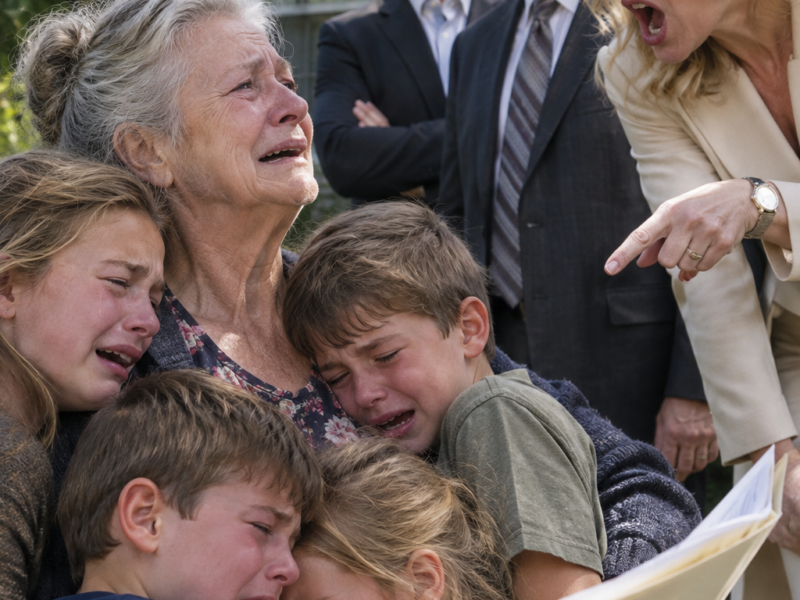
Raising My 4 Grandkids Alone After My Son Died, I Inherited His House—But When I…
Raising My 4 Grandkids Alone After My Son Died, I Inherited His House—But When I…
The first thing I noticed when I opened my dead son’s front door was the silence. Not the peaceful silence of an empty house waiting for its family to return, but the cold, hollow silence of a place that had been deliberately stripped of everything that once made it a home. I stood in the doorway with a brass key in my trembling hand, staring into a living room that looked as though a tornado had swept through it and carried away every trace of the people I loved.
Four months earlier, my son Garrett and his wife Hannah had died in a terrible crash on Interstate 70. Since that morning, I had been raising their four children alone. I was seventy-one years old, living on a modest pension, and working overnight shifts at a building supply warehouse because my retirement checks could no longer cover groceries, school supplies, heating bills, and winter clothing for four growing children.
That morning, I had walked into Garrett’s house believing our circumstances were finally about to improve. The property was located in a desirable neighborhood in Dublin, Ohio, and I had hoped to rent it for approximately $3,800 a month. That income would allow me to quit the warehouse, spend more time with my grandchildren, and give them something resembling the childhood their parents had intended.
Instead, I found myself standing in the middle of what looked like a crime scene.
The leather sectional where Garrett and I had watched football was gone. The oak dining table we had carried into the house together six years earlier had disappeared. The family photographs were missing from the staircase wall, leaving pale rectangular shadows on the paint. Even the ceiling fixtures had been removed.
In the kitchen, empty spaces marked where the refrigerator and oven had stood. Electrical wires dangled from exposed openings. Cabinet doors hung crookedly, and dust covered the granite countertops.
But what frightened me most was the crimson envelope lying in the center of the kitchen island.
Inside was a foreclosure notice.
According to the paperwork, somebody had borrowed $380,000 against my son’s house through a home equity line of credit. The payments were overdue, and the bank was preparing to take possession of the property unless the balance was resolved within thirty days.
I read the number three times.
Three hundred and eighty thousand dollars.
It made absolutely no sense.
Garrett had been a senior supply chain engineer earning a comfortable salary. He was careful with money, kept meticulous financial records, and had proudly told me only months before his death that his original mortgage was nearly paid off.
I had spent forty years working as a structural building inspector. My job had taught me to recognize when something was wrong beneath a perfectly respectable surface. Looking at that foreclosure notice, I felt the same instinctive warning that used to come over me when I found a suspicious crack in a foundation.
Something about this house was terribly wrong.
I walked toward Garrett’s private office.
The door had been broken open. Bookshelves lay overturned, the flooring had been torn apart, and a small wall safe had been cut open with what appeared to be an industrial torch.
Whoever had entered this house had not merely been stealing furniture. They had been searching for something.
Kneeling beside the ruined safe, I noticed a small piece of scorched paper trapped beneath the baseboard. I pulled it free and examined the surviving text.
One section referred to withdrawals from college savings accounts. Another contained the serial number of a heavy industrial vault, followed by a note written in Garrett’s familiar handwriting.
Before I could study it further, I heard the back door opening.
Two men entered the kitchen. One carried a toolbox, and the other held a replacement lock.
I recognized the man in front immediately.
Travis Sterling.
He was Hannah’s younger brother, a thirty-four-year-old man whose expensive clothes and endless business schemes had never seemed to match his actual income.
When he saw me, his expression changed from surprise to anger.
“What are you doing here, old man?”
I straightened slowly.
“I could ask you the same question.”
He glanced at the damaged hallway, then back at me.
“My mother and I are handling Hannah’s property. You shouldn’t be here.”
I showed him the keys.
“The probate attorney appointed me administrator of Garrett’s estate. This house belongs to his children. Now explain why it has been emptied and why somebody destroyed the safe.”
Travis took a threatening step toward me.
“You have no idea what you’re getting involved in.”
“Then explain it.”
Instead, he smiled.
“By tomorrow, you’ll be begging us to take this place off your hands.”
He turned and walked out, taking the locksmith with him.
I remained in that empty kitchen for several minutes after they left. Outside, wind shook the bare branches of the trees. Inside, the foreclosure notice rustled between my fingers.
I did not yet understand how many people had betrayed my son, how much money had been stolen, or how closely his death was connected to the strange destruction around me.
But I knew one thing.
I was not going to sign away my grandchildren’s inheritance simply because somebody believed an old man could be frightened into obedience.
To understand what happened next, you need to understand what the previous four months had done to my family.
My name is Harrison Cole. I had already buried my wife Clara six years earlier after a painful battle with pancreatic cancer. Losing her had nearly destroyed me. Losing Garrett felt as though somebody had returned to finish the job.
He was only thirty-nine.
At the funeral, his four children sat together on the front bench. Liam was twelve, Noah was nine, and the twins, Maya and Tessa, had just turned six.
Liam held his little brother’s hand throughout the service. The girls clung to each other, their faces swollen from crying.
I remember watching them while the pastor spoke, wondering how anyone could possibly explain to children that their parents would never walk through the door again.
After the burial, I approached my surviving daughter, Diana, and her husband, Victor Mercer.
They lived in a beautiful five-bedroom house in Upper Arlington. They had successful careers, expensive cars, and more space than they knew what to do with.
I asked whether they could help care for the children while the estate was settled.
Diana looked at me as though I had suggested something outrageous.
“Dad, Victor and I travel constantly. We can’t just reorganize our lives around four children.”
“They’re your brother’s children,” I reminded her.
“And you’re retired,” she replied. “You have plenty of time.”
Victor nodded.
“Taking them in would completely disrupt our lifestyle.”
Hannah’s mother, Beatrice Sterling, was standing nearby. When I looked toward her, she immediately shook her head.
“My condominium isn’t suitable for four noisy children. Besides, Harrison, they’re your son’s responsibility.”
I remember the exact moment my heart hardened.
It was not when they refused to help. People have limitations, and I could have understood fear or uncertainty.
It was the indifference in their voices.
Their son, brother, and daughter had just been buried, yet the surviving adults were discussing four grieving children as though they were unwanted furniture.
Behind me, Liam stood near the chapel entrance.
He had heard everything.
I could see it in his eyes.
I knelt before him and opened my arms.
“You’re all coming home with Grandpa,” I told the children. “And nobody under my roof is ever going to call you a burden.”
That evening, I brought them to my two-bedroom bungalow outside Columbus.
The girls took my bedroom. Liam and Noah shared the other one. I moved onto the living room sofa.
For a while, we managed.
I cooked breakfast before school, helped with homework, learned which twin preferred strawberry jam and which one hated mushrooms, and sat beside Noah whenever his nightmares woke him.
But money disappeared faster than I could replace it.
My pension and Social Security totaled $2,450 a month. Groceries alone sometimes exceeded $1,100. There were school expenses, medicine, utility bills, and winter coats that four children desperately needed.
I emptied the $18,400 retirement account Clara and I had spent decades building.
Then I took a night job at a building supply warehouse.
Five nights a week, I worked from eleven until five, loading lumber, concrete bags, and drywall onto pallets for fourteen dollars an hour.
My back had two damaged discs. By morning, my knees were swollen, and my hands often shook from exhaustion.
Still, I returned home, made breakfast, sent the children to school, and slept a few hours on the sofa before starting again.
Not once did Diana call to ask whether we needed groceries.
Not once did Beatrice offer to buy school supplies.
For 120 days, those children depended on an old man who sometimes had to lean against the kitchen counter to remain standing.
And I would have done it for another twenty years if necessary.
That was why finding the foreclosure notice felt so devastating.
I had finally seen a path toward stability, only to discover another disaster waiting behind the front door.
But the real nightmare began that evening.
Around seven o’clock, a luxury sedan pulled into my driveway. Diana stepped out with Victor and Beatrice.
My daughter carried a small plastic bag of apples and wore an affectionate smile that I had not seen since the funeral.
“We’ve been worried about you, Dad,” she announced.
I looked at the apples, then at the three expensive coats standing on my porch.
“Funny,” I said. “You didn’t seem worried during the last four months.”
They entered anyway.
Once the children were safely in their bedroom, I placed the foreclosure notice on the kitchen table.
“Tell me why Garrett’s house has been gutted.”
Beatrice immediately began pretending to cry.
She claimed Garrett had secretly lost money trading risky technology stocks. According to her, Hannah had been forced to borrow $380,000 to cover his losses.
When I asked about the missing furniture, Beatrice said Travis had sold it to pay the overdue interest.
When I mentioned the destroyed safe, she claimed Garrett had forgotten the combination.
The lies came so smoothly that I knew they had rehearsed them.
Then Victor opened his briefcase.
He produced a purchase agreement offering $410,000 for Garrett’s property.
“Sign this tonight,” he said. “My investors will pay the bank and leave you with thirty thousand dollars.”
I knew the house was worth far more than that.
Even damaged, the land and structure were worth at least $850,000.
Victor insisted the foreclosure deadline made his offer reasonable. Diana became impatient and reminded me that I was an elderly man barely surviving on a pension.
They gave me until five the following afternoon to decide.
I pushed the contract back across the table.
“I’ll speak to the bank first.”
Diana slammed her hand down.
“You are going to ruin everything with your stubbornness!”
I stood and opened the front door.
“Goodnight, Diana.”
They left furious.
Later, after the children were asleep, I unfolded the burned paper I had found in Garrett’s office.
The surviving transaction record showed that $142,000 had been withdrawn from the children’s college savings accounts just before the crash.
Attached to it was a manufacturer’s label for a Vulcan SF900 structural vault.
Beneath the serial number, Garrett had written:
“Subframe anchor. Four-inch offset. Clara’s birthday.”
I stared at those words.
Clara’s birthday.
August 14, 1952.
My son had left me a clue.
Before I could fully understand what it meant, another discovery changed everything.
Around midnight, I heard crying coming from the hallway closet.
Liam was sitting inside, wrapped in Garrett’s old engineering jacket.
He was trembling so badly that I lowered myself onto the floor beside him.
“What’s wrong, buddy?”
He stared at me with frightened eyes.
“Grandpa, please don’t let Aunt Diana take us away.”
“She isn’t taking you anywhere.”
His lower lip quivered.
“Mom said if I told anybody what I heard, Grandma Beatrice and Uncle Travis would go to prison. She said it would be my fault.”
I gently took his hand.
“What did you hear?”
Liam told me about an argument the night before his parents died.
Garrett had been shouting in his office. Hannah was crying. Travis and Beatrice were present.
Liam had overheard his father accusing them of stealing the money from the college accounts.
Then Garrett had shouted that Victor had forged his signature on a $380,000 loan.
According to Liam, Hannah begged Garrett not to report them. Travis had gambling debts, and Victor needed money for a failing commercial property venture.
But Garrett refused to remain silent.
He told them he was meeting attorney Evelyn Vance Ross at nine the following morning to report the fraud.
That morning, he left the house in his SUV.
Hannah ran after him and climbed into the passenger seat.
Less than half an hour later, they were dead.
I sat beside Liam without speaking.
The boy began to cry harder.
“I thought the crash happened because I listened at the door.”
I pulled him into my arms.
“Listen carefully, son. Nothing that happened to your parents was your fault. Nothing.”
I held him until he fell asleep.
Then I sat awake in the dark, thinking about Garrett’s final argument and the strange timing of the accident.
The next morning, I went to the bank.
Mrs. Keaton, the branch vice president, reviewed my probate documents and eventually provided copies of the original loan records.
The moment I saw Garrett’s supposed signature, I knew it was forged.
My son was left-handed. His writing had a backward slant and a distinctive underline beneath the capital G.
The signature before me slanted sharply to the right.
But the real shock came when I examined the certification page.
The loan had been originated by Victor Mercer’s brokerage.
And the notary who certified Garrett’s signature was Diana Cole Mercer.
My daughter.
I stared at her name for a long time.
I had taught Diana to ride a bicycle. Clara and I had paid for her education. I had carried her on my shoulders at county fairs and stayed awake beside her hospital bed when she was sick.
Now her official seal appeared on documents that had helped steal hundreds of thousands of dollars from her dead brother’s children.
I left the bank feeling as though I had aged another ten years.
But grief was no longer the only thing moving inside me.
I had spent four decades examining construction failures. I knew that the smallest flaw often revealed the location of a much larger structural problem.
And I knew how to follow evidence.
That afternoon, I retrieved Garrett’s original house blueprints from my tool shed.
Looking at the garage dimensions, I remembered the note about a four-inch offset.
There was only one location where a heavy steel vault could have been concealed against the structural frame without interfering with the mechanical systems.
The back wall of the garage.
That night, after Mrs. Gable, our kind elderly neighbor, agreed to watch the children, I returned to Garrett’s house.
I had purchased new locks and four small security cameras. I secured the entrances and placed the cameras where they could record anyone entering the property.
Then I went into the garage.
The original drawings showed an interior depth of twenty-four feet, six inches.
My laser distance meter showed twenty-four feet, two inches.
Four inches were missing.
I moved Garrett’s heavy workbench and tapped along the wall with a hammer.
Most of it sounded solid.
One section rang with the unmistakable sound of steel.
Using a pry bar, I removed a section of drywall.
Behind it, welded directly to a structural beam, was a large gray vault.
I recognized Garrett’s welding technique immediately.
I had taught him to weld when he was sixteen. The careful overlapping beads were as familiar to me as his handwriting.
I rested my hand against the cold metal.
“Good thinking, son,” I whispered.
The vault had a mechanical combination dial.
I entered Clara’s birthday.
The lock clicked.
Inside were a leather financial ledger, an external hard drive, and a sealed envelope containing legal documents.
The first document was an irrevocable trust Garrett had established shortly before his death.
It protected a $1.5 million life insurance benefit and a $1.3 million investment portfolio.
Together, the assets totaled $2.8 million.
Every dollar was designated for his four children.
And Garrett had named me successor trustee.
I could hardly breathe.
For months, I had been destroying my aging body in a freezing warehouse while my son had left behind enough money to protect his children for life.
The next document revealed another secret.
A medical group expanding its facilities near Garrett’s neighborhood had offered approximately $1.35 million for his property and adjoining land.
Victor had known about the development.
He had tried to purchase the house for $410,000 because he understood what it could eventually sell for.
He had not been rescuing us.
He had been positioning himself to steal an enormous profit.
But the most important discovery was still inside the vault.
Attached to the hard drive was a handwritten letter.
It began with one word.
“Dad.”
Garrett explained that he had uncovered the missing college funds and fraudulent loan. He believed Hannah had been manipulated by her mother and brother, while Victor had orchestrated the financial scheme.
He had saved the bank records and security footage.
He intended to take everything to Evelyn the following morning.
The final lines were almost unbearable to read.
“If anything happens to me, please take care of Liam, Noah, Maya, and Tessa. Don’t let them near my children’s inheritance. I love you, Dad.”
I read those words repeatedly.
Then I plugged the drive into my laptop.
Two folders appeared. One contained financial records. The other contained recordings from Garrett’s garage security system and vehicle cameras.
I opened the final garage recording.
The timestamp showed 2:14 in the morning, only hours before the crash.
Beatrice appeared on the screen.
She stood near the interior garage door while Travis crawled beneath Garrett’s SUV carrying tools.
I watched him deliberately interfere with the braking system.
Then I heard Beatrice ask whether the damage would stop Garrett from reaching his lawyer.
Travis explained that he expected the vehicle to lose braking power near the bottom of the neighborhood, causing a minor collision that would delay Garrett long enough for the financial records to be destroyed.
I sat completely still.
They had never intended for Garrett to reach the interstate.
But they had tampered with a machine whose failure could kill people.
The next recording came from the SUV itself.
I watched Garrett leave the garage.
Hannah ran outside and climbed into the passenger seat, pleading with him not to report her family.
They argued as he drove toward Interstate 70.
Then traffic slowed ahead.
Garrett pressed the brake pedal.
The vehicle did not slow.
His terrified voice filled my kitchen.
“The brakes aren’t working!”
Hannah screamed.
The SUV swerved toward a concrete barrier.
The recording ended.
For a long time, I could not move.
I had spent four months imagining my son’s final moments. Now I had heard his voice during them.
I wept until dawn.
But when the children awakened, I made their breakfast, kissed their foreheads, and sent them to school.
They needed a grandfather.
I would give them one.
After the bus disappeared, I called Mitch Donovan, a retired financial crimes investigator and old friend.
We met Evelyn at her office.
I placed the documents and recordings on her conference table.
When the footage ended, neither of them spoke for several moments.
Finally, Evelyn wiped her eyes.
“Garrett called me the night before he died,” she said. “He asked me to clear my calendar for an emergency meeting.”
Mitch examined the financial records.
“This is much larger than a family dispute,” he told us. “We need to preserve everything and involve investigators.”
Evelyn reviewed the trust and confirmed that Garrett’s original documents could secure the children’s inheritance.
She arranged an advance for their immediate needs.
For the first time in months, I drove to the grocery store without mentally calculating how much milk and bread I could afford.
I bought fresh fruit, good meat, warm clothing, and everything the children had quietly gone without.
Then I called the warehouse and resigned.
I thought perhaps the worst was behind us.
I was wrong.
The following afternoon, my phone alerted me that somebody had entered Garrett’s house.
Mitch was sitting beside me when we opened the security feed.
Victor, Diana, Beatrice, and Travis had broken inside.
They gathered in Garrett’s ruined office.
Victor announced that he had discovered the $2.8 million trust.
Their expressions changed instantly.
The people who had rejected four orphaned children at a funeral suddenly became intensely interested in their welfare.
Beatrice wondered aloud why they had not taken the children four months earlier.
Diana quickly proposed a solution.
They would accuse me of neglect.
They would claim I was elderly, confused, financially ruined, and incapable of caring for the children.
Then they would petition for custody and control of the trust.
I watched my own daughter explain how she could turn my age and poverty into weapons against me.
Within hours, Child Protective Services arrived at my bungalow.
Ms. Jennings, the lead social worker, explained that someone had reported severe neglect and possible cognitive decline.
Diana and Victor arrived moments later, pretending to be concerned relatives.
My daughter reached toward Maya and Tessa.
Both girls recoiled behind my legs.
I welcomed the social workers inside.
They found a clean house, a refrigerator full of food, school attendance records, medical documentation, and four children who were clearly loved.
When Ms. Jennings asked Liam whether he wanted to live with his aunt, he stood in front of his siblings.
“No,” he answered firmly. “Grandpa takes care of us. They didn’t want us until they found out about the money.”
The social worker looked toward Diana with an expression I will never forget.
The complaint was dismissed, and the visitors were instructed to leave.
But Diana and Victor did not surrender.
The next morning, a process server brought an emergency petition asking the court to revoke my guardianship and appoint Victor as conservator of Garrett’s estate.
They accused me of dementia, financial misconduct, and inability to care for the children.
The hearing was scheduled for Tuesday.
Mitch had continued tracing the stolen money. His investigation showed that Victor had used half the fraudulent loan to support his struggling brokerage and redirected the remainder through a company associated with Beatrice’s condominium.
The college savings had been transferred to Travis, who had used much of it to repay gambling debts and purchase expensive possessions.
We had the records.
We had the recordings.
And we had Garrett’s letter.
Still, Evelyn wanted the evidence presented carefully.
On Sunday, Diana called.
Her voice was gentle and trembling.
“Daddy, can we please meet for dinner? I don’t want our family fighting in court.”
I agreed.
Mitch arranged for me to record the conversation.
At seven that evening, I walked into a downtown steakhouse wearing my old flannel shirt and work boots.
Victor and Diana were waiting in a private booth.
They offered me twenty thousand dollars to surrender guardianship and all authority over the estate.
When I refused, Victor became threatening.
He claimed they had obtained medical opinions proving I was mentally unfit.
Diana laughed at my modest lifestyle.
She accused me of wasting my life by refusing dishonest opportunities during my years as an inspector.
Then she said something that finally extinguished the last hope I had been carrying for her.
She admitted that she supported having me declared incompetent because she believed she and Victor could invest the children’s millions more profitably.
I looked at my daughter and remembered the little girl who had once fallen asleep against my shoulder after a long day at the fair.
For a moment, I wanted to ask where that child had gone.
Instead, I quietly pushed the paperwork away.
“You’ll have to let the judge decide.”
They laughed as I left.
Outside, I joined Mitch in his car.
He had captured every word.
The following morning, we delivered our evidence to the prosecutor’s office.
Investigators compared the garage footage with the original crash reconstruction records. Financial specialists examined the loan, the transfers, and Victor’s brokerage accounts.
By afternoon, the authorities had enough evidence to pursue criminal charges.
The guardianship hearing would take place the next day under heightened security.
I barely slept that night.
At dawn, I stood in the children’s bedroom watching them breathe.
Liam had one hand resting on Garrett’s jacket beside his pillow. Noah was curled beneath his blanket. The twins had fallen asleep together after insisting that their stuffed animals needed to share a bed.
I remembered my promise at the funeral.
Nobody would make them feel unwanted again.
At 8:45 Tuesday morning, I entered courtroom four of the Franklin County Courthouse.
Diana and Victor were already seated beside their expensive attorney.
Beatrice and Travis sat behind them.
Their confidence was obvious.
Diana smirked when she saw my plain gray suit and Garrett’s worn leather briefcase.
Victor whispered something that made her laugh.
Then Judge Gregory Hale entered.
When he reviewed the petition and looked toward my table, recognition crossed his face.
He knew me.
Twenty-five years earlier, when he was a young attorney, his father had been falsely blamed for a construction accident. I had uncovered defective structural components, refused a substantial bribe, and testified truthfully about the real cause.
My evidence had helped clear his father’s name.
Judge Hale acknowledged our history and addressed the possibility of a conflict. After the procedural question was considered, the hearing proceeded.
Victor’s attorney began presenting their accusations.
Beatrice testified that Garrett had ruined himself through reckless investing.
She denied entering his house after the crash.
Diana claimed I was mentally deteriorating and had neglected the children.
Victor testified that Garrett had personally authorized the loan.
I sat silently beside Evelyn.
Every false statement made the truth more important.
When the petitioners finished, Evelyn rose.
She first presented the recorded steakhouse conversation.
Victor’s voice filled the courtroom, offering me twenty thousand dollars to surrender my grandchildren.
Then came his threats about manufactured medical reports.
Finally, Diana’s own voice admitted that she wanted the trust money for their business ventures.
Her confident expression collapsed.
Next, Evelyn played the video from Garrett’s house.
The courtroom watched the four relatives break inside, discuss the trust, and plan the false Child Protective Services complaint.
Beatrice lowered her head.
Travis stared at the exits.
Mitch then explained the financial records.
He showed the forged mortgage documents, Diana’s notary certification, the transfers into Victor’s business, and the stolen college savings.
Victor rose abruptly as though he intended to leave.
A deputy stopped him.
But the most devastating evidence remained.
I asked Evelyn to play the garage recording.
On the courtroom monitor, Beatrice appeared near the laundry room door.
Travis crawled beneath Garrett’s SUV.
The sound of his tools echoed through the courtroom.
Everyone heard the conversation about preventing Garrett from reaching his attorney.
Then we watched the dashcam footage.
I could not bear to look at the screen again, so I watched Beatrice instead.
She stared at Hannah running across the lawn and climbing into the vehicle.
Her face changed as she realized what was coming.
When Garrett shouted that the brakes had failed, Beatrice covered her mouth.
When the recording ended, she began screaming.
She turned on Travis, crying that they had killed her daughter.
Deputies separated them.
For months, Beatrice had treated Garrett and Hannah’s deaths as an inconvenience standing between her and stolen money.
Now she had to confront the fact that the woman she claimed to love had died because of the sabotage she helped conceal.
Judge Hale brought the courtroom back to order.
After reviewing the guardianship evidence and Garrett’s trust documents, the court rejected the attempt to remove me from the children’s lives.
The trust remained protected for Liam, Noah, Maya, and Tessa.
The criminal allegations were referred for prosecution, and the authorities waiting outside entered to take the suspects into custody.
Travis, Beatrice, and Victor were led away in handcuffs.
Diana remained behind briefly.
When I entered the courthouse hallway, she ran after me.
“Daddy, please!”
She fell to her knees and clutched my trousers.
She begged me to help her, claiming Victor had manipulated her and insisting that I was her only remaining parent.
Then she asked whether I could use Garrett’s trust money to hire her a criminal defense team.
Even at that moment, she still saw the children’s inheritance as money available for her own rescue.
I gently removed her hands.
“Diana,” I said, “four months ago, you looked at those children and called them a burden. You watched me work myself sick to feed them. Then you tried to take them away because you discovered they were wealthy.”
She cried harder.
“I made mistakes, Dad.”
“You made choices.”
I looked into her eyes.
“I will never use Garrett’s money to protect the people who robbed his children.”
A deputy approached.
I turned away before Diana was taken into custody.
Walking down the courthouse steps beside Evelyn and Mitch, I felt no triumph.
My son was still dead.
Hannah was still dead.
And the daughter Clara and I had raised had helped betray her own family.
Justice could protect the living, but it could not bring back those we had lost.
Over the following months, the criminal cases moved through the courts.
Travis received a twenty-year prison sentence for his role in the fatal sabotage and financial crimes. Beatrice received twelve years. Victor’s broader mortgage and financial fraud led to a ten-year federal sentence and the loss of his professional license.
Diana pleaded guilty to serious offenses connected with the forged documents and false allegations. She avoided prison but received strict probation, extensive community service, and permanent damage to her professional reputation.
Restitution proceedings recovered the children’s stolen college money, and the fraudulent mortgage was removed from Garrett’s property.
The house was safe.
The inheritance was protected.
But the work of rebuilding our lives had only begun.
Evelyn helped me arrange conservative management of the trust so the children could be cared for without recklessly spending the principal.
We also renegotiated the medical group’s land purchase. Rather than selling Garrett’s entire property, we sold a portion of the adjoining acreage for $750,000.
That allowed us to keep the house and its generous backyard.
I hired contractors to restore the stripped interior.
New appliances filled the kitchen. The damaged hardwood floors were refinished. The missing oak dining table was recovered, along with several family photographs and Garrett’s tools.
I personally hung every photograph back on the staircase wall.
When the children entered the restored house for the first time, Maya stopped before a picture of her parents.
“Grandpa, that’s where Mommy used to hang it.”
“I know, sweetheart.”
She touched the frame.
“Can it stay there forever?”
“As long as this house is ours.”
But there was one part of the property I could not leave unchanged.
The garage.
I could not bear the thought of my grandchildren standing in the same dark space where Travis had sabotaged their father’s vehicle.
So we transformed it.
We installed wide windows, bright lighting, warm maple flooring, and sturdy workbenches.
Garrett’s tools lined the walls beside the tools I had used throughout my career.
The place that had hidden a terrible secret became a sunny family woodworking shop.
Liam took to it immediately.
He loved measuring lumber, practicing joinery, and learning how to use the hand planes that had belonged to his father.
One Saturday, while we were finishing a small bookshelf for the twins, he looked at me.
“Grandpa, do you think Dad would like this?”
I studied the smooth edges and careful joints.
“Your dad would be proud of the work,” I told him. “But he’d be even prouder of the person you’re becoming.”
Liam smiled.
It was the first completely unguarded smile I had seen on his face since the funeral.
We also found a compassionate trauma therapist, Dr. Ramirez, who helped the children work through their grief.
It was not easy.
Noah sometimes woke up crying for Hannah. Maya worried that people who drove away might never return. Tessa became frightened whenever she heard sirens.
And Liam continued to struggle with guilt over the argument he had overheard.
We worked through those fears slowly.
We learned that healing did not mean forgetting.
It meant allowing memories of Garrett and Hannah to exist without always feeling the sharpest edge of their loss.
Every Sunday, I prepared the family meals Clara had loved.
Pot roast, cornbread, vegetables, and warm apple pie filled the kitchen with familiar smells.
Mitch and Evelyn often joined us. Mrs. Gable became an honorary grandmother to the children.
Our table was always crowded.
And every time I looked around it, I remembered the funeral when so many relatives had claimed there was no room in their lives for four children.
Now we had a family built not around obligation or inheritance, but around the people who actually showed up.
A year after the court hearing, I encountered Diana again.
It happened on a Friday evening while I was shopping for birthday candles and ice cream for Maya and Tessa.
I had stopped at a twenty-four-hour supermarket on the south side of Columbus.
Turning into the dairy aisle, I saw a woman kneeling beside a janitorial cart, scrubbing something from the floor.
Her uniform was faded. Her hands were red and chapped.
When she looked up, I recognized my daughter.
For a moment, neither of us spoke.
The designer clothes were gone. Her carefully styled hair had been pulled into a simple ponytail, and there were gray strands around her temples.
“Hello, Diana,” I said.
“Dad.”
She looked embarrassed, then lowered her eyes.
She explained that she had lost her corporate job, her home, and nearly everything she owned. She was living in a small apartment and working the night cleaning shift to satisfy the conditions of her probation.
Then she asked whether I could spare five minutes after she finished her work.
I agreed.
Outside, we sat near the supermarket entrance beneath the fluorescent lights.
For several moments, Diana said nothing.
Finally, she began to cry.
She told me that every night, while pushing a mop bucket and working through exhaustion, she remembered how she had mocked me for loading lumber to feed Garrett’s children.
She remembered her expensive clothes, her comfortable home, and the way she had refused to buy even a loaf of bread for her grieving nieces and nephews.
“I understand now, Dad,” she whispered. “You were doing the most important thing in the world, and I was too selfish to see it.”
I listened carefully.
For the first time, she did not ask me for money.
She did not blame Victor.
She did not demand forgiveness.
Instead, she asked one simple question.
“Are the children happy?”
I showed her a photograph on my phone.
Liam, Noah, Maya, and Tessa were sitting together in the backyard, laughing beneath the afternoon sun.
Diana stared at their faces.
Then she covered her mouth and cried quietly.
“Thank you for taking care of them.”
I put the phone away.
“I hope you continue making better choices, Diana.”
She nodded.
“Do you think you’ll ever forgive me?”
I looked toward the dark parking lot.
“I don’t know,” I answered. “Trust takes more than an apology. Finish your probation. Live honestly. Stop looking for shortcuts. If you can do that consistently, perhaps someday we’ll have a conversation that doesn’t begin with what you want from me.”
She accepted my words without argument.
Then she returned to work.
As I drove home, I thought about Clara.
I wondered what she would have said if she had been sitting beside me.
Clara had always believed people could change, but she had also believed that love without boundaries could become another form of cruelty.
I decided I would leave the future open without sacrificing the children’s safety.
Two years after I first entered Garrett’s devastated house, I stood outside a renovated brick building in downtown Columbus.
I was seventy-three.
Beside me stood my four grandchildren, now taller, stronger, and more confident than I could have imagined during those terrible first months.
A polished brass sign above the entrance read:
“The Garrett and Clara Cole Kinship Foundation.”
The idea had come from Liam.
One evening, we were discussing how fortunate we had been to find Garrett’s hidden records and secure his estate.
Liam listened quietly, then asked what happened to grandparents who did not have an inheritance or a lawyer to help them.
I explained that many older relatives struggled to raise children after a family tragedy. Some exhausted their retirement savings. Others faced complicated custody cases or relatives trying to seize property.
Liam thought about that.
“Grandpa,” he said, “we should help them.”
And so we did.
Working with Evelyn, Mitch, and a group of local professionals, we established a foundation that offered emergency financial assistance, legal guidance, and estate-protection services for grandparents unexpectedly raising grandchildren.
We helped families buy groceries, keep their electricity connected, find suitable housing, and protect property meant for children.
We worked with social workers and attorneys to make sure vulnerable families were not pushed aside simply because an older caregiver lacked money or influence.
At the opening ceremony, I looked out at dozens of grandparents standing with their children.
Some had tired eyes. Some leaned on canes. Others held toddlers in their arms.
I recognized the exhaustion in their faces.
I had lived it.
When I stepped to the microphone, I did not speak about millions of dollars or courtroom victories.
I spoke about a twelve-year-old boy sitting in a dark closet, terrified that the truth would destroy his family.
I spoke about a nine-year-old who still missed his mother’s bedtime stories.
I spoke about two little girls who wanted nothing more than to know someone would be there when they woke up.
And I spoke about an ordinary father who had loved his children enough to hide evidence inside a steel vault because he feared they would need protection.
Then I looked toward Liam, Noah, Maya, and Tessa.
“This building,” I said, “exists because four children deserved to be loved when the world had given them every reason to feel abandoned.”
We cut the ribbon together.
That evening, we returned home to Dublin.
The late spring sun was sinking behind the trees, covering the backyard in soft gold.
Liam and Noah were working near the open doors of our garage workshop. The younger boy was learning how to adjust his bicycle, while Liam patiently explained what each tool did.
Maya and Tessa ran across the grass laughing, their shoes damp from the evening dew.
From the back porch, I watched them.
It was difficult to believe that only two years earlier, those same children had arrived at my bungalow with a few suitcases and hearts full of grief.
I had been frightened then.
Frightened of money running out. Frightened that my failing body could not keep pace with their needs. Frightened that I would not live long enough to guide them into adulthood.
But I had discovered that courage did not mean living without fear.
Sometimes courage meant getting out of bed when your body ached, making four lunches, and pretending you were not worried because four children needed you to be strong.
Sometimes it meant walking into a bank and demanding answers.
Sometimes it meant confronting the people you loved most and accepting that they were capable of things you could never have imagined.
And sometimes it meant sitting quietly beside a frightened child until he finally believed that he was safe.
I reached into my pocket and removed a small leather photograph holder.
Inside were two pictures.
One showed Clara smiling in her kitchen apron.
The other showed Garrett wearing his engineering hard hat, a rolled blueprint tucked beneath his arm.
I looked at their faces for a long time.
There had been days when I thought I would never experience peace again. Days when grief felt like a physical weight against my chest, and every sound of a passing car reminded me of the highway where my son had died.
But now I could hear the children laughing.
I could smell freshly cut wood drifting from the workshop.
And through the open kitchen window came the warm scent of the apple pie cooling on the counter.
For the first time in years, my house felt complete.
Not because everyone I loved had survived.
They had not.
Not because justice had erased what happened.
It never could.
But because the love Garrett and Clara had given this family was still alive in the four children playing beneath the evening sky.
I touched Garrett’s photograph.
“We made it, son,” I whispered.
Across the lawn, Liam called for me to come look at the bicycle he and Noah had repaired.
I slipped the photographs back into my pocket and stood.
At seventy-three, I still had stiff knees and a back that complained on cold mornings.
But I had somewhere important to be.
I walked down the porch steps toward the children, knowing that my family was no longer defined by the people who had betrayed us.
It was defined by those who stayed, those who protected one another, and those who loved without calculating what they might receive in return.
Blood may connect people by birth, but it does not automatically make them family. Family is built through sacrifice, loyalty, kindness, and the willingness to stand beside someone when there is nothing to gain.
My son had left his children a fortune, but the greatest inheritance he gave them was not hidden inside a vault.
It was the knowledge that they were worth protecting.
And as I reached the garage, where Liam proudly held up his father’s old wrench and Noah grinned beside his repaired bicycle, I understood something that would stay with me for whatever years I had left.
We had not simply recovered a house.
We had reclaimed the future that greed had almost stolen from four innocent children.
And that was worth more than every dollar in the world.
THE END