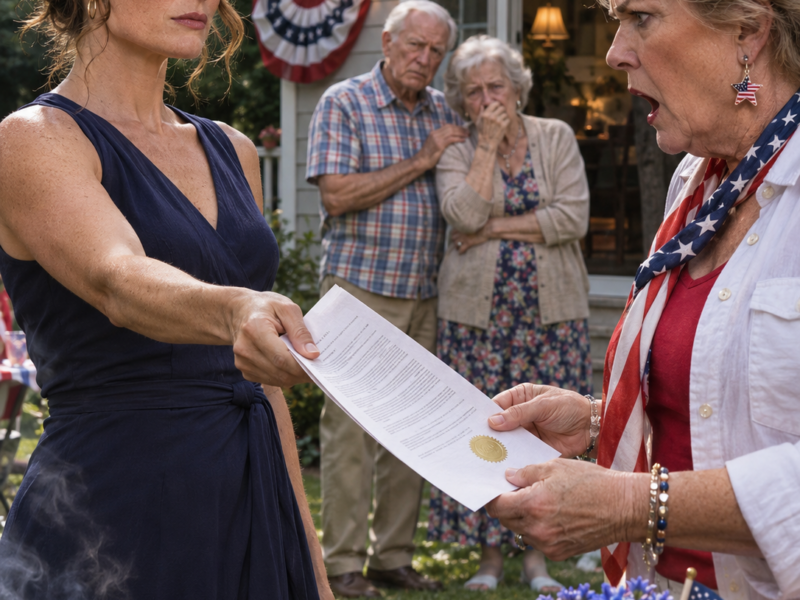
On the Fourth of July, I Found My 81-Year-Old Father and 78-Year-Old Mother Sitting in Their Car in 91-Degree Heat After My Mother-in-Law Locked Them Out of the Home I Had Built for Them. Inside My House, She Raised Her Wineglass Before 20 Guests and Declared, “Tell Everyone This Is Your Husband’s Family Home Now.” Instead of Arguing, I Smiled and Handed Her a Folded Eviction Notice Bearing My Husband’s Signature. Her Face Turned Pale—but When Her Husband Read the Letter, He Suddenly Recognized Something From 17 Years Earlier…
On the Fourth of July, I Found My 81-Year-Old Father and 78-Year-Old Mother Sitting in Their Car in 91-Degree Heat After My Mother-in-Law Locked Them Out of the Home I Had Built for Them. Inside My House, She Raised Her Wineglass Before 20 Guests and Declared, “Tell Everyone This Is Your Husband’s Family Home Now.” Instead of Arguing, I Smiled and Handed Her a Folded Eviction Notice Bearing My Husband’s Signature. Her Face Turned Pale—but When Her Husband Read the Letter, He Suddenly Recognized Something From 17 Years Earlier…
My mother-in-law was standing in the middle of my living room, raising a glass of wine to twenty guests, when I walked through the front door on the Fourth of July.
Outside, three houses down, my elderly parents were sitting in their old Buick with the engine running, trying to stay cool in ninety-one-degree heat.
My father was eighty-one. My mother was seventy-eight and diabetic. Neither of them had eaten a proper lunch, and they had been sitting in that car for more than two hours.
They weren’t waiting for someone to pick them up.
They weren’t enjoying a quiet afternoon away from the celebration.
They had been locked out of their own living quarters by a woman who had decided that their home should belong to her.
And that woman was my husband’s mother.
When Glenda Prescott noticed me standing in the doorway, she smiled broadly.
“There she is!” she announced. “Caitlin, darling, come tell everyone that this is your husband’s family home now.”
The guests turned toward me, some smiling, others holding paper plates loaded with barbecue and potato salad.
I looked at the framed photographs Glenda had brought from her house and arranged across my mantel.
I looked at the keys hanging from her wrist.
Then I smiled.
“Actually, Glenda, there’s something I’d like everyone to see first.”
I reached into my purse, removed a folded piece of paper, and handed it to her.
She opened it casually.
But the moment she recognized what she was holding, the color disappeared from her face.
Her wineglass stopped halfway to her mouth.
“Caitlin,” she whispered, “where did you get this?”
“Does it matter?”
She looked around the room.
For the first time in twelve years, my mother-in-law appeared to have absolutely nothing to say.
What she didn’t realize was that the document in her hand was about to expose more than her attempt to steal my parents’ home.
It was going to uncover something she had done seventeen years earlier.
Something her husband had spent nearly two decades trying to forget.
And something that would change our entire family forever.
My name is Caitlin Farmer. I’m forty-eight years old, and for most of my adult life, I’ve worked in public education.
As an assistant principal, I’ve learned how to recognize dishonesty, manipulation, and the complicated ways people justify hurting one another.
I’ve sat across from parents who refused to believe their children had done anything wrong. I’ve mediated arguments between teachers, investigated complaints, and dealt with situations that seemed impossible until someone finally told the truth.
Yet somehow, despite all those years of experience, I failed to recognize what was happening inside my own home.
Perhaps that’s because we see strangers more clearly than we see the people we love.
Perhaps it’s because acknowledging betrayal within your family means admitting that the people you trusted were capable of hurting you.
Or perhaps I simply wanted to believe that my husband would never allow his mother to do anything truly terrible.
Whatever the reason, I spent years overlooking warning signs that now seem painfully obvious.
I purchased my house in West Knoxville in June 2012, when I was thirty-four years old.
It was a modest brick ranch on Laurel Ridge Drive, with a large backyard, an aging kitchen, and a front porch that leaned slightly on one side.
The asking price was $186,000.
To some people, it might not have seemed particularly impressive.
To me, it represented six years of sacrifice.
I had saved money from every paycheck, driven an unreliable car long after my friends had replaced theirs, and turned down vacations because I wanted to build a future that didn’t depend on anyone else’s promises.
When the realtor finally handed me the keys, I sat alone in my empty living room and cried.
My parents drove down from their farm in Kentucky the following weekend.
My father arrived with a toolbox, a ladder, and enough supplies to repair problems I hadn’t even noticed.
He spent Saturday afternoon replacing the porch light.
My mother stood beside me in the yard, watching him work.
“You know why a porch light is important, Katie?” she asked.
I smiled.
“So you don’t trip over the steps?”
She shook her head.
“Because when somebody leaves a light on for you, it means they’re waiting for you to come home.”
That was my mother.
She could turn the simplest household object into a lesson about love.
Before leaving, she asked for a copy of my closing documents.
She folded the papers and tucked them into her white Bible, the same Bible she had carried for decades.
Mama kept everything important inside it.
Birth announcements. Funeral programs. Photographs. Letters from relatives who had died years earlier.
My father used to joke that if their farmhouse caught fire, she would rescue the Bible before rescuing him.
“You’re perfectly capable of getting yourself outside,” she always replied.
Two years after purchasing my house, I met Dylan Prescott.
He was a firefighter assigned to a safety presentation at my school.
I remember him helping me put away folding chairs after the assembly, even though everyone else had already left.
He asked me to dinner without trying to impress me.
There was something reassuring about him.
He listened when I spoke. He remembered small details. He never made me feel as though I needed to perform some better version of myself to deserve his attention.
Within a few months, I knew I loved him.
Unfortunately, falling in love with Dylan also meant becoming part of the Prescott family.
I met his mother, Glenda, at Easter dinner.
She was wearing a lavender suit and a necklace of imitation pearls. Her hair was perfectly arranged, and she greeted me with a smile that somehow made me feel as though I were being inspected.
During dinner, she asked about my job.
Then she asked where I lived.
When I mentioned that I owned a house, she laughed.
“Well, Dylan, you’d better watch yourself. A woman with her own house probably thinks she doesn’t need a husband.”
Several relatives chuckled.
I waited for Dylan to respond.
Instead, he squeezed my knee beneath the table.
Later, on the drive home, I asked him why he hadn’t said anything.
He sighed.
“That’s just Mom.”
“What does that mean?”
“She likes hearing herself talk. It’s easier to ignore her.”
I remember staring out the passenger window, feeling disappointed but unwilling to turn our evening into an argument.
I didn’t know then that those words would become the defining excuse of our marriage.
It’s easier to ignore her.
It’s easier to let her talk.
It’s easier not to argue.
For Dylan, avoiding conflict with his mother had become second nature.
His father, Earl, behaved the same way.
Earl was a retired electrician, a gentle man who rarely interrupted anyone. Whenever Glenda became demanding, he usually found something that needed repairing in another room.
I initially mistook their silence for patience.
Eventually, I understood that it was surrender.
Dylan and I married in October 2016.
He moved into my house, and we divided our household expenses in a way that made sense for us.
I continued paying the mortgage.
He paid utilities and handled most maintenance and repairs.
His name was never added to the deed.
We discussed it occasionally, but neither of us considered it necessary.
Glenda, however, seemed deeply bothered by the fact that her son lived in a house his wife had purchased.
She began referring to it as Dylan’s house.
At family gatherings, she told people he had bought a lovely place in West Knoxville.
Once, a woman from her church congratulated me on marrying a man who could provide such a beautiful home.
I corrected her.
Glenda laughed.
“Oh, Caitlin’s always been very particular about whose name is on things.”
Dylan said nothing.
When I confronted him afterward, he gave me the same answer.
“She doesn’t mean anything by it.”
I wanted to believe him.
For several years, I managed to overlook Glenda’s behavior.
She could be irritating, certainly, but she lived in Maryville with Earl, and we didn’t see her every day.
I never imagined she would become a genuine threat to my parents.
That changed in October 2024.
My father fell from the porch steps at his farm and fractured his hip.
He was seventy-nine years old.
For a man who had spent his entire life working outdoors, losing his independence was devastating.
My mother tried to care for him while maintaining the property, managing their finances, and keeping up with her own medical needs.
Every time I called, she insisted they were managing.
But during one visit, I found her sitting at the kitchen table with her head in her hands.
She looked exhausted.
Daddy was asleep in the next room.
“Mama,” I said gently, “you can’t keep doing this alone.”
She looked up.
“He’s my husband.”
“I know.”
“We’ve been taking care of each other for fifty years.”
“And now it’s my turn to help.”
I suggested that they sell the farm and move to Knoxville.
Daddy refused.
He said he wasn’t going to become a burden.
I argued with him for nearly two weeks without making any progress.
Then Dylan drove to Kentucky on his days off.
He spent an entire afternoon talking with Daddy.
When he returned, he told me my father had agreed.
“What did you say to him?” I asked.
Dylan smiled.
“I told him there’s a difference between being a burden and being loved.”
Those words made me fall in love with him all over again.
We decided to convert part of our house into an independent living suite.
The project took ten months.
Dylan spent his days off installing cabinets, laying flooring, framing walls, and making sure the space would be comfortable for my parents.
We included a small kitchen, a private bedroom, a sitting room, and a bathroom designed around Daddy’s mobility limitations.
There was a separate entrance with a ramp.
The project cost approximately $18,000.
My father insisted on purchasing the lumber for the ramp himself.
“A man ought to pay for the path to his own front door,” he said.
I understood that allowing him to contribute was important to his dignity.
So we accepted.
One afternoon, while the construction was still underway, Glenda arrived with two church friends.
I heard their voices from the laundry room.
“Look at what my son is building for me,” Glenda announced.
I stepped into the hallway.
“For you?”
She turned.
“Oh, Caitlin. I didn’t know you were home.”
“This is my parents’ suite.”
She smiled.
“Well, naturally. They’ll use it first.”
Her friends exchanged uncertain glances.
I felt my face grow warm.
“Glenda, there is no ‘first.’ We’re building it so my parents can live here permanently.”
“Of course, sweetheart.”
She said it in a tone that made it clear she didn’t believe me.
That evening, I told Dylan what had happened.
He laughed.
“She’s been calling it her apartment for months.”
I stared at him.
“And you haven’t corrected her?”
“She knows what we’re doing.”
“Apparently, she doesn’t.”
“Don’t worry about it.”
I should have insisted that he call her immediately.
I should have demanded that we establish clear boundaries before the construction was finished.
Instead, I accepted his reassurance.
My parents sold their farm in September 2025 and moved into the suite the following month.
Daddy brought forty years of tools.
He hung them neatly on a pegboard in the garage, arranging the wrenches and screwdrivers according to size.
Mama brought her favorite dishes, several quilts, her rosemary plants, and her white Bible.
Within days, the suite looked like a real home.
Daddy spent his mornings tinkering in the garage.
Mama baked biscuits, tended her plants, and occasionally walked with Loretta Banks, our neighbor three houses down.
Every evening, she switched on the porch light.
If I worked late, she left it burning until I returned.
For the first time in years, I stopped worrying about receiving a midnight telephone call from Kentucky.
My parents were safe.
They were happy.
And they were close enough that I could enjoy the years we still had together.
Then Earl developed heart problems.
In February 2026, he underwent a procedure to have two stents placed.
Glenda stayed in our guest room for several nights because we lived closer to the hospital.
On the third morning, I found her standing at my kitchen window, watching Mama water her rosemary plants.
“Your parents certainly landed on their feet,” she remarked.
I poured myself coffee.
“They’re happy here.”
“I can see that.”
She paused.
“Must be nice having a daughter who can provide such a comfortable retirement.”
“They worked hard their entire lives.”
Glenda didn’t answer immediately.
Then she said, “I wonder whether Dylan would do the same thing for me.”
“He loves you, Glenda.”
“That’s not what I asked.”
I looked at her.
She returned her attention to the window.
“My apartment would have been lovely.”
“What?”
“That apartment,” she corrected herself.
I told Dylan about the conversation later.
He dismissed it as jealousy.
When Glenda left our house, he gave her a spare key.
It was attached to a little brass cross.
He explained that it was for emergencies involving Earl’s health.
I didn’t object.
I would spend months regretting that decision.
On Mother’s Day, both sets of parents joined us for lunch.
We were eating dessert when Glenda announced that Earl’s knees were becoming troublesome.
“Eventually, we’ll need somewhere without stairs,” she said.
I nodded sympathetically.
Then she looked directly at me.
“That suite would be perfect.”
The conversation stopped.
“My parents live there,” I reminded her.
“Well, they can’t stay forever.”
I set down my fork.
“They aren’t temporary guests.”
Glenda gave me a tight smile.
“People’s circumstances change.”
“My parents’ circumstances have already changed. That’s why we built the suite.”
Dylan cleared his throat.
“Mom, leave it alone.”
Glenda stared at him.
For a moment, I thought she might argue.
Instead, she picked up her fork and changed the subject.
That night, Dylan mentioned that his mother had been asking about the suite repeatedly.
“She keeps saying maybe someday…” he began.
Then he stopped.
“Maybe someday what?”
He shook his head.
“Nothing. Forget it.”
I was tired.
He was tired.
And once again, we allowed an uncomfortable conversation to disappear before it was finished.
June arrived with the usual chaos at school.
By the middle of the month, I was overwhelmed.
One evening, I returned home after nine o’clock carrying a heavy bag of paperwork.
Mama met me in the hallway with a glass of iced tea.
“Honey, you look exhausted. What can I do?”
Without thinking, I answered, “Mama, I can’t take care of everybody all the time.”
Her smile faded.
“Of course.”
I walked past her.
I wasn’t angry with my mother.
I was frustrated with work, exhausted by responsibilities, and desperate for a few minutes alone.
But she couldn’t see all the thoughts behind my words.
She only heard what I said.
The following morning, I found the untouched glass on the hallway table.
I intended to apologize.
Then another busy day began, and I forgot.
Two days later, on June twentieth, Glenda visited my parents.
I wouldn’t discover what happened during that visit until the Fourth of July.
But I began noticing strange changes almost immediately.
Mama started packing boxes.
She told me she was organizing things for donation.
Daddy began giving his tools away to Tyler, Loretta’s seventeen-year-old grandson.
When I asked why, he shrugged.
“I won’t need them forever.”
One evening, I came home and noticed that the porch light outside the suite was dark.
Mama claimed she was trying to save electricity.
I accepted the explanation.
Then Daddy stopped me in the garage.
He was standing beside the pegboard, staring at the empty spaces where his tools had once hung.
“Katie?”
“Yes?”
“You’d tell us if we were getting in the way, wouldn’t you?”
I laughed softly.
“Daddy, don’t be ridiculous.”
He didn’t smile.
“I mean it.”
“You’re not in the way.”
I continued carrying groceries into the kitchen.
I didn’t ask why he needed reassurance.
I didn’t notice the expression on his face.
And I didn’t understand that my father was trying, in his own quiet way, to find out whether his daughter still wanted him.
On June twenty-sixth, Dylan asked whether Glenda could host a small Fourth of July gathering at our house.
He explained that Earl had been replacing the kitchen flooring in Maryville and that their house wasn’t suitable for entertaining.
A real estate agent was also supposed to visit them.
“How many people?” I asked.
“Eight, maybe.”
I would be helping Aunt Bev recover from knee replacement surgery in Lexington, Kentucky, but I expected to return sometime during the holiday.
“Eight people,” I agreed. “And my parents are guests. They’re not cooking, cleaning, or serving anybody.”
“Absolutely.”
“Make sure Glenda understands.”
“She promised.”
That was the arrangement.
Eight people.
A few hours.
Nothing more.
On July first, I drove to Lexington.
Aunt Bev’s surgery had gone well, but she needed assistance moving around, managing medications, and preparing meals.
Her son couldn’t arrive from Cincinnati until the holiday weekend.
I offered to stay with her for three days.
Everything seemed ordinary until the afternoon of July third.
I was standing in her kitchen when my phone rang.
The caller introduced herself as Pam Whitfield from Brookhaven Senior Apartments.
“You’re listed as the emergency contact for Ruth and Walter Farmer.”
My stomach tightened.
“Has something happened to my parents?”
“Oh, no. They’re fine. I’m just trying to confirm Monday’s move-in arrangements.”
I thought I had misunderstood.
“Whose move-in?”
“Your parents’. Unit 114. They’re scheduled for nine o’clock on July sixth.”
I gripped the counter.
“My parents aren’t moving.”
There was a long silence.
Then Pam spoke more carefully.
“They submitted an application on June twenty-fourth. Your mother paid the deposit.”
“How much?”
“Twelve hundred dollars.”
I felt dizzy.
“Why would they apply for an apartment?”
Pam hesitated.
“The application indicates they’re facing displacement from their current residence.”
Displacement.
I stared at the kitchen wall.
“Can you send me the paperwork?”
My mother had authorized Brookhaven to share relevant information with me as her emergency contact.
Within minutes, the documents arrived.
I printed them using Aunt Bev’s old printer.
The application was in Mama’s handwriting.
The receipt confirmed that $1,200 had been paid from my parents’ savings account.
Then I reached the final document.
Across the top, in capital letters, were the words NOTICE TO VACATE.
The date was June twentieth.
The notice read:
“This suite is needed for family. Please make other arrangements no later than July 6th. Please do not involve Caitlin. This decision is final.”
At the bottom was my husband’s name.
Dylan Prescott.
Homeowner.
I sat down.
For several minutes, I couldn’t do anything except stare at the signature.
My husband.
The man who had convinced my father to move to Knoxville.
The man who had built the ramp, installed the shower, and spent ten months creating a safe home for my parents.
Had he really ordered them to leave?
Had he secretly agreed to give the suite to his mother?
I wanted to dismiss the possibility immediately.
But then I remembered all the times he had refused to challenge Glenda.
All the conversations he had avoided.
All the lies he had allowed her to repeat.
And suddenly, I wasn’t certain of anything.
I called Mama.
She answered with her usual gentle voice.
“How’s Bev doing?”
“She’s recovering. Mama, is there something you need to tell me?”
Silence.
Then she said, “Nothing that can’t wait.”
“Are you sure?”
“Glenda’s getting ready for tomorrow. Your daddy and I will stay out of the way.”
“Mama, why would you need to stay out of the way?”
“Oh, honey, don’t worry about us.”
She ended the call without saying she loved me.
That had never happened before.
I tried reaching Dylan, but he was working a twenty-four-hour shift.
I sent him a message asking him to call.
He didn’t respond.
That night, I barely slept.
I lay on Aunt Bev’s couch, listening to the ceiling fan and replaying every conversation from the previous two months.
The boxes.
The missing tools.
The dark porch light.
My father’s question.
I finally understood what I had been seeing.
My parents weren’t decluttering.
They were preparing to leave.
And they were doing it quietly because they believed I wanted them gone.
The following morning, I called Dylan again.
He answered at eight ten.
“Hey, babe. I’m helping Mom get chairs from the church.”
“How many chairs?”
“Twenty, I think.”
“Twenty?”
“Yeah. She’s got tables, too. I need to pick up ice and Dad’s prescriptions.”
“Dylan, we need to talk.”
“Can I call you later? I’m running behind.”
He hung up before I could explain.
I called Aunt Bev’s son and asked him to come as soon as possible.
He arrived shortly after ten thirty.
As I prepared to leave, Aunt Bev caught my hand.
“Your mama has always been the sort of woman who’d give up her chair before asking somebody to make room for her,” she said.
I looked at her.
“Even when we were children. If there wasn’t enough food, Ruth said she wasn’t hungry. If somebody needed something, she gave it away.”
Her grip tightened.
“Some people see that kind of goodness and mistake it for weakness.”
I nodded, unable to speak.
Then I drove toward Knoxville.
The journey was approximately 175 miles.
I spent the first hour trying to control my emotions.
I needed to protect my parents.
I needed to determine whether Dylan had signed the notice.
And I needed to avoid giving Glenda the opportunity to portray me as unreasonable.
At a rest area outside London, Kentucky, I stopped and examined the document again.
This time, I studied it carefully.
The date was written in an old-fashioned style.
June 20th.
Dylan usually wrote dates using numbers and slashes.
The wording sounded wrong, too.
“Please make other arrangements.”
That wasn’t how Dylan spoke.
Then I noticed the signature.
His entire name was written in careful, looping handwriting.
I remembered the get-well card he had signed for Aunt Bev.
I had photographed it after she opened it.
I found the picture on my phone and enlarged the signature.
D. Prescott.
Quick. Angular. Familiar.
The signature on the eviction notice looked completely different.
I felt a sudden surge of hope.
Then I reminded myself that handwriting alone didn’t prove anything.
Still, there was another detail.
Homeowner.
Dylan had never used that word to describe himself.
He knew the house was in my name.
Could someone have forged the document?
Could Glenda have done it herself?
The possibility seemed outrageous.
But so did everything else that had happened.
I returned to the highway.
At one thirty-five, near Caryville, my phone buzzed.
It was a message from Loretta.
She had attached a photograph of my parents sitting inside their Buick beneath her oak tree.
“Your folks have been here since shortly after noon,” she wrote. “Glenda took their key and told them to leave. I’ve brought water and offered to let them come inside. Ruth says she doesn’t want to impose. She asked me not to bother you, but you need to know.”
I pulled into a gas station.
Then I called my mother.
She answered immediately.
“Please don’t make a fuss, honey.”
“Mama, why are you in the car?”
“It’s only for the party.”
“Is the air conditioning running?”
“Your daddy has it on.”
I heard him say they had about a quarter tank of gasoline left.
My hands began shaking.
My mother was diabetic.
My father had undergone major hip surgery.
The temperature outside was ninety-one degrees.
And my mother-in-law had locked them out of the home I had built for them.
I asked Loretta to stay nearby and make sure they had water.
Then I drove the remaining distance as quickly as I safely could.
When I finally turned onto Laurel Ridge Drive, I barely recognized my own house.
Cars crowded the street.
Patriotic decorations hung from the porch.
Music played in the backyard.
And three houses away, my parents sat in their Buick.
I parked behind them.
Mama rolled down her window.
Her face looked exhausted.
Daddy’s neck was flushed.
There was a half-empty package of crackers in Mama’s lap.
I crouched beside the passenger door.
“Tell me exactly what happened.”
Mama looked down.
“Glenda said we didn’t belong there anymore.”
“Those were her words?”
She nodded.
“She said the guests were coming, and we needed to be gone before they arrived.”
Daddy stared through the windshield.
“She said today was close enough to the sixth.”
I felt my jaw tighten.
Then Mama whispered, “She said you wanted us to go. You were just too soft to tell us.”
I took her hand.
“That is not true.”
Her eyes filled.
“Not one word of it.”
Loretta approached with two bottles of cold water.
I asked her to stay with my parents while I went inside.
Daddy caught my arm.
“Don’t do anything you’ll regret, Katie.”
I looked at him.
“I won’t.”
Then I walked toward my house.
Inside, the first thing I noticed was that my family photographs had been removed.
My parents’ anniversary picture was missing.
My wedding photograph had been turned facedown.
In their place were portraits of Glenda, Earl, and the Prescott family.
Glenda’s sister Connie was standing behind my kitchen island, pouring drinks.
Earl sat quietly on the couch.
Tammy, Dylan’s cousin, was talking with several relatives.
And Glenda stood in the center of the room, wearing a white blouse and a flag pin.
“Next year,” she was saying, “we’ll celebrate in my new apartment.”
Then she noticed me.
“Finally! Caitlin, tell everyone this is your husband’s family home now.”
I smiled.
“Good idea.”
I handed her the eviction notice.
She unfolded it.
Her expression collapsed.
For several seconds, she stared at the page without speaking.
Then she folded it quickly.
“This is private.”
“You made it public when you invited twenty people here.”
She looked around the room.
Then, remarkably, she began smiling again.
“Oh, sweetheart. Dylan wrote this. He didn’t know how to tell you.”
A murmur passed through the guests.
“Your parents understand,” she continued. “They’ve agreed to move. It’s for the best.”
I watched her carefully.
She was relying on Dylan’s silence.
For twelve years, he had avoided contradicting her in public.
She expected him to do it again.
“Then he can explain it himself,” I said.
The patio door opened.
Dylan stepped inside carrying grill tongs.
He looked exhausted.
“Hey, babe. You’re home.”
Then he noticed everyone’s expressions.
“What’s wrong?”
Glenda moved toward him.
“Tell Caitlin about the letter, honey.”
He frowned.
“What letter?”
I handed him my second copy.
He read it slowly.
Then he read it again.
His face hardened.
“That’s not my signature.”
Glenda laughed nervously.
“You’re tired. You’ve been working all night.”
“I know my own signature, Mom.”
He held the document up.
“I sign D. Prescott. I’ve signed that way since the fire academy.”
Glenda opened her mouth.
Dylan continued.
“And I’m not the homeowner. Caitlin owns this house.”
Someone near the window whispered, “Oh, my goodness.”
Dylan looked down the hallway.
“Where are Walter and Ruth?”
I answered.
“In their car. Three houses down. They’ve been there since noon.”
He stared at me.
“What?”
“Your mother took their key.”
He turned toward Glenda.
“Tell me that’s not true.”
She lifted her chin.
“Ruth said she felt like a burden. They wanted to leave. I helped them.”
“Then why does the letter say not to involve Caitlin?”
Glenda didn’t answer.
I showed everyone Loretta’s photograph.
“Does this look like two people who wanted to spend their afternoon in a hot car?”
Tammy stepped closer.
She looked at the photograph and then at Glenda.
“You told me they were resting inside Loretta’s house.”
Glenda waved her hand.
“They needed some quiet.”
“They were sitting in a car!”
Tammy’s voice rose.
“I asked about Ruth when I arrived. I brought her peach chutney. You told me not to disturb her.”
The room became painfully quiet.
I opened my folder and explained the Brookhaven paperwork.
The application.
The $1,200 deposit.
The move-in date.
The reason listed for priority placement.
Displacement from their current residence.
I held up the notice.
“This is the document they submitted as proof.”
Dylan stared at his mother.
“You did this?”
Glenda crossed her arms.
“I did what was necessary.”
“For what?”
“For our family!”
Tammy suddenly took out her phone.
“There’s something you need to see, Dylan.”
She opened a message Glenda had sent to the family group chat on June twenty-second.
It read:
“Prescott Fourth at Dylan’s this year, our new family home. Bring a side dish and come see my apartment.”
Dylan looked stunned.
“You told me eight people.”
Glenda shrugged.
“Plans changed.”
“You told me Walter and Ruth were resting at Loretta’s.”
“They were fine.”
“You told me those boxes in the garage were donations for the church.”
Glenda looked away.
Dylan’s voice dropped.
“I carried tables past their belongings without realizing what was happening.”
Earl removed his cap.
“She told me the same thing,” he said quietly.
Glenda turned toward him.
“Don’t start, Earl.”
Then she faced the room.
“My son built that apartment. He worked on it for ten months. He has every right to decide who lives there.”
I stepped forward.
“I bought this house in 2012. I met Dylan in 2014. I’ve paid the mortgage every month since before we knew each other.”
“You’re married,” she snapped.
“That doesn’t give you permission to evict my parents.”
She looked at Dylan.
“Tell her.”
He was silent for several seconds.
Then he said, “I built that suite for Walter and Ruth.”
Glenda blinked.
“I built it because Walter needed somewhere safe to live. Because Ruth couldn’t manage the farm alone anymore.”
He looked directly at his mother.
“I did not build it for you.”
Her face reddened.
“After everything I’ve done for you?”
“I should have corrected you the first time you called it your apartment.”
He took a breath.
“I should have stopped you when you told people this was my house.”
He glanced at me.
“I let you talk because it was easier.”
Then he looked back at her.
“And that was wrong.”
Glenda searched the room for support.
Nobody spoke.
Dylan extended his hand.
“Give me the key to their suite.”
She covered the keys hanging from her wrist.
“You are not going to embarrass me like this.”
Then Earl spoke.
“Give him the key, Glenda.”
Everyone turned.
His voice wasn’t loud.
But it carried a firmness I had never heard from him before.
Glenda stared at her husband.
Finally, she removed the key and placed it in Dylan’s palm.
He turned toward me.
“Let’s bring them home.”
We walked back to the Buick together.
Dylan knelt beside my father’s window.
“Walter, I didn’t write that letter.”
Daddy looked at him without speaking.
“I swear to you. I never saw it until today.”
My father’s eyes moved slowly toward me.
Mama began crying.
“We thought you wanted us gone.”
I crouched beside her.
“Never.”
“But you were so tired. And you said you couldn’t do everything for everybody.”
I closed my eyes.
That single careless sentence.
That glass of iced tea I had never touched.
Glenda had taken my mother’s insecurity and turned it into a weapon.
“Mama, I was tired of work. I was tired of responsibilities. I was never tired of you.”
She reached through the window and touched my face.
“I thought we were making things harder for you.”
“You make my life better.”
She covered her mouth.
Daddy looked down at his hands.
“I gave Tyler my tools.”
Dylan rested a hand on his shoulder.
“We’ll get them back.”
“Forty years’ worth.”
“Every last one.”
Mama reached into her purse and removed her white Bible.
“When Glenda told us to leave, I took this first,” she said.
I looked at the worn cover.
She had carried it out of the suite because she believed she might never return.
That thought nearly broke me.
Dylan helped Daddy out of the car.
I helped Mama.
Together, we walked back to the house.
The guests stepped aside as we entered.
Several apologized.
Others lowered their eyes.
Mama hesitated outside the suite.
I placed my hand against her back.
“This is your home.”
Dylan unlocked the door.
Then I switched on the porch light.
It was still broad daylight.
But I wanted that light burning.
Daddy’s recliner had been moved into the garage.
Dylan carried it back.
Mama placed her Bible on the nightstand.
Once I was satisfied that they were comfortable, I returned to the living room.
That was when I noticed Earl holding the eviction notice.
He was staring at it with an expression I couldn’t understand.
“Please make other arrangements,” he read aloud.
Glenda stiffened.
“Earl, put that down.”
He looked at her.
“I’ve seen this before.”
Dylan stepped into the room behind me.
“What do you mean?”
Earl held up the paper.
“Your mother wrote a letter like this to Grandma Ida.”
The silence was immediate.
I knew a little about Dylan’s grandmother.
She had moved into Brookhaven Health and Rehab in 2009 and died there two years later.
Glenda and Earl had subsequently moved into her house in Maryville.
According to the family, Ida had needed more assistance than they could provide.
That was the story everyone knew.
But Earl was about to tell us another version.
“Mama received a letter in 2009,” he said. “Typed. Just like this.”
Glenda shook her head.
“Not here, Earl.”
He ignored her.
“It told her we couldn’t care for her anymore. It told her to make other arrangements.”
His voice became rough.
“And it had my name at the bottom.”
Dylan stared at him.
“You wrote Grandma a letter?”
“No.”
Earl looked directly at his wife.
“Your mother did.”
Nobody moved.
“Grandma thought I didn’t want her anymore,” Earl continued. “She thought her only son had decided she was too much trouble.”
He swallowed.
“So she moved into Brookhaven without arguing.”
Dylan’s face had gone pale.
“Did you know?”
“Not until after she died.”
Earl lowered his eyes.
“I found the letter in her Bible after the funeral. I asked your mother about it. She admitted writing it.”
Glenda spoke sharply.
“Ida needed professional care.”
“That doesn’t explain why you signed my name.”
“She wouldn’t have agreed otherwise.”
“Exactly.”
Earl’s voice cracked.
“She died believing I didn’t want her.”
Dylan took a step backward.
For a moment, he looked like a child hearing something too terrible to understand.
Earl continued.
“By then, we were living in Mama’s house. I let it go because it was easier than admitting what had happened.”
He looked at the notice in his hands.
“Today, you told me Walter and Ruth were resting at Loretta’s.”
He shook his head.
“I believed you again.”
His eyes filled.
“I let you do it once. God forgive me, I almost let you do it twice.”
Glenda’s expression changed.
The confident woman who had been raising a glass to her new apartment was gone.
In her place stood someone frightened and furious.
“Do any of you understand what I’ve lived through?” she demanded.
Nobody answered.
“I’ve spent fifty-two years living in houses that belonged to other people. Earl’s parents’ farmhouse. Rentals. His mother’s house.”
She looked toward the hallway.
“I’ve never had anything that was mine.”
Her voice trembled.
“I’m seventy-three years old. I’m not going to spend the rest of my life waiting for somebody to decide I’m a burden.”
For a brief moment, I understood her fear.
But before I could respond, my mother appeared in the hallway.
She was holding the wall for support.
Her cotton blouse was still damp from the heat.
She looked at Glenda.
“Then you knew exactly how I would feel.”
Glenda stared at her.
Mama continued.
“You knew what it would do to a mother to believe her child didn’t want her anymore.”
Her voice was gentle.
There was no accusation in her tone, which somehow made the words more devastating.
“You were afraid somebody would make you feel unwanted. So you made us feel that way first.”
Glenda opened her mouth.
Then she closed it.
For the first time all afternoon, she had no explanation.
I stepped into the center of my living room.
“Thank you all for coming. The party is over.”
Nobody protested.
Tammy began helping people collect their dishes.
One of Earl’s cousins went into the garage and started carrying my parents’ boxes back into the suite.
Several guests apologized to Mama.
Connie gathered the framed Prescott photographs.
When she reached for Dylan’s fire academy portrait, he stopped her.
“Leave that one.”
After the guests departed, I retrieved my parents’ anniversary photograph and returned it to the mantel.
Then I approached Glenda.
“The spare key, please.”
She looked at Dylan.
“You’re going to let her throw your mother out?”
Dylan stood beside me.
“You’re leaving because of what you did.”
“I’m your mother.”
“I know.”
He paused.
“That’s why it took me this long.”
She stared at him.
“You forged my signature. You lied to Walter and Ruth. You lied to Caitlin. You lied to Dad.”
He held out his hand.
“You won’t come back until Walter and Ruth decide you’re welcome.”
Glenda looked at me.
Then she removed the brass key with the little cross and placed it in my palm.
“Earl, get the car.”
Earl remained seated.
“Connie can take you.”
“What?”
“I’m going home alone.”
Glenda looked horrified.
“Earl Prescott, get up.”
He slowly raised his head.
“I need to spend some time in my mother’s house and think about what I allowed to happen there.”
For a long moment, they stared at each other.
Then Glenda turned toward Dylan.
“Please, son.”
He shook his head.
“Call me when you’re ready to apologize to Walter and Ruth.”
Connie took Glenda to her home in Sevierville.
Earl returned to Maryville alone.
Before leaving, he stood outside my parents’ suite and asked Daddy whether he might return someday to apologize properly.
Daddy nodded.
“When you’re ready.”
Later that afternoon, Dylan went to retrieve my father’s tools.
Tyler had kept everything organized inside a large toolbox.
When Dylan explained the situation, the teenager immediately began carrying the tools back.
“Mr. Farmer told me I’d need them when I got my own place,” he said.
He shrugged.
“I can wait.”
While they restored the pegboard, I helped Mama unpack her boxes.
Inside were sweaters, dishes, photo albums, and an envelope containing drawings I had made as a child.
One picture showed a farmhouse with a huge yellow circle beside the front door.
“What’s that?” I asked.
Mama smiled.
“The porch light.”
I looked at her.
“You drew it when you were seven. You said you wanted it bright enough that everybody could find their way home.”
I held the drawing carefully.
Then I hugged her.
From the garage came the sound of Daddy hanging his hammer back onto its hook.
It was a small, ordinary noise.
But to me, it sounded like someone reclaiming a life that had nearly been taken from him.
That evening, fireworks began exploding over Knoxville.
Mama and I sat outside the suite beneath the porch light.
She finally told me exactly what Glenda had done on June twentieth.
She had arrived carrying a chicken casserole.
Daddy was asleep.
Glenda handed Mama the notice and claimed Dylan had asked her to deliver it.
Then she told Mama that I wanted my parents gone.
She said I was too kind to tell them myself.
She warned that staying would force me to choose between my husband and my parents.
“So I decided to leave,” Mama whispered. “I didn’t want you to have to choose.”
I took her hand.
“You should never have been put in that position.”
She nodded.
“Monday, I’m calling Brookhaven myself.”
“I can help.”
“No, honey. I signed the application. I’ll cancel it.”
I smiled.
“All right.”
A little after ten, Dylan’s phone lit up.
It was a message from Glenda.
“You chose her family over your own.”
He showed it to me.
Then he typed his response.
“They are my family.”
He sent the message and switched off his phone.
We watched the remaining fireworks together.
On Monday morning, Mama called Brookhaven.
She explained that she would not be moving in.
Because the lease hadn’t been finalized, the $1,200 deposit would be refunded.
When Pam asked where to send the check, Mama gave our address.
“Send it to my home,” she said.
There was no hesitation.
I turned toward the kitchen window, pretending to be interested in the backyard.
The following Saturday, Earl returned carrying his mother’s old leather Bible.
He placed it on our kitchen table.
Inside was the letter Glenda had written in 2009.
The wording was remarkably similar to the notice my parents had received.
“We can no longer provide the care you need. Please make other arrangements.”
At the bottom was Earl’s forged signature.
Dylan stared at both documents.
Then he sat down and began crying.
Earl placed a hand on his son’s shoulder.
“Your grandmother was a wonderful woman,” he said. “She could still beat me at checkers the week she died.”
Dylan covered his face.
“I wish I’d known.”
“So do I, son.”
Then Earl revealed another part of Glenda’s plan.
The real estate agent who had been visiting their Maryville property wasn’t simply providing advice about renovations.
Glenda had been preparing to sell the house.
The property had been inherited by Earl from his mother, and she couldn’t sell it without his cooperation.
Her intention had been to move into our suite first.
Once she was settled, she could pressure Earl into selling the Maryville house.
She had already discussed a potential listing date for the fall.
Earl canceled those arrangements.
He also told Glenda that he wouldn’t consider living with her again until she sought counseling and demonstrated that she understood the harm she had caused.
By the end of July, word had spread through the Prescott family and Glenda’s church.
She stepped down from her position as hospitality chair.
Nobody asked her to reconsider.
Tammy announced that the following year’s Fourth of July celebration would be held at her house.
She specifically invited my parents.
Twenty relatives reacted with hearts.
Glenda eventually sent Mama a two-page letter.
It began with the words, “I’m sorry you felt hurt.”
The rest consisted mostly of explanations and excuses.
Mama read it quietly.
Then she folded it and placed it inside a kitchen drawer.
“That doesn’t belong in my Bible,” she said.
I didn’t argue.
In August, Dylan and I began marriage counseling.
I needed him to understand that although he hadn’t forged the notice, his years of silence had made it possible for me to believe he might have.
“For nearly twenty hours,” I told him during one session, “I thought you had betrayed my parents.”
He nodded.
“I know.”
“I couldn’t understand how the man who built their home could suddenly take it away.”
He reached for my hand.
“I gave you reasons to doubt me. Every time I let Mom say something that wasn’t true.”
We established boundaries.
Glenda would not enter our home unless my parents invited her.
Dylan would no longer answer every demand she made.
And neither of us would avoid difficult conversations simply because silence seemed easier.
Earl began visiting on Sundays.
He and Daddy gradually developed a friendship.
Sometimes they sat outside the suite without speaking.
Other times, they discussed tools, gardening, and repairs.
One evening, Dylan apologized to Daddy again.
My father listened patiently.
Then he handed Dylan a level from the pegboard.
“You came and got us,” he said.
“That’s the part I’m keeping.”
By Labor Day, the atmosphere in our home had changed.
Daddy and Dylan spent the morning building raised garden beds.
Tyler helped carry boards.
Mama watched from the porch, occasionally reminding them to drink water.
Earl arrived with a warm peach cobbler.
We ate together in the backyard.
For the first time since July, the house felt completely peaceful.
That afternoon, Mama brought her white Bible into the kitchen.
“Could you write something for me, honey?”
“What would you like?”
“Whatever you want.”
I tore a small piece of paper from the notepad on the refrigerator.
I thought about the forged notice.
I thought about the nights she had spent wondering whether her daughter still loved her.
Then I wrote three words.
“You belong here.”
Underneath, I signed my name.
Mama read the note.
Her eyes filled.
She opened the Bible to the place where Glenda’s eviction notice had been kept.
Then she slipped my message inside.
The old paper had been replaced.
Not with another demand.
Not with an apology that avoided responsibility.
But with a promise.
Later, she showed me the porch swing she had purchased using the refunded $1,200 deposit from Brookhaven.
Dylan and Daddy had installed it outside the suite.
She sat down and invited me to join her.
We watched the sun begin disappearing behind the trees.
For a long time, neither of us spoke.
Then Mama squeezed my hand.
“You know, Katie, I never wanted anything from you except to know you were happy.”
I looked at her.
“And I never wanted anything from you except to know you were safe.”
She smiled.
“We should have talked sooner.”
I nodded.
“We should have.”
As evening approached, I stood in the backyard and looked at the house I had purchased fourteen years earlier.
The crooked mailbox was still there.
The porch still sagged slightly.
The bricks were beginning to show their age.
But the house felt more precious to me than it ever had.
Not because of its price.
Not because my name appeared on the deed.
And certainly not because I had defeated someone who wanted to take part of it for herself.
It mattered because the people I loved were inside.
That summer taught me something I wish I had understood years earlier.
Keeping the peace is not the same as protecting your family.
Sometimes silence protects the person causing harm.
Sometimes forgiveness without accountability becomes permission to repeat the same cruelty.
And sometimes the most loving thing you can do is refuse to let someone continue hurting the people who trust you.
Glenda had believed that possessing a key meant possessing a home.
She had believed that manipulating her son gave her authority over his marriage.
She had believed that my parents’ kindness made them easy to remove.
What she never understood was that my parents had something she couldn’t manufacture through forged signatures or carefully arranged family gatherings.
They were loved.
As the sky darkened over Laurel Ridge Drive, the porch light outside their suite came on.
Mama had switched it on herself.
Its warm glow spread across the ramp Daddy had paid for, the rosemary plants Mama had tended, and the swing they had bought with money once intended for an apartment they never wanted.
I stood there watching the light.
And I remembered what Mama had told me when I first purchased the house.
A porch light means somebody is waiting for you.
It means you have somewhere to return.
It means that no matter how difficult the world becomes, someone wants you to come home.
My mother-in-law had tried to take that feeling away from my parents.
She had nearly succeeded.
But she had underestimated one thing.
The little girl who once drew an enormous yellow porch light beside a farmhouse had grown into a woman who would never allow anyone to make her parents feel unwanted again.
And as long as I lived, that light would always be burning for them.