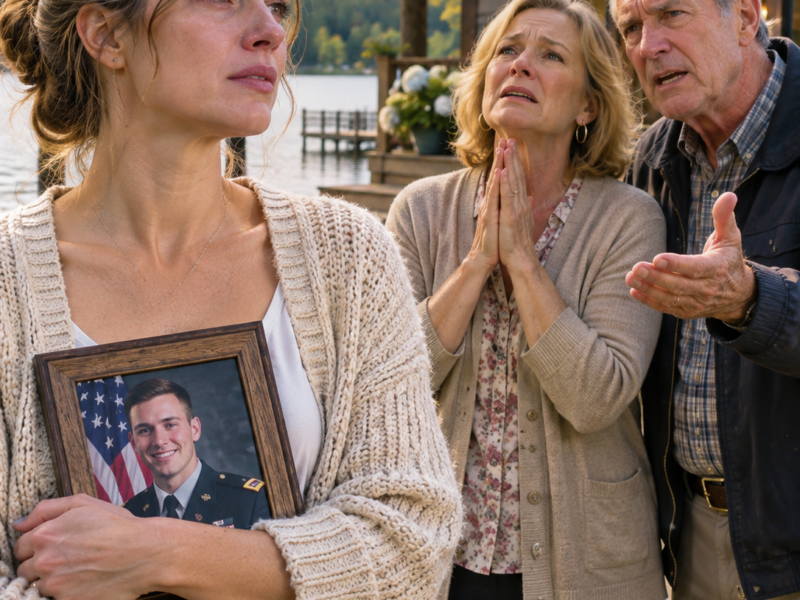
On my 14th birthday, my mother bought plane tickets for everyone except me, saying, “You’re too old for family trips now,” and left me alone for 12 days with just $11. Twenty years later, my parents showed up at my lake house, expecting to spend their retirement in the apartment downstairs. Instead of arguing, I let them meet the 84-year-old man who was already living there. But when he opened a faded red ledger and showed my father an entry from 2006, everything changed…
On my 14th birthday, my mother bought plane tickets for everyone except me, saying, “You’re too old for family trips now,” and left me alone for 12 days with just $11. Twenty years later, my parents showed up at my lake house, expecting to spend their retirement in the apartment downstairs. Instead of arguing, I let them meet the 84-year-old man who was already living there. But when he opened a faded red ledger and showed my father an entry from 2006, everything changed…
Part 1
On my fourteenth birthday, my mother bought three plane tickets for a family vacation. Twenty years later, she stood outside my lake house, expecting me to provide her with a comfortable retirement.
She had no idea who was already living downstairs.
My name is Jory Ackerly. Growing up in Wexcom, Ohio, I learned early that my older brother, Rolo, was the center of our family’s universe. My mother, Adaline, celebrated his smallest achievements, while my father, Vernon, quietly supported every decision she made.
I was simply expected to manage on my own.
When I was thirteen, I spent an entire summer mowing lawns to buy a welding machine. I saved $360 in an old Band-Aid tin, only to discover one afternoon that every dollar had disappeared.
My mother had taken it to pay for Rolo’s baseball camp.
“It’s for your brother’s future,” she explained, patting my shoulder. “That’s my boy.”
Nobody ever repaid me.
The following June, on my fourteenth birthday, my mother announced that the family was going to Clearwater, Florida.
When I asked where my ticket was, she smiled.
“Oh, honey, you’re too old for family trips now. You’ve always been the independent one.”
Two days later, they left without saying goodbye.
With eleven dollars in my pocket, I rode my bicycle along a country road searching for work. That’s how I discovered Maddox Welding and met Isham, a sixty-four-year-old retired Navy welder.
He handed me a broom and offered me ten dollars to clean his workshop.
His wife, Dessa, brought me lunch. Isham taught me how to weld, how to respect my work, and how to turn discarded welding rods into little metal birds.
During those twelve days, my parents never called.
But Isham showed up every morning.
Over the following years, he became my mentor, and Dessa became the closest thing I had to a loving mother. Isham recorded every hour I worked in a red ledger, insisting that I sign for every payment.
At eighteen, my father asked to borrow $5,000 to replace our broken furnace. Remembering Isham’s lessons, I requested written acknowledgment.
He signed an envelope promising repayment.
The furnace was never replaced. Instead, Rolo moved to Florida to pursue a career in real estate.
My money disappeared again.
I eventually built a successful welding business, married a wonderful woman named Eloise, and bought a beautiful property overlooking a lake. We renovated the house and created a separate downstairs apartment.
Meanwhile, my parents sold their Ohio home and purchased a Florida condominium, putting everything in Rolo’s name.
Then disaster struck.
My aunt Lorna revealed that Rolo had borrowed $95,000 against the condominium to purchase a charter fishing boat. Hurricane Ian destroyed the boat, damaged the building, and left my parents facing a $41,000 assessment.
But that wasn’t the worst revelation.
My mother had also cashed the savings bonds my grandmother had left me, worth more than $1,200, to finance the Florida vacation from which she had excluded me.
I had unknowingly paid for my own abandonment.
That spring, Isham fell outside his farmhouse, breaking his wrist and cracking two ribs. Dessa admitted they could no longer safely live there.
Eloise immediately offered them our downstairs apartment.
I widened the doorways, installed grab bars, and built a forty-foot steel ramp leading to the dock. Isham insisted on paying $150 monthly. I accepted his envelopes but never spent the money.
Three years later, on my thirty-fourth birthday, my parents appeared unexpectedly.
My mother carried a folder containing floor plans and retirement budgets.
Rolo had sold their condominium, and his wife wanted them out of their spare bedroom.
“We came about your downstairs,” Mother announced. “You’d have family right here.”
Before I could respond, the downstairs door opened.
Dessa appeared carrying a homemade lemon cake. Behind her walked Isham, holding his familiar red ledger.
My mother’s confident smile disappeared.
For the first time in twenty years, she was about to discover what her abandoned son had built without her.
Part 2
“Do you live here?” my mother asked.
“Going on three years,” Dessa replied.
Isham placed his ledger on the porch table and opened it before my father.
The first entry was dated June 26, 2006.
Jory Ackerly, age fourteen. Came on a bicycle. Folks in Florida. Swept floor. Paid $10.
Below ten consecutive entries were two devastating words.
Nobody called.
My father stared at them.
Then, unexpectedly, he admitted that Mother had cashed my grandmother’s savings bonds for their vacation.
“I know,” I replied quietly.
I went upstairs and retrieved the envelope he had signed sixteen years earlier.
I owe Jory $5,000.
Mother turned pale.
“I’m not here to collect, Dad. It’s done.”
His face crumpled.
“Jory, I’m sorry.”
It was the first apology he had ever given me.
I explained that Isham and Dessa weren’t leaving. However, I offered to help my parents find affordable senior apartments nearby.
“How can you build a home for strangers and not your own mother?” she demanded.
“I built it for the people who showed up.”
She stormed back to the car.
My father shook Isham’s hand.
“Thank you for the summers.”
After they left, Isham squeezed my shoulder.
“That’s my boy.”
This time, those words finally felt like love.
Part 3
Eleven weeks later, my father called. They had moved into a senior apartment, and Mother needed a railing outside.
I installed one without charging them.
While I worked, Dad revealed something unexpected. When Mother was eighteen, her father had taken her college savings to buy her brother a car.
He had told her she was independent enough to manage.
She had simply repeated the cruelty she had experienced.
“It explains it, Dad,” I said. “It doesn’t pay it back.”
Mother watched through the screen door.
“Thank you,” she whispered.
It wasn’t an apology, but it was something.
Months later, Rolo’s fourteen-year-old son, Linus, visited my workshop. I taught him to weld using the same lessons Isham had taught me.
Together, we made a crooked little metal bird.
“Can I come back next summer?” he asked.
“The doors open at seven,” I told him.
I wasn’t going to punish another child for his parents’ mistakes.
Nowadays, every Sunday, Eloise, our daughter Ren, Isham, Dessa, and I sit together beside the lake.
Twenty years ago, my mother told me I was too old for family trips.
Now, I take one every week.
It’s only forty feet long, from my porch to the dock.
And every person waiting there has taught me the same beautiful truth.
Family isn’t simply who shares your blood. It’s who shows up when everyone else walks away.