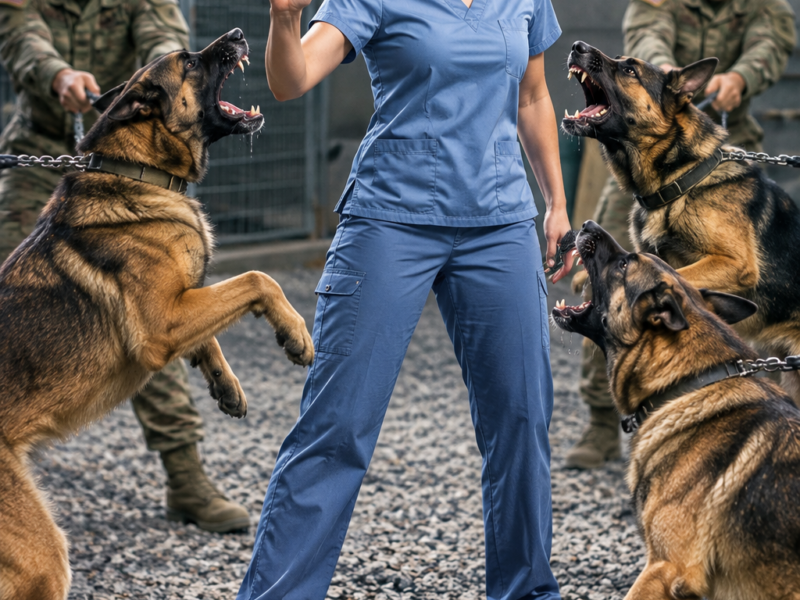
Nobody Could Calm the 3 Military K9s — Until an ER Nurse Whispered One Forgotten Command
Nobody Could Calm the 3 Military K9s — Until an ER Nurse Whispered One Forgotten Command
The first thing the soldiers noticed was the silence.
For fourteen days, the military working dog compound at Iron Ridge Medical Center had been filled with sounds nobody wanted to hear. Claws scraping against concrete. Heavy breathing in the darkness. Sudden explosions of barking that sent experienced handlers instinctively stepping backward. The harsh metallic rattle of kennel doors shaking beneath the weight of animals that seemed to have forgotten every command they had ever learned.
Three military dogs, all highly trained, all with years of conditioning behind them, had become impossible to control.
Rex, a Belgian Malinois once considered one of the unit’s most reliable working dogs, had bitten a handler badly enough to send him to medical care. Kilo, a German Shepherd with an almost flawless service history, had withdrawn into himself, refusing commands and barely responding to familiar voices. And Dax, the youngest of the three, had become so unpredictable that no one could approach his enclosure without risking a violent reaction.
The military had tried everything it knew.
Two canine specialists had been brought in from Fort Bragg. A behavioral consultant with government clearance had spent three days reviewing the animals. Veterinarians had conducted examinations, handlers had attempted familiar routines, and senior officers had held meeting after meeting, trying to understand how three valuable military assets could deteriorate so suddenly.
Nothing worked.
And the deadline was approaching.
In four days, the commanding officer would have to decide whether these dogs could ever safely return to duty.
Everyone understood what might happen if the answer was no.
Then, on a cold Wednesday morning, a thirty-one-year-old emergency room nurse arrived at the front gate wearing civilian scrubs and a hospital identification badge.
Her name was Emily Carter.
She carried no special equipment, no training aids, and nothing that suggested she belonged in a military working dog facility.
Captain Olivia Mercer, the officer responsible for security, looked her over and gave her five minutes.
Five minutes to observe animals that some of the military’s best specialists had failed to understand.
But something happened during those five minutes that nobody at Iron Ridge would ever forget.
All three dogs stopped moving.
Not one after another.
Not gradually.
At almost the same moment, the frantic movement inside the kennels ceased, and three sets of eyes turned toward the unfamiliar woman standing beyond the fence.
Emily did not raise her voice.
She did not give a command.
She simply stood there.
And somewhere beneath fourteen days of fear, confusion, and distress, the dogs seemed to recognize something in her that the humans around them had overlooked.
To understand why that moment mattered, however, you have to understand the life Emily Carter had spent three years trying to leave behind.
Long before she appeared at Iron Ridge, Emily had learned that silence could be deceiving.
Every morning, she woke before sunrise in a small apartment in Redstone City. The building was ordinary, the neighborhood quiet, and her life looked remarkably uncomplicated from the outside.
She worked four shifts a week in the emergency department at Callaway Regional Hospital. She drove a ten-year-old Honda Civic, bought groceries at the same store every Sunday, and rarely spoke about her past.
To her colleagues, she was an excellent nurse. Calm during emergencies, unusually observant, and capable of making difficult decisions without allowing panic to interfere.
But at four-thirty every morning, when the streets were still dark, Emily often lay awake listening to sounds that belonged to a peaceful city while her mind continued searching for dangers that were no longer there.
Three years had passed since she left the Army.
Her body had not entirely accepted the separation.
Sometimes a car door slamming outside made her heart accelerate before she understood the sound. Sometimes she woke with memories of concrete walls, distant explosions, and a wounded animal trembling against her hands.
She had learned not to fight those mornings.
Instead, she made coffee.
On the Wednesday that changed everything, Emily was finishing her second cup when her telephone rang.
The caller identified himself as Paulson, an administrative coordinator at Iron Ridge Military Medical Center.
His voice was formal, almost excessively careful.
“Ms. Carter, we’ve been given your name regarding a situation with our military working dog unit.”
Emily glanced at the clock.
“What kind of situation?”
“Three animals have been placed under behavioral restriction. They’ve been unresponsive to normal handling procedures for nearly two weeks.”
“Are they injured?”
“Not physically, according to our veterinary team.”
“Then why are you calling an emergency room nurse?”
There was a brief silence.
“You came highly recommended.”
“By whom?”
“I’m not authorized to discuss the referral chain.”
Emily looked toward the kitchen window.
The sky was beginning to lighten above the neighboring buildings.
She had spent three years building a life where people did not ask her questions about military dogs.
Now somebody had found her anyway.
“What time do you need me?”
“As soon as possible.”
“I can be there by eight.”
She ended the call and remained standing beside the counter for several seconds.
The past had a strange way of finding people.
Sometimes it arrived in dreams.
Sometimes it appeared in the shape of an old photograph or an unexpected name.
And sometimes it called at seven in the morning, asking for help with three dogs.
By the time Emily reached Iron Ridge, the sun was rising over the hills behind the facility.
She parked in the visitor section, adjusted the lanyard holding her hospital badge, and approached the security checkpoint.
A young military police officer inspected her identification.
“Emily Carter?”
“That’s right.”
“You’re here for the canine consultation?”
“Apparently.”
He studied her scrubs.
She recognized the expression immediately.
It was the same one she had encountered many times after leaving the military, when people assumed that the quiet woman standing before them could only be what her current identification suggested.
A nurse.
Nothing more.
Corporal Hewitt arrived to escort her through security.
He was young, polite, and clearly uncertain why a civilian medical professional had been invited to a restricted kennel facility.
They passed through two checkpoints before reaching a low concrete building near the eastern perimeter.
Captain Olivia Mercer was waiting outside.
Mercer had the posture of someone accustomed to authority and the expression of someone who had already decided this visit would be a waste of time.
“You’re Carter?”
“Yes, Captain.”
“You work at Callaway Regional?”
“Emergency department.”
Mercer folded her arms.
“Then I want to be clear about something. We have highly trained military handlers here. We’ve consulted veterinary specialists and behavioral experts. None of them has been able to stabilize these animals.”
Emily waited.
“I’m struggling to understand what an emergency room nurse can contribute.”
The words were professionally delivered, but their meaning was unmistakable.
Emily had encountered worse dismissals.
“Then let me assess the situation,” she replied.
Mercer’s eyebrows lifted slightly.
“And what exactly will that accomplish?”
“I won’t know until I’ve seen it.”
For a moment, the captain seemed surprised by the absence of defensiveness.
Finally, she stepped aside.
“Five minutes. You stay outside the secure perimeter. No interaction with the dogs.”
“Understood.”
The kennel compound smelled of disinfectant, metal, and the distinctive sourness of prolonged animal stress.
Three enclosures occupied the isolation section.
Emily stopped at the outer fence and observed them without speaking.
Kilo, the German Shepherd, lay almost motionless near the rear wall. His eyes followed activity, but his body remained heavy against the concrete.
Rex stood alert in the first enclosure, his muscles tense and his gaze shifting from one person to another.
Dax paced.
Twelve feet forward.
Turn.
Twelve feet backward.
Turn.
Again.
And again.
The handlers had described the movement as aggressive agitation.
Emily watched for nearly two minutes.
Then she noticed something.
Every time Dax reached the far end of his enclosure, his head dropped slightly before he turned.
The movement was almost invisible.
But it happened at precisely the same location every time.
She looked toward Hewitt.
“What’s behind that wall?”
He followed her gaze.
“An old supply corridor.”
“Still in use?”
“Not regularly.”
“Is there ventilation connecting the corridor to the kennels?”
“I’m not sure.”
Emily watched Dax complete another circuit.
His head dipped.
He turned.
“There may be something coming through that wall,” she said. “A sound or a scent. He’s reacting to it repeatedly.”
Hewitt frowned.
“The handlers have been watching him for two weeks.”
“They’ve been watching for signs of attack.”
“And you’re watching for what?”
“A reason.”
Before he could answer, Mercer approached.
“Time’s up.”
Emily was about to respond when Rex suddenly stopped shifting his weight.
His ears moved forward.
His gaze fixed on her.
Then Dax stopped pacing.
Kilo raised his head.
The entire kennel section became still.
Mercer stared.
No one had spoken a command.
No one had moved toward the animals.
Yet the three dogs were now watching Emily with a concentration unlike anything their handlers had witnessed in fourteen days.
“What did you do?” Hewitt whispered.
“Nothing.”
Mercer recovered first.
“Coincidence.”
“Possibly,” Emily said.
She looked once more at Rex.
The animal held her gaze.
“May I return tomorrow?”
“No.”
The answer came immediately.
Mercer straightened.
“This is a restricted facility, Ms. Carter. We appreciate your observations, but continued access is not authorized.”
Emily nodded.
She had no intention of arguing.
Instead, she walked back toward the main checkpoint, already thinking about the strange behavior she had seen.
She was almost at the exit when footsteps hurried behind her.
“Ms. Carter!”
Hewitt was approaching, slightly breathless.
“Captain Mercer wants you to wait.”
Emily stopped.
“Why?”
“Something came through from command.”
Eleven minutes later, Mercer entered a small waiting room carrying a manila folder.
Her expression had changed.
She placed the folder on the table.
“Sit down.”
Emily sat.
Mercer opened the file.
At the top of the first page was Emily Carter’s name, followed by military identification information and a classification marking.
Mercer looked at her carefully.
“You served six years in the United States Army.”
Emily said nothing.
“Combat medic. Two overseas deployments. Three years attached to military working dog units.”
The captain turned another page.
“Handler training. Canine trauma intervention. Rehabilitation under combat conditions.”
She looked up.
“You also have advanced qualifications in military canine behavioral recovery.”
“Yes.”
“Why didn’t you tell me?”
Emily met her eyes.
“You didn’t ask.”
The answer remained between them.
Mercer glanced at the hospital badge hanging from Emily’s neck.
She understood immediately.
She had assessed the woman by her clothing, made a decision, and stopped looking.
Now the document in front of her was forcing an uncomfortable correction.
“These dogs are approaching a critical decision point,” Mercer said eventually. “Four days from now, command may authorize their permanent removal from operational service.”
Emily’s expression tightened.
“Then we should stop wasting time.”
“What do you need?”
“Full incident reports. Training histories. Handler rotation records. And access to the animals without people crowding them.”
Mercer hesitated.
“They’re dangerous.”
“I know.”
“One handler is recovering from a serious bite.”
“I know that too.”
Mercer closed the folder.
After forty minutes of telephone calls and authorization requests, Emily received a temporary pass.
Twenty-four hours of access.
Strict supervision.
An armed handler outside the perimeter.
And the authority to begin an assessment.
The first thing Emily did was change into a utility uniform.
The fabric felt familiar.
Too familiar.
As she tightened the borrowed boots, she caught her reflection in a locker-room mirror.
For a moment, the woman looking back at her was not simply the emergency nurse from Callaway Regional.
She was the Army medic who had once worked through the night beneath harsh lights, trying to stabilize injured dogs while explosions sounded somewhere beyond the walls.
She looked away.
There was work to do.
Staff Sergeant Birkett met her at the kennel entrance.
He was a broad-shouldered man with tired eyes and the guarded demeanor of someone who had spent too many days unsuccessfully confronting the same problem.
“You’re the civilian consultant?”
“Emily Carter.”
He studied her temporary authorization.
“Rex bit Hendricks four days ago. No one has been able to approach him safely since.”
“What happened before the behavior changed?”
“A building-breach training exercise.”
“Who supervised it?”
“Lieutenant Garst.”
“How long has Garst been working with the unit?”
“Seven months.”
Emily asked Birkett to describe the commands Garst used.
The sergeant began listing them.
After the third command, she interrupted.
“Repeat the holding cue.”
He did.
Emily went completely still.
“Again.”
Birkett repeated the phrase.
“That’s not the correct cue for this conditioning system.”
He stared at her.
“What?”
“Those dogs were originally trained under a different framework. The phrase Garst is using sounds too close to a release cue.”
Birkett frowned.
“But he’s been using it for months.”
“Exactly.”
The implication began to settle.
Every time the dogs entered a high-stress situation, they were receiving contradictory instructions.
Hold.
Release.
Remain.
Move.
The signals were similar enough to create confusion but different enough that the animals could not reliably interpret them.
For seven months, those contradictions had accumulated.
Then came an exhausting six-hour training exercise.
The dogs had reached their limit.
“They weren’t suddenly becoming disobedient,” Emily explained. “They were being asked to make sense of instructions that no longer made sense.”
Birkett looked toward the kennels.
“Garst doesn’t know.”
“I don’t think he does.”
For the first time, the sergeant’s expression softened into something resembling grief.
He had watched the animals deteriorate.
He had blamed himself.
Now he was beginning to understand that the problem might have been built into the system around them.
Emily approached Rex first.
She remained outside his enclosure, allowing him to observe her.
She did not reach through the fence.
She did not try to demonstrate authority.
For several minutes, she simply stood in the corridor.
Then she began speaking softly.
The words were unfamiliar to the soldiers listening outside.
It was an old cadence, drawn from a military canine conditioning system Emily had learned overseas.
Not an invitation to attack.
Not an order demanding obedience.
A familiar pattern associated with safety and release from tension.
Rex’s ears shifted.
His breathing changed.
Emily repeated the cadence.
The dog approached.
One step.
Then another.
Outside the perimeter, Specialist Okafor watched with one hand resting near his holstered weapon.
Rex reached Emily and paused.
She crouched slowly.
The Malinois lowered his head.
Then he pressed his muzzle against her shoulder.
Nobody spoke.
For fourteen days, the animal had resisted nearly every attempt at contact.
Now he was leaning against a woman he had met less than an hour earlier.
Emily rested her hand gently against his neck.
She could feel the tension beneath his fur.
His muscles had not suddenly forgotten two weeks of distress.
But his breathing was slowing.
He was no longer preparing for a threat.
Behind her, Mercer spoke quietly.
“What exactly are we watching?”
Birkett swallowed.
“I think we’re watching him recognize a command system he understands.”
Emily remained beside Rex.
She knew the moment was important, but she also knew it was only the beginning.
A frightened animal might respond positively once and regress the next day.
Trust had to be rebuilt through repetition.
Still, when she moved to Kilo’s enclosure, the Shepherd eventually rose and approached the fence.
Dax remained more suspicious.
He watched from the rear corner, his body rigid.
Emily stayed nearby without forcing contact.
After several minutes, he advanced two steps.
Then stopped.
It was almost nothing.
To Emily, it was progress.
By the time she left the secure area, all three dogs were quieter than they had been that morning.
And somewhere in Iron Ridge’s administrative wing, a much larger problem was beginning to emerge.
Mercer summoned Emily to a conference room.
She explained that Colonel Haskell, the regional commanding officer, had authorized the referral after speaking with someone from Emily’s former unit.
He had known about her military background.
Mercer had not.
“Your record was restricted,” Mercer said. “Why?”
Emily looked toward the window.
“When I left the Army, I needed a different life.”
“Your file contains commendations.”
“I know.”
“And a formal complaint against a superior officer.”
Emily’s jaw tightened.
“Yes.”
“The complaint was partially upheld.”
“Yes.”
“The officer was reassigned.”
“He kept his rank.”
Mercer said nothing.
Emily had not left the military because she disliked the work.
She had left because certain memories and certain institutional battles had become too heavy to carry every day.
She had saved lives.
She had also discovered that doing the right thing could threaten the careers of people powerful enough to make that choice expensive.
She did not want to become a symbol of courage.
She wanted to be allowed to live.
Now, once again, she had found herself inside a military facility where the truth appeared to be more complicated than the official explanation.
She explained the command mismatch in detail.
Mercer listened.
Then Birkett arrived with training records.
Together, they traced the dogs’ behavioral deterioration through months of exercises.
Early inconsistencies appeared in January.
More serious avoidance behaviors developed after consecutive high-intensity sessions in February.
By the time the final building-breach exercise took place, the dogs had experienced months of contradictory cues.
“How long to reverse it?” Mercer asked.
“Rex may stabilize within several days. Kilo will need longer. Dax could take considerably more time.”
“We only have four days before the command decision.”
“Then we don’t need to prove they’re fully recovered in four days,” Emily replied. “We need to prove recovery is possible.”
Mercer studied her.
“Can you do that?”
Emily looked down at the records.
“I can try.”
The next morning, she returned at six.
Rex was waiting near the front of his enclosure.
He watched her carefully, as though comparing her behavior with the memory of the previous day.
Emily worked with him for forty minutes.
She restored simple commands from his original conditioning framework, rewarding correct responses and avoiding unnecessary pressure.
By the end, Rex followed three basic cues without hesitation.
Kilo showed slower improvement.
Dax remained cautious, but he no longer retreated immediately when Emily approached.
Every response was documented.
Every session timed.
Every small change recorded.
Mercer arrived shortly before lunch.
“Colonel Haskell has extended your access to ten days,” she announced.
Emily looked surprised.
“That’s generous.”
“He reviewed your complete service record.”
Mercer paused.
“He said we should have called you on the first day.”
Emily glanced toward Rex.
“He wasn’t wrong.”
“No,” Mercer admitted. “He wasn’t.”
Then the captain revealed something that changed the entire investigation.
Three weeks of Lieutenant Garst’s training records were missing.
Not misplaced.
Removed.
The physical documents had disappeared from storage, and the electronic copies had been overwritten.
The missing period corresponded almost exactly to the weeks when the command mismatch should have become obvious.
Emily stared at her.
“Who removed them?”
“We’re investigating.”
“Garst?”
“No.”
Mercer’s expression hardened.
“Garst was being considered for a training division promotion. A documented handling problem would have damaged that recommendation.”
“Someone was protecting his career.”
“Or protecting the recommendation itself.”
“Who submitted it?”
Mercer hesitated.
“Lieutenant Colonel Voss.”
The name meant little to Emily personally.
But the rank, the authority, and the timing meant a great deal.
Voss directed the military working dog training program.
He had supervised the broader command structure for years.
And now, somewhere within that structure, records that could have prevented three dogs from suffering had disappeared.
Emily returned to the kennels.
She knew better than to allow an investigation to distract her from the animals still struggling in front of her.
Throughout the afternoon, she worked with Dax.
He tested every movement.
Every pause.
Every change in her breathing.
At one point, he approached within two feet of the fence and stayed there.
Emily resisted the temptation to move closer.
She allowed him to decide when the distance felt safe.
Late that afternoon, Okafor brought her coffee.
They stood on opposite sides of the perimeter fence, watching the sunlight move across the concrete.
“You were really Army?” he asked.
“Six years.”
“That explains some things.”
“Not everything.”
He smiled faintly.
Then his expression became serious.
“Voss is here.”
Emily looked toward the administration building.
“He arrived about half an hour ago. He’s meeting with Mercer.”
Okafor lowered his voice.
“He’s been running this program for three years. He knows everyone.”
Emily understood the warning.
An officer with that much influence could shape more than a meeting.
He could shape careers.
Reports.
Recommendations.
And sometimes the truth itself.
At six that evening, Emily walked into Conference Room B.
Lieutenant Colonel Voss was already seated at the head of the table.
He was a polished man in his late forties, with carefully arranged documents and the practiced confidence of someone accustomed to controlling conversations.
He smiled when Emily entered.
“Ms. Carter. I’ve heard encouraging reports.”
“Thank you, sir.”
“Perhaps you can summarize your preliminary findings.”
Emily placed her notes on the table.
She explained Rex’s improvement, Kilo’s gradual stabilization, and Dax’s cautious progress.
She cited timestamps and documented behavioral responses.
Voss listened politely.
When she finished, he nodded.
“Encouraging, certainly. Although it’s important not to draw premature conclusions.”
“I agree.”
He seemed pleased.
Then Emily continued.
“That’s why I included the original training data and the missing March records in my report to Colonel Haskell.”
Voss’s smile remained.
But something changed behind it.
“The missing records were part of a routine compliance audit,” he explained. “The electronic copies were affected by a system migration.”
Emily looked at him.
“During the same period?”
“Correct.”
“And the missing records happen to cover the most important phase of the command drift?”
“Coincidences occur, Ms. Carter.”
“They do.”
She opened her folder.
“But patterns also occur.”
She laid out the training progression.
January.
February.
March.
The precise dates when behavioral inconsistencies began.
The sessions when the problem intensified.
The unexplained absence of records at the moment the issue was most detectable.
Voss tried several times to describe the analysis as preliminary.
Emily agreed that rehabilitation was incomplete.
Then she pointed out that the documented sequence remained valid regardless of the eventual recovery outcome.
Finally, she mentioned that Haskell’s office already possessed the technical report.
The lieutenant colonel became very still.
After several seconds, he closed his folder.
“Then I see no need to continue.”
He dismissed the meeting with professional courtesy.
But Mercer watched him leave and knew the confrontation was far from over.
“He’s going to make calls tonight,” she said.
Emily gathered her notes.
“I assumed he would.”
The next morning brought the first serious setback.
Dax had been making steady progress.
Then a sanitation crew entered his enclosure according to the normal cleaning schedule.
Nobody had informed them that his behavioral rehabilitation required a modified routine.
At almost the same time, maintenance workers had disturbed the old supply corridor behind the kennels.
Equipment had been moved.
Cleaning chemicals introduced.
The familiar scent environment had changed.
For a dog already struggling with contradictory signals, the sudden disruption was overwhelming.
When Emily arrived, Dax was throwing himself against the enclosure fence.
A lower section of chain link had been badly bent.
Birkett was preparing to request sedation.
Emily examined the damage and watched the animal’s movement.
“He’s not trying to escape,” she said.
“He’s attacking the fence,” Birkett replied.
“Because something is overwhelming him. We need to identify what changed.”
Okafor confirmed the maintenance activity.
Emily immediately requested that the area be cleared and the environmental disturbances stopped.
Then she approached the inner gate.
Dax turned toward her.
His eyes were wide.
His breathing rapid.
Every muscle appeared ready to explode.
She remained still.
Then she spoke the familiar cadence.
For several seconds, nothing happened.
Dax took one step.
Then another.
Emily repeated the phrase.
The dog came closer.
Suddenly, he lunged toward the damaged fence.
The metal rattled violently.
Emily reacted instinctively, stepping into the protected corridor near the enclosure and issuing a sharp command from the original training system.
“Dax. Hold!”
The sound cut through the chaos.
The dog stopped.
For one terrifying moment, he stood trembling, his attention shifting between the fence and Emily.
She did not advance.
Instead, she lowered her voice.
“Easy.”
His breathing remained heavy.
She gave him space to settle.
Then, slowly, Dax lowered himself onto the concrete.
The immediate crisis passed.
Outside the perimeter, Okafor exhaled.
Birkett lowered his radio.
Emily stayed close enough for Dax to see her while allowing him to recover without further pressure.
When she finally emerged, Mercer was approaching with a document in her hand.
Her face was tight with anger.
“Voss has filed a formal objection to your continued access.”
Emily took the paper.
The objection alleged procedural misconduct and improper interference with an ongoing investigation.
He had also accused Mercer of bypassing the chain of command.
Emily read it once.
Then again.
“He moved quickly.”
“He moved because he’s frightened,” Mercer replied.
“And Haskell?”
“He wants a formal briefing at fourteen hundred hours.”
Emily checked her watch.
There were just over three hours to prepare.
Mercer continued.
“The IT analysis is complete.”
Emily looked up.
“The missing records were manually overwritten at 3:17 in the morning, using a terminal inside the K9 administrative office.”
“Who had access?”
“Four people.”
“And?”
“Three were confirmed off base.”
The implications were unmistakable.
Emily returned to her paperwork.
She arranged every relevant record in sequence.
The training histories.
The behavioral reports.
The missing documentation.
The electronic override.
The incident report signed by Voss after Hendricks had been bitten.
That report contained a particularly troubling omission.
A section requiring the supervising officer to document possible command-related contributing factors had been left completely blank.
Voss had signed it anyway.
At exactly two o’clock, Colonel Haskell entered the briefing room.
Several senior officers were present, along with a military legal representative and an investigator from the Inspector General’s office.
Emily presented the evidence calmly.
She did not accuse Voss of anything she could not demonstrate.
Instead, she explained what the records showed.
The original command framework.
Garst’s incompatible training cues.
The gradual deterioration of the dogs.
The missing documentation.
The late-night computer access.
The resulting injuries and behavioral lockdown.
When she finished, Haskell asked several questions.
Then Mercer presented the incident report.
The room became very quiet.
Finally, Haskell turned toward the door.
“Bring Lieutenant Colonel Voss in.”
Voss entered wearing his full uniform.
He looked composed until the IT report was placed before him.
Haskell explained that the supposed compliance audit had no supporting record created before that morning.
The system migration documentation had also appeared only after the missing files became the subject of investigation.
Voss straightened the papers in front of him.
“I would like to consult legal counsel.”
“You’re entitled to do so,” Haskell replied.
Then the colonel leaned forward.
“But effective immediately, your authority over the military working dog program is suspended pending investigation.”
Voss’s expression barely changed.
His hands, however, tightened against the table.
“Your access to the program’s records and personnel is revoked. You will leave the facility under escort.”
For several moments, no one spoke.
Then Voss looked toward Emily.
“Whatever you believe about my decisions, those dogs were always my priority.”
Emily remembered Rex pressing his muzzle against her shoulder.
She remembered Kilo lying motionless in his enclosure.
She remembered Dax throwing himself against the fence because nobody had understood what was happening to him.
She met Voss’s eyes.
“They are now.”
The lieutenant colonel was escorted from Iron Ridge that afternoon.
But the investigation was not finished.
And Emily was about to discover that the missing records were only part of the story.
That evening, after another rehabilitation session, her personal telephone rang.
It was Pritchard, the charge nurse at Callaway Regional.
A patient had been transferred to the emergency department from Iron Ridge.
He was specifically asking for Emily.
His name was Daniel Hendricks.
The handler Rex had bitten.
Emily immediately drove to the hospital.
She found Hendricks sitting upright in a treatment room, his forearm bandaged and his face pale.
He looked exhausted.
Not simply from physical pain.
From fear.
Emily pulled a chair beside his bed.
“What happened?”
He glanced toward the door.
She closed it.
For several seconds, he struggled to speak.
Then the story came out.
Two days earlier, Voss had telephoned him personally.
The lieutenant colonel had explained what he called the official account of the bite incident.
Rex had reacted unpredictably.
No command errors had contributed.
The injury was simply an unfortunate occupational hazard.
Voss had instructed him to confirm that version if investigators asked questions.
“He called it aligning the record,” Hendricks said.
Emily listened without interrupting.
“Then he called again today.”
“After his suspension?”
Hendricks nodded.
“He sounded different. Angry. He said the investigation was politically motivated and that I needed to stick with the original account.”
Emily looked at his bandaged arm.
“Did you witness something different?”
Hendricks swallowed.
“Yes.”
Three minutes before the bite, Garst had issued a command sequence.
Rex had immediately shown signs of confusion and distress.
Hendricks had noticed it.
He had documented the sequence in a personal log.
But when Voss approved the official incident report without mentioning the command problem, Hendricks had assumed his observations were unimportant.
He was new to the unit.
Voss was a lieutenant colonel.
The difference in authority had been enough to silence him.
“Do you still have that log?” Emily asked.
He reached for his telephone.
“Every entry.”
Emily felt a familiar heaviness settle in her chest.
She had seen versions of this before.
People who recognized a problem but convinced themselves they must be mistaken because someone with more authority had already decided otherwise.
“What you documented matters,” she told him.
Hendricks lowered his eyes.
“I didn’t know who to trust.”
“Then trust the evidence.”
He looked at her.
“That’s why I asked for you.”
Emily contacted Mercer.
Within hours, the military legal office received Hendricks’s personal notes and information about Voss’s telephone calls.
The evidence added a new dimension to the investigation.
Voss had not merely failed to document the truth.
He had attempted to influence a witness after losing his authority.
For the first time, the consequences of his actions extended beyond missing paperwork and procedural violations.
They exposed an effort to control what another person would say.
Nine days later, the investigation reached its formal conclusion.
Voss faced charges involving falsified records, dereliction of duty, and obstruction.
Additional irregularities emerged from earlier incidents under his supervision.
His career in military animal training ended.
The program itself came under regional review.
Every training protocol, command framework, and reporting procedure would be examined.
And at the center of the investigation were three dogs whose behavior had originally been dismissed as inexplicable aggression.
But while officials worked through legal documents and disciplinary proceedings, Emily continued spending her mornings in the kennels.
Rex recovered fastest.
By the third day, he was following seven familiar command sequences.
Soon, that number increased to ten.
His movements became more confident.
He began responding not simply out of conditioned obedience, but with the attentiveness of an animal that understood what was being asked.
Kilo needed more time.
The German Shepherd had withdrawn so deeply that even small changes required patience.
Emily never forced him to advance beyond what he could manage.
She repeated simple exercises.
Rewarded reliable responses.
Allowed long periods of rest.
Eventually, his eyes became brighter.
He began approaching the fence voluntarily.
His body loosened.
He slept deeply.
Dax remained the greatest challenge.
The younger Malinois had learned to distrust not only commands but also sudden environmental changes.
Progress arrived in small increments.
A step toward Emily.
A relaxed posture.
A moment of stillness without fear.
Then one morning, when Emily approached his enclosure, Dax walked all the way to the fence.
He pressed his nose toward her hand.
She allowed him to investigate.
He remained there.
No lunging.
No frantic retreat.
Just quiet curiosity.
Emily smiled for the first time that morning.
“Good boy.”
The words were barely audible.
But Dax’s ears moved toward her voice.
Several days later, Lieutenant Garst returned to Iron Ridge.
He was twenty-nine years old and looked as though he had aged several years during his administrative leave.
His face was drawn.
His eyes carried the exhaustion of someone who had spent too many nights imagining what he could have done differently.
Emily met him outside the kennels.
“I read your report,” he said.
“And?”
“I keep going through the exercises in my head. I should have noticed.”
“You were trained under one command framework and assigned dogs conditioned under another.”
“I still gave the commands.”
“Yes. And you need retraining. But you weren’t given the information necessary to recognize the mismatch.”
Garst looked down.
“I thought I’d destroyed them.”
Emily gestured toward the first enclosure.
“Come see Rex.”
The Malinois was resting near the fence.
When he saw Garst, he stood.
Then he walked forward.
Garst stopped breathing for a moment.
Rex reached the fence and pressed against it.
The young lieutenant raised one trembling hand.
The dog leaned closer.
There was no sudden display of fear.
No aggression.
Only recognition.
Garst’s eyes filled with tears.
“He remembers me.”
“Of course he does.”
“I thought he’d hate me.”
Emily watched Rex.
“He was confused. That doesn’t mean he stopped recognizing someone important to him.”
Garst crouched beside the fence.
For a long time, he said nothing.
Rex remained near him.
Kilo responded to Garst with cautious familiarity.
Dax stayed farther away, watching quietly.
But even that was progress.
The lieutenant understood.
He agreed to complete the full retraining and recertification program.
Later, under Emily’s supervision, Garst worked with Rex using the corrected command framework.
The dog responded smoothly.
One command followed another.
The familiar rhythm returned.
Halfway through the session, Garst began crying.
He continued working.
His voice remained steady.
His hands performed the familiar gestures.
But tears moved down his face as the dog he thought he had ruined demonstrated that he could still trust him.
Emily watched from outside the perimeter.
She had no reason to interrupt.
Some moments were more meaningful without commentary.
When the session ended, Garst approached her.
“Thank you.”
She nodded.
“I’m going to learn both systems,” he continued. “Every difference. I never want this happening again.”
“I believe you.”
“Why?”
Emily looked toward Rex.
“Because you came back.”
The following days brought a different kind of attention to Emily.
Senior officers wanted reports.
Training specialists requested her notes.
Colonel Haskell’s office asked whether her rehabilitation methods could be incorporated into future handler certification programs.
On the ninth day, Mercer arrived carrying two documents.
The first was a formal commendation.
The second requested that Emily submit her methodology for review as a supplemental training module.
Mercer handed them over.
“The colonel believes your work could prevent similar incidents elsewhere.”
Emily read the documents carefully.
Three years earlier, she had left military service determined to separate herself from the expectations attached to her record.
Now the institution was asking her to return, at least in a limited capacity, not as a soldier but as someone whose experience might improve its systems.
She thought about the dogs.
About Garst.
About Hendricks.
About the countless animals that might be spared unnecessary suffering if handlers were trained to recognize command conflicts and behavioral distress more accurately.
“I’ll submit the methodology,” she said.
Mercer nodded.
Then she remained standing.
There was something else she wanted to say.
“Emily.”
It was the first time the captain had used her first name.
Emily looked up.
“I was wrong about you.”
The admission was simple.
Mercer did not decorate it with explanations.
“I saw your hospital badge and assumed you had no reason to be here. I decided what you could contribute before hearing you speak.”
Emily remained quiet.
“I should have asked questions. I should have looked more carefully.”
“Yes,” Emily said.
Mercer accepted the answer.
There was no resentment in it.
Only accuracy.
Finally, the captain extended her hand.
“I’m glad you stayed.”
Emily shook it.
“So am I.”
On the tenth and final day of her authorized assignment, Emily arrived before sunrise.
The compound was quiet.
Not the strained, unnatural silence of animals in distress.
A different quiet.
Rex stood patiently near the front of his enclosure.
Kilo was sleeping.
Dax watched the doorway without pacing.
Emily moved through the morning exactly as she had throughout the assignment.
No ceremony.
No speeches.
Just careful work.
She ran Rex through the full command framework and observed his response under controlled simulated stress.
He performed with confidence.
Her final report recommended him for formal operational reevaluation.
Kilo was close behind.
He still needed additional consolidation, but his recovery was unmistakable.
For Dax, Emily prepared a detailed continuation plan.
His progress was real, but she would not pretend the work was finished.
He needed familiar routines.
Environmental consistency.
Patient handlers.
Time.
During their final session, Dax completed several simple exercises and then approached Emily without being asked.
He sat beside her.
His flank rested against her leg.
She remained still.
The warmth of his body pressed gently through the fabric of her trousers.
Ten days earlier, this animal had been so overwhelmed that he could barely tolerate someone approaching his fence.
Now he was resting against a person by choice.
Emily placed her hand on his shoulder.
“You’re going to be all right.”
She did not know whether the dog understood the words.
But his breathing remained steady.
And for that moment, the words felt true.
At two o’clock, Emily completed the final paperwork.
Birkett walked with her toward the main gate.
They crossed the compound without speaking much.
The buildings looked exactly as they had on her first morning.
The security checkpoints were unchanged.
The hills beyond the facility still rose against the pale sky.
But almost everything else was different.
Near the gate, Birkett stopped.
“There’s something Sergeant Doyle wanted you to have.”
He handed Emily a folded sheet of paper.
Doyle had been appointed interim leader of the canine unit while the training program underwent review.
Emily unfolded the note.
It thanked her for saving the three dogs, acknowledged how much the unit had overlooked, and admitted that experienced handlers sometimes became so focused on enforcing commands that they forgot to understand the animals receiving them.
She read it twice.
Then folded it carefully.
“Tell him thank you.”
Birkett nodded.
“And tell him something else.”
“What?”
“The dogs were trying to communicate from the beginning. They weren’t hiding the problem. We just weren’t listening.”
Birkett looked toward the kennel building.
For a moment, he seemed unable to speak.
Finally, he extended his hand.
“Come visit sometime.”
Emily smiled.
“I work twenty minutes away.”
“I know.”
She shook his hand and walked through the gate.
Three days later, Emily Carter returned to her ordinary shift at Callaway Regional Hospital.
There was no military escort.
No special announcement.
No one waiting with a commendation.
She wore blue scrubs, comfortable sneakers, and the same hospital badge that had caused Captain Mercer to dismiss her ten days earlier.
Within her first hour, Emily helped treat a wrist injury, assisted with a pediatric fever assessment, and comforted a frightened child receiving stitches.
She ate lunch standing beside the nursing station.
The emergency department was busy, noisy, and imperfect.
A monitor malfunctioned.
A patient complained about waiting.
Someone misplaced a form.
A physician requested assistance while Emily was already handling three tasks.
It was ordinary work.
And Emily loved it.
That afternoon, Pritchard stopped beside her.
“How are you doing?”
Emily glanced up from a chart.
“Fine.”
Pritchard raised an eyebrow.
“That’s your professional answer.”
Emily smiled faintly.
“It was a complicated couple of weeks.”
“I heard.”
“From whom?”
“Hendricks called. He wanted us to tell you he’s been discharged and is returning to the unit.”
Emily stopped writing.
“He’s doing well?”
“Apparently. He also said the dogs are recovering.”
Emily looked down at the chart in front of her.
For several seconds, she didn’t speak.
Then she nodded.
“Good.”
Pritchard studied her.
“Whatever you did out there, it mattered.”
Emily considered the statement.
She remembered the first morning at Iron Ridge.
The crossed arms.
The skeptical looks.
The five-minute limit.
She remembered how close she had come to walking away from the facility permanently.
If Hewitt had not stopped her at the gate, perhaps none of the later events would have unfolded in quite the same way.
The missing records might have remained hidden.
Garst might never have learned why his dogs stopped responding.
Hendricks might have continued carrying a truth he was afraid to report.
Rex, Kilo, and Dax might have been judged beyond recovery.
All because people had mistaken visible behavior for the complete explanation.
She thought about Voss.
He had possessed rank, influence, authority, and the power to shape official records.
Yet he had lost everything because he valued controlling the narrative more than discovering what was true.
She thought about Mercer.
The captain had begun by dismissing her, then demonstrated something far more valuable than never making mistakes.
She had been willing to acknowledge one and change her position when the evidence demanded it.
She thought about Birkett and Okafor, men who had remained steady when the situation became complicated.
And Garst, whose tears had accompanied the return of a dog he feared he had permanently harmed.
But most of all, she remembered Dax.
The young Malinois sitting beside her on the final day, no longer fighting an invisible battle against every sound, scent, and movement around him.
She had not performed a miracle.
She had not discovered a magical command capable of instantly transforming dangerous animals into obedient companions.
She had recognized a pattern.
She had asked questions others had stopped asking.
She had listened.
And then she had worked patiently, hour after hour, until the signals finally began to make sense again.
That was the part people tended to overlook when they retold stories like this.
They remembered the dramatic moment when three military dogs became silent at the sight of a civilian nurse.
They remembered the powerful officer being escorted away.
They remembered the extraordinary service record hidden behind an ordinary hospital badge.
But the real transformation had taken place in quieter moments.
In forty-minute training sessions.
In carefully maintained logs.
In a frightened dog taking one step toward a fence.
In a young handler finding the courage to tell the truth.
In a captain admitting that she had judged someone too quickly.
And in a woman who had learned, through years of difficult experience, that being underestimated did not require her to prove herself through anger.
Sometimes the strongest response was simply to continue doing the work.
Emily finished her chart.
A voice called from the far end of the emergency department.
“Nurse Carter, we need you in Bay Six.”
She looked up.
“I’m coming.”
She placed the chart down and walked toward the next patient.
No one in the hospital corridor stopped to salute her.
No one mentioned the commendation folded neatly in a drawer at home.
No one knew that three military dogs were alive and recovering because she had refused to accept the easiest explanation for their suffering.
And Emily was perfectly comfortable with that.
She had spent years learning that a person’s value was not determined by how quickly others recognized it.
It was not contained in a uniform, a title, a rank, or the letters printed beneath a name.
It existed in what a person understood, what they were willing to notice, and what they chose to do when someone vulnerable needed help.
At Iron Ridge, the soldiers had spent fourteen days trying to make three dogs obey.
Emily Carter had arrived and asked a different question.
What were the dogs trying to tell them?
That single difference had changed everything.
And somewhere inside the military compound, Rex rested comfortably after another successful training session. Kilo slept without fear, and Dax waited patiently beside the fence for the handler who would continue his rehabilitation.
Their recovery was not a legend or a miracle.
It was proof that confusion could be understood, mistakes could be corrected, and trust, even after being badly damaged, could sometimes be rebuilt.
The woman who helped them find that trust was already back at work, moving between hospital beds, carrying out the ordinary duties of an emergency room nurse.
She had never needed the world to know everything she had survived.
She had only needed to remember what those experiences had taught her.
And perhaps that was the most remarkable part of the entire story.
The military had searched for someone powerful enough to control three dangerous dogs.
What it actually needed was someone patient enough to understand them.
Emily Carter had been that person.
Not because she was the loudest.
Not because she carried the highest rank.
And certainly not because anyone at the gate expected her to be.
But because when everyone else saw aggression, she saw distress. When others saw disobedience, she recognized confusion. And when the world told her she had only five minutes to prove she belonged, she used those five minutes to notice something that fourteen days of authority had failed to see.
The dogs had not needed someone to overpower them.
They had needed someone who understood that trust cannot be demanded, only earned.
And long before the officers, investigators, and commanders understood who Emily Carter really was, three frightened animals had already begun to trust her.
Sometimes, the quietest person in the room carries the deepest experience.
Sometimes, the person everyone overlooks is the one who sees what everyone else has missed.
And sometimes, saving a life begins with something far simpler than courage, strength, or authority.
It begins with the willingness to listen.
THE END