No Woman Wanted Me After Prison… Until She Said, “Your Past Doesn’t Scare Me.”
No Woman Wanted Me After Prison… Until She Said, “Your Past Doesn’t Scare Me.”
Part 1
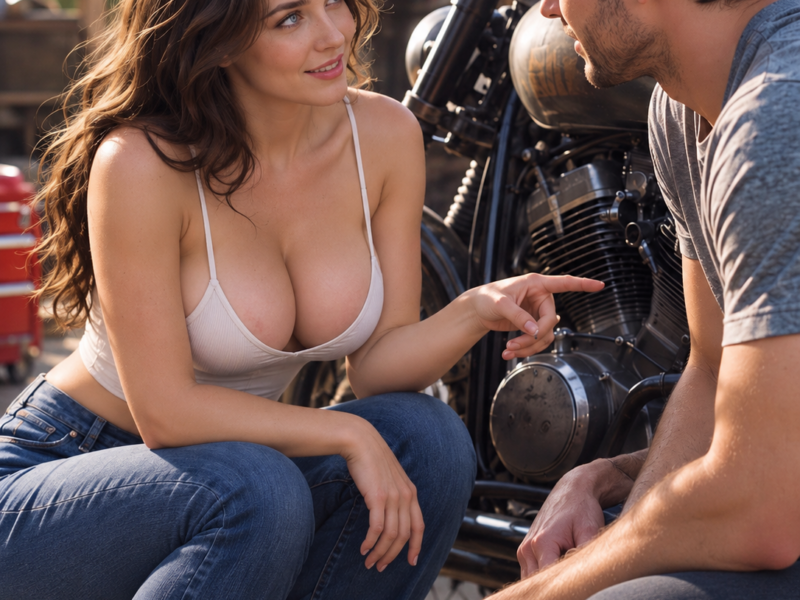
The first time Crystal Singleton told me that my past didn’t scare her, I was kneeling beside a motorcycle, my hands covered in grease, trying to convince myself that I hadn’t heard her correctly.
“Your past doesn’t scare me, Tyler,” she said, holding out a clean shop rag. “What scares me is how quickly you shut every door before anyone else gets a chance to decide whether it should stay open.”
I stared at her.
There were plenty of things I could have said. I could have laughed, changed the subject, or told her she didn’t know what she was talking about.
Instead, I did what I always did when someone got too close.
I looked away.
At thirty years old, I had become remarkably good at disappearing from people’s lives before they could decide they didn’t want me in them.
Four years in prison had taught me many things. How to repair engines. How to survive in places where weakness was expensive. How to recognize when someone was lying.
But the lesson that had stayed with me longest was much simpler.
People could forgive a mistake until they learned exactly what that mistake was.
Then everything changed.
The way they looked at you. The way they spoke your name. The hesitation before they handed you their keys or invited you into their homes.
I had watched that transformation happen enough times to know it by heart.
And I had decided, somewhere along the way, that avoiding rejection was easier than hoping someone might surprise me.
Then Crystal appeared.
She was crouching beside my black 1974 Honda CB550 outside Espinoza’s Moto & Vintage, a newly opened motorcycle shop in Oregon’s Willamette Valley.
Her white tank top was bright beneath the afternoon sunlight, and a strand of dark hair had escaped the ponytail she’d tied before crawling around my engine.
She pointed toward the left carburetors.
“You’re running rich on that side,” she said.
“I know.”
“And your mechanical advance is sticking.”
“I know that, too.”
“Then why haven’t you fixed it?”
“Because I came here to buy a throttle cable, not have my motorcycle insulted.”
She laughed.
It wasn’t the polite laugh people offered when they wanted a conversation to end. It was genuine, sudden, and completely unguarded.
For reasons I didn’t understand, that made me more nervous than anything else.
Before she could answer, the wooden bay doors opened behind us.
Jonathan Espinoza stepped outside.
He was in his late fifties, with graying hair, broad shoulders, and the tired expression of a man who had invested his retirement savings into a business that hadn’t yet earned enough to let him sleep peacefully.
“Crystal,” he said, “I can’t use a customer’s motorcycle to test your judgment.”
She straightened.
“Dad, he identified the problem in less than a minute.”
Jonathan folded his arms.
“I heard an uneven idle.”
“You heard noise,” she replied. “He heard the reason.”
I shut off the Honda.
The sudden silence felt uncomfortable.
“I only came for a cable,” I said. “I can find one in Salem.”
Crystal glanced at me.
“That’s your third refusal in ten minutes.”
Jonathan frowned.
“Third?”
“The rag, lunch, and the trial job he decided he wouldn’t accept before I finished offering it.”
I stared at her.
“You were going to offer me a job?”
“A trial,” she corrected. “And you’ve already decided to refuse it.”
She was right.
That annoyed me.
Three days earlier, Crystal had asked me to lunch after noticing my Honda parked outside a parts supplier.
I’d told her about prison almost immediately.
I hadn’t offered excuses or softened the facts.
When I was twenty-one, I had helped three friends break into a commercial parts warehouse. We stole inventory, sold what we could, and were eventually caught.
I knew what I was doing.
I wasn’t innocent.
I served four years.
Usually, that confession ended whatever interest a woman had shown in me.
Some became uncomfortable. Others asked questions that made it clear they saw a criminal before they saw a person.
One woman had asked whether I was still dangerous.
Another stopped returning my calls.
Crystal had simply asked whether Thursday or Friday worked better for lunch.
I had been suspicious ever since.
Now she gestured toward the shop.
“Amanda Bright has a Kawasaki in Bay Two. It loses ignition after about twenty minutes, then starts again when it cools. Two mechanics have already looked at it.”
Jonathan’s expression tightened.
“Crystal—”
“Give Tyler until Friday afternoon,” she continued. “One day’s flat rate if he finds the problem. Nothing owed if he doesn’t.”
Jonathan looked at me.
I could practically see the objections forming behind his eyes.
An unfamiliar mechanic. A valuable customer’s motorcycle. A new business that couldn’t afford expensive mistakes.
And a daughter who was making promises faster than he could approve them.
I understood his hesitation.
What bothered me was how much I wanted the opportunity.
For three years, I had made a living repairing lawn mowers, generators, pumps, and old motorcycles that farmers dragged out of barns.
I worked from a small rented shed behind a laundromat, where I also lived in a one-bedroom apartment upstairs.
I didn’t make much money.
But I paid my bills.
Every tool in my possession had been purchased legally. Every expensive part came with a receipt.
My Honda had been rebuilt from a bare frame.
Piece by piece, bolt by bolt, I had turned something abandoned into something reliable.
I suppose I had been trying to do the same thing with myself.
The difference was that motorcycles didn’t care about criminal records.
People did.
“Tomorrow,” I finally said.
Jonathan raised an eyebrow.
“Seven in the morning. I’ll bring my tools. You can inspect everything I touch. Every test gets documented. If I can’t give you a defensible diagnosis by Friday, I’ll walk away.”
For several seconds, neither man spoke.
Then Jonathan nodded.
“No guessing. No replacing parts just because they might be bad. Another technician verifies everything before the customer gets the bike.”
“Agreed.”
Crystal smiled.
Not triumphantly.
More like she’d been waiting for me to catch up with something she already knew.
“Seven, Tyler.”
That evening, I sat at the kitchen table in my apartment, arranging tools beneath a flickering fluorescent light.
Outside my window, dryers hummed through the walls.
The smell of detergent mixed with old coffee.
I checked my multimeter twice, organized my insulated leads, and polished screwdrivers that were already clean.
I told myself I was preparing for work.
But I kept thinking about Crystal.
She wasn’t naive.
That was the part I couldn’t explain away.
She represented a regional parts distributor and traveled between Portland and Eugene, selling components to repair shops that often underestimated her because she was young, attractive, and friendly.
I’d seen her handle those men.
She remembered discontinued bearings, defective components, supplier mistakes, and inventory numbers that experienced mechanics couldn’t recall.
She had a way of smiling while proving someone wrong without making them feel humiliated.
And she had apparently decided I was worth taking seriously.
I didn’t know what frightened me more.
That she might be wrong.
Or that she might be right.
The following morning, I arrived fifteen minutes early.
Mist hung above the gravel parking lot.
Jonathan was unlocking the shop when I pulled in.
I removed my red toolbox from the Honda and handed him a folded sheet of paper.
He examined it.
“What’s this?”
“Tool inventory. Receipts for the expensive equipment.”
He looked up.
“Why?”
“Because we both know what you’re worried about.”
For a moment, his expression changed.
Not quite embarrassment.
Not quite respect.
Something in between.
He folded the paper and placed it on his desk.
“Bay Two,” he said. “Don’t scratch Amanda’s tank.”
The Kawasaki KZ650 was metallic red, beautifully maintained, and far too clean for a machine that apparently stranded its owner every few days.
I photographed the existing wiring, checked battery voltage, inspected connectors, and began documenting my findings.
At eight o’clock, the side door opened.
Crystal entered carrying four coffees, a clipboard, and a phone pressed against her ear.
“No,” she said into the phone. “Lot 318B. Not 318D. Different diode pack.”
She placed a coffee beside my toolbox.
I shook my head.
She continued talking.
When she ended the call, she pointed toward the cup.
“Drink it.”
“I didn’t ask for coffee.”
“I noticed.”
“You shouldn’t spend money on me.”
“It’s coffee, Tyler. Not a mortgage.”
I looked at the lid.
My name was written across it in black marker.
“That’s not my coffee.”
“It has your name on it.”
“Anyone can write a name.”
“Then drink it before this mysterious other Tyler arrives.”
I finally took a sip.
She smiled without saying anything.
Somehow, that small victory seemed more important to her than it should have.
We began working through Amanda’s complaint.
The motorcycle ran normally for fifteen to twenty minutes before bucking under load, losing power, and shutting down. After cooling, it restarted.
“A heat-related ignition failure,” I suggested.
“Possibly,” Crystal said. “But the previous shop replaced both coils three months ago.”
“New parts can fail.”
“They also installed an aftermarket regulator-rectifier from a supplier that recently issued returns on two production lots.”
I looked at her.
“You already traced the part?”
“I traced the invoice. We still need the stamp.”
She smiled.
The regulator was buried beneath the battery tray.
I would have to remove it.
She would have to confirm the batch.
For the first time, I realized she wasn’t simply offering encouragement.
She was working beside me.
By midmorning, she’d drawn a line down the center of a piece of cardboard.
On one side, she wrote Wrench.
On the other, Desk.
“What is that?”
“Our scorecard.”
“For what?”
“Useful discoveries. Whoever wins chooses lunch.”
“You already invited me to lunch.”
She put down the marker.
For a moment, her playful expression disappeared.
“Because I wanted to sit across a table from you, Tyler.”
I said nothing.
She held my gaze.
“Not because I feel sorry for you. Not because I think you need saving. Because I like talking to you.”
My fingers tightened around the wrench.
I had spent years imagining the moment someone might say something like that.
Now that it was happening, I wanted to escape.
“After work,” I finally managed.
Her smile returned.
“After work.”
“And the job decision stays separate.”
“Of course.”
I looked back at the Kawasaki.
For the first time in years, I wasn’t sure whether the most dangerous thing in front of me was a malfunctioning motorcycle.
Or a woman who kept refusing to let me disappear.
And I had no idea that, before Friday ended, I would have to choose between running away from everything I’d begun to want and risking the life I had spent years convincing myself I no longer deserved.
Part 2
By Wednesday, Crystal and I had developed a rhythm that felt dangerously natural.
I tested the Kawasaki’s electrical system while she traced invoices, questioned suppliers, and uncovered records nobody else had bothered to examine.
Every afternoon, she returned with another useful discovery and another excuse to make me smile.
I began looking forward to the sound of her car arriving.
That frightened me.
On Thursday, she found me skipping lunch again.
She placed a sandwich beside my tools.
“I already ate,” I lied.
“No. You drank coffee.”
“I’m working.”
“So am I.”
When I pushed the food away, she stopped smiling.
“Tyler, I asked you here because you’re a good mechanic. I keep coming back because I like you. Those are separate things.”
I looked at her.
“People change their minds.”
“Yes,” she said. “But you never let them make that choice.”
Something inside me shifted.
For the first time, I told her everything about the warehouse burglary, prison, and the humiliating rejections afterward.
She listened without interrupting.
Then she said something I couldn’t forget.
“I don’t need you to be perfect. I need you to stop running before anything difficult happens.”
That evening, we finally identified the faulty regulator.
But Friday brought a problem neither of us had anticipated.
Part 3
Friday morning should have been the day everything came together.
We had identified the problem with Amanda’s motorcycle, located a replacement part, and developed a repair plan that Jonathan could verify.
The Kawasaki’s regulator-rectifier belonged to a defective production batch.
Crystal had traced the supplier’s records.
I had demonstrated how the fault appeared after the electrical system reached operating temperature.
For once, the evidence was clear.
I should have felt relieved.
Instead, when I arrived at the shop, Jonathan was waiting in his office.
Crystal stood beside the filing cabinet.
Neither of them was smiling.
“Tyler,” Jonathan said, “close the door.”
I knew something was wrong before I sat down.
My application lay open on his desk.
Jonathan placed one hand on it.
“Dave at the Salem warehouse saw your name on the warranty authorization.”
I remained silent.
“He knows someone who worked at the state correctional facility. Apparently, they recognized your name.”
My stomach tightened.
There it was.
The familiar sensation.
That sudden shift in a room when my past arrived before I had finished proving my present.
“I disclosed my conviction,” I said.
Jonathan nodded.
“You did.”
“It’s on the application.”
“I know. But I hadn’t reviewed the entire form before you started working in a customer bay.”
He glanced toward Crystal.
“And that’s a mistake both of us have to acknowledge.”
Crystal lowered her eyes.
“I pushed the trial before we discussed it properly,” she admitted. “That was my decision.”
Jonathan rubbed his forehead.
“Dave says he won’t authorize the warranty replacement if someone he considers a liability signs the repair.”
For a moment, I couldn’t hear anything except the distant hum of the shop ventilation system.
I knew how the conversation would end.
I’d heard versions of it before.
The details were always different, but the result was remarkably consistent.
A man could be skilled, reliable, and hardworking.
Then someone discovered he’d been incarcerated.
Suddenly, every good thing about him required reconsideration.
Jonathan leaned forward.
“I’m not saying Dave gets to choose my employees. But I can’t put the business or Amanda’s repair at risk because I ignored our hiring process.”
“So you’re ending the trial?”
“I’m pausing the hiring decision.”
It was a small distinction.
But when you’ve spent years watching doors close, even a pause can sound like a lock turning.
“You have two choices,” Jonathan continued. “Finish Amanda’s motorcycle under my supervision, with another technician verifying the work. Or take the day’s pay and leave now.”
He hesitated.
“No penalty. You’ve already done valuable work.”
I nodded.
“Understood.”
I walked out before Crystal could speak.
The Kawasaki sat in Bay Two, its red fuel tank reflecting the ceiling lights.
My toolbox was beside it.
I began packing.
One wrench.
Then another.
Each tool returned to its assigned compartment.
I wiped the grease from a screwdriver that didn’t need cleaning.
I folded my test leads.
By the time I closed the lid, I had convinced myself that leaving was the sensible decision.
I had a generator repair scheduled at noon.
Cash payment.
No applications.
No background checks.
No supplier calling to question whether I deserved to touch a machine.
I could return to my shed, finish the repair, collect my money, and continue living exactly as I had before meeting Crystal.
It would be easier.
And easy had become my specialty.
I found my Honda key.
Then I heard footsteps.
Crystal entered the bay.
She saw the closed toolbox.
For several seconds, she didn’t speak.
Finally, she said, “You’re leaving.”
“Your father paused the job.”
“He paused the hiring decision.”
“Same difference.”
“No, Tyler. It isn’t.”
I picked up the toolbox handle.
She didn’t try to take it away.
Instead, she crossed the room and removed the cardboard scorecard we’d been using all week.
She looked at the marks we’d made.
Then she dropped it into the trash.
“What are you doing?” I asked.
“Ending the part where we pretend this is a game.”
I looked toward her father’s office.
“Crystal, I’m not asking you to fight him.”
“Good. Because I’m not doing that.”
Her voice remained steady.
“I’m taking responsibility for the decision I made. Amanda needs her bike today. We found the problem. The correct part is waiting in Salem.”
“Dave won’t release it.”
“He will if someone from the account collects it personally and signs the lot documentation.”
I stared at her.
“You’re going?”
“Yes.”
“You have your sales route today.”
“I know.”
“You told me one of those stops could be your biggest commission this week.”
“I remember.”
“Then you shouldn’t lose that money because of me.”
Her expression changed.
Not with anger.
With disappointment.
“Do you really think every decision I make about you is something you need to protect me from?”
I had no answer.
She stepped closer.
“I’m not going to Salem because you’re helpless. I’m going because Amanda is a customer who trusted this shop, and I believe we can finish what we started.”
“But your father might still refuse to hire me.”
“Yes.”
The answer landed harder than reassurance would have.
She wasn’t promising me a happy ending.
She was offering me the chance to act without one.
“And you might decide all this is more trouble than it’s worth,” she continued. “But please stop making that decision for me.”
For a long time, I looked at her.
Then I looked at my key.
I remembered what she’d said on Thursday.
You need to prove you can stay long enough for someone else to make a choice.
I’d spent years calling my departures independence.
Sometimes I’d called them dignity.
Sometimes I’d pretended I was doing other people a favor.
But standing there, watching Crystal prepare to drive to Salem without knowing whether I would still be there when she returned, I finally recognized the truth.
I was afraid.
Not because I couldn’t handle disappointment.
But because I had started wanting something badly enough that losing it would hurt.
I placed my Honda key on top of the toolbox.
“I’ll stay.”
Crystal watched me carefully.
“I have to reschedule the generator repair,” I continued. “Then I’ll prepare the wiring and inspect the ground connections before you return.”
She nodded.
“All right.”
No dramatic smile.
No embrace.
No promise that everything would work out.
She picked up her keys and left.
I reopened my toolbox.
It was the smallest decision I’d made all week.
And somehow, the most difficult.
For the next three hours, I worked alone.
Jonathan remained in his office, making calls.
I removed the battery box, inspected the terminals, and examined the mounting surfaces.
I discovered two connections that had been exposed to excessive heat.
Then I found something else.
The ground strap had been tightened over painted metal during the previous repair.
It wasn’t the primary cause of the shutdown, but it had increased resistance and contributed to the electrical stress.
I photographed everything.
I documented the voltage readings.
I wrote a clear explanation for Amanda.
That mattered to me.
She was a hospital employee who depended on her motorcycle to get to work.
When she rode home after a late shift, the difference between a proper repair and a convenient guess could determine whether she reached her driveway safely.
I knew what it meant to have someone else’s decisions control your life.
I wasn’t going to make hers harder.
At 11:40, tires crunched across the gravel outside.
Crystal’s car appeared.
She stepped out holding a sealed parts box, a packet of documentation, and a paper bag.
When she entered the bay, she placed everything beside my multimeter.
“Correct unit,” she announced. “Verified replacement lot.”
“And Dave?”
“Technically cooperative. Personally unpleasant.”
I almost smiled.
She pushed the paper bag toward me.
“Breakfast. Or lunch. Depends how you classify it.”
I looked inside.
A bacon, egg, and cheese biscuit.
Then I noticed the clean shop rag she’d placed on top of the bag.
The same rag she’d offered me the first afternoon.
Back then, I’d refused it repeatedly.
Now I understood the gesture.
She was offering something simple.
And asking me to accept it without turning kindness into an obligation.
I took the bag.
“Thank you.”
Her shoulders relaxed.
It was such a small movement that I might have missed it a week earlier.
“Eat,” she said. “I’ll check the replacement diagram.”
For once, I did exactly what she asked.
We worked together through the afternoon.
Crystal discovered that the replacement supplier had changed two wire colors between production runs.
We verified every connection by function rather than appearance.
I cleaned the grounding point to bare metal, installed the correct hardware, and secured the new regulator.
Then we started the Kawasaki.
Five minutes passed.
Ten.
Fifteen.
The engine continued running.
At twenty minutes, I caught myself holding my breath.
That was when the failure usually appeared.
But the idle remained steady.
At thirty minutes, the electrical readings were still stable.
At forty, Jonathan entered with another technician.
The man repeated our critical tests, inspected the repaired connections, and signed the verification sheet.
“Clean work,” he said.
I felt something loosen inside my chest.
Not because he had praised me.
Because the work had held up under scrutiny.
Crystal leaned against my toolbox, looking exhausted.
“We did it,” she whispered.
I looked at the Kawasaki.
Then at her.
“We did.”
And for the first time, I understood how different those two words felt from the lonely satisfaction of saying, I did it myself.
But the biggest test of that Friday was still waiting.
Amanda hadn’t arrived.
Jonathan hadn’t made his hiring decision.
And Crystal and I had yet to speak honestly about what would happen if the shop’s doors closed to me forever.
Part 4
Amanda Bright arrived a little after four o’clock.
She wore hospital scrubs beneath a dark jacket and looked like someone who had spent far too many days rearranging her life around an unreliable motorcycle.
When she stepped into Bay Two, her eyes went immediately to the Kawasaki.
“Is it fixed?”
I could hear the hope in her voice.
I didn’t want to promise anything we couldn’t support.
“We found a defective regulator-rectifier,” I explained. “It was failing when the charging system heated up. We replaced it, repaired the ground connection, and ran repeated tests.”
Crystal handed her the documentation.
“The replacement part comes from a verified production lot,” she added. “And we had an independent technician inspect the repair.”
Amanda examined the paperwork.
Then she looked at Jonathan.
“So it isn’t going to leave me stranded at a stoplight again?”
Jonathan gave a cautious smile.
“We’ve tested it well beyond the conditions that produced the original failure. You’re welcome to take a short ride before accepting it.”
Amanda nodded immediately.
She put on her helmet, wheeled the Kawasaki outside, and started the engine.
I watched from the bay entrance.
Crystal stood beside me.
Neither of us spoke as Amanda rode down the industrial road.
Five minutes later, we heard the familiar sound of the Kawasaki returning.
It rolled into the parking lot and stopped.
The engine kept running.
Amanda looked down at the instrument panel as though she couldn’t quite believe it.
Then she laughed.
“That’s the first time it’s stayed running after I’ve stopped at a light in weeks.”
I didn’t realize how tense I’d been until I felt my shoulders relax.
She thanked us repeatedly.
Jonathan offered to arrange delivery, but she insisted on riding the motorcycle home herself.
Before leaving, she shook my hand.
“Thank you for not giving up on it.”
It was an ordinary sentence.
A customer thanking a mechanic.
But I carried those words with me long after her motorcycle disappeared down the road.
Because I knew what giving up looked like.
I’d nearly done it that morning.
After Amanda left, Jonathan approached the bay.
“Tyler, finish putting things away. Then come to my office.”
I nodded.
His expression revealed nothing.
Crystal began organizing the paperwork beside me.
I could feel the question hanging between us.
Would I be hired?
Would Jonathan decide I was too much of a risk?
Would the supplier’s objections outweigh the work I’d done?
Then Crystal looked up.
“Whatever happens, we finished the repair.”
“I know.”
“And Amanda is happy.”
“I know.”
She studied me.
“Then why do you look like you’re waiting for someone to pronounce a sentence?”
I gave a humorless laugh.
“Old habit.”
She set down the papers.
“Come outside with me.”
We walked into the parking lot.
The afternoon sun had lowered behind the trees, spreading long shadows across the gravel.
My Honda stood near the fence.
The same motorcycle that had brought me into Crystal’s life.
The same machine I’d rebuilt alone, never imagining anyone might eventually want to share the ride.
For a moment, we stood on opposite sides of it.
Then I walked around to her.
“Crystal, there’s something I need to say before I go into your father’s office.”
She waited.
I searched for the right words.
That had always been difficult for me.
Engines were easier.
With an engine, a problem usually had a physical cause. Something measurable. Something you could isolate and repair.
People weren’t like that.
You could say exactly what you meant and still lose everything.
But I was tired of confusing silence with safety.
“If he doesn’t hire me,” I began, “I still want next Thursday.”
Crystal blinked.
“Our date?”
“Yes.”
Her lips curved slightly.
“And?”
“And if it goes well, I want another one.”
She remained quiet.
I continued before I could lose my nerve.
“I don’t want to see you because you defended me. Or because you brought a replacement part. Or because you gave me a chance when other people wouldn’t.”
“Then why?”
“Because I like who you are.”
The words felt almost embarrassingly simple.
But once I started, I couldn’t stop.
“I like that you remember every ridiculous inventory number. I like that you argue with warehouse managers until they admit they’re wrong. I like that you believe customers deserve the truth, even when the truth makes the shop look imperfect.”
Her eyes softened.
“I like the way you care about your father’s business without allowing it to swallow your own ambitions,” I continued. “And I like that you don’t pretend to agree with me just to make me comfortable.”
A quiet breeze moved through the trees.
“I want to know you when there’s no broken motorcycle giving us an excuse to spend time together.”
Crystal looked at me for a long moment.
Then she said, “Tyler, I need you to understand something.”
My stomach tightened.
Those words had preceded rejection before.
But this time, I stayed.
“I didn’t ask you into the shop because I needed someone to rescue,” she said. “I believed you were a good mechanic. That was a professional judgment.”
I nodded.
“And then I started noticing other things.”
“Like what?”
“The way you make coffee for someone without announcing you’ve done it. The way you listen when I talk about my work. The way you treat customers’ property as though it’s the only thing that matters.”
She stepped closer.
“And this morning, when you had every reason to leave, you stayed.”
“I almost didn’t.”
“I know.”
She smiled gently.
“I’m not interested in pretending you never get scared, Tyler. I want to know what you do when you are.”
For the first time, I didn’t feel the need to defend myself.
“I want to date you,” I said. “Properly. Not secretly. Not as part of some arrangement with your father.”
“Yes.”
I stared at her.
“What?”
“Yes,” she repeated. “I’d like that.”
I laughed, mostly because I didn’t know what else to do.
But she raised a finger.
“One condition.”
“Of course there’s a condition.”
“The next time something scares you, tell me. If you need an hour alone, take one. If you’re angry, say so. But don’t disappear and convince yourself you’re protecting me.”
I considered that.
It sounded reasonable.
And terrifying.
“I can do that.”
“And I won’t make decisions for you just because I think I know what’s best.”
“Deal.”
Her hand rested lightly against my forearm.
I touched her waist, giving her room to step away.
She didn’t.
Instead, she moved closer.
Our first kiss happened beside a forty-year-old motorcycle in a gravel parking lot, while her father sat inside deciding whether I had a future at his shop.
It wasn’t dramatic.
There were no fireworks.
No music.
No miraculous feeling that my past had suddenly disappeared.
It was brief, warm, and real.
And when we separated, she smiled at me in a way I knew I would remember for the rest of my life.
“You should go inside,” she whispered.
“Probably.”
“Dad doesn’t like being kept waiting.”
“I noticed.”
She laughed.
I turned toward the shop.
For the first time, I wasn’t walking toward judgment with the belief that one man’s decision could determine my entire worth.
Whatever happened in that office, Crystal and I had made a choice of our own.
Jonathan was seated behind his desk when I entered.
My application was closed.
There was no pen waiting beside it.
“Sit down,” he said.
I sat.
“I spoke to Amanda.”
I nodded.
“I spoke to the technician who verified your work.”
I said nothing.
“And I called two people who’ve sent you small-engine repairs over the last three years.”
That surprised me.
Jonathan leaned back.
“They said you were reliable. That your invoices were fair. That when a repair took longer than expected, you told them why instead of inventing excuses.”
I stared at him.
“I didn’t know you were checking references.”
“I wasn’t going to make the decision Dave wanted me to make without knowing what I was actually deciding.”
He paused.
“I also spoke to Dave.”
My stomach tightened again.
“What happened?”
“I told him suppliers don’t choose my employees.”
I looked up.
Jonathan’s expression was serious.
“He didn’t appreciate that.”
“What did he do?”
“He removed our new-shop discount and suspended same-day priority service for ninety days.”
I couldn’t speak.
For a business as new as Espinoza’s Moto & Vintage, that was no small punishment.
It could affect scheduling, profits, and customer satisfaction.
All because Jonathan had refused to let an outside supplier dictate his hiring decision.
“I’m sorry,” I said.
He shook his head.
“Don’t apologize for a decision I made.”
He leaned forward.
“Understand something, Tyler. I’m not hiring you because I feel sorry for you. And I’m not hiring you because my daughter likes you.”
I held his gaze.
“I’m listening.”
“You made a serious mistake when you were younger. You paid the legal consequences. That doesn’t mean I automatically trust you.”
“I understand.”
“But your work was careful before anybody defended you. You documented everything. You stayed when leaving would have been easier.”
He opened a folder.
“And I believe a man should be judged by what he’s willing to do now, not only by the worst thing he’s done.”
I barely breathed.
“Ninety-day probation,” Jonathan said. “Same pay scale and expectations as every other technician. I’ll review your vintage repairs until I’m satisfied.”
For several seconds, I couldn’t find my voice.
Then I managed three words.
“I’ll take it.”
Jonathan stood and extended his hand.
His grip was firm.
Not warm.
Not yet.
But honest.
“Monday. Six forty-five.”
“I’ll be here.”
As I reached the door, he spoke again.
“And Tyler?”
I turned.
“My daughter makes her own decisions.”
“Yes, sir.”
“Respect them. Even when they aren’t what you want.”
I nodded.
“I will.”
Outside, Crystal was leaning against the Honda.
She looked at me.
I didn’t say anything.
I simply held up the key to the shop Jonathan had just given me.
She smiled.
And for the first time in years, I allowed myself to believe that something good might actually last.
Part 5
The first few weeks at Espinoza’s Moto & Vintage were nothing like the triumphant new beginning I might have imagined.
I was still the new mechanic.
Jonathan still checked my work.
Some customers asked questions when they learned I was responsible for their motorcycles.
And every time someone looked at me a little too carefully, I felt the old instinct returning.
Leave before they discover something.
Leave before they change their minds.
Leave while you can still pretend it was your decision.
But each morning, I arrived at six forty-five.
I unlocked my toolbox.
I opened the work orders.
And I stayed.
There were days when staying was easy.
And days when it felt like the most exhausting thing I’d ever done.
Jonathan wasn’t an unfair employer.
He was demanding.
He expected detailed records, accurate diagnostics, clean workspaces, and honest communication with customers.
I respected that.
What surprised me was how much he respected effort that didn’t produce immediate results.
Once, an old Suzuki arrived with an electrical problem that refused to appear during testing.
I spent nearly an entire afternoon tracing a wiring harness.
By closing time, I still hadn’t found the fault.
I expected Jonathan to criticize the wasted hours.
Instead, he reviewed my notes.
“You eliminated the wrong possibilities properly,” he said.
“Yes.”
“Then tomorrow you start with fewer possibilities.”
It was such a simple statement.
But I thought about it all evening.
For years, I’d treated every setback as evidence that I wasn’t good enough to belong anywhere.
Jonathan treated a difficult problem as part of the work.
Not a personal failure.
And slowly, painfully, I began learning the difference.
Crystal kept her sales route between Portland and Eugene.
I was relieved about that.
Not because I wanted distance.
Because I knew how important her career was to her.
She had spent years building relationships with suppliers and shop owners who initially dismissed her as Jonathan Espinoza’s daughter.
She’d earned their respect with knowledge, persistence, and an almost frightening memory for part numbers.
I didn’t want our relationship to become another reason people overlooked what she’d accomplished.
Two afternoons each week, she helped develop the shop’s parts operation.
The rest of the time, she worked independently.
Sometimes she called me from warehouse parking lots.
Sometimes she sent photographs of ridiculous supplier labels.
And occasionally, she arrived at the shop with sandwiches because she knew I would forget lunch when a repair became complicated.
The difference was that I stopped refusing them.
At first, accepting kindness felt unnatural.
When Crystal brought food, I wanted to pay her back immediately.
When she offered help, I searched for something I could do in return.
When she complimented my work, I found reasons to explain why it wasn’t impressive.
One evening, after listening to me argue about the cost of a sandwich, she put down her fork.
“Tyler, can I ask you something?”
“Sure.”
“Why does everything have to become a transaction?”
I frowned.
“What do you mean?”
“If I buy dinner, you calculate what you owe me. If I help you, you look for a way to repay it before I can finish. If I tell you something nice, you act like I’ve made an accounting error.”
I looked at my plate.
“I don’t like owing people.”
“I’m not asking you to owe me.”
“Then what are you asking?”
She reached across the table and rested her hand over mine.
“To let me care about you.”
It sounded simple.
But it struck something deep.
Because I’d spent years believing affection created debt.
That if someone gave me something good, they would eventually expect repayment.
And if I couldn’t provide it, they’d remind me who I used to be.
Crystal wasn’t interested in that kind of relationship.
She wasn’t collecting favors.
She was building something.
And she expected me to participate without constantly questioning whether I deserved a place in it.
So I started trying.
Not perfectly.
But deliberately.
On our first proper date, we went to a small diner outside Salem.
Crystal ordered pancakes for dinner.
I ordered a burger and spent the first ten minutes wondering whether I was supposed to talk about prison again.
Finally, she noticed my discomfort.
“What’s wrong?”
“Nothing.”
She gave me a look.
I sighed.
“I don’t know what normal people talk about on dates.”
She grinned.
“That’s convenient. Neither do I.”
I laughed.
Then she asked me what I’d do if I could take my Honda anywhere in the country.
I told her about the Pacific Coast Highway.
About the desert roads in Arizona.
About the mountains in Colorado.
Places I’d only seen in magazines during the years when travel wasn’t an option.
She listened carefully.
Then she asked, “Would you go alone?”
The question caught me off guard.
My Honda had a narrow solo seat.
I’d built it that way because I’d never expected to have anyone riding behind me.
“Probably,” I admitted.
“Sounds lonely.”
“I’ve gotten used to it.”
She looked at me over her coffee.
“Getting used to something doesn’t mean you have to keep choosing it.”
That sentence stayed with me.
Over the following months, our relationship developed through ordinary moments.
We argued over restaurants.
She teased me about how carefully I organized my tools.
I teased her about the way she talked to warehouse managers who couldn’t locate inventory sitting directly in front of them.
She learned that I became quiet when I was overwhelmed.
I learned that she became overly cheerful when she was worried.
We both discovered that neither habit was particularly helpful during an argument.
Our first serious disagreement happened after a customer complained about a delayed repair.
Crystal believed we should call the customer immediately and explain the supply problem.
I wanted to finish investigating an alternate part before making promises.
She accused me of avoiding an uncomfortable conversation.
I accused her of rushing decisions.
The argument grew sharper than either of us intended.
Eventually, I walked outside.
I stood beside my Honda with my hands in my pockets, staring at the gravel.
The old version of me would have gone home.
I could have started the engine, disappeared for several hours, and returned only after I felt completely in control.
Instead, I remembered our agreement.
I took out my phone.
I’m frustrated. I need thirty minutes. I’m not leaving you. I just need to calm down.
She replied almost immediately.
Okay. I’ll be here. And we still need to solve the customer problem.
I laughed despite myself.
Thirty minutes later, I went back inside.
We apologized.
Then we called the customer together.
Nothing magical happened.
We still disagreed about parts of the decision.
But we resolved the problem without treating disagreement as a reason to abandon each other.
I began to understand that a stable relationship wasn’t one without conflict.
It was one where conflict didn’t automatically threaten everything.
Four months after my first trial day, autumn arrived in the Willamette Valley.
The mornings grew colder.
Rain tapped against the shop’s metal roof.
Trees along the industrial road turned yellow and gold.
Espinoza’s Moto & Vintage had expanded to three active service bays, and older Japanese motorcycles were arriving faster than we could schedule them.
Jonathan had taken on another mechanic.
Crystal had negotiated new supplier relationships through Portland.
And the shop had developed a reputation for something she had wanted from the beginning.
Honesty.
Customers knew we wouldn’t invent repairs, conceal uncertainty, or replace expensive parts without a reason.
Amanda Bright’s Kawasaki never developed the same problem again.
She sent two customers our way.
Then she mailed a handwritten thank-you note.
Jonathan pinned it beside the register.
When Crystal asked why he’d displayed it so prominently, he claimed there was simply no other available space.
Neither of us believed him.
But we let him have his explanation.
By then, Jonathan and I had developed an understanding.
He still wasn’t a sentimental man.
He didn’t offer praise casually.
And he rarely discussed my past.
But something had changed.
He no longer watched my toolbox when I entered the shop.
He no longer hesitated before leaving me alone with valuable motorcycles.
And when a customer asked about vintage Japanese engines, he usually pointed toward my bay.
“Talk to Tyler,” he’d say. “That’s his department.”
Every time I heard those words, I felt something quiet and unfamiliar.
Pride.
Not the defensive kind I’d carried after prison.
Not the pride that demanded I prove everyone wrong.
Just the satisfaction of knowing I belonged somewhere because I’d earned my place.
One Tuesday afternoon, Jonathan rolled his personal motorcycle into my bay.
It was a 1969 Triumph Bonneville.
Beautifully maintained.
Polished chrome, deep paint, and the kind of mechanical character that modern motorcycles couldn’t quite reproduce.
I knew he’d owned it for decades.
Longer than Crystal had been alive.
He tossed me the keys.
“Front brake feels vague,” he said. “Inspect it, then take it out for a test ride.”
I stared at the keys in my palm.
“You want me to ride it?”
“Yes.”
“Your Triumph?”
He frowned.
“Do you see another one?”
I smiled.
“No.”
“Then don’t scratch it.”
And with that, he walked away.
He didn’t make a speech about trust.
He didn’t tell me how far I’d come.
He simply gave me the keys to something he loved.
Sometimes the most important changes in a relationship happen without anyone announcing them.
I stood there for a moment, holding those keys, remembering the folded tool inventory I’d handed him on my first morning.
Back then, I’d wanted him to know exactly what I owned so he wouldn’t suspect me of stealing.
Now he was trusting me with a motorcycle worth more than all the tools in my possession.
I placed the keys carefully on the workbench.
Beside them sat two coffees.
One lid read Tyler.
The other read Crystal.
Jonathan had bought them.
I laughed quietly.
Apparently, even he had learned that some things didn’t need to be repaid.
Around four o’clock, Crystal’s car pulled into the gravel parking lot.
She climbed out wearing a cream-colored sweater, her phone pressed against one ear.
“No,” she said as she approached. “I need bearing 402, not 404.”
She listened.
Then she stopped walking.
“I understand that the computer says it’s unavailable. I’m asking you to check the shelf.”
Another pause.
“Because I know three boxes arrived yesterday.”
She smiled triumphantly.
“Thank you. I’ll wait.”
She ended the call and stepped into my bay.
“Good afternoon,” she said.
“Did you win?”
“Obviously.”
“Should I feel sorry for the warehouse?”
“Only if they keep ignoring their inventory.”
She placed a paper bag on my workbench.
“Late lunch.”
Then she kissed my cheek.
I opened the bag.
A sandwich from my favorite diner.
“Thank you,” I said.
She gave me a pleased little smile.
“You’re getting good at that.”
“At eating?”
“At accepting things without making them complicated.”
“I’ve had an excellent teacher.”
She glanced at the Triumph.
Then at the keys.
Her eyes widened.
“Dad gave you the Bonneville?”
“Asked me to inspect the brakes.”
“He actually handed you the keys?”
“Yes.”
She looked toward his office.
“Well, that’s interesting.”
“What?”
“That motorcycle has been his favorite possession since before I was born.”
“I know.”
“When I was twelve, he wouldn’t let me sit on it without supervision.”
I laughed.
“He told me not to scratch it.”
“He’s told me that for twenty years.”
She leaned against the toolbox while I finished adjusting the brake lever pivot.
For a while, we worked quietly.
The radio played softly near the front counter.
Rain threatened beyond the open bay doors.
Everything felt ordinary.
And that ordinary feeling was more precious to me than I would have believed possible four months earlier.
Because I’d spent so long imagining happiness as something dramatic.
An event.
A victory.
A moment when the entire world would finally recognize that I’d changed.
But real happiness had arrived in smaller ways.
A steady paycheck.
A motorcycle that needed repairing.
Someone bringing lunch.
A woman who could sit beside me without demanding conversation.
A future I didn’t immediately dismiss as impossible.
Eventually, Crystal noticed something outside.
She tilted her head.
“Tyler?”
“Yeah?”
“What’s different about your Honda?”
I continued tightening the pivot.
“Several things.”
“Don’t do that.”
“Do what?”
“Pretend you don’t know what I’m talking about.”
I smiled.
She crossed the bay and stepped outside.
I followed.
My black Honda stood near the fence, its chrome catching the pale afternoon light.
But the narrow solo seat was gone.
I’d replaced it with a longer seat pan, carefully fabricated to match the motorcycle’s vintage lines.
I’d installed passenger foot pegs.
Adjusted the rear suspension.
Reinforced the mounting points.
And hanging from the right handlebar was a new white full-face helmet.
Crystal stopped beside it.
For several seconds, she said nothing.
Then she lifted the helmet.
“You measured this.”
“I made an educated guess.”
She turned toward me.
“You asked for my helmet size last month.”
“That improved the accuracy of the guess.”
She looked at the passenger seat.
Then back at me.
“Is this for me?”
My heart began beating faster.
It was ridiculous.
I’d spent years repairing engines that could fail in a hundred complicated ways.
I’d survived prison.
I’d rebuilt a life from nearly nothing.
But standing in front of a woman I loved, trying to explain why I’d made room for her on my motorcycle, suddenly felt more frightening than any of it.
“Yes,” I said.
She held the helmet against her hip.
“For tonight?”
“For tonight. And whenever else you want to ride.”
Her expression softened.
I stepped closer.
“There’s something I’ve been trying to tell you.”
She waited.
I’d learned by then that she was very good at waiting when the words mattered.
“When I rebuilt this motorcycle, I made it for one person,” I said.
She glanced at the old seat brackets.
“I noticed.”
“I didn’t think I’d ever need room for anyone else.”
I looked toward the road.
“After prison, I told myself being alone was easier. I made my life small enough that nobody could take much from me.”
Crystal listened quietly.
“I could work. Pay rent. Repair motorcycles. Ride wherever I wanted.”
I paused.
“And whenever someone started getting close, I could leave before they had a chance to hurt me.”
She reached for my hand.
I took it.
“Then you came along,” I continued. “And you didn’t try to convince me my past didn’t happen. You didn’t pretend I was innocent. You didn’t ask me to become someone else overnight.”
Her fingers tightened around mine.
“You just kept asking me to stay long enough to see what might happen.”
The words came more easily now.
“I don’t want you to be proof that I’ve changed. I don’t want people to look at us and think you saved some broken man.”
She opened her mouth, but I shook my head gently.
“I want you because my days are better when you’re in them. Because I like the way you think. Because I trust you. Because even when we disagree, I want to work through it instead of leaving.”
I looked at the Honda.
“I want the long shifts. The late supplier calls. The arguments about things that matter. The quiet dinners when we’re both exhausted.”
I smiled.
“And the ordinary ride home after all of it.”
For a long moment, she didn’t answer.
Then she set the helmet carefully on the seat and stepped into my arms.
“I want that, too,” she whispered.
I held her.
There was no audience.
No dramatic announcement.
No promise that our lives would always be easy.
Just the two of us in a gravel parking lot beside a motorcycle that finally had room for someone else.
Eventually, she pulled back.
“But I have one condition.”
I laughed.
“You always have one condition.”
“That’s because you need structure.”
“What is it?”
“I have one supplier call left, and I need to lock up my counter before we go.”
I smiled.
“I can wait.”
She studied me.
Then her expression changed into something softer than happiness.
Trust.
“I know,” she said.
She went back inside.
And I waited.
Not anxiously.
Not counting the minutes.
Not wondering whether she’d change her mind and never return.
I simply leaned against the Honda, listening to the distant sounds of the shop.
Jonathan was closing his office.
Someone was rolling a motorcycle onto a lift.
The smell of oil and cool autumn air drifted through the parking lot.
A few minutes later, Jonathan appeared at the bay entrance.
He looked at the Honda.
Then at the passenger seat.
“Made some modifications?”
“Yes.”
He examined the work from a distance.
“Looks clean.”
“Thank you.”
He nodded toward the helmet.
“Crystal’s?”
“Yes.”
For a moment, he said nothing.
Then he looked at me.
“Take care of her.”
I met his eyes.
“I will.”
He shook his head slightly.
“She’s quite capable of taking care of herself.”
I smiled.
“I know that, too.”
Something like approval crossed his face.
“Good.”
He turned to go inside.
Then stopped.
“And Tyler?”
“Yes?”
“See you at six forty-five.”
“I’ll be here.”
He disappeared through the doors.
I watched him go, remembering the man who had once inspected my receipts because he wasn’t sure whether he could trust me.
I remembered the warehouse manager who believed a conviction made me permanently unworthy.
The women who stopped answering my calls.
The lonely evenings above the laundromat.
The years I’d spent imagining that the worst thing I’d ever done would always be the only thing people saw when they looked at me.
None of those memories had disappeared.
They probably never would.
But they no longer controlled every decision I made.
I thought about how different my life might have been if I’d left that Friday morning.
I would have returned to my apartment.
I would have repaired the generator.
I would have earned a little money and convinced myself I’d made the practical choice.
Crystal would have gone to Salem.
Amanda’s motorcycle might still have been repaired.
Jonathan might have found another mechanic.
And I would have continued believing that leaving first was the only way to avoid being abandoned.
Instead, I’d stayed.
Not because I knew everything would turn out well.
But because, for once, I was willing to let someone else decide whether I belonged in their life.
I heard the shop door open.
Crystal came toward me carrying the white helmet.
“All finished,” she announced.
“Successful call?”
“Very.”
“Did you threaten anyone?”
“Only with a detailed inventory audit.”
I laughed.
She fastened the helmet beneath her chin.
I checked the strap, adjusted the fit, and showed her where the passenger pegs were.
She climbed onto the seat behind me.
For a moment, I looked down at the motorcycle.
It had carried me through some of the loneliest years of my life.
I’d ridden it to job interviews that ended in disappointment.
I’d taken it down empty highways when my apartment felt too small.
I’d worked on it late into the night because machinery was easier to understand than people.
And now someone was sitting behind me, her hands resting gently around my waist.
Not because she felt sorry for me.
Not because she believed my past had vanished.
But because she knew the truth and had chosen to be there anyway.
“You ready?” I asked.
Crystal leaned closer.
“Whenever you are.”
I pressed the starter.
The Honda came alive on the first touch.
Its engine settled into a smooth, steady idle.
I smiled.
Four months earlier, I would have made a joke about the motorcycle showing off for her.
Now I simply listened to it running.
We rolled slowly out of the parking lot.
The shop grew smaller behind us.
Ahead, the road stretched between golden trees beneath a pale autumn sky.
Crystal tightened her arms around my waist as we turned onto the highway.
I felt her presence behind me.
Warm.
Certain.
Real.
And somewhere along that quiet road, I realized something I’d spent years being unable to understand.
A second chance wasn’t a guarantee that people would forgive you.
It wasn’t a promise that your past would stop mattering.
And it certainly wasn’t something another person could hand you simply by saying the right words.
A second chance was something you built.
One honest decision at a time.
One difficult conversation.
One responsibility fulfilled.
One moment of choosing to stay when every frightened part of you wanted to run.
Crystal hadn’t erased what I’d done at twenty-one.
Jonathan hadn’t pretended it didn’t matter.
Neither of them had given me unconditional trust.
They’d given me something better.
The opportunity to earn it.
And I’d finally allowed myself to accept that opportunity.
As we followed the winding road toward home, I thought about the man I’d been when I first rebuilt the Honda.
He had made room for one person because he believed that was all his future could hold.
I wished I could tell him what I knew now.
That one day, a woman would stand beside his motorcycle and offer him a clean rag.
That she would hear the truth about his worst mistake and still ask him to lunch.
That her father would eventually trust him with the keys to a beloved Triumph.
That a hospital worker would thank him for not giving up.
And that one ordinary autumn evening, he would ride home with someone holding him close, no longer afraid of the road ahead.
I couldn’t go back and tell that younger version of myself any of those things.
But I could honor him by living differently now.
The Honda hummed beneath us.
Crystal rested her helmet lightly against my shoulder.
And for the first time in longer than I could remember, I wasn’t wondering when this happiness would end.
I was looking forward to tomorrow.
Because maybe a new life doesn’t begin when someone forgets your past.
Maybe it begins when you finally stop running long enough to let someone know who you are today.
And maybe love isn’t finding someone who promises never to leave.
Maybe it’s finding someone who sees the truth, stays long enough to understand it, and chooses to build something with you anyway.
That evening, with Crystal’s arms around my waist and the last light of autumn falling across the Oregon hills, I finally understood the difference.
For years, I’d been riding away from everything I was afraid to lose.
Now, for the first time, I was riding toward a life I wanted to keep.