Navy SEAL Slapped a Rookie Nurse—3 Seconds Later, He Learned Who She Really Was
Navy SEAL Slapped a Rookie Nurse—3 Seconds Later, He Learned Who She Really Was
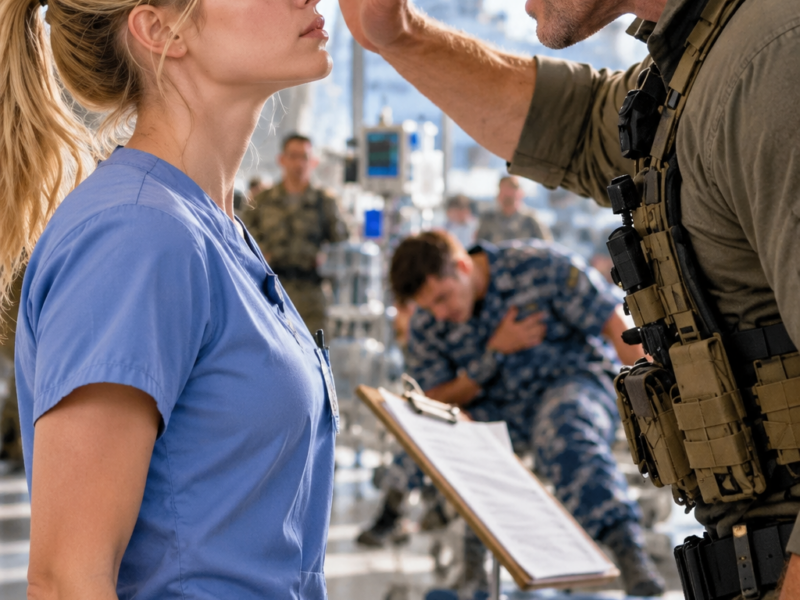
The sound of the slap echoed through Hangar Three like a gunshot, and for one terrible moment, nearly a thousand military personnel seemed to forget how to breathe.
Chief Petty Officer Drake Weston stood with his shoulders squared, his face hardened by eighteen years of military service and the certainty that nobody beneath him would dare question his authority. Across from him stood a young nurse named Lena Marsh, her clipboard scattered across the concrete floor, a red mark slowly appearing on her cheek.
Weston had made his position perfectly clear just seconds earlier.
“I’m a Navy SEAL,” he had declared, loud enough for the nearby officers, trainees, and camera crews to hear. “And you’re a rookie nurse. Learn your place.”
He had expected her to retreat. Perhaps apologize. Perhaps lower her eyes and surrender the argument, just as countless junior personnel had done before her.
Instead, Lena looked directly at him.
There was no fear in her expression. No outrage. Not even the trembling anger that might have been understandable after being struck in front of hundreds of witnesses.
Something far more unsettling appeared in her eyes.
Recognition.
It was as though an old part of her, something buried beneath years of carefully constructed ordinary life, had suddenly awakened.
When Weston reached toward her again, Lena moved.
Three seconds later, the decorated Navy SEAL was lying face down on the concrete, one arm controlled behind him, completely unable to rise.
She had not punched him. She had not injured him. She had simply redirected his movement with such extraordinary precision that several experienced military instructors watching nearby stood frozen.
Then, before anyone could decide what to say, a young sailor collapsed twenty feet away.
And what had begun as a confrontation between an arrogant instructor and an apparently inexperienced nurse became the opening moment of a crisis that would expose dangerous failures, destroy a powerful man’s career, and reveal a secret Lena Marsh had spent three years trying to bury.
Forty-one days earlier, nobody at Coastal Pines Regional Medical Center would have imagined Lena capable of anything extraordinary.
She was twenty-eight years old, quiet, punctual, and almost aggressively unremarkable.
Every morning, she arrived five minutes before her scheduled shift. She checked her supplies, reviewed patient information, and worked through her assignments without complaint. Her documentation was meticulous, sometimes more detailed than the senior nurses considered necessary, but never inaccurate.
She rarely joined conversations in the breakroom. She avoided workplace gossip, never boasted about her qualifications, and seemed perfectly content to remain another face among the hospital’s busy emergency department staff.
Her employment application listed a nursing degree with honors, emergency medical certifications, and several years of healthcare experience involving federal programs.
It did not explain the nature of those programs.
Nobody had asked.
That omission was exactly what Lena wanted.
For most of her adult life, she had existed in environments where every mistake could become a catastrophe and every success carried consequences that ordinary people never saw. She had learned to recognize danger before it announced itself, to remain composed when everyone around her panicked, and to make decisions while other people were still trying to understand what was happening.
But those years had taken something from her.
She had come to Coastal Pines seeking a different life.
A small apartment overlooking a quiet street. An honest nursing position. Grocery shopping on weekends. Coffee before sunrise. A schedule she could understand without classified briefings or emergency deployments.
Most importantly, she wanted a place where nobody knew her name.
Not the name printed on her nursing license.
The other one.
The name that had once traveled through naval medical units and special operations communities, whispered over radios when situations became desperate.
She had promised herself that name belonged to the past.
On October 15, that promise began to unravel.
The morning was unusually humid for autumn along the Virginia coast. A heavy gray sky hung over Lanford Naval Station, where Operation Iron Crest was underway.
The exercise involved approximately 960 active-duty personnel from multiple military branches. Throughout the day, participants would rotate through physical assessments, equipment inspections, simulated tactical missions, and readiness evaluations.
Senior military leaders were expected to attend. Camera crews had been invited to record portions of the event. For the instructors overseeing the exercise, successful execution represented more than another training day.
It was an opportunity to demonstrate competence before people capable of influencing promotions and assignments.
Coastal Pines had been contracted to provide additional medical support.
A temporary station occupied the northeastern corner of the enormous training hangar. Four treatment bays stood beneath portable lighting. Medical supplies lined folding tables, and a crash cart waited beside the physician’s workstation.
Dr. Sarah Hollis supervised the morning medical rotation.
Lena had been assigned to triage.
She arrived at 6:45, checked her equipment twice, and began receiving patients shortly after seven.
For the first two hours, nothing seemed unusual.
There were twisted ankles, blisters, mild dehydration, headaches, and a young corpsman who had nearly fainted after skipping breakfast.
Lena handled each case methodically, asking questions, recording observations, and referring anything concerning to Dr. Hollis.
By nine o’clock, she had treated eleven people.
Then, at 9:53, a twenty-two-year-old Navy logistics specialist named Tyler Oaks entered the medical station.
He was trying very hard to appear healthy.
That was the first thing Lena noticed.
His shoulders were unnaturally straight. His jaw was tight. His eyes moved around the room as though he expected someone important to appear at any second.
“I’m fine,” he announced before she had even finished asking him to sit down.
Lena pulled a chair opposite him.
“That’s good,” she replied calmly. “But tell me why you’re here.”
Tyler hesitated.
“Headache.”
“When did it start?”
“Maybe an hour ago. Hour and a half.”
“How bad?”
“Four out of ten.”
Lena watched the way he pressed his lips together.
“Your expression suggests something closer to six.”
A reluctant smile crossed his face.
“Maybe five.”
She continued asking questions.
Had he eaten breakfast? How much water had he consumed? Had he experienced nausea, dizziness, blurred vision, or difficulty concentrating?
The more he answered, the less comfortable she became.
His sweating was excessive even for the humid conditions. His eye movements were slightly delayed. He seemed to have difficulty maintaining his posture without consciously concentrating on it.
And his headache had not improved with rest.
“Which training stations did you complete this morning?” she asked.
Tyler listed several exercises.
When he mentioned the enclosed tactical simulation building, Lena stopped writing.
“How long were you inside?”
“About forty minutes.”
“Did anyone else in your group complain about feeling sick?”
He thought for a moment.
“Petrov said his head hurt. We figured it was from the respirator.”
“Was Petrov in your group?”
“No. Lima team. They went through before us.”
Lena looked at the intake sheet.
One young sailor with a persistent headache could mean almost anything.
Two sailors from different groups experiencing similar symptoms after entering the same enclosed structure suggested a possibility that could not be dismissed.
She found Dr. Hollis and presented her observations.
“Persistent headache, nausea, abnormal eye tracking, and delayed recovery despite rest and fluids,” Lena explained. “Another participant from an earlier rotation reported similar symptoms.”
Hollis considered the information.
“Could still be heat illness.”
“It could,” Lena agreed. “But the pattern doesn’t match the other heat-related cases I’ve seen today.”
Hollis looked up.
“You’ve only seen four.”
“Yes.”
“And you think this is different?”
“I do.”
There was something in Lena’s voice that made Hollis put down her pen.
Not arrogance.
Certainty disciplined by caution.
“All right,” the physician said. “I’ll reassess him.”
Lena returned to Tyler and explained that he would remain under observation.
He glanced anxiously toward the training floor.
“Chief Weston is going to be angry.”
“Who is Chief Weston?”
“My readiness instructor.”
“Why would he be angry?”
“He doesn’t like people dropping out during important exercises.”
Lena placed the clipboard on the table.
“Your health is more important than his schedule.”
Tyler gave her a nervous look.
“You don’t know Chief Weston.”
“No,” she answered. “But I know you’re my patient.”
Eight minutes later, she met the man everyone seemed afraid to disappoint.
Drake Weston entered the medical station with the physical confidence of someone accustomed to having doors opened and decisions reversed.
He was thirty-nine, powerfully built, with dark hair and a face that seemed permanently arranged into an expression of controlled impatience.
His record was impressive. Eighteen years of service. Multiple commendations. Extensive operational experience. A reputation as one of the most demanding readiness instructors at Lanford.
Unfortunately, he had also developed the dangerous belief that experience made him incapable of being wrong.
“Oaks,” Weston said sharply. “Why aren’t you with your team?”
Tyler immediately straightened.
“Sir, the nurse wants me under observation.”
Weston turned toward Lena.
His eyes moved over her identification badge.
“Lena Marsh. Registered nurse.”
He seemed unimpressed.
“What’s the problem?”
“Persistent neurological symptoms requiring physician clearance before he returns to training.”
“He skipped breakfast.”
“That doesn’t adequately explain his presentation.”
“He needs ten minutes and some water.”
“He’s already had both.”
Weston folded his arms.
“The next assessment begins in twenty minutes.”
“Then he’ll miss it unless Dr. Hollis clears him.”
A brief silence followed.
Weston looked at her as though she had spoken a language he rarely encountered.
The language of refusal.
“How long have you worked here?”
“Six weeks.”
He gave a humorless laugh.
“Six weeks.”
Several trainees near the entrance turned toward them.
Weston noticed the attention.
His voice became louder.
“I’ve spent eighteen years training personnel in conditions most civilians couldn’t survive. You’re telling me a sailor needs to miss a readiness assessment because of a headache?”
“I’m telling you he needs medical evaluation.”
“Do you understand how important this exercise is?”
“Yes.”
“Then why are you interfering with it?”
Lena kept her expression neutral.
“Because the exercise doesn’t change his symptoms.”
At that moment, Dr. Hollis returned and confirmed that Tyler was not cleared to participate.
Weston attempted to argue with her, but the physician remained firm.
His irritation deepened.
He had expected an easy correction. Instead, two medical professionals were refusing to cooperate, and the younger one showed no sign of intimidation.
“How much experience do you really have?” he demanded, turning back toward Lena.
“Enough to recognize when a patient requires further assessment.”
“That’s not what I asked.”
“Then ask something relevant.”
Several witnesses exchanged uncomfortable glances.
Weston’s face tightened.
“You’re getting dangerously close to forgetting your position.”
Lena looked at him steadily.
“My position is beside my patient.”
Weston turned toward Tyler.
“Oaks, get up.”
The young sailor instinctively began rising.
“Tyler,” Lena said quietly, “sit down.”
He froze halfway between standing and sitting.
For a moment, his eyes moved helplessly between them.
Then he lowered himself into the chair.
Weston stared.
Something had changed.
His authority had been challenged in front of people whose respect he considered essential, and he was no longer thinking clearly about the patient.
He was thinking about winning.
He snatched Tyler’s chart from the table.
“Give me whatever form I need to sign.”
“You cannot authorize his discharge.”
“Then find someone who can.”
“Dr. Hollis has already made the medical decision.”
Weston released the chart.
Papers scattered across the concrete.
Lena crouched to collect them.
When she stood, he was directly in front of her.
“I’m a Navy SEAL,” he said, projecting his voice across the hangar. “I know what exhaustion looks like. You’re a rookie nurse. Stay in your lane.”
Lena did not answer.
That seemed to anger him even more.
He grabbed her upper arm.
She pulled free.
“Don’t touch me.”
His palm struck her cheek.
The sound stopped conversations across the training floor.
For an instant, Weston seemed surprised by his own action.
Then he reached toward her again.
Lena moved with extraordinary economy.
She shifted her balance, redirected his reaching arm, and used his forward momentum to bring him down onto the concrete. Before he could recover, she controlled his arm and positioned herself so that any attempt to rise would fail.
The movement was fast enough to look almost effortless.
There was no unnecessary violence.
No attempt to humiliate him.
Only complete physical control.
Three seconds later, Weston was immobilized.
A senior enlisted instructor watching nearby whispered, “What the hell?”
Another veteran shook his head slowly.
“That wasn’t civilian self-defense.”
Lena held Weston only until he stopped struggling.
Then she released him and stepped away.
She had barely taken a breath when a terrible sound came from behind her.
Tyler Oaks had collapsed.
His chair overturned as he fell onto the concrete.
Lena immediately forgot about Weston.
“Tyler!”
She rushed across the floor and dropped beside him.
His breathing was shallow. His skin had become frighteningly pale, and his pulse was abnormal.
“Dr. Hollis!” she called. “Crash cart! Now!”
Her voice carried through the hangar with the unmistakable authority of someone who knew exactly what needed to happen.
“Clear this area. Give him room.”
Personnel moved instinctively.
She assessed his breathing, checked his responsiveness, and carefully supported his head.
“Tyler, look at me.”
His eyelids fluttered.
“Stay with me.”
“I knew\…” he whispered.
“Don’t talk.”
“I knew something was wrong.”
“I know. We’ve got you.”
The medical team arrived less than a minute later.
Lena delivered her handoff rapidly, covering symptom onset, neurological abnormalities, exposure history, and the earlier report about Petrov.
Hollis listened intently.
Then Lena looked beyond the treatment area.
A woman emerging from the tactical simulation building was pressing two fingers against her temple.
Near the obstacle course, another sailor had sat down unexpectedly.
A senior chief beside the southern wall appeared disoriented.
Different units.
Different levels of physical fitness.
Different training rotations.
Similar symptoms.
One shared location.
Lena felt an old, familiar awareness settle over her.
The kind that came when a collection of unrelated details suddenly formed a single dangerous picture.
“Sarah,” she said, using the physician’s first name for the first time that day.
Hollis looked up.
“What’s wrong?”
“How many people have gone through the simulation structure?”
“I don’t know.”
“We need the rotation roster immediately.”
A logistics lieutenant standing nearby answered before anyone else could.
“Three hundred fifteen this morning.”
Lena turned sharply.
“Three hundred fifteen?”
“Yes, ma’am.”
She stared toward the structure.
Three hundred fifteen potential exposures.
And the symptoms were spreading.
“Close the building,” Hollis ordered.
Weston, now standing near the medical station, reacted immediately.
“Nobody is closing anything without authorization.”
Hollis faced him.
“I’m the physician responsible for this station. We have multiple people presenting with similar symptoms after entering the same enclosed environment.”
“That’s speculation.”
“It’s a medical safety concern.”
“It’s a readiness exercise!”
“And those are patients!”
The force in Hollis’s voice silenced him briefly.
Lena was already moving toward the structure.
She did not enter.
Instead, she examined the exterior ventilation system and the temporary generator positioned beside the loading area.
Something was wrong.
The generator’s exhaust faced toward an air intake.
Fresh tire tracks and disturbed gravel suggested that the equipment had recently been moved.
She remembered the positioning diagram distributed during the morning briefing.
The generator had not been placed there originally.
A sick feeling tightened in her chest.
She returned quickly.
“Sarah, I think we have carbon monoxide exposure.”
Hollis looked startled.
“From the generator?”
“The exhaust is directed toward the building’s intake. It appears to have been repositioned.”
“Are you certain?”
“No. But we need environmental testing immediately, and everyone who entered that building needs to be identified.”
Hollis contacted poison control and initiated an emergency response.
Meanwhile, the number of symptomatic personnel continued rising.
Five.
Seven.
Nine.
Eleven.
Some complained of headaches. Others experienced nausea, weakness, or confusion.
One young woman, Petty Officer Dana Vril, struggled to remember the number of the bunk where she had slept for three months.
Lena immediately marked her as requiring close observation.
“How long were you inside the structure?”
“Twice,” Dana replied. “Our first rotation got interrupted, so we went back.”
Lena’s concern intensified.
Two exposure periods could mean substantially greater cumulative risk.
Before she could finish documenting Dana’s symptoms, Tyler began convulsing.
His body stiffened against the floor.
Someone shouted.
Several trainees backed away.
Lena reached him first.
“Clear the space!”
Dr. Hollis was right behind her.
They protected Tyler from injury, monitored his airway, and timed the seizure while preparing further treatment.
Forty-two seconds later, the convulsions stopped.
Tyler lay exhausted, blinking toward the ceiling.
Lena leaned close.
“You’re still with us.”
His eyes slowly found hers.
She allowed herself one controlled breath.
Then the transport team arrived.
Tyler needed advanced care, and Hollis was already coordinating emergency transfer arrangements and consultation for suspected carbon monoxide poisoning.
The hangar had transformed.
Military training had stopped. Medical personnel moved between patients. Officers spoke urgently into radios. The camera crews, initially invited to film a successful readiness demonstration, were now recording an unfolding emergency.
And Drake Weston was furious.
Not because the event was dangerous.
Not primarily because people were sick.
He was furious because control had slipped away from him in front of senior command.
He began demanding that Lena be detained for assaulting him.
He described the shutdown as an overreaction.
He claimed she had exceeded her authority.
Unfortunately, the first video circulating among observers showed only Lena forcing him to the floor.
It did not show the slap clearly.
It did not capture the earlier threats.
And by the time hospital administrator Paul Garrett arrived, Weston had already begun shaping the story.
Garrett approached Lena near the medical station.
“Ms. Marsh, I need you to step away from clinical duties.”
She glanced toward the patients.
“I still have exposure information to transfer.”
“There’s been a serious incident.”
“Yes. Nineteen people may eventually require evaluation because of an environmental hazard.”
“I’m referring to the altercation.”
Lena studied him.
He looked uncomfortable, but his decision had already been made.
“You’ve seen the video?” she asked.
“Enough of it.”
“Did you see what happened before I defended myself?”
Garrett hesitated.
“We’ll investigate that.”
“Then you haven’t seen enough.”
His face tightened.
“I need you to cooperate.”
She remained silent for a moment.
Then she nodded.
“Give me two minutes.”
She returned to the station and assembled the patient records into a concise exposure timeline.
She documented which teams had entered the structure, when symptoms had appeared, and which participants required additional monitoring.
Hollis received the pages directly.
“Pay particular attention to the second rotation,” Lena said. “Depending on when that generator moved, they may have been inside during the highest exposure period.”
Hollis examined the documentation.
“Where did you learn to track incidents like this?”
Lena did not answer.
“Make sure Dana’s second exposure is documented,” she said instead.
Then she followed Garrett out.
Twenty minutes later, Lena Marsh was formally suspended pending investigation.
Her hospital badge was collected.
She was escorted into a small records office overlooking the parking structure.
After forty-one days of successfully living an ordinary life, she had become the most controversial employee at Coastal Pines.
She sat beside the window and watched ambulances arrive.
Every emergency vehicle made the same question heavier.
How many people were still sick?
Her phone vibrated.
A message from Dr. Hollis.
Another patient had suffered a seizure.
The exposure timeline Lena had assembled was proving accurate.
Seven minutes later, a second message arrived.
Facilities personnel had confirmed that the generator was moved at 8:47 that morning.
The exhaust had been redirected toward the intake.
The simulation building had been occupied from nine onward.
Lena closed her eyes briefly.
She had been right.
But being right meant people had been poisoned.
There was no satisfaction in that.
Then another message appeared.
Weston was telling command that her inexperienced judgment had caused an unnecessary shutdown. Garrett was reportedly supporting parts of that account.
Lena stared at the screen.
She understood what was happening.
A powerful instructor was trying to protect his reputation.
A hospital administrator was trying to protect his institution.
And an ordinary nurse with only six weeks of employment history was becoming the easiest person to blame.
Her phone rang.
Unknown number.
She answered.
“Marsh.”
“This is Master Chief Felix Doran.”
The voice was deep, controlled, and unmistakably military.
“I’ve reviewed the footage from Hangar Three. We need to speak.”
Lena sat straighter.
“How did you get my number?”
“Your hospital’s emergency contact process. I convinced someone I had a legitimate reason.”
“Do you?”
A pause.
“I know who you are.”
For the first time that day, Lena felt something closer to fear.
Not fear of violence.
Fear of recognition.
Ten minutes later, Master Chief Doran entered the records room with Paul Garrett.
Doran was silver-haired, broad-shouldered, and carried himself with the quiet authority of someone who no longer needed to demonstrate it.
He looked at Lena for several seconds.
Then he turned toward Garrett.
“I need five minutes alone with her.”
Garrett began to object.
Doran interrupted calmly.
“Afterward, I’ll explain why suspending this nurse may be one of the worst decisions you’ve made today.”
Garrett left.
The door closed.
Doran turned back.
“Northstar.”
The word struck Lena harder than Weston’s slap.
She had not heard that name spoken aloud in three years.
“Don’t,” she whispered.
Doran’s expression softened slightly.
“I wasn’t going to use it in front of him.”
“Then don’t use it here.”
He nodded.
“All right, Lena.”
He pulled out a chair.
“Four people have asked me how a six-week civilian nurse took down a veteran SEAL without injuring him and identified a clustered environmental exposure before the safety team.”
She said nothing.
“I haven’t answered them.”
“Thank you.”
“That wasn’t a favor. Your history belongs to you.”
She looked toward the window.
“Then why are you here?”
“Because Weston is building a case against you, and you’re allowing him to do it without providing the information that would destroy his argument.”
Lena understood immediately.
“My service record.”
“Yes.”
“No.”
“Lena—”
“I left.”
Doran waited.
“I left that world behind. I earned the right to be ordinary.”
“I’m not questioning that.”
“If I release those records, people will start asking questions. They’ll want stories. They’ll want explanations. They’ll want Northstar back.”
Doran leaned forward.
“And if you don’t, what lesson does this hospital learn?”
She remained silent.
“That a nurse who notices something dangerous gets suspended. That junior personnel should keep quiet when someone powerful tells them to. That rank matters more than medical evidence.”
He paused.
“People could die from that lesson.”
Lena looked away.
He continued more quietly.
“There’s another reason I came.”
She turned back.
“One of Weston’s junior instructors has a message on his phone. An instruction sent before the exercise began.”
“What kind of instruction?”
“Something about minimizing medical referrals during high-visibility assessments.”
Lena felt her jaw tighten.
“Who has it?”
“Corporal Nate Briggs. Twenty-three years old.”
“Has he submitted it?”
“No.”
“Why?”
“Because he thinks doing so could end his career.”
Lena stood.
“Where is he?”
Doran watched her for a moment.
Then he gave her the location.
The young corporal sat in a corridor outside the emergency department’s second bay, holding his phone with both hands.
And walking directly toward him was Drake Weston.
Lena reached the corridor just before Weston did.
They stopped several feet apart.
For a moment, neither spoke.
Then Weston looked at her civilian clothing.
“You’re supposed to be under administrative suspension.”
“I surrendered my badge.”
“Then leave.”
“I’m here to speak with Corporal Briggs.”
Weston’s eyes narrowed.
“That’s military business.”
“It concerns an ongoing patient safety investigation.”
“You’re not authorized to conduct one.”
“I’m not conducting anything. I’m speaking to someone.”
Weston turned toward Briggs.
“Corporal, we need to discuss something privately.”
Briggs remained seated.
His face was pale.
Before he could answer, Doran appeared behind Lena.
“Chief Weston.”
Weston turned.
“Master Chief.”
“I believe Admiral Larch’s staff is waiting for your statement.”
The warning was unmistakable.
Weston’s expression tightened.
For several seconds, he looked between Doran, Lena, and Briggs.
Finally, he stepped aside.
As he passed the corporal, he spoke quietly.
“Think carefully about what you’re doing.”
Then he walked away.
Lena pulled a chair opposite Briggs.
“How long have you had the message?”
“Since 7:45.”
“Do you understand why it matters?”
He nodded reluctantly.
“Yes, ma’am.”
“Are you willing to give it to the investigator?”
His hands tightened around the phone.
“If I do, Chief Weston will know it came from me.”
“Probably.”
“He could ruin my career.”
“Possibly.”
Briggs looked startled by her answer.
Most people would have reassured him.
Lena would not lie.
“I can’t promise this won’t cost you something,” she said. “But I can tell you what happened to Tyler Oaks.”
Briggs lowered his eyes.
“He reported feeling sick before he entered the building again. His concerns weren’t properly escalated. Later, he collapsed and suffered a seizure.”
The corporal swallowed.
“He’s going to be okay?”
“We’re doing everything possible.”
Silence settled between them.
Then Briggs asked, “What would you do?”
Lena considered the question.
For years, she had been asking herself a version of it.
Would she protect the life she had built?
Or would she risk losing it because somebody else needed the truth?
“I’d tell the investigator,” she answered.
Briggs looked at the phone.
After a long moment, he stood.
“Then show me where to go.”
Commander Rita Stall, the naval officer assigned to investigate the incident, had already begun collecting statements when Briggs entered her temporary office.
He provided the message.
Its contents were devastating.
Weston had instructed his subordinate instructors to minimize medical referrals during major assessment blocks unless personnel were visibly incapacitated.
The language was framed as readiness discipline.
Its practical effect was to discourage early reporting of symptoms.
Tyler had complained of nausea and dizziness before his later training rotation.
Those complaints had never reached the medical team.
Other personnel had reported headaches.
Their symptoms had been dismissed or left undocumented.
Weston had not created the carbon monoxide leak.
But his instructions had helped prevent anyone from recognizing the developing emergency early enough to limit exposure.
When Lena entered Stall’s office, the investigator asked her to describe everything that had happened.
Lena began at 9:53.
She explained Tyler’s symptoms, her concerns, Hollis’s reassessment, Weston’s interference, the physical assault, and the defensive movement she had used.
She described Tyler’s collapse and the emerging pattern among trainees.
Then she explained the generator, the ventilation system, and the exposure timeline.
Stall listened without interruption.
When Lena finished, the commander studied her.
“Where did you learn to perform that restraint?”
Lena remained quiet.
“The witnesses who saw it include experienced combat instructors,” Stall continued. “They describe a level of precision inconsistent with ordinary civilian training.”
“I used only the force necessary to stop an assault.”
“That’s not what I asked.”
Lena looked at the table.
The moment had finally arrived.
She had spent three years avoiding it.
“I can provide a sealed summary of my prior service,” she said.
Stall leaned back.
“Military service?”
“Yes.”
“What branch?”
“Navy.”
“Specialty?”
“Medical.”
The commander’s expression shifted.
“All right. Prepare the summary.”
Lena spent thirty-five minutes writing in a borrowed office.
The information was concise.
Eight years of active-duty naval medical service.
Hospital corpsman.
Independent duty qualifications.
Tactical combat casualty care instructor.
Advanced trauma and prolonged field care specialist.
Mass-casualty response training.
Final assignment attached to a Naval Special Warfare support element.
Operational experience in multiple environments.
Honorable separation.
She included one additional line explaining that she had served under an operational designation whose supporting details remained restricted.
She did not write the designation itself.
Northstar.
She also did not write about Jonah Vale.
That memory belonged somewhere the investigator’s paperwork could not reach.
Jonah had been part of a medical evacuation operation years earlier. Lena had made decisions under impossible conditions, and eight people had survived because of them.
Jonah had not.
The formal review cleared her decisions.
Her superiors praised her judgment.
The commendation arrived weeks later.
None of it changed the empty place Jonah left behind.
It was after his death that Lena began to understand the unbearable weight of becoming someone everyone expected to save them.
The more successful she became, the more responsibility followed.
Every deployment. Every injury. Every difficult evacuation.
Someone would ask for Northstar.
And Lena would go.
Eventually, she could no longer bear the idea that being exceptionally capable meant she had to be endlessly available.
So she left.
She completed her transition into civilian nursing, moved to the Virginia coast, and began building a life small enough to hold without breaking.
Now, in a single morning, that carefully protected life was disappearing.
When Commander Stall read the service summary, she looked up with an entirely different expression.
“Does Master Chief Doran know about this?”
“Yes.”
“I need to speak with him.”
Shortly afterward, Lena and Doran traveled to the base command conference facility, where Rear Admiral Larch was reviewing the disaster.
Weston had already spent considerable time presenting his account.
He claimed Lena had overreacted to ordinary heat illness.
He described the training shutdown as unnecessary.
He accused her of escalating a routine disagreement into a physical confrontation.
And he questioned whether her employment credentials were fully legitimate.
When Lena entered the conference room, eight senior personnel turned toward her.
Admiral Larch sat at the head of the table.
The sealed service summary rested before him.
“Ms. Marsh,” he said. “Please sit.”
She obeyed.
“I’ve reviewed your background.”
“Yes, sir.”
He studied her.
“Chief Weston claims you misidentified the medical situation and initiated the confrontation.”
“That is not accurate.”
“Explain.”
Lena gave her account again, without anger or embellishment.
The admiral listened.
Then Weston spoke.
“Sir, with respect, I have never encountered her in any special operations training program.”
Doran answered from the doorway.
“That’s because you weren’t in her training pipeline.”
Weston turned sharply.
Doran continued.
“Naval medical support training operates through different channels. Lena trained personnel who supported special operations units. Some of your medics may have attended her instruction. You would not necessarily have met her.”
Weston’s face darkened.
“Then why was she working as an entry-level nurse?”
Lena answered before anyone else could.
“Because that’s the job I wanted.”
Silence followed.
Admiral Larch looked at Weston.
“Chief, there’s another issue.”
Weston straightened.
“Sir?”
“Commander Stall has received a message you sent to your instructors before the exercise.”
The room became very still.
“Can you explain why your guidance discouraged medical referrals unless personnel were incapacitated?”
Weston hesitated.
“It was intended to prevent unnecessary attrition during a high-visibility assessment.”
Stall opened a folder.
“The practical instruction was to avoid sending symptomatic personnel for evaluation unless they could no longer continue training.”
“That wasn’t the intent.”
Lena spoke calmly.
“Tyler Oaks reported symptoms before his second rotation. His concerns weren’t documented. He returned to the enclosed structure and later collapsed.”
Weston looked toward her.
“I didn’t know there was carbon monoxide.”
“No,” she said. “You didn’t.”
She leaned forward slightly.
“But you created a system where people were afraid to report the symptoms that could have warned you.”
Nobody interrupted.
“Sixteen people were receiving emergency care when I left the hospital,” Lena continued. “The number has since increased. They didn’t all become sick because of your message. The generator caused the exposure. But your instructions helped delay recognition.”
Weston stared at the table.
His eighteen years of experience could not answer that.
Neither could his commendations.
The evidence was too specific.
Admiral Larch closed the folder.
“Chief Weston, effective immediately, you are relieved of all instructor responsibilities pending formal investigation.”
Weston’s head lifted.
“Sir—”
“You will not contact Corporal Briggs or any other witness regarding this investigation. You will cooperate fully with Commander Stall’s team.”
Weston’s hands tightened.
“Understood, sir.”
“You’re dismissed.”
For several seconds, he did not move.
Then he turned and walked out.
The door closed behind him.
Nobody celebrated.
The situation was too serious for that.
Admiral Larch turned toward Lena.
“I’ll be speaking with your hospital administrator about the suspension.”
“Thank you, sir.”
He glanced at the sealed summary.
“Your prior service clearly influenced the medical decisions you made today.”
“Yes, sir.”
“I intend to ensure the investigation reflects that.”
Lena nodded.
Then she made one request.
“Please keep the summary restricted for as long as possible.”
The admiral considered her.
“I’ll recommend it. I can’t guarantee it.”
“I understand.”
He hesitated before continuing.
“There’s something else you should know. Video of your confrontation with Weston is circulating online.”
Lena felt her stomach tighten.
“Has my name been released?”
“Not officially. Most posts refer to an unidentified nurse.”
For a moment, she thought that might be enough.
Then the admiral added, “But some military veterans appear to recognize the technique you used.”
Lena understood.
The old world had found her.
Again.
When she returned to Coastal Pines, the emergency department had begun recovering from the morning’s surge.
Nineteen people had required medical evaluation.
Nine remained admitted.
Two had been transferred to specialized facilities.
The others had either been discharged or continued under observation.
Dr. Hollis was reviewing records when Lena approached.
“You’re supposed to be suspended,” the physician said.
“I know. I’m not here to treat patients.”
She placed additional exposure notes on the counter.
“Dana Vril had two separate exposure periods. Her cumulative time may be significantly higher than the other transfer case.”
Hollis studied the papers.
“She’s stable at St. Crispin’s. The neurologist has her under close observation.”
Lena nodded.
The relief was small but genuine.
“How’s Tyler?”
“Stable. Resting.”
A pause.
“He asked about you.”
Lena looked toward the corridor.
“Can I see him?”
“After his monitoring period.”
She waited.
While she sat in the hospital lobby, Paul Garrett approached.
He looked exhausted.
The confident administrator who had escorted her away from the medical station was gone.
In his place stood a man who had spent the day learning how badly a decision could age.
He sat beside her.
“I’ve spoken with Commander Stall.”
Lena waited.
“And Admiral Larch.”
She said nothing.
Garrett looked down at his hands.
“I made a decision based on incomplete information.”
“Yes.”
“I prioritized what the incident looked like instead of determining what actually happened.”
“Yes.”
He accepted both answers.
“I’m rescinding your suspension effective immediately. Your employment record will be corrected.”
“Thank you.”
“I’d also like to discuss a clinical leadership position.”
Lena looked at him.
“Why?”
“Because your judgment and coordination today demonstrated skills this department needs.”
She thought about that.
Only hours earlier, he had considered her too dangerous to remain on the floor.
Now he wanted to promote her.
The irony was obvious.
But she could also see that he genuinely understood something he had failed to understand that morning.
“I’ll think about it,” she replied.
Garrett nodded.
He did not press.
When Lena finally entered Tyler’s room, he was sitting upright in bed.
He looked tired but alert.
“Hey,” he said.
“How’s the headache?”
“Better.”
“That’s good.”
He noticed she was not wearing her hospital badge.
“Are you in trouble?”
“Not anymore.”
He looked relieved.
“I heard Weston got removed.”
“Temporarily, pending investigation.”
Tyler stared at his hands.
“I thought I was being weak.”
Lena pulled a chair close.
“When?”
“Before I came to see you. My head was hurting, but everybody else seemed fine. I didn’t want Chief Weston thinking I couldn’t handle the exercise.”
Lena listened.
“Petty Officer Vargas asked me twice if I needed medical attention. I told her no.”
“Why?”
“Because I thought that was the answer I was supposed to give.”
There it was.
The real danger beneath the day’s events.
Not merely one arrogant instructor.
Not merely one poorly positioned generator.
A culture in which young service members had learned to ignore their bodies because admitting discomfort felt like admitting failure.
“Tyler,” Lena said, “there’s a difference between enduring discomfort and ignoring danger.”
He nodded.
“I know that now.”
“Make sure you remember it.”
He looked at her carefully.
“Master Chief Doran told me you used to work with special operations medical teams.”
“I did.”
“Is that why you knew something was wrong?”
“Partly.”
He hesitated.
“Did you ever have somebody in charge who refused to listen when someone was sick?”
Lena thought about Jonah.
“Yes.”
“What happened?”
She looked toward the window.
“Eventually, they listened.”
“Was it too late?”
She remained silent.
Tyler understood.
He did not ask again.
As she stood to leave, he spoke.
“Thank you for making me stay.”
Lena turned.
“You needed medical care.”
“Still.”
She gave him a small smile.
“Get better. Then do something useful with what you learned.”
He promised he would.
Later that evening, Master Chief Doran found Lena in the east stairwell.
The interim investigation had identified three major failures.
The generator had been moved without adequate safety review.
Weston’s instructions had discouraged medical reporting.
And the hospital’s initial administrative response had prioritized reputational concerns over complete clinical evidence.
Weston remained suspended from instruction.
A formal command review would follow.
Garrett had agreed to implement corrective action procedures.
But Lena was thinking about something else.
“What happens at the next exercise?” she asked.
Doran looked at her.
“What do you mean?”
“The next time a young sailor says he has a headache. The next time an instructor thinks medical evaluation will make his team look weak. The next time a civilian nurse needs to challenge someone with rank.”
Doran was quiet.
“An investigation doesn’t automatically change those habits,” Lena continued.
“No.”
“We need training.”
He raised an eyebrow.
“We have training.”
“Not the right kind.”
She began explaining.
A joint program connecting civilian emergency nurses, naval corpsmen, and military readiness supervisors.
Training on early deterioration patterns.
Clear procedures for escalating medical concerns across rank structures.
Documentation that preserved what patients reported before symptoms became emergencies.
Scenario-based exercises teaching personnel how to make decisions when authority and medical judgment conflicted.
Doran listened closely.
When she finished, he said, “There’s someone you should meet.”
“Who?”
“Rihanna Moser. Medical readiness officer at Lanford. She’s been trying to build something similar for two years.”
Lena considered that.
“Then perhaps we should stop trying separately.”
Doran smiled faintly.
For the first time that day, Lena felt something resembling possibility.
Not the dramatic possibility of restoring her reputation.
Something more practical.
The possibility of preventing another Hangar Three.
The following morning, she met Rihanna Moser.
Moser was forty-one, a former Navy nurse who had moved into medical readiness administration after twelve years of clinical work.
She arrived carrying two binders, an unfinished curriculum, and the exhausted determination of someone who had spent years trying to convince institutions to solve a problem before it became a disaster.
Within twenty minutes, she and Lena were arguing about training priorities.
Within an hour, they were revising the curriculum together.
By lunchtime, they had a plan.
Garrett agreed to provide space in the hospital’s education wing, protected preparation time, and institutional support.
Lanford’s medical readiness office committed personnel and coordination.
Lena made one condition clear.
The program would not be named after her.
It would not become a publicity campaign about Iron Crest.
There would be no dramatic ceremony celebrating Northstar.
It would exist because the work needed doing.
Seven weeks after the incident, the first training cohort began.
Twelve participants sat in a circle.
Four civilian emergency nurses.
Four naval corpsmen.
Four military training supervisors.
One of the supervisors was Senior Chief Marcus Callaway, a veteran who had witnessed the confrontation in the hangar.
At the beginning of the session, he sat with his arms crossed.
Lena approached him during the first break.
“You were there that morning.”
“Yes, ma’am.”
“What do you think went wrong?”
Callaway studied her.
Then he surprised her.
“Weston wasn’t unusual.”
Lena remained quiet.
“The way he pressured instructors. The way people were expected to push through symptoms. I’ve seen that before.”
“How often?”
“Too often.”
“Was it documented?”
“Sometimes.”
“And when it wasn’t?”
Callaway looked uncomfortable.
“People moved on.”
Lena nodded.
“That’s what we’re here to change.”
By the end of the first training day, Callaway was asking questions.
Not about regulations everyone could recite.
About what happened when a junior sailor reported symptoms to an instructor who feared disappointing senior command.
About whether medical referrals could be protected from informal retaliation.
About how to document concerns before they disappeared into conversations nobody could later prove had occurred.
Those questions mattered more than any speech Lena could have delivered.
They meant someone was beginning to understand the real problem.
Meanwhile, the formal Iron Crest investigation moved forward.
The final report documented the generator relocation, failures in medical escalation, and the institutional decisions that had allowed the event to grow.
Weston was permanently removed from training responsibilities.
His conduct case resulted in formal disciplinary consequences, including a reprimand and restrictions on future supervisory duties.
His years of genuine service were not erased.
But neither did they excuse his actions.
He was reassigned to a non-instructional role.
The authority he had used to silence others was no longer his to exercise.
Lena read the findings once.
Then she returned to work.
She did not feel triumphant.
What had happened to Weston was accountability, not entertainment.
The purpose of the investigation had never been to give her revenge.
It was to establish what had happened and make repetition less likely.
That distinction mattered to her.
Nate Briggs later received a formal commendation for cooperating with Commander Stall.
When he visited Coastal Pines for a follow-up assessment, he found Lena near the nurses’ station.
“They put it in my service record,” he said, sounding embarrassed.
“What?”
“The commendation.”
“Good.”
He looked uncomfortable.
“All I did was give them my phone.”
Lena shook her head.
“No. You made a decision when staying silent would have been easier.”
He thought about that.
“I almost didn’t.”
“But you did.”
He smiled slightly.
“Guess that counts.”
“It does.”
Dana Vril recovered more slowly.
Her repeated exposure required specialized treatment and extended monitoring.
For several days, Lena received updates through Dr. Hollis.
Stable.
Improving.
Still experiencing headaches.
Neurological testing underway.
Then, nine days after her transfer, Dana was discharged.
At her sixty-day follow-up, she returned to Coastal Pines.
She found Lena outside the consultation area.
“The neurologist says I’m cleared,” Dana announced.
“That’s excellent.”
“He also said the exposure timeline you documented helped the medical team understand what happened.”
Lena nodded.
“They had good information.”
Dana folded her arms.
“You’re going to make this difficult, aren’t you?”
“What?”
“Thanking you.”
Lena almost smiled.
Dana stepped closer.
“Thank you for not letting me leave that afternoon.”
“You were sick.”
“I know.”
“You needed medical care.”
“I know that too.”
Dana held out her hand.
“Just accept it.”
Lena shook it.
“You’re welcome.”
It was a small moment.
There were no cameras.
No senior officers.
No dramatic revelation.
But Lena carried it with her for the rest of the day.
Tyler Oaks returned for his neurological follow-up several weeks later.
His test results were normal.
His symptoms had resolved.
And he had news.
“I put in for a transfer.”
Lena looked up from his chart.
“Where?”
“Medical logistics.”
“Why?”
He shrugged.
“I thought about what you said. Doing something useful with what I learned.”
She listened as he explained that he wanted to support the personnel who kept medical teams supplied during emergencies.
It was still logistics, the field he knew.
But now he understood what could happen when critical supplies, information, or decisions failed to arrive on time.
He wanted his work to matter in that direction.
Lena signed the necessary paperwork.
“Sounds like a good decision.”
He hesitated at the door.
“People online are still calling you Northstar.”
Her pen stopped.
“What people?”
“Veterans. Some of them say you trained them. One guy wrote that he survived a deployment because of something you taught him.”
Lena looked down.
“People exaggerate.”
“Maybe.”
Tyler smiled.
“But I don’t think that guy was exaggerating.”
He left before she could answer.
For a long time, Lena sat with the chart open.
Northstar.
The name still existed.
The people she had trained still remembered.
The things she had taught them had continued working long after she walked away.
She had spent three years believing that the name represented a life she needed to escape.
Now she was beginning to see something she had missed.
A name could carry painful memories without being defined entirely by them.
The past did not disappear because she refused to speak about it.
And perhaps it did not need to.
Three months after Iron Crest, Dr. Hollis found Lena in the breakroom.
The physician rarely sat down unless she had a specific reason.
That morning, she brought coffee and pulled out a chair.
“I owe you an apology.”
Lena looked up.
“For what?”
“For not moving faster when you raised the first concerns about Tyler.”
“You listened.”
“Eventually.”
“You reassessed him.”
“But I hesitated.”
Lena considered her words.
“You were evaluating incomplete information. That’s part of your job.”
Hollis shook her head.
“I also underestimated you.”
“That wasn’t unreasonable.”
“Maybe not. But it was wrong.”
A small silence followed.
Then Hollis said, “I’d like to attend your next training cohort.”
Lena raised an eyebrow.
“You’re not exactly the intended audience.”
“I know. But I want to understand what the military corpsmen are learning and how we can communicate better with them.”
Lena smiled faintly.
“Monday. Eight o’clock. Education Wing, Room Four.”
“I’ll be there.”
“And bring a difficult case.”
“What kind?”
“One where the clinical picture was uncertain. Where somebody noticed something before anyone else understood it.”
Hollis thought for a moment.
“I have one.”
“Good.”
By the fourth cohort, the joint readiness program had grown beyond its original pilot.
Participants came from different departments and training divisions.
The curriculum had become a formally recognized protocol.
More importantly, it was changing behavior.
Supervisors who previously might have dismissed vague symptoms were documenting them.
Junior personnel were learning how to escalate concerns without treating medical requests as admissions of weakness.
Hospital nurses were becoming more comfortable navigating military command structures without surrendering clinical responsibility.
Lena refused to call the program successful based on attendance numbers.
“Ask me in a year,” she told anyone who praised it.
“A program works when people use what they’ve learned without someone standing over them.”
Six months after Iron Crest, she finally saw evidence of that.
On a Tuesday afternoon in March, a civilian maintenance contractor arrived at Coastal Pines complaining of chest tightness and shortness of breath.
He had been working inside an enclosed utility space at Lanford.
The person who brought him to the hospital was Petty Officer Grant Abara, a training supervisor who had attended the program’s third cohort.
Abara had removed the contractor from the space when symptoms appeared.
He had documented the time, location, equipment involved, and duration of possible exposure.
He had contacted the hospital before arrival.
And when he reached triage, he gave the receiving nurse the information in exactly the sequence the medical team needed.
The documentation helped the physician evaluate the situation efficiently.
The contractor was assessed, treated, and discharged that day.
Later, another nurse showed Lena the intake sheet.
“Look at this.”
Lena reviewed the handwriting.
She recognized it.
Abara had used the documentation structure from the training program.
Not because Lena was watching.
Not because someone had ordered him to demonstrate it.
Because he had encountered a medical concern and understood what to do.
“Did he mention the program?” Lena asked.
“He said that’s where he learned it.”
She looked at the sheet again.
For a moment, she thought about Hangar Three.
The frightened young sailor trying to hide his headache.
The instructor demanding obedience.
The scattered clipboard.
The slap.
The generator beside the ventilation intake.
The ambulances.
Jonah Vale.
And the long, painful road between being someone who saved people and someone who believed she had to disappear to survive.
She thought about all the people who had helped change the outcome.
Dr. Hollis, who eventually supported the clinical assessment.
Nate Briggs, who handed over the message despite his fear.
Master Chief Doran, who recognized her but allowed her to decide how much of herself to reveal.
Rihanna Moser, who had spent two years refusing to abandon a program nobody seemed ready to support.
Tyler Oaks, who learned that reporting illness was not weakness.
Dana Vril, who recovered and returned to duty.
And now Grant Abara, who had used his training exactly when it mattered.
No one had called him a hero.
Nobody had filmed the incident.
There had been no confrontation with a decorated instructor.
The system had simply worked.
And that was the point.
Later that afternoon, Lena finished her patient documentation and prepared to leave.
The emergency department had settled into its familiar rhythm.
Monitors beeped softly.
Nurses moved between rooms.
A physician spoke with a family near the consultation area.
Somewhere in the distance, a cart rolled across the polished floor.
Ordinary sounds.
The sounds of the life Lena had come here to find.
In the staff room, she removed her identification badge and held it briefly.
Lena Marsh.
RN.
Coastal Pines Regional Medical Center.
Nothing else.
Six months earlier, she had believed those simple words were a disguise.
A way to hide everything that had come before.
Now she understood they were not.
They were true.
She was Lena Marsh, a nurse.
She was also the former naval medical instructor known as Northstar.
She was the woman who had lost Jonah Vale and spent years trying to make peace with surviving.
She was the person who had recognized a medical emergency when others saw only exhausted trainees.
She was the woman who had defended herself against a decorated SEAL without allowing anger to turn defense into revenge.
And she was the person who had helped build a program that might protect hundreds of people she would never meet.
None of those truths canceled the others.
She placed the badge around her neck.
Outside, the March evening carried the scent of saltwater and the faint warmth of an approaching spring.
She walked toward the hospital entrance, passing the central nursing station.
A young naval corpsman participating in a clinical rotation was reviewing a patient chart with a senior nurse.
Lena heard him ask a question.
It was precise.
Relevant.
Exactly the kind of question the joint program had been designed to teach.
She slowed for a moment.
The corpsman did not notice her.
He was not asking because Northstar was nearby.
He was asking because he understood that the answer mattered.
Lena continued walking.
She stepped outside into the cool evening air.
For the first time in years, she felt no need to decide which version of herself deserved to exist.
She could be ordinary without being invisible.
She could be capable without becoming responsible for every outcome.
She could honor the people she had lost without allowing grief to determine the limits of her future.
Behind her, in Education Wing Room Four, twelve chairs remained arranged in a circle from the morning’s training session.
On the whiteboard, Rihanna Moser had written one final question.
When does pushing through pain stop being courage and start becoming danger?
Beneath it, three participants had written their answers.
Different words.
Different experiences.
The same essential truth.
Courage was not always standing firm.
Sometimes it meant admitting something was wrong.
Sometimes it meant questioning an order.
Sometimes it meant refusing to let fear decide whether another person received help.
And sometimes, courage meant returning to a life you had once abandoned, not because you had forgotten what it cost you, but because you had finally learned that your past did not have to own your future.
Lena reached her car.
She looked back once at the hospital, its windows glowing beneath the darkening Virginia sky.
Inside that building, patients were being treated, nurses were asking questions, and young service members were learning that medical care was never a sign of failure.
The work continued.
Most of the people doing it would never know the full story of Hangar Three.
They would never know how close Tyler Oaks had come to tragedy, how a single message had silenced early warnings, or how a quiet nurse with a hidden past had changed the direction of an entire investigation.
And that was perfectly fine with Lena.
Because the greatest victory of that day was not the moment she brought Drake Weston to the ground.
It was not the revelation of her military background.
It was not the loss of his instructor authority or the restoration of her reputation.
The greatest victory was something quieter.
A young sailor had learned to ask for help.
A frightened corporal had learned to speak the truth.
An institution had learned to listen.
And six months later, a petty officer had recognized danger, acted early, and helped someone get home safely.
Lena opened her car door.
A cool breeze moved through the parking lot.
For an instant, she remembered Jonah’s voice from years earlier, telling her that nobody could save everyone, but that every person they brought home mattered.
She had spent too long hearing only the first half of that lesson.
Now, finally, she understood the second.
She got into the car, started the engine, and drove away from Coastal Pines as evening settled over the coast.
Tomorrow would bring more patients.
More difficult questions.
More ordinary work.
And she would be there.
Not because anyone had ordered Northstar to return.
Not because the world needed another hero.
But because Lena Marsh had chosen to stay.
And somewhere inside the hospital, beneath the steady hum of fluorescent lights, the work she had begun was already continuing without her.
That was how she knew it would last.
THE END