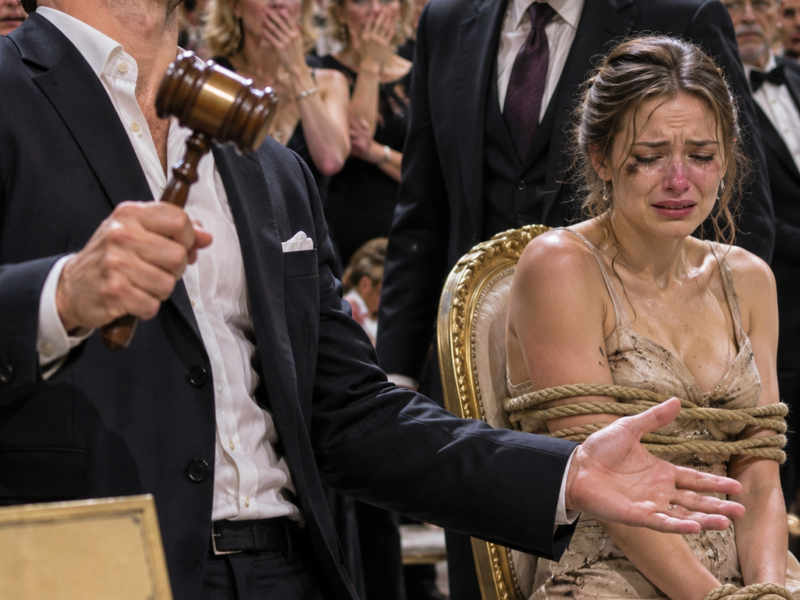
My Son-in-Law Humiliated Me in Front of 300 Guests at a Charity Gala, Making Me Look Like a Grieving Father Who Could No Longer Think Clearly While Portraying My Daughter as Mentally Unstable. Weeks Later, He Tried to Have Her Suspended From the Foundation, Unaware That I Had Uncovered Evidence of $2.7 Million in Suspicious Transactions. Just as I Reached for My Briefcase, My Daughter Stopped Me and Said, “I Need to Speak for Myself.” Then She Opened Her Handwritten Notebook, and His Confident Smile Vanished…
My Son-in-Law Humiliated Me in Front of 300 Guests at a Charity Gala, Making Me Look Like a Grieving Father Who Could No Longer Think Clearly While Portraying My Daughter as Mentally Unstable. Weeks Later, He Tried to Have Her Suspended From the Foundation, Unaware That I Had Uncovered Evidence of $2.7 Million in Suspicious Transactions. Just as I Reached for My Briefcase, My Daughter Stopped Me and Said, “I Need to Speak for Myself.” Then She Opened Her Handwritten Notebook, and His Confident Smile Vanished…
Part 1
The night my son-in-law publicly humiliated me in front of three hundred people, I discovered that the man my daughter had married wasn’t simply trying to push me out of her life.
He was trying to destroy hers.
And if I hadn’t noticed the way Nora was trembling beneath the ballroom lights, he might have succeeded.
My name is Everard Callaway. Three years before that evening, I lost my wife, Cecile, after spending nearly forty years believing we would grow old together. Her death left me with a collection of photographs, a quiet apartment in Ardmore, Pennsylvania, and a daughter who had always been the brightest part of our lives.
Nora inherited her mother’s intelligence, determination, and generosity. She had a successful career at the Philadelphia Community Foundation, an organization Cecile had helped build.
Then she married Dalton Vane.
At first, I believed she had found someone worthy of her.
Dalton was articulate, successful, and remarkably skilled at making people feel important. He remembered birthdays, brought expensive wine to family dinners, and spoke about charitable work with convincing enthusiasm.
When he looked at Nora during their wedding, I thought I recognized the expression of a man who understood how fortunate he was.
I was wrong.
The changes began so gradually that I could never identify the precise moment when my daughter started disappearing.
Our Thursday dinners became less frequent. Her telephone calls grew shorter. Invitations were canceled because Dalton had arranged something else.
Whenever I asked whether everything was all right, she gave me the same answer.
“I’m just tired, Dad.”
I believed her until the morning I found an old folder containing documents for the Callaway Family Charitable Fund.
Cecile and I had established the fund in 2007. It was separate from the foundation where Nora worked, and its assets were intended to support charitable initiatives long after we were gone.
Looking at Cecile’s signature brought back memories of conversations we had shared about protecting Nora’s future.
On impulse, I called my daughter.
Dalton answered.
“Nora’s resting,” he explained. “She’s been having some difficulties lately.”
“What kind of difficulties?”
“Stress. Forgetfulness. Nothing you need to worry about.”
There was something about his answer that bothered me.
Nora had always been exceptionally organized. She kept a handwritten planner, remembered appointments months in advance, and could recall details from conversations I had forgotten entirely.
Forgetfulness didn’t sound like her.
Over the following weeks, I began paying closer attention.
When I visited their house, Dalton rarely left us alone. He answered questions directed at Nora, corrected her recollections, and occasionally laughed when she tried to explain something.
“You’re getting confused again, sweetheart.”
He said it affectionately.
That was what made it so disturbing.
One afternoon, Nora mentioned a foundation payment she didn’t remember approving.
Dalton immediately interrupted.
“We’ve discussed this already.”
“I know, but the amount—”
“Nora.”
One word.
She stopped speaking.
I watched my daughter lower her eyes like a child who had been reprimanded.
Later, when Dalton stepped outside to take a telephone call, I asked whether she was happy.
She looked toward the doorway.
“Of course.”
“You know you can tell me anything.”
“I know, Dad.”
But she didn’t look at me when she said it.
A few days later, I received a voicemail from her in the middle of the night. Her voice was barely audible.
She started saying something about documents at the foundation, then abruptly stopped. I heard movement in the background before the recording ended.
When I called the following morning, Dalton assured me she had been exhausted and confused.
He was becoming increasingly interested in explaining my daughter’s behavior.
And increasingly determined to prevent me from hearing her explain it herself.
I started examining publicly available foundation records and the financial information Cecile had kept. Some vendor payments struck me as unusual, particularly repeated transactions associated with a company called Northshore Business Services.
I couldn’t prove anything, but the pattern bothered me.
Then I discovered something far more alarming.
Dalton had begun gathering documentation concerning Nora’s mental capacity.
What he presented as concern for his wife’s health appeared to be the beginning of a case against her ability to manage her own affairs.
When I questioned him, his expression changed.
“Everard, I understand that losing Cecile has been difficult for you. But Nora is my wife. You need to respect our boundaries.”
“I’m her father.”
“And she’s an adult.”
The irony was almost unbearable.
He demanded that I respect Nora’s independence while systematically stripping it away.
Soon afterward, relatives began contacting me.
My cousin Lucinda called first.
“Dalton mentioned you’ve been struggling.”
“Struggling with what?”
“Cecile’s death. Nora moving on with her life.”
I understood immediately.
Dalton had anticipated my suspicions and was preparing everyone to dismiss them.
Within four days, I received twelve messages from relatives expressing concern about my emotional well-being.
People who had known me for decades were suddenly questioning my judgment because a charming man had suggested grief was clouding it.
I wanted to defend myself.
Instead, I began documenting everything.
Then came the foundation’s annual gala.
Cecile had loved that event. For years, we had attended together, greeting donors and celebrating programs that helped families throughout Philadelphia.
This time, when I arrived at the ballroom, a young woman informed me that my seating assignment had been changed.
She escorted me past the family table, past the board members and major donors, until we reached Table 17.
It stood near the back of the room, partially hidden behind a decorative column.
I could barely see the stage.
The message was unmistakable.
I was no longer important.
Twenty minutes later, Dalton approached, shook my hand, and greeted me with the distant politeness reserved for an inconvenient acquaintance.
“Everard. Glad you could make it.”
Before I could answer, he turned toward another guest.
Across the ballroom, I spotted Nora wearing a burgundy dress. Her hands were clasped so tightly that her knuckles had turned white.
Our eyes met.
She looked terrified.
I started to rise, but someone approached her, and the moment passed.
At eight o’clock, Dalton took the microphone.
He thanked the donors, praised the foundation’s accomplishments, and spoke about its future. Then his attention shifted toward his wife.
He began discussing the importance of recognizing when people needed help, even when they were reluctant to accept it.
His tone was sympathetic.
His words were devastating.
He suggested Nora had been struggling with responsibilities she could no longer manage comfortably.
People turned toward her.
She stood motionless.
I felt anger rising through my chest.
This wasn’t a husband protecting his wife. This was a man publicly establishing a narrative that would make anything she said afterward seem unreliable.
Then Dalton made a remark about the difficulty of maintaining appropriate boundaries with family members.
His eyes briefly traveled toward my table.
Several guests followed his gaze.
I understood that he was humiliating both of us at once.
Nora was being presented as fragile and incapable.
I was being presented as the grieving father who refused to accept reality.
Dalton smiled beneath the spotlight, apparently satisfied with the performance.
But then something happened that he hadn’t anticipated.
Nora moved toward the stage.
Her face was pale, and I could see that she was struggling to keep herself composed.
Dalton extended his hand as though welcoming her into a carefully rehearsed moment.
She didn’t take it.
Instead, she looked directly at him.
For several seconds, neither of them spoke.
The microphone slipped from Dalton’s hand and struck the floor with a deafening crash.
Three hundred people fell silent.
And as I watched my daughter’s expression, I realized something that would change everything.
She wasn’t confused.
She wasn’t imagining things.
She was frightened because she knew exactly what her husband was doing.
What I didn’t yet understand was how much money was involved, how far Dalton had gone to conceal it, or why he needed everyone to believe Nora was losing her mind.
That answer would come through a collection of financial records, a worn cloth-bound planner, and a secret that Dalton had spent eighteen months making certain nobody would discover.
He thought he had already won.
He had no idea that his wife was about to become the most dangerous witness against him.
Part 2
After the gala, I stopped trying to convince my relatives that something was wrong.
Dalton had already poisoned their perception of me. Every accusation I made would strengthen the story he had created.
Instead, I contacted Baxter Holden, a forensic accounting professional capable of examining the foundation’s suspicious transactions.
What he discovered made my stomach turn.
Northshore Business Services wasn’t an ordinary vendor. Its ownership was connected to Garrett Morrow, a man whose relationship with Dalton raised serious questions about where the foundation’s money was actually going.
Even worse, numerous questionable payments appeared to carry Nora’s authorization.
My daughter wasn’t simply being controlled.
She was being positioned to take responsibility for financial misconduct.
When I finally managed to speak with her privately, she admitted that Dalton had repeatedly insisted she had signed documents she couldn’t remember seeing.
“Sometimes I think I’m going crazy, Dad.”
I reached across the table.
“What if you’re remembering everything correctly?”
She stared at me.
Then she told me about her planner.
Every meeting, appointment, and professional commitment had been recorded by hand.
If Dalton’s documents were genuine, the dates would match.
If they weren’t, we could prove it.
And the very first authorization we examined contained an impossibility Dalton had never considered.
Part 3
The first document claimed Nora had authorized a $70,000 payment on March 14 at 2:47 in the afternoon.
According to the foundation’s records, she had approved the transaction from her office in Philadelphia.
Nora opened her planner.
“March fourteenth,” she whispered.
Her finger stopped halfway down the page.
“I was in Harrisburg.”
She had attended a foundation meeting that afternoon and hadn’t returned to Philadelphia until evening.
There were meeting minutes, attendance records, and emails confirming her participation.
We examined another authorization.
June 22. Another $70,000.
Nora had been in New York, delivering a presentation at a nonprofit leadership conference.
The third authorization involved $90,000 on September 8.
She had been in Baltimore. A parking receipt, restaurant transaction, and meeting confirmation established her whereabouts.
Three separate transactions.
Three separate contradictions.
Someone had created financial records bearing my daughter’s name and manipulated the authorization system to make them appear legitimate.
Dalton had apparently assumed that controlling her electronic records meant controlling every piece of evidence that mattered.
He had overlooked a simple handwritten planner.
But what Nora told me next surprised me even more.
“Dad, there’s something else you need to know.”
She reached into her bag and removed a small notebook.
Its corners were bent, and the pages were crowded with handwritten entries.
“I’ve been keeping this since July.”
I opened it.
July 15: Dalton had taken a telephone call shortly before midnight, discussing a Northshore payment.
July 22: The foundation had approved $180,000 in expenditures, but transfer records showed $240,000 moving out of its accounts.
August 3: Dalton had met Garrett Morrow for lunch, claiming he was meeting a donor. Garrett wasn’t listed in the foundation’s donor database.
Page after page contained suspicious transactions, unexplained meetings, and conversations Nora had overheard.
For two months, my daughter had been investigating her own husband.
She had even hired professional investigators when the irregularities became too serious to ignore.
I looked up at her.
“Why didn’t you tell me?”
Her expression softened.
“He checks everything, Dad. My phone, my laptop, my emails. Sometimes I think he even knows where I’ve been before I get home.”
She explained that Dalton had become more controlling after she began asking questions about the foundation’s finances.
Whenever she challenged him, he insisted she was misremembering events.
When she produced evidence, he suggested she was interpreting it incorrectly.
Eventually, he began telling other people she was experiencing emotional difficulties.
“He made me question things I knew were true,” she admitted. “But I kept writing them down. I thought that someday I might need proof.”
I felt an overwhelming mixture of pride and grief.
While I had been worrying that my daughter was helpless, she had been quietly gathering evidence under the most difficult circumstances imaginable.
Baxter’s investigation had established the financial scale of Dalton’s activities.
Approximately $2.7 million had been diverted through Northshore Business Services over eighteen months.
The company had been established through layers of corporate ownership that ultimately led to Garrett Morrow, Dalton’s former graduate school colleague.
There were no convincing records of legitimate consulting services.
No meaningful business operations.
No evidence that the foundation had received anything remotely equivalent to the money it had paid.
Yet the documents authorizing those payments repeatedly pointed toward Nora.
Dalton’s plan was becoming clear.
If anyone discovered the missing money, he could present his wife as the person responsible. He could then use his carefully assembled documentation about her mental capacity to argue that she was incapable of managing her responsibilities.
Either way, he intended to emerge as the concerned husband who had tried to prevent a tragedy.
Meanwhile, Nora would lose her professional reputation, her independence, and possibly control over her own financial affairs.
The thought made me physically sick.
“We need to get you out of that house,” I said.
Nora shook her head.
“Not until we’re ready.”
“Nora—”
“If he knows what we’ve found, he’ll start destroying evidence. Or he’ll try to have me removed from the foundation before I can defend myself.”
I wanted to argue.
Every instinct I possessed told me to take her somewhere safe and never let Dalton near her again.
But I recognized the determination in her expression.
She had inherited it from Cecile.
And she was right about one thing: we needed professional assistance and a carefully prepared strategy, not an impulsive confrontation.
We agreed that our next steps would be coordinated with legal and financial advisers.
The evidence would be preserved outside Dalton’s reach. Nora would decide when and how she could safely leave. We would avoid communicating through accounts she believed he monitored.
Most importantly, we wouldn’t give him an opportunity to turn our accusations into further evidence of instability.
Before leaving the café, Nora reached across the table and took my hand.
“I’m sorry I couldn’t tell you sooner.”
“You don’t owe me an apology.”
“There were nights when I almost called. I just didn’t know what would happen if he found out.”
I squeezed her fingers.
“You’ve told me now. That’s what matters.”
For the next several days, Baxter and I worked through the financial records.
The deeper we went, the more deliberate Dalton’s scheme appeared.
Payments had frequently been arranged in amounts that avoided triggering comprehensive board review.
Descriptions of consulting services were vague enough to discourage detailed questions.
Authorizations had been processed through systems Dalton could access.
The documentation concerning Nora’s supposed mental decline appeared to have developed alongside the financial irregularities.
These weren’t disconnected problems.
They were pieces of the same arrangement.
One evening, I sat at my kitchen table surrounded by documents and found myself staring at a photograph of Cecile.
She was smiling beside Nora at a foundation event years earlier.
Our daughter had just accepted a position with the organization. Cecile had been so proud that she told practically everyone she encountered.
Now the institution she had devoted years to building was being used as a weapon against that same daughter.
I wished more than anything that she were sitting beside me.
She would have known what to say.
Eventually, I put the photograph down and returned to the records.
By the time we finished, we had assembled a 147-page dossier containing transaction histories, corporate ownership documents, inconsistencies in the authorization records, and supporting evidence.
Nora reviewed everything.
She knew precisely which documents mattered and how they connected.
Then we learned Dalton was arranging a special board meeting.
He intended to present evidence of financial irregularities and recommend that Nora be suspended from her foundation responsibilities.
The timing was almost perfect for him.
He believed his wife remained isolated.
He believed her father was discredited.
He believed the board would accept his documentation without serious opposition.
What he didn’t know was that the people he had spent eighteen months undermining were now working together.
The night before the meeting, I barely slept.
I kept imagining the board accepting Dalton’s story and watching helplessly as my daughter lost everything her mother had helped her build.
Shortly before midnight, I opened the briefcase containing our evidence and checked its contents one last time.
Then I closed it.
There was nothing more to prepare.
The following morning, Nora arrived wearing a dark professional suit.
Her expression was composed, but I noticed her hands trembling slightly.
“Are you ready?” I asked.
She took a deep breath.
“I’ve been ready for longer than you know.”
We entered the foundation’s headquarters together.
Inside the conference room, Dalton was already waiting.
A neat stack of folders sat in front of him.
He smiled when he saw us.
Not the smile of a man facing exposure.
The smile of someone who believed the outcome had already been decided.
“Everard,” he said pleasantly. “I’m glad you’re here. This concerns the whole family.”
I placed my briefcase beside my chair.
“Yes,” I replied. “It certainly does.”
He had no idea what was inside it.
Part 4
Vivian Ostroff, the foundation’s board chair, called the meeting to order.
Dalton began speaking almost immediately.
He thanked everyone for attending, acknowledged the seriousness of the situation, and expressed regret that circumstances had forced him to bring private family difficulties into a professional setting.
Then he distributed his folders.
“I’ve spent considerable time reviewing financial irregularities within the foundation,” he announced. “What I’ve discovered is deeply concerning.”
He projected a series of documents onto the conference room screen.
Each contained Nora’s name.
Each appeared to authorize a payment to Northshore Business Services.
He walked the board through the transactions with extraordinary confidence.
A $70,000 payment in March.
Another $60,000 in April.
An $85,000 authorization in May.
He explained that the payments had been arranged in a pattern that allowed them to escape normal scrutiny.
Several board members began making notes.
Dalton sighed before continuing.
“I want to emphasize that I don’t believe my wife acted maliciously.”
Nora remained perfectly still.
“I believe she’s been struggling with the demands of her position. I’ve tried to help her privately, but the situation has reached a point where we must protect both her and the foundation.”
I watched the board members absorb his explanation.
He was remarkably convincing.
The documents looked official. His voice conveyed concern. His apparent reluctance to accuse his wife made the accusation seem even more credible.
He wasn’t simply blaming Nora for the missing money.
He was presenting himself as the person most deserving of sympathy.
“The responsible course of action,” he concluded, “would be to temporarily suspend Nora’s financial authority while we investigate further and ensure she receives appropriate support.”
Silence settled over the room.
Vivian looked toward Nora with an expression that suggested she had already begun accepting Dalton’s explanation.
My heart sank.
Even knowing what was inside my briefcase, I understood how dangerous this moment was.
Dalton had spent eighteen months building his credibility.
We had one meeting to dismantle it.
“Thank you, Dalton,” Vivian said. “These are substantial allegations. Naturally, we’d like to hear from Nora and Mr. Callaway before proceeding.”
I reached toward my briefcase.
But Nora placed her hand on my arm.
“Dad.”
I turned.
“Thank you for everything you’ve done to help me prepare for today,” she said. “But I need to speak for myself.”
For a moment, I didn’t move.
Then I understood.
Dalton had expected me to defend her. He wanted the board to see a distressed woman relying on her father to explain her behavior.
Nora wasn’t going to give him that satisfaction.
I withdrew my hand.
She stood and placed her cloth-bound planner on the table.
“I’ve kept this planner for three years,” she began. “Every appointment, every professional commitment, every meeting. Everything is recorded as it happens.”
Dalton shifted in his chair.
Nora opened the planner to March 14.
“The first authorization Dalton presented claims I approved a $70,000 payment from our Philadelphia office at 2:47 p.m.”
She distributed copies of the supporting records.
“On that date, I was attending a foundation meeting in Harrisburg.”
Alden Fairweather, a board member with extensive banking experience, examined the documents.
“The Harrisburg meeting is on our official calendar,” he confirmed.
Nora continued.
“Here are the meeting minutes confirming my attendance. Here are the venue records. Here is the correspondence arranging my participation.”
Dalton leaned forward.
“There may be discrepancies in the system’s timestamps—”
“Then perhaps we should examine another transaction,” Nora interrupted calmly.
She opened her planner to June 22.
“This authorization was supposedly processed while I was in Philadelphia. In reality, I was presenting at a leadership conference in New York.”
She distributed another set of documents.
Conference schedules.
Hotel reservations.
Attendance confirmations.
Then she presented the Baltimore transaction.
By the time she finished, nobody was looking at her with sympathy.
They were looking at Dalton with suspicion.
Alden removed his glasses.
“If Nora wasn’t present when these authorizations were processed, who signed them in her name?”
Dalton opened his mouth.
Then closed it.
For the first time that morning, he seemed unable to find the appropriate words.
I stood.
“There’s another question we should be asking.”
I opened my briefcase.
“Who received the money?”
I distributed Baxter’s findings.
The corporate ownership chart traced Northshore Business Services through several entities to Garrett Morrow.
Dalton’s face changed when his friend’s name appeared.
“Garrett Morrow,” I explained, “is Dalton’s former graduate school colleague. His company was established approximately eighteen months ago, shortly before these suspicious payments began.”
Vivian studied the incorporation records.
“Are you suggesting these payments were fraudulent?”
“I’m presenting evidence that $2.7 million was transferred to a company without identifiable legitimate operations sufficient to justify those payments.”
The figure seemed to alter the atmosphere in the room.
Two million seven hundred thousand dollars.
Money intended to support educational opportunities, community programs, and families in need.
Money Cecile would have considered a sacred responsibility.
Dalton stood abruptly.
“This is an extraordinary misrepresentation.”
“Then explain it,” Alden said.
“Corporate ownership structures can be complicated. A personal acquaintance doesn’t establish wrongdoing.”
“No,” Nora agreed. “But forged authorizations, suspicious transfers, and nonexistent consulting deliverables establish grounds for a comprehensive investigation.”
She looked around the table.
“If you believe I’ve done something wrong, investigate me. Examine every transaction. Review every authorization. Audit everything from the past two years.”
Dalton stared at her.
She continued.
“I have nothing to hide. Can everyone in this room say the same?”
Nobody answered.
Vivian turned toward the other board members.
“I believe we need to expand the scope of the proposed audit.”
Dalton immediately objected.
“That would be unnecessarily disruptive.”
Alden frowned.
“Disruptive to whom?”
“To the foundation. To our donors. We need to consider the reputational consequences of launching an investigation of this magnitude.”
Vivian’s expression hardened.
“We’re discussing millions of dollars in potentially fraudulent transactions. The reputational consequences of ignoring them would be considerably worse.”
A vote was called.
Six board members supported expanding the investigation.
Dalton was the only person who opposed it.
The man who had entered the room demanding accountability from his wife was now voting against an investigation into the very transactions he had presented.
His hands tightened around the back of his chair.
Then the conference room door opened.
Baxter Holden entered, accompanied by a man carrying a badge.
“This is Detective Nolan Hart,” Baxter explained. “Philadelphia Police Department, Financial Crimes Unit.”
Dalton went pale.
Detective Hart introduced himself and explained that the financial evidence warranted formal examination by law enforcement.
Nobody spoke.
Then, in a desperate change of direction, Dalton turned toward me.
“Everard, we need to discuss the Callaway Family Charitable Fund.”
I stared at him.
He began explaining that the foundation might face immediate financial difficulties because of the expanded investigation.
He suggested our family fund could provide emergency financial support.
“Cecile helped build this organization,” he reminded me. “Surely you understand your responsibility to protect what she created.”
There it was.
My wife’s name.
The one thing he believed could still influence my judgment.
For months, he had treated me as an outsider. He had dismissed my questions, isolated me from my daughter, and persuaded my relatives that I was emotionally unstable.
Now that his own position was collapsing, he wanted access to the money Cecile and I had protected for years.
I met his eyes.
“You spent nearly two years telling me I had no right to question your decisions.”
“Everard, this isn’t personal.”
“You made it personal when you used my daughter’s name to conceal suspicious transactions.”
He glanced toward the detective.
“The foundation needs stability.”
“The foundation needs accountability.”
I leaned forward.
“You will not receive a single dollar from the Callaway Family Charitable Fund.”
His expression hardened.
“You’re jeopardizing Cecile’s legacy.”
“No, Dalton. I’m protecting it.”
Nora looked at me.
For the first time that morning, she smiled.
The board authorized a comprehensive independent forensic audit and took steps to protect the foundation’s accounts and records.
Dalton’s influence was slipping away.
But we still needed definitive findings that would establish his responsibility beyond the circumstantial evidence we had assembled.
Those findings arrived later.
And they were even more damaging than Dalton could have imagined.
Part 5
The independent forensic investigation confirmed what Nora and I had suspected.
The suspicious payments weren’t isolated accounting mistakes.
They were part of a systematic financial arrangement designed to divert money from the foundation while concealing the identity of the people responsible.
Investigators examined bank records, corporate filings, authorization histories, and the electronic systems used to approve payments.
They found evidence connecting Dalton to transactions he had insisted were Nora’s responsibility.
The documentation he had relied upon to portray her as incompetent was now being examined as part of a broader pattern of deception.
When the findings were presented to the board, Dalton sat at the conference table without his usual confidence.
His hands rested flat in front of him.
Vivian summarized the conclusions.
Then she asked whether he wished to respond.
He said nothing.
I remembered all the times I had watched him dominate conversations.
The dinners where he corrected Nora.
The telephone calls where he explained her feelings.
The gala where he had controlled the attention of three hundred people.
The board meeting where he had presented himself as a devoted husband reluctantly exposing his wife’s failures.
Now, confronted with independently verified evidence, he couldn’t offer a convincing explanation.
Vivian called for his immediate suspension.
His access to the foundation’s financial systems would be revoked. His credentials and institutional property would be surrendered. The evidence would be delivered to law enforcement for criminal investigation.
Six hands rose.
Dalton remained motionless.
“The motion carries,” Vivian announced.
Just like that, the authority he had spent years accumulating disappeared.
Detective Hart informed him that investigators would require his cooperation.
The other board members began gathering their belongings.
Nora stood beside me.
I expected her to look triumphant.
Instead, she looked exhausted.
As we walked toward the door, I glanced back.
Dalton was watching her.
There was no reassuring smile. No carefully rehearsed expression of concern.
Only the face of a man who had finally discovered that the person he considered powerless had been capable of destroying his entire arrangement.
Outside the building, Nora stopped.
For several moments, we stood together on the pavement.
Then she exhaled.
“It’s over.”
I wanted to tell her that everything would be all right.
But I knew better.
The investigation was only one part of what lay ahead.
There would be lawyers, financial disputes, difficult conversations, and memories that wouldn’t disappear simply because Dalton had lost his position.
Still, something fundamental had changed.
Nobody could legitimately claim that Nora was incapable of managing her life.
She had demonstrated extraordinary judgment under circumstances that would have overwhelmed many people.
And she had done it without surrendering her voice.
Not long afterward, she moved into a furnished apartment near the university.
She consulted a divorce attorney experienced in cases involving financial deception and controlling relationships.
When she told me about the appointment, I immediately offered to accompany her.
Then I caught myself.
“Would you like me to come?”
“No, Dad. I need to do this part on my own.”
“All right.”
There was a brief silence.
“Thank you for asking,” she added. “Instead of deciding.”
Those words stayed with me.
I had spent months trying to protect my daughter from a man who made decisions on her behalf.
Yet my own instinct to protect her sometimes led me dangerously close to forgetting that she was entitled to make those decisions herself.
Love didn’t give me permission to replace Dalton’s control with my own.
It gave me a responsibility to respect the freedom she had fought to reclaim.
Meanwhile, the foundation began rebuilding.
Vivian and the board worked with independent professionals to strengthen financial oversight, review vendor relationships, and restore donor confidence.
The criminal investigation continued through official channels.
Garrett Morrow’s involvement and the corporate structures used to conceal the money were no longer protected by Dalton’s position.
The people responsible would have to answer for their actions.
Relatives who had previously questioned my judgment began contacting me again.
Lucinda called one afternoon.
“Everard, I heard what happened.”
I waited.
“I owe you an apology.”
Her voice cracked.
“I thought Dalton was worried about you. I never imagined he was doing something like this.”
“Neither did I, at first.”
“I should have listened.”
“Yes,” I replied gently. “You should have.”
I didn’t need to punish her.
But I wasn’t going to pretend that her willingness to dismiss my concerns hadn’t hurt me.
Trust would have to be rebuilt through actions, not a single apologetic telephone call.
Other relatives offered similar explanations.
Some were genuinely remorseful.
Others seemed more embarrassed about having been wrong than concerned about what Nora had endured.
I accepted the sincere apologies and stopped investing energy in the rest.
For the first time since Cecile’s death, I understood that preserving family relationships didn’t require accepting every version of events someone offered me.
One evening, Nora called while I was preparing dinner.
“Dalton tried to get a message to me today.”
My hand tightened around the kitchen counter.
“What did he want?”
“To talk before the divorce is finalized.”
“What did you say?”
“No.”
The simplicity of her answer surprised me.
“No?”
“If there’s something legal to discuss, he can contact my attorney. I’m finished having conversations where he tries to convince me that what happened didn’t happen.”
Then she changed the subject.
She told me about a consulting opportunity she was considering, a yoga class she had joined, and her plans to visit Cecile’s grave on what would have been her mother’s birthday.
Dalton had occupied less than a minute of our conversation.
Once, his opinions had determined whether she trusted her own memories.
Now, his attempt to contact her barely interrupted her evening.
“You sound happy,” I said.
“I feel lighter.”
I smiled.
That was all I had wanted for her.
Several weeks later, Nora came to my apartment carrying a folder.
She sat beside the window while I made coffee.
“I’ve been thinking about the family fund,” she said.
I turned toward her.
“What about it?”
“Not about protecting it from Dalton. About what we could actually do with it.”
She opened the folder.
Inside were notes about educational scholarships, professional training, emergency assistance, and programs designed to support women rebuilding their lives after leaving controlling relationships.
“Some women can’t leave because they don’t have money,” she explained. “Or because their careers have been destroyed. Or because someone has convinced them they’re incapable of surviving independently.”
I sat down across from her.
“I want to help them get their lives back.”
For a moment, I couldn’t speak.
I thought about Cecile signing the original fund documents in April 2007.
We had talked endlessly about creating something that would outlive us, something capable of making a meaningful difference in the lives of people we might never meet.
Now our daughter was proposing to use that legacy to help women facing the same circumstances she had survived.
“Your mother would have loved this,” I finally said.
Nora smiled.
“I was hoping you’d say that.”
We began working with the appropriate advisers to establish a scholarship initiative through the Callaway Family Charitable Fund.
It would support women pursuing education and professional independence after leaving controlling or financially abusive relationships.
The program would offer practical assistance rather than simply encouragement.
For someone starting over, tuition payments, professional certification fees, or other essential expenses could make the difference between returning to an unsafe situation and building an independent future.
Nora understood that better than either of us would have wished.
And she was determined to turn that understanding into something useful.
Our Thursday dinners resumed.
Sometimes we talked about the foundation.
Sometimes we discussed the scholarship program.
Other evenings, we argued about movies, shared stories about Cecile, or laughed over ordinary things.
Those ordinary evenings became especially precious to me.
There was no husband monitoring the time.
No telephone call demanding to know when Nora would return.
No need for her to explain why she wanted to spend an evening with her father.
One Thursday, she arrived carrying a bottle of wine and a photograph she had found while sorting through her belongings.
It showed the three of us standing outside our old family home.
Cecile had her arm around Nora, and I was squinting into the sunlight.
Nora placed it on the table.
“I think Mom would be proud of us.”
I looked at the photograph.
“She would be proud of you.”
“Of both of us, Dad.”
We sat quietly for a moment.
Then she reached for my hand.
Months earlier, I had believed that saving my daughter meant exposing Dalton, proving the fraud, and forcing everyone who doubted me to acknowledge the truth.
I had been wrong about what mattered most.
The evidence was important.
The investigation was necessary.
Dalton’s removal was essential.
But none of those things could restore Nora’s independence unless she was given the freedom to reclaim it herself.
She had done exactly that.
The woman who had once stood trembling beneath the ballroom lights had confronted a room full of people prepared to believe the worst about her.
She had defended herself with facts.
She had challenged the man who had controlled her life.
And afterward, she had chosen a future that belonged entirely to her.
One evening, after Nora went home, I opened the drawer containing Cecile’s old paperwork.
I took out the original documents for our family fund and studied her signature.
For years, that handwriting had reminded me of everything I had lost.
Now it reminded me of something that had survived.
The values Cecile had passed on to our daughter.
The generosity she had encouraged.
The courage she had demonstrated throughout her life.
Dalton had tried to exploit those things.
Instead, they had become the foundation of his downfall.
I returned the documents to their folder and closed the drawer.
Outside, the neighborhood continued with its usual evening routines.
People walked their dogs. Cars passed beneath the streetlights. Families gathered around dinner tables.
Somewhere across town, my daughter was living a life she no longer needed anyone’s permission to enjoy.
The scholarship program was preparing to welcome its first applicants.
The foundation was finding its footing again.
And our Thursday dinners would continue, not because Nora needed rescuing, but because we genuinely enjoyed being together.
I still missed Cecile.
I always would.
But the future no longer felt like something I had to endure alone.
Looking back, I realize the most dangerous thing Dalton did wasn’t stealing millions of dollars.
It was persuading a capable, intelligent woman that she couldn’t trust herself.
He nearly succeeded because his manipulation arrived disguised as affection.
His restrictions sounded like concern.
His accusations sounded like protection.
And his lies sounded convincing because he repeated them with such confidence.
But Nora’s handwritten records preserved something he couldn’t control.
The truth.
He had underestimated the importance of a notebook, the loyalty of a father, and the strength of a woman who refused to surrender her own judgment.
For eighteen months, Dalton worked to make my daughter believe she was powerless.
In the end, she was the person who stood before the board and dismantled everything he had built.
And the greatest victory wasn’t watching him lose his position, his influence, or his carefully manufactured reputation.
It was hearing Nora laugh again.
It was watching her make decisions without apologizing.
It was knowing that when she woke each morning, nobody could tell her what to believe about herself.
Dalton had stolen money, manipulated relationships, and attempted to rewrite our family’s history.
But he couldn’t take away the one thing that ultimately mattered.
My daughter’s right to write the rest of her own story.