My Roommate Left Her Door Open Six Nights… On the Seventh, She Came Wearing Only My Shirt.
My Roommate Left Her Door Open Six Nights… On the Seventh, She Came Wearing Only My Shirt.
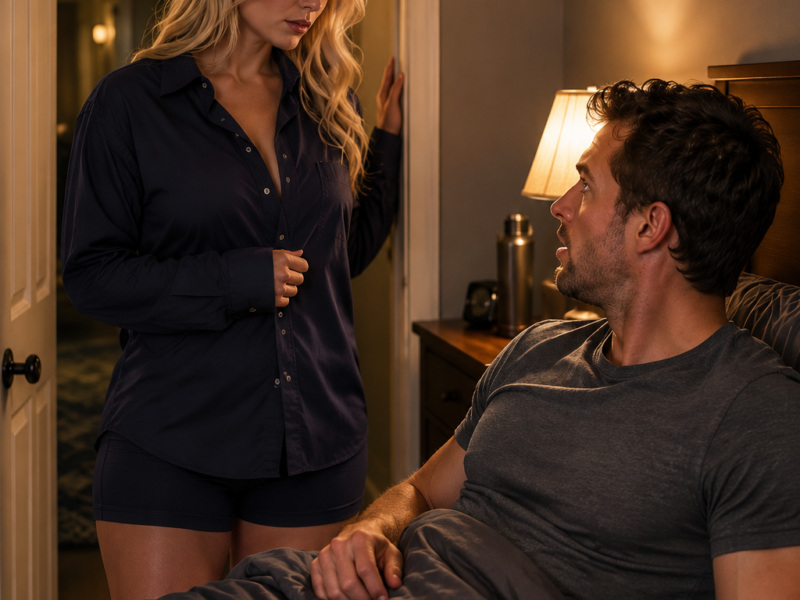
At 11:08 on a Tuesday night, I was standing in my kitchen eating cereal out of a coffee mug when the woman who had been quietly rearranging my life for the past six days appeared in my bedroom doorway wearing nothing but my navy button-down shirt.
And for the first time since she had moved into my apartment, Paige Sullivan knocked.
Not on the front door. Not on her bedroom door. On mine.
I turned around with a spoon halfway to my mouth and nearly forgot how to swallow.
She stood beneath the hallway light, her dark hair falling loosely over one shoulder, the sleeves of my old shirt rolled up to her elbows. The hem reached somewhere around the middle of her thighs, and she had bare feet tucked against the wooden floor. She looked nervous, determined, and entirely too beautiful for an apartment that smelled faintly of microwave popcorn and furniture polish.
I lowered the spoon.
“Before you panic,” she said, lifting one eyebrow, “I’m not here to seduce you.”
I stared at her for a moment.
“That’s exactly what someone would say if they were here to seduce me.”
A small smile appeared on her face, but it disappeared almost immediately.
“Owen.”
There was something different about the way she said my name. Usually, she said it with a teasing edge, as though she were about to accuse me of something ridiculous. This time, it sounded softer. More serious. Almost like she was asking me to pay attention.
“I need to ask you something.”
And suddenly, every little moment from the previous six nights came rushing back.
My name is Owen Mercer. I was twenty-five years old, single, and professionally skilled at making furniture look better than it had any right to. I restored old tables, chairs, dressers, and anything else people were ready to throw away. My workshop was a rented garage behind a hardware store in Portland, Maine, where most of my days were spent sanding wood, replacing broken joints, and trying to convince damaged furniture that it still had a future.
I was considerably better at restoring old furniture than dealing with people.
Furniture, at least, didn’t ask difficult questions. It didn’t leave without warning. It didn’t tell you that you were a good man who somehow never let anyone close enough to know you.
My last girlfriend had said something similar eight months before Paige arrived.
She had called me safe, kind, dependable, and emotionally unreachable. She said she sometimes felt as though she were dating a locked filing cabinet.
I had laughed when she said it, because making jokes was easier than admitting that she was right.
After she left, I settled into a routine that required very little from me. Work during the day, takeout or cereal at night, occasional television, and weekends spent pretending that I enjoyed the peace of having nobody around.
My apartment was clean, quiet, and perfectly organized. Everything had a place. Nothing was particularly personal. I owned furniture that I had restored myself, but most of it remained almost empty, as though I were furnishing a temporary rental instead of somewhere I actually lived.
Then my landlord, Uncle Rob, called me.
He explained that his niece needed somewhere to stay for a few months after accepting a position at a children’s clinic downtown. She was starting a new job, wanted to be closer to the city, and needed an affordable room.
The rent was already ridiculous, and splitting it would make my life considerably easier.
I agreed before he finished explaining.
I had no idea that the decision would eventually change almost everything.
Paige arrived on a Wednesday afternoon carrying two cardboard boxes and wearing ripped jeans, a cream-colored sweater, and boots that looked as though they had survived several questionable adventures.
She was trying to carry both boxes up the stairs at once.
“I can help,” I offered.
“I’m fine.”
The third step disagreed.
One of the boxes split open, sending books, socks, a ceramic rabbit, and several other belongings tumbling across the stairwell. A framed photograph slid toward the railing, and a red bra landed directly on my work boot.
We both stared at it.
Paige closed her eyes.
“Well, good. At least we’ve established dominance early.”
I picked up the bra by one strap and handed it to her with the seriousness of someone returning classified evidence.
“I’m Owen.”
“I’m moving out immediately.”
That was the first time she made me laugh.
Not the polite kind of laugh I usually offered strangers. A real one, unexpected and slightly embarrassing.
She noticed.
Her smile widened, and something about the expression made the apartment feel less empty.
By the end of that evening, Paige had unpacked one lamp, three coffee mugs, a small speaker, and approximately half a bookshelf. She played old soul music while assembling the shelves without reading the instructions.
The result leaned slightly to the left.
She insisted it was intentional.
I didn’t argue.
What I did notice was that her bedroom door remained open.
My bedroom was directly across the hallway, so it was difficult not to see into her room whenever I passed. I tried to convince myself that I wasn’t paying attention, but I was.
That first night, I walked past her doorway on my way to brush my teeth. She was sitting cross-legged on the floor wearing gray sweatpants, sorting paperbacks into little piles.
“You don’t have to keep your door open,” I said.
She looked up.
“Does it bother you?”
“No.”
“Then I’m good.”
“Okay.”
I continued toward the bathroom.
“Owen?”
I turned.
“Yeah?”
“If you ever become the kind of roommate who narrates his hallway movements, I’m raising your rent.”
“I don’t own the building.”
“I’ll find a way.”
I shook my head, smiling, and went to bed.
The second night, her door was open again.
She was sitting on her bed wearing a lavender T-shirt, her laptop balanced on her knees. A medical training video played quietly while she whispered along with the instructions, occasionally pausing to write something in a notebook.
There was a pen between her teeth and a small crease between her eyebrows.
I had seen plenty of beautiful women before. That wasn’t unusual.
But there was something arresting about watching Paige concentrate. She wasn’t trying to look attractive. She wasn’t performing for anyone. She was simply absorbed in what she was doing.
I found myself standing in the hallway longer than necessary.
Eventually, I remembered that I had supposedly been looking for a clean towel.
I opened the linen closet and stood there for ten seconds holding absolutely nothing.
The third night, she burned toast.
It happened at approximately 9:40 p.m., when I heard the smoke detector begin screaming.
I rushed into the kitchen to find Paige waving a dish towel beneath it while a thin cloud of smoke drifted toward the ceiling.
“I have everything under control,” she announced.
I looked at the blackened bread.
“Clearly.”
“I’m usually very competent.”
“At toast?”
“At everything except toast.”
“That’s a narrow weakness.”
“It keeps me humble.”
I opened the windows while she rescued what remained of the bread. Eventually, we abandoned the entire operation and ate cereal at the kitchen counter.
Mine came from a mug.
Hers came from a proper bowl.
She noticed immediately.
“Is that a bachelor cry for help?”
“It’s a space-saving strategy.”
“You own six bowls.”
“I don’t like being predictable.”
She smiled into her spoon.
“No, you like being unreachable. There’s a difference.”
I looked at her.
The joke had disappeared somewhere between her words, revealing something unexpectedly perceptive underneath.
She wasn’t looking at me like she had discovered a weakness she could exploit. She simply seemed to understand that there was something I wasn’t saying.
I considered making another joke.
Instead, I looked down at my cereal.
Paige didn’t push.
That was one of the things I would eventually understand about her. She never threw the truth at someone like a weapon. She placed it between you and waited to see whether you were brave enough to pick it up.
I wasn’t.
Not yet.
On the fourth night, I found her sitting on the hallway floor painting her toenails a dark burgundy color. One foot rested on a moving box labeled TAXES / MAYBE CANDLES.
She was holding my phone charger.
“Borrowed,” she said before I could ask.
“Stolen.”
“Borrowed with confidence.”
“You could have asked.”
“You were in the garage making a chair look emotionally available.”
I leaned against the wall.
“That chair has been through a lot.”
“So have you, I’m guessing.”
There it was again.
That quiet ability to see more than I intended to show.
I glanced toward her bedroom.
“Do you always leave your door open?”
Her nail polish brush stopped moving.
“Not always.”
“Sorry. None of my business.”
“It’s fine.”
She looked up at me.
“Closed doors make a place feel temporary.”
I didn’t know what to say.
She returned to painting her nails, and I eventually went back to my room.
But her answer stayed with me.
I understood what she meant more than I wanted to admit.
For years, I had treated my apartment as somewhere I slept between workdays. I had never really thought about making it feel like home. Home was a word I associated with people who stayed, and I had become very comfortable not expecting anyone to do that.
Paige seemed to be trying to build something different.
On the fifth night, I came home late after delivering a refinished oak table to a couple in Cape Elizabeth.
Paige was standing in the kitchen wearing navy scrubs, her hair pinned up in a way that suggested she had lost an argument with several hair clips.
She was eating peanut butter directly from a spoon.
“Rough day?” I asked.
“A four-year-old told me my bangs were uneven.”
“He sounds honest.”
“He was ruthless.”
I laughed.
She made a dramatic face and continued eating.
Then I noticed a loose strand of hair near her temple. Before I could think about what I was doing, I reached up and brushed it gently away.
My fingers came close to her skin.
Not exactly touching her.
Not exactly not.
Paige went still.
Her eyes lifted toward mine.
For one brief second, the kitchen seemed to lose every ordinary sound. The refrigerator hummed, the clock ticked, and somewhere outside a car passed along the street.
Neither of us moved.
Then I lowered my hand.
“Sorry.”
“Don’t be,” she whispered.
That answer was worse than an apology.
Because it meant she had noticed what I was trying not to admit.
I returned to my room that night and spent far too long staring at the ceiling.
The sixth night, her bedroom door was open, but she wasn’t there.
Her lamp illuminated a half-unpacked box. A paperback lay face down on the bed, and my old navy button-down was draped across the back of her chair.
I stopped walking.
That shirt had been in the laundry basket outside the bathroom that morning. It was faded, soft, and missing one button on the cuff. I usually wore it when sanding furniture because I didn’t care if it got stained.
I told myself she had grabbed it by mistake.
I told myself a lot of things.
Later, she came out of the bathroom wearing her robe. When she noticed me looking toward the chair, she followed my gaze.
“Oh.”
“My shirt?”
“Laundry mix-up.”
“Your laundry mix-ups involve theft?”
“Borrowed with confidence.”
Her cheeks turned slightly pink.
I should have asked why she kept borrowing my things. I should have asked why she seemed so comfortable around me, or why she watched me with an expression that made me feel as though she were waiting for me to do something.
Instead, I nodded.
“Keep it,” I said.
“It looks better on your chair.”
Her expression changed.
Only slightly.
But I noticed.
It was as though I had almost said something she wanted to hear, then stopped just before reaching the important part.
And that brings me back to the seventh night.
Paige stood in my doorway wearing that same navy shirt.
Only this time, she wasn’t pretending it was an innocent laundry mistake.
I set my cereal mug on the desk.
“Paige, are you okay?”
“No.”
I took a step forward.
She looked at me.
“Yes. I mean, I don’t know.”
“What happened?”
“Nothing happened.”
I waited.
“That’s the problem.”
She laughed softly, but the sound broke halfway through.
“I have left my door open for six nights, Owen.”
“I noticed.”
“I know you noticed.”
My pulse began moving somewhere near my throat.
She tugged at the sleeve of my shirt, almost as though she were borrowing courage along with the fabric.
“And every night you walked past like you were trying to win an award for honorable suffering.”
“That sounds like an important award.”
“It’s not.”
“What’s the trophy?”
“Loneliness.”
The word landed harder than I expected.
I looked at her properly.
Her mouth was trying to smile, but her eyes were serious.
“Why my shirt?” I asked.
She glanced down.
“Because if I wore something of mine, I could pretend this was casual.”
“And this isn’t?”
“No.”
The space between us suddenly felt smaller.
Paige stepped into my room. I could smell the laundry detergent from my shirt, mixed with the warm, familiar scent that belonged only to her.
She glanced around at my unmade bed, the books stacked on the floor, and the dresser I had restored but never properly filled.
Then she looked back at me.
“I didn’t come here to seduce you,” she said again.
This time, her voice was quieter.
I believed her.
“Then why did you come?”
She took a breath.
For the first time since moving into the apartment, Paige Sullivan looked genuinely afraid of what might happen next.
But she didn’t turn around.
Instead, she reached for my hand.
She did it slowly, carefully, leaving me every opportunity to pull away.
I didn’t.
Her fingers slipped between mine.
“Because I’m tired of hoping you’ll choose me by accident,” she whispered.
There are sentences that don’t merely enter a room. They rearrange everything inside it.
That was one of them.
I looked down at our hands. Her thumb rested against the scar across my knuckle, a souvenir from a walnut dresser and a particularly stupid decision involving a dull chisel.
I could have made a joke.
I had several ready.
Something about emotional accidents, furniture restoration, or the legal consequences of seducing your roommate in stolen workwear.
Instead, I said the most honest thing I had managed in months.
“I’ve been choosing you every night.”
Her eyes searched mine.
“Badly,” I added.
She let out a breath that sounded halfway between relief and laughter.
“Yes. Very badly.”
“I know.”
“Painfully badly.”
“I’m getting that.”
“Like if emotional constipation were an Olympic event, Owen, you’d have several gold medals.”
I smiled despite myself.
“Sorry. Vulnerability makes me insulting.”
“I noticed.”
“You like it.”
God help me, I did.
I stepped closer, slowly enough that she could change her mind.
She didn’t.
Her fingers tightened around mine, pulling her nearer until the hem of my shirt brushed against my sweatpants.
I wanted to kiss her.
I wanted to forget every careful rule I had built since she moved into the apartment.
But she was my roommate. She was my landlord’s niece. More importantly, this was her home, too.
I didn’t want her to feel that being honest with me meant surrendering any part of the comfort she had found here.
“I need to say this right,” I told her.
“That would be a refreshing change.”
I looked at our joined hands.
“I didn’t walk past your door because I didn’t want you.”
Her expression softened.
“I walked past because I did. Every time I saw you reading, or burning toast, or stealing my charger like a tiny domestic criminal, I wanted to come inside.”
She smiled faintly.
“I wanted to sit on your floor and talk until midnight. I wanted to hear about your day. I wanted to kiss you against that ridiculous bookshelf you built crooked.”
“It is not crooked.”
“It leans like it has secrets.”
She bit her lip.
I nearly forgot what I was saying.
“But I didn’t want you to feel cornered. This is your home, too. I didn’t want to become the reason you had to close your door.”
For a moment, she said nothing.
Then she looked down at the shirt.
“Owen, I wore your shirt and came to your bedroom.”
“I realize the environmental clues are becoming less subtle.”
She laughed.
Then her expression grew serious again.
“And for the record, I didn’t leave my door open because I was waiting for some man to rescue me from loneliness.”
“I didn’t think that.”
“I left it open because I liked you. Because you made this apartment feel less temporary. Because you look at broken things like they’re worth the time.”
Her voice became softer.
“And because when you touched my hair the other night, I thought about it for an embarrassing number of hours.”
My chest tightened.
“I thought about it, too.”
“How many hours?”
“Paige.”
“I want numbers.”
“All of them.”
Her smile unfolded slowly.
Then she lifted our joined hands and pressed her lips against my knuckles.
It wasn’t quite a kiss meant to start something.
It was a question.
I understood.
“Choose me on purpose,” she whispered.
So I did.
I lifted my free hand to her cheek, and when she leaned into my palm, I lowered my head and kissed her.
The first kiss was careful.
The second wasn’t.
Paige stepped closer, her hand sliding up my chest until her fingers curled into my T-shirt. I felt her smile against my mouth, and something inside me that had been tightly locked for years finally began to loosen.
I had imagined kissing her more times than I wanted to admit.
None of those imagined versions had included the warmth of her hand against my chest, the small sound she made when I pulled her closer, or the way she seemed to understand that I was trying to be brave.
Eventually, I backed up until my legs touched the side of the bed.
But I didn’t pull her down.
I broke the kiss because I wanted her to know that she could still choose what happened next.
Her eyes opened slowly.
“If you apologize,” she said breathlessly, “I’m moving out.”
“I wasn’t going to apologize.”
“Good.”
“I was going to ask if you’d like to go on a date.”
She blinked.
“Now?”
“Yes.”
“Owen, I’m not wearing pants.”
I looked at her.
Then at the shirt.
Then back at her face.
“I noticed heroically little.”
She burst out laughing.
“You want to take me on a pantsless date?”
“No. I want to take you on a date where you wear whatever you want, and I spend the entire evening trying not to look as stunned as I feel.”
Her smile softened.
“You’re serious.”
“I’m trying something new.”
“Direct communication?”
“It’s ugly, but I’m told it works.”
She brushed her thumb along my neck.
“What would this date involve?”
“Dinner. Somewhere with actual plates. Maybe a walk by the water if you don’t hate wind.”
“I live in Maine. Hating wind is a full-time job.”
“Then dessert first. The walk is negotiable.”
“And no pretending it’s roommate logistics?”
“No.”
“No saying we’re just grabbing food?”
“No.”
“No panicking tomorrow and sanding a chair for fourteen hours to avoid me?”
I paused.
She lifted an eyebrow.
“I can keep it to six,” I offered.
She laughed, but the laughter faded when I noticed the uncertainty returning to her eyes.
“What if it ruins this?” she asked.
I understood what she meant.
The apartment. The comfortable evenings. The cereal at midnight. The easy conversations that had slowly become the best part of my day.
“What if we go slow enough not to be careless?” I said.
“I don’t want slow if slow means hiding.”
“It doesn’t.”
“Or if slow means you kiss me once and then become a haunted Victorian widower.”
“That was one time.”
“With who?”
“Mostly with myself.”
She laughed again, and I kissed her because I could.
Because she wanted me to.
Because I had spent six nights pretending not to hunger for something that was standing right in front of me.
The kiss was shorter this time, sweeter.
It ended with her forehead resting against mine.
For a while, we simply stood there.
Then her stomach growled.
Loudly.
Paige closed her eyes.
“No.”
I looked down.
“Was that a medical emergency?”
“That was betrayal.”
“You came to emotionally corner me in my own shirt without eating dinner?”
“I specifically said I didn’t come to seduce you.”
“Of course. You came to deliver an emotional ambush.”
“Yes, and I’d appreciate privacy during this difficult time.”
I laughed and took her hand.
“Come on. I’ll make you something.”
She followed me toward the kitchen, but hesitated at the doorway.
“Owen?”
I turned.
“Are we really doing this?”
There were several questions hidden inside those four words.
Would I still want her tomorrow?
Would I regret being brave?
Would I make her feel foolish for reaching first?
I lifted our joined hands and kissed her fingers.
“Yes,” I said. “On purpose.”
Her shoulders relaxed.
In the kitchen, I made grilled cheese because it was the only meal I could prepare reliably without consulting a box.
Paige sat on the counter wearing my shirt, her bare feet swinging against the cabinet while she watched me butter the bread.
“You’re very focused.”
“I’m trying not to burn dinner for the woman I just kissed.”
“Was that a singular kiss or plural?”
“Are you asking for official documentation?”
“I work in a clinic. Records matter.”
I flipped the sandwich.
Perfectly golden.
A personal triumph.
“Plural,” I said. “Definitely plural.”
She smiled down at her knees.
When I placed the sandwich beside her, I cut it diagonally.
Paige gasped.
“You do know how to love someone.”
I froze.
Only for a second, but she noticed.
“Too soon?”
“No.”
I leaned against the opposite counter.
“Just unfamiliar.”
“Being loved?”
“Being easy with it.”
She picked up half the sandwich but didn’t eat immediately.
“I’m not easy with it either,” she said.
“You seemed pretty brave ten minutes ago.”
“I was terrified.”
“You didn’t look it.”
“I’m spectacular under pressure.”
“Is that true?”
“No. I once cried because a vending machine kept my pretzels.”
I laughed.
And somehow, that felt almost as intimate as kissing her.
Maybe more.
After dinner, she slipped off the counter and stood in front of me.
“I should go to bed.”
“Yeah.”
Neither of us moved.
“Date tomorrow?” she asked.
“Tomorrow.”
“Good night, Owen.”
“Good night, Paige.”
She walked backward toward the hallway, still wearing my shirt and still watching me.
At her bedroom door, she paused.
Then she deliberately left it open.
This time, she smiled before disappearing inside.
The next morning, I woke up with three immediate thoughts.
First, I had kissed my roommate.
Second, my roommate had kissed me back with the enthusiasm of someone who had spent six nights waiting for me to stop being an idiot.
Third, I had promised her a date, and almost every decent shirt I owned had wood stain on it.
At 7:12 a.m., I stood in front of my closet holding a black sweater with a suspicious pale streak across one sleeve.
Paige appeared in my doorway wearing her scrubs, sneakers, and a smile that made the entire room feel awake.
“Morning.”
I turned too quickly and hit my elbow against the closet door.
Her smile widened.
“Smooth.”
“I was testing structural integrity.”
“Of your elbow?”
“Of the apartment.”
She leaned against the doorway.
“How’d it do?”
“Needs work.”
For a moment, we simply looked at each other.
Last night hung between us, but it wasn’t uncomfortable. It felt like a string of lights we hadn’t quite figured out how to plug in.
Then she walked into my room.
Two small steps.
My pulse treated them like a parade.
She rose onto her toes and kissed the corner of my mouth.
Soft.
Quick.
Certain.
“Just checking,” she said.
My hand found her waist.
“Checking what?”
“That you weren’t going to act like a haunted Victorian widower.”
“I considered it.”
“I know.”
“I had a whole window-staring plan.”
“Rain?”
“Fog, ideally.”
She laughed, and I kissed her properly.
For half a breath, she leaned into me. Then she placed a hand against my chest and stepped back.
“I have to go save children from uneven bangs and suspicious rashes.”
“Dinner at seven?”
“Yes.”
She pointed at me.
“And do not overthink this into a woodworking project.”
“No promises.”
“Owen.”
“I’ll try.”
Her expression softened.
“That’s all I wanted.”
After she left, I managed approximately one hour of productive work at the garage.
Then I spent twenty minutes sanding the same drawer front because my mind kept returning to her.
At noon, my phone buzzed.
Paige had sent a message.
If you are currently emotionally processing through furniture, drink water.
I looked at the unfinished drawer.
This drawer has a lot of feelings.
Her response came almost immediately.
Tell the drawer I believe in it.
It says thank you.
A moment passed.
Are you nervous?
I stared at the screen.
Then I typed the truth.
Yes.
Three dots appeared, disappeared, and appeared again.
Good.
Me too.
That small admission did something to me.
I had spent so long believing that being nervous meant I wasn’t ready for something. Paige seemed to understand that sometimes courage and fear occupied exactly the same space.
I typed again.
I want tonight to matter.
Her answer arrived quickly.
It already does.
By seven, I had changed shirts four times and finally settled on a dark green button-down I hadn’t managed to ruin.
Paige emerged from her room wearing a soft black dress, boots, and a denim jacket.
Her hair was down.
Her lips were a warm berry color.
I forgot every word I knew.
She stopped in the hallway and looked down at herself.
“Bad?”
“No.”
“Too much?”
“No.”
“Then why do you look like you just saw a ghost with excellent legs?”
“Because I live with you,” I said, “and somehow I was unprepared for you.”
Her expression changed.
The teasing disappeared, replaced by something quiet and pleased.
“Well,” she said, smoothing the front of her dress, “that was annoyingly good.”
“I’ve been saving up direct communication.”
“Dangerous. Use responsibly.”
We went to a small Italian restaurant near the harbor, the kind with candles in cloudy glass jars and tables so close together that pretending not to touch knees required considerable discipline.
We did not pretend particularly well.
Paige ordered pasta with lemon and capers. I ordered whatever the waiter recommended because I was too busy watching her tuck her hair behind one ear.
“Stop looking at me like that,” she said.
“Like what?”
“Like you’re deciding where I belong in your apartment.”
I leaned back.
“That sounds concerning.”
“It’s not.”
She traced the rim of her water glass.
“I like it.”
I watched her for a moment.
“You look at spaces like they can become homes,” she continued.
I swallowed.
“That’s what you did.”
“What?”
“Became home before I noticed.”
Her fingers stopped moving against the glass.
The candle flickered between us.
“Owen.”
There was no joke attached to my name this time.
I reached across the small table, palm up.
She looked at my hand and placed hers inside it.
“I don’t say things easily,” I admitted.
“I know.”
“But I mean them.”
“I know that, too.”
Her thumb moved across the scar on my knuckle.
“I’m not asking for perfect,” she said. “I’m asking for present.”
“I can do present.”
“Can you?”
I deserved the question.
So I answered honestly.
“I can learn.”
Something in her expression relaxed.
“Good,” she said. “Because I’m terrible at pretending not to want what I want.”
“I noticed when you wore my shirt.”
“I was making a nuanced point.”
“You were practically pantsless.”
“Nuance comes in many forms.”
We laughed, and the evening became easier.
We talked about the clinic, the garage, our childhoods, and the ridiculous things we had done before becoming adults who were supposed to know better.
Paige told me about accidentally locking herself out of her college apartment and attempting to convince a firefighter that she was emotionally flammable.
I told her about my first restoration job, a rocking chair I had repaired for an older widower who cried when he saw it finished.
By dessert, Paige had stolen two bites of my tiramisu and declared it community property.
“You have your own dessert,” I reminded her.
“Yours tastes like victory.”
“You’re a menace.”
“You invited me.”
“I kissed you first.”
She tilted her head.
“Technically, I kissed your hand first.”
“So this is your fault.”
“Completely.”
Outside, the wind coming off the water was immediate and rude.
Paige tucked her hands into the sleeves of her jacket.
“Still want that walk?” I asked.
“I want to be the kind of woman who wants that walk.”
“We can admire her from indoors.”
She laughed.
“Maybe just a short one.”
We walked along the harbor with our shoulders brushing.
Eventually, I stopped being an idiot and took her hand.
She looked down at our linked fingers.
“There he is.”
“I was creating anticipation.”
“You were panicking.”
“Also that.”
She squeezed my hand.
A few minutes later, her phone rang.
She glanced at the screen, and something in her expression tightened.
She silenced it.
I had seen the name before it disappeared.
Aunt Viv.
“Everything okay?” I asked.
“Probably.”
She slid the phone into her pocket.
“She’s my uncle’s wife.”
“She worries professionally?”
“About everyone. Mostly me lately.”
I waited.
Paige stopped near the railing and stared at the dark water.
“I didn’t move in because of the clinic.”
The wind moved her hair across her cheek.
I wanted to brush it away, but I held still.
“The clinic was part of it,” she continued. “But I also needed somewhere to breathe.”
She looked down at the water.
“My mom died last year.”
I felt something tighten in my chest.
“After that, my family started treating me like glass. Every decision became a group project. Where I lived. Where I worked. Whether I was eating enough soup.”
I tried to smile.
“Surrendering soup autonomy is serious.”
She laughed softly.
“Exactly.”
Then her face became serious again.
“I loved them, but I couldn’t keep having everyone decide what was best for me. I needed to make some decisions without having to explain every little thing.”
“So you chose the apartment.”
“I chose an open door.”
She looked at me.
“And then I found you across the hall pretending cereal mugs were normal.”
I smiled.
The ache in my chest was sharp and sweet.
“I’m glad you found me.”
Her eyes reflected the harbor lights.
“Me too.”
I reached up and brushed her hair away from her cheek.
This time, I didn’t hesitate.
She leaned into my hand.
Then I kissed her.
The wind was cold, her mouth was warm, and her fingers gripped the front of my coat as though she had found something she wanted to hold onto.
I wrapped an arm around her waist.
She leaned closer, not because she needed rescuing, not because she wanted someone to shelter her from the world, but because she had chosen to stand beside me.
When we separated, she stayed close.
“I should call my aunt back,” she murmured.
“Do you want to?”
“No.”
“Then don’t.”
She smiled against my collar.
“Bad influence.”
“Present influence.”
That made her lift her head.
“Take me home,” she said.
“Home?”
“Not the apartment. Home.”
I understood.
“Yeah,” I told her. “I can do that.”
On the walk back, she kept my hand in hers.
When we arrived, she didn’t go straight to her room. She followed me into the kitchen, kicked off her boots, and leaned against the counter as though she belonged there.
I made tea.
She stole my sweatshirt.
We sat on the couch with our knees touching.
She told me more about her mother, including the fact that she had possessed an absolutely terrible singing voice and insisted on performing old songs while cooking dinner.
I told Paige about my father leaving when I was nine.
I hadn’t talked about that much with anyone.
He had left without much explanation, and for years I had told myself it didn’t matter. My mother worked hard, raised me, and never allowed me to believe I was unwanted.
But somewhere along the way, I learned not to ask people to stay.
It seemed safer to expect nothing.
Paige listened without interrupting.
Then she set her mug down, shifted closer, and rested her head against my shoulder.
“I’m staying tonight,” she said.
My heart tripped.
“At the apartment,” she clarified, poking my ribs. “Don’t combust.”
“I wasn’t.”
“You were smoking slightly.”
I kissed the top of her head.
For the first time in a long time, wanting someone didn’t feel like a threat.
It felt like an answer.
By Friday, Paige and I had become terrible liars.
Not to each other.
To the apartment.
We kept pretending nothing had changed while absolutely everything had.
Her toothbrush had migrated into the cup beside mine. My green sweater appeared on the back of her desk chair. She began buying the cinnamon cereal I liked and denied doing so while standing directly beside the box.
“You bought the cinnamon one,” I said.
“I bought cereal for the household.”
“You hate cinnamon cereal.”
“I support its journey.”
“You like me.”
She glanced over her shoulder, her hair piled messily on top of her head. She was wearing leggings and my sweatshirt.
“Unfortunately.”
I stepped closer behind her at the counter.
“Tragic.”
“Deeply. I had plans.”
“What plans?”
“To be mysterious. Emotionally unavailable. Maybe own one silk robe.”
“You still can.”
“No, Owen. You made me affectionate. Now I’m ruined.”
I placed my hands on her waist and kissed the side of her neck.
She stopped pouring coffee.
“That was manipulative.”
“Did it work?”
“I forgot my own name for a second, so yes.”
I smiled against her skin.
That was the dangerous part, I realized.
Not the wanting.
Not even the kissing.
The ease.
The way she leaned back into me while the coffee maker hissed. The way my hands seemed to fit naturally around her waist. The way I could picture Sunday mornings, laundry mixed together on purpose, and her books taking over every available shelf.
I could picture too much.
And naturally, I ruined it.
It started that afternoon when I came home early and found Paige pacing in the living room with her phone pressed against her ear.
“I know,” she was saying. “I know you’re trying to help, but I’m not moving back.”
I stopped near the doorway.
Her eyes flicked toward me, then away.
“No, Aunt Viv. I’m not being stubborn. I’m being twenty-six.”
A pause.
“Because I like it here.”
Another pause.
Then her expression changed.
“I’m not discussing Owen with you.”
My stomach dropped.
I should have gone into the kitchen.
I should have announced myself, made some noise, or done anything other than stand there with my coat half off and my insecurities suddenly taking inventory of every possible reason this could end badly.
Paige listened for a moment.
“That’s unfair. You don’t know him.”
Silence.
Then she spoke more quietly.
“No, he’s not the reason I’m staying. He’s one of them.”
My heart moved.
Her eyes found mine again.
“I have to go,” she said. “I love you, too, but stop calling Uncle Rob to ask if my door is open. That’s weird.”
She hung up.
For a moment, neither of us spoke.
Then I said, “Your aunt asks about your door?”
Paige groaned.
“My family has boundary issues and excellent phone plans.”
“Is she worried because of me?”
“She’s worried because I’m not living under the collective surveillance of six relatives and a casserole rotation.”
“That sounds intense.”
“It is.”
She dropped her phone onto the couch.
“But also, yes. She’s worried about me.”
I waited.
“She thinks I’m grieving and impulsive,” Paige continued. “She thinks I’m confusing comfort with feelings.”
The room became too quiet.
She stepped toward me.
“Owen.”
And I did the thing I hated most about myself.
I retreated without physically moving.
“Maybe she has a point,” I said.
Her expression changed.
“Don’t do that.”
“I’m not doing anything.”
“You are. You’re putting on that careful face.”
I looked away.
“I just don’t want to be another temporary thing you reached for because everything hurt.”
She stared at me.
“Do you really think that’s what this is?”
“I don’t know.”
“You’re saying my feelings are suspect because I lost my mother.”
“I’m saying I don’t want to take advantage of you.”
Paige let out a short, sharp laugh.
“I came to your room, Owen. I asked you to choose me. I kissed you back repeatedly, with enthusiasm and documented intent.”
I almost smiled.
But she wasn’t finished.
“That’s not what I meant,” I said.
“It’s exactly what you did.”
Her eyes shone.
“You turned my choice into something fragile so you could feel noble stepping away from it.”
I had no defense.
Because she was right.
She had never asked me to rescue her. She had never suggested that I was responsible for fixing her grief. She had simply told me what she wanted.
And I had responded by questioning whether she was capable of knowing her own mind.
“I need a minute,” I said.
Her face went quiet.
“Take one.”
Then she walked into her bedroom and closed the door.
The sound was soft.
It still knocked the breath out of me.
For the next three hours, the apartment became a museum of my cowardice.
Her door remained closed.
Two mugs sat in the sink. Her boots were beside mine. Her sweatshirt hung over the back of the couch.
Everything looked exactly as it had that morning.
Everything felt different.
I tried sanding a chair leg, but after five minutes I stopped because even the furniture seemed disappointed in me.
I thought about my father.
I thought about my ex-girlfriend.
I thought about the way I had spent years convincing myself that keeping emotional distance was a sign of maturity.
Perhaps it was simply fear dressed in respectable clothing.
At 9:15, I stood outside Paige’s bedroom holding a plate of toast.
Not grilled cheese.
Toast.
Slightly burnt.
I knocked.
No answer.
“I brought a peace offering.”
Silence.
“It’s toast, so technically it’s also an apology for being bad at apologies.”
A muffled voice came through the door.
“Is it burnt?”
“A little.”
“Good. I don’t trust perfect toast.”
The door opened.
Paige stood there wearing pajama pants and a tank top. Her hair was loose, and her eyes looked tired.
She was beautiful, but that wasn’t what hurt.
What hurt was knowing I had made someone who had trusted me feel unwanted.
I held up the plate.
“I panicked.”
She folded her arms.
“Yes.”
“I heard your aunt and felt like the universe was handing me a permission slip to run.”
“Yes.”
“I told myself I was protecting you.”
She waited.
“But I was protecting myself.”
Her expression softened slightly.
“From what?”
“From needing you. From being chosen and still believing I could be left.”
For a moment, she said nothing.
Then she looked at me.
“I’m not your father, Owen.”
“I know.”
“I’m not your ex.”
“I know.”
“And I’m not a chair you can restore from a safe distance.”
A weak laugh escaped me.
“I really hate how accurate that is.”
She took the plate and placed it on her dresser.
Then she turned back.
“I can be grieving and still know what I want,” she said. “I can miss my mother and still want you. Those things don’t cancel each other out.”
I looked at her.
“I know.”
“Do you?”
This time, I didn’t answer immediately.
Because I wanted my answer to mean something.
“I do now.”
She stepped closer.
“Do you want me, Owen? Not responsibly. Not theoretically. Not from across the hall.”
Her eyes held mine.
“Me.”
The answer rose so quickly that it almost hurt.
“Yes.”
She reached for my hands.
“Then come here.”
I stepped into her room.
Not because her door was open.
Because she had asked, and I was finally done making her reach alone.
Paige took both my hands and pulled me close until our foreheads touched.
“Say it better,” she whispered.
“I want you.”
Her fingers tightened around mine.
“I choose you.”
I swallowed.
“And I’m scared. But I’m not leaving this just because being chosen feels unfamiliar.”
Her breath trembled.
“Better.”
I kissed her.
Slowly at first, then with all the feeling I had almost ruined by refusing to say it.
Her arms circled my neck, and my hands settled against her back.
When we finally separated, she pressed her face into my chest.
“I closed the door,” she murmured.
“I noticed.”
“I hated it.”
“Me too.”
She leaned back.
“Then don’t make me do it again just to get your attention.”
“I won’t.”
“Promise?”
I brushed my thumb beneath her eye.
“Promise.”
We sat on her bedroom floor, eating burnt toast from the same plate, our backs against her bed and our knees touching.
For a while, neither of us said anything.
Then Paige looked at me.
“My family’s coming Sunday.”
I turned.
“All of them?”
“Only four. Maybe five if my cousin smells conflict.”
“That’s a lot of relatives.”
“They want to check on me.”
“Which means they’ll inspect the apartment, the pantry, and probably my moral fiber.”
“My aunt takes moral fiber very seriously.”
“My fiber is medium at best.”
She smiled, then grew serious.
“I don’t need you to perform boyfriend in front of them.”
The word stayed in the room.
Boyfriend.
I looked at her.
“Boyfriend?”
She suddenly seemed nervous.
“Unless that’s too soon.”
“No.”
Her eyes lifted.
“No?”
I took her hand.
“I don’t want to perform it.”
Her fingers curled around mine.
“I want to be it.”
The smile that spread across her face was slow and disbelieving.
“Good,” she whispered. “Because I was going to ask.”
I kissed her knuckles.
“Beat you to it.”
“Barely.”
“Still counts.”
She rested her head against my shoulder.
For once, I didn’t look for the nearest exit.
I looked around her room. At the crooked bookshelf, the lamp, the unfinished boxes, and the one labeled TAXES / MAYBE CANDLES.
And I thought, yes.
Here.
Her phone buzzed on the floor.
A message from Aunt Viv appeared on the screen.
Sunday at noon. We need to talk about whether this living arrangement is healthy.
Paige sighed.
I kissed her temple before the worry could take root.
“Sunday at noon, then.”
“You sure?”
“No.”
She looked up.
“But I’m present.”
She smiled against my shoulder.
“That’ll do.”
Sunday arrived with the kind of determination usually associated with natural disasters.
At noon, Paige opened the front door like a woman accepting a duel.
Aunt Viv entered first, carrying a casserole dish and wearing the expression of someone prepared to locate every possible hazard within twenty feet.
Behind her came Uncle Rob, my landlord, who looked apologetic before anyone had even said hello.
Two cousins followed with flowers, grocery bags, and extremely curious expressions.
Paige stood beside me wearing jeans and a cream sweater.
I didn’t immediately reach for her hand.
Not because I didn’t want to, but because I wanted to let her decide how she wanted to introduce us.
She glanced up at me, rolled her eyes affectionately, and took my hand herself.
Aunt Viv noticed immediately.
Her eyebrows rose.
Paige lifted her chin.
“This is Owen. You already know that, but I’m introducing him again because now he’s my boyfriend, and everyone is going to behave normally about it.”
One of her cousins whispered, “Called it.”
Paige pointed at her.
“No.”
I squeezed Paige’s hand.
“Nice to see you all.”
Aunt Viv looked me over.
I stood still and allowed it.
“So,” she said, “you restore furniture.”
“Yes, ma’am.”
“And you live across the hall from my niece.”
“Yes.”
“And now you’re dating her.”
“Yes.”
She narrowed her eyes.
“That was fast.”
Paige’s fingers tightened around mine, but before she could respond, I spoke.
“It felt fast because I was slow.”
The room became quiet.
Paige turned toward me.
I looked at Aunt Viv, keeping my thumb moving gently over Paige’s knuckles.
“She was clear before I was brave. She chose this before I knew how to trust it. I care about her, and I respect her.”
Aunt Viv watched me.
“And if you’re worried she’s making decisions because she’s grieving, I understand why. But I’m not here because she’s fragile.”
I looked at Paige.
“I’m here because she’s Paige. And she asked me to choose her on purpose.”
Her eyes became shiny.
Aunt Viv’s expression softened, although she clearly wasn’t entirely comfortable with allowing it.
“And have you?”
“Yes.”
I squeezed Paige’s hand.
“Every day since.”
Paige pressed her lips together, trying to smile and avoid crying simultaneously.
Uncle Rob cleared his throat.
“Well, I like him.”
Aunt Viv turned toward him.
“You like everyone.”
“I do not.”
“You absolutely do.”
“I hated that plumber in 2018.”
“You hated him because he overcharged you twelve dollars.”
“And I stand by it.”
The tension finally broke.
Paige laughed first, leaning into my side, and suddenly the apartment filled with noise.
Casserole dishes were opened. Grocery bags were inspected. Someone complimented the crooked bookshelf, which made Paige look personally vindicated.
Her cousins asked about my workshop, and Uncle Rob started telling a story about a tenant who had attempted to repair a sink with duct tape.
I was beginning to think we might survive the afternoon.
Then Aunt Viv cornered me in the kitchen while I was pouring coffee.
“I’m protective,” she said.
“I noticed.”
“She lost her mother.”
I nodded.
“She’s always been independent. But lately, she tries so hard to be fine that people forget she might need someone to ask whether she’s actually okay.”
I glanced toward the living room.
Paige was arguing with a cousin about whether soup counted as a full personality.
“I know,” I said.
Viv studied me.
“Don’t make her smaller to keep her safe.”
The words landed cleanly because they were fair.
“I won’t.”
I glanced toward Paige again.
“She wouldn’t let me anyway.”
That earned the smallest smile from her aunt.
“Good.”
Later, after everyone had finally left, the apartment looked as though a family gathering had exploded across every available surface.
There were dishes in the sink, flowers on the table, and a casserole container that none of us could identify.
Paige closed the front door and leaned against it.
“Well.”
I looked at her.
“You survived.”
“I think your aunt measured my soul.”
“She does that.”
“Did mine pass?”
“With minor notes.”
“What notes?”
“Needs more soup.”
She laughed.
I walked over, slipped my hands around her waist, and drew her closer.
“I can improve.”
Her arms circled my neck.
“You were good today.”
“I meant it.”
“I know.”
She touched my jaw, her thumb brushing the corner of my mouth.
“That’s why it mattered.”
I kissed her in the entryway, between the coats and abandoned grocery bags, with sunlight coming through the windows and her family’s flowers on the table.
It wasn’t our first kiss.
It was better.
It was the kind of kiss that knew what it had survived.
When I pulled back, Paige looked up at me.
“Stay,” she whispered.
I smiled.
“I live here.”
“You know what I mean.”
I did.
So I kissed her forehead.
“I’m staying.”
Winter arrived slowly in Portland.
The mornings became colder, the harbor wind became more aggressive, and the apartment began collecting the little signs of a life shared by two people.
By then, we had stopped pretending her open door was an accident.
Some nights it was open because she wanted to talk while folding laundry.
Some nights mine was open because she had fallen asleep on my bed reading clinic notes, a pen still resting between her fingers.
Sometimes both doors were open, and we ended up brushing our teeth in the hallway, bumping shoulders, laughing about absolutely nothing.
We made rules.
No disappearing into fear without saying something.
No using “I’m fine” as a locked door.
No stealing chargers without legal acknowledgment.
Paige broke the charger rule weekly.
I began learning things about her that had nothing to do with how beautiful she looked wearing my clothes.
She hated mushrooms but loved mushroom-shaped decorations.
She couldn’t sleep without a small lamp on.
She sang terribly when she was cooking and became offended if anyone suggested she was off-key.
She bought books faster than she could read them and believed every plant deserved at least three chances before being declared dead.
She also had a habit of leaving little notes around the apartment.
Sometimes they were reminders.
Sometimes they were jokes.
Once, I found a note attached to my toolbox that read:
Please inform the furniture that it is allowed to be happy.
I kept that one.
In return, she discovered that I talked to furniture while working, hated raisins, and occasionally spent entire evenings researching restoration techniques for objects I had no intention of buying.
She also learned that I was much less emotionally unavailable when I wasn’t actively trying to be.
There were difficult days, too.
Some evenings Paige came home from the clinic exhausted after dealing with frightened children and worried parents. She didn’t always want to talk. Sometimes she simply sat beside me on the couch and rested her head against my shoulder.
I learned not to mistake silence for rejection.
I learned that being present sometimes meant making tea and leaving the television off.
And she learned that when I became unusually quiet, it usually meant I was thinking too much rather than being angry.
We weren’t perfect.
We were simply getting better at telling each other what was happening before fear could make decisions for us.
By the following spring, Paige had officially moved from across the hall into my bedroom.
She insisted it was an administrative adjustment because half her sweaters were already there.
Her old bedroom became a reading room.
Then it became a plant room.
Eventually, it became both.
I built shelves for her books.
This time, they didn’t lean.
She accused them of lacking character.
So I carved a tiny crooked rabbit into the underside of one shelf, where only she would know to look.
She discovered it three days later.
I found her standing in the room, smiling at the little carving.
“You made this for me?”
“Maybe.”
“It’s crooked.”
“Intentionally.”
She turned toward me.
“I love it.”
I stepped closer.
“I love you, too.”
The words came out so naturally that I almost didn’t recognize my own voice.
Paige went still.
Then her smile appeared.
Not the teasing one.
The private one.
The one that made me feel as though I had finally found the right place to stand.
“I love you, Owen.”
She kissed me.
And I understood something I had spent years avoiding.
Love wasn’t necessarily a dramatic declaration or a promise that nobody would ever leave.
Sometimes it was two mugs in the kitchen.
A toothbrush beside yours.
A person remembering which cereal you liked.
A hand finding yours beneath a blanket after a difficult day.
It was choosing to stay even when staying required you to be honest about your fears.
On the anniversary of the night she first knocked on my bedroom doorway, I came home from the garage to find my old navy button-down folded neatly on the bed.
The missing cuff button was still missing.
A small note sat on top.
Wear this.
I picked it up and smiled.
Then I found Paige in the kitchen wearing a dark green dress.
Her hair was down, and the same smile that had once made me forget how to speak was waiting for me.
The table was set.
There was grilled cheese, tomato soup, and two coffee mugs filled with cereal.
I stared at the arrangement.
“You planned a date?”
“I planned a historical reenactment.”
“Of the night you stole my shirt?”
“Borrowed with confidence.”
I looked down at the shirt in my hands.
Then at the table.
Then at her.
“You’re ridiculous.”
“And yet you love me.”
“Unfortunately.”
She walked toward me and tugged gently at the front of my button-down.
“Besides, it was never really about the shirt.”
“No?”
“No.”
Her voice softened.
“It was about the door.”
I looked at her.
At the woman who had walked into my careful, quiet life and refused to let me confuse safety with distance.
I thought about those first six nights.
The open doorway.
The burnt toast.
The borrowed charger.
The little moments when she had offered me an opportunity to know her, while I stood across the hallway pretending I wasn’t interested.
I thought about how close I had come to missing something wonderful simply because I was afraid of wanting it.
“I’m glad you left it open,” I said.
Paige smiled.
“I’m glad you finally walked through.”
I wrapped my arms around her waist and kissed her in the kitchen.
The tomato soup steamed on the table. The old floorboards creaked beneath our feet. Somewhere outside, a car passed along the street, and the evening settled gently over the apartment.
It wasn’t a perfect life.
There were still unfinished projects in my garage, bills on the counter, difficult days at the clinic, and relatives who occasionally believed that calling six times in one afternoon counted as checking in.
But there was laughter now.
There was music coming from Paige’s little speaker.
There were books everywhere, plants in the windows, and furniture that no longer looked as though nobody was planning to stay.
There was someone waiting for me when I came home.
And there was someone I wanted to come home to.
Later that night, when we finally turned off the lights, Paige slipped her hand into mine beneath the blankets.
“Do you remember what you said the first time I wore this shirt?” she asked.
“I said it looked better on your chair.”
She laughed softly.
“Romantic.”
“I was working with limited emotional resources.”
“You’ve improved.”
“Thank you.”
She shifted closer.
“Owen?”
“Yeah?”
“Would you have come through my door if I hadn’t knocked?”
I considered the question.
The honest answer was probably not.
I would have continued walking past, telling myself that I was being respectful, that I was protecting her, that I was perfectly happy with the quiet life I had built.
I might have spent months wondering what could have happened.
Maybe years.
But Paige had been brave enough for both of us that first night.
And eventually, I had learned that love wasn’t something you waited to stumble into by accident.
It was something you had to recognize.
Something you had to choose.
“I don’t know,” I admitted. “But I’m glad you knocked.”
She pressed a kiss against my shoulder.
“Me too.”
I reached over and switched off the bedside lamp.
Neither of us closed the bedroom door.
We didn’t need to.
For the first time in my life, an open door didn’t feel like an invitation I was too afraid to accept.
It felt like home.
THE END